1
About
'English Made Simple is a company founded and based in
London, the United Kingdom. The goal of our organization is
to help people attain their goals through improving their
English. We have helped people from different countries not
only improve their general English but more specifically in
things such as IELTS, TOEFL, OET, Cambridge FCE and
CAE.
We have helped students from different countries, ages,
backgrounds from all over the world to improve the standard
of their English through organizing classes and also providing
other forms of support and assistance.
Not only do we have a website but we have a YouTube
channel with educational videos on different aspects of the
English language. In addition to that we have a Facebook
group of over 112,000 members and also publish educational
material including e-books.'
Content
Chapter 1: Understanding the IELTS Writing Exam (p. 4)
Chapter 2: The Marking Criteria (p. 7)
Chapter 3: Task Achievement (p. 9)
Chapter 4: Coherence and Cohesion (p. 11)
Chapter 5: Lexical Resource (p. 13)
Chapter 6: Grammatical Range and Accuracy (p. 15)
Chapter 7: Types of Questions (p. 17)
Chapter 8: IELTS Task 2 Writing Structure (p. 19)
Chapter 9: Getting Started (p. 23)
Chapter 10: How to Use This Book (p. 25)
Chapter 11: Essay 1: Problem-Solution Essay (p. 26)
Chapter 12: Essay 2: Discussion & Opinion Essay (p. 32)
Chapter 1: Understanding the IELTS Writing Exam
Welcome to the journey towards mastering the IELTS Writing exam! In this first chapter, we embark
on a comprehensive exploration of what the IELTS writing exam entails, its significance, and how
mastering its intricacies can pave the way for achieving your academic and professional aspirations.
However, this book is only about IELTS writing task 2 but we will begin by looking at the IELTS
exam in general.
What is the IELTS Exam?
The International English Language Testing System (IELTS) is a globally recognized examination
designed to assess the English language proficiency of non-native speakers. Administered by the
British Council, IDP Education, and Cambridge Assessment English, the IELTS evaluates candidates
across four key language skills: Listening, Reading, Writing, and Speaking.
Purpose and Importance
The IELTS exam is used widely by both universities in English-speaking countries such as the UK,
USA, and Australia on judging whether a potential student has the sufficient level of English language
competency to study on a course conducted in the English language. However, it is also used as a
valid assessment of language competency by universities in other countries such as Germany, Spain,
and Turkey and all over the world where there are university programs or courses taught in English. In
addition, it holds importance for individuals seeking opportunities to, work, or migrate to English-
speaking countries such as the United Kingdom, Australia, Canada, and New Zealand. Whether you
aspire to pursue higher education in a prestigious institution, enhance your career prospects, or
relocate for personal or professional reasons, achieving a desirable score in the IELTS Writing section
is crucial.
Navigating the Writing Component
Among the four modules of the IELTS exam, the Writing section demands careful attention and
preparation. It not only assesses your ability to articulate ideas coherently and accurately but also
evaluates your proficiency in academic or general writing tasks, depending on the module you choose.
Throughout this short e-book we'll delve into the intricacies of the IELTS Writing task 2, dissecting its
structure, understanding the evaluation criteria, and uncovering the strategies that will empower you
to excel in this pivotal aspect of the test.
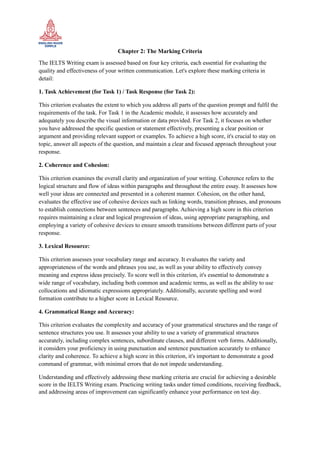
Chapter 2: The Marking Criteria
The IELTS Writing exam is assessed based on four key criteria, each essential for evaluating the
quality and effectiveness of your written communication. Let's explore these marking criteria in
detail:
1. Task Achievement (for Task 1) / Task Response (for Task 2):
This criterion evaluates the extent to which you address all parts of the question prompt and fulfil the
requirements of the task. For Task 1 in the Academic module, it assesses how accurately and
adequately you describe the visual information or data provided. For Task 2, it focuses on whether
you have addressed the specific question or statement effectively, presenting a clear position or
argument and providing relevant support or examples. To achieve a high score, it's crucial to stay on
topic, answer all aspects of the question, and maintain a clear and focused approach throughout your
response.
2. Coherence and Cohesion:
This criterion examines the overall clarity and organization of your writing. Coherence refers to the
logical structure and flow of ideas within paragraphs and throughout the entire essay. It assesses how
well your ideas are connected and presented in a coherent manner. Cohesion, on the other hand,
evaluates the effective use of cohesive devices such as linking words, transition phrases, and pronouns
to establish connections between sentences and paragraphs. Achieving a high score in this criterion
requires maintaining a clear and logical progression of ideas, using appropriate paragraphing, and
employing a variety of cohesive devices to ensure smooth transitions between different parts of your
response.
3. Lexical Resource:
This criterion assesses your vocabulary range and accuracy. It evaluates the variety and
appropriateness of the words and phrases you use, as well as your ability to effectively convey
meaning and express ideas precisely. To score well in this criterion, it's essential to demonstrate a
wide range of vocabulary, including both common and academic terms, as well as the ability to use
collocations and idiomatic expressions appropriately. Additionally, accurate spelling and word
formation contribute to a higher score in Lexical Resource.
4. Grammatical Range and Accuracy:
This criterion evaluates the complexity and accuracy of your grammatical structures and the range of
sentence structures you use. It assesses your ability to use a variety of grammatical structures
accurately, including complex sentences, subordinate clauses, and different verb forms. Additionally,
it considers your proficiency in using punctuation and sentence punctuation accurately to enhance
clarity and coherence. To achieve a high score in this criterion, it's important to demonstrate a good
command of grammar, with minimal errors that do not impede understanding.
Understanding and effectively addressing these marking criteria are crucial for achieving a desirable
score in the IELTS Writing exam. Practicing writing tasks under timed conditions, receiving feedback,
and addressing areas of improvement can significantly enhance your performance on test day.
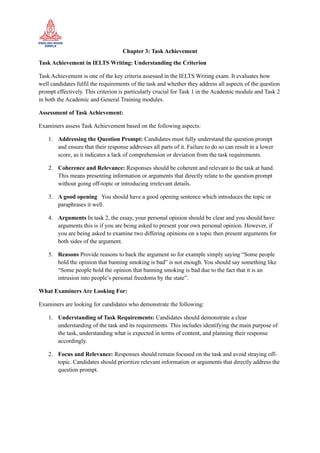
Chapter 3: Task Achievement
Task Achievement in IELTS Writing: Understanding the Criterion
Task Achievement is one of the key criteria assessed in the IELTS Writing exam. It evaluates how
well candidates fulfil the requirements of the task and whether they address all aspects of the question
prompt effectively. This criterion is particularly crucial for Task 1 in the Academic module and Task 2
in both the Academic and General Training modules.
Assessment of Task Achievement:
Examiners assess Task Achievement based on the following aspects:
1. Addressing the Question Prompt: Candidates must fully understand the question prompt
and ensure that their response addresses all parts of it. Failure to do so can result in a lower
score, as it indicates a lack of comprehension or deviation from the task requirements.
2. Coherence and Relevance: Responses should be coherent and relevant to the task at hand.
This means presenting information or arguments that directly relate to the question prompt
without going off-topic or introducing irrelevant details.
3. A good opening You should have a good opening sentence which introduces the topic or
paraphrases it well.
4. Arguments In task 2, the essay, your personal opinion should be clear and you should have
arguments this is if you are being asked to present your own personal opinion. However, if
you are being asked to examine two differing opinions on a topic then present arguments for
both sides of the argument.
5. Reasons Provide reasons to back the argument so for example simply saying “Some people
hold the opinion that banning smoking is bad” is not enough. You should say something like
“Some people hold the opinion that banning smoking is bad due to the fact that it is an
intrusion into people’s personal freedoms by the state”.
What Examiners Are Looking For:
Examiners are looking for candidates who demonstrate the following:
1. Understanding of Task Requirements: Candidates should demonstrate a clear
understanding of the task and its requirements. This includes identifying the main purpose of
the task, understanding what is expected in terms of content, and planning their response
accordingly.
2. Focus and Relevance: Responses should remain focused on the task and avoid straying off-
topic. Candidates should prioritize relevant information or arguments that directly address the
question prompt.
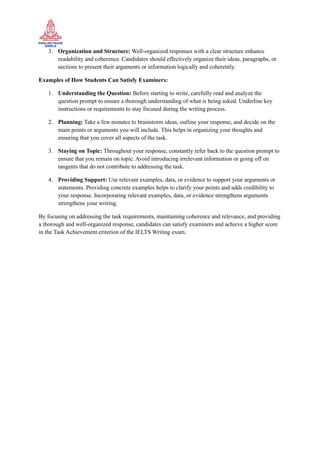
3. Organization and Structure: Well-organized responses with a clear structure enhance
readability and coherence. Candidates should effectively organize their ideas, paragraphs, or
sections to present their arguments or information logically and coherently.
Examples of How Students Can Satisfy Examiners:
1. Understanding the Question: Before starting to write, carefully read and analyze the
question prompt to ensure a thorough understanding of what is being asked. Underline key
instructions or requirements to stay focused during the writing process.
2. Planning: Take a few minutes to brainstorm ideas, outline your response, and decide on the
main points or arguments you will include. This helps in organizing your thoughts and
ensuring that you cover all aspects of the task.
3. Staying on Topic: Throughout your response, constantly refer back to the question prompt to
ensure that you remain on topic. Avoid introducing irrelevant information or going off on
tangents that do not contribute to addressing the task.
4. Providing Support: Use relevant examples, data, or evidence to support your arguments or
statements. Providing concrete examples helps to clarify your points and adds credibility to
your response. Incorporating relevant examples, data, or evidence strengthens arguments
strengthens your writing.
By focusing on addressing the task requirements, maintaining coherence and relevance, and providing
a thorough and well-organized response, candidates can satisfy examiners and achieve a higher score
in the Task Achievement criterion of the IELTS Writing exam.
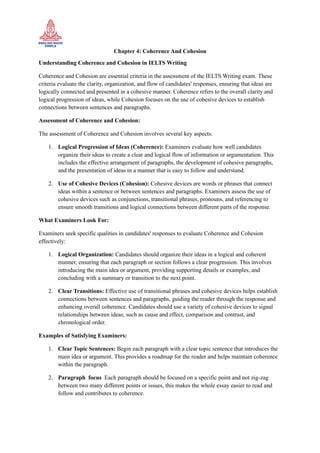
Chapter 4: Coherence And Cohesion
Understanding Coherence and Cohesion in IELTS Writing
Coherence and Cohesion are essential criteria in the assessment of the IELTS Writing exam. These
criteria evaluate the clarity, organization, and flow of candidates' responses, ensuring that ideas are
logically connected and presented in a cohesive manner. Coherence refers to the overall clarity and
logical progression of ideas, while Cohesion focuses on the use of cohesive devices to establish
connections between sentences and paragraphs.
Assessment of Coherence and Cohesion:
The assessment of Coherence and Cohesion involves several key aspects:
1. Logical Progression of Ideas (Coherence): Examiners evaluate how well candidates
organize their ideas to create a clear and logical flow of information or argumentation. This
includes the effective arrangement of paragraphs, the development of cohesive paragraphs,
and the presentation of ideas in a manner that is easy to follow and understand.
2. Use of Cohesive Devices (Cohesion): Cohesive devices are words or phrases that connect
ideas within a sentence or between sentences and paragraphs. Examiners assess the use of
cohesive devices such as conjunctions, transitional phrases, pronouns, and referencing to
ensure smooth transitions and logical connections between different parts of the response.
What Examiners Look For:
Examiners seek specific qualities in candidates' responses to evaluate Coherence and Cohesion
effectively:
1. Logical Organization: Candidates should organize their ideas in a logical and coherent
manner, ensuring that each paragraph or section follows a clear progression. This involves
introducing the main idea or argument, providing supporting details or examples, and
concluding with a summary or transition to the next point.
2. Clear Transitions: Effective use of transitional phrases and cohesive devices helps establish
connections between sentences and paragraphs, guiding the reader through the response and
enhancing overall coherence. Candidates should use a variety of cohesive devices to signal
relationships between ideas, such as cause and effect, comparison and contrast, and
chronological order.
Examples of Satisfying Examiners:
1. Clear Topic Sentences: Begin each paragraph with a clear topic sentence that introduces the
main idea or argument. This provides a roadmap for the reader and helps maintain coherence
within the paragraph.
2. Paragraph focus Each paragraph should be focused on a specific point and not zig-zag
between two many different points or issues, this makes the whole essay easier to read and
follow and contributes to coherence.
3. Consistent Pronoun Usage: Use pronouns consistently to refer back to previously mentioned
nouns or ideas. This avoids confusion and strengthens the connections between sentences and
paragraphs.
4. Transitional Phrases: Incorporate transitional phrases such as "however," "on the other
hand," "furthermore," and "in conclusion" to signal shifts in ideas or provide additional
information. This enhances coherence by guiding the reader through the response and
highlighting the relationships between different parts of the text. These are often called
‘connectors’ or ‘linking words’.
5. Logical Ordering of Ideas: Arrange ideas in a logical sequence, with each paragraph
building upon the previous one. This ensures a smooth flow of information and enhances the
reader's understanding of the overall argument or narrative.
By demonstrating logical organization, clear transitions, and consistent use of cohesive devices,
candidates can effectively satisfy examiners and achieve a higher score in the Coherence and
Cohesion criterion of the IELTS Writing exam.
Chapter 5: Lexical Resource
Understanding Lexical Resource in IELTS Writing
Lexical Resource is a crucial criterion in the assessment of the IELTS Writing exam. It evaluates the
range, accuracy, and appropriateness of candidates' vocabulary use. A strong lexical resource
demonstrates a varied vocabulary, precise word choice, and effective expression of ideas, contributing
significantly to the overall quality of the response.
Assessment of Lexical Resource:
The assessment of Lexical Resource involves several key aspects:
1. Vocabulary Range: Examiners evaluate the breadth of candidates' vocabulary by assessing
their ability to use a wide range of words and phrases. This includes both common vocabulary
and more specialized or academic terms relevant to the topic. Candidates should demonstrate
versatility in their word choice and avoid repetition or reliance on basic vocabulary.
2. Accuracy and Precision: Candidates are expected to use vocabulary accurately and
precisely, selecting words that convey the intended meaning clearly and appropriately.
Examiners assess the correctness of word usage, including spelling, word formation, and
collocations. Candidates should avoid errors in vocabulary use that may impede
understanding or detract from the overall clarity of the response.
What Examiners Look For:
Examiners seek specific qualities in candidates' responses to evaluate Lexical Resource effectively:
1. Variety of Vocabulary: Candidates should demonstrate a wide range of vocabulary,
including both general and topic-specific terms. This showcases their ability to express ideas
effectively and adapt their language to different contexts and topics.
2. Appropriate Word Choice: Selecting words that are appropriate to the context and convey
the intended meaning accurately is crucial. Candidates should avoid using overly simplistic or
informal language in academic contexts and ensure that their word choice aligns with the tone
and purpose of the writing task.
Examples of Satisfying Examiners:
1. Synonyms and Antonyms: Use synonyms and antonyms to vary your vocabulary and avoid
repetition. For example, instead of repeatedly using the word "important," consider
alternatives such as "significant," "crucial," or "essential."
2. Precise Language: Choose words that accurately convey your intended meaning and avoid
vague or ambiguous language. For instance, instead of saying "a lot of people," consider
specifying the quantity with phrases like "a significant number of individuals" or "a large
proportion of the population."
3. Specialized Terminology: Incorporate topic-specific vocabulary when discussing specialized
subjects or academic topics. This demonstrates your familiarity with the subject matter and
enhances the credibility of your response. However, be cautious not to overuse technical
jargon, as clarity and accessibility should remain priorities. However it is here when you need
to understand that simply doing an IELTS course cannot fast track you into passing an IELTS
exam. You need to have a relatively comprehensive knowledge of the language or at least a
wide familiarity with it including subject-specific vocabulary related to many topics. This
often entails having read widely and accumulated vocabulary that way. Simple passive
awareness of vocabulary is not enough though as you will need to be able to use subject-
specific vocabulary appropriately.
For instance if your question relates to education and you are not familiar with words such as
‘academic’, ‘tertiary’ (as in the third level of education after high school), ‘under-graduate’, ‘post-
graduate’ then there is a deficiency in your English and you will need to learn such words for this
particular topic.
4. Collocations: Pay attention to common word combinations or collocations that native
speakers use naturally. Using collocations appropriately can enhance the fluency and
naturalness of your writing. For example, instead of saying "make a decision," use the
collocation "reach a decision" for a more idiomatic expression.
By demonstrating a varied vocabulary, precise word choice, and accurate usage of vocabulary,
candidates can effectively satisfy examiners and achieve a higher score in the Lexical Resource
criterion of the IELTS Writing exam.
Chapter 6: Grammatical Range and Accuracy
Understanding Grammatical Range and Accuracy in IELTS Writing
Grammatical Range and Accuracy are essential criteria in the assessment of the IELTS Writing exam.
This criterion evaluates the complexity, variety, and correctness of candidates' grammatical structures,
as well as their ability to use punctuation effectively. A strong performance in this criterion
demonstrates a command of grammar, contributing significantly to the clarity and coherence of the
response.
Assessment of Grammatical Range and Accuracy:
The assessment of Grammatical Range and Accuracy involves several key aspects:
1. Range of Grammatical Structures: Examiners evaluate candidates' ability to use a variety
of grammatical structures accurately and appropriately. This includes the use of simple and
complex sentence structures, verb forms, tense usage, conditionals, passive tense and relative
clauses. Candidates should demonstrate versatility in their sentence construction and avoid
overreliance on basic sentence patterns.
2. Accuracy: Candidates are expected to use grammatical structures accurately, with minimal
errors that do not impede understanding. Examiners assess the correctness of subject-verb
agreement, verb tense usage, word order, articles, pronouns, and other grammatical features.
Candidates should strive for grammatical precision and clarity in their writing.
What Examiners Look For:
Examiners seek specific qualities in candidates' responses to evaluate Grammatical Range and
Accuracy effectively:
1. Variety of Sentence Structures: Candidates should demonstrate the ability to use a range of
sentence structures, including simple, compound, complex, and compound-complex
sentences. This showcases their proficiency in constructing sentences of varying lengths and
complexities to convey meaning effectively.
2. Correct Usage of Grammar: Candidates are expected to use grammar accurately and
appropriately to convey their ideas clearly. This includes accurate subject-verb agreement,
correct verb tense usage, appropriate word order, and consistent use of grammatical forms
throughout the response.
Examples of Satisfying Examiners:
1. Complex Sentences: Incorporate complex sentence structures, such as subordinate clauses,
relative clauses, and conditional sentences, to demonstrate grammatical range and
sophistication. For example, instead of using only simple sentences, combine ideas using
subordinating conjunctions like "although," "because," or "while."
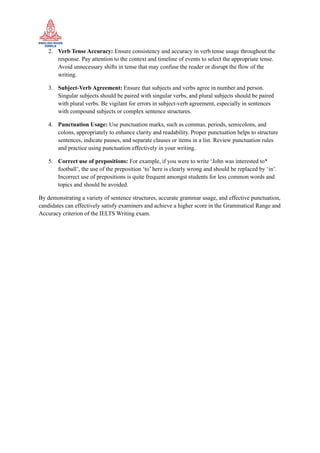
2. Verb Tense Accuracy: Ensure consistency and accuracy in verb tense usage throughout the
response. Pay attention to the context and timeline of events to select the appropriate tense.
Avoid unnecessary shifts in tense that may confuse the reader or disrupt the flow of the
writing.
3. Subject-Verb Agreement: Ensure that subjects and verbs agree in number and person.
Singular subjects should be paired with singular verbs, and plural subjects should be paired
with plural verbs. Be vigilant for errors in subject-verb agreement, especially in sentences
with compound subjects or complex sentence structures.
4. Punctuation Usage: Use punctuation marks, such as commas, periods, semicolons, and
colons, appropriately to enhance clarity and readability. Proper punctuation helps to structure
sentences, indicate pauses, and separate clauses or items in a list. Review punctuation rules
and practice using punctuation effectively in your writing.
5. Correct use of prepositions: For example, if you were to write ‘John was interested to*
football’, the use of the preposition ‘to’ here is clearly wrong and should be replaced by ‘in’.
Incorrect use of prepositions is quite frequent amongst students for less common words and
topics and should be avoided.
By demonstrating a variety of sentence structures, accurate grammar usage, and effective punctuation,
candidates can effectively satisfy examiners and achieve a higher score in the Grammatical Range and
Accuracy criterion of the IELTS Writing exam.
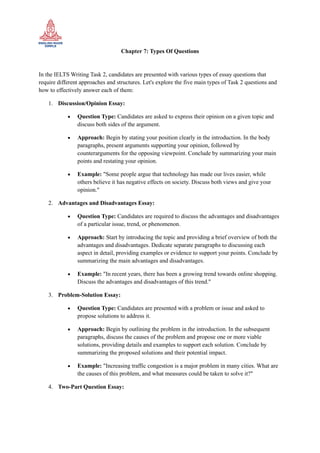
Chapter 7: Types Of Questions
In the IELTS Writing Task 2, candidates are presented with various types of essay questions that
require different approaches and structures. Let's explore the five main types of Task 2 questions and
how to effectively answer each of them:
1. Discussion/Opinion Essay:
• Question Type: Candidates are asked to express their opinion on a given topic and
discuss both sides of the argument.
• Approach: Begin by stating your position clearly in the introduction. In the body
paragraphs, present arguments supporting your opinion, followed by
counterarguments for the opposing viewpoint. Conclude by summarizing your main
points and restating your opinion.
• Example: "Some people argue that technology has made our lives easier, while
others believe it has negative effects on society. Discuss both views and give your
opinion."
2. Advantages and Disadvantages Essay:
• Question Type: Candidates are required to discuss the advantages and disadvantages
of a particular issue, trend, or phenomenon.
• Approach: Start by introducing the topic and providing a brief overview of both the
advantages and disadvantages. Dedicate separate paragraphs to discussing each
aspect in detail, providing examples or evidence to support your points. Conclude by
summarizing the main advantages and disadvantages.
• Example: "In recent years, there has been a growing trend towards online shopping.
Discuss the advantages and disadvantages of this trend."
3. Problem-Solution Essay:
• Question Type: Candidates are presented with a problem or issue and asked to
propose solutions to address it.
• Approach: Begin by outlining the problem in the introduction. In the subsequent
paragraphs, discuss the causes of the problem and propose one or more viable
solutions, providing details and examples to support each solution. Conclude by
summarizing the proposed solutions and their potential impact.
• Example: "Increasing traffic congestion is a major problem in many cities. What are
the causes of this problem, and what measures could be taken to solve it?"
4. Two-Part Question Essay:
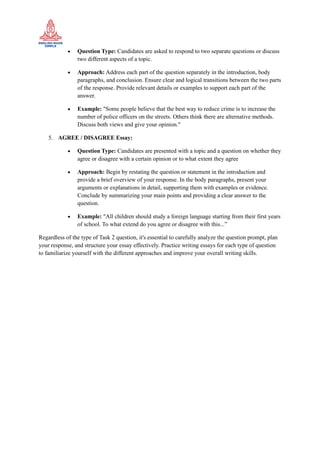
• Question Type: Candidates are asked to respond to two separate questions or discuss
two different aspects of a topic.
• Approach: Address each part of the question separately in the introduction, body
paragraphs, and conclusion. Ensure clear and logical transitions between the two parts
of the response. Provide relevant details or examples to support each part of the
answer.
• Example: "Some people believe that the best way to reduce crime is to increase the
number of police officers on the streets. Others think there are alternative methods.
Discuss both views and give your opinion."
5. AGREE / DISAGREE Essay:
• Question Type: Candidates are presented with a topic and a question on whether they
agree or disagree with a certain opinion or to what extent they agree
• Approach: Begin by restating the question or statement in the introduction and
provide a brief overview of your response. In the body paragraphs, present your
arguments or explanations in detail, supporting them with examples or evidence.
Conclude by summarizing your main points and providing a clear answer to the
question.
• Example: "All children should study a foreign language starting from their first years
of school. To what extend do you agree or disagree with this...”
Regardless of the type of Task 2 question, it's essential to carefully analyze the question prompt, plan
your response, and structure your essay effectively. Practice writing essays for each type of question
to familiarize yourself with the different approaches and improve your overall writing skills.
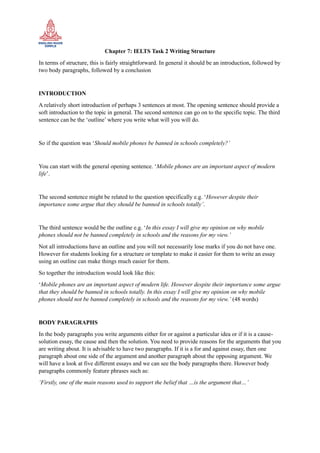
Chapter 7: IELTS Task 2 Writing Structure
In terms of structure, this is fairly straightforward. In general it should be an introduction, followed by
two body paragraphs, followed by a conclusion
INTRODUCTION
A relatively short introduction of perhaps 3 sentences at most. The opening sentence should provide a
soft introduction to the topic in general. The second sentence can go on to the specific topic. The third
sentence can be the ‘outline’ where you write what will you will do.
So if the question was ‘Should mobile phones be banned in schools completely?’
You can start with the general opening sentence. ‘Mobile phones are an important aspect of modern
life’.
The second sentence might be related to the question specifically e.g. ‘However despite their
importance some argue that they should be banned in schools totally’.
The third sentence would be the outline e.g. ‘In this essay I will give my opinion on why mobile
phones should not be banned completely in schools and the reasons for my view.’
Not all introductions have an outline and you will not necessarily lose marks if you do not have one.
However for students looking for a structure or template to make it easier for them to write an essay
using an outline can make things much easier for them.
So together the introduction would look like this:
‘Mobile phones are an important aspect of modern life. However despite their importance some argue
that they should be banned in schools totally. In this essay I will give my opinion on why mobile
phones should not be banned completely in schools and the reasons for my view.’ (48 words)
BODY PARAGRAPHS
In the body paragraphs you write arguments either for or against a particular idea or if it is a cause-
solution essay, the cause and then the solution. You need to provide reasons for the arguments that you
are writing about. It is advisable to have two paragraphs. If it is a for and against essay, then one
paragraph about one side of the argument and another paragraph about the opposing argument. We
will have a look at five different essays and we can see the body paragraphs there. However body
paragraphs commonly feature phrases such as:
‘Firstly, one of the main reasons used to support the belief that …is the argument that…’
‘In addition to this another reason given is the claim that….’
‘In contrast to the previous argument others hold the belief that …’
A lot of this book will be devoted to looking at the sentences in different body paragraphs including
some of the grammatical structures which can be used.
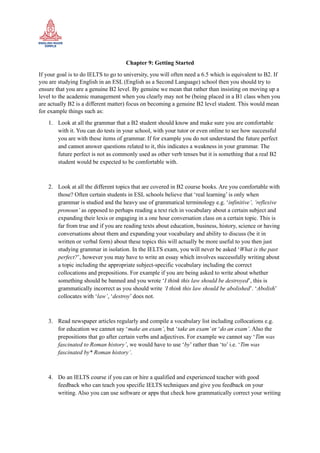
Below is a table with the band descriptors:
Chapter 9: Getting Started
If your goal is to do IELTS to go to university, you will often need a 6.5 which is equivalent to B2. If
you are studying English in an ESL (English as a Second Language) school then you should try to
ensure that you are a genuine B2 level. By genuine we mean that rather than insisting on moving up a
level to the academic management when you clearly may not be (being placed in a B1 class when you
are actually B2 is a different matter) focus on becoming a genuine B2 level student. This would mean
for example things such as:
1. Look at all the grammar that a B2 student should know and make sure you are comfortable
with it. You can do tests in your school, with your tutor or even online to see how successful
you are with these items of grammar. If for example you do not understand the future perfect
and cannot answer questions related to it, this indicates a weakness in your grammar. The
future perfect is not as commonly used as other verb tenses but it is something that a real B2
student would be expected to be comfortable with.
2. Look at all the different topics that are covered in B2 course books. Are you comfortable with
those? Often certain students in ESL schools believe that ‘real learning’ is only when
grammar is studied and the heavy use of grammatical terminology e.g. ‘infinitive’, ‘reflexive
pronoun’ as opposed to perhaps reading a text rich in vocabulary about a certain subject and
expanding their lexis or engaging in a one hour conversation class on a certain topic. This is
far from true and if you are reading texts about education, business, history, science or having
conversations about them and expanding your vocabulary and ability to discuss (be it in
written or verbal form) about these topics this will actually be more useful to you then just
studying grammar in isolation. In the IELTS exam, you will never be asked ‘What is the past
perfect?’, however you may have to write an essay which involves successfully writing about
a topic including the appropriate subject-specific vocabulary including the correct
collocations and prepositions. For example if you are being asked to write about whether
something should be banned and you wrote ‘I think this law should be destroyed’, this is
grammatically incorrect as you should write ‘I think this law should be abolished’. ‘Abolish’
collocates with ‘law’, ‘destroy’ does not.
3. Read newspaper articles regularly and compile a vocabulary list including collocations e.g.
for education we cannot say ‘make an exam’, but ‘take an exam’or ‘do an exam’. Also the
prepositions that go after certain verbs and adjectives. For example we cannot say ‘Tim was
fascinated to Roman history’, we would have to use ‘by’ rather than ‘to’ i.e. ‘Tim was
fascinated by* Roman history’.
4. Do an IELTS course if you can or hire a qualified and experienced teacher with good
feedback who can teach you specific IELTS techniques and give you feedback on your
writing. Also you can use software or apps that check how grammatically correct your writing
is. If you do this frequently and become aware of your frequently recurring grammatical
mistakes then you can reduce your mistakes more and more. One example of a website which
detects grammatical mistakes is Grammarly.
5. Read as many model essays as you can. Pay attention to the grammatical structures and
vocabulary they use. Make a note of them in a notebook specifically devoted to IELTS
writing. Try and use this vocabulary yourself with a tutor or study buddy. You will only get
better.
Remember writing can often be the hardest skill in any language. Not only that but you are trying not
to write a short whatsapp message or email but to study at the highest educational level, i.e. university.
Therefore there are no short cuts or magic tricks. Instead there are things which you must be aware of
and work hard on e.g. grammatical accuracy, learning vocabulary about different topics and so on.
Chapter 10: How To Use This Book
This book can be used by either students or teachers. There are five essays for each of the five main
types of questions. You will read the question and the essay. Then after that we look at each paragraph
and look at things such as:
1- How many sentences per paragraph.
2- The way each sentence begins.
3- The grammar used in these sentences including at times several example
sentences with that same type of grammar.
4- The more impressive vocabulary used in the paragraph.
You keep on repeating this process so that by the end of this short book you have done this twenty
times so that your mind starts to get into the habit of looking at model essays and analysing them. It
becomes easier and easier with practice and repetition until it could even perhaps become a bit
‘boring’!
However if you did find it ‘boring’ or even ‘easy’ then that would be the whole point. We want you to
lose any fear or nervousness about the IELTS writing task 2 exam and feel at ease so you can perform
better in the real exam.
Compile a list of the useful vocabulary you learn after the analysis of each paragraph as well as make
notes on the grammar and if you want try and practice writing similar sentences. If you are a teacher
you could use a big part of your lesson analysing the essay paragraphs with your sentences and
organising follow up activities such as getting students to write sentences with some of the more
sophisticated vocabulary in the paragraphs or some of the grammatical structures.
So with all that said and done, let’s look at 8 sample essays which are band 8.
Chapter 11: Essay 1: Problem- Solution Essay
Question:
For a long time art has been considered an essential part of all cultures in the world. However,
nowadays people’s values have changed, and we tend to consider science, technology and business
more important than arts.
What do you think are the causes of this?
What can be done to draw people’s attention to art?
Model answer:
Art has long been regarded as a cornerstone of global cultures, serving as a medium for expression,
reflection, and cultural preservation. However, contemporary societal values have witnessed a shift
towards prioritizing disciplines such as science, technology, and business over the arts. This essay will
explore the underlying causes of this trend and propose strategies to reignite public interest in the arts.
Several factors have contributed to the diminishing significance of art in modern society. Firstly, the
rapid advancement in science and technology has led to an increased emphasis on practical, tangible
outcomes, overshadowing the perceived abstract and subjective nature of art. Furthermore, the
globalization of economies has propelled a greater focus on skills and knowledge deemed essential for
economic competitiveness, with STEM (Science, Technology, Engineering, and Mathematics) fields
often receiving more attention and funding compared to arts education.
To reverse this trend and rekindle public interest in art, several measures can be implemented. Firstly,
educational institutions should integrate arts education into core curricula from an early age,
emphasizing its intrinsic value in fostering creativity, critical thinking, and emotional intelligence.
Moreover, public awareness campaigns and initiatives should be launched to highlight the societal and
cultural significance of art, showcasing its role in promoting diversity, empathy, and social cohesion.
In conclusion, while the prioritization of science, technology, and business over the arts reflects
evolving societal values, concerted efforts are needed to reverse this trend. By integrating arts
education, raising awareness of its importance, fostering interdisciplinary collaborations, and
enhancing accessibility, we can revitalize public interest in art and reaffirm its status as something
very important for society.
This is a band 8 answer.
Let’s analyse it:
FIRST PARAGRAPH
Let’s look at the first paragraph:
Art has long been regarded as a cornerstone of global cultures, serving as a medium for expression,
reflection, and cultural preservation. However, contemporary societal values have witnessed a shift
towards prioritizing disciplines such as science, technology, and business over the arts. This essay will
explore the underlying causes of this trend and propose strategies to reignite public interest in the arts.
1. There are three sentences.
2. The first sentence starts off ‘Art has long been regarded as ….’ Here we are using the present
perfect. This is often used for something topical which is still happening. For instance we can
say:
‘The topic of how to protect our environment has been the subject of much debate for a long while’.
‘The issue of whether to ban smoking completely for all citizens has provoked much debate amongst
people in the past few years.’
3. Not only is the first sentence ‘present perfect’ it is also ‘passive’ with the use of the word
‘regarded’. Using passive structures makes your writing look more sophisticated. Here are
two more examples of present perfect passive:
‘The success of the English language has been thought to be heavily due to US global influence.
‘The internet has been considered to be one of the most important things to have occurred in modern
history.’
4. The first sentence also has more sophisticated vocabulary such as ‘cornerstone’, ‘medium’
and ‘preservation’. It is this use of sophisticated vocabulary which will really help students to
gain higher marks. This is acquired either through extensive reading or extensive listening e.g.
to online documentaries.
5. The third sentence of the opening paragraph has what we call an ‘outline’. A sentence where
you state what you will do in the essay. The outline here is: ‘This essay will explore the
underlying causes of this trend…’Here the writer highlights they will look at the reasons for
this trend. This goes back to the question ‘What do you think are the causes of this?’
However he does not just live his outline at this but also writes ‘….and propose strategies to reignite
public interest in the arts’ which addresses the second question which was ‘What can be done to draw
people’s attention to art?’ This also relates to ‘Task Achievement’ and the student writing specifically
to answer the question provided.
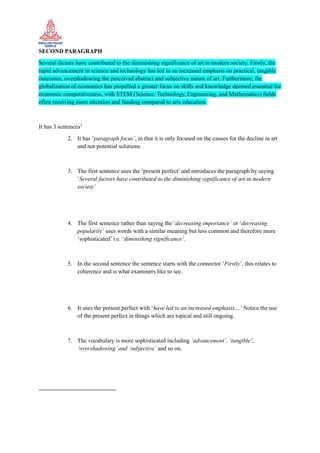
SECOND PARAGRAPH
Several factors have contributed to the diminishing significance of art in modern society. Firstly, the
rapid advancement in science and technology has led to an increased emphasis on practical, tangible
outcomes, overshadowing the perceived abstract and subjective nature of art. Furthermore, the
globalization of economies has propelled a greater focus on skills and knowledge deemed essential for
economic competitiveness, with STEM (Science, Technology, Engineering, and Mathematics) fields
often receiving more attention and funding compared to arts education.
It has 3 sentences1
2. It has ‘paragraph focus’, in that it is only focused on the causes for the decline in art
and not potential solutions.
3. The first sentence uses the ‘present perfect’ and introduces the paragraph by saying
‘Several factors have contributed to the diminishing significance of art in modern
society’
4. The first sentence rather than saying the ‘decreasing importance’ or ‘decreasing
popularity’ uses words with a similar meaning but less common and therefore more
‘sophisticated’ i.e. ‘diminishing significance’.
5. In the second sentence the sentence starts with the connector ‘Firstly’, this relates to
coherence and is what examiners like to see.
6. It uses the present perfect with ‘have led to an increased emphasis…’ Notice the use
of the present perfect in things which are topical and still ongoing.
7. The vocabulary is more sophisticated including ‘advancement’, ‘tangible’,
‘overshadowing’and ‘subjective’ and so on.
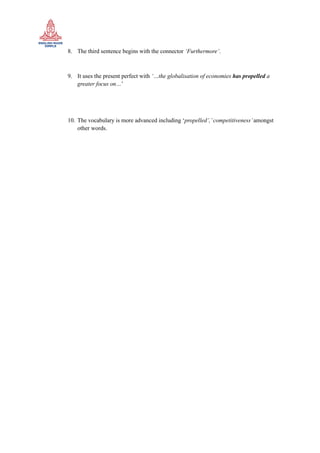
8. The third sentence begins with the connector ‘Furthermore’.
9. It uses the present perfect with ‘…the globalisation of economies has propelled a
greater focus on…’
10. The vocabulary is more advanced including ‘propelled’,’competitiveness’amongst
other words.
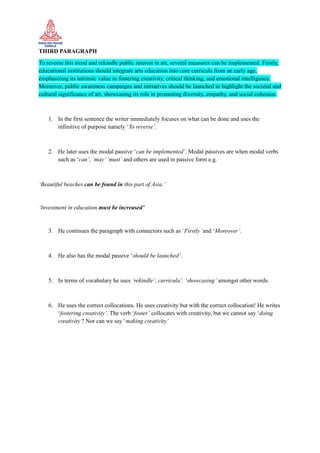
THIRD PARAGRAPH
To reverse this trend and rekindle public interest in art, several measures can be implemented. Firstly,
educational institutions should integrate arts education into core curricula from an early age,
emphasizing its intrinsic value in fostering creativity, critical thinking, and emotional intelligence.
Moreover, public awareness campaigns and initiatives should be launched to highlight the societal and
cultural significance of art, showcasing its role in promoting diversity, empathy, and social cohesion.
1. In the first sentence the writer immediately focuses on what can be done and uses the
infinitive of purpose namely ‘To reverse’.
2. He later uses the modal passive ‘can be implemented’. Modal passives are when modal verbs
such as ‘can’, ‘may’‘must’ and others are used in passive form e.g.
‘Beautiful beaches can be found in this part of Asia.’
‘Investment in education must be increased’
3. He continues the paragraph with connectors such as ‘Firstly’and ‘Moreover’.
4. He also has the modal passive ‘should be launched’.
5. In terms of vocabulary he uses ‘rekindle’, curricula’, ‘showcasing’ amongst other words.
6. He uses the correct collocations. He uses creativity but with the correct collocation! He writes
‘fostering creativity’. The verb ‘foster’ collocates with creativity, but we cannot say ‘doing
creativity’! Nor can we say ‘making creativity’
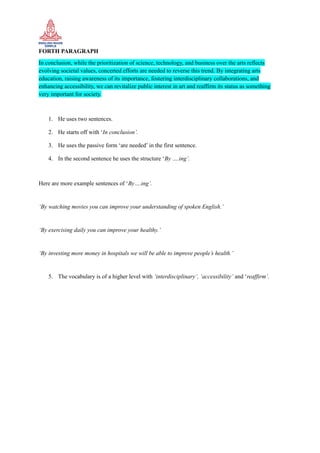
FORTH PARAGRAPH
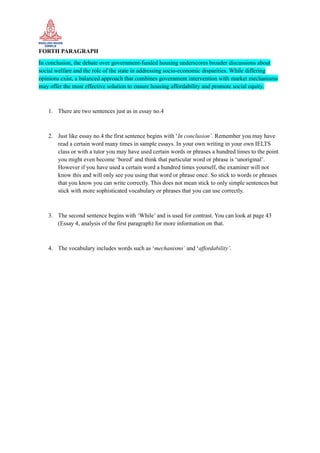
In conclusion, while the prioritization of science, technology, and business over the arts reflects
evolving societal values, concerted efforts are needed to reverse this trend. By integrating arts
education, raising awareness of its importance, fostering interdisciplinary collaborations, and
enhancing accessibility, we can revitalize public interest in art and reaffirm its status as something
very important for society.
1. He uses two sentences.
2. He starts off with ‘In conclusion’.
3. He uses the passive form ‘are needed’ in the first sentence.
4. In the second sentence he uses the structure ‘By ….ing’.
Here are more example sentences of ‘By….ing’.
‘By watching movies you can improve your understanding of spoken English.’
‘By exercising daily you can improve your healthy.’
‘By investing more money in hospitals we will be able to improve people’s health.’
5. The vocabulary is of a higher level with ‘interdisciplinary’, ‘accessibility’ and ‘reaffirm’.
Chapter 11: ESSAY 2: Discussion & Opinion Essay
Question:
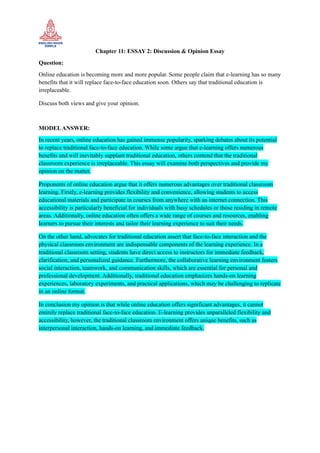
Online education is becoming more and more popular. Some people claim that e-learning has so many
benefits that it will replace face-to-face education soon. Others say that traditional education is
irreplaceable.
Discuss both views and give your opinion.
MODELANSWER:
In recent years, online education has gained immense popularity, sparking debates about its potential
to replace traditional face-to-face education. While some argue that e-learning offers numerous
benefits and will inevitably supplant traditional education, others contend that the traditional
classroom experience is irreplaceable. This essay will examine both perspectives and provide my
opinion on the matter.
Proponents of online education argue that it offers numerous advantages over traditional classroom
learning. Firstly, e-learning provides flexibility and convenience, allowing students to access
educational materials and participate in courses from anywhere with an internet connection. This
accessibility is particularly beneficial for individuals with busy schedules or those residing in remote
areas. Additionally, online education often offers a wide range of courses and resources, enabling
learners to pursue their interests and tailor their learning experience to suit their needs.
On the other hand, advocates for traditional education assert that face-to-face interaction and the
physical classroom environment are indispensable components of the learning experience. In a
traditional classroom setting, students have direct access to instructors for immediate feedback,
clarification, and personalized guidance. Furthermore, the collaborative learning environment fosters
social interaction, teamwork, and communication skills, which are essential for personal and
professional development. Additionally, traditional education emphasizes hands-on learning
experiences, laboratory experiments, and practical applications, which may be challenging to replicate
in an online format.
In conclusion my opinion is that while online education offers significant advantages, it cannot
entirely replace traditional face-to-face education. E-learning provides unparalleled flexibility and
accessibility, however, the traditional classroom environment offers unique benefits, such as
interpersonal interaction, hands-on learning, and immediate feedback.
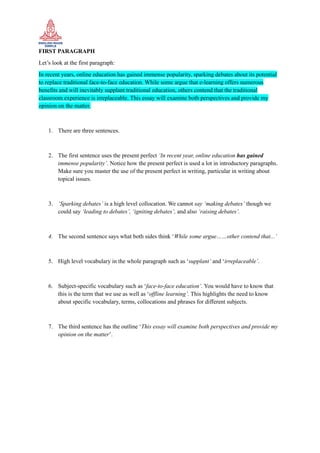
FIRST PARAGRAPH
Let’s look at the first paragraph:
In recent years, online education has gained immense popularity, sparking debates about its potential
to replace traditional face-to-face education. While some argue that e-learning offers numerous
benefits and will inevitably supplant traditional education, others contend that the traditional
classroom experience is irreplaceable. This essay will examine both perspectives and provide my
opinion on the matter.
1. There are three sentences.
2. The first sentence uses the present perfect ‘In recent year, online education has gained
immense popularity’. Notice how the present perfect is used a lot in introductory paragraphs.
Make sure you master the use of the present perfect in writing, particular in writing about
topical issues.
3. ‘Sparking debates’ is a high level collocation. We cannot say ‘making debates’ though we
could say ‘leading to debates’, ‘igniting debates’, and also ‘raising debates’.
4. The second sentence says what both sides think ‘While some argue……other contend that...’
5. High level vocabulary in the whole paragraph such as ‘supplant’ and ‘irreplaceable’.
6. Subject-specific vocabulary such as ‘face-to-face education’. You would have to know that
this is the term that we use as well as ‘offline learning’. This highlights the need to know
about specific vocabulary, terms, collocations and phrases for different subjects.
7. The third sentence has the outline ‘This essay will examine both perspectives and provide my
opinion on the matter’.
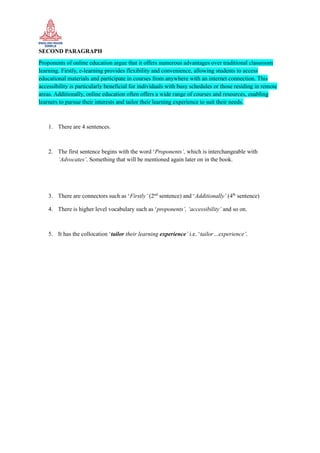
SECOND PARAGRAPH
Proponents of online education argue that it offers numerous advantages over traditional classroom
learning. Firstly, e-learning provides flexibility and convenience, allowing students to access
educational materials and participate in courses from anywhere with an internet connection. This
accessibility is particularly beneficial for individuals with busy schedules or those residing in remote
areas. Additionally, online education often offers a wide range of courses and resources, enabling
learners to pursue their interests and tailor their learning experience to suit their needs.
1. There are 4 sentences.
2. The first sentence begins with the word ‘Proponents’, which is interchangeable with
‘Advocates’. Something that will be mentioned again later on in the book.
3. There are connectors such as ‘Firstly’ (2nd
sentence) and ‘Additionally’ (4th
sentence)
4. There is higher level vocabulary such as ‘proponents’, ‘accessibility’ and so on.
5. It has the collocation ‘tailor their learning experience’ i.e. ‘tailor…experience’.
THIRD PARAGRAPH
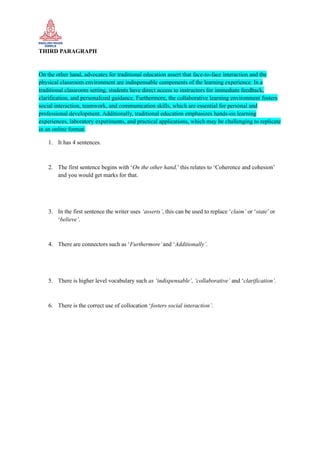
On the other hand, advocates for traditional education assert that face-to-face interaction and the
physical classroom environment are indispensable components of the learning experience. In a
traditional classroom setting, students have direct access to instructors for immediate feedback,
clarification, and personalized guidance. Furthermore, the collaborative learning environment fosters
social interaction, teamwork, and communication skills, which are essential for personal and
professional development. Additionally, traditional education emphasizes hands-on learning
experiences, laboratory experiments, and practical applications, which may be challenging to replicate
in an online format.
1. It has 4 sentences.
2. The first sentence begins with ‘On the other hand,’ this relates to ‘Coherence and cohesion’
and you would get marks for that.
3. In the first sentence the writer uses ‘asserts’, this can be used to replace ‘claim’ or ‘state’ or
‘believe’.
4. There are connectors such as ‘Furthermore’and ‘Additionally’.
5. There is higher level vocabulary such as ‘indispensable’, ‘collaborative’ and ‘clarification’.
6. There is the correct use of collocation ‘fosters social interaction’.
FORTH PARAGRAPH
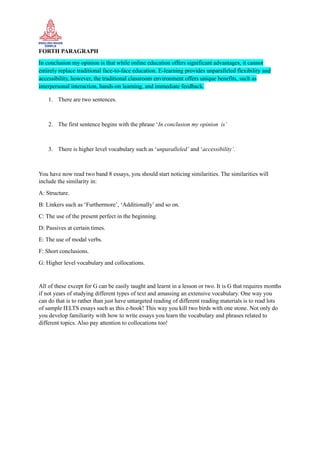
In conclusion my opinion is that while online education offers significant advantages, it cannot
entirely replace traditional face-to-face education. E-learning provides unparalleled flexibility and
accessibility, however, the traditional classroom environment offers unique benefits, such as
interpersonal interaction, hands-on learning, and immediate feedback.
1. There are two sentences.
2. The first sentence begins with the phrase ‘In conclusion my opinion is’
3. There is higher level vocabulary such as ‘unparalleled’ and ‘accessibility’.
You have now read two band 8 essays, you should start noticing similarities. The similarities will
include the similarity in:
A: Structure.
B: Linkers such as ‘Furthermore’, ‘Additionally’ and so on.
C: The use of the present perfect in the beginning.
D: Passives at certain times.
E: The use of modal verbs.
F: Short conclusions.
G: Higher level vocabulary and collocations.
All of these except for G can be easily taught and learnt in a lesson or two. It is G that requires months
if not years of studying different types of text and amassing an extensive vocabulary. One way you
can do that is to rather than just have untargeted reading of different reading materials is to read lots
of sample IELTS essays such as this e-book! This way you kill two birds with one stone. Not only do
you develop familiarity with how to write essays you learn the vocabulary and phrases related to
different topics. Also pay attention to collocations too!
ESSAY 3: ADVANTAGES AND DISADVANTAGES
Question:
Nowadays genetically modified food is widespread all over the world. While proponents of GM crops
ensure that these foods are safe for human consumption and help to increase food supplies, others
argue that their effects on health have not been studied long enough.
Describe pros and cons of genetically modified foods.
Genetically modified (GM) foods have become ubiquitous worldwide, sparking debates regarding
their safety and benefits. Proponents of GM crops argue that they offer numerous advantages,
including increased food production and enhanced resistance to pests and diseases. However,
opponents raise concerns about potential health risks and environmental consequences associated with
genetically modified organisms (GMOs). This essay will explore the pros and cons of genetically
modified foods.
One of the primary advantages of GM foods is their potential to address global food security
challenges. Through genetic modification, crops can be engineered to withstand adverse
environmental conditions, such as drought, salinity, or extreme temperatures, thereby increasing
yields and ensuring food availability in regions prone to agricultural challenges. Additionally, GM
crops can be engineered to contain essential nutrients or vitamins, addressing malnutrition and
improving the nutritional quality of food supplies.
However, opponents of GM foods raise concerns about potential health risks and environmental
consequences. Critics argue that the long-term effects of consuming genetically modified organisms
have not been sufficiently studied, and there is uncertainty surrounding their impact on human health.
Additionally, the cultivation of GM crops may lead to unintended ecological consequences, such as
the development of resistant pests or the contamination of non-GM crops through cross-pollination.
In conclusion, genetically modified foods offer potential benefits in terms of increased food
production, reduced pesticide use, and improved nutritional quality. However, concerns about their
long-term effects on human health, environmental impact, and ethical implications persist. It is
essential to continue conducting rigorous scientific research and implementing regulatory measures to
ensure the safety and sustainability of genetically modified foods while balancing the needs of
agriculture, health, and the environment.
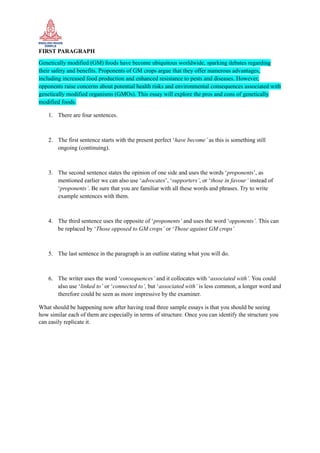
FIRST PARAGRAPH
Genetically modified (GM) foods have become ubiquitous worldwide, sparking debates regarding
their safety and benefits. Proponents of GM crops argue that they offer numerous advantages,
including increased food production and enhanced resistance to pests and diseases. However,
opponents raise concerns about potential health risks and environmental consequences associated with
genetically modified organisms (GMOs). This essay will explore the pros and cons of genetically
modified foods.
1. There are four sentences.
2. The first sentence starts with the present perfect ‘have become’ as this is something still
ongoing (continuing).
3. The second sentence states the opinion of one side and uses the words ‘proponents’, as
mentioned earlier we can also use ‘advocates’, ‘supporters’, or ‘those in favour’ instead of
‘proponents’. Be sure that you are familiar with all these words and phrases. Try to write
example sentences with them.
4. The third sentence uses the opposite of ‘proponents’ and uses the word ‘opponents’. This can
be replaced by ‘Those opposed to GM crops’ or ‘Those against GM crops’
5. The last sentence in the paragraph is an outline stating what you will do.
6. The writer uses the word ‘consequences’ and it collocates with ‘associated with’. You could
also use ‘linked to’ or ‘connected to’, but ‘associated with’ is less common, a longer word and
therefore could be seen as more impressive by the examiner.
What should be happening now after having read three sample essays is that you should be seeing
how similar each of them are especially in terms of structure. Once you can identify the structure you
can easily replicate it.
SECOND PARAGRAPH
One of the primary advantages of GM foods is their potential to address global food security
challenges. Through genetic modification, crops can be engineered to withstand adverse
environmental conditions, such as drought, salinity, or extreme temperatures, thereby increasing
yields and ensuring food availability in regions prone to agricultural challenges. Additionally, GM
crops can be engineered to contain essential nutrients or vitamins, addressing malnutrition and
improving the nutritional quality of food supplies.
1. It has three sentences.
2. The first sentence uses the phrase ‘One of the primary advantages of’. You can use this in
your writing and replace ‘primary’ with ‘main’, ‘principal’, ‘foremost’ and so on.
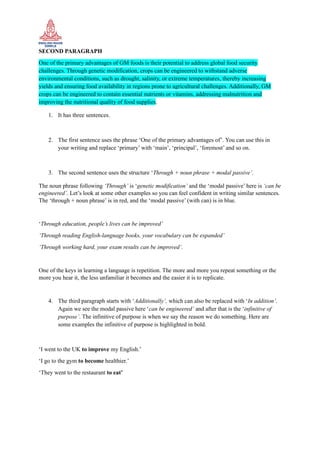
3. The second sentence uses the structure ‘Through + noun phrase + modal passive’.
The noun phrase following ‘Through’ is ‘genetic modification’ and the ‘modal passive’ here is ‘can be
engineered’. Let’s look at some other examples so you can feel confident in writing similar sentences.
The ‘through + noun phrase’ is in red, and the ‘modal passive’ (with can) is in blue.
‘Through education, people’s lives can be improved’
‘Through reading English-language books, your vocabulary can be expanded’
‘Through working hard, your exam results can be improved’.
One of the keys in learning a language is repetition. The more and more you repeat something or the
more you hear it, the less unfamiliar it becomes and the easier it is to replicate.
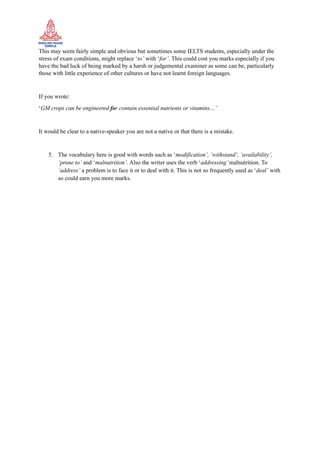
4. The third paragraph starts with ‘Additionally’, which can also be replaced with ‘In addition’.
Again we see the modal passive here ‘can be engineered’ and after that is the ‘infinitive of
purpose’. The infinitive of purpose is when we say the reason we do something. Here are
some examples the infinitive of purpose is highlighted in bold.
‘I went to the UK to improve my English.’
‘I go to the gym to become healthier.’
‘They went to the restaurant to eat’
This may seem fairly simple and obvious but sometimes some IELTS students, especially under the
stress of exam conditions, might replace ‘to’ with ‘for’. This could cost you marks especially if you
have the bad luck of being marked by a harsh or judgemental examiner as some can be, particularly
those with little experience of other cultures or have not learnt foreign languages.
If you wrote:
‘GM crops can be engineered for contain essential nutrients or vitamins…’
It would be clear to a native-speaker you are not a native or that there is a mistake.
5. The vocabulary here is good with words such as ‘modification’, ‘withstand’, ‘availability’,
‘prone to’ and ‘malnutrition’. Also the writer uses the verb ‘addressing’malnutrition. To
‘address’ a problem is to face it or to deal with it. This is not so frequently used as ‘deal’ with
so could earn you more marks.
THIRD PARAGRAPH
However, opponents of GM foods raise concerns about potential health risks and environmental
consequences. Critics argue that the long-term effects of consuming genetically modified organisms
have not been sufficiently studied, and there is uncertainty surrounding their impact on human health.
In addition to this they state that the cultivation of GM crops may lead to unintended ecological
consequences, such as the development of resistant pests or the contamination of non-GM crops
through cross-pollination.
1. Three sentences.
2. First sentence starts off with ‘However, opponents of…’ then uses the phrase ‘raise concerns’.
You can replace ‘raise’with ‘bring up’, or ‘highlight’.
3. The second sentence replaces ‘opponents’ with ‘critics’.
4. The last sentence starts off with ‘In addition to this’ and then continues with ‘they state that’.
These are phrases you can use yourself in your writing.
5. The vocabulary is good and includes ‘uncertainty’, ‘unintended’, ‘resistant’, ‘contamination’
and ‘cross-pollination’. Some of these phrases are ‘subject-specific’ and you would only
know them if you have studied or read about food or agriculture or something similar.
However this once again highlights that you cannot just pass IELTS writing by learning some
‘useful techniques’. You have to have a good knowledge of English including a wide variety
of topics which would mean you should read different types of texts including ones related to
science, history, business, social affairs and many other topics.
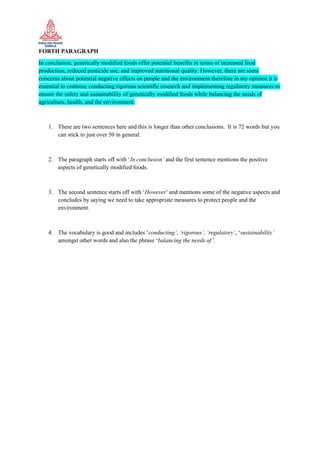
FORTH PARAGRAPH
In conclusion, genetically modified foods offer potential benefits in terms of increased food
production, reduced pesticide use, and improved nutritional quality. However, there are some
concerns about potential negative effects on people and the environment therefore in my opinion it is
essential to continue conducting rigorous scientific research and implementing regulatory measures to
ensure the safety and sustainability of genetically modified foods while balancing the needs of
agriculture, health, and the environment.
1. There are two sentences here and this is longer than other conclusions. It is 72 words but you
can stick to just over 50 in general.
2. The paragraph starts off with ‘In conclusion’ and the first sentence mentions the positive
aspects of genetically modified foods.
3. The second sentence starts off with ‘However’ and mentions some of the negative aspects and
concludes by saying we need to take appropriate measures to protect people and the
environment.
4. The vocabulary is good and includes ‘conducting’, ‘rigorous’, ‘regulatory’, ‘sustainability’
amongst other words and also the phrase ‘balancing the needs of’.
ESSAY 4: AGREE/DISAGREE ESSAY
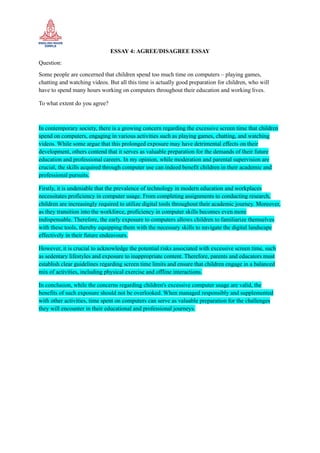
Question:
Some people are concerned that children spend too much time on computers – playing games,
chatting and watching videos. But all this time is actually good preparation for children, who will
have to spend many hours working on computers throughout their education and working lives.
To what extent do you agree?
In contemporary society, there is a growing concern regarding the excessive screen time that children
spend on computers, engaging in various activities such as playing games, chatting, and watching
videos. While some argue that this prolonged exposure may have detrimental effects on their
development, others contend that it serves as valuable preparation for the demands of their future
education and professional careers. In my opinion, while moderation and parental supervision are
crucial, the skills acquired through computer use can indeed benefit children in their academic and
professional pursuits.
Firstly, it is undeniable that the prevalence of technology in modern education and workplaces
necessitates proficiency in computer usage. From completing assignments to conducting research,
children are increasingly required to utilize digital tools throughout their academic journey. Moreover,
as they transition into the workforce, proficiency in computer skills becomes even more
indispensable. Therefore, the early exposure to computers allows children to familiarize themselves
with these tools, thereby equipping them with the necessary skills to navigate the digital landscape
effectively in their future endeavours.
However, it is crucial to acknowledge the potential risks associated with excessive screen time, such
as sedentary lifestyles and exposure to inappropriate content. Therefore, parents and educators must
establish clear guidelines regarding screen time limits and ensure that children engage in a balanced
mix of activities, including physical exercise and offline interactions.
In conclusion, while the concerns regarding children's excessive computer usage are valid, the
benefits of such exposure should not be overlooked. When managed responsibly and supplemented
with other activities, time spent on computers can serve as valuable preparation for the challenges
they will encounter in their educational and professional journeys.
FIRST PARAGRAPH
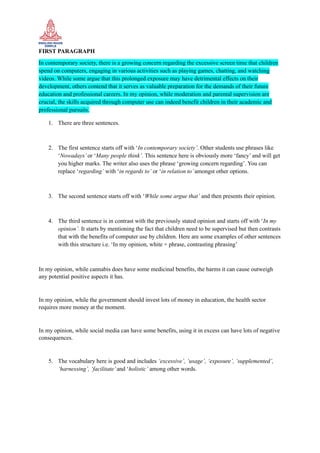
In contemporary society, there is a growing concern regarding the excessive screen time that children
spend on computers, engaging in various activities such as playing games, chatting, and watching
videos. While some argue that this prolonged exposure may have detrimental effects on their
development, others contend that it serves as valuable preparation for the demands of their future
education and professional careers. In my opinion, while moderation and parental supervision are
crucial, the skills acquired through computer use can indeed benefit children in their academic and
professional pursuits.
1. There are three sentences.
2. The first sentence starts off with ‘In contemporary society’. Other students use phrases like
‘Nowadays’or ‘Many people think’. This sentence here is obviously more ‘fancy’ and will get
you higher marks. The writer also uses the phrase ‘growing concern regarding’. You can
replace ‘regarding’ with ‘in regards to’ or ‘in relation to’amongst other options.
3. The second sentence starts off with ‘While some argue that’ and then presents their opinion.
4. The third sentence is in contrast with the previously stated opinion and starts off with ‘In my
opinion’. It starts by mentioning the fact that children need to be supervised but then contrasts
that with the benefits of computer use by children. Here are some examples of other sentences
with this structure i.e. ‘In my opinion, white + phrase, contrasting phrasing’
In my opinion, while cannabis does have some medicinal benefits, the harms it can cause outweigh
any potential positive aspects it has.
In my opinion, while the government should invest lots of money in education, the health sector
requires more money at the moment.
In my opinion, while social media can have some benefits, using it in excess can have lots of negative
consequences.
5. The vocabulary here is good and includes ‘excessive’, ‘usage’, ‘exposure’, ‘supplemented’,
‘harnessing’, ‘facilitate’and ‘holistic’ among other words.
SECOND PARAGRAPH
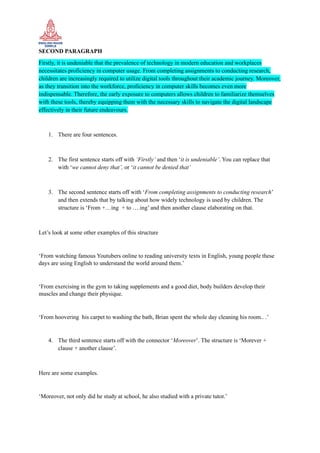
Firstly, it is undeniable that the prevalence of technology in modern education and workplaces
necessitates proficiency in computer usage. From completing assignments to conducting research,
children are increasingly required to utilize digital tools throughout their academic journey. Moreover,
as they transition into the workforce, proficiency in computer skills becomes even more
indispensable. Therefore, the early exposure to computers allows children to familiarize themselves
with these tools, thereby equipping them with the necessary skills to navigate the digital landscape
effectively in their future endeavours.
1. There are four sentences.
2. The first sentence starts off with ‘Firstly’ and then ‘it is undeniable’. You can replace that
with ‘we cannot deny that’, or ‘it cannot be denied that’
3. The second sentence starts off with ‘From completing assignments to conducting research’
and then extends that by talking about how widely technology is used by children. The
structure is ‘From +…ing + to ….ing’ and then another clause elaborating on that.
Let’s look at some other examples of this structure
‘From watching famous Youtubers online to reading university texts in English, young people these
days are using English to understand the world around them.’
‘From exercising in the gym to taking supplements and a good diet, body builders develop their
muscles and change their physique.
‘From hoovering his carpet to washing the bath, Brian spent the whole day cleaning his room.. .’
4. The third sentence starts off with the connector ‘Moreover’. The structure is ‘Morever +
clause + another clause’.
Here are some examples.
‘Moreover, not only did he study at school, he also studied with a private tutor.’
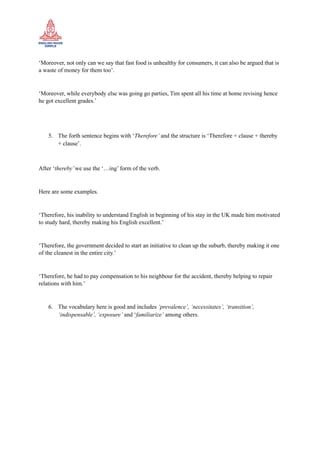
‘Moreover, not only can we say that fast food is unhealthy for consumers, it can also be argued that is
a waste of money for them too’.
‘Moreover, while everybody else was going go parties, Tim spent all his time at home revising hence
he got excellent grades.’
5. The forth sentence begins with ‘Therefore’ and the structure is ‘Therefore + clause + thereby
+ clause’.
After ‘thereby’we use the ‘…ing’ form of the verb.
Here are some examples.
‘Therefore, his inability to understand English in beginning of his stay in the UK made him motivated
to study hard, thereby making his English excellent.’
‘Therefore, the government decided to start an initiative to clean up the suburb, thereby making it one
of the cleanest in the entire city.’
‘Therefore, he had to pay compensation to his neighbour for the accident, thereby helping to repair
relations with him.’
6. The vocabulary here is good and includes ‘prevalence’, ‘necessitates’, ‘transition’,
‘indispensable’, ‘exposure’ and ‘familiarize’ among others.
THIRD PARAGRAPH
However, it is crucial to acknowledge the potential risks associated with excessive screen time, such
as sedentary lifestyles and exposure to inappropriate content. Therefore, parents and educators must
establish clear guidelines regarding screen time limits and ensure that children engage in a balanced
mix of activities, including physical exercise and offline interactions.
There are two sentences.
1. The first sentence starts off with ‘However’ and uses good vocabulary such as ‘associated
with’, ‘excessive’, ‘sedentary’, ‘exposure’ and ‘inappropriate’.
2. The second sentence begins with ‘Therefore’and of course once again there is more
sophisticated vocabulary. This time examples include ‘educators’ and ‘establish clear
guidelines’.
There is not much to add here. We have already read four different essays and either consciously or
subconsciously we will be developing a sense of what sort of vocabulary and structures are used,
some of them recurring quite frequently. The more and more sample essays you read or the more
formal non-fiction English you read the better you will become at writing an IELTS writing task 2
answer if you pay attention to the structure, vocabulary and grammar (including what prepositions go
with which words, the collocations and individual sentence structures).
FORTH PARAGRAPH
In conclusion, while the concerns regarding children's excessive computer usage are valid, the
benefits of such exposure should not be overlooked. When managed responsibly and supplemented
with other activities, time spent on computers can serve as valuable preparation for the challenges
they will encounter in their educational and professional journeys.
1. There are two sentences.
2. The first sentence begins with ‘In conclusion’ once again. We can also use ‘To conclude’ of
course. It also uses the word ‘valid’ which can be replaced by legitimate. It says that though
concerns are valid the benefits ‘should not be overlooked’. The last phrase is a modal passive
but this time negative because of ‘not’.
Here are some examples
‘Excessive amounts of sugar should not be consumed by children.’
‘Controversial topics should not be discussed in this classroom.’
‘This form should not be signed by anyone except the manager.’
3. The last sentence begins with ‘When’followed by the past participle ‘managed’. Let us look
at some more examples of this type of structure.
‘When eaten in moderate amounts, sugar is something that can be enjoyed in class.’
‘When discussed in a polite and respectful manner, political issues can be discussed in this
classroom.’
‘When approved by the manager, then staff can go home early.’
4. The conclusion generally has a good standard of vocabulary including the usage of some
words that we have seen in the previous essays.
ESSAY 5: TWO PART QUESTION
Question:
Online education is becoming more and more popular. Some people claim that e-learning has so many
benefits that it will replace face-to-face education soon. Others say that traditional education is
irreplaceable.
Discuss both views and give your opinion.
Opinions diverge on whether governments should offer free housing to their citizens. Advocates argue
that housing is a fundamental human right, necessitating government intervention to ensure access for
all. Conversely, opponents assert that such measures may foster dependency and strain public
resources. Both viewpoints warrant consideration.
Supporters of government-funded housing emphasize the moral importance for society to ensure
shelter for all individuals. They contend that access to affordable housing is essential for maintaining
human dignity and social stability. In many urban centres, soaring housing costs have led to
homelessness and housing insecurity among vulnerable populations. Thus, government intervention is
seen as crucial to address these disparities and promote social equality. By providing free housing,
governments can mitigate poverty, reduce social inequality, and foster cohesive communities. They
argue that we cannot rely on money-orientated private landlords whose main or only priority is to
make money.
In contrast, detractors argue that government-funded housing may breed complacency and hinder
individual responsibility. They feel that reliance on state support could disincentivize individuals from
seeking employment or pursuing self-sufficiency. Furthermore, they raise concerns about the financial
burden on taxpayers and the potential inefficiencies in resource allocation. Instead, they advocate for
market-driven solutions, such as incentivizing private developers to build affordable housing or
implementing policies that stimulate economic growth.
In conclusion, the debate over government-funded housing underscores broader discussions about
social welfare and the role of the state in addressing socio-economic disparities. While differing
opinions exist, a balanced approach that combines government intervention with market mechanisms
may offer the most effective solution to ensure housing affordability and promote social equity.
FIRST PARAGRAPH
Opinions diverge on whether governments should offer free housing to their citizens. Advocates argue
that housing is a fundamental human right, necessitating government intervention to ensure access for
all. Conversely, opponents assert that such measures may encourage dependency and strain public
resources. Both viewpoints will be looked at in this essay.
1. The paragraph has four sentences.
2. The first sentence uses the phrase ‘Opinions diverge on’. This can also be replaced by
‘Opinions vary on’ or ‘Opinions differ on’. So these are some additional phrases that
you can add to your list of useful vocabulary and phrases.
3. The second sentence starts off with ‘Advocates’. This can be replaced by ‘Those in
favour of free housing’ or ‘Proponents of free housing’ as we saw earlier on above.
Also the word ‘whether’ is used. This is a word which many lower level students e.g.
B1 (intermediate) and below have difficulty with. It is used when there are two
choices.
Let us look at some examples:
‘People differ regarding whether smoking should be banned or not.’
‘There is controversy on whether Britain should have left the EU or not.’
‘There is heavy debate on whether schools should change the way the organise exams’.
So the structure in the sentences above is ‘….whether on + noun phrase’.
4. The third sentence begins with the word ‘conversely’, this can be replaced with ‘On
the other hand’ or ‘In contrast’. The writer also uses the word ‘opponents’ which can
be replaced with ‘critics’ or ‘those opposed to free housing’, and then after that they
use the word ‘assert’ which can be replaced with ‘claim’ or ‘maintain’ or ‘state’
amongst other options.
5. The last sentence, ‘Both viewpoints will be looked at in this essay’ is a standard
phrase that can be used in any essay.
6. In terms of vocabulary we have words like ‘intervention’ and ‘dependency’
SECOND PARAGRAPH
Supporters of government-funded housing emphasize the moral importance for society to ensure
shelter for all individuals. They contend that access to affordable housing is essential for maintaining
human dignity and social stability. In many urban centres, soaring housing costs have led to
homelessness and housing insecurity among vulnerable populations. Thus, government intervention is
seen as crucial to addressing these disparities and promote social equality. By providing free housing,
governments can mitigate poverty, reduce social inequality, and foster cohesive communities. They
argue that we cannot rely on money-orientated private landlords whose main or only priority is to
make money.
1. There are six sentences here. Usually it might be advisable to have four or five but
this is an example of a body paragraph with six sentences.
2. Sentence one begins with the word ‘supporters’ which as we have seen earlier is
interchangeable with ‘advocates’ and uses the verb ‘emphasize’.
3. Sentence two continues and referring to the aforementioned supporters uses the verb
‘contend’ in ‘They contend’. ‘Contend’ is interchangeable with ‘assert’, ‘maintain’,
‘claim’, ‘believe’, ‘state’, ‘hold’ and so forth.
4. The third sentence uses the present perfect saying that ‘soaring coasts have led to
homelessness…’
5. The forth sentence uses the word ‘thus’. This is an interesting word. In essence it
means ‘so’, but it has a more formal tone and is often used in literature or older
English. This sentence also features the use of the passive with ‘is seen as crucial’.
6. The fifth sentence uses the structure ‘By + …ing’ in the form of ‘By providing’. Here
we see ‘By providing’ + another clause. This was looked at p.30 (Essay 1, analysis of
paragraph 4) of this book. So you can go back there if you want more information
about this.
7. The sixth sentence is the type of sentence we have seen before and has nothing
particularly distinctive about it in comparison to other sentences we have seen. It is
merely ‘They argue’ followed by the rest of the sentence. If this sentence seems fairly
ordinary well that should be the case because the more and more sample essays you
read the more and more familiarity you should develop with vocabulary and
sentences. However these sentences being easily understood and familiar are not
enough, the next stage is then to be able to reproduce such sentences yourself.
8. In terms of words the paragraph features the same standard of vocabulary we have
seen in other essays and includes ‘disparities’, ‘mitigate’, and ‘cohesive’ amongst
other words.
THIRD PARAGRAPH
In contrast, detractors argue that government-funded housing may breed complacency and hinder
individual responsibility. They feel that reliance on state support could disincentivize individuals from
seeking employment or pursuing self-sufficiency. Furthermore, they raise concerns about the financial
burden on taxpayers and the potential inefficiencies in resource allocation. Instead, they advocate for
market-driven solutions, such as incentivizing private developers to build affordable housing or
implementing policies that stimulate economic growth.
1. There are four sentences.
2. The first sentence begins with ‘In contrast,’ followed by ‘detractors’ which can also be
replaced by ‘critics’ or ‘opponents’ as we have seen earlier.
3. The second sentence extends the argument by saying ‘They feel that’ referring to the
aforementioned ‘detractors’.
4. The third sentence starts off with the connector ‘furthermore’.
5. The last sentence begins with ‘Instead’.
6. In terms of vocabulary there are words such as ‘complacency’, ‘disincentivize’, ‘self-
sufficiency’, ‘inefficiencies’ and ‘allocation’ which if used properly in your own writing
exam can help you to get higher marks.
FORTH PARAGRAPH
In conclusion, the debate over government-funded housing underscores broader discussions about
social welfare and the role of the state in addressing socio-economic disparities. While differing
opinions exist, a balanced approach that combines government intervention with market mechanisms
may offer the most effective solution to ensure housing affordability and promote social equity.
1. There are two sentences just as in essay no.4
2. Just like essay no.4 the first sentence begins with ‘In conclusion’. Remember you may have
read a certain word many times in sample essays. In your own writing in your own IELTS
class or with a tutor you may have used certain words or phrases a hundred times to the point
you might even become ‘bored’ and think that particular word or phrase is ‘unoriginal’.
However if you have used a certain word a hundred times yourself, the examiner will not
know this and will only see you using that word or phrase once. So stick to words or phrases
that you know you can write correctly. This does not mean stick to only simple sentences but
stick with more sophisticated vocabulary or phrases that you can use correctly.
3. The second sentence begins with ‘While’ and is used for contrast. You can look at page 43
(Essay 4, analysis of the first paragraph) for more information on that.
4. The vocabulary includes words such as ‘mechanisms’ and ‘affordability’.
CONCLUSION
So we have seen five model essays of a standard of band 8. We have looked at each paragraph and
seen how many sentences they contain. How they start, some of the grammatical features and
structures and also the vocabulary. This does not mean you are going to pass your IELTS writing
exam but what it does mean is that it should help you to understand how to read and analyse model
essays (and there are plenty available online these days), how to deconstruct them and then work
slowly on replicating them.
This can help you as a foundation for future success in IELTS writing. Your job now will be to read
more and more model essays including those on our website www.englishmadesimple.org and analyse
the language and work on the reproducing it.
We wish you the best in your IELTS exam and in your education and future goals.

Understanding the IELTS Writing Task 2 skills

  • 1.
  • 2.
    About 'English Made Simpleis a company founded and based in London, the United Kingdom. The goal of our organization is to help people attain their goals through improving their English. We have helped people from different countries not only improve their general English but more specifically in things such as IELTS, TOEFL, OET, Cambridge FCE and CAE. We have helped students from different countries, ages, backgrounds from all over the world to improve the standard of their English through organizing classes and also providing other forms of support and assistance. Not only do we have a website but we have a YouTube channel with educational videos on different aspects of the English language. In addition to that we have a Facebook group of over 112,000 members and also publish educational material including e-books.'
  • 3.
    Content Chapter 1: Understandingthe IELTS Writing Exam (p. 4) Chapter 2: The Marking Criteria (p. 7) Chapter 3: Task Achievement (p. 9) Chapter 4: Coherence and Cohesion (p. 11) Chapter 5: Lexical Resource (p. 13) Chapter 6: Grammatical Range and Accuracy (p. 15) Chapter 7: Types of Questions (p. 17) Chapter 8: IELTS Task 2 Writing Structure (p. 19) Chapter 9: Getting Started (p. 23) Chapter 10: How to Use This Book (p. 25) Chapter 11: Essay 1: Problem-Solution Essay (p. 26) Chapter 12: Essay 2: Discussion & Opinion Essay (p. 32)
  • 4.
    Chapter 1: Understandingthe IELTS Writing Exam Welcome to the journey towards mastering the IELTS Writing exam! In this first chapter, we embark on a comprehensive exploration of what the IELTS writing exam entails, its significance, and how mastering its intricacies can pave the way for achieving your academic and professional aspirations. However, this book is only about IELTS writing task 2 but we will begin by looking at the IELTS exam in general. What is the IELTS Exam? The International English Language Testing System (IELTS) is a globally recognized examination designed to assess the English language proficiency of non-native speakers. Administered by the British Council, IDP Education, and Cambridge Assessment English, the IELTS evaluates candidates across four key language skills: Listening, Reading, Writing, and Speaking. Purpose and Importance The IELTS exam is used widely by both universities in English-speaking countries such as the UK, USA, and Australia on judging whether a potential student has the sufficient level of English language competency to study on a course conducted in the English language. However, it is also used as a valid assessment of language competency by universities in other countries such as Germany, Spain, and Turkey and all over the world where there are university programs or courses taught in English. In addition, it holds importance for individuals seeking opportunities to, work, or migrate to English- speaking countries such as the United Kingdom, Australia, Canada, and New Zealand. Whether you aspire to pursue higher education in a prestigious institution, enhance your career prospects, or relocate for personal or professional reasons, achieving a desirable score in the IELTS Writing section is crucial. Navigating the Writing Component Among the four modules of the IELTS exam, the Writing section demands careful attention and preparation. It not only assesses your ability to articulate ideas coherently and accurately but also evaluates your proficiency in academic or general writing tasks, depending on the module you choose. Throughout this short e-book we'll delve into the intricacies of the IELTS Writing task 2, dissecting its structure, understanding the evaluation criteria, and uncovering the strategies that will empower you to excel in this pivotal aspect of the test.
  • 5.
    Chapter 2: TheMarking Criteria The IELTS Writing exam is assessed based on four key criteria, each essential for evaluating the quality and effectiveness of your written communication. Let's explore these marking criteria in detail: 1. Task Achievement (for Task 1) / Task Response (for Task 2): This criterion evaluates the extent to which you address all parts of the question prompt and fulfil the requirements of the task. For Task 1 in the Academic module, it assesses how accurately and adequately you describe the visual information or data provided. For Task 2, it focuses on whether you have addressed the specific question or statement effectively, presenting a clear position or argument and providing relevant support or examples. To achieve a high score, it's crucial to stay on topic, answer all aspects of the question, and maintain a clear and focused approach throughout your response. 2. Coherence and Cohesion: This criterion examines the overall clarity and organization of your writing. Coherence refers to the logical structure and flow of ideas within paragraphs and throughout the entire essay. It assesses how well your ideas are connected and presented in a coherent manner. Cohesion, on the other hand, evaluates the effective use of cohesive devices such as linking words, transition phrases, and pronouns to establish connections between sentences and paragraphs. Achieving a high score in this criterion requires maintaining a clear and logical progression of ideas, using appropriate paragraphing, and employing a variety of cohesive devices to ensure smooth transitions between different parts of your response. 3. Lexical Resource: This criterion assesses your vocabulary range and accuracy. It evaluates the variety and appropriateness of the words and phrases you use, as well as your ability to effectively convey meaning and express ideas precisely. To score well in this criterion, it's essential to demonstrate a wide range of vocabulary, including both common and academic terms, as well as the ability to use collocations and idiomatic expressions appropriately. Additionally, accurate spelling and word formation contribute to a higher score in Lexical Resource. 4. Grammatical Range and Accuracy: This criterion evaluates the complexity and accuracy of your grammatical structures and the range of sentence structures you use. It assesses your ability to use a variety of grammatical structures accurately, including complex sentences, subordinate clauses, and different verb forms. Additionally, it considers your proficiency in using punctuation and sentence punctuation accurately to enhance clarity and coherence. To achieve a high score in this criterion, it's important to demonstrate a good command of grammar, with minimal errors that do not impede understanding. Understanding and effectively addressing these marking criteria are crucial for achieving a desirable score in the IELTS Writing exam. Practicing writing tasks under timed conditions, receiving feedback, and addressing areas of improvement can significantly enhance your performance on test day.
  • 6.
    Chapter 3: TaskAchievement Task Achievement in IELTS Writing: Understanding the Criterion Task Achievement is one of the key criteria assessed in the IELTS Writing exam. It evaluates how well candidates fulfil the requirements of the task and whether they address all aspects of the question prompt effectively. This criterion is particularly crucial for Task 1 in the Academic module and Task 2 in both the Academic and General Training modules. Assessment of Task Achievement: Examiners assess Task Achievement based on the following aspects: 1. Addressing the Question Prompt: Candidates must fully understand the question prompt and ensure that their response addresses all parts of it. Failure to do so can result in a lower score, as it indicates a lack of comprehension or deviation from the task requirements. 2. Coherence and Relevance: Responses should be coherent and relevant to the task at hand. This means presenting information or arguments that directly relate to the question prompt without going off-topic or introducing irrelevant details. 3. A good opening You should have a good opening sentence which introduces the topic or paraphrases it well. 4. Arguments In task 2, the essay, your personal opinion should be clear and you should have arguments this is if you are being asked to present your own personal opinion. However, if you are being asked to examine two differing opinions on a topic then present arguments for both sides of the argument. 5. Reasons Provide reasons to back the argument so for example simply saying “Some people hold the opinion that banning smoking is bad” is not enough. You should say something like “Some people hold the opinion that banning smoking is bad due to the fact that it is an intrusion into people’s personal freedoms by the state”. What Examiners Are Looking For: Examiners are looking for candidates who demonstrate the following: 1. Understanding of Task Requirements: Candidates should demonstrate a clear understanding of the task and its requirements. This includes identifying the main purpose of the task, understanding what is expected in terms of content, and planning their response accordingly. 2. Focus and Relevance: Responses should remain focused on the task and avoid straying off- topic. Candidates should prioritize relevant information or arguments that directly address the question prompt.
  • 7.
    3. Organization andStructure: Well-organized responses with a clear structure enhance readability and coherence. Candidates should effectively organize their ideas, paragraphs, or sections to present their arguments or information logically and coherently. Examples of How Students Can Satisfy Examiners: 1. Understanding the Question: Before starting to write, carefully read and analyze the question prompt to ensure a thorough understanding of what is being asked. Underline key instructions or requirements to stay focused during the writing process. 2. Planning: Take a few minutes to brainstorm ideas, outline your response, and decide on the main points or arguments you will include. This helps in organizing your thoughts and ensuring that you cover all aspects of the task. 3. Staying on Topic: Throughout your response, constantly refer back to the question prompt to ensure that you remain on topic. Avoid introducing irrelevant information or going off on tangents that do not contribute to addressing the task. 4. Providing Support: Use relevant examples, data, or evidence to support your arguments or statements. Providing concrete examples helps to clarify your points and adds credibility to your response. Incorporating relevant examples, data, or evidence strengthens arguments strengthens your writing. By focusing on addressing the task requirements, maintaining coherence and relevance, and providing a thorough and well-organized response, candidates can satisfy examiners and achieve a higher score in the Task Achievement criterion of the IELTS Writing exam.
  • 8.
    Chapter 4: CoherenceAnd Cohesion Understanding Coherence and Cohesion in IELTS Writing Coherence and Cohesion are essential criteria in the assessment of the IELTS Writing exam. These criteria evaluate the clarity, organization, and flow of candidates' responses, ensuring that ideas are logically connected and presented in a cohesive manner. Coherence refers to the overall clarity and logical progression of ideas, while Cohesion focuses on the use of cohesive devices to establish connections between sentences and paragraphs. Assessment of Coherence and Cohesion: The assessment of Coherence and Cohesion involves several key aspects: 1. Logical Progression of Ideas (Coherence): Examiners evaluate how well candidates organize their ideas to create a clear and logical flow of information or argumentation. This includes the effective arrangement of paragraphs, the development of cohesive paragraphs, and the presentation of ideas in a manner that is easy to follow and understand. 2. Use of Cohesive Devices (Cohesion): Cohesive devices are words or phrases that connect ideas within a sentence or between sentences and paragraphs. Examiners assess the use of cohesive devices such as conjunctions, transitional phrases, pronouns, and referencing to ensure smooth transitions and logical connections between different parts of the response. What Examiners Look For: Examiners seek specific qualities in candidates' responses to evaluate Coherence and Cohesion effectively: 1. Logical Organization: Candidates should organize their ideas in a logical and coherent manner, ensuring that each paragraph or section follows a clear progression. This involves introducing the main idea or argument, providing supporting details or examples, and concluding with a summary or transition to the next point. 2. Clear Transitions: Effective use of transitional phrases and cohesive devices helps establish connections between sentences and paragraphs, guiding the reader through the response and enhancing overall coherence. Candidates should use a variety of cohesive devices to signal relationships between ideas, such as cause and effect, comparison and contrast, and chronological order. Examples of Satisfying Examiners: 1. Clear Topic Sentences: Begin each paragraph with a clear topic sentence that introduces the main idea or argument. This provides a roadmap for the reader and helps maintain coherence within the paragraph. 2. Paragraph focus Each paragraph should be focused on a specific point and not zig-zag between two many different points or issues, this makes the whole essay easier to read and follow and contributes to coherence.
  • 9.
    3. Consistent PronounUsage: Use pronouns consistently to refer back to previously mentioned nouns or ideas. This avoids confusion and strengthens the connections between sentences and paragraphs. 4. Transitional Phrases: Incorporate transitional phrases such as "however," "on the other hand," "furthermore," and "in conclusion" to signal shifts in ideas or provide additional information. This enhances coherence by guiding the reader through the response and highlighting the relationships between different parts of the text. These are often called ‘connectors’ or ‘linking words’. 5. Logical Ordering of Ideas: Arrange ideas in a logical sequence, with each paragraph building upon the previous one. This ensures a smooth flow of information and enhances the reader's understanding of the overall argument or narrative. By demonstrating logical organization, clear transitions, and consistent use of cohesive devices, candidates can effectively satisfy examiners and achieve a higher score in the Coherence and Cohesion criterion of the IELTS Writing exam.
  • 10.
    Chapter 5: LexicalResource Understanding Lexical Resource in IELTS Writing Lexical Resource is a crucial criterion in the assessment of the IELTS Writing exam. It evaluates the range, accuracy, and appropriateness of candidates' vocabulary use. A strong lexical resource demonstrates a varied vocabulary, precise word choice, and effective expression of ideas, contributing significantly to the overall quality of the response. Assessment of Lexical Resource: The assessment of Lexical Resource involves several key aspects: 1. Vocabulary Range: Examiners evaluate the breadth of candidates' vocabulary by assessing their ability to use a wide range of words and phrases. This includes both common vocabulary and more specialized or academic terms relevant to the topic. Candidates should demonstrate versatility in their word choice and avoid repetition or reliance on basic vocabulary. 2. Accuracy and Precision: Candidates are expected to use vocabulary accurately and precisely, selecting words that convey the intended meaning clearly and appropriately. Examiners assess the correctness of word usage, including spelling, word formation, and collocations. Candidates should avoid errors in vocabulary use that may impede understanding or detract from the overall clarity of the response. What Examiners Look For: Examiners seek specific qualities in candidates' responses to evaluate Lexical Resource effectively: 1. Variety of Vocabulary: Candidates should demonstrate a wide range of vocabulary, including both general and topic-specific terms. This showcases their ability to express ideas effectively and adapt their language to different contexts and topics. 2. Appropriate Word Choice: Selecting words that are appropriate to the context and convey the intended meaning accurately is crucial. Candidates should avoid using overly simplistic or informal language in academic contexts and ensure that their word choice aligns with the tone and purpose of the writing task. Examples of Satisfying Examiners: 1. Synonyms and Antonyms: Use synonyms and antonyms to vary your vocabulary and avoid repetition. For example, instead of repeatedly using the word "important," consider alternatives such as "significant," "crucial," or "essential." 2. Precise Language: Choose words that accurately convey your intended meaning and avoid vague or ambiguous language. For instance, instead of saying "a lot of people," consider specifying the quantity with phrases like "a significant number of individuals" or "a large proportion of the population."
  • 11.
    3. Specialized Terminology:Incorporate topic-specific vocabulary when discussing specialized subjects or academic topics. This demonstrates your familiarity with the subject matter and enhances the credibility of your response. However, be cautious not to overuse technical jargon, as clarity and accessibility should remain priorities. However it is here when you need to understand that simply doing an IELTS course cannot fast track you into passing an IELTS exam. You need to have a relatively comprehensive knowledge of the language or at least a wide familiarity with it including subject-specific vocabulary related to many topics. This often entails having read widely and accumulated vocabulary that way. Simple passive awareness of vocabulary is not enough though as you will need to be able to use subject- specific vocabulary appropriately. For instance if your question relates to education and you are not familiar with words such as ‘academic’, ‘tertiary’ (as in the third level of education after high school), ‘under-graduate’, ‘post- graduate’ then there is a deficiency in your English and you will need to learn such words for this particular topic. 4. Collocations: Pay attention to common word combinations or collocations that native speakers use naturally. Using collocations appropriately can enhance the fluency and naturalness of your writing. For example, instead of saying "make a decision," use the collocation "reach a decision" for a more idiomatic expression. By demonstrating a varied vocabulary, precise word choice, and accurate usage of vocabulary, candidates can effectively satisfy examiners and achieve a higher score in the Lexical Resource criterion of the IELTS Writing exam.
  • 12.
    Chapter 6: GrammaticalRange and Accuracy Understanding Grammatical Range and Accuracy in IELTS Writing Grammatical Range and Accuracy are essential criteria in the assessment of the IELTS Writing exam. This criterion evaluates the complexity, variety, and correctness of candidates' grammatical structures, as well as their ability to use punctuation effectively. A strong performance in this criterion demonstrates a command of grammar, contributing significantly to the clarity and coherence of the response. Assessment of Grammatical Range and Accuracy: The assessment of Grammatical Range and Accuracy involves several key aspects: 1. Range of Grammatical Structures: Examiners evaluate candidates' ability to use a variety of grammatical structures accurately and appropriately. This includes the use of simple and complex sentence structures, verb forms, tense usage, conditionals, passive tense and relative clauses. Candidates should demonstrate versatility in their sentence construction and avoid overreliance on basic sentence patterns. 2. Accuracy: Candidates are expected to use grammatical structures accurately, with minimal errors that do not impede understanding. Examiners assess the correctness of subject-verb agreement, verb tense usage, word order, articles, pronouns, and other grammatical features. Candidates should strive for grammatical precision and clarity in their writing. What Examiners Look For: Examiners seek specific qualities in candidates' responses to evaluate Grammatical Range and Accuracy effectively: 1. Variety of Sentence Structures: Candidates should demonstrate the ability to use a range of sentence structures, including simple, compound, complex, and compound-complex sentences. This showcases their proficiency in constructing sentences of varying lengths and complexities to convey meaning effectively. 2. Correct Usage of Grammar: Candidates are expected to use grammar accurately and appropriately to convey their ideas clearly. This includes accurate subject-verb agreement, correct verb tense usage, appropriate word order, and consistent use of grammatical forms throughout the response. Examples of Satisfying Examiners: 1. Complex Sentences: Incorporate complex sentence structures, such as subordinate clauses, relative clauses, and conditional sentences, to demonstrate grammatical range and sophistication. For example, instead of using only simple sentences, combine ideas using subordinating conjunctions like "although," "because," or "while."
  • 13.
    2. Verb TenseAccuracy: Ensure consistency and accuracy in verb tense usage throughout the response. Pay attention to the context and timeline of events to select the appropriate tense. Avoid unnecessary shifts in tense that may confuse the reader or disrupt the flow of the writing. 3. Subject-Verb Agreement: Ensure that subjects and verbs agree in number and person. Singular subjects should be paired with singular verbs, and plural subjects should be paired with plural verbs. Be vigilant for errors in subject-verb agreement, especially in sentences with compound subjects or complex sentence structures. 4. Punctuation Usage: Use punctuation marks, such as commas, periods, semicolons, and colons, appropriately to enhance clarity and readability. Proper punctuation helps to structure sentences, indicate pauses, and separate clauses or items in a list. Review punctuation rules and practice using punctuation effectively in your writing. 5. Correct use of prepositions: For example, if you were to write ‘John was interested to* football’, the use of the preposition ‘to’ here is clearly wrong and should be replaced by ‘in’. Incorrect use of prepositions is quite frequent amongst students for less common words and topics and should be avoided. By demonstrating a variety of sentence structures, accurate grammar usage, and effective punctuation, candidates can effectively satisfy examiners and achieve a higher score in the Grammatical Range and Accuracy criterion of the IELTS Writing exam.
  • 14.
    Chapter 7: TypesOf Questions In the IELTS Writing Task 2, candidates are presented with various types of essay questions that require different approaches and structures. Let's explore the five main types of Task 2 questions and how to effectively answer each of them: 1. Discussion/Opinion Essay: • Question Type: Candidates are asked to express their opinion on a given topic and discuss both sides of the argument. • Approach: Begin by stating your position clearly in the introduction. In the body paragraphs, present arguments supporting your opinion, followed by counterarguments for the opposing viewpoint. Conclude by summarizing your main points and restating your opinion. • Example: "Some people argue that technology has made our lives easier, while others believe it has negative effects on society. Discuss both views and give your opinion." 2. Advantages and Disadvantages Essay: • Question Type: Candidates are required to discuss the advantages and disadvantages of a particular issue, trend, or phenomenon. • Approach: Start by introducing the topic and providing a brief overview of both the advantages and disadvantages. Dedicate separate paragraphs to discussing each aspect in detail, providing examples or evidence to support your points. Conclude by summarizing the main advantages and disadvantages. • Example: "In recent years, there has been a growing trend towards online shopping. Discuss the advantages and disadvantages of this trend." 3. Problem-Solution Essay: • Question Type: Candidates are presented with a problem or issue and asked to propose solutions to address it. • Approach: Begin by outlining the problem in the introduction. In the subsequent paragraphs, discuss the causes of the problem and propose one or more viable solutions, providing details and examples to support each solution. Conclude by summarizing the proposed solutions and their potential impact. • Example: "Increasing traffic congestion is a major problem in many cities. What are the causes of this problem, and what measures could be taken to solve it?" 4. Two-Part Question Essay:
  • 15.
    • Question Type:Candidates are asked to respond to two separate questions or discuss two different aspects of a topic. • Approach: Address each part of the question separately in the introduction, body paragraphs, and conclusion. Ensure clear and logical transitions between the two parts of the response. Provide relevant details or examples to support each part of the answer. • Example: "Some people believe that the best way to reduce crime is to increase the number of police officers on the streets. Others think there are alternative methods. Discuss both views and give your opinion." 5. AGREE / DISAGREE Essay: • Question Type: Candidates are presented with a topic and a question on whether they agree or disagree with a certain opinion or to what extent they agree • Approach: Begin by restating the question or statement in the introduction and provide a brief overview of your response. In the body paragraphs, present your arguments or explanations in detail, supporting them with examples or evidence. Conclude by summarizing your main points and providing a clear answer to the question. • Example: "All children should study a foreign language starting from their first years of school. To what extend do you agree or disagree with this...” Regardless of the type of Task 2 question, it's essential to carefully analyze the question prompt, plan your response, and structure your essay effectively. Practice writing essays for each type of question to familiarize yourself with the different approaches and improve your overall writing skills.
  • 16.
    Chapter 7: IELTSTask 2 Writing Structure In terms of structure, this is fairly straightforward. In general it should be an introduction, followed by two body paragraphs, followed by a conclusion INTRODUCTION A relatively short introduction of perhaps 3 sentences at most. The opening sentence should provide a soft introduction to the topic in general. The second sentence can go on to the specific topic. The third sentence can be the ‘outline’ where you write what will you will do. So if the question was ‘Should mobile phones be banned in schools completely?’ You can start with the general opening sentence. ‘Mobile phones are an important aspect of modern life’. The second sentence might be related to the question specifically e.g. ‘However despite their importance some argue that they should be banned in schools totally’. The third sentence would be the outline e.g. ‘In this essay I will give my opinion on why mobile phones should not be banned completely in schools and the reasons for my view.’ Not all introductions have an outline and you will not necessarily lose marks if you do not have one. However for students looking for a structure or template to make it easier for them to write an essay using an outline can make things much easier for them. So together the introduction would look like this: ‘Mobile phones are an important aspect of modern life. However despite their importance some argue that they should be banned in schools totally. In this essay I will give my opinion on why mobile phones should not be banned completely in schools and the reasons for my view.’ (48 words) BODY PARAGRAPHS In the body paragraphs you write arguments either for or against a particular idea or if it is a cause- solution essay, the cause and then the solution. You need to provide reasons for the arguments that you are writing about. It is advisable to have two paragraphs. If it is a for and against essay, then one paragraph about one side of the argument and another paragraph about the opposing argument. We will have a look at five different essays and we can see the body paragraphs there. However body paragraphs commonly feature phrases such as: ‘Firstly, one of the main reasons used to support the belief that …is the argument that…’
  • 17.
    ‘In addition tothis another reason given is the claim that….’ ‘In contrast to the previous argument others hold the belief that …’ A lot of this book will be devoted to looking at the sentences in different body paragraphs including some of the grammatical structures which can be used.
  • 18.
    Below is atable with the band descriptors:
  • 19.
    Chapter 9: GettingStarted If your goal is to do IELTS to go to university, you will often need a 6.5 which is equivalent to B2. If you are studying English in an ESL (English as a Second Language) school then you should try to ensure that you are a genuine B2 level. By genuine we mean that rather than insisting on moving up a level to the academic management when you clearly may not be (being placed in a B1 class when you are actually B2 is a different matter) focus on becoming a genuine B2 level student. This would mean for example things such as: 1. Look at all the grammar that a B2 student should know and make sure you are comfortable with it. You can do tests in your school, with your tutor or even online to see how successful you are with these items of grammar. If for example you do not understand the future perfect and cannot answer questions related to it, this indicates a weakness in your grammar. The future perfect is not as commonly used as other verb tenses but it is something that a real B2 student would be expected to be comfortable with. 2. Look at all the different topics that are covered in B2 course books. Are you comfortable with those? Often certain students in ESL schools believe that ‘real learning’ is only when grammar is studied and the heavy use of grammatical terminology e.g. ‘infinitive’, ‘reflexive pronoun’ as opposed to perhaps reading a text rich in vocabulary about a certain subject and expanding their lexis or engaging in a one hour conversation class on a certain topic. This is far from true and if you are reading texts about education, business, history, science or having conversations about them and expanding your vocabulary and ability to discuss (be it in written or verbal form) about these topics this will actually be more useful to you then just studying grammar in isolation. In the IELTS exam, you will never be asked ‘What is the past perfect?’, however you may have to write an essay which involves successfully writing about a topic including the appropriate subject-specific vocabulary including the correct collocations and prepositions. For example if you are being asked to write about whether something should be banned and you wrote ‘I think this law should be destroyed’, this is grammatically incorrect as you should write ‘I think this law should be abolished’. ‘Abolish’ collocates with ‘law’, ‘destroy’ does not. 3. Read newspaper articles regularly and compile a vocabulary list including collocations e.g. for education we cannot say ‘make an exam’, but ‘take an exam’or ‘do an exam’. Also the prepositions that go after certain verbs and adjectives. For example we cannot say ‘Tim was fascinated to Roman history’, we would have to use ‘by’ rather than ‘to’ i.e. ‘Tim was fascinated by* Roman history’. 4. Do an IELTS course if you can or hire a qualified and experienced teacher with good feedback who can teach you specific IELTS techniques and give you feedback on your writing. Also you can use software or apps that check how grammatically correct your writing
  • 20.
    is. If youdo this frequently and become aware of your frequently recurring grammatical mistakes then you can reduce your mistakes more and more. One example of a website which detects grammatical mistakes is Grammarly. 5. Read as many model essays as you can. Pay attention to the grammatical structures and vocabulary they use. Make a note of them in a notebook specifically devoted to IELTS writing. Try and use this vocabulary yourself with a tutor or study buddy. You will only get better. Remember writing can often be the hardest skill in any language. Not only that but you are trying not to write a short whatsapp message or email but to study at the highest educational level, i.e. university. Therefore there are no short cuts or magic tricks. Instead there are things which you must be aware of and work hard on e.g. grammatical accuracy, learning vocabulary about different topics and so on.
  • 21.
    Chapter 10: HowTo Use This Book This book can be used by either students or teachers. There are five essays for each of the five main types of questions. You will read the question and the essay. Then after that we look at each paragraph and look at things such as: 1- How many sentences per paragraph. 2- The way each sentence begins. 3- The grammar used in these sentences including at times several example sentences with that same type of grammar. 4- The more impressive vocabulary used in the paragraph. You keep on repeating this process so that by the end of this short book you have done this twenty times so that your mind starts to get into the habit of looking at model essays and analysing them. It becomes easier and easier with practice and repetition until it could even perhaps become a bit ‘boring’! However if you did find it ‘boring’ or even ‘easy’ then that would be the whole point. We want you to lose any fear or nervousness about the IELTS writing task 2 exam and feel at ease so you can perform better in the real exam. Compile a list of the useful vocabulary you learn after the analysis of each paragraph as well as make notes on the grammar and if you want try and practice writing similar sentences. If you are a teacher you could use a big part of your lesson analysing the essay paragraphs with your sentences and organising follow up activities such as getting students to write sentences with some of the more sophisticated vocabulary in the paragraphs or some of the grammatical structures. So with all that said and done, let’s look at 8 sample essays which are band 8.
  • 22.
    Chapter 11: Essay1: Problem- Solution Essay Question: For a long time art has been considered an essential part of all cultures in the world. However, nowadays people’s values have changed, and we tend to consider science, technology and business more important than arts. What do you think are the causes of this? What can be done to draw people’s attention to art? Model answer: Art has long been regarded as a cornerstone of global cultures, serving as a medium for expression, reflection, and cultural preservation. However, contemporary societal values have witnessed a shift towards prioritizing disciplines such as science, technology, and business over the arts. This essay will explore the underlying causes of this trend and propose strategies to reignite public interest in the arts. Several factors have contributed to the diminishing significance of art in modern society. Firstly, the rapid advancement in science and technology has led to an increased emphasis on practical, tangible outcomes, overshadowing the perceived abstract and subjective nature of art. Furthermore, the globalization of economies has propelled a greater focus on skills and knowledge deemed essential for economic competitiveness, with STEM (Science, Technology, Engineering, and Mathematics) fields often receiving more attention and funding compared to arts education. To reverse this trend and rekindle public interest in art, several measures can be implemented. Firstly, educational institutions should integrate arts education into core curricula from an early age, emphasizing its intrinsic value in fostering creativity, critical thinking, and emotional intelligence. Moreover, public awareness campaigns and initiatives should be launched to highlight the societal and cultural significance of art, showcasing its role in promoting diversity, empathy, and social cohesion. In conclusion, while the prioritization of science, technology, and business over the arts reflects evolving societal values, concerted efforts are needed to reverse this trend. By integrating arts education, raising awareness of its importance, fostering interdisciplinary collaborations, and enhancing accessibility, we can revitalize public interest in art and reaffirm its status as something very important for society. This is a band 8 answer. Let’s analyse it:
  • 23.
    FIRST PARAGRAPH Let’s lookat the first paragraph: Art has long been regarded as a cornerstone of global cultures, serving as a medium for expression, reflection, and cultural preservation. However, contemporary societal values have witnessed a shift towards prioritizing disciplines such as science, technology, and business over the arts. This essay will explore the underlying causes of this trend and propose strategies to reignite public interest in the arts. 1. There are three sentences. 2. The first sentence starts off ‘Art has long been regarded as ….’ Here we are using the present perfect. This is often used for something topical which is still happening. For instance we can say: ‘The topic of how to protect our environment has been the subject of much debate for a long while’. ‘The issue of whether to ban smoking completely for all citizens has provoked much debate amongst people in the past few years.’ 3. Not only is the first sentence ‘present perfect’ it is also ‘passive’ with the use of the word ‘regarded’. Using passive structures makes your writing look more sophisticated. Here are two more examples of present perfect passive: ‘The success of the English language has been thought to be heavily due to US global influence. ‘The internet has been considered to be one of the most important things to have occurred in modern history.’ 4. The first sentence also has more sophisticated vocabulary such as ‘cornerstone’, ‘medium’ and ‘preservation’. It is this use of sophisticated vocabulary which will really help students to gain higher marks. This is acquired either through extensive reading or extensive listening e.g. to online documentaries.
  • 24.
    5. The thirdsentence of the opening paragraph has what we call an ‘outline’. A sentence where you state what you will do in the essay. The outline here is: ‘This essay will explore the underlying causes of this trend…’Here the writer highlights they will look at the reasons for this trend. This goes back to the question ‘What do you think are the causes of this?’ However he does not just live his outline at this but also writes ‘….and propose strategies to reignite public interest in the arts’ which addresses the second question which was ‘What can be done to draw people’s attention to art?’ This also relates to ‘Task Achievement’ and the student writing specifically to answer the question provided.
  • 25.
    SECOND PARAGRAPH Several factorshave contributed to the diminishing significance of art in modern society. Firstly, the rapid advancement in science and technology has led to an increased emphasis on practical, tangible outcomes, overshadowing the perceived abstract and subjective nature of art. Furthermore, the globalization of economies has propelled a greater focus on skills and knowledge deemed essential for economic competitiveness, with STEM (Science, Technology, Engineering, and Mathematics) fields often receiving more attention and funding compared to arts education. It has 3 sentences1 2. It has ‘paragraph focus’, in that it is only focused on the causes for the decline in art and not potential solutions. 3. The first sentence uses the ‘present perfect’ and introduces the paragraph by saying ‘Several factors have contributed to the diminishing significance of art in modern society’ 4. The first sentence rather than saying the ‘decreasing importance’ or ‘decreasing popularity’ uses words with a similar meaning but less common and therefore more ‘sophisticated’ i.e. ‘diminishing significance’. 5. In the second sentence the sentence starts with the connector ‘Firstly’, this relates to coherence and is what examiners like to see. 6. It uses the present perfect with ‘have led to an increased emphasis…’ Notice the use of the present perfect in things which are topical and still ongoing. 7. The vocabulary is more sophisticated including ‘advancement’, ‘tangible’, ‘overshadowing’and ‘subjective’ and so on.
  • 26.
    8. The thirdsentence begins with the connector ‘Furthermore’. 9. It uses the present perfect with ‘…the globalisation of economies has propelled a greater focus on…’ 10. The vocabulary is more advanced including ‘propelled’,’competitiveness’amongst other words.
  • 27.
    THIRD PARAGRAPH To reversethis trend and rekindle public interest in art, several measures can be implemented. Firstly, educational institutions should integrate arts education into core curricula from an early age, emphasizing its intrinsic value in fostering creativity, critical thinking, and emotional intelligence. Moreover, public awareness campaigns and initiatives should be launched to highlight the societal and cultural significance of art, showcasing its role in promoting diversity, empathy, and social cohesion. 1. In the first sentence the writer immediately focuses on what can be done and uses the infinitive of purpose namely ‘To reverse’. 2. He later uses the modal passive ‘can be implemented’. Modal passives are when modal verbs such as ‘can’, ‘may’‘must’ and others are used in passive form e.g. ‘Beautiful beaches can be found in this part of Asia.’ ‘Investment in education must be increased’ 3. He continues the paragraph with connectors such as ‘Firstly’and ‘Moreover’. 4. He also has the modal passive ‘should be launched’. 5. In terms of vocabulary he uses ‘rekindle’, curricula’, ‘showcasing’ amongst other words. 6. He uses the correct collocations. He uses creativity but with the correct collocation! He writes ‘fostering creativity’. The verb ‘foster’ collocates with creativity, but we cannot say ‘doing creativity’! Nor can we say ‘making creativity’
  • 28.
    FORTH PARAGRAPH In conclusion,while the prioritization of science, technology, and business over the arts reflects evolving societal values, concerted efforts are needed to reverse this trend. By integrating arts education, raising awareness of its importance, fostering interdisciplinary collaborations, and enhancing accessibility, we can revitalize public interest in art and reaffirm its status as something very important for society. 1. He uses two sentences. 2. He starts off with ‘In conclusion’. 3. He uses the passive form ‘are needed’ in the first sentence. 4. In the second sentence he uses the structure ‘By ….ing’. Here are more example sentences of ‘By….ing’. ‘By watching movies you can improve your understanding of spoken English.’ ‘By exercising daily you can improve your healthy.’ ‘By investing more money in hospitals we will be able to improve people’s health.’ 5. The vocabulary is of a higher level with ‘interdisciplinary’, ‘accessibility’ and ‘reaffirm’.
  • 29.
    Chapter 11: ESSAY2: Discussion & Opinion Essay Question: Online education is becoming more and more popular. Some people claim that e-learning has so many benefits that it will replace face-to-face education soon. Others say that traditional education is irreplaceable. Discuss both views and give your opinion. MODELANSWER: In recent years, online education has gained immense popularity, sparking debates about its potential to replace traditional face-to-face education. While some argue that e-learning offers numerous benefits and will inevitably supplant traditional education, others contend that the traditional classroom experience is irreplaceable. This essay will examine both perspectives and provide my opinion on the matter. Proponents of online education argue that it offers numerous advantages over traditional classroom learning. Firstly, e-learning provides flexibility and convenience, allowing students to access educational materials and participate in courses from anywhere with an internet connection. This accessibility is particularly beneficial for individuals with busy schedules or those residing in remote areas. Additionally, online education often offers a wide range of courses and resources, enabling learners to pursue their interests and tailor their learning experience to suit their needs. On the other hand, advocates for traditional education assert that face-to-face interaction and the physical classroom environment are indispensable components of the learning experience. In a traditional classroom setting, students have direct access to instructors for immediate feedback, clarification, and personalized guidance. Furthermore, the collaborative learning environment fosters social interaction, teamwork, and communication skills, which are essential for personal and professional development. Additionally, traditional education emphasizes hands-on learning experiences, laboratory experiments, and practical applications, which may be challenging to replicate in an online format. In conclusion my opinion is that while online education offers significant advantages, it cannot entirely replace traditional face-to-face education. E-learning provides unparalleled flexibility and accessibility, however, the traditional classroom environment offers unique benefits, such as interpersonal interaction, hands-on learning, and immediate feedback.
  • 30.
    FIRST PARAGRAPH Let’s lookat the first paragraph: In recent years, online education has gained immense popularity, sparking debates about its potential to replace traditional face-to-face education. While some argue that e-learning offers numerous benefits and will inevitably supplant traditional education, others contend that the traditional classroom experience is irreplaceable. This essay will examine both perspectives and provide my opinion on the matter. 1. There are three sentences. 2. The first sentence uses the present perfect ‘In recent year, online education has gained immense popularity’. Notice how the present perfect is used a lot in introductory paragraphs. Make sure you master the use of the present perfect in writing, particular in writing about topical issues. 3. ‘Sparking debates’ is a high level collocation. We cannot say ‘making debates’ though we could say ‘leading to debates’, ‘igniting debates’, and also ‘raising debates’. 4. The second sentence says what both sides think ‘While some argue……other contend that...’ 5. High level vocabulary in the whole paragraph such as ‘supplant’ and ‘irreplaceable’. 6. Subject-specific vocabulary such as ‘face-to-face education’. You would have to know that this is the term that we use as well as ‘offline learning’. This highlights the need to know about specific vocabulary, terms, collocations and phrases for different subjects. 7. The third sentence has the outline ‘This essay will examine both perspectives and provide my opinion on the matter’.
  • 31.
    SECOND PARAGRAPH Proponents ofonline education argue that it offers numerous advantages over traditional classroom learning. Firstly, e-learning provides flexibility and convenience, allowing students to access educational materials and participate in courses from anywhere with an internet connection. This accessibility is particularly beneficial for individuals with busy schedules or those residing in remote areas. Additionally, online education often offers a wide range of courses and resources, enabling learners to pursue their interests and tailor their learning experience to suit their needs. 1. There are 4 sentences. 2. The first sentence begins with the word ‘Proponents’, which is interchangeable with ‘Advocates’. Something that will be mentioned again later on in the book. 3. There are connectors such as ‘Firstly’ (2nd sentence) and ‘Additionally’ (4th sentence) 4. There is higher level vocabulary such as ‘proponents’, ‘accessibility’ and so on. 5. It has the collocation ‘tailor their learning experience’ i.e. ‘tailor…experience’.
  • 32.
    THIRD PARAGRAPH On theother hand, advocates for traditional education assert that face-to-face interaction and the physical classroom environment are indispensable components of the learning experience. In a traditional classroom setting, students have direct access to instructors for immediate feedback, clarification, and personalized guidance. Furthermore, the collaborative learning environment fosters social interaction, teamwork, and communication skills, which are essential for personal and professional development. Additionally, traditional education emphasizes hands-on learning experiences, laboratory experiments, and practical applications, which may be challenging to replicate in an online format. 1. It has 4 sentences. 2. The first sentence begins with ‘On the other hand,’ this relates to ‘Coherence and cohesion’ and you would get marks for that. 3. In the first sentence the writer uses ‘asserts’, this can be used to replace ‘claim’ or ‘state’ or ‘believe’. 4. There are connectors such as ‘Furthermore’and ‘Additionally’. 5. There is higher level vocabulary such as ‘indispensable’, ‘collaborative’ and ‘clarification’. 6. There is the correct use of collocation ‘fosters social interaction’.
  • 33.
    FORTH PARAGRAPH In conclusionmy opinion is that while online education offers significant advantages, it cannot entirely replace traditional face-to-face education. E-learning provides unparalleled flexibility and accessibility, however, the traditional classroom environment offers unique benefits, such as interpersonal interaction, hands-on learning, and immediate feedback. 1. There are two sentences. 2. The first sentence begins with the phrase ‘In conclusion my opinion is’ 3. There is higher level vocabulary such as ‘unparalleled’ and ‘accessibility’. You have now read two band 8 essays, you should start noticing similarities. The similarities will include the similarity in: A: Structure. B: Linkers such as ‘Furthermore’, ‘Additionally’ and so on. C: The use of the present perfect in the beginning. D: Passives at certain times. E: The use of modal verbs. F: Short conclusions. G: Higher level vocabulary and collocations. All of these except for G can be easily taught and learnt in a lesson or two. It is G that requires months if not years of studying different types of text and amassing an extensive vocabulary. One way you can do that is to rather than just have untargeted reading of different reading materials is to read lots of sample IELTS essays such as this e-book! This way you kill two birds with one stone. Not only do you develop familiarity with how to write essays you learn the vocabulary and phrases related to different topics. Also pay attention to collocations too!
  • 34.
    ESSAY 3: ADVANTAGESAND DISADVANTAGES Question: Nowadays genetically modified food is widespread all over the world. While proponents of GM crops ensure that these foods are safe for human consumption and help to increase food supplies, others argue that their effects on health have not been studied long enough. Describe pros and cons of genetically modified foods. Genetically modified (GM) foods have become ubiquitous worldwide, sparking debates regarding their safety and benefits. Proponents of GM crops argue that they offer numerous advantages, including increased food production and enhanced resistance to pests and diseases. However, opponents raise concerns about potential health risks and environmental consequences associated with genetically modified organisms (GMOs). This essay will explore the pros and cons of genetically modified foods. One of the primary advantages of GM foods is their potential to address global food security challenges. Through genetic modification, crops can be engineered to withstand adverse environmental conditions, such as drought, salinity, or extreme temperatures, thereby increasing yields and ensuring food availability in regions prone to agricultural challenges. Additionally, GM crops can be engineered to contain essential nutrients or vitamins, addressing malnutrition and improving the nutritional quality of food supplies. However, opponents of GM foods raise concerns about potential health risks and environmental consequences. Critics argue that the long-term effects of consuming genetically modified organisms have not been sufficiently studied, and there is uncertainty surrounding their impact on human health. Additionally, the cultivation of GM crops may lead to unintended ecological consequences, such as the development of resistant pests or the contamination of non-GM crops through cross-pollination. In conclusion, genetically modified foods offer potential benefits in terms of increased food production, reduced pesticide use, and improved nutritional quality. However, concerns about their long-term effects on human health, environmental impact, and ethical implications persist. It is essential to continue conducting rigorous scientific research and implementing regulatory measures to ensure the safety and sustainability of genetically modified foods while balancing the needs of agriculture, health, and the environment.
  • 35.
    FIRST PARAGRAPH Genetically modified(GM) foods have become ubiquitous worldwide, sparking debates regarding their safety and benefits. Proponents of GM crops argue that they offer numerous advantages, including increased food production and enhanced resistance to pests and diseases. However, opponents raise concerns about potential health risks and environmental consequences associated with genetically modified organisms (GMOs). This essay will explore the pros and cons of genetically modified foods. 1. There are four sentences. 2. The first sentence starts with the present perfect ‘have become’ as this is something still ongoing (continuing). 3. The second sentence states the opinion of one side and uses the words ‘proponents’, as mentioned earlier we can also use ‘advocates’, ‘supporters’, or ‘those in favour’ instead of ‘proponents’. Be sure that you are familiar with all these words and phrases. Try to write example sentences with them. 4. The third sentence uses the opposite of ‘proponents’ and uses the word ‘opponents’. This can be replaced by ‘Those opposed to GM crops’ or ‘Those against GM crops’ 5. The last sentence in the paragraph is an outline stating what you will do. 6. The writer uses the word ‘consequences’ and it collocates with ‘associated with’. You could also use ‘linked to’ or ‘connected to’, but ‘associated with’ is less common, a longer word and therefore could be seen as more impressive by the examiner. What should be happening now after having read three sample essays is that you should be seeing how similar each of them are especially in terms of structure. Once you can identify the structure you can easily replicate it.
  • 36.
    SECOND PARAGRAPH One ofthe primary advantages of GM foods is their potential to address global food security challenges. Through genetic modification, crops can be engineered to withstand adverse environmental conditions, such as drought, salinity, or extreme temperatures, thereby increasing yields and ensuring food availability in regions prone to agricultural challenges. Additionally, GM crops can be engineered to contain essential nutrients or vitamins, addressing malnutrition and improving the nutritional quality of food supplies. 1. It has three sentences. 2. The first sentence uses the phrase ‘One of the primary advantages of’. You can use this in your writing and replace ‘primary’ with ‘main’, ‘principal’, ‘foremost’ and so on. 3. The second sentence uses the structure ‘Through + noun phrase + modal passive’. The noun phrase following ‘Through’ is ‘genetic modification’ and the ‘modal passive’ here is ‘can be engineered’. Let’s look at some other examples so you can feel confident in writing similar sentences. The ‘through + noun phrase’ is in red, and the ‘modal passive’ (with can) is in blue. ‘Through education, people’s lives can be improved’ ‘Through reading English-language books, your vocabulary can be expanded’ ‘Through working hard, your exam results can be improved’. One of the keys in learning a language is repetition. The more and more you repeat something or the more you hear it, the less unfamiliar it becomes and the easier it is to replicate. 4. The third paragraph starts with ‘Additionally’, which can also be replaced with ‘In addition’. Again we see the modal passive here ‘can be engineered’ and after that is the ‘infinitive of purpose’. The infinitive of purpose is when we say the reason we do something. Here are some examples the infinitive of purpose is highlighted in bold. ‘I went to the UK to improve my English.’ ‘I go to the gym to become healthier.’ ‘They went to the restaurant to eat’
  • 37.
    This may seemfairly simple and obvious but sometimes some IELTS students, especially under the stress of exam conditions, might replace ‘to’ with ‘for’. This could cost you marks especially if you have the bad luck of being marked by a harsh or judgemental examiner as some can be, particularly those with little experience of other cultures or have not learnt foreign languages. If you wrote: ‘GM crops can be engineered for contain essential nutrients or vitamins…’ It would be clear to a native-speaker you are not a native or that there is a mistake. 5. The vocabulary here is good with words such as ‘modification’, ‘withstand’, ‘availability’, ‘prone to’ and ‘malnutrition’. Also the writer uses the verb ‘addressing’malnutrition. To ‘address’ a problem is to face it or to deal with it. This is not so frequently used as ‘deal’ with so could earn you more marks.
  • 38.
    THIRD PARAGRAPH However, opponentsof GM foods raise concerns about potential health risks and environmental consequences. Critics argue that the long-term effects of consuming genetically modified organisms have not been sufficiently studied, and there is uncertainty surrounding their impact on human health. In addition to this they state that the cultivation of GM crops may lead to unintended ecological consequences, such as the development of resistant pests or the contamination of non-GM crops through cross-pollination. 1. Three sentences. 2. First sentence starts off with ‘However, opponents of…’ then uses the phrase ‘raise concerns’. You can replace ‘raise’with ‘bring up’, or ‘highlight’. 3. The second sentence replaces ‘opponents’ with ‘critics’. 4. The last sentence starts off with ‘In addition to this’ and then continues with ‘they state that’. These are phrases you can use yourself in your writing. 5. The vocabulary is good and includes ‘uncertainty’, ‘unintended’, ‘resistant’, ‘contamination’ and ‘cross-pollination’. Some of these phrases are ‘subject-specific’ and you would only know them if you have studied or read about food or agriculture or something similar. However this once again highlights that you cannot just pass IELTS writing by learning some ‘useful techniques’. You have to have a good knowledge of English including a wide variety of topics which would mean you should read different types of texts including ones related to science, history, business, social affairs and many other topics.
  • 39.
    FORTH PARAGRAPH In conclusion,genetically modified foods offer potential benefits in terms of increased food production, reduced pesticide use, and improved nutritional quality. However, there are some concerns about potential negative effects on people and the environment therefore in my opinion it is essential to continue conducting rigorous scientific research and implementing regulatory measures to ensure the safety and sustainability of genetically modified foods while balancing the needs of agriculture, health, and the environment. 1. There are two sentences here and this is longer than other conclusions. It is 72 words but you can stick to just over 50 in general. 2. The paragraph starts off with ‘In conclusion’ and the first sentence mentions the positive aspects of genetically modified foods. 3. The second sentence starts off with ‘However’ and mentions some of the negative aspects and concludes by saying we need to take appropriate measures to protect people and the environment. 4. The vocabulary is good and includes ‘conducting’, ‘rigorous’, ‘regulatory’, ‘sustainability’ amongst other words and also the phrase ‘balancing the needs of’.
  • 40.
    ESSAY 4: AGREE/DISAGREEESSAY Question: Some people are concerned that children spend too much time on computers – playing games, chatting and watching videos. But all this time is actually good preparation for children, who will have to spend many hours working on computers throughout their education and working lives. To what extent do you agree? In contemporary society, there is a growing concern regarding the excessive screen time that children spend on computers, engaging in various activities such as playing games, chatting, and watching videos. While some argue that this prolonged exposure may have detrimental effects on their development, others contend that it serves as valuable preparation for the demands of their future education and professional careers. In my opinion, while moderation and parental supervision are crucial, the skills acquired through computer use can indeed benefit children in their academic and professional pursuits. Firstly, it is undeniable that the prevalence of technology in modern education and workplaces necessitates proficiency in computer usage. From completing assignments to conducting research, children are increasingly required to utilize digital tools throughout their academic journey. Moreover, as they transition into the workforce, proficiency in computer skills becomes even more indispensable. Therefore, the early exposure to computers allows children to familiarize themselves with these tools, thereby equipping them with the necessary skills to navigate the digital landscape effectively in their future endeavours. However, it is crucial to acknowledge the potential risks associated with excessive screen time, such as sedentary lifestyles and exposure to inappropriate content. Therefore, parents and educators must establish clear guidelines regarding screen time limits and ensure that children engage in a balanced mix of activities, including physical exercise and offline interactions. In conclusion, while the concerns regarding children's excessive computer usage are valid, the benefits of such exposure should not be overlooked. When managed responsibly and supplemented with other activities, time spent on computers can serve as valuable preparation for the challenges they will encounter in their educational and professional journeys.
  • 41.
    FIRST PARAGRAPH In contemporarysociety, there is a growing concern regarding the excessive screen time that children spend on computers, engaging in various activities such as playing games, chatting, and watching videos. While some argue that this prolonged exposure may have detrimental effects on their development, others contend that it serves as valuable preparation for the demands of their future education and professional careers. In my opinion, while moderation and parental supervision are crucial, the skills acquired through computer use can indeed benefit children in their academic and professional pursuits. 1. There are three sentences. 2. The first sentence starts off with ‘In contemporary society’. Other students use phrases like ‘Nowadays’or ‘Many people think’. This sentence here is obviously more ‘fancy’ and will get you higher marks. The writer also uses the phrase ‘growing concern regarding’. You can replace ‘regarding’ with ‘in regards to’ or ‘in relation to’amongst other options. 3. The second sentence starts off with ‘While some argue that’ and then presents their opinion. 4. The third sentence is in contrast with the previously stated opinion and starts off with ‘In my opinion’. It starts by mentioning the fact that children need to be supervised but then contrasts that with the benefits of computer use by children. Here are some examples of other sentences with this structure i.e. ‘In my opinion, white + phrase, contrasting phrasing’ In my opinion, while cannabis does have some medicinal benefits, the harms it can cause outweigh any potential positive aspects it has. In my opinion, while the government should invest lots of money in education, the health sector requires more money at the moment. In my opinion, while social media can have some benefits, using it in excess can have lots of negative consequences. 5. The vocabulary here is good and includes ‘excessive’, ‘usage’, ‘exposure’, ‘supplemented’, ‘harnessing’, ‘facilitate’and ‘holistic’ among other words.
  • 42.
    SECOND PARAGRAPH Firstly, itis undeniable that the prevalence of technology in modern education and workplaces necessitates proficiency in computer usage. From completing assignments to conducting research, children are increasingly required to utilize digital tools throughout their academic journey. Moreover, as they transition into the workforce, proficiency in computer skills becomes even more indispensable. Therefore, the early exposure to computers allows children to familiarize themselves with these tools, thereby equipping them with the necessary skills to navigate the digital landscape effectively in their future endeavours. 1. There are four sentences. 2. The first sentence starts off with ‘Firstly’ and then ‘it is undeniable’. You can replace that with ‘we cannot deny that’, or ‘it cannot be denied that’ 3. The second sentence starts off with ‘From completing assignments to conducting research’ and then extends that by talking about how widely technology is used by children. The structure is ‘From +…ing + to ….ing’ and then another clause elaborating on that. Let’s look at some other examples of this structure ‘From watching famous Youtubers online to reading university texts in English, young people these days are using English to understand the world around them.’ ‘From exercising in the gym to taking supplements and a good diet, body builders develop their muscles and change their physique. ‘From hoovering his carpet to washing the bath, Brian spent the whole day cleaning his room.. .’ 4. The third sentence starts off with the connector ‘Moreover’. The structure is ‘Morever + clause + another clause’. Here are some examples. ‘Moreover, not only did he study at school, he also studied with a private tutor.’
  • 43.
    ‘Moreover, not onlycan we say that fast food is unhealthy for consumers, it can also be argued that is a waste of money for them too’. ‘Moreover, while everybody else was going go parties, Tim spent all his time at home revising hence he got excellent grades.’ 5. The forth sentence begins with ‘Therefore’ and the structure is ‘Therefore + clause + thereby + clause’. After ‘thereby’we use the ‘…ing’ form of the verb. Here are some examples. ‘Therefore, his inability to understand English in beginning of his stay in the UK made him motivated to study hard, thereby making his English excellent.’ ‘Therefore, the government decided to start an initiative to clean up the suburb, thereby making it one of the cleanest in the entire city.’ ‘Therefore, he had to pay compensation to his neighbour for the accident, thereby helping to repair relations with him.’ 6. The vocabulary here is good and includes ‘prevalence’, ‘necessitates’, ‘transition’, ‘indispensable’, ‘exposure’ and ‘familiarize’ among others.
  • 44.
    THIRD PARAGRAPH However, itis crucial to acknowledge the potential risks associated with excessive screen time, such as sedentary lifestyles and exposure to inappropriate content. Therefore, parents and educators must establish clear guidelines regarding screen time limits and ensure that children engage in a balanced mix of activities, including physical exercise and offline interactions. There are two sentences. 1. The first sentence starts off with ‘However’ and uses good vocabulary such as ‘associated with’, ‘excessive’, ‘sedentary’, ‘exposure’ and ‘inappropriate’. 2. The second sentence begins with ‘Therefore’and of course once again there is more sophisticated vocabulary. This time examples include ‘educators’ and ‘establish clear guidelines’. There is not much to add here. We have already read four different essays and either consciously or subconsciously we will be developing a sense of what sort of vocabulary and structures are used, some of them recurring quite frequently. The more and more sample essays you read or the more formal non-fiction English you read the better you will become at writing an IELTS writing task 2 answer if you pay attention to the structure, vocabulary and grammar (including what prepositions go with which words, the collocations and individual sentence structures).
  • 45.
    FORTH PARAGRAPH In conclusion,while the concerns regarding children's excessive computer usage are valid, the benefits of such exposure should not be overlooked. When managed responsibly and supplemented with other activities, time spent on computers can serve as valuable preparation for the challenges they will encounter in their educational and professional journeys. 1. There are two sentences. 2. The first sentence begins with ‘In conclusion’ once again. We can also use ‘To conclude’ of course. It also uses the word ‘valid’ which can be replaced by legitimate. It says that though concerns are valid the benefits ‘should not be overlooked’. The last phrase is a modal passive but this time negative because of ‘not’. Here are some examples ‘Excessive amounts of sugar should not be consumed by children.’ ‘Controversial topics should not be discussed in this classroom.’ ‘This form should not be signed by anyone except the manager.’ 3. The last sentence begins with ‘When’followed by the past participle ‘managed’. Let us look at some more examples of this type of structure. ‘When eaten in moderate amounts, sugar is something that can be enjoyed in class.’ ‘When discussed in a polite and respectful manner, political issues can be discussed in this classroom.’ ‘When approved by the manager, then staff can go home early.’ 4. The conclusion generally has a good standard of vocabulary including the usage of some words that we have seen in the previous essays.
  • 46.
    ESSAY 5: TWOPART QUESTION Question: Online education is becoming more and more popular. Some people claim that e-learning has so many benefits that it will replace face-to-face education soon. Others say that traditional education is irreplaceable. Discuss both views and give your opinion. Opinions diverge on whether governments should offer free housing to their citizens. Advocates argue that housing is a fundamental human right, necessitating government intervention to ensure access for all. Conversely, opponents assert that such measures may foster dependency and strain public resources. Both viewpoints warrant consideration. Supporters of government-funded housing emphasize the moral importance for society to ensure shelter for all individuals. They contend that access to affordable housing is essential for maintaining human dignity and social stability. In many urban centres, soaring housing costs have led to homelessness and housing insecurity among vulnerable populations. Thus, government intervention is seen as crucial to address these disparities and promote social equality. By providing free housing, governments can mitigate poverty, reduce social inequality, and foster cohesive communities. They argue that we cannot rely on money-orientated private landlords whose main or only priority is to make money. In contrast, detractors argue that government-funded housing may breed complacency and hinder individual responsibility. They feel that reliance on state support could disincentivize individuals from seeking employment or pursuing self-sufficiency. Furthermore, they raise concerns about the financial burden on taxpayers and the potential inefficiencies in resource allocation. Instead, they advocate for market-driven solutions, such as incentivizing private developers to build affordable housing or implementing policies that stimulate economic growth. In conclusion, the debate over government-funded housing underscores broader discussions about social welfare and the role of the state in addressing socio-economic disparities. While differing opinions exist, a balanced approach that combines government intervention with market mechanisms may offer the most effective solution to ensure housing affordability and promote social equity.
  • 47.
    FIRST PARAGRAPH Opinions divergeon whether governments should offer free housing to their citizens. Advocates argue that housing is a fundamental human right, necessitating government intervention to ensure access for all. Conversely, opponents assert that such measures may encourage dependency and strain public resources. Both viewpoints will be looked at in this essay. 1. The paragraph has four sentences. 2. The first sentence uses the phrase ‘Opinions diverge on’. This can also be replaced by ‘Opinions vary on’ or ‘Opinions differ on’. So these are some additional phrases that you can add to your list of useful vocabulary and phrases. 3. The second sentence starts off with ‘Advocates’. This can be replaced by ‘Those in favour of free housing’ or ‘Proponents of free housing’ as we saw earlier on above. Also the word ‘whether’ is used. This is a word which many lower level students e.g. B1 (intermediate) and below have difficulty with. It is used when there are two choices. Let us look at some examples: ‘People differ regarding whether smoking should be banned or not.’ ‘There is controversy on whether Britain should have left the EU or not.’ ‘There is heavy debate on whether schools should change the way the organise exams’. So the structure in the sentences above is ‘….whether on + noun phrase’. 4. The third sentence begins with the word ‘conversely’, this can be replaced with ‘On the other hand’ or ‘In contrast’. The writer also uses the word ‘opponents’ which can be replaced with ‘critics’ or ‘those opposed to free housing’, and then after that they
  • 48.
    use the word‘assert’ which can be replaced with ‘claim’ or ‘maintain’ or ‘state’ amongst other options. 5. The last sentence, ‘Both viewpoints will be looked at in this essay’ is a standard phrase that can be used in any essay. 6. In terms of vocabulary we have words like ‘intervention’ and ‘dependency’
  • 49.
    SECOND PARAGRAPH Supporters ofgovernment-funded housing emphasize the moral importance for society to ensure shelter for all individuals. They contend that access to affordable housing is essential for maintaining human dignity and social stability. In many urban centres, soaring housing costs have led to homelessness and housing insecurity among vulnerable populations. Thus, government intervention is seen as crucial to addressing these disparities and promote social equality. By providing free housing, governments can mitigate poverty, reduce social inequality, and foster cohesive communities. They argue that we cannot rely on money-orientated private landlords whose main or only priority is to make money. 1. There are six sentences here. Usually it might be advisable to have four or five but this is an example of a body paragraph with six sentences. 2. Sentence one begins with the word ‘supporters’ which as we have seen earlier is interchangeable with ‘advocates’ and uses the verb ‘emphasize’. 3. Sentence two continues and referring to the aforementioned supporters uses the verb ‘contend’ in ‘They contend’. ‘Contend’ is interchangeable with ‘assert’, ‘maintain’, ‘claim’, ‘believe’, ‘state’, ‘hold’ and so forth. 4. The third sentence uses the present perfect saying that ‘soaring coasts have led to homelessness…’ 5. The forth sentence uses the word ‘thus’. This is an interesting word. In essence it means ‘so’, but it has a more formal tone and is often used in literature or older English. This sentence also features the use of the passive with ‘is seen as crucial’. 6. The fifth sentence uses the structure ‘By + …ing’ in the form of ‘By providing’. Here we see ‘By providing’ + another clause. This was looked at p.30 (Essay 1, analysis of paragraph 4) of this book. So you can go back there if you want more information about this. 7. The sixth sentence is the type of sentence we have seen before and has nothing particularly distinctive about it in comparison to other sentences we have seen. It is merely ‘They argue’ followed by the rest of the sentence. If this sentence seems fairly ordinary well that should be the case because the more and more sample essays you read the more and more familiarity you should develop with vocabulary and
  • 50.
    sentences. However thesesentences being easily understood and familiar are not enough, the next stage is then to be able to reproduce such sentences yourself. 8. In terms of words the paragraph features the same standard of vocabulary we have seen in other essays and includes ‘disparities’, ‘mitigate’, and ‘cohesive’ amongst other words.
  • 51.
    THIRD PARAGRAPH In contrast,detractors argue that government-funded housing may breed complacency and hinder individual responsibility. They feel that reliance on state support could disincentivize individuals from seeking employment or pursuing self-sufficiency. Furthermore, they raise concerns about the financial burden on taxpayers and the potential inefficiencies in resource allocation. Instead, they advocate for market-driven solutions, such as incentivizing private developers to build affordable housing or implementing policies that stimulate economic growth. 1. There are four sentences. 2. The first sentence begins with ‘In contrast,’ followed by ‘detractors’ which can also be replaced by ‘critics’ or ‘opponents’ as we have seen earlier. 3. The second sentence extends the argument by saying ‘They feel that’ referring to the aforementioned ‘detractors’. 4. The third sentence starts off with the connector ‘furthermore’. 5. The last sentence begins with ‘Instead’. 6. In terms of vocabulary there are words such as ‘complacency’, ‘disincentivize’, ‘self- sufficiency’, ‘inefficiencies’ and ‘allocation’ which if used properly in your own writing exam can help you to get higher marks.
  • 52.
    FORTH PARAGRAPH In conclusion,the debate over government-funded housing underscores broader discussions about social welfare and the role of the state in addressing socio-economic disparities. While differing opinions exist, a balanced approach that combines government intervention with market mechanisms may offer the most effective solution to ensure housing affordability and promote social equity. 1. There are two sentences just as in essay no.4 2. Just like essay no.4 the first sentence begins with ‘In conclusion’. Remember you may have read a certain word many times in sample essays. In your own writing in your own IELTS class or with a tutor you may have used certain words or phrases a hundred times to the point you might even become ‘bored’ and think that particular word or phrase is ‘unoriginal’. However if you have used a certain word a hundred times yourself, the examiner will not know this and will only see you using that word or phrase once. So stick to words or phrases that you know you can write correctly. This does not mean stick to only simple sentences but stick with more sophisticated vocabulary or phrases that you can use correctly. 3. The second sentence begins with ‘While’ and is used for contrast. You can look at page 43 (Essay 4, analysis of the first paragraph) for more information on that. 4. The vocabulary includes words such as ‘mechanisms’ and ‘affordability’.
  • 53.
    CONCLUSION So we haveseen five model essays of a standard of band 8. We have looked at each paragraph and seen how many sentences they contain. How they start, some of the grammatical features and structures and also the vocabulary. This does not mean you are going to pass your IELTS writing exam but what it does mean is that it should help you to understand how to read and analyse model essays (and there are plenty available online these days), how to deconstruct them and then work slowly on replicating them. This can help you as a foundation for future success in IELTS writing. Your job now will be to read more and more model essays including those on our website www.englishmadesimple.org and analyse the language and work on the reproducing it. We wish you the best in your IELTS exam and in your education and future goals.