4th presentation -IELTS Speaking
PART 2 & 3
IELTS SPEAKING TEST
EXPLANATION & USEFUL TIPS.
Part
2.
In the second part of the test, the IELTS examiner will give you a topic
card. On the card, there will be a short description of a topic, with some
ideas for what to include. (Mostly these points are questions starting
with WHO, WHAT, WHERE, HOW and WHY)
You will be given one minute to prepare.
You will then be asked to talk for 1-2 minutes on the topic. You will not be
interrupted during this time.
After 2 minutes the examiner will interrupt and ask you one or two extra
questions about the topic. Then, you move to IELTS Speaking Part 3.
You can not choose the topic and you also can not ask to change it.
Part 3.
Two-way
discussion
In this part, the examiner will ask you further questions related to the
same topic. These questions are designed to check your ability to
discuss more abstract issues and ideas.
They are around 6 questions divided into two groups; one or two
specific to the topic of Part 2 and other covering a wider aspect of
the same topic.
 Firstly, listen to the questions carefully. Most of the questions in part 3
are a group of two to three questions. You must make sure to answer all
of them.
 Secondly, use transition words to answer the second or third part of the
question, so, it gets clear to the examiner that you have replied to all
parts of the question.
Use transition words to answer the second
or third part of the question.
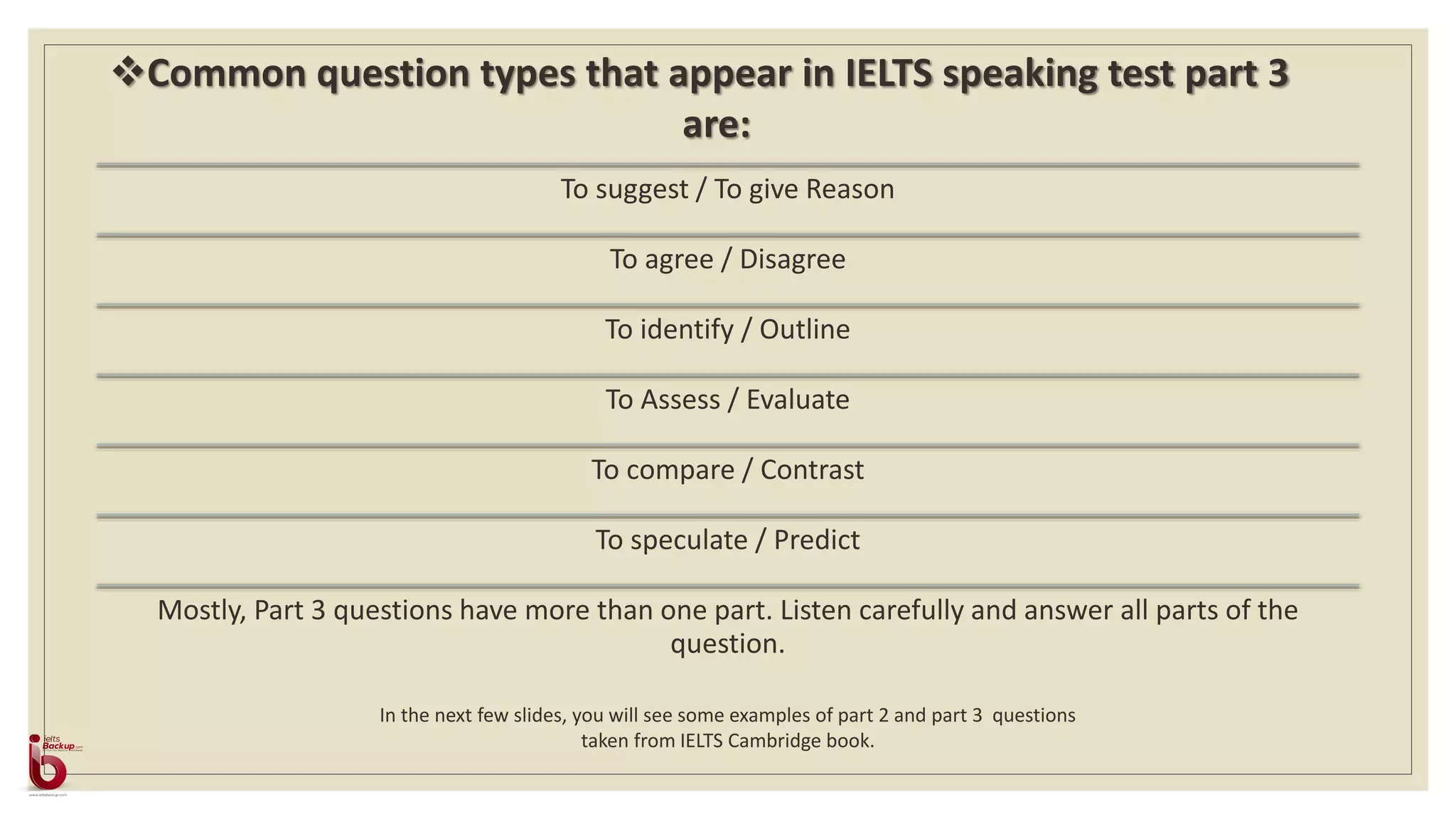
To suggest / To give Reason
To agree / Disagree
To identify / Outline
To Assess / Evaluate
To compare / Contrast
To speculate / Predict
Mostly, Part 3 questions have more than one part. Listen carefully and answer all parts of the
question.
Common question types that appear in IELTS speaking test part 3
are:
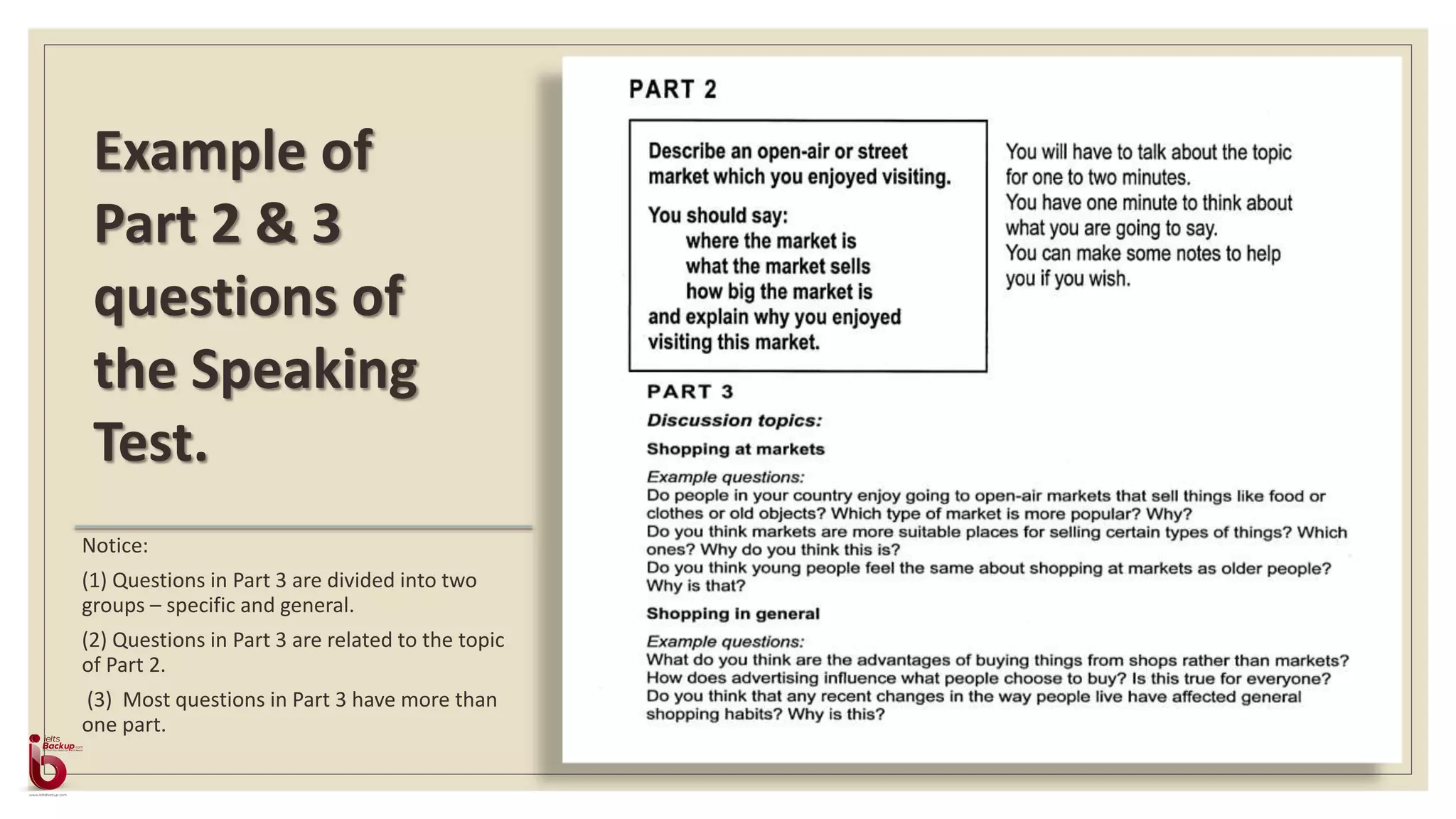
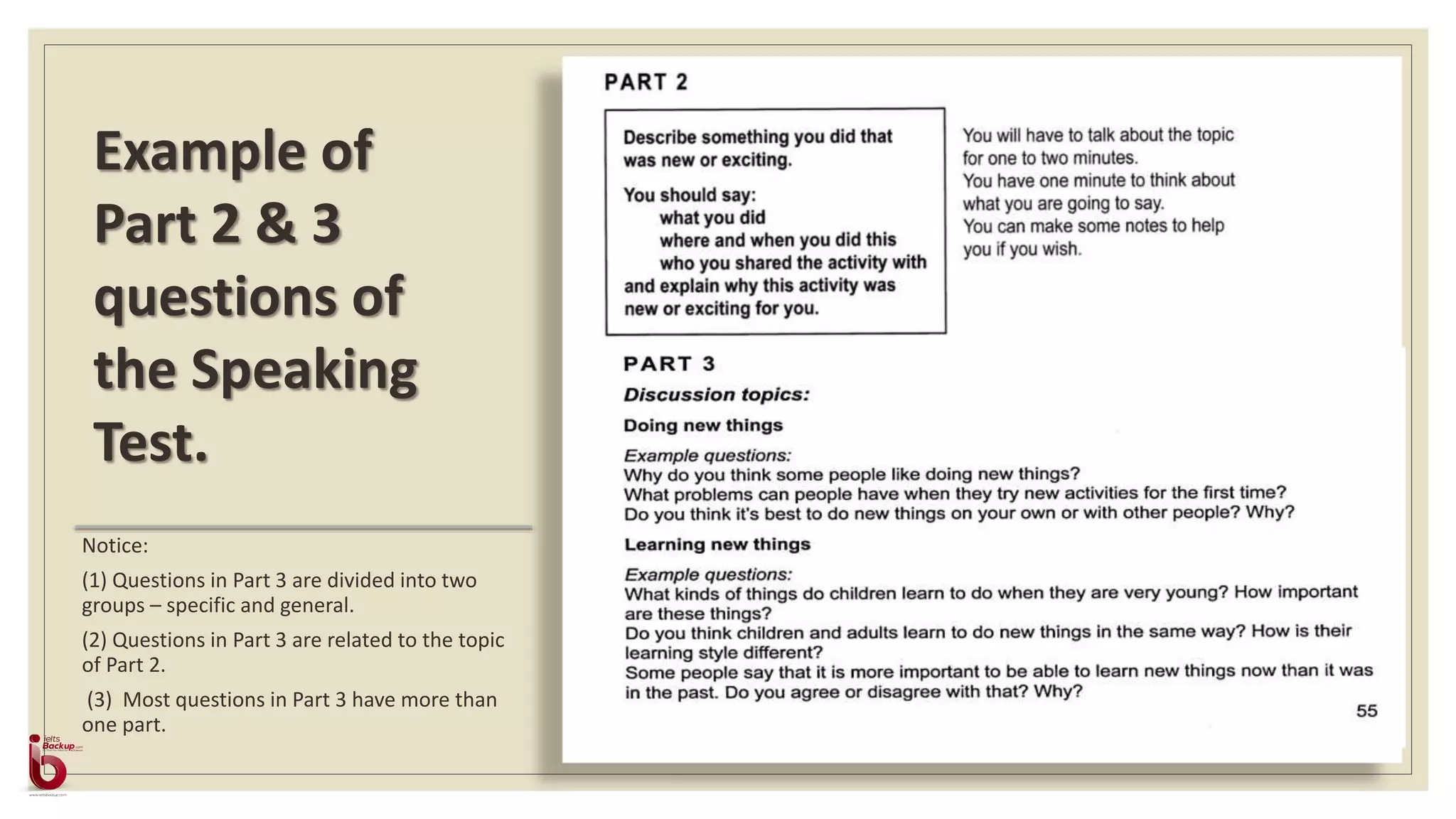
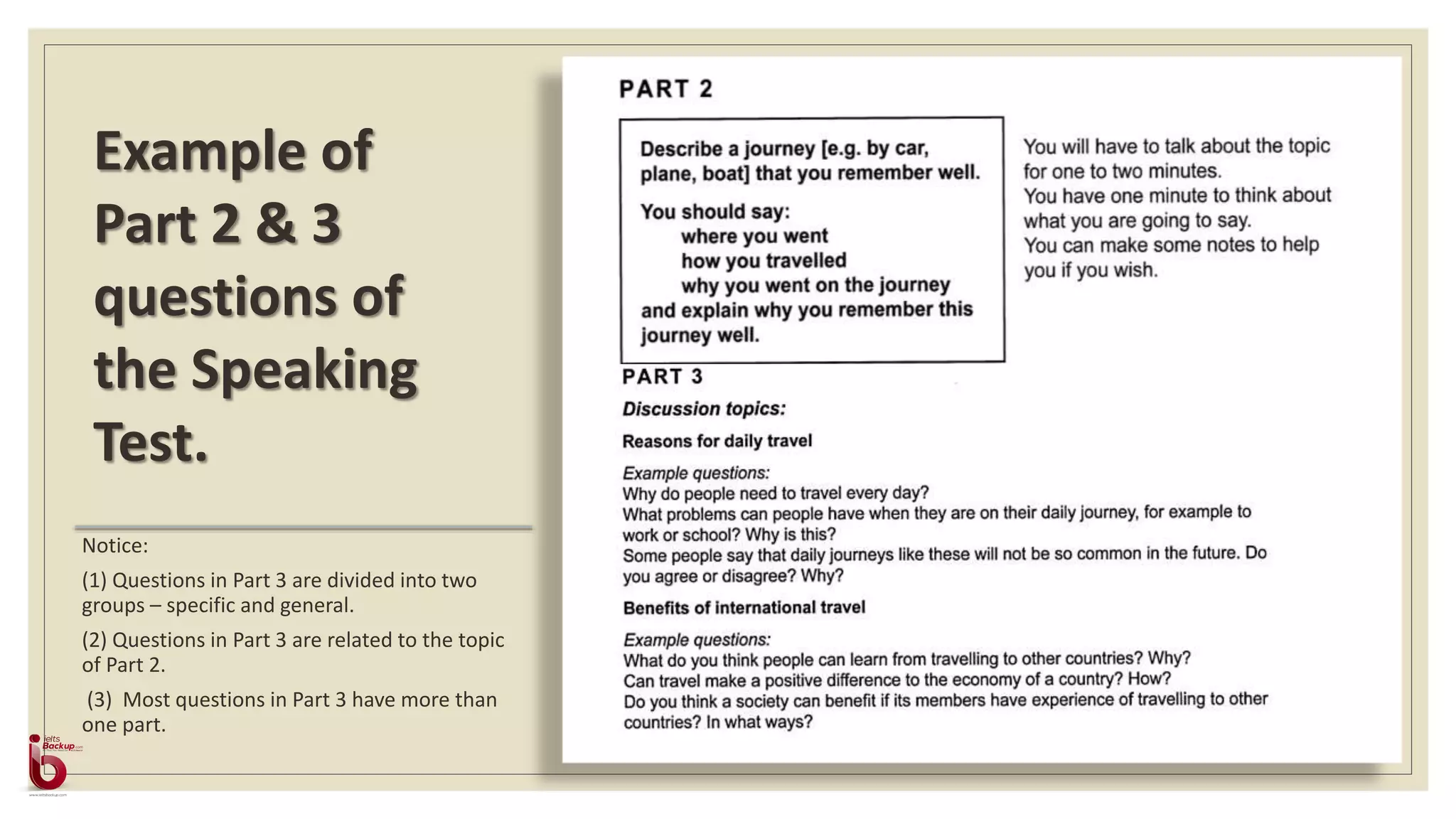
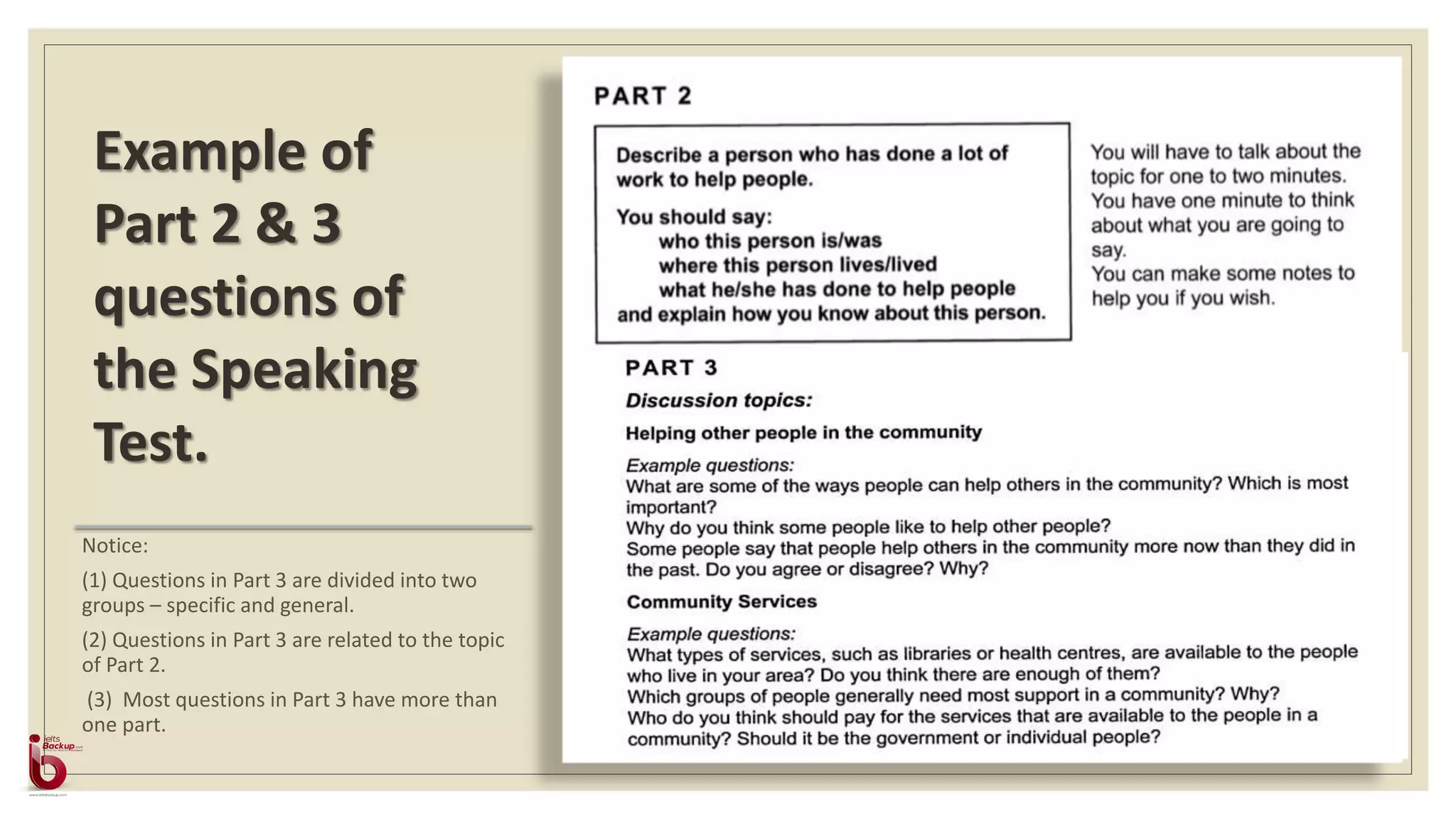
In the next few slides, you will see some examples of part 2 and part 3 questions
taken from IELTS Cambridge book.
Notice:
(1) Questions in Part 3 are divided into two
groups – specific and general.
(2) Questions in Part 3 are related to the topic
of Part 2.
(3) Most questions in Part 3 have more than
one part.
Example of
Part 2 & 3
questions of
the Speaking
Test.
Notice:
(1) Questions in Part 3 are divided into two
groups – specific and general.
(2) Questions in Part 3 are related to the topic
of Part 2.
(3) Most questions in Part 3 have more than
one part.
Example of
Part 2 & 3
questions of
the Speaking
Test.
Notice:
(1) Questions in Part 3 are divided into two
groups – specific and general.
(2) Questions in Part 3 are related to the topic
of Part 2.
(3) Most questions in Part 3 have more than
one part.
Example of
Part 2 & 3
questions of
the Speaking
Test.
Notice:
(1) Questions in Part 3 are divided into two
groups – specific and general.
(2) Questions in Part 3 are related to the topic
of Part 2.
(3) Most questions in Part 3 have more than
one part.
Example of
Part 2 & 3
questions of
the Speaking
Test.
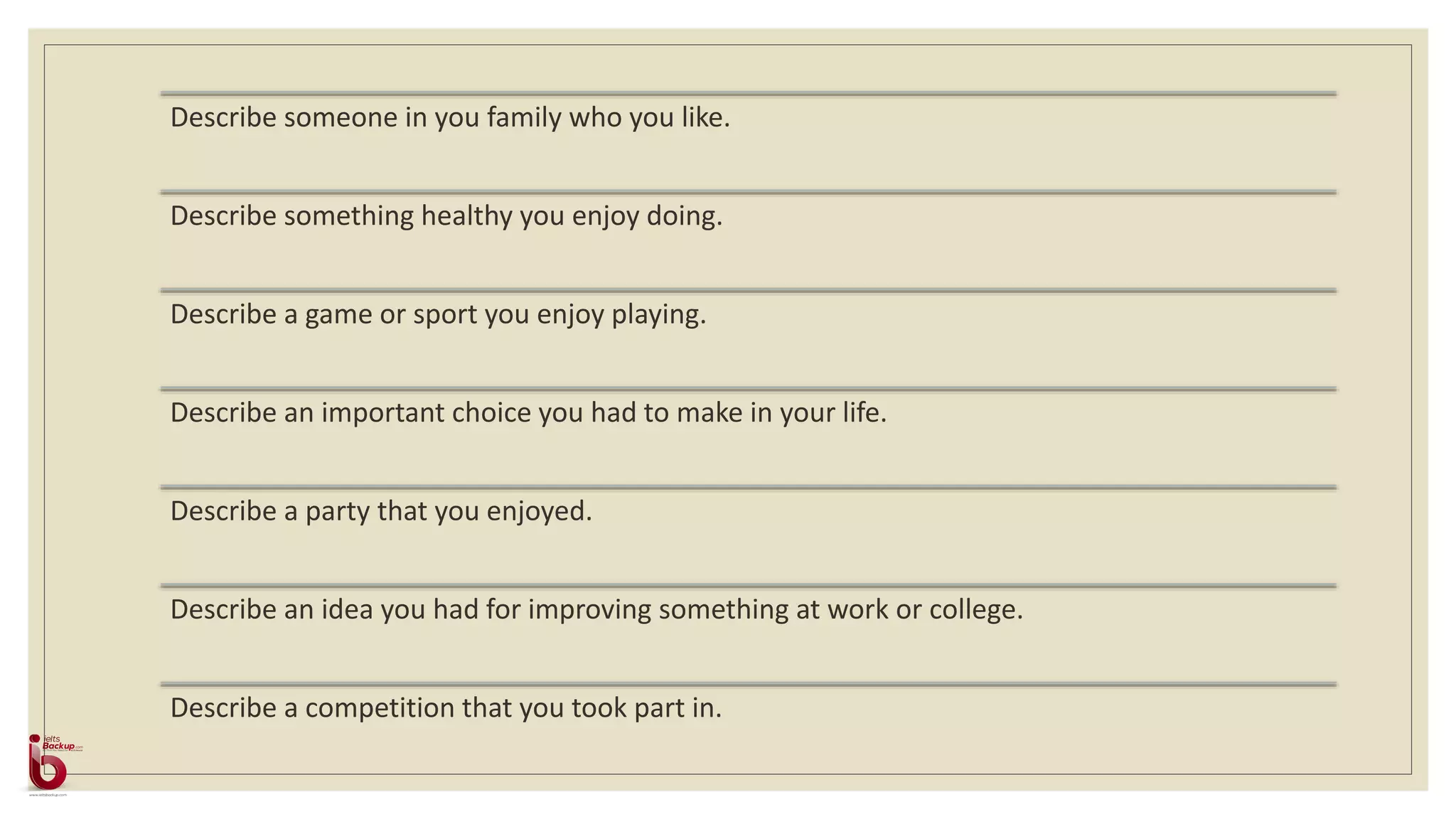
Describe someone in you family who you like.
Describe something healthy you enjoy doing.
Describe a game or sport you enjoy playing.
Describe an important choice you had to make in your life.
Describe a party that you enjoyed.
Describe an idea you had for improving something at work or college.
Describe a competition that you took part in.
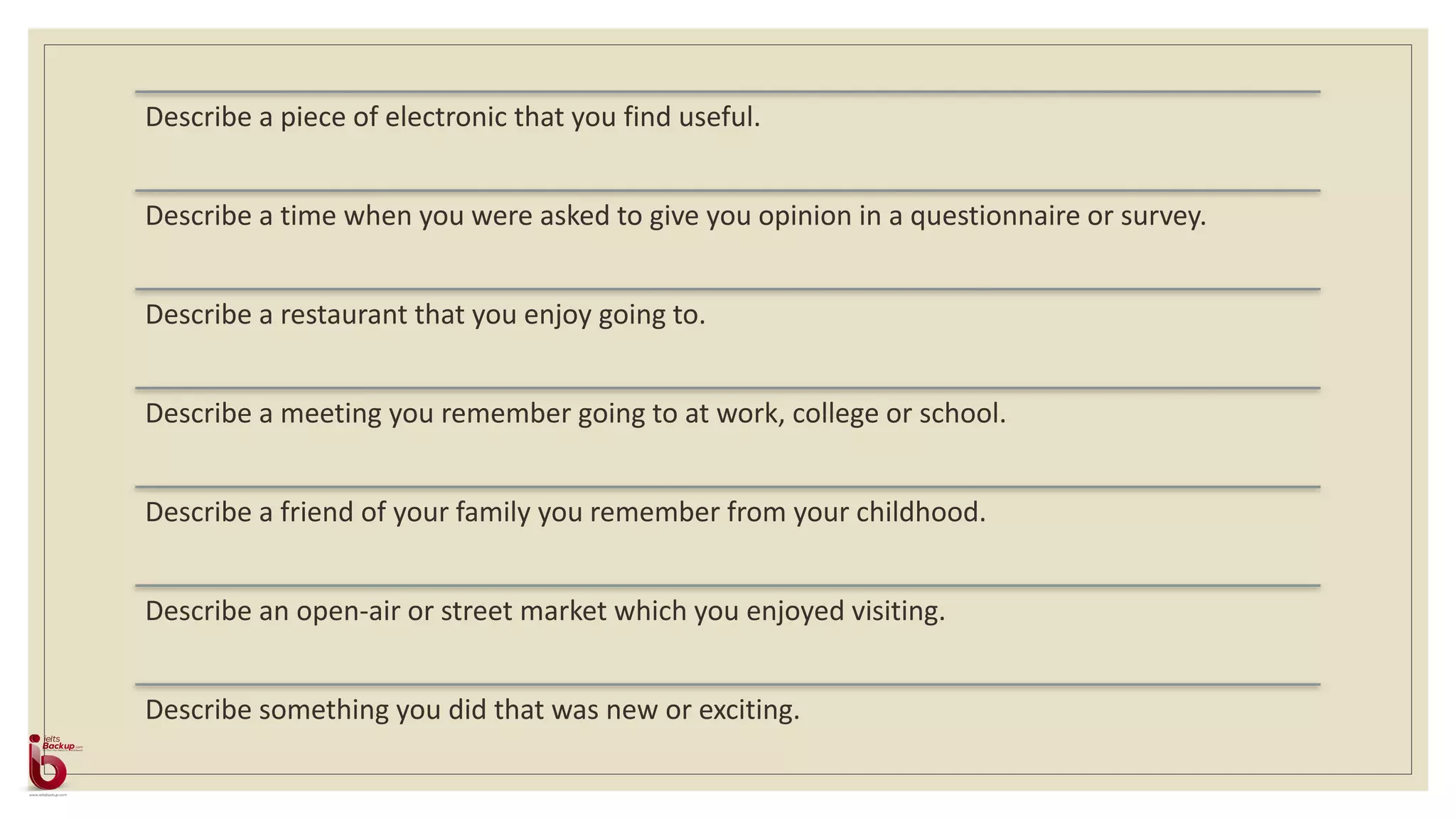
Describe a piece of electronic that you find useful.
Describe a time when you were asked to give you opinion in a questionnaire or survey.
Describe a restaurant that you enjoy going to.
Describe a meeting you remember going to at work, college or school.
Describe a friend of your family you remember from your childhood.
Describe an open-air or street market which you enjoyed visiting.
Describe something you did that was new or exciting.
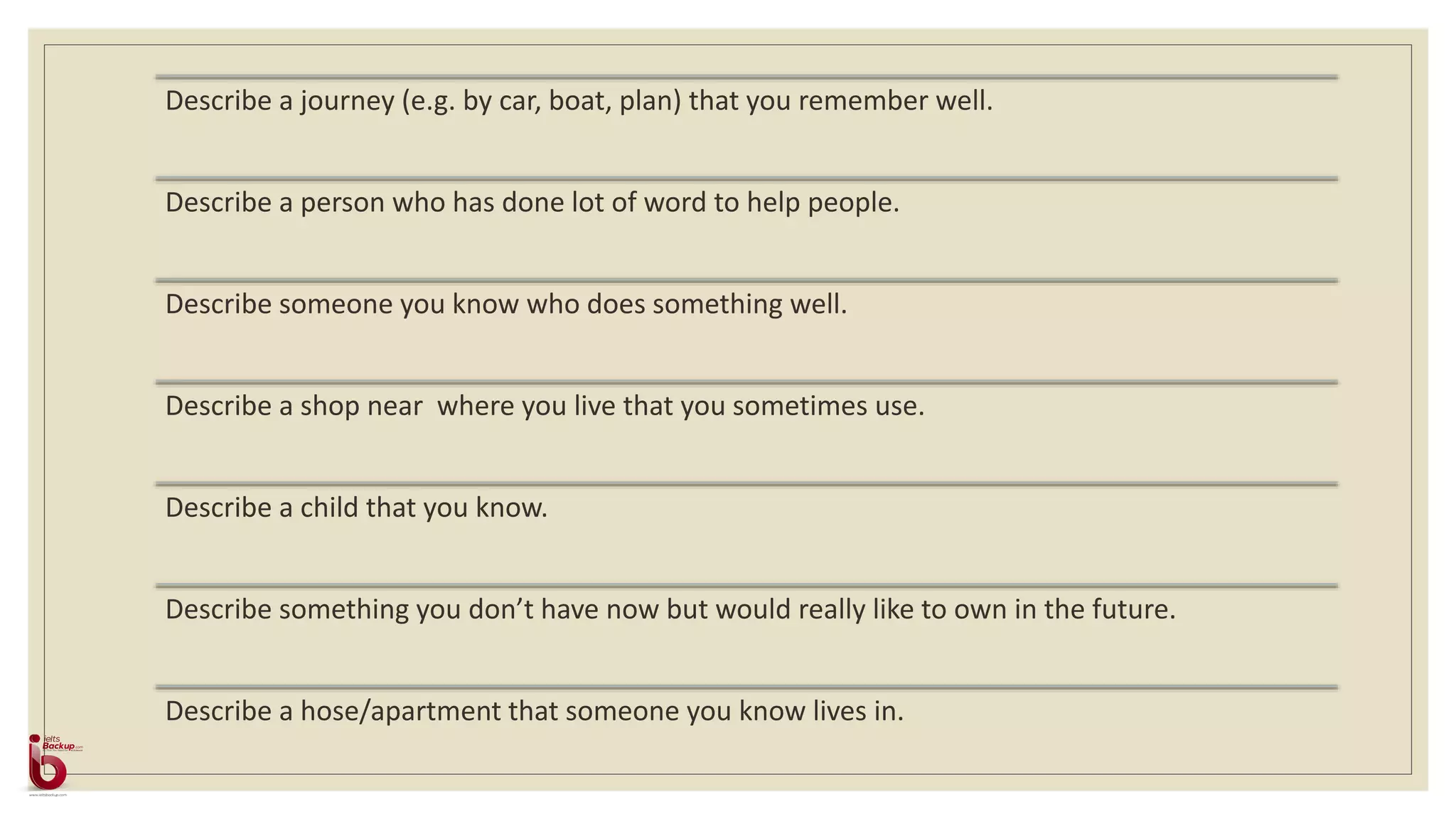
Describe a journey (e.g. by car, boat, plan) that you remember well.
Describe a person who has done lot of word to help people.
Describe someone you know who does something well.
Describe a shop near where you live that you sometimes use.
Describe a child that you know.
Describe something you don’t have now but would really like to own in the future.
Describe a hose/apartment that someone you know lives in.
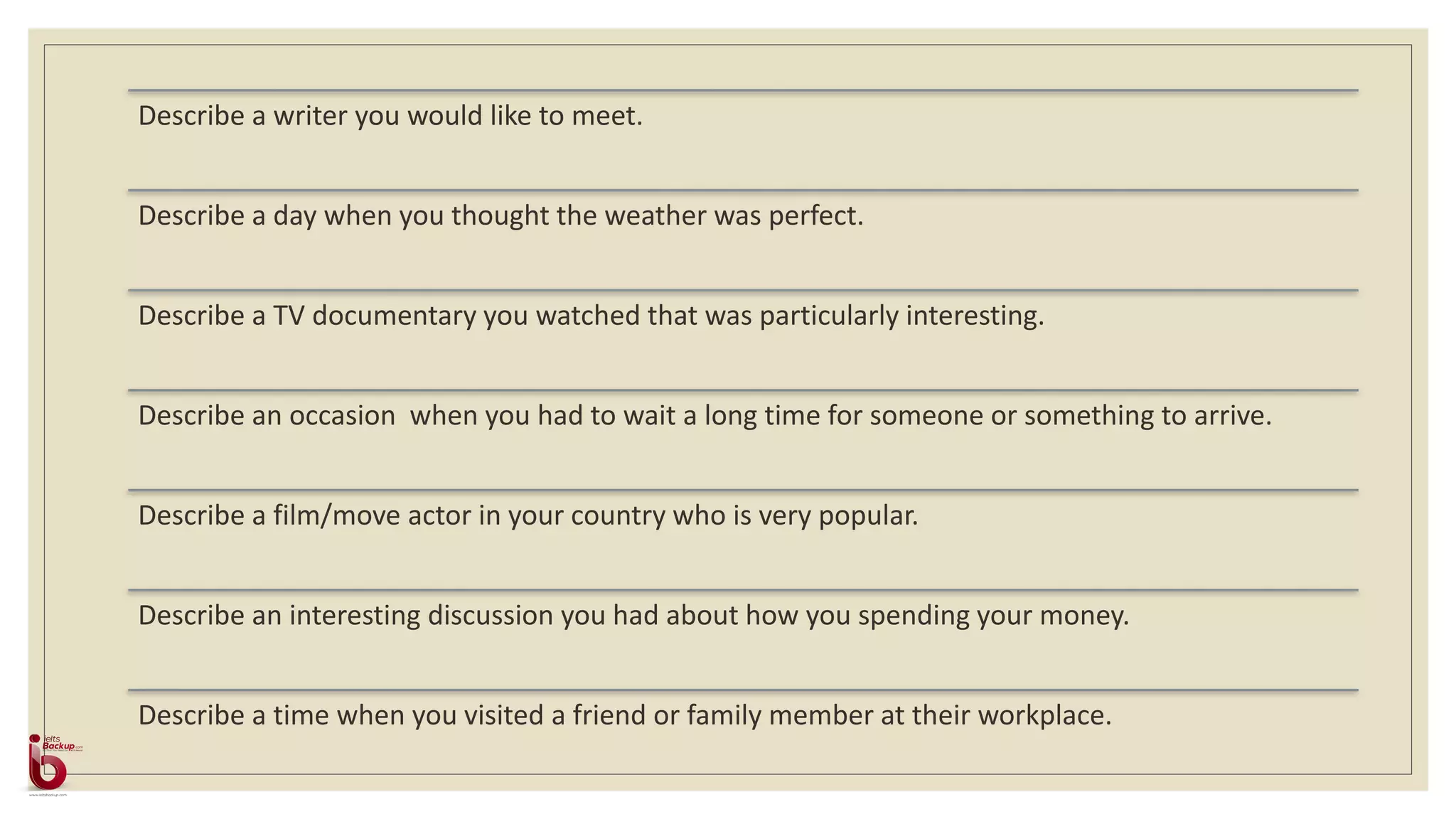
Describe a writer you would like to meet.
Describe a day when you thought the weather was perfect.
Describe a TV documentary you watched that was particularly interesting.
Describe an occasion when you had to wait a long time for someone or something to arrive.
Describe a film/move actor in your country who is very popular.
Describe an interesting discussion you had about how you spending your money.
Describe a time when you visited a friend or family member at their workplace.
Here are few useful tips to help you in Part
2 of IELTS Speaking Test.
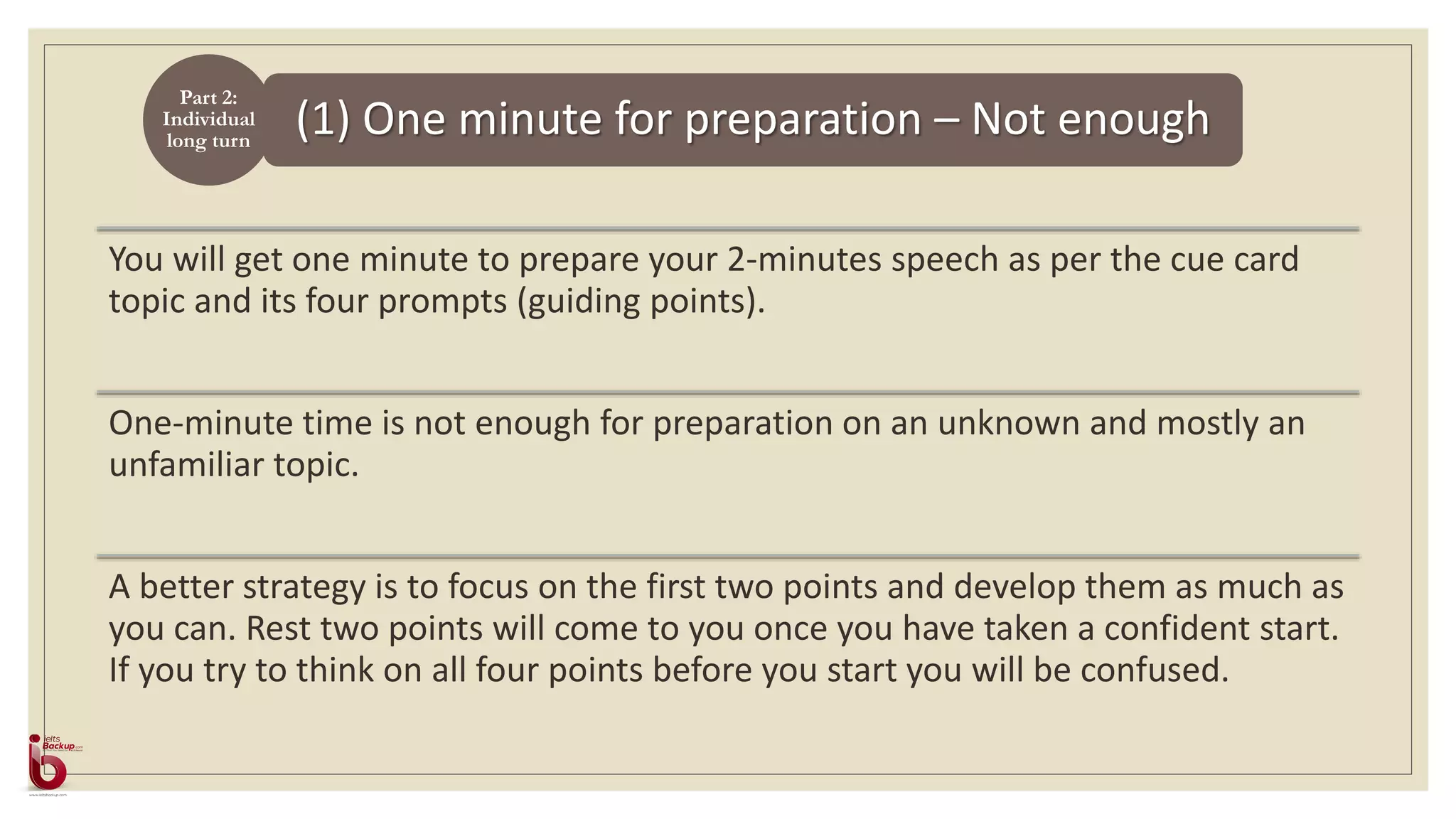
(1) One minute for preparation – Not enough
You will get one minute to prepare your 2-minutes speech as per the cue card
topic and its four prompts (guiding points).
One-minute time is not enough for preparation on an unknown and mostly an
unfamiliar topic.
A better strategy is to focus on the first two points and develop them as much as
you can. Rest two points will come to you once you have taken a confident start.
If you try to think on all four points before you start you will be confused.
Part 2:
Individual
long turn
(2) Speak as much as on the first 2-3 points.
Keep the last point in the reserve. Try to extend your answer
as much as you can for the first two or three points of your
cue card because if you finish first two or three points fast you
will find very hard to continue talking one single point for
remaining time.
Part 2:
Individual
long turn
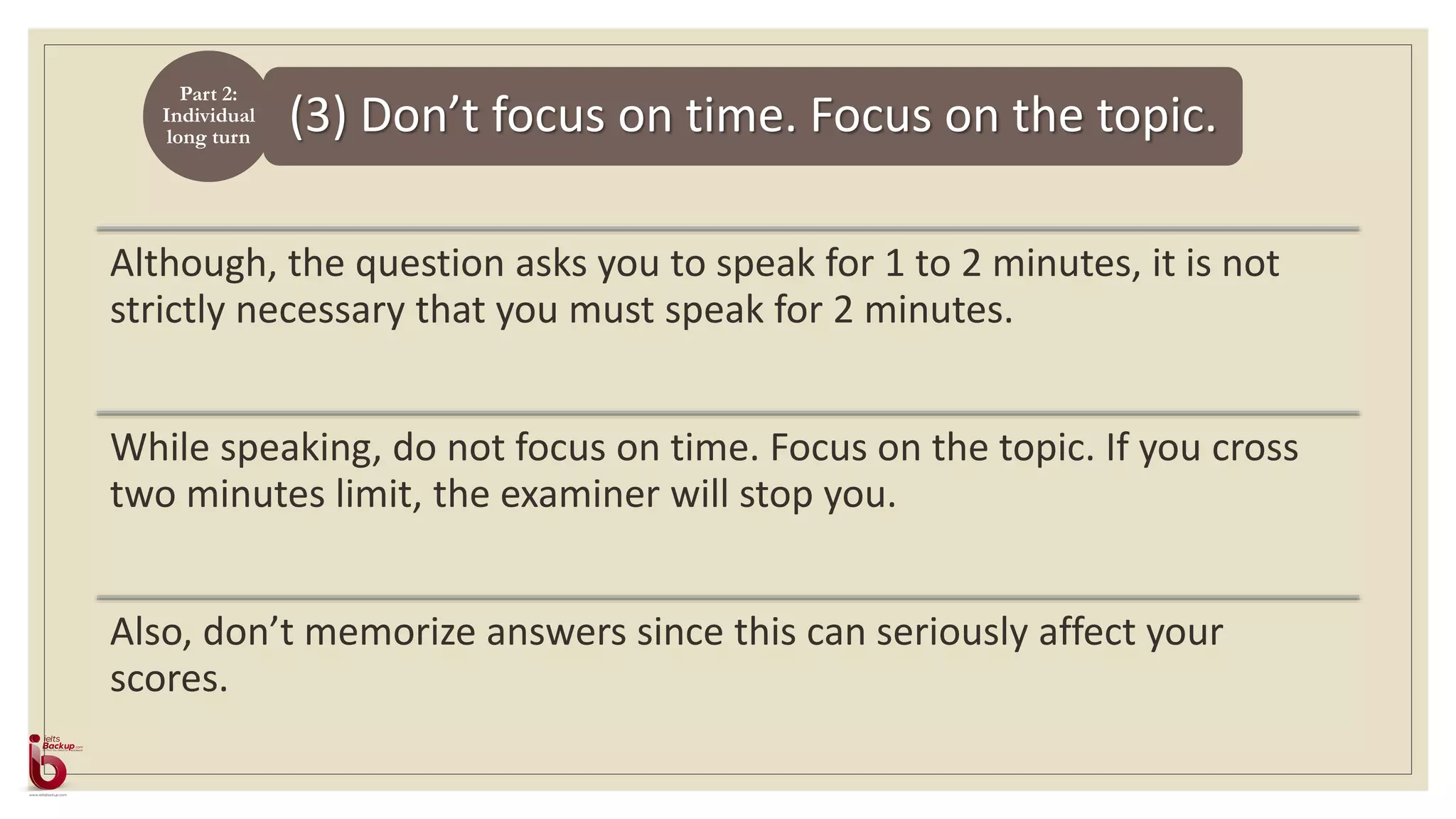
(3) Don’t focus on time. Focus on the topic.
Although, the question asks you to speak for 1 to 2 minutes, it is not
strictly necessary that you must speak for 2 minutes.
While speaking, do not focus on time. Focus on the topic. If you cross
two minutes limit, the examiner will stop you.
Also, don’t memorize answers since this can seriously affect your
scores.
Part 2:
Individual
long turn
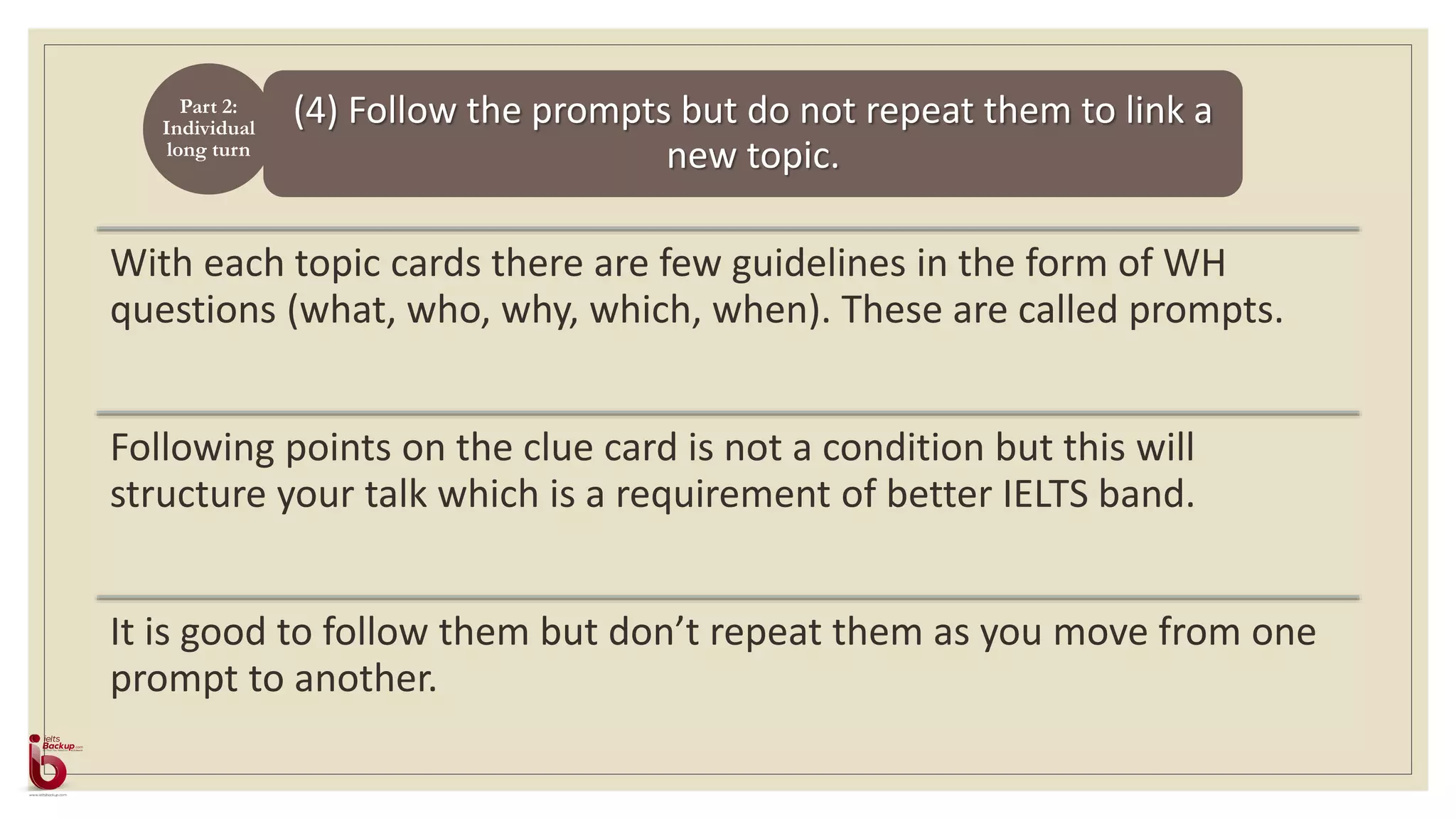
(4) Follow the prompts but do not repeat them to link a
new topic.
With each topic cards there are few guidelines in the form of WH
questions (what, who, why, which, when). These are called prompts.
Following points on the clue card is not a condition but this will
structure your talk which is a requirement of better IELTS band.
It is good to follow them but don’t repeat them as you move from one
prompt to another.
Part 2:
Individual
long turn
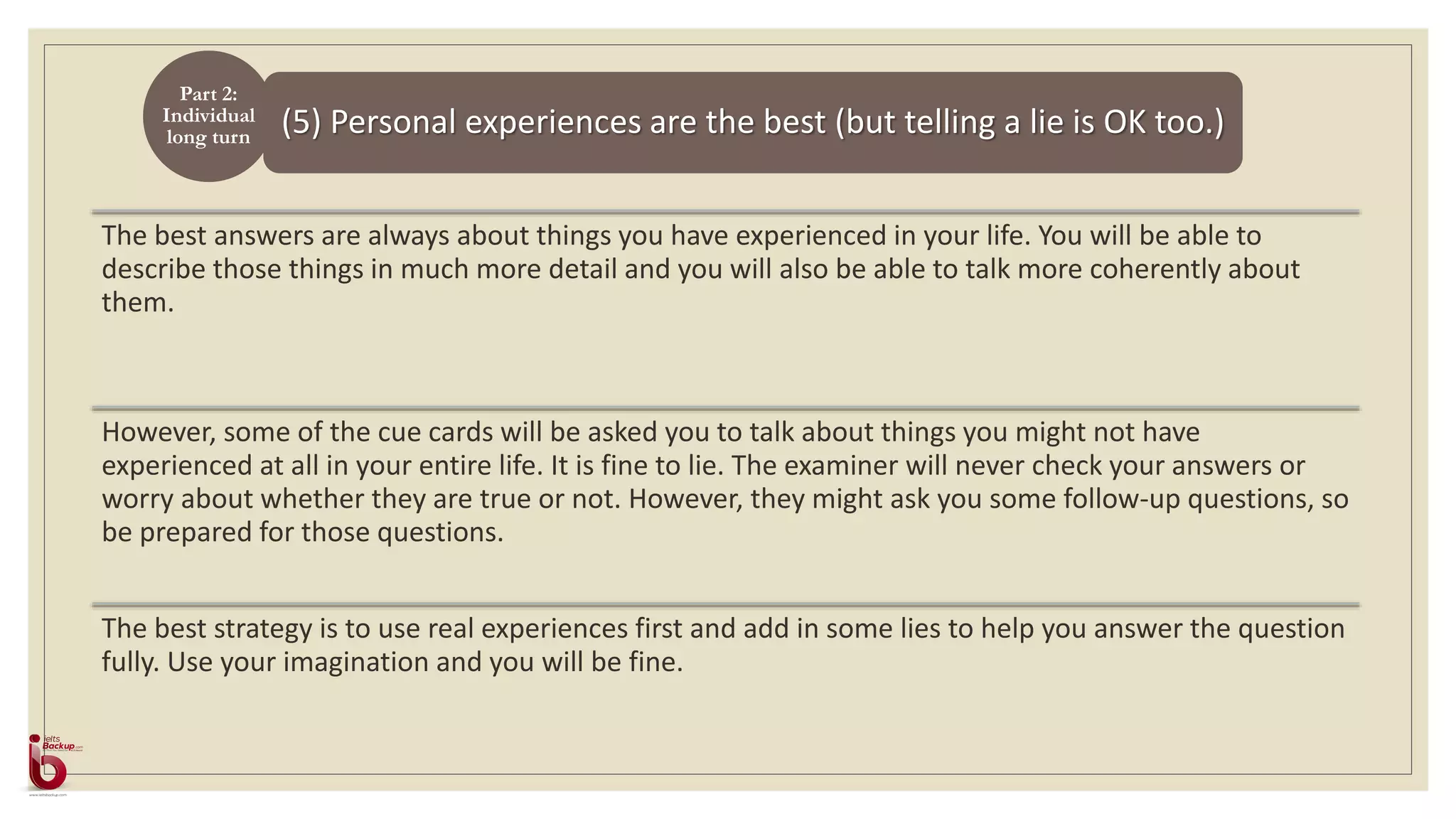
(5) Personal experiences are the best (but telling a lie is OK too.)
Part 2:
Individual
long turn
The best answers are always about things you have experienced in your life. You will be able to
describe those things in much more detail and you will also be able to talk more coherently about
them.
However, some of the cue cards will be asked you to talk about things you might not have
experienced at all in your entire life. It is fine to lie. The examiner will never check your answers or
worry about whether they are true or not. However, they might ask you some follow-up questions, so
be prepared for those questions.
The best strategy is to use real experiences first and add in some lies to help you answer the question
fully. Use your imagination and you will be fine.
Here are few useful tips to help you in Part
3 of IELTS Speaking Test.
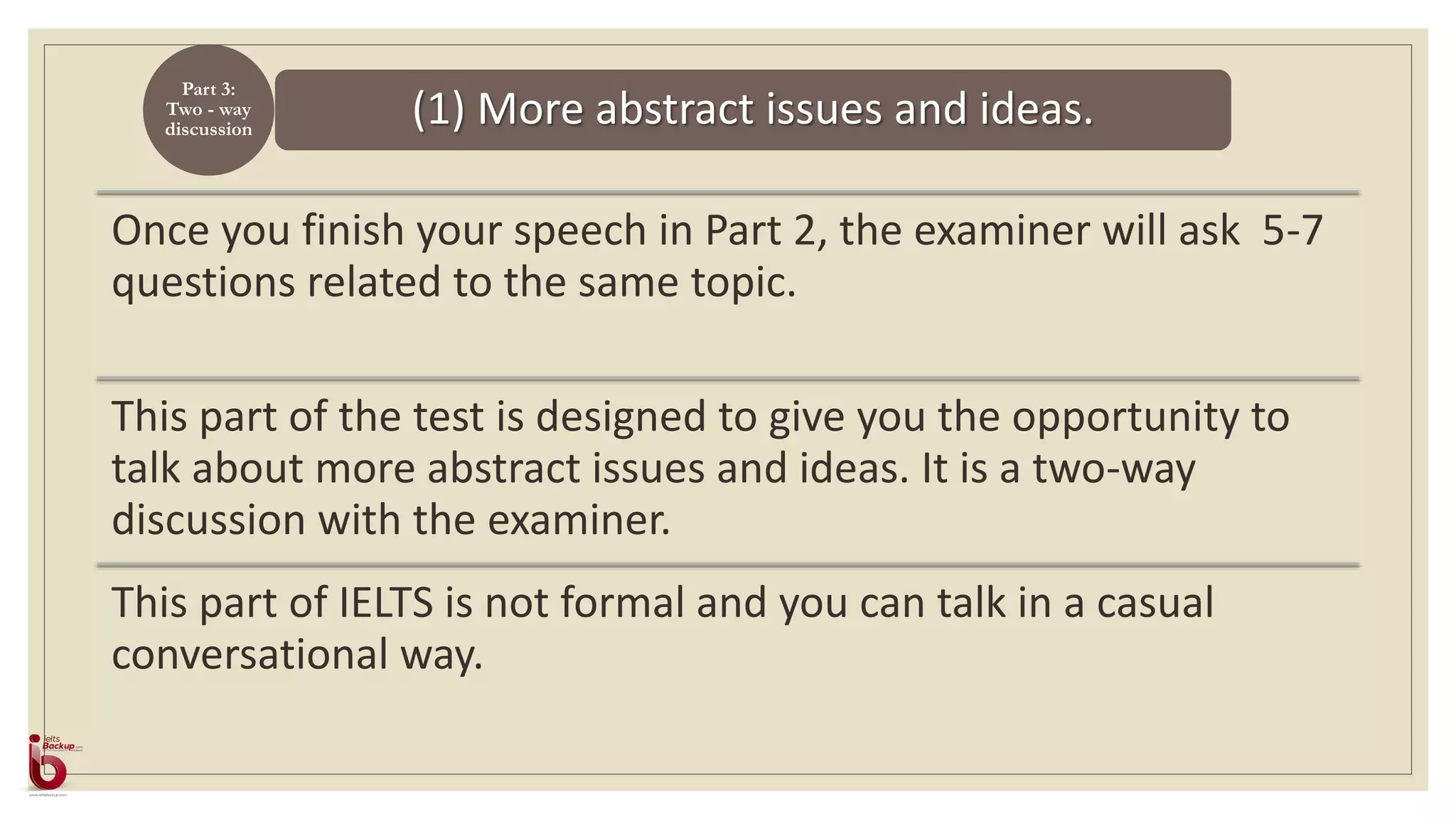
(1) More abstract issues and ideas.
Part 3:
Two - way
discussion
Once you finish your speech in Part 2, the examiner will ask 5-7
questions related to the same topic.
This part of the test is designed to give you the opportunity to
talk about more abstract issues and ideas. It is a two-way
discussion with the examiner.
This part of IELTS is not formal and you can talk in a casual
conversational way.
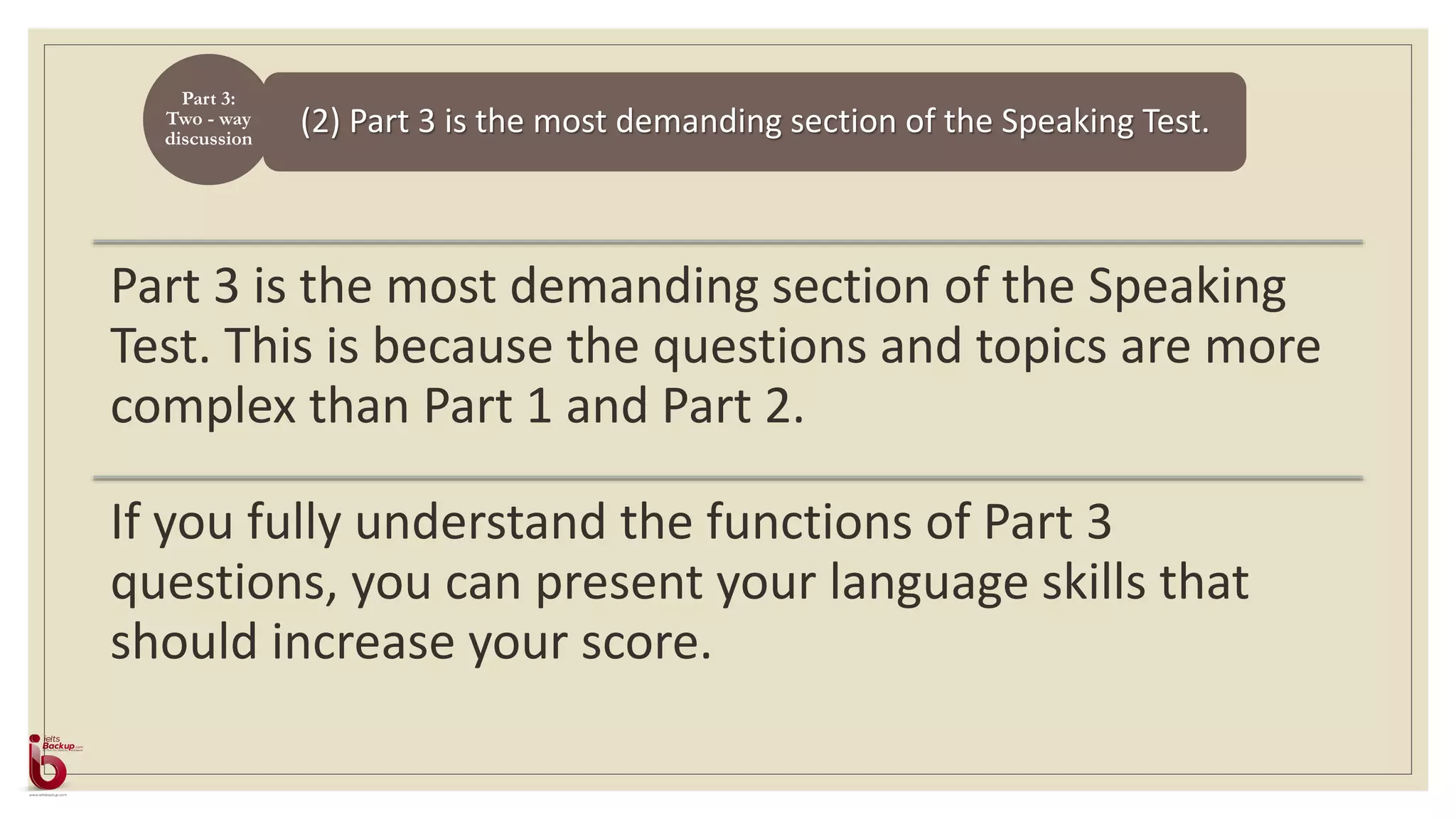
(2) Part 3 is the most demanding section of the Speaking Test.
Part 3:
Two - way
discussion
Part 3 is the most demanding section of the Speaking
Test. This is because the questions and topics are more
complex than Part 1 and Part 2.
If you fully understand the functions of Part 3
questions, you can present your language skills that
should increase your score.
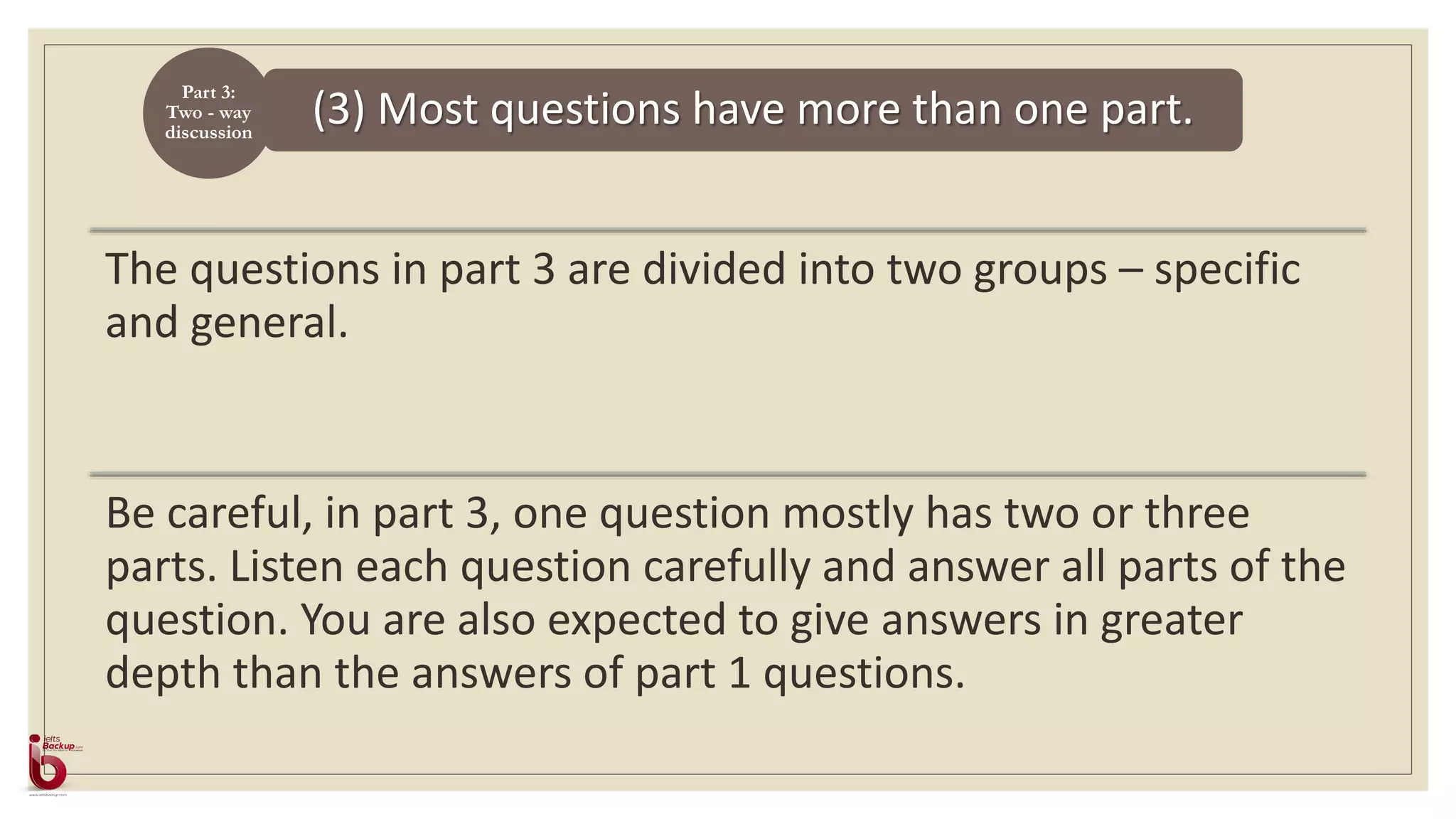
(3) Most questions have more than one part.
Part 3:
Two - way
discussion
The questions in part 3 are divided into two groups – specific
and general.
Be careful, in part 3, one question mostly has two or three
parts. Listen each question carefully and answer all parts of the
question. You are also expected to give answers in greater
depth than the answers of part 1 questions.
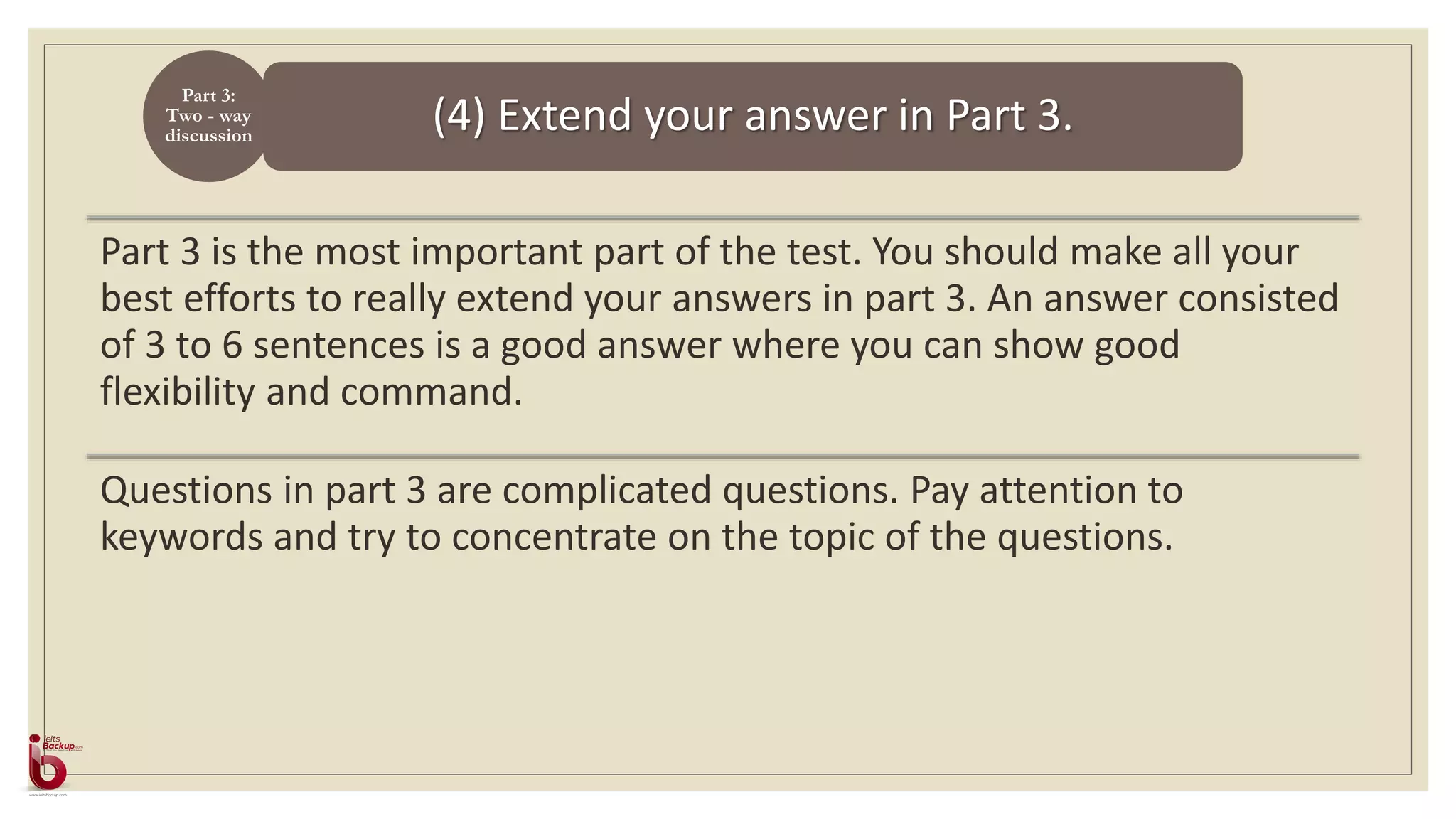
(4) Extend your answer in Part 3.
Part 3:
Two - way
discussion
Part 3 is the most important part of the test. You should make all your
best efforts to really extend your answers in part 3. An answer consisted
of 3 to 6 sentences is a good answer where you can show good
flexibility and command.
Questions in part 3 are complicated questions. Pay attention to
keywords and try to concentrate on the topic of the questions.
(5) You can ask for further clarification.
Part 3:
Two -way
discussion
In part 3, you can ask for further clarification if you find
a question that you have absolutely no idea. The
examiner in this part of the test has the flexibility to
explain you little further. But do not use this option
very often.
This is the end of this presentation.
for watching
For a complete IELTS training course and
practice.
Visit: www.ieltsbackup.com
Send us your feedback and suggestions on
info@ieltsbackup.com
Hi,
I have developed a systematic approach for all question types frequently
appearing in IELTS. Students who tired them in their IELTS exams have
received amazing results.
(Zafar Yar Khan)
Author and Publisher
If you need help in achieving your goals in IELTS,
write to me at info@ieltsbackup.com or visit
www.ieltsbackup.com
and click on “IELTS Tuition”.
I will contact you as soon as I can.

IELTS Speaking - Part 2 - 3 - Explanation - Useful Tips.

  • 2.
    4th presentation -IELTSSpeaking PART 2 & 3 IELTS SPEAKING TEST EXPLANATION & USEFUL TIPS.
  • 3.
    Part 2. In the secondpart of the test, the IELTS examiner will give you a topic card. On the card, there will be a short description of a topic, with some ideas for what to include. (Mostly these points are questions starting with WHO, WHAT, WHERE, HOW and WHY) You will be given one minute to prepare. You will then be asked to talk for 1-2 minutes on the topic. You will not be interrupted during this time. After 2 minutes the examiner will interrupt and ask you one or two extra questions about the topic. Then, you move to IELTS Speaking Part 3. You can not choose the topic and you also can not ask to change it.
  • 4.
    Part 3. Two-way discussion In thispart, the examiner will ask you further questions related to the same topic. These questions are designed to check your ability to discuss more abstract issues and ideas. They are around 6 questions divided into two groups; one or two specific to the topic of Part 2 and other covering a wider aspect of the same topic.
  • 5.
     Firstly, listento the questions carefully. Most of the questions in part 3 are a group of two to three questions. You must make sure to answer all of them.  Secondly, use transition words to answer the second or third part of the question, so, it gets clear to the examiner that you have replied to all parts of the question. Use transition words to answer the second or third part of the question.
  • 6.
    To suggest /To give Reason To agree / Disagree To identify / Outline To Assess / Evaluate To compare / Contrast To speculate / Predict Mostly, Part 3 questions have more than one part. Listen carefully and answer all parts of the question. Common question types that appear in IELTS speaking test part 3 are: In the next few slides, you will see some examples of part 2 and part 3 questions taken from IELTS Cambridge book.
  • 7.
    Notice: (1) Questions inPart 3 are divided into two groups – specific and general. (2) Questions in Part 3 are related to the topic of Part 2. (3) Most questions in Part 3 have more than one part. Example of Part 2 & 3 questions of the Speaking Test.
  • 8.
    Notice: (1) Questions inPart 3 are divided into two groups – specific and general. (2) Questions in Part 3 are related to the topic of Part 2. (3) Most questions in Part 3 have more than one part. Example of Part 2 & 3 questions of the Speaking Test.
  • 9.
    Notice: (1) Questions inPart 3 are divided into two groups – specific and general. (2) Questions in Part 3 are related to the topic of Part 2. (3) Most questions in Part 3 have more than one part. Example of Part 2 & 3 questions of the Speaking Test.
  • 10.
    Notice: (1) Questions inPart 3 are divided into two groups – specific and general. (2) Questions in Part 3 are related to the topic of Part 2. (3) Most questions in Part 3 have more than one part. Example of Part 2 & 3 questions of the Speaking Test.
  • 12.
    Describe someone inyou family who you like. Describe something healthy you enjoy doing. Describe a game or sport you enjoy playing. Describe an important choice you had to make in your life. Describe a party that you enjoyed. Describe an idea you had for improving something at work or college. Describe a competition that you took part in.
  • 13.
    Describe a pieceof electronic that you find useful. Describe a time when you were asked to give you opinion in a questionnaire or survey. Describe a restaurant that you enjoy going to. Describe a meeting you remember going to at work, college or school. Describe a friend of your family you remember from your childhood. Describe an open-air or street market which you enjoyed visiting. Describe something you did that was new or exciting.
  • 14.
    Describe a journey(e.g. by car, boat, plan) that you remember well. Describe a person who has done lot of word to help people. Describe someone you know who does something well. Describe a shop near where you live that you sometimes use. Describe a child that you know. Describe something you don’t have now but would really like to own in the future. Describe a hose/apartment that someone you know lives in.
  • 15.
    Describe a writeryou would like to meet. Describe a day when you thought the weather was perfect. Describe a TV documentary you watched that was particularly interesting. Describe an occasion when you had to wait a long time for someone or something to arrive. Describe a film/move actor in your country who is very popular. Describe an interesting discussion you had about how you spending your money. Describe a time when you visited a friend or family member at their workplace.
  • 16.
    Here are fewuseful tips to help you in Part 2 of IELTS Speaking Test.
  • 17.
    (1) One minutefor preparation – Not enough You will get one minute to prepare your 2-minutes speech as per the cue card topic and its four prompts (guiding points). One-minute time is not enough for preparation on an unknown and mostly an unfamiliar topic. A better strategy is to focus on the first two points and develop them as much as you can. Rest two points will come to you once you have taken a confident start. If you try to think on all four points before you start you will be confused. Part 2: Individual long turn
  • 18.
    (2) Speak asmuch as on the first 2-3 points. Keep the last point in the reserve. Try to extend your answer as much as you can for the first two or three points of your cue card because if you finish first two or three points fast you will find very hard to continue talking one single point for remaining time. Part 2: Individual long turn
  • 19.
    (3) Don’t focuson time. Focus on the topic. Although, the question asks you to speak for 1 to 2 minutes, it is not strictly necessary that you must speak for 2 minutes. While speaking, do not focus on time. Focus on the topic. If you cross two minutes limit, the examiner will stop you. Also, don’t memorize answers since this can seriously affect your scores. Part 2: Individual long turn
  • 20.
    (4) Follow theprompts but do not repeat them to link a new topic. With each topic cards there are few guidelines in the form of WH questions (what, who, why, which, when). These are called prompts. Following points on the clue card is not a condition but this will structure your talk which is a requirement of better IELTS band. It is good to follow them but don’t repeat them as you move from one prompt to another. Part 2: Individual long turn
  • 21.
    (5) Personal experiencesare the best (but telling a lie is OK too.) Part 2: Individual long turn The best answers are always about things you have experienced in your life. You will be able to describe those things in much more detail and you will also be able to talk more coherently about them. However, some of the cue cards will be asked you to talk about things you might not have experienced at all in your entire life. It is fine to lie. The examiner will never check your answers or worry about whether they are true or not. However, they might ask you some follow-up questions, so be prepared for those questions. The best strategy is to use real experiences first and add in some lies to help you answer the question fully. Use your imagination and you will be fine.
  • 22.
    Here are fewuseful tips to help you in Part 3 of IELTS Speaking Test.
  • 23.
    (1) More abstractissues and ideas. Part 3: Two - way discussion Once you finish your speech in Part 2, the examiner will ask 5-7 questions related to the same topic. This part of the test is designed to give you the opportunity to talk about more abstract issues and ideas. It is a two-way discussion with the examiner. This part of IELTS is not formal and you can talk in a casual conversational way.
  • 24.
    (2) Part 3is the most demanding section of the Speaking Test. Part 3: Two - way discussion Part 3 is the most demanding section of the Speaking Test. This is because the questions and topics are more complex than Part 1 and Part 2. If you fully understand the functions of Part 3 questions, you can present your language skills that should increase your score.
  • 25.
    (3) Most questionshave more than one part. Part 3: Two - way discussion The questions in part 3 are divided into two groups – specific and general. Be careful, in part 3, one question mostly has two or three parts. Listen each question carefully and answer all parts of the question. You are also expected to give answers in greater depth than the answers of part 1 questions.
  • 26.
    (4) Extend youranswer in Part 3. Part 3: Two - way discussion Part 3 is the most important part of the test. You should make all your best efforts to really extend your answers in part 3. An answer consisted of 3 to 6 sentences is a good answer where you can show good flexibility and command. Questions in part 3 are complicated questions. Pay attention to keywords and try to concentrate on the topic of the questions.
  • 27.
    (5) You canask for further clarification. Part 3: Two -way discussion In part 3, you can ask for further clarification if you find a question that you have absolutely no idea. The examiner in this part of the test has the flexibility to explain you little further. But do not use this option very often.
  • 28.
    This is theend of this presentation. for watching For a complete IELTS training course and practice. Visit: www.ieltsbackup.com Send us your feedback and suggestions on info@ieltsbackup.com
  • 29.
    Hi, I have developeda systematic approach for all question types frequently appearing in IELTS. Students who tired them in their IELTS exams have received amazing results. (Zafar Yar Khan) Author and Publisher If you need help in achieving your goals in IELTS, write to me at info@ieltsbackup.com or visit www.ieltsbackup.com and click on “IELTS Tuition”. I will contact you as soon as I can.

Editor's Notes

  • #29 © Copyright Showeet.com – Free PowerPoint Templates