Soil and Water Conservation
Practices
6/8/2015 1
Muhajir Utomo,
University of Lampung
2013
6/8/2015 2
Soil and Water Conservation:
Why we need this?
 Soil erosion exceeds
tolerance level due
to unsustainable management
Forest
Cropping Wood and
grazing
Construction
Urban
Meansedimentconcentration
Year, land use change
Sediment and Land Use Change
Strategy for Soil and Water
Conservation Practices
6/8/2015 4
Aim of Strategy:
 To reduce erosion to a level at which
the maximum sustainable of production
can be obtained
 Tolerance level: rate of soil forming (world basis)
0.01-7.7 (average 0.1) mm/yr
 Tolerance level (equal to rate of soil forming):
0.3-2 ton/ha/yr with average 1 ton/ha/yr
or 0.1 mm/yr
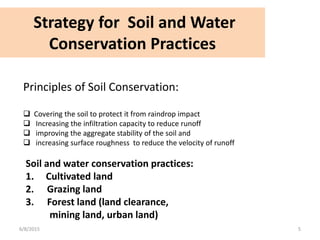
Strategy for Soil and Water
Conservation Practices
6/8/2015 5
Principles of Soil Conservation:
 Covering the soil to protect it from raindrop impact
 Increasing the infiltration capacity to reduce runoff
 improving the aggregate stability of the soil and
 increasing surface roughness to reduce the velocity of runoff
Soil and water conservation practices:
1. Cultivated land
2. Grazing land
3. Forest land (land clearance,
mining land, urban land)
Approaches to Soil Conservation
6/8/2015 6
Cultivated Land:
o A risk of erosion exists due to trees, bushes
and grasses are removed
o Erosion is exacerbated by
mismanagement practiced such
as tillage, cultivating up-and –down, etc.
o Conservation strategy: establishing and
maintaining good ground cover and
reducing tillage frequency.
Approaches to Soil Conservation
6/8/2015 7
Grazing Land:
o Erosion problems arise when vegetative cover is
removed through overgrazing
o Erosion problems also arise by soil compaction
due to traffic of cattle
o Conservation strategy: establishing
and maintaining suitable stocking rates
and planting erosion resistance grass and shrubs
Approaches to Soil Conservation
6/8/2015 8
Forest Land:
o Forest provide excellent protection of
the soil against erosion
o Increase erosion occur when the land
change to agriculture, illegal logging,
land clearance, mining or grazing
o Conservation strategy: reforestation and
agro-forest
6/8/2015 9
Methods of Soil and Water
Conservation Practices
1. Vegetative Method
Crop rotation
Cover crops
(Green manure),
Mulching
Agro forestry
2. Mechanical Method
Conservation tillage
Contour bund
Terrace
3. Chemical Method
Soil conditioner
1. Agronomic Methods
Crop rotation
Cover crops
(Green manure)
Strip cropping
Multiple cropping
Mulching
Revegetation
Agro forestry
2. Soil Management
Conservation tillage
Soil stabilizer
3. Mechanical Method
Contour bund
Terrace
Waterways
(Arsyad, 2010)
(Morgan, 2006)
Vegetative Method/ Agronomic
Practices
o Soil completely covered with vegetation is
ideal condition to absorbed moisture and
resist erosion
o The reasons: (a) reduce direct impact of rain
on soil surface, (b) reduce speed of water
flowing, (c) increase soil organic matter favor
infiltration of water
o Examples:
Crop rotation
Cover crops
(Green manure)
Strip cropping
Multiple cropping
Mulching
Revegetation
Agro forestry
6/8/2015 10
6/8/2015 11
1. Crop Rotation
What it is?:
• A system in which different crops
are grown in recurrent succession
on a single piece of land
• Long-term effect of rotation is
significant: on 4o slope, erosion
from continuous corn was 44 t/ha
vs 6 t/ha from rotation.
• After 100 years, land under
continuous corn had only 44% as
much top soil as permanently
under grass, whereas land under
rotation had 70%
6/8/2015 12
Crop Rotation
How it works?
• Objective: to preserve productivity
and yield
• Rotate cereals (small grain, grass)-
legumes or legume-grass mixture
• Types of rotation depends on soil
type, economic condition and
cropping system/region
• Rotation crops covering land can
protect soil from rain drops
• Soil organic matter from crop
residue can enhance soil fertility

soil and water

  • 1.
    Soil and WaterConservation Practices 6/8/2015 1 Muhajir Utomo, University of Lampung 2013
  • 2.
    6/8/2015 2 Soil andWater Conservation: Why we need this?  Soil erosion exceeds tolerance level due to unsustainable management
  • 3.
  • 4.
    Strategy for Soiland Water Conservation Practices 6/8/2015 4 Aim of Strategy:  To reduce erosion to a level at which the maximum sustainable of production can be obtained  Tolerance level: rate of soil forming (world basis) 0.01-7.7 (average 0.1) mm/yr  Tolerance level (equal to rate of soil forming): 0.3-2 ton/ha/yr with average 1 ton/ha/yr or 0.1 mm/yr
  • 5.
    Strategy for Soiland Water Conservation Practices 6/8/2015 5 Principles of Soil Conservation:  Covering the soil to protect it from raindrop impact  Increasing the infiltration capacity to reduce runoff  improving the aggregate stability of the soil and  increasing surface roughness to reduce the velocity of runoff Soil and water conservation practices: 1. Cultivated land 2. Grazing land 3. Forest land (land clearance, mining land, urban land)
  • 6.
    Approaches to SoilConservation 6/8/2015 6 Cultivated Land: o A risk of erosion exists due to trees, bushes and grasses are removed o Erosion is exacerbated by mismanagement practiced such as tillage, cultivating up-and –down, etc. o Conservation strategy: establishing and maintaining good ground cover and reducing tillage frequency.
  • 7.
    Approaches to SoilConservation 6/8/2015 7 Grazing Land: o Erosion problems arise when vegetative cover is removed through overgrazing o Erosion problems also arise by soil compaction due to traffic of cattle o Conservation strategy: establishing and maintaining suitable stocking rates and planting erosion resistance grass and shrubs
  • 8.
    Approaches to SoilConservation 6/8/2015 8 Forest Land: o Forest provide excellent protection of the soil against erosion o Increase erosion occur when the land change to agriculture, illegal logging, land clearance, mining or grazing o Conservation strategy: reforestation and agro-forest
  • 9.
    6/8/2015 9 Methods ofSoil and Water Conservation Practices 1. Vegetative Method Crop rotation Cover crops (Green manure), Mulching Agro forestry 2. Mechanical Method Conservation tillage Contour bund Terrace 3. Chemical Method Soil conditioner 1. Agronomic Methods Crop rotation Cover crops (Green manure) Strip cropping Multiple cropping Mulching Revegetation Agro forestry 2. Soil Management Conservation tillage Soil stabilizer 3. Mechanical Method Contour bund Terrace Waterways (Arsyad, 2010) (Morgan, 2006)
  • 10.
    Vegetative Method/ Agronomic Practices oSoil completely covered with vegetation is ideal condition to absorbed moisture and resist erosion o The reasons: (a) reduce direct impact of rain on soil surface, (b) reduce speed of water flowing, (c) increase soil organic matter favor infiltration of water o Examples: Crop rotation Cover crops (Green manure) Strip cropping Multiple cropping Mulching Revegetation Agro forestry 6/8/2015 10
  • 11.
    6/8/2015 11 1. CropRotation What it is?: • A system in which different crops are grown in recurrent succession on a single piece of land • Long-term effect of rotation is significant: on 4o slope, erosion from continuous corn was 44 t/ha vs 6 t/ha from rotation. • After 100 years, land under continuous corn had only 44% as much top soil as permanently under grass, whereas land under rotation had 70%
  • 12.
    6/8/2015 12 Crop Rotation Howit works? • Objective: to preserve productivity and yield • Rotate cereals (small grain, grass)- legumes or legume-grass mixture • Types of rotation depends on soil type, economic condition and cropping system/region • Rotation crops covering land can protect soil from rain drops • Soil organic matter from crop residue can enhance soil fertility