Soil Conservation
Rysul Hasan Hredoy
ID - 18531041
Department of Environmental Science
Bangladesh University of Professionals
1. Abstract
Soil conservation practices suggest that inappropriate solutions are commonly applied, often achieving only a
partial solution to the identified “problem” and/or unforeseen detrimental impacts. Studies show that the
implementation of soil conservation measures depends on a multitude of factors but it is also clear that rapid
change in agricultural systems only happens when a clear economic incentive is present for the farmer. oil erosion
severely threatens the soil resource and the sustainability of agriculture.
2. Introduction
Soil conservation is the prevention of loss of the top most
layer of the soil from erosion or prevention of reduced
fertility caused by over usage, acidification, salinization or
other chemical soil contamination. In broad terms, soil
erosion occurring at rates higher than acceptable is a
problem. Soil conservation is the act of solving that problem.
Yet while that sounds simple, in practice it is not. Nor should
we expect it to be. Erosion is a natural process that occurs
inevitably and continuously. However, its rate can be greatly
accelerated by removal of protective vegetation and its
residues and by mechanical cultivation or trampling of the
soil. Accelerated erosion may cause great damages to soils
and to ecosystems. people are looking into ways of keeping
our planet sound. One such way to do this is soil
conservation.
3. Objective
The objective of this study is to evaluate the effective ways
of soil conservation as well as importance and general ideas
of soil conservation.
4. Method
Secondary source of data
like research paper, article,
books and online source on
this topic is use to
determine the effective
ways of soil conservation.
From multiple ways of soil
conservation numbers of
methods has been selected
as effective, those are
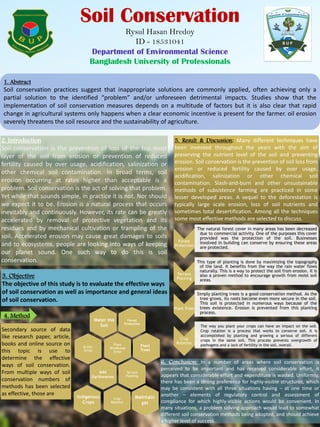
Forest
Protection
Plant
Windbreak
Areas
Terrace
Planting
Plant
Trees
Buffer
Strips
Crop
Rotation
Water the
Soil
Add
Earthworms
Maintain
pH
Indigenous
Crops
Forest
Protection
The natural forest cover in many areas has been decreased
due to commercial activity. One of the purposes this cover
provided was the protection of the soil. Businesses
involved in building can conserve by ensuring these areas
are protected.
Terrace
Planting
This type of planting is done by maximizing the topography
of the land. It benefits from the way the rain water flows
naturally. This is a way to protect the soil from erosion. It is
also a proven method to encourage growth from moist soil
areas.
Plant Trees
Simply planting trees is a good conservation method. As the
tree grows, its roots become even more secure in the soil.
This soil is protected in numerous ways because of the
trees existence. Erosion is prevented from this planting
process.
Crop
Rotation
5. Result & Discussion: Many different techniques have
been invented throughout the years with the aim of
preserving the nutrient level of the soil and preventing
erosion. Soil conservation is the prevention of soil loss from
erosion or reduced fertility caused by over usage,
acidification, salinization or other chemical soil
contamination. Slash-and-burn and other unsustainable
methods of subsistence farming are practiced in some
lesser developed areas. A sequel to the deforestation is
typically large scale erosion, loss of soil nutrients and
sometimes total desertification. Among all the techniques
some most effective methods are selected to discuss.
The way you plant your crops can have an impact on the soil.
Crop rotation is a process that works to conserve soil. It is
accomplished by planting and growing a serious of different
crops in the same soil. This process prevents overgrowth of
pathogens and a lack of fertility in the soil, overall.
6. Conclusion: In a number of areas where soil conservation is
perceived to be important and has received considerable effort, it
appears that considerable effort and expenditure is wasted. Uniformly,
there has been a strong preference for highly-visible structures, which
may be consistent with all three situations having – at one time or
another – elements of regulatory control and assessment of
compliance for which highly-visible actions would be convenient. In
many situations, a problem solving approach would lead to somewhat
different soil conservation methods being adopted, and should achieve
a higher level of success.

Poster on Soil conservation

  • 1.
    Soil Conservation Rysul HasanHredoy ID - 18531041 Department of Environmental Science Bangladesh University of Professionals 1. Abstract Soil conservation practices suggest that inappropriate solutions are commonly applied, often achieving only a partial solution to the identified “problem” and/or unforeseen detrimental impacts. Studies show that the implementation of soil conservation measures depends on a multitude of factors but it is also clear that rapid change in agricultural systems only happens when a clear economic incentive is present for the farmer. oil erosion severely threatens the soil resource and the sustainability of agriculture. 2. Introduction Soil conservation is the prevention of loss of the top most layer of the soil from erosion or prevention of reduced fertility caused by over usage, acidification, salinization or other chemical soil contamination. In broad terms, soil erosion occurring at rates higher than acceptable is a problem. Soil conservation is the act of solving that problem. Yet while that sounds simple, in practice it is not. Nor should we expect it to be. Erosion is a natural process that occurs inevitably and continuously. However, its rate can be greatly accelerated by removal of protective vegetation and its residues and by mechanical cultivation or trampling of the soil. Accelerated erosion may cause great damages to soils and to ecosystems. people are looking into ways of keeping our planet sound. One such way to do this is soil conservation. 3. Objective The objective of this study is to evaluate the effective ways of soil conservation as well as importance and general ideas of soil conservation. 4. Method Secondary source of data like research paper, article, books and online source on this topic is use to determine the effective ways of soil conservation. From multiple ways of soil conservation numbers of methods has been selected as effective, those are Forest Protection Plant Windbreak Areas Terrace Planting Plant Trees Buffer Strips Crop Rotation Water the Soil Add Earthworms Maintain pH Indigenous Crops Forest Protection The natural forest cover in many areas has been decreased due to commercial activity. One of the purposes this cover provided was the protection of the soil. Businesses involved in building can conserve by ensuring these areas are protected. Terrace Planting This type of planting is done by maximizing the topography of the land. It benefits from the way the rain water flows naturally. This is a way to protect the soil from erosion. It is also a proven method to encourage growth from moist soil areas. Plant Trees Simply planting trees is a good conservation method. As the tree grows, its roots become even more secure in the soil. This soil is protected in numerous ways because of the trees existence. Erosion is prevented from this planting process. Crop Rotation 5. Result & Discussion: Many different techniques have been invented throughout the years with the aim of preserving the nutrient level of the soil and preventing erosion. Soil conservation is the prevention of soil loss from erosion or reduced fertility caused by over usage, acidification, salinization or other chemical soil contamination. Slash-and-burn and other unsustainable methods of subsistence farming are practiced in some lesser developed areas. A sequel to the deforestation is typically large scale erosion, loss of soil nutrients and sometimes total desertification. Among all the techniques some most effective methods are selected to discuss. The way you plant your crops can have an impact on the soil. Crop rotation is a process that works to conserve soil. It is accomplished by planting and growing a serious of different crops in the same soil. This process prevents overgrowth of pathogens and a lack of fertility in the soil, overall. 6. Conclusion: In a number of areas where soil conservation is perceived to be important and has received considerable effort, it appears that considerable effort and expenditure is wasted. Uniformly, there has been a strong preference for highly-visible structures, which may be consistent with all three situations having – at one time or another – elements of regulatory control and assessment of compliance for which highly-visible actions would be convenient. In many situations, a problem solving approach would lead to somewhat different soil conservation methods being adopted, and should achieve a higher level of success.