SOIL CONSERVATION
• Soilconservation is a set of management
strategies for prevention
of soil being eroded from the Earth’s surface
or becoming chemically altered by
overuse, acidification, Stalinization, soil
erosion or other chemical soil contamination
to retain the fertility of soil.
• Stores water
•Soil is the basis of life on Earth
• Plants get nutrients from soil and provide
glucose & oxygen.
l
?
conservation
nt
oi
a
s
r
t
is
o
y
p
h
im
W
• Recycle/filter water
• Provide nutrients
8.
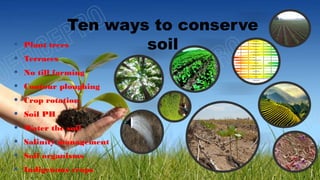
Ten ways toconserve
soil
• Plant trees
• Terraces
• No till farming
• Contour ploughing
• Crop rotation
• Soil PH
• Water the soil
• Salinity management
• Soil organisms
• Indigenous crops
10.
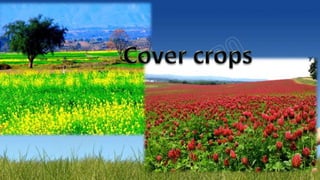
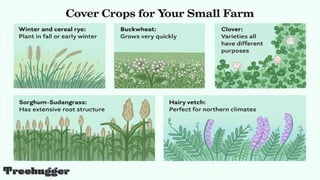
Cover crops
• Covercrops are “close-growing crops that provide
soil protection, seeding protection, and soil
improvement between periods of normal crop
production
• Use of mixed cover crops, including grasses and
legumes,increases the biomass return to the soil,
enhances activity of soil organisms, and improves soil
productivity
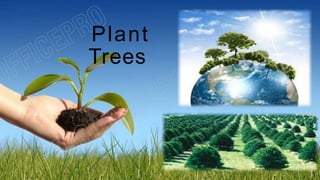
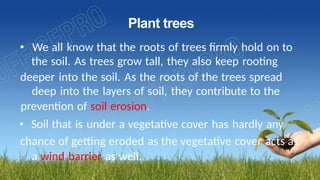
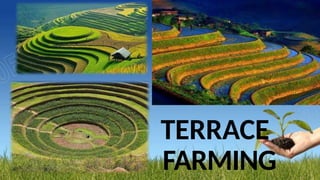
Plant trees
• Weall know that the roots of trees firmly hold on to
the soil. As trees grow tall, they also keep rooting
deeper into the soil. As the roots of the trees spread
deep into the layers of soil, they contribute to the
prevention of soil erosion.
• Soil that is under a vegetative cover has hardly any
chance of getting eroded as the vegetative cover acts as
a wind barrier as well.
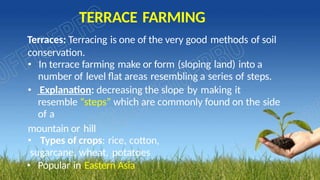
TERRACE FARMING
Terraces: Terracingis one of the very good methods of soil
conservation.
• In terrace farming make or form (sloping land) into a
number of level flat areas resembling a series of steps.
• Explanation: decreasing the slope by making it
resemble “steps” which are commonly found on the side
of a
mountain or hill
• Types of crops: rice, cotton,
sugarcane, wheat, potatoes
• Popular in Eastern Asia
17.
Advantages:
• Reduces erosion
•Contour farming effectively reduces rate of erosion in
soils with slopes of up to 10%
• Holds rainwater which allows for the cultivation of
water intensive crops as mentioned before.
• Farmers use this technique because it allows for the
cultivation of water intensive crops in these areas
because it helpstrap and hold rainwater
No-Till Farming
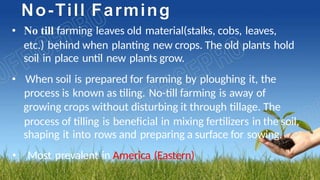
• Notill farming leaves old material(stalks, cobs, leaves,
etc.) behind when planting new crops. The old plants hold
soil in place until new plants grow.
• When soil is prepared for farming by ploughing it, the
process is known as tiling. No-till farming is away of
growing crops without disturbing it through tillage. The
process of tilling is beneficial in mixing fertilizers in the soil,
shaping it into rows and preparing a surface for sowing.
• Most prevalent in America (Eastern)
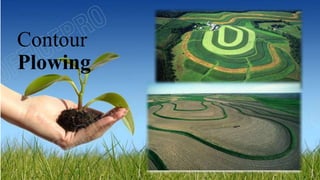
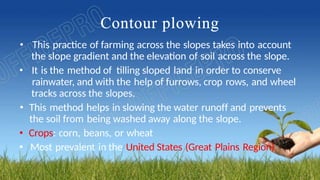
Contour plowing
• Thispractice of farming across the slopes takes into account
the slope gradient and the elevation of soil across the slope.
• It is the method of tilling sloped land in order to conserve
rainwater, and with the help of furrows, crop rows, and wheel
tracks across the slopes.
• This method helps in slowing the water runoff and prevents
the soil from being washed away along the slope.
• Crops: corn, beans, or wheat
• Most prevalent in the United States (Great Plains Region)
23.
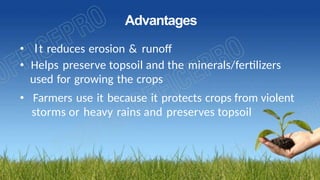
Advantages
• It reduceserosion & runoff
• Helps preserve topsoil and the minerals/fertilizers
used for growing the crops
• Farmers use it because it protects crops from violent
storms or heavy rains and preserves topsoil
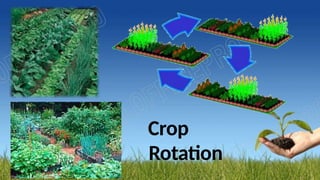
Crop Rotation
• Croprotation is the practice of growing a series of dissimilar
types of crops in the same area in sequential seasons.
• Continuous cultivation of the same crop also leads to an
imbalance in the fertility demands of the soil. To prevent
these adverse effects from taking place, crop rotation is
practiced.
• It is a method of growing a series of dissimilar crops in an area
sequentially.
• Planting three or more different crops before returning to the
original crop constitutes long-term rotations
26.
Advantages
1.Reduce soil erosion,
2.Improve soil properties,
3. Increase organic matter content,
4. Improve soil fertility,
5. Increase crop yields,
6. Reduce build-up of pests,
7. Increase net profits,
8. Improve wildlife habitat,
9. Reduce use of chemicals, and
10. Reduce water pollution.
28.
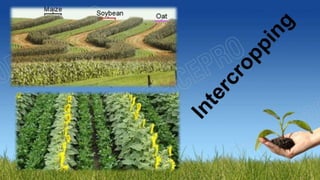
Intercropping
• Intercropping isa multiple cropping system where two or
more crops are grown simultaneously on the same field
• Intercropping takes into account all beneficial interactions
between and among crops while creating possible negative
interactions caused by the neighborly effects.
• For example, plant species such as garlic and onion repel
certain insects and protect adjacent vegetables (e.g., tomato,
lettuce, carrot) from pest attacks provided that the
competition for light and water is negligible.
• Intercropping with legumes or deep-rooted plant species
absorbs nutrients from deeper soil horizons and reduces N
deficiencies among neighboring and succeeding non-legume
crops.
29.
Advantages
• Reduces erosionand vulnerability.
• Increases plant biodiversity to help disguise plants from
insect species.
• Improves the overall health of crops and decreases
chance of disease.
• It minimizes pest problems and improves soil fertility
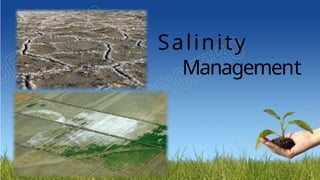
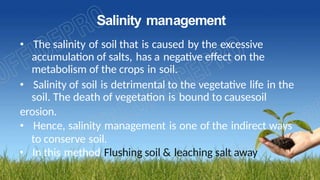
Salinity management
• Thesalinity of soil that is caused by the excessive
accumulation of salts, has a negative effect on the
metabolism of the crops in soil.
• Salinity of soil is detrimental to the vegetative life in the
soil. The death of vegetation is bound to causesoil
erosion.
• Hence, salinity management is one of the indirect ways
to conserve soil.
• In this method Flushing soil & leaching salt away
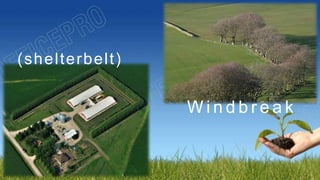
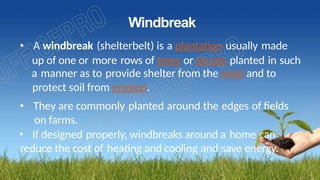
Windbreak
• A windbreak(shelterbelt) is a plantation usually made
up of one or more rows of trees or shrubs planted in such
a manner as to provide shelter from the wind and to
protect soil from erosion.
• They are commonly planted around the edges of fields
on farms.
• If designed properly, windbreaks around a home can
reduce the cost of heating and cooling and save energy.
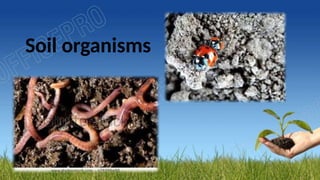
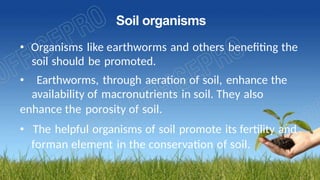
Soil organisms
• Organismslike earthworms and others benefiting the
soil should be promoted.
• Earthworms, through aeration of soil, enhance the
availability of macronutrients in soil. They also
enhance the porosity of soil.
• The helpful organisms of soil promote its fertility and
forman element in the conservation of soil.
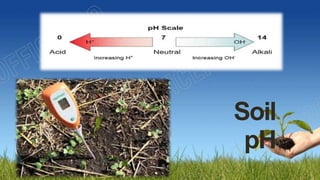
Soil pH
• Thecontamination of soil by addition of acidic or basic
pollutants and acid rains has an adverse effect on the
pH of soil.
• Soil pH is one of the determinants of the availability of
nutrients in soil.
• The uptake of nutrients in plants is also governed to a
certain extent, by the soil pH.
• The maintenance of the most suitable value of pH, is
thus, essential for the conservation of soil.
38.
• In responseto the Dust Bowl of the 1930’s, the
US government increased support for soil
conservation and best practices for agriculture.
• Soil Conservation Service (SCS)
– Established in 1935 to work with farmers to develop
conservation plans for their farms.
• Natural Resource Conservation Service (NRCS)
– SCS was renamed theNRCS in 1994 – and water quality
protection was added to its responsibilities.
• Conservation Reserve Program (CRP)
– Part of the 1985 Farm Bill, it pays farmers to stop
cultivating lands that erode easily and plant them
instead with trees and deep-rooted grasses.
Soil Conservation Policies
39.
Conclusion
• Well-designed croppingsystems enhance soil fertility, reduce
soil erosion,and improve soil properties
• Management of cropping systems involves management of
tillage, crop residues, nutrients, pests, and erosion control
practices.
• Cropping systems include fallow systems, monoculture, strip
cropping, multiple cropping, contourstrip cropping, crop
rotations,cover crops, mixed and relay cropping, and organic
farming.
• Appropriate choice of cropping systems is a strategy to
minimize environmental pollution.
40.
Why promote soilconservation?
The Philippines has a total land area of about 30 million hectares.
More than one-half of this land area are found in the uplands and
hilly lands (Adornado and Yoshida, 2008) where the slope is greater
than 18 percent. In this landscape, soil erosion is a serious problem
not only due to topographic reasons but more so because an
estimated 17.8 million people are living in these areas (Cruz et. al.,
1988; Pava et. al., 1993; Calanog and Calderon, 1990; Escano and
Tababa, 1998 and Paningbatan et. al., 1992). Moreover, the frequent
typhoons that visit the country, which are bringing heavier rains
because of climate change, can further aggravate the worsening
erosion problem.