Glencoe Accounting  Key Terms  chart of accounts ledger double-entry accounting debit credit T account normal balance Accounts and the Double-Entry Accounting System Section 4.1
The Chart of Accounts Glencoe Accounting  chart of accounts A list of all accounts used by a business. Accounts and the Double-Entry Accounting System Section 4.1
The Chart of Accounts Glencoe Accounting  ledger A group of accounts; also referred to as a  general ledger . Accounts and the Double-Entry Accounting System Section 4.1 A system for numbering accounts makes it easy to  locate individual accounts in the  ledger .
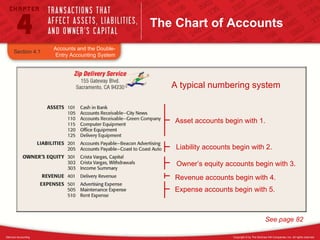
The Chart of Accounts Glencoe Accounting  Accounts and the Double-Entry Accounting System Section 4.1 A typical numbering system See page 82 Asset accounts begin with 1. Liability accounts begin with 2. Owner’s equity accounts begin with 3. Revenue accounts begin with 4. Expense accounts begin with 5.
Double-Entry Accounting Glencoe Accounting  Accounts and the Double-Entry Accounting System Section 4.1 The  double-entry accounting  system recognizes both the  debit  and  credit  side of a business transaction. double-entry accounting A system used to analyze and record  a transaction. debit An entry on the left side of an account. credit An entry on the right side of an account.
Double-Entry Accounting Glencoe Accounting  Accounts and the Double-Entry Accounting System Section 4.1 The  T account  gets its name from being shaped like a T. T-account A visual representation of a ledger account. The T account is a tool used to analyze transactions.
Double-Entry Accounting Glencoe Accounting  Accounts and the Double-Entry Accounting System Section 4.1 normal balance The increase side of an account.  The word  normal  here means usual.
Double-Entry Accounting Glencoe Accounting  Accounts and the Double-Entry Accounting System Section 4.1 Rules for Asset Accounts It is  increased  on the  debit  side (left side). It is  decreased  on the  credit  side (right side). The  normal balance  is the  increase  or  debit  side.
Double-Entry Accounting Glencoe Accounting  Accounts and the Double-Entry Accounting System Section 4.1 Rules for Liability and Owner’s Capital Accounts It is  increased  on the  credit  side (right side). It is  decreased  on the  debit  side (left side). The  normal balance  is the  increase  or  credit  side.
Assets and Equities Transactions Glencoe Accounting  Applying the Rules of Debit and Credit Section 4.2 Analyzing Business Transactions Business Transaction 1 On October 1 Crista Vargas took $25,000 from personal savings and  deposited that amount to open a business checking account in the name of  Zip Delivery Service. See page 87
Assets and Equities Transactions Glencoe Accounting  Applying the Rules of Debit and Credit Section 4.2 Use a T account to analyze an owner’s investment in the business: Business Transaction 2 On October 2 Crista Vargas took two telephones valued at $200 each from her home and transferred them to the business as office equipment. See page 87
Assets and Equities Transactions Glencoe Accounting  Applying the Rules of Debit and Credit Section 4.2 Increase an asset and decrease another asset: Business Transaction 3 On October 4 Zip issued Check 101 for $3,000 to buy a computer system. See page 88
Assets and Equities Transactions Glencoe Accounting  Applying the Rules of Debit and Credit Section 4.2 Increase an asset and increase a liability: Business Transaction 4 On October 9 Zip bought a used truck on account from Coast to Coast Auto  for $12,000. See page 89
Assets and Equities Transactions Glencoe Accounting  Applying the Rules of Debit and Credit Section 4.2 Increase an asset and decrease another asset: Business Transaction 5 On October 11 Zip sold one phone on account to Green Company for $200. See page 89
Assets and Equities Transactions Glencoe Accounting  Applying the Rules of Debit and Credit Section 4.2 Decrease a liability and decrease an asset: Business Transaction 6 On October 12 Zip mailed Check 102 for $350 as the first installment on the truck purchased from Coast to Coast Auto on October 9. See page 90
Assets and Equities Transactions Glencoe Accounting  Applying the Rules of Debit and Credit Section 4.2 Increase an asset and decrease another asset: Business Transaction 7 On October 14 Zip received and deposited a check for $200 from Green Company. The check is full payment for the telephone sold on account to Green Company on October 11. See page 90
Glencoe Accounting  Question 1 Identify the  normal balance  for each of the following accounts by indicating Debit or Credit. Cash in Bank  __________  Accounts Receivable  __________  Richard Sims, Capital __________ Computer Equipment  __________  Accounts Payable  __________ Car Wash Equipment  __________  Building  __________ Office Supplies  __________ DEBIT DEBIT CREDIT DEBIT CREDIT DEBIT DEBIT DEBIT
Glencoe Accounting  Question 2 On October 18 Dick’s Car Wash bought $10,000 worth of car wash equipment by issuing Check #111. Using the Business Transaction Analysis method in your book, list the steps you would use to record this transaction. Assume that asset accounts for Cash in Bank and Car Wash Equipment exist.   Step 1:  Identify the accounts affected. The accounts Car Wash Equipment and Cash in Bank are affected. Step 2:  Classify the accounts affected. Car Wash Equipment is an asset account. Cash in Bank is an asset account (continued)
Glencoe Accounting  Question 2 On October 18 Dick’s Car Wash bought $10,000 worth of car wash equipment by issuing Check #111. Using the Business Transaction Analysis method in your book, list the steps you would use to record this transaction. Assume that asset accounts for Cash in Bank and Car Wash Equipment exist.   Step 3:  Determine the amount of increase or decrease for each account affected. Car Wash Equipment is increased by $10,000. Cash in Bank is decreased by $10,000. (continued)
Glencoe Accounting  Question 2 On October 18 Dick’s Car Wash bought $10,000 worth of car wash equipment by issuing Check #111. Using the Business Transaction Analysis method in your book, list the steps you would use to record this transaction. Assume that asset accounts for Cash in Bank and Car Wash Equipment exist.   Step 4:  Which account is debited and for what amount? Increases in asset accounts are recorded as debits.  Debit Car Wash Equipment for $10,000. Step 5:  Which account is credited and for what amount? Decreases in asset accounts are recorded as credits.  Credit Cash in Bank for $10,000.

Ch 4 powerpoint

  • 1.
  • 2.
    Glencoe Accounting Key Terms chart of accounts ledger double-entry accounting debit credit T account normal balance Accounts and the Double-Entry Accounting System Section 4.1
  • 3.
    The Chart ofAccounts Glencoe Accounting chart of accounts A list of all accounts used by a business. Accounts and the Double-Entry Accounting System Section 4.1
  • 4.
    The Chart ofAccounts Glencoe Accounting ledger A group of accounts; also referred to as a general ledger . Accounts and the Double-Entry Accounting System Section 4.1 A system for numbering accounts makes it easy to locate individual accounts in the ledger .
  • 5.
    The Chart ofAccounts Glencoe Accounting Accounts and the Double-Entry Accounting System Section 4.1 A typical numbering system See page 82 Asset accounts begin with 1. Liability accounts begin with 2. Owner’s equity accounts begin with 3. Revenue accounts begin with 4. Expense accounts begin with 5.
  • 6.
    Double-Entry Accounting GlencoeAccounting Accounts and the Double-Entry Accounting System Section 4.1 The double-entry accounting system recognizes both the debit and credit side of a business transaction. double-entry accounting A system used to analyze and record a transaction. debit An entry on the left side of an account. credit An entry on the right side of an account.
  • 7.
    Double-Entry Accounting GlencoeAccounting Accounts and the Double-Entry Accounting System Section 4.1 The T account gets its name from being shaped like a T. T-account A visual representation of a ledger account. The T account is a tool used to analyze transactions.
  • 8.
    Double-Entry Accounting GlencoeAccounting Accounts and the Double-Entry Accounting System Section 4.1 normal balance The increase side of an account. The word normal here means usual.
  • 9.
    Double-Entry Accounting GlencoeAccounting Accounts and the Double-Entry Accounting System Section 4.1 Rules for Asset Accounts It is increased on the debit side (left side). It is decreased on the credit side (right side). The normal balance is the increase or debit side.
  • 10.
    Double-Entry Accounting GlencoeAccounting Accounts and the Double-Entry Accounting System Section 4.1 Rules for Liability and Owner’s Capital Accounts It is increased on the credit side (right side). It is decreased on the debit side (left side). The normal balance is the increase or credit side.
  • 11.
    Assets and EquitiesTransactions Glencoe Accounting Applying the Rules of Debit and Credit Section 4.2 Analyzing Business Transactions Business Transaction 1 On October 1 Crista Vargas took $25,000 from personal savings and deposited that amount to open a business checking account in the name of Zip Delivery Service. See page 87
  • 12.
    Assets and EquitiesTransactions Glencoe Accounting Applying the Rules of Debit and Credit Section 4.2 Use a T account to analyze an owner’s investment in the business: Business Transaction 2 On October 2 Crista Vargas took two telephones valued at $200 each from her home and transferred them to the business as office equipment. See page 87
  • 13.
    Assets and EquitiesTransactions Glencoe Accounting Applying the Rules of Debit and Credit Section 4.2 Increase an asset and decrease another asset: Business Transaction 3 On October 4 Zip issued Check 101 for $3,000 to buy a computer system. See page 88
  • 14.
    Assets and EquitiesTransactions Glencoe Accounting Applying the Rules of Debit and Credit Section 4.2 Increase an asset and increase a liability: Business Transaction 4 On October 9 Zip bought a used truck on account from Coast to Coast Auto for $12,000. See page 89
  • 15.
    Assets and EquitiesTransactions Glencoe Accounting Applying the Rules of Debit and Credit Section 4.2 Increase an asset and decrease another asset: Business Transaction 5 On October 11 Zip sold one phone on account to Green Company for $200. See page 89
  • 16.
    Assets and EquitiesTransactions Glencoe Accounting Applying the Rules of Debit and Credit Section 4.2 Decrease a liability and decrease an asset: Business Transaction 6 On October 12 Zip mailed Check 102 for $350 as the first installment on the truck purchased from Coast to Coast Auto on October 9. See page 90
  • 17.
    Assets and EquitiesTransactions Glencoe Accounting Applying the Rules of Debit and Credit Section 4.2 Increase an asset and decrease another asset: Business Transaction 7 On October 14 Zip received and deposited a check for $200 from Green Company. The check is full payment for the telephone sold on account to Green Company on October 11. See page 90
  • 18.
    Glencoe Accounting Question 1 Identify the normal balance for each of the following accounts by indicating Debit or Credit. Cash in Bank __________ Accounts Receivable __________ Richard Sims, Capital __________ Computer Equipment __________ Accounts Payable __________ Car Wash Equipment __________ Building __________ Office Supplies __________ DEBIT DEBIT CREDIT DEBIT CREDIT DEBIT DEBIT DEBIT
  • 19.
    Glencoe Accounting Question 2 On October 18 Dick’s Car Wash bought $10,000 worth of car wash equipment by issuing Check #111. Using the Business Transaction Analysis method in your book, list the steps you would use to record this transaction. Assume that asset accounts for Cash in Bank and Car Wash Equipment exist. Step 1: Identify the accounts affected. The accounts Car Wash Equipment and Cash in Bank are affected. Step 2: Classify the accounts affected. Car Wash Equipment is an asset account. Cash in Bank is an asset account (continued)
  • 20.
    Glencoe Accounting Question 2 On October 18 Dick’s Car Wash bought $10,000 worth of car wash equipment by issuing Check #111. Using the Business Transaction Analysis method in your book, list the steps you would use to record this transaction. Assume that asset accounts for Cash in Bank and Car Wash Equipment exist. Step 3: Determine the amount of increase or decrease for each account affected. Car Wash Equipment is increased by $10,000. Cash in Bank is decreased by $10,000. (continued)
  • 21.
    Glencoe Accounting Question 2 On October 18 Dick’s Car Wash bought $10,000 worth of car wash equipment by issuing Check #111. Using the Business Transaction Analysis method in your book, list the steps you would use to record this transaction. Assume that asset accounts for Cash in Bank and Car Wash Equipment exist. Step 4: Which account is debited and for what amount? Increases in asset accounts are recorded as debits. Debit Car Wash Equipment for $10,000. Step 5: Which account is credited and for what amount? Decreases in asset accounts are recorded as credits. Credit Cash in Bank for $10,000.