

Simplicity on the Other  Side of Complexity An Introduction to Complexity  Science and Management
I.  Introductions and Purpose Introductions Faculty Staff Special Guests
Our Purpose To build understanding of & confidence in using complexity principles and practices
Who Is In The Room? Connection Before Content Find a “strange attractor” “ Exercise or Exorcism?”
II.  How This Workshop Will Be Different Structured Improvisation Many activities may seem paradoxical: structured with simple rules that draw out insight; familiar  and  fundamentally different We will rely on emergence as well as formal methods We intend to have serious fun (and surprises) as we learn!  We will work at three levels throughout the day: transferring information, skill building, and mental model shifting
 
The Illuminating, Profound  Poetry of Complexity Language can be used for poetry or prose.  In a poem, the meaning of words is far more dense.  That is, each word may carry several meanings; and a sentence as a whole may carry an enormous density of interlocking meanings… together they  illuminate the whole  from multiple perspectives. The more dense and embedded -- the more breadth and depth -- the more profound a poem can become. Like poetry, this complexity course strings together many patterns in words, images & experience.  Within the embedded patterns or fractals,  we hope you will find simplicity illuminated… and linked directly to multiple levels of your experience. We hope for illumination both in the larger patterns in which your work is embedded (our ecology & economy) and the smaller patterns that are embedded in it (day-to-day activities).
Creative Illumination The poet’s eye, in a fine frenzy rolling, Doth glance from heaven to earth, from earth to heaven, And, as imagination bodies forth The forms of things unknown, the poet’s pen Turns them into shapes, and gives to airy nothing A local habitation and name.  William Shakespeare,  A Midsummer Night’s Dream
Bridging Polarities We will move from Either/Or to “Yes, And”  Thinking Paradox frames the door to life.   Charles Johnson
Workshop Agenda & Rules See Agenda for details Lunch & break times will be set as we go Take responsibility for your own learning;  vote with your feet  during interactive sessions Expect to be provoked, challenged and surprised -- complexity turns convention on its head Please turn off cellular phone and beepers Try to keep your “stuff” collected. We will be moving about the room Phones and bathrooms are...
How We Will Measure Success See Handout
III.  Seeing Through A Complexity Lens
Inspiration from  Complex Adaptive Systems Definition:  A collection of individual agents, who have the freedom to act in unpredictable ways, and whose actions are interconnected such that one agent’s actions changes the context for other agents.   Examples: termite colonies, stock markets, the Internet, gardens, human beings, groups of people
Defining Complex Adaptive Systems Alternative CAS  definition by Ralph Stacey:   CASs consist of a network of agents that interact with each other according to a set of rules that require them to examine and respond to each other’s behavior to improve their behavior and thus the behavior of the system they comprise.
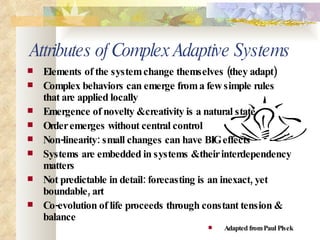
Attributes of Complex Adaptive Systems Elements of the system change themselves (they adapt) Complex behaviors can emerge from a few simple rules that are applied locally  Emergence of novelty & creativity is a natural state  Order emerges without central control Non-linearity: small changes can have BIG effects Systems are embedded in systems & their interdependency matters Not predictable in detail: forecasting is an inexact, yet boundable, art Co-evolution of life proceeds through constant tension & balance Adapted from Paul Plsek
Interdependent Attributes Adaptable Elements Embedded Systems Co-Evolution Non-Linearity Simple Rules Not Predicable in Detail Order w/o Central  Control Natural  Emergence & Creativity
Why Now? More of our world is connected, complex and interdependent than ever before  Entities that embrace these principles and practices seem to adapt and grow; and, institutions that don’t, are not functioning well at all New complexity science  directly  challenges pervasive Newtonian “machine-age” thinking Advances in biology & CASs are informing science & technology advances in other fields Time and space have been compressed (the lags & gaps have disappeared)
Complexity Lens Reflection We are finely tuned “complex adaptive systems,” especially when we are working at our highest intelligence & purpose.   Describe a time or experience when a  collaborative effort  created or encouraged  something surprising .  It should be something you are proud to have been a part of… a difference that made a difference.  It can be a very small, subtle thing.  It could be from your current workplace or a past effort of any kind. See the  Workbook Handout
When Complexity Practices Are Useful When you are frustrated with current and past approaches When challenges are wicked and messy When you want to start something new  When there is little agreement or certainty about how to respond  *  * See the Zone of Complexity in Ralph Stacey’s diagram
Stacey Diagram Know When Your Challenges Are In the Zone of Complexity Certainty Agreement Close to Far from Far from Close to Simple Plan, control Chaotic Seek Patterns Zone of Complexity
Stacey Diagram Know When Your Challenges Are In the Zone of Complexity Certainty Agreement Close to Far from Far from Close to Simple Plan, control Chaotic Seek Patterns Complicated Complex Swarm
What Approaches Are Useful in the Zone? Certainty Agreement Close to Far from Far from Close to Simple Plan, control Chaos Seek Patterns CAS Metaphors, Good Enough Vision,  Minimum Specs, Seeking Out Paradox,  Multiple Actions, Chunking, Generative Relationships, Informal Networks, Tuning To Your System & Natural Attractors, Swarmware Creative Adaptability
Simple & Complex Approaches Simple Plan then act Create explicit plans Look for agreement & a clear outcome Limit type of actions Drive implementation & set targets Complex “ Act-learn-plan” at the same time Look for divergence Use multiple actions & min specs Tune to the edge Build on what emerges & grows
 
Leadership Tasks In A Professional Bureaucracy role defining   –  job and task descriptions tight structuring  – use chain of command simplifying   –  prioritize or limit simple actions socializing   –  seek homogeneous values & ideas decision making   –  find the “best” choice knowing   –  decide & tell others what to do controlling   –  tightly managed execution planning via forecasting   –  plan & then roll out staying the course  – align & maintain focus Adapted from Ruth Anderson & Reuben McDaniel, JR.
Leadership Tasks Complex Adaptive System relationship building  – work with patterns of interaction loose coupling  – informal communities of practice complicating  – add more degrees of freedom diversifying  – draw out & exploit difference sense making  – collective interpretation/meaning learning  – act/learn/plan at the same time improvising  – intuition guiding action w/min specs thinking about the future  – imagine surprises noticing emergent direction  – build on what works Adapted from Ruth Anderson & Reuben McDaniel, JR.
Leadership Tasks Adapted from Ruth Anderson & Reuben McDaniel, JR. Professional Bureaucracy Complex Adaptive System role defining tight structuring simplifying socializing decision making knowing controlling (w/ max specs) planning via forecasting  stay the course relationship building loose coupling complicating diversifying sense making learning  improvising (w/ min specs) thinking about the future noticing emergent direction
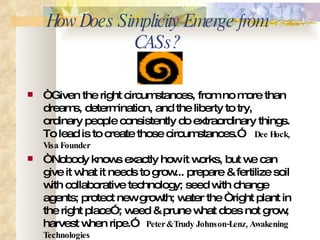
How Does Simplicity Emerge from CASs? “ Given the right circumstances, from no more than dreams, determination, and the liberty to try, ordinary people consistently do extraordinary things. To lead is to create those circumstances.”  Dee Hock, Visa Founder “ Nobody knows exactly how it works, but we can give it what it needs to grow... prepare & fertilize soil with collaborative technology; seed with change agents; protect new growth; water the “right plant in the right place”; weed & prune what does not grow; harvest when ripe.”   Peter & Trudy Johnson-Lenz, Awakening Technologies
“ Farmers don’t grow crops.  They create the conditions for crops to grow.”   Gareth Morgan
Simplicity on the Other Side of Complexity IV.  Scientific Origins & Emerging Insights
Scientific Origins
Surprising Convergence of Disciplines Biology Ecology Meteorology Mathematics Chemistry Psychology S ociology Economics Physics Computer  Science
Before Complexity   Scientists believed the future was knowable given enough data points Dissecting discrete parts would reveal how everything -- the whole system -- works Phenomena can be reduced to simple cause & effect relationships The role of scientists, technology, & leaders was to predict and control the future Increasing levels of control  over  nature would improve our quality of life
Newton & the Machine Metaphor   In science the search for the basic building blocks In management The whole is  no more or no less than  the sum of parts, so focus on the parts (e.g. functions, disciplines) Organizations and people are implicitly viewed as  machines (or machine parts)
Tom Petzinger   Wall Street Journal “ Even as it was toppled from unassailability in science, Newtonian mechanics remained firmly lodged as the mental model of management, from the first stirrings of the industrial revolution right through the advent of modern-day M.B.A. studies.” As biologists and other pioneers began to realize, it could not explain the self renewing processes of life.
Roots Of Complexity Santa Fe Institute  Physics-chaos theory Math-fractal geometry Meteorology-butterfly effect Biology-complex adaptive systems
From Physics Envy To Biology Envy
Surprising Convergence:   We Stand on the Shoulders of Giants Complex Adaptive  Systems ((( Murray Gell-Mann ))) The Quark & the Jaguar ((( Stuart Kaufmann ))) At Home in the Universe ((( John Holland ))) Emergence ((( Brian Arthur ))) Increasing Returns Ecology James Lovelock,  Gaia Hypothesis Meteorology Edward Lorenz,  The Butterfly Effect Sociology Robert Axelrod,  Complexity of Cooperation Chemistry Ilya Prigogine,  Order Out of Chaos Physiology Ary Goldberger, Cardiac Research Socio-Biology E.O. Wilson  Consilience Computer Science Christopher Langton Genetics R.C. Lewontin,  Biology as Ideology Philosophy Ken Wilbur, Integral Science & Religion Physics-Ecology Fritjof Capra,  Web of Life Mathematics Mandlebrot,  Fractals Physics David Bohm,  Wholeness  & the Implicate Order
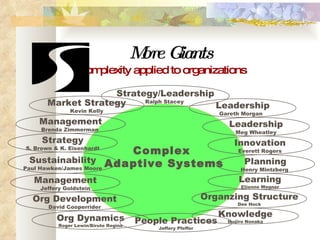
More Giants   Complexity applied to organizations Complex  Adaptive Systems People Practices Jeffery Pfeffer Org Development David Cooperrider Leadership Gareth Morgan  Market Strategy Kevin Kelly Strategy/Leadership Ralph Stacey  Innovation Everett Rogers Management Brenda Zimmerman  Planning Henry Mintzberg  Strategy S. Brown & K. Eisenhardt Leadership Meg Wheatley Learning Etienne Wegner Management Jeffery Goldstein Organzing Structure Dee Hock Sustainability Paul Hawken/James Moore Knowledge Ikujiro Nonaka Org Dynamics Roger Lewin/Birute Regine
Complexity In Practice Dee Hock --  managed the banking “commons” &  balanced competition/cooperation while leading VISA ( Birth of the Chaordic Age ) Arie de Geus --  brought a natural system lens to Royal Dutch Shell & scenario planning ( The Living Company ) Orpheus Chamber Symphony  -- a leaderless group Tom Petzinger --  WSJ stories &  The New Pioneers Roger Lewin & Birute Regine  --  The Soul at Work  Irv Dardik’s Heart Waves --  applied to health and chronic disease (clinical trials are underway)
Emerging Insights
Key Attributes   Elements of the system change themselves (they adapt) Complex behaviors can emerge from a few simple rules that are applied locally  Emergence of novelty & creativity is a natural state  Order emerges without central control Non-linearity: small changes can have BIG effects Systems are embedded in systems & their interdependency matters Not predictable in detail: forecasting is an inexact, yet boundable, art Co-evolution of life proceeds through constant tension & balance
Key Attributes Adaptable  Elements Embedded Systems Co-Evolution Non-Linearity Simple Rules Not Predictable in Detail Order w/o Central  Control Natural  Emergence & Creativity
Simple Rules in Practice Living systems follow “simple rules” Craig Reynolds’ “Boids” simulation uses minimum rules of interaction Gareth Morgan’s “min specs” Simple rules  include “Must do’s” or “Never do’s”
Example: Reynolds’ Steering Rules Maintain a minimum distance from other boids and objects Match speed of neighboring boids Move toward the center of mass of  flock-mates in your area Complex “flocking” emerges!
Living Systems Are Non-Linear Not predictable in long-term Future not just unknown but unknowable Small events may trigger huge effects Huge efforts may have negligible effects
Rosa Parks’ refusal to yield her seat Weather, hurricanes A statement or word used by Alan Greenspan Examples Of Non-Linearity
The 15% Principle Learning how to “flow” with & “tune to” change in complex systems W. Edwards Deming suggested that everyone -- from the CEO to the front line worker -- has influence over 15% of their system.  The other 85% is beyond their discretionary control.  Recognize that you have 15% discretionary influence… it may sound small but you can use it to make  a difference that makes a difference.
Simple Rules & Attractors “Auto-Pilot” Rules.... New Pattern Emerging Search for simple rules, subtle patterns or  rhythms that attract natural energy in your system.
How Does an Attractor  Pattern Shift or Flip?   A system chooses to be disturbed the disturbance gets amplified it creates instability the system falls apart it flips or shifts to a new attractor (e.g. new simple rules) by searching for & organizing around new meaning Source:  Margaret Wheatley
“ How To” Disturb & Amplify Allow new information into the system  Work with organizational boundaries  Connect systems to environment  Question differences Challenge assumptions  Take advantage of chance and serendipity Adapted from:  Jeffrey Goldstein,  The Unshackled Organization
Chunking   Building on what works from the ground up The only way to make a successful  complex system is to begin with a simple system that works.  Complex systems are not instantly installed... they are assembled incrementally from pieces that can operate independently.  The interdependent parts share control and act locally in parallel.  A central command slows things down in a distributed network.  Source :  Kevin Kelly
Lessons From Physiology Healthy Heart  OR   Dying Heart
Heart Rate Dynamics ? ?
Heart Rate Dynamics
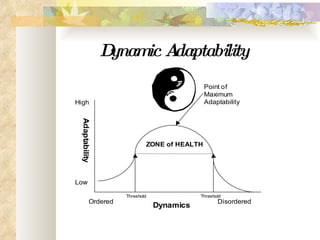
Dynamic Adaptability
Application:  Heart Wave Cycles Cyclic Exercise & Health A series of activation-relaxation cycles Pulse rate rises & falls to generate a sequence of heart rate waves The timing, intensity and “rhythm” of one cycle is related to the previous cycle Conventional Exercise & Health Continuous, prolonged Elevated, extended pulse rate Interval training Increasing, sequenced pulse rate
A New Definition of Health That state of wholeness in which the  individual is poised for maximal adaptability.  It is a state characterized by a dynamic  tension resulting from the interplay of interactive forces at many different scales.
Nine Interdependent Principles Complexity Lens Seek Paradox Shadow System Good Enough  Vision Multiple Actions Chunking Tune To The Edge Clockware/ Swarmware Competition/ Cooperation
Nine Emerging & Connected Principles View your system through the lens of complexity Build a “good enough” vision, use a “min specs” approach When life is far from certain, lead with clockware and swarmware in tandem
More Principles... Uncover and work with paradox & tension Tune your place to the edge Go for multiple actions at the fringes, let direction arise
More Principles... Listen to the “shadow system” Grow complex systems by chunking Mix competition and cooperation
Reflection – Interdependent Principles Complexity Lens Seek Paradox Shadow System Good Enough  Vision Multiple Actions Chunking Tune To The Edge Clockware/ Swarmware Competition/ Cooperation
Kevin Kelly’s 10 Rules for the New Economy Opportunities  Before  Efficiencies Let Go  at the Top Increasing  Returns Relationship Tech Follow the Free Embrace  the Swarm From Places to Spaces No Harmony,  All Flux Plenitude,  not Scarcity Feed the  Web First
Simplicity on the Other Side of Complexity V.  Stories that Illustrate Complexity Principles in Practice
Stories We Will Explore Improving Admissions by Tuning to Patients  Growing a Sustainable, “Green” Carpet Business [Add your favorite stories from  Edgeware ,  Edgeplace ,  The New Pioneers ,  The Soul at Work,… ]
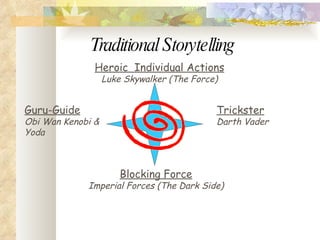
Traditional Storytelling Heroic  Individual Actions Luke Skywalker (The Force) Guru-Guide Obi Wan Kenobi & Yoda Trickster Darth Vader Blocking Force Imperial Forces (The Dark Side)
Storytelling Through a Complexity Lens   Heroic Individual Actions   New Attractor Pattern Guru-Guide Adaptive Principles-At-Play Trickster Waves of Emergence & Serendipity Blocking Force “ Autopilot” Attractor ( Self-Fulfilling Prophecy)
New Attractor Pattern > Notice how new patterns emerge in far-from-equilibrium conditions Adaptive Principles > Discern complexity practices-in-action Waves of Emergence > Expect novelty & surprise that dampens or amplifies change “ Autopilot” Attractor ( Self-Fulfilling Prophecy) > Uncover subtle/simple rules embedded in current patterns of behavior    Keith McCandless, 1999
Improving Flow by Tuning to Patients Who is involved : nurses, physicians, administrators, ancillary departments Focus : Improving patient flow through in a hospital based outpatient unit in Utah (LDS) Results : 50% increase in volume without plant expansion, reduced expense, dramatically improved patient satisfaction Source:  The New Pioneers , by Tom Petzinger, Jr. (pages 87-90)
New Attractor Pattern Notice how new patterns emerge in far-from-equilibrium conditions > “Do what is right for the patient!” > Frustration & commitment to change Adaptive Principles Discern complexity practices-in-action > Seek paradox > Tune to the edge > Good-enough vision > Simple rules Waves of Emergence Expect novelty & surprise that dampens or amplifies change > Patients  can  walk to surgery! > All stakeholders benefit when patient is the focus > Common-sense AND radical at the same time “ Autopilot” Attractor Uncover subtle/simple rules embedded  in current patterns of behavior > Do what the surgeons want… and, don’t question it! > Acceptance of “The operation is a success, the patient is pissed!”
Growing a Sustainable,  “Green” Carpet Business Who is involved : Executive (Ray Anderson) and managers at the Interface flooring company; suppliers & customers Focus : Extreme (and green) reduction in resource use through developing sustainable production and business practices Results : Immediate waste reductions won favor among investors; tens of millions of dollars went to the bottom line; market differentiation Source:  The New Pioneers , by Tom Petzinger, Jr. (pages 246-253)
New Attractor Pattern Notice how new patterns emerge in far-from-equilibrium conditions > Early 1990’s recession; Ray’s soul searching; Ecology of Commerce > Pesky customers asking about recycled materials; grow by cleaning up! Adaptive Principles Discern complexity practices-in-action > Systems-in-systems interdependency > Good-enough vision > Simple rules Waves of Emergence Expect novelty & surprise that dampens or amplifies change > Some suppliers got on board > “Evergreen leasing” > “All beauty starts with nature” & customers noticed “ Autopilot” Attractor Uncover subtle/simple rules embedded  in current patterns of behavior > Sell “flexibility”; buy supplies cheap; and, grow by acquisition > Manage  internal  production -- ignore how your suppliers produce their goods and how your customers dispose of your product
New Attractor Pattern > Notice how new patterns emerge in far-from-equilibrium conditions Adaptive Principles > Discern complexity practices-in-action Waves of Emergence > Expect novelty & surprise that dampens or amplifies change “ Autopilot” Attractor ( Self-Fulfilling Prophecy) > Uncover subtle/simple rules embedded in current patterns of behavior    Keith McCandless, 1999
Material and Ideas Contributed by: Kevin Dooley, PhD; Glenda Eoyang; Ralph Stacey, PhD; Ary Goldberger, MD; Brenda Zimmerman, PhD; Jeffrey Goldstein, PhD; Gareth Morgan, PhD; Curt Lindberg; Paul Plsek; and, a vibrant community of complexity pioneers Composed and developed for VHA Inc. by Keith McCandless in Seattle (keithmccandless@earthlink.net)

Complexity Thinking

  • 1.
    Simplicity on theOther Side of Complexity An Introduction to Complexity Science and Management
  • 2.
    I. Introductionsand Purpose Introductions Faculty Staff Special Guests
  • 3.
    Our Purpose Tobuild understanding of & confidence in using complexity principles and practices
  • 4.
    Who Is InThe Room? Connection Before Content Find a “strange attractor” “ Exercise or Exorcism?”
  • 5.
    II. HowThis Workshop Will Be Different Structured Improvisation Many activities may seem paradoxical: structured with simple rules that draw out insight; familiar and fundamentally different We will rely on emergence as well as formal methods We intend to have serious fun (and surprises) as we learn! We will work at three levels throughout the day: transferring information, skill building, and mental model shifting
  • 6.
  • 7.
    The Illuminating, Profound Poetry of Complexity Language can be used for poetry or prose. In a poem, the meaning of words is far more dense. That is, each word may carry several meanings; and a sentence as a whole may carry an enormous density of interlocking meanings… together they illuminate the whole from multiple perspectives. The more dense and embedded -- the more breadth and depth -- the more profound a poem can become. Like poetry, this complexity course strings together many patterns in words, images & experience. Within the embedded patterns or fractals, we hope you will find simplicity illuminated… and linked directly to multiple levels of your experience. We hope for illumination both in the larger patterns in which your work is embedded (our ecology & economy) and the smaller patterns that are embedded in it (day-to-day activities).
  • 8.
    Creative Illumination Thepoet’s eye, in a fine frenzy rolling, Doth glance from heaven to earth, from earth to heaven, And, as imagination bodies forth The forms of things unknown, the poet’s pen Turns them into shapes, and gives to airy nothing A local habitation and name. William Shakespeare, A Midsummer Night’s Dream
  • 9.
    Bridging Polarities Wewill move from Either/Or to “Yes, And” Thinking Paradox frames the door to life. Charles Johnson
  • 10.
    Workshop Agenda &Rules See Agenda for details Lunch & break times will be set as we go Take responsibility for your own learning; vote with your feet during interactive sessions Expect to be provoked, challenged and surprised -- complexity turns convention on its head Please turn off cellular phone and beepers Try to keep your “stuff” collected. We will be moving about the room Phones and bathrooms are...
  • 11.
    How We WillMeasure Success See Handout
  • 12.
    III. SeeingThrough A Complexity Lens
  • 13.
    Inspiration from Complex Adaptive Systems Definition: A collection of individual agents, who have the freedom to act in unpredictable ways, and whose actions are interconnected such that one agent’s actions changes the context for other agents. Examples: termite colonies, stock markets, the Internet, gardens, human beings, groups of people
  • 14.
    Defining Complex AdaptiveSystems Alternative CAS definition by Ralph Stacey: CASs consist of a network of agents that interact with each other according to a set of rules that require them to examine and respond to each other’s behavior to improve their behavior and thus the behavior of the system they comprise.
  • 15.
    Attributes of ComplexAdaptive Systems Elements of the system change themselves (they adapt) Complex behaviors can emerge from a few simple rules that are applied locally Emergence of novelty & creativity is a natural state Order emerges without central control Non-linearity: small changes can have BIG effects Systems are embedded in systems & their interdependency matters Not predictable in detail: forecasting is an inexact, yet boundable, art Co-evolution of life proceeds through constant tension & balance Adapted from Paul Plsek
  • 16.
    Interdependent Attributes AdaptableElements Embedded Systems Co-Evolution Non-Linearity Simple Rules Not Predicable in Detail Order w/o Central Control Natural Emergence & Creativity
  • 17.
    Why Now? Moreof our world is connected, complex and interdependent than ever before Entities that embrace these principles and practices seem to adapt and grow; and, institutions that don’t, are not functioning well at all New complexity science directly challenges pervasive Newtonian “machine-age” thinking Advances in biology & CASs are informing science & technology advances in other fields Time and space have been compressed (the lags & gaps have disappeared)
  • 18.
    Complexity Lens ReflectionWe are finely tuned “complex adaptive systems,” especially when we are working at our highest intelligence & purpose. Describe a time or experience when a collaborative effort created or encouraged something surprising . It should be something you are proud to have been a part of… a difference that made a difference. It can be a very small, subtle thing. It could be from your current workplace or a past effort of any kind. See the Workbook Handout
  • 19.
    When Complexity PracticesAre Useful When you are frustrated with current and past approaches When challenges are wicked and messy When you want to start something new When there is little agreement or certainty about how to respond * * See the Zone of Complexity in Ralph Stacey’s diagram
  • 20.
    Stacey Diagram KnowWhen Your Challenges Are In the Zone of Complexity Certainty Agreement Close to Far from Far from Close to Simple Plan, control Chaotic Seek Patterns Zone of Complexity
  • 21.
    Stacey Diagram KnowWhen Your Challenges Are In the Zone of Complexity Certainty Agreement Close to Far from Far from Close to Simple Plan, control Chaotic Seek Patterns Complicated Complex Swarm
  • 22.
    What Approaches AreUseful in the Zone? Certainty Agreement Close to Far from Far from Close to Simple Plan, control Chaos Seek Patterns CAS Metaphors, Good Enough Vision, Minimum Specs, Seeking Out Paradox, Multiple Actions, Chunking, Generative Relationships, Informal Networks, Tuning To Your System & Natural Attractors, Swarmware Creative Adaptability
  • 23.
    Simple & ComplexApproaches Simple Plan then act Create explicit plans Look for agreement & a clear outcome Limit type of actions Drive implementation & set targets Complex “ Act-learn-plan” at the same time Look for divergence Use multiple actions & min specs Tune to the edge Build on what emerges & grows
  • 24.
  • 25.
    Leadership Tasks InA Professional Bureaucracy role defining – job and task descriptions tight structuring – use chain of command simplifying – prioritize or limit simple actions socializing – seek homogeneous values & ideas decision making – find the “best” choice knowing – decide & tell others what to do controlling – tightly managed execution planning via forecasting – plan & then roll out staying the course – align & maintain focus Adapted from Ruth Anderson & Reuben McDaniel, JR.
  • 26.
    Leadership Tasks ComplexAdaptive System relationship building – work with patterns of interaction loose coupling – informal communities of practice complicating – add more degrees of freedom diversifying – draw out & exploit difference sense making – collective interpretation/meaning learning – act/learn/plan at the same time improvising – intuition guiding action w/min specs thinking about the future – imagine surprises noticing emergent direction – build on what works Adapted from Ruth Anderson & Reuben McDaniel, JR.
  • 27.
    Leadership Tasks Adaptedfrom Ruth Anderson & Reuben McDaniel, JR. Professional Bureaucracy Complex Adaptive System role defining tight structuring simplifying socializing decision making knowing controlling (w/ max specs) planning via forecasting stay the course relationship building loose coupling complicating diversifying sense making learning improvising (w/ min specs) thinking about the future noticing emergent direction
  • 28.
    How Does SimplicityEmerge from CASs? “ Given the right circumstances, from no more than dreams, determination, and the liberty to try, ordinary people consistently do extraordinary things. To lead is to create those circumstances.” Dee Hock, Visa Founder “ Nobody knows exactly how it works, but we can give it what it needs to grow... prepare & fertilize soil with collaborative technology; seed with change agents; protect new growth; water the “right plant in the right place”; weed & prune what does not grow; harvest when ripe.” Peter & Trudy Johnson-Lenz, Awakening Technologies
  • 29.
    “ Farmers don’tgrow crops. They create the conditions for crops to grow.” Gareth Morgan
  • 30.
    Simplicity on theOther Side of Complexity IV. Scientific Origins & Emerging Insights
  • 31.
  • 32.
    Surprising Convergence ofDisciplines Biology Ecology Meteorology Mathematics Chemistry Psychology S ociology Economics Physics Computer Science
  • 33.
    Before Complexity Scientists believed the future was knowable given enough data points Dissecting discrete parts would reveal how everything -- the whole system -- works Phenomena can be reduced to simple cause & effect relationships The role of scientists, technology, & leaders was to predict and control the future Increasing levels of control over nature would improve our quality of life
  • 34.
    Newton & theMachine Metaphor In science the search for the basic building blocks In management The whole is no more or no less than the sum of parts, so focus on the parts (e.g. functions, disciplines) Organizations and people are implicitly viewed as machines (or machine parts)
  • 35.
    Tom Petzinger Wall Street Journal “ Even as it was toppled from unassailability in science, Newtonian mechanics remained firmly lodged as the mental model of management, from the first stirrings of the industrial revolution right through the advent of modern-day M.B.A. studies.” As biologists and other pioneers began to realize, it could not explain the self renewing processes of life.
  • 36.
    Roots Of ComplexitySanta Fe Institute Physics-chaos theory Math-fractal geometry Meteorology-butterfly effect Biology-complex adaptive systems
  • 37.
    From Physics EnvyTo Biology Envy
  • 38.
    Surprising Convergence: We Stand on the Shoulders of Giants Complex Adaptive Systems ((( Murray Gell-Mann ))) The Quark & the Jaguar ((( Stuart Kaufmann ))) At Home in the Universe ((( John Holland ))) Emergence ((( Brian Arthur ))) Increasing Returns Ecology James Lovelock, Gaia Hypothesis Meteorology Edward Lorenz, The Butterfly Effect Sociology Robert Axelrod, Complexity of Cooperation Chemistry Ilya Prigogine, Order Out of Chaos Physiology Ary Goldberger, Cardiac Research Socio-Biology E.O. Wilson Consilience Computer Science Christopher Langton Genetics R.C. Lewontin, Biology as Ideology Philosophy Ken Wilbur, Integral Science & Religion Physics-Ecology Fritjof Capra, Web of Life Mathematics Mandlebrot, Fractals Physics David Bohm, Wholeness & the Implicate Order
  • 39.
    More Giants Complexity applied to organizations Complex Adaptive Systems People Practices Jeffery Pfeffer Org Development David Cooperrider Leadership Gareth Morgan Market Strategy Kevin Kelly Strategy/Leadership Ralph Stacey Innovation Everett Rogers Management Brenda Zimmerman Planning Henry Mintzberg Strategy S. Brown & K. Eisenhardt Leadership Meg Wheatley Learning Etienne Wegner Management Jeffery Goldstein Organzing Structure Dee Hock Sustainability Paul Hawken/James Moore Knowledge Ikujiro Nonaka Org Dynamics Roger Lewin/Birute Regine
  • 40.
    Complexity In PracticeDee Hock -- managed the banking “commons” & balanced competition/cooperation while leading VISA ( Birth of the Chaordic Age ) Arie de Geus -- brought a natural system lens to Royal Dutch Shell & scenario planning ( The Living Company ) Orpheus Chamber Symphony -- a leaderless group Tom Petzinger -- WSJ stories & The New Pioneers Roger Lewin & Birute Regine -- The Soul at Work Irv Dardik’s Heart Waves -- applied to health and chronic disease (clinical trials are underway)
  • 41.
  • 42.
    Key Attributes Elements of the system change themselves (they adapt) Complex behaviors can emerge from a few simple rules that are applied locally Emergence of novelty & creativity is a natural state Order emerges without central control Non-linearity: small changes can have BIG effects Systems are embedded in systems & their interdependency matters Not predictable in detail: forecasting is an inexact, yet boundable, art Co-evolution of life proceeds through constant tension & balance
  • 43.
    Key Attributes Adaptable Elements Embedded Systems Co-Evolution Non-Linearity Simple Rules Not Predictable in Detail Order w/o Central Control Natural Emergence & Creativity
  • 44.
    Simple Rules inPractice Living systems follow “simple rules” Craig Reynolds’ “Boids” simulation uses minimum rules of interaction Gareth Morgan’s “min specs” Simple rules include “Must do’s” or “Never do’s”
  • 45.
    Example: Reynolds’ SteeringRules Maintain a minimum distance from other boids and objects Match speed of neighboring boids Move toward the center of mass of flock-mates in your area Complex “flocking” emerges!
  • 46.
    Living Systems AreNon-Linear Not predictable in long-term Future not just unknown but unknowable Small events may trigger huge effects Huge efforts may have negligible effects
  • 47.
    Rosa Parks’ refusalto yield her seat Weather, hurricanes A statement or word used by Alan Greenspan Examples Of Non-Linearity
  • 48.
    The 15% PrincipleLearning how to “flow” with & “tune to” change in complex systems W. Edwards Deming suggested that everyone -- from the CEO to the front line worker -- has influence over 15% of their system. The other 85% is beyond their discretionary control. Recognize that you have 15% discretionary influence… it may sound small but you can use it to make a difference that makes a difference.
  • 49.
    Simple Rules &Attractors “Auto-Pilot” Rules.... New Pattern Emerging Search for simple rules, subtle patterns or rhythms that attract natural energy in your system.
  • 50.
    How Does anAttractor Pattern Shift or Flip? A system chooses to be disturbed the disturbance gets amplified it creates instability the system falls apart it flips or shifts to a new attractor (e.g. new simple rules) by searching for & organizing around new meaning Source: Margaret Wheatley
  • 51.
    “ How To”Disturb & Amplify Allow new information into the system Work with organizational boundaries Connect systems to environment Question differences Challenge assumptions Take advantage of chance and serendipity Adapted from: Jeffrey Goldstein, The Unshackled Organization
  • 52.
    Chunking Building on what works from the ground up The only way to make a successful complex system is to begin with a simple system that works. Complex systems are not instantly installed... they are assembled incrementally from pieces that can operate independently. The interdependent parts share control and act locally in parallel. A central command slows things down in a distributed network. Source : Kevin Kelly
  • 53.
    Lessons From PhysiologyHealthy Heart OR Dying Heart
  • 54.
  • 55.
  • 56.
  • 57.
    Application: HeartWave Cycles Cyclic Exercise & Health A series of activation-relaxation cycles Pulse rate rises & falls to generate a sequence of heart rate waves The timing, intensity and “rhythm” of one cycle is related to the previous cycle Conventional Exercise & Health Continuous, prolonged Elevated, extended pulse rate Interval training Increasing, sequenced pulse rate
  • 58.
    A New Definitionof Health That state of wholeness in which the individual is poised for maximal adaptability. It is a state characterized by a dynamic tension resulting from the interplay of interactive forces at many different scales.
  • 59.
    Nine Interdependent PrinciplesComplexity Lens Seek Paradox Shadow System Good Enough Vision Multiple Actions Chunking Tune To The Edge Clockware/ Swarmware Competition/ Cooperation
  • 60.
    Nine Emerging &Connected Principles View your system through the lens of complexity Build a “good enough” vision, use a “min specs” approach When life is far from certain, lead with clockware and swarmware in tandem
  • 61.
    More Principles... Uncoverand work with paradox & tension Tune your place to the edge Go for multiple actions at the fringes, let direction arise
  • 62.
    More Principles... Listento the “shadow system” Grow complex systems by chunking Mix competition and cooperation
  • 63.
    Reflection – InterdependentPrinciples Complexity Lens Seek Paradox Shadow System Good Enough Vision Multiple Actions Chunking Tune To The Edge Clockware/ Swarmware Competition/ Cooperation
  • 64.
    Kevin Kelly’s 10Rules for the New Economy Opportunities Before Efficiencies Let Go at the Top Increasing Returns Relationship Tech Follow the Free Embrace the Swarm From Places to Spaces No Harmony, All Flux Plenitude, not Scarcity Feed the Web First
  • 65.
    Simplicity on theOther Side of Complexity V. Stories that Illustrate Complexity Principles in Practice
  • 66.
    Stories We WillExplore Improving Admissions by Tuning to Patients Growing a Sustainable, “Green” Carpet Business [Add your favorite stories from Edgeware , Edgeplace , The New Pioneers , The Soul at Work,… ]
  • 67.
    Traditional Storytelling Heroic Individual Actions Luke Skywalker (The Force) Guru-Guide Obi Wan Kenobi & Yoda Trickster Darth Vader Blocking Force Imperial Forces (The Dark Side)
  • 68.
    Storytelling Through aComplexity Lens Heroic Individual Actions New Attractor Pattern Guru-Guide Adaptive Principles-At-Play Trickster Waves of Emergence & Serendipity Blocking Force “ Autopilot” Attractor ( Self-Fulfilling Prophecy)
  • 69.
    New Attractor Pattern> Notice how new patterns emerge in far-from-equilibrium conditions Adaptive Principles > Discern complexity practices-in-action Waves of Emergence > Expect novelty & surprise that dampens or amplifies change “ Autopilot” Attractor ( Self-Fulfilling Prophecy) > Uncover subtle/simple rules embedded in current patterns of behavior  Keith McCandless, 1999
  • 70.
    Improving Flow byTuning to Patients Who is involved : nurses, physicians, administrators, ancillary departments Focus : Improving patient flow through in a hospital based outpatient unit in Utah (LDS) Results : 50% increase in volume without plant expansion, reduced expense, dramatically improved patient satisfaction Source: The New Pioneers , by Tom Petzinger, Jr. (pages 87-90)
  • 71.
    New Attractor PatternNotice how new patterns emerge in far-from-equilibrium conditions > “Do what is right for the patient!” > Frustration & commitment to change Adaptive Principles Discern complexity practices-in-action > Seek paradox > Tune to the edge > Good-enough vision > Simple rules Waves of Emergence Expect novelty & surprise that dampens or amplifies change > Patients can walk to surgery! > All stakeholders benefit when patient is the focus > Common-sense AND radical at the same time “ Autopilot” Attractor Uncover subtle/simple rules embedded in current patterns of behavior > Do what the surgeons want… and, don’t question it! > Acceptance of “The operation is a success, the patient is pissed!”
  • 72.
    Growing a Sustainable, “Green” Carpet Business Who is involved : Executive (Ray Anderson) and managers at the Interface flooring company; suppliers & customers Focus : Extreme (and green) reduction in resource use through developing sustainable production and business practices Results : Immediate waste reductions won favor among investors; tens of millions of dollars went to the bottom line; market differentiation Source: The New Pioneers , by Tom Petzinger, Jr. (pages 246-253)
  • 73.
    New Attractor PatternNotice how new patterns emerge in far-from-equilibrium conditions > Early 1990’s recession; Ray’s soul searching; Ecology of Commerce > Pesky customers asking about recycled materials; grow by cleaning up! Adaptive Principles Discern complexity practices-in-action > Systems-in-systems interdependency > Good-enough vision > Simple rules Waves of Emergence Expect novelty & surprise that dampens or amplifies change > Some suppliers got on board > “Evergreen leasing” > “All beauty starts with nature” & customers noticed “ Autopilot” Attractor Uncover subtle/simple rules embedded in current patterns of behavior > Sell “flexibility”; buy supplies cheap; and, grow by acquisition > Manage internal production -- ignore how your suppliers produce their goods and how your customers dispose of your product
  • 74.
    New Attractor Pattern> Notice how new patterns emerge in far-from-equilibrium conditions Adaptive Principles > Discern complexity practices-in-action Waves of Emergence > Expect novelty & surprise that dampens or amplifies change “ Autopilot” Attractor ( Self-Fulfilling Prophecy) > Uncover subtle/simple rules embedded in current patterns of behavior  Keith McCandless, 1999
  • 75.
    Material and IdeasContributed by: Kevin Dooley, PhD; Glenda Eoyang; Ralph Stacey, PhD; Ary Goldberger, MD; Brenda Zimmerman, PhD; Jeffrey Goldstein, PhD; Gareth Morgan, PhD; Curt Lindberg; Paul Plsek; and, a vibrant community of complexity pioneers Composed and developed for VHA Inc. by Keith McCandless in Seattle (keithmccandless@earthlink.net)

Editor's Notes

  • #2 06/07/09 Simplicity on the Other Side of Complexity I would not give a fig for the simplicity this side of complexity, but I would give my life for the simplicity on the other side of complexity. Oliver Wendell Holmes… Who better to begin our exploration of organizational mysteries and a new science? A physician, scientist and writer. Through examining new science, our view of the world will change. This has been true over the course of history. In turn, our framework or mindset for managing, decision-making and acting will shift. A new “scientific management” is emerging. This is an opportunity for the presenter/faculty to express why they are attracted to this emerging science. Briefly. For me, I like to help people make connections to each other and whole systems “outside themselves.” Like our ecological system, the Earth. Connecting and remembering “where we fit in larger systems” creates healing, surprise, joy, reverence, humility and deep understanding. Complexity provides a framework for me to understand and accept my role/place in the universe.