MANAGING
COMPLEXITY
TathagatVarma
Founder & CEO
http://ThoughtLeadership.in
ABOUT ME
• 1991: Ex-Computer Scientist (DRDO),Antarctic Researcher
(16 months @ Indian station “Maitri”)
• 1995: Hi-Tech Products (Siemens, Philips, Huawei, McAfee),
Leader (NetScout,Yahoo!, [24]7 Innovation Labs)
• 2014:Thought Leader, Strategy Consulting,Agility &
Innovation Coach (5000+ trained), Public Speaker (200+ talks),
Blogger (150+ blogs), Startup mentor (100+ startups), Visiting
Faculty (5+ courses taught),Author (1 book published, 2 WIP)
REFLECTION #1
Rate your performance on last project, or last one year:
1. Disaster:Whatever we do, we never seem to win. Every project is "Dead on
Arrival”…
2. Firefighting:We don’t really believe in planning, but somehow we are able to react.
Met partial objectives but often at great cost…
3. Meticulous:Able to plan for anticipated changes and respond gracefully to
“negative risks”. Met objectives reasonably well…
4. Strategic:Able to accommodate unanticipated changes and well-prepared to
exploit “positive risks”. Exceeded objectives…
5. Futurist:Able to initiate significant change and disrupt the status quo. Created a
new opportunity…
REFLECTION #1
• Why are you where you are?
• How many $$$s are you bleeding?
• What would it take for you to fix that?
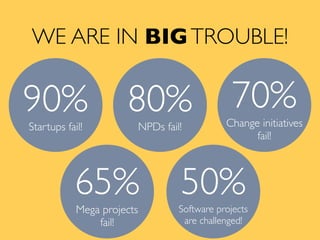
WE ARE IN BIGTROUBLE!
65%
Mega projects
fail!
50%Software projects
are challenged!
70%
Change initiatives
fail!
90%
Startups fail!
80%
NPDs fail!
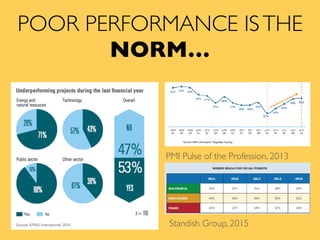
POOR PERFORMANCE ISTHE
NORM…
PMI Pulse of the Profession, 2013
Standish Group, 2015
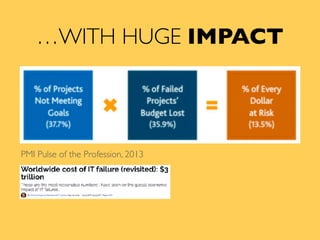
…WITH HUGE IMPACT
PMI Pulse of the Profession, 2013
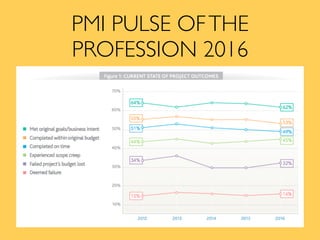
PMI PULSE OFTHE
PROFESSION 2016
WHY?
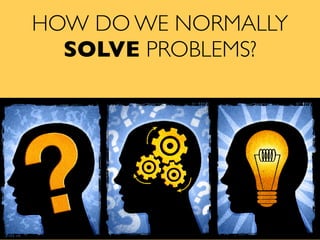
HOW DO WE NORMALLY
SOLVE PROBLEMS?
TYPICAL STEPS
• Define:Articulate the problem
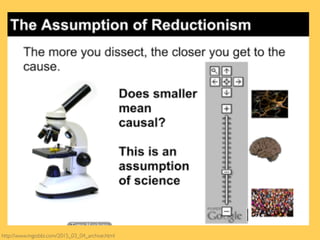
• Reductionism: Breakdown into smaller components
and known patterns
• Creativity: Generate alternatives and potential solutions
• Decision-making: Evaluate and select best ones
• Project management: Implement solution(s)
REDUCTIONISM
• The practice of analysing and describing a
complex phenomenon in terms of its
simple or fundamental
constituents, especially when this is said
to provide a sufficient explanation.
• The whole is equal to sum of parts
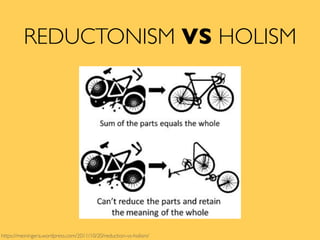
REDUCTONISM VS HOLISM
https://meiningera.wordpress.com/2011/10/20/reduction-vs-holism/
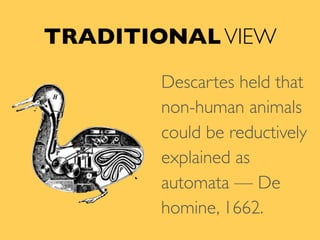
TRADITIONALVIEW
Descartes held that
non-human animals
could be reductively
explained as
automata — De
homine, 1662.
http://www.mgiobbi.com/2015_03_04_archive.html
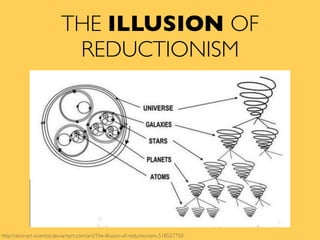
THE ILLUSION OF
REDUCTIONISM
http://abstract-scientist.deviantart.com/art/The-illusion-of-reductionism-518557750
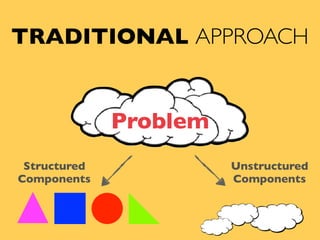
TRADITIONAL APPROACH
Problem
Structured
Components
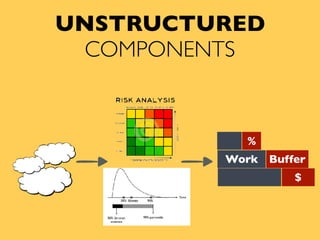
Unstructured
Components
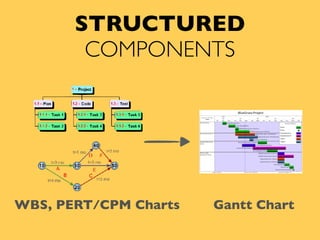
STRUCTURED
COMPONENTS
WBS, PERT/CPM Charts Gantt Chart
UNSTRUCTURED
COMPONENTS
Work Buffer
%
$
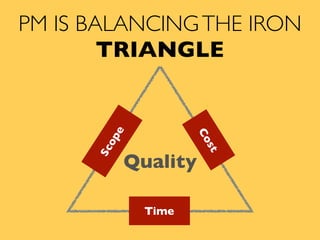
PM IS BALANCINGTHE IRON
TRIANGLE
Quality
Scope
CostTime
REFLECTION #2
• Situation:You have been assigned to manage a
new project (say, NPD, or an M&A, or a
Change initiative, etc.) in a totally new domain,
and your success depends on delivering
world-class results. Project kick-offs in a month.
How will you proceed?
• Time: 5min
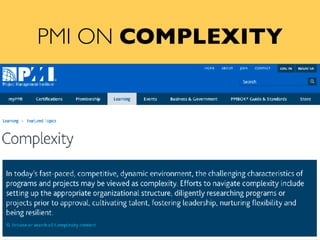
PMI ON COMPLEXITY
WHAT IS COMPLEXITY?
• Wikipedia: Complexity describes the behaviour of a system or model
whose components interact in multiple ways and follow local rules, meaning
there is no reasonable higher instruction to define the various possible
interactions.
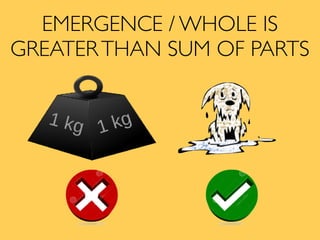
• Complexity is generally used to characterize something with many parts
where those parts interact with each other in multiple ways, culminating in
a higher order of emergence greater than the sum of its parts. Just like
there is no absolute definition of "intelligence", there is no absolute
definition of "complexity"; the only consensus among researchers is that
there is no agreement about the specific definition of complexity. However,
a characterization of what is complex is possible.
COMPLEX ADAPTIVE SYSTEMS
(CAS)
• A complex adaptive system is a "complex macroscopic collection" of
relatively "similar and partially connected micro-structures" formed in
order to adapt to the changing environment and increase its
survivability as a macro-structure
• They are complex in that they are dynamic networks of interactions,
and their relationships are not aggregations of the individual static
entities, i.e., the behavior of the ensemble is not predicted by the
behavior of the components.
• They are adaptive in that the individual and collective behavior mutate
and self-organize corresponding to the change-initiating micro-event
or collection of events.
Wikipedia
COMPLEX ADAPTIVE SYSTEM
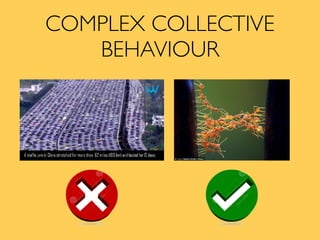
• Melanie Mithcell: a system in which large networks
of components with no central control and simple
rules of operation give rise to complex collective
behaviour, sophisticated information processing,
and adaptation via learning or evolution.
• a system that exhibits nontrivial emergent and self-
organising behaviour
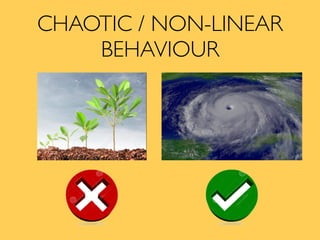
CHAOTIC + ORDER =
CHAORDIC
Any self-organizing, adaptive, nonlinear complex
system, whether physical, biological, or social, the
behavior of which exhibits characteristics of both
order and chaos or loosely translated to business
terminology. - Dee Hock
CHARACTERISTICS OF
COMPLEX SYSTEMS
Let’s study each of them…
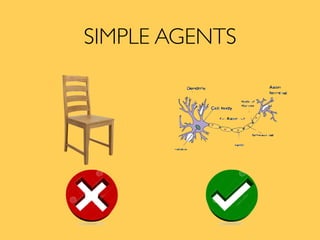
SIMPLE AGENTS
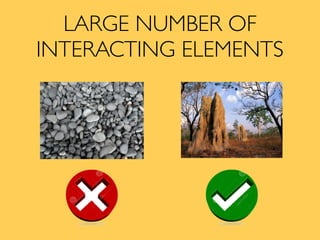
LARGE NUMBER OF
INTERACTING ELEMENTS
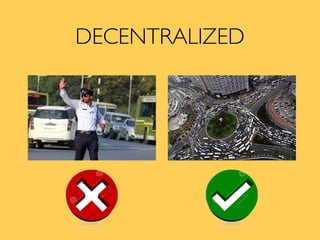
DECENTRALIZED
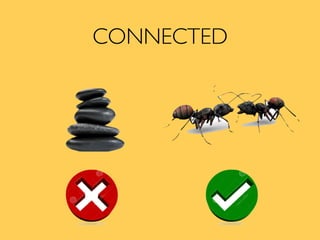
CONNECTED
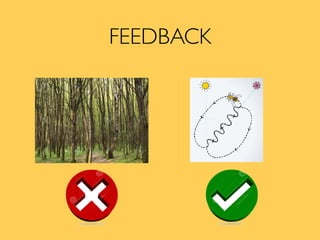
FEEDBACK
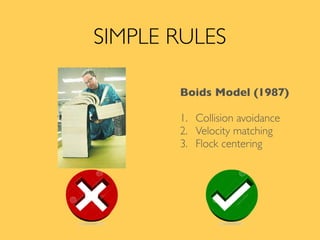
SIMPLE RULES
Boids Model (1987)
1. Collision avoidance
2. Velocity matching
3. Flock centering
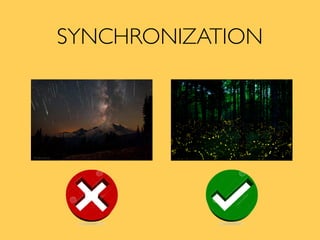
SYNCHRONIZATION
SYNCHRONIZATION
COMPLEX COLLECTIVE
BEHAVIOUR
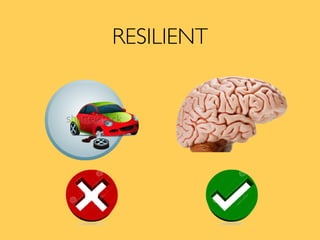
RESILIENT
CHAOTIC / NON-LINEAR
BEHAVIOUR
EMERGENCE / WHOLE IS
GREATERTHAN SUM OF PARTS
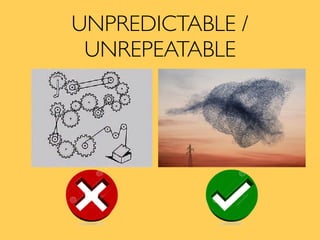
UNPREDICTABLE /
UNREPEATABLE
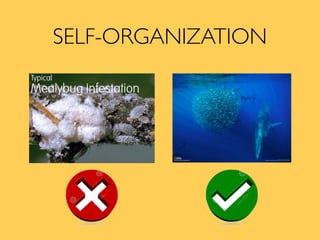
SELF-ORGANIZATION
SELF-ORGANIZATION
• Self-organization is a process where some form of overall order or
coordination arises out of the local interactions between smaller
component parts of an initially disordered system.
• The process of self-organization can be spontaneous, and it is not
necessarily controlled by any auxiliary agent outside of the system. It is
often triggered by random fluctuations that are amplified by positive
feedback.
• The resulting organization is wholly decentralized or distributed over all the
components of the system.As such, the organization is typically robust and
able to survive and, even, self-repair substantial damage or perturbations
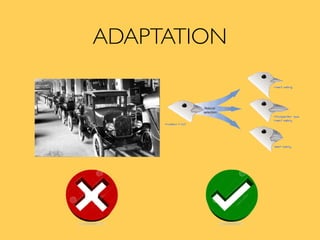
ADAPTATION
REFLECTION #3
• Can you think of elements at work that display
characteristics of complex systems?
• Explain why you think they are “complex”?
• Describe how you “manage” them currently?
SO, HOW COULD WE
MANAGE COMPLEXITY?
• From Predict to Understand
• From Control to Influence
• From Plan to Learn
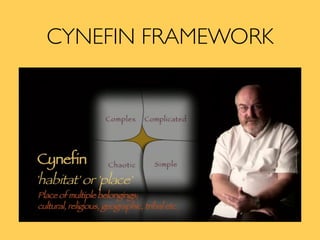
CYNEFIN FRAMEWORK
“CYNEFIN”
• Wikipedia: Cynefin is defined as the state of being
influenced by multiple pasts of which we can only be
partly aware: cultural, religious, geographic, tribal, etc. "It
describes that relationship: the place of your birth and of
your upbringing, the environment in which you live and to
which you are naturally acclimatised." [5] or knowledge
and sense of place that is passed down the generations.
[6] Cynefin has been linked to the MaoriTūrangawaewae
which means a place to stand. [7]
CYNEFIN FRAMEWORK
• Wikipedia:The framework provides a typology of contexts
that guides what sort of explanations or solutions might apply.
It draws on research into complex adaptive systems theory,
cognitive science, anthropology, and narrative patterns, as well
as evolutionary psychology, to describe problems, situations,
and systems. It "explores the relationship between man,
experience, and context"[4] and proposes new approaches
to communication, decision-making, policy-making, and
knowledge management in complex social environments.
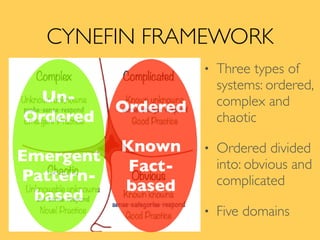
CYNEFIN FRAMEWORK
• Three types of
systems: ordered,
complex and
chaotic
• Ordered divided
into: obvious and
complicated
• Five domains
Ordered
Known
Fact-
based
Un-
Ordered
Emergent
Pattern-
based
CYNEFIN FRAMEWORK
• Sensemaking model where data proceeds framework;
not a categorisation model: where framework proceeds data
• Not a tool but a decision, analytic framework -
doesn’t tell how to solve a problem but helps you pick the
right approach
• Initially used in knowledge management, cultural change and
now used in several domains, including product development,
organisational strategy and national security
SENSEMAKING
“Sensemaking is the ability or attempt to make sense of
an ambiguous situation. More exactly, sensemaking is
the process of creating situational awareness
and understanding in situations of high complexity or
uncertainty in order to make decisions. It is “a
motivated, continuous effort to understand connections
(which can be among people, places, and events) in
order to anticipate their trajectories and act effectively.”
http://cognitive-edge.com/blog/what-is-sense-making/
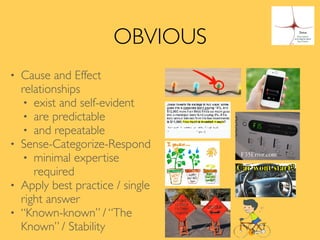
OBVIOUS
• Cause and Effect
relationships
• exist and self-evident
• are predictable
• and repeatable
• Sense-Categorize-Respond
• minimal expertise
required
• Apply best practice / single
right answer
• “Known-known” / “The
Known” / Stability
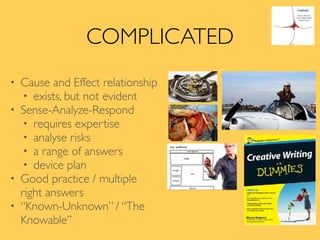
COMPLICATED
• Cause and Effect relationship
• exists, but not evident
• Sense-Analyze-Respond
• requires expertise
• analyse risks
• a range of answers
• device plan
• Good practice / multiple
right answers
• “Known-Unknown” / “The
Knowable”
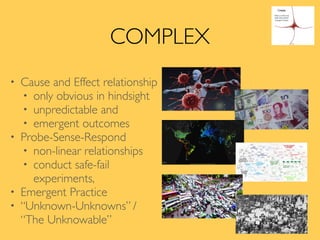
COMPLEX
• Cause and Effect relationship
• only obvious in hindsight
• unpredictable and
• emergent outcomes
• Probe-Sense-Respond
• non-linear relationships
• conduct safe-fail
experiments,
• Emergent Practice
• “Unknown-Unknowns” /
“The Unknowable”
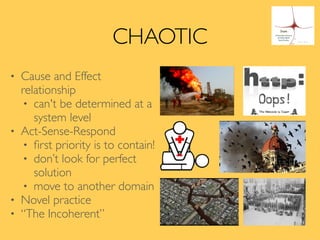
CHAOTIC
• Cause and Effect
relationship
• can't be determined at a
system level
• Act-Sense-Respond
• first priority is to contain!
• don’t look for perfect
solution
• move to another domain
• Novel practice
• “The Incoherent”
DISORDER
• Not knowing which domain you are
in! Causality unknown
• People will revert to their own
comfort zone in making a decision
• Immediate priority is to move to one
of the other domains
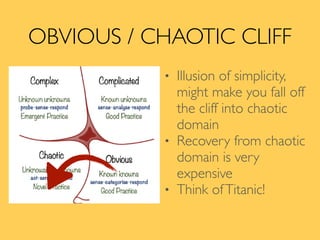
OBVIOUS / CHAOTIC CLIFF
• Illusion of simplicity,
might make you fall off
the cliff into chaotic
domain
• Recovery from chaotic
domain is very
expensive
• Think ofTitanic!
TOOLSTO MANAGE IN
COMPLEX CONTEXT
• Open up the discussion
• Set barriers
• Stimulate attractors
• Encourage dissent and discovery
• Manage starting conditions and monitor for emergence
REFLECTION #4
• Take the recent demonetisation initiative by the
Govt. Use Cynefin framework to map elements in
each of the five domains
• Let’s discuss what strategies would you use to
address the issues
RECAP
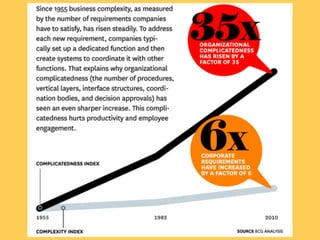
• Complexity is all around us, and increasing!
• Understanding of complex systems requires
fundamentally different thinking.
• Managing complexity requires first sensemaking,
and then choosing appropriate methods.
• Cynefin framework is a great tool for sense making.
REFERENCES
• A Leader's Framework for Decision Making, https://hbr.org/2007/11/a-leaders-
framework-for-decision-making
• Complexity:AVery Short Introduction, John H. Holland, 2014
• https://en.wikipedia.org/wiki/Cynefin_Framework
• https://en.wikipedia.org/wiki/Complex_adaptive_system
• https://www.godaddy.com/garage/tech/process/cynefin-suggestive-framework-
problem-solving/
• http://www.valuebasedprojectmanagement.com/sites/default/files/downloads/
Summary.pdf

Managing Complexity

  • 1.
  • 2.
    ABOUT ME • 1991:Ex-Computer Scientist (DRDO),Antarctic Researcher (16 months @ Indian station “Maitri”) • 1995: Hi-Tech Products (Siemens, Philips, Huawei, McAfee), Leader (NetScout,Yahoo!, [24]7 Innovation Labs) • 2014:Thought Leader, Strategy Consulting,Agility & Innovation Coach (5000+ trained), Public Speaker (200+ talks), Blogger (150+ blogs), Startup mentor (100+ startups), Visiting Faculty (5+ courses taught),Author (1 book published, 2 WIP)
  • 3.
    REFLECTION #1 Rate yourperformance on last project, or last one year: 1. Disaster:Whatever we do, we never seem to win. Every project is "Dead on Arrival”… 2. Firefighting:We don’t really believe in planning, but somehow we are able to react. Met partial objectives but often at great cost… 3. Meticulous:Able to plan for anticipated changes and respond gracefully to “negative risks”. Met objectives reasonably well… 4. Strategic:Able to accommodate unanticipated changes and well-prepared to exploit “positive risks”. Exceeded objectives… 5. Futurist:Able to initiate significant change and disrupt the status quo. Created a new opportunity…
  • 4.
    REFLECTION #1 • Whyare you where you are? • How many $$$s are you bleeding? • What would it take for you to fix that?
  • 5.
    WE ARE INBIGTROUBLE! 65% Mega projects fail! 50%Software projects are challenged! 70% Change initiatives fail! 90% Startups fail! 80% NPDs fail!
  • 6.
    POOR PERFORMANCE ISTHE NORM… PMIPulse of the Profession, 2013 Standish Group, 2015
  • 7.
    …WITH HUGE IMPACT PMIPulse of the Profession, 2013
  • 8.
  • 9.
  • 11.
    HOW DO WENORMALLY SOLVE PROBLEMS?
  • 12.
    TYPICAL STEPS • Define:Articulatethe problem • Reductionism: Breakdown into smaller components and known patterns • Creativity: Generate alternatives and potential solutions • Decision-making: Evaluate and select best ones • Project management: Implement solution(s)
  • 13.
    REDUCTIONISM • The practiceof analysing and describing a complex phenomenon in terms of its simple or fundamental constituents, especially when this is said to provide a sufficient explanation. • The whole is equal to sum of parts
  • 14.
  • 15.
    TRADITIONALVIEW Descartes held that non-humananimals could be reductively explained as automata — De homine, 1662.
  • 16.
  • 17.
  • 18.
  • 19.
  • 20.
  • 21.
    PM IS BALANCINGTHEIRON TRIANGLE Quality Scope CostTime
  • 22.
    REFLECTION #2 • Situation:Youhave been assigned to manage a new project (say, NPD, or an M&A, or a Change initiative, etc.) in a totally new domain, and your success depends on delivering world-class results. Project kick-offs in a month. How will you proceed? • Time: 5min
  • 23.
  • 24.
    WHAT IS COMPLEXITY? •Wikipedia: Complexity describes the behaviour of a system or model whose components interact in multiple ways and follow local rules, meaning there is no reasonable higher instruction to define the various possible interactions. • Complexity is generally used to characterize something with many parts where those parts interact with each other in multiple ways, culminating in a higher order of emergence greater than the sum of its parts. Just like there is no absolute definition of "intelligence", there is no absolute definition of "complexity"; the only consensus among researchers is that there is no agreement about the specific definition of complexity. However, a characterization of what is complex is possible.
  • 25.
    COMPLEX ADAPTIVE SYSTEMS (CAS) •A complex adaptive system is a "complex macroscopic collection" of relatively "similar and partially connected micro-structures" formed in order to adapt to the changing environment and increase its survivability as a macro-structure • They are complex in that they are dynamic networks of interactions, and their relationships are not aggregations of the individual static entities, i.e., the behavior of the ensemble is not predicted by the behavior of the components. • They are adaptive in that the individual and collective behavior mutate and self-organize corresponding to the change-initiating micro-event or collection of events. Wikipedia
  • 26.
    COMPLEX ADAPTIVE SYSTEM •Melanie Mithcell: a system in which large networks of components with no central control and simple rules of operation give rise to complex collective behaviour, sophisticated information processing, and adaptation via learning or evolution. • a system that exhibits nontrivial emergent and self- organising behaviour
  • 27.
    CHAOTIC + ORDER= CHAORDIC Any self-organizing, adaptive, nonlinear complex system, whether physical, biological, or social, the behavior of which exhibits characteristics of both order and chaos or loosely translated to business terminology. - Dee Hock
  • 28.
  • 29.
  • 30.
  • 31.
  • 32.
  • 33.
  • 34.
    SIMPLE RULES Boids Model(1987) 1. Collision avoidance 2. Velocity matching 3. Flock centering
  • 35.
  • 36.
  • 37.
  • 38.
  • 39.
  • 40.
    EMERGENCE / WHOLEIS GREATERTHAN SUM OF PARTS
  • 41.
  • 42.
  • 43.
    SELF-ORGANIZATION • Self-organization isa process where some form of overall order or coordination arises out of the local interactions between smaller component parts of an initially disordered system. • The process of self-organization can be spontaneous, and it is not necessarily controlled by any auxiliary agent outside of the system. It is often triggered by random fluctuations that are amplified by positive feedback. • The resulting organization is wholly decentralized or distributed over all the components of the system.As such, the organization is typically robust and able to survive and, even, self-repair substantial damage or perturbations
  • 44.
  • 45.
    REFLECTION #3 • Canyou think of elements at work that display characteristics of complex systems? • Explain why you think they are “complex”? • Describe how you “manage” them currently?
  • 46.
    SO, HOW COULDWE MANAGE COMPLEXITY? • From Predict to Understand • From Control to Influence • From Plan to Learn
  • 47.
  • 48.
    “CYNEFIN” • Wikipedia: Cynefinis defined as the state of being influenced by multiple pasts of which we can only be partly aware: cultural, religious, geographic, tribal, etc. "It describes that relationship: the place of your birth and of your upbringing, the environment in which you live and to which you are naturally acclimatised." [5] or knowledge and sense of place that is passed down the generations. [6] Cynefin has been linked to the MaoriTūrangawaewae which means a place to stand. [7]
  • 49.
    CYNEFIN FRAMEWORK • Wikipedia:Theframework provides a typology of contexts that guides what sort of explanations or solutions might apply. It draws on research into complex adaptive systems theory, cognitive science, anthropology, and narrative patterns, as well as evolutionary psychology, to describe problems, situations, and systems. It "explores the relationship between man, experience, and context"[4] and proposes new approaches to communication, decision-making, policy-making, and knowledge management in complex social environments.
  • 50.
    CYNEFIN FRAMEWORK • Threetypes of systems: ordered, complex and chaotic • Ordered divided into: obvious and complicated • Five domains Ordered Known Fact- based Un- Ordered Emergent Pattern- based
  • 51.
    CYNEFIN FRAMEWORK • Sensemakingmodel where data proceeds framework; not a categorisation model: where framework proceeds data • Not a tool but a decision, analytic framework - doesn’t tell how to solve a problem but helps you pick the right approach • Initially used in knowledge management, cultural change and now used in several domains, including product development, organisational strategy and national security
  • 52.
    SENSEMAKING “Sensemaking is theability or attempt to make sense of an ambiguous situation. More exactly, sensemaking is the process of creating situational awareness and understanding in situations of high complexity or uncertainty in order to make decisions. It is “a motivated, continuous effort to understand connections (which can be among people, places, and events) in order to anticipate their trajectories and act effectively.” http://cognitive-edge.com/blog/what-is-sense-making/
  • 53.
    OBVIOUS • Cause andEffect relationships • exist and self-evident • are predictable • and repeatable • Sense-Categorize-Respond • minimal expertise required • Apply best practice / single right answer • “Known-known” / “The Known” / Stability
  • 54.
    COMPLICATED • Cause andEffect relationship • exists, but not evident • Sense-Analyze-Respond • requires expertise • analyse risks • a range of answers • device plan • Good practice / multiple right answers • “Known-Unknown” / “The Knowable”
  • 55.
    COMPLEX • Cause andEffect relationship • only obvious in hindsight • unpredictable and • emergent outcomes • Probe-Sense-Respond • non-linear relationships • conduct safe-fail experiments, • Emergent Practice • “Unknown-Unknowns” / “The Unknowable”
  • 56.
    CHAOTIC • Cause andEffect relationship • can't be determined at a system level • Act-Sense-Respond • first priority is to contain! • don’t look for perfect solution • move to another domain • Novel practice • “The Incoherent”
  • 57.
    DISORDER • Not knowingwhich domain you are in! Causality unknown • People will revert to their own comfort zone in making a decision • Immediate priority is to move to one of the other domains
  • 58.
    OBVIOUS / CHAOTICCLIFF • Illusion of simplicity, might make you fall off the cliff into chaotic domain • Recovery from chaotic domain is very expensive • Think ofTitanic!
  • 59.
    TOOLSTO MANAGE IN COMPLEXCONTEXT • Open up the discussion • Set barriers • Stimulate attractors • Encourage dissent and discovery • Manage starting conditions and monitor for emergence
  • 60.
    REFLECTION #4 • Takethe recent demonetisation initiative by the Govt. Use Cynefin framework to map elements in each of the five domains • Let’s discuss what strategies would you use to address the issues
  • 61.
    RECAP • Complexity isall around us, and increasing! • Understanding of complex systems requires fundamentally different thinking. • Managing complexity requires first sensemaking, and then choosing appropriate methods. • Cynefin framework is a great tool for sense making.
  • 62.
    REFERENCES • A Leader'sFramework for Decision Making, https://hbr.org/2007/11/a-leaders- framework-for-decision-making • Complexity:AVery Short Introduction, John H. Holland, 2014 • https://en.wikipedia.org/wiki/Cynefin_Framework • https://en.wikipedia.org/wiki/Complex_adaptive_system • https://www.godaddy.com/garage/tech/process/cynefin-suggestive-framework- problem-solving/ • http://www.valuebasedprojectmanagement.com/sites/default/files/downloads/ Summary.pdf