Developing Emergent Practices
through Tacit Knowledge Sharing


Presented at:

The United States Coast Guard
Human Performance Technology Conference
September 15, 2011 - Williamsburg, Virginia


                 Ms. Janet Cichelli
                           Serco, Inc.
                 LinkedIn: janet-cichelli
Today’s Increasingly Complex Work Environment

     The ability to figure things out, especially
   wicked problems, is now a key competency.

 Wicked problems differ from very hard problems.
   Developing a new weapon system is a hard
 problem, but it's not wicked, because the goal is
              pretty straightforward.

             • Righting a troubled economy
              • Deepwater Horizon Oil Spill
                     • Haiti, Katrina
                                      --Now, that’s wicked
Knowledge


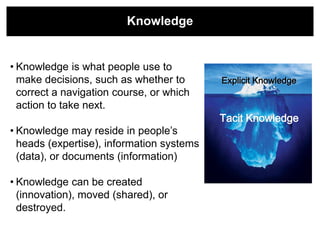
• Knowledge is what people use to
  make decisions, such as whether to       Explicit Knowledge
  correct a navigation course, or which
  action to take next.
                                           Tacit Knowledge
• Knowledge may reside in people’s
  heads (expertise), information systems
  (data), or documents (information)

• Knowledge can be created
  (innovation), moved (shared), or
  destroyed.
Knowledge Management


• Knowledge can be managed directly,
  e.g., by embedding knowledge tools
  and techniques in the work environment

• Knowledge can be managed indirectly,
  by fostering an environment where
  knowledge activities (e.g., creation and
  sharing) are encouraged.
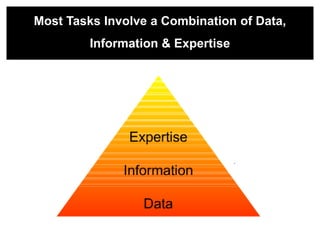
Most Tasks Involve a Combination of Data,
         Information & Expertise
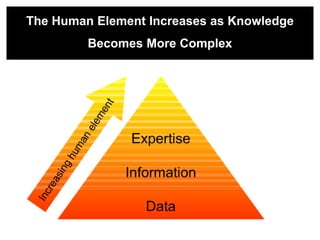
The Human Element Increases as Knowledge
         Becomes More Complex
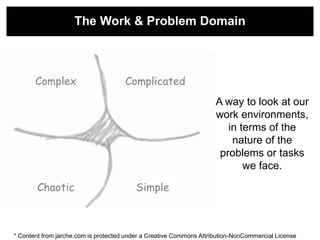
The Work & Problem Domain


       Complex                        Complicated
                                                                     A way to look at our
                                                                     work environments,
                                                                        in terms of the
                                                                         nature of the
                                                                      problems or tasks
                                                                            we face.

        Chaotic                          Simple


* Content from jarche.com is protected under a Creative Commons Attribution-NonCommercial License
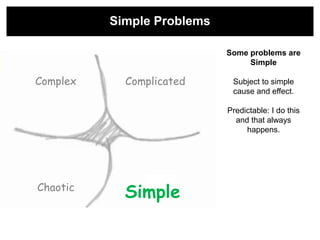
Simple Problems

                            Some problems are
                                 Simple

Complex     Complicated      Subject to simple
                             cause and effect.

                            Predictable: I do this
                              and that always
                                 happens.


Chaotic
            Simple
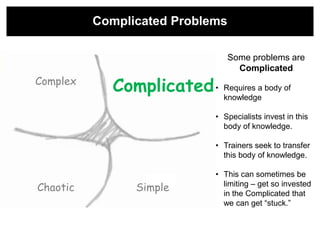
Complicated Problems

                                 Some problems are
                                   Complicated
Complex
            Complicated • Requires a body of
                          knowledge

                              • Specialists invest in this
                                body of knowledge.

                              • Trainers seek to transfer
                                this body of knowledge.

                              • This can sometimes be
Chaotic         Simple          limiting – get so invested
                                in the Complicated that
                                we can get ―stuck.‖
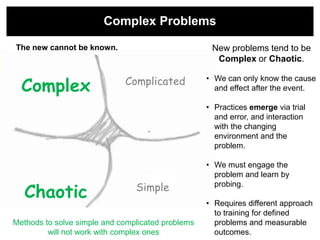
Complex Problems

The new cannot be known.                            New problems tend to be
                                                     Complex or Chaotic.


  Complex                    Complicated           • We can only know the cause
                                                     and effect after the event.

                                                   • Practices emerge via trial
                                                     and error, and interaction
                                   .                 with the changing
                                                     environment and the
                                                     problem.

                                                   • We must engage the
                                                     problem and learn by

   Chaotic                      Simple               probing.

                                                   • Requires different approach
                                                     to training for defined
Methods to solve simple and complicated problems     problems and measurable
         will not work with complex ones             outcomes.
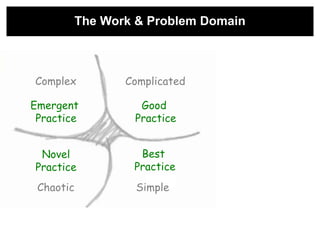
The Work & Problem Domain


Complex           Complicated

Emergent            Good
 Practice          Practice


 Novel              Best
Practice           Practice
 Chaotic            Simple
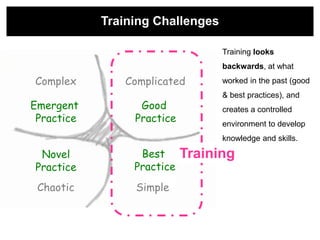
Training Challenges

                                  Training looks
                                  backwards, at what
Complex        Complicated        worked in the past (good
                                  & best practices), and
Emergent          Good            creates a controlled
 Practice        Practice         environment to develop
                                  knowledge and skills.

 Novel            Best      Training
Practice         Practice
 Chaotic         Simple
To Address Complexity, Organizations Need to
         Support Emergent Work Practices

This means having an environment to support

•   collaboration,
•   conversation,
•   synthesis,
•   pattern recognition,
•   and creative tension

all within a secure and trusting environment.
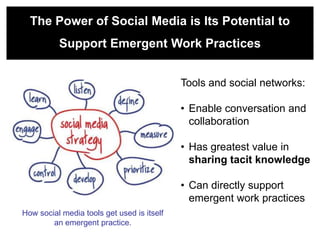
The Power of Social Media is Its Potential to
          Support Emergent Work Practices


                                            Tools and social networks:

                                            • Enable conversation and
                                              collaboration

                                            • Has greatest value in
                                              sharing tacit knowledge

                                            • Can directly support
                                              emergent work practices
How social media tools get used is itself
        an emergent practice.
Methods for Supporting Emergent Practices


Social Media integrated with Serious Games
• Identify expert performer patterns
• Convert tacit knowledge to explicit knowledge
• Continuously improve training


Social Media integrated with Enterprise Portal Applications
• Real-time conversation & collaboration
• Fostering of communities of practice (CoP)
• Provides for communication, synthesis, and creative tension
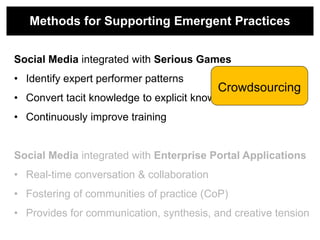
Methods for Supporting Emergent Practices


Social Media integrated with Serious Games
• Identify expert performer patterns
                                           Crowdsourcing
• Convert tacit knowledge to explicit knowledge
• Continuously improve training


Social Media integrated with Enterprise Portal Applications
• Real-time conversation & collaboration
• Fostering of communities of practice (CoP)
• Provides for communication, synthesis, and creative tension
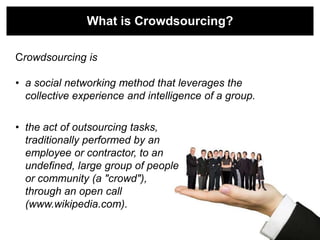
What is Crowdsourcing?

Crowdsourcing is

• a social networking method that leverages the
  collective experience and intelligence of a group.

• the act of outsourcing tasks,
  traditionally performed by an
  employee or contractor, to an
  undefined, large group of people
  or community (a "crowd"),
  through an open call
  (www.wikipedia.com).
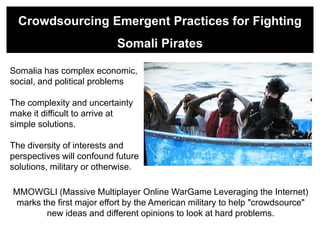
Crowdsourcing Emergent Practices for Fighting
                           Somali Pirates

Somalia has complex economic,
social, and political problems

The complexity and uncertainty
make it difficult to arrive at
simple solutions.

The diversity of interests and
perspectives will confound future
solutions, military or otherwise.

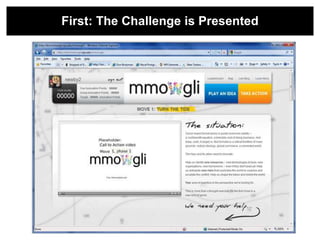
MMOWGLI (Massive Multiplayer Online WarGame Leveraging the Internet)
marks the first major effort by the American military to help "crowdsource"
       new ideas and different opinions to look at hard problems.
First: The Challenge is Presented
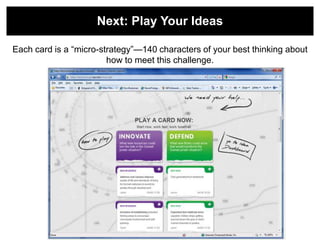
Next: Play Your Ideas

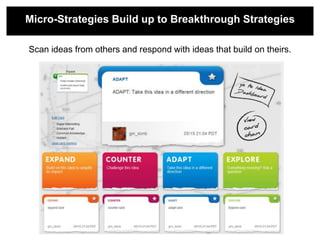
Each card is a ―micro-strategy‖—140 characters of your best thinking about
                        how to meet this challenge.
Micro-Strategies Build up to Breakthrough Strategies

Scan ideas from others and respond with ideas that build on theirs.
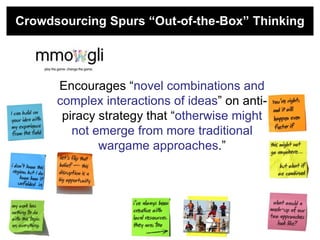
Crowdsourcing Spurs “Out-of-the-Box” Thinking


      Encourages ―novel combinations and
      complex interactions of ideas‖ on anti-
       piracy strategy that ―otherwise might
         not emerge from more traditional
              wargame approaches.‖
Methods for Supporting Emergent Practices


Social Media integrated with Serious Games
• Identify expert performer patterns
• Convert tacit knowledge to explicit knowledge
• Continuously improve training


Social Media integrated with Enterprise Portal Applications
• Real-time conversation & collaboration
• Fostering of communities of practice (CoP)
• Provides for communication, synthesis, and creative tension
Methods for Supporting Emergent Practices


Social Media integrated with Serious Games
• Identify expert performer patterns
• Convert tacit knowledge to explicit knowledge
• Continuously improve training


Social Media integrated with Enterprise Portal Applications
• Real-time conversation & collaboration
                                           Micro-Blogging
• Fostering of communities of practice (CoP)
• Provides for communication, synthesis, and creative tension
What is Micro-Blogging?

Micro-blogging is

• A form of blogging that allows users to write brief
  text updates (usually less than 140 characters) and
  publish them.

• Can be viewed by anyone or by a restricted group
  chosen by the user.
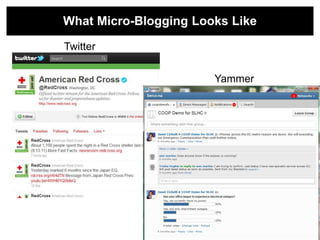
What Micro-Blogging Looks Like

Twitter


                       Yammer
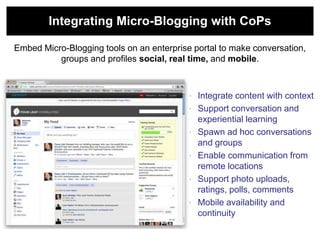
Integrating Micro-Blogging with CoPs

Embed Micro-Blogging tools on an enterprise portal to make conversation,
          groups and profiles social, real time, and mobile.


                                           • Integrate content with context
                                           • Support conversation and
                                               experiential learning
                                           •   Spawn ad hoc conversations
                                               and groups
                                           •   Enable communication from
                                               remote locations
                                           •   Support photo uploads,
                                               ratings, polls, comments
                                           •   Mobile availability and
                                               continuity
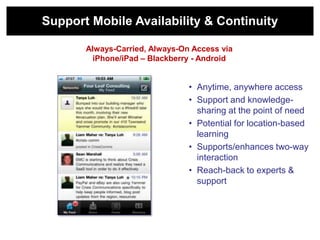
Support Mobile Availability & Continuity

       Always-Carried, Always-On Access via
         iPhone/iPad – Blackberry - Android


                                • Anytime, anywhere access
                                • Support and knowledge-
                                  sharing at the point of need
                                • Potential for location-based
                                  learning
                                • Supports/enhances two-way
                                  interaction
                                • Reach-back to experts &
                                  support
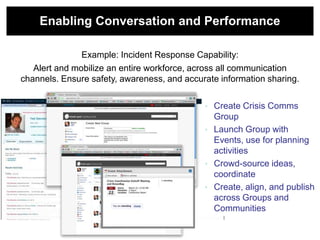
Enabling Conversation and Performance

               Example: Incident Response Capability:
   Alert and mobilize an entire workforce, across all communication
channels. Ensure safety, awareness, and accurate information sharing.


                                             • Create Crisis Comms
                                               Group
                                             • Launch Group with
                                               Events, use for planning
                                               activities
                                             • Crowd-source ideas,
                                               coordinate
                                             • Create, align, and publish
                                               across Groups and
                                               Communities
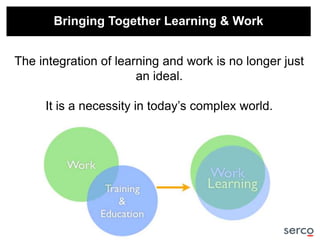
Bringing Together Learning & Work


The integration of learning and work is no longer just
                       an ideal.

     It is a necessity in today’s complex world.
In Summary


•        New work problems are increasingly complex

•        Less about trying to determine a lock-step process
         toward a predictable outcome

•        More about supporting and influencing possibilities

•        Falls squarely into the Human Performance domain

•        Requires tacit knowledge that cannot be documented
         as best practice

•        Social media tools and methods can support

    31   emergent practices
Questions? Conversation.


            Janet Cichelli
Practice Manager, Advanced Learning & KM
            Serco North America
                240-778-1223
        janet.cichelli@serco-na.com

Tacit Knowledge Sharing for Emerging Practices

  • 1.
    Developing Emergent Practices throughTacit Knowledge Sharing Presented at: The United States Coast Guard Human Performance Technology Conference September 15, 2011 - Williamsburg, Virginia Ms. Janet Cichelli Serco, Inc. LinkedIn: janet-cichelli
  • 2.
    Today’s Increasingly ComplexWork Environment The ability to figure things out, especially wicked problems, is now a key competency. Wicked problems differ from very hard problems. Developing a new weapon system is a hard problem, but it's not wicked, because the goal is pretty straightforward. • Righting a troubled economy • Deepwater Horizon Oil Spill • Haiti, Katrina --Now, that’s wicked
  • 3.
    Knowledge • Knowledge iswhat people use to make decisions, such as whether to Explicit Knowledge correct a navigation course, or which action to take next. Tacit Knowledge • Knowledge may reside in people’s heads (expertise), information systems (data), or documents (information) • Knowledge can be created (innovation), moved (shared), or destroyed.
  • 4.
    Knowledge Management • Knowledgecan be managed directly, e.g., by embedding knowledge tools and techniques in the work environment • Knowledge can be managed indirectly, by fostering an environment where knowledge activities (e.g., creation and sharing) are encouraged.
  • 5.
    Most Tasks Involvea Combination of Data, Information & Expertise
  • 6.
    The Human ElementIncreases as Knowledge Becomes More Complex
  • 7.
    The Work &Problem Domain Complex Complicated A way to look at our work environments, in terms of the nature of the problems or tasks we face. Chaotic Simple * Content from jarche.com is protected under a Creative Commons Attribution-NonCommercial License
  • 8.
    Simple Problems Some problems are Simple Complex Complicated Subject to simple cause and effect. Predictable: I do this and that always happens. Chaotic Simple
  • 9.
    Complicated Problems Some problems are Complicated Complex Complicated • Requires a body of knowledge • Specialists invest in this body of knowledge. • Trainers seek to transfer this body of knowledge. • This can sometimes be Chaotic Simple limiting – get so invested in the Complicated that we can get ―stuck.‖
  • 10.
    Complex Problems The newcannot be known. New problems tend to be Complex or Chaotic. Complex Complicated • We can only know the cause and effect after the event. • Practices emerge via trial and error, and interaction . with the changing environment and the problem. • We must engage the problem and learn by Chaotic Simple probing. • Requires different approach to training for defined Methods to solve simple and complicated problems problems and measurable will not work with complex ones outcomes.
  • 11.
    The Work &Problem Domain Complex Complicated Emergent Good Practice Practice Novel Best Practice Practice Chaotic Simple
  • 12.
    Training Challenges Training looks backwards, at what Complex Complicated worked in the past (good & best practices), and Emergent Good creates a controlled Practice Practice environment to develop knowledge and skills. Novel Best Training Practice Practice Chaotic Simple
  • 13.
    To Address Complexity,Organizations Need to Support Emergent Work Practices This means having an environment to support • collaboration, • conversation, • synthesis, • pattern recognition, • and creative tension all within a secure and trusting environment.
  • 14.
    The Power ofSocial Media is Its Potential to Support Emergent Work Practices Tools and social networks: • Enable conversation and collaboration • Has greatest value in sharing tacit knowledge • Can directly support emergent work practices How social media tools get used is itself an emergent practice.
  • 15.
    Methods for SupportingEmergent Practices Social Media integrated with Serious Games • Identify expert performer patterns • Convert tacit knowledge to explicit knowledge • Continuously improve training Social Media integrated with Enterprise Portal Applications • Real-time conversation & collaboration • Fostering of communities of practice (CoP) • Provides for communication, synthesis, and creative tension
  • 16.
    Methods for SupportingEmergent Practices Social Media integrated with Serious Games • Identify expert performer patterns Crowdsourcing • Convert tacit knowledge to explicit knowledge • Continuously improve training Social Media integrated with Enterprise Portal Applications • Real-time conversation & collaboration • Fostering of communities of practice (CoP) • Provides for communication, synthesis, and creative tension
  • 17.
    What is Crowdsourcing? Crowdsourcingis • a social networking method that leverages the collective experience and intelligence of a group. • the act of outsourcing tasks, traditionally performed by an employee or contractor, to an undefined, large group of people or community (a "crowd"), through an open call (www.wikipedia.com).
  • 18.
    Crowdsourcing Emergent Practicesfor Fighting Somali Pirates Somalia has complex economic, social, and political problems The complexity and uncertainty make it difficult to arrive at simple solutions. The diversity of interests and perspectives will confound future solutions, military or otherwise. MMOWGLI (Massive Multiplayer Online WarGame Leveraging the Internet) marks the first major effort by the American military to help "crowdsource" new ideas and different opinions to look at hard problems.
  • 19.
  • 20.
    Next: Play YourIdeas Each card is a ―micro-strategy‖—140 characters of your best thinking about how to meet this challenge.
  • 21.
    Micro-Strategies Build upto Breakthrough Strategies Scan ideas from others and respond with ideas that build on theirs.
  • 22.
    Crowdsourcing Spurs “Out-of-the-Box”Thinking Encourages ―novel combinations and complex interactions of ideas‖ on anti- piracy strategy that ―otherwise might not emerge from more traditional wargame approaches.‖
  • 23.
    Methods for SupportingEmergent Practices Social Media integrated with Serious Games • Identify expert performer patterns • Convert tacit knowledge to explicit knowledge • Continuously improve training Social Media integrated with Enterprise Portal Applications • Real-time conversation & collaboration • Fostering of communities of practice (CoP) • Provides for communication, synthesis, and creative tension
  • 24.
    Methods for SupportingEmergent Practices Social Media integrated with Serious Games • Identify expert performer patterns • Convert tacit knowledge to explicit knowledge • Continuously improve training Social Media integrated with Enterprise Portal Applications • Real-time conversation & collaboration Micro-Blogging • Fostering of communities of practice (CoP) • Provides for communication, synthesis, and creative tension
  • 25.
    What is Micro-Blogging? Micro-bloggingis • A form of blogging that allows users to write brief text updates (usually less than 140 characters) and publish them. • Can be viewed by anyone or by a restricted group chosen by the user.
  • 26.
    What Micro-Blogging LooksLike Twitter Yammer
  • 27.
    Integrating Micro-Blogging withCoPs Embed Micro-Blogging tools on an enterprise portal to make conversation, groups and profiles social, real time, and mobile. • Integrate content with context • Support conversation and experiential learning • Spawn ad hoc conversations and groups • Enable communication from remote locations • Support photo uploads, ratings, polls, comments • Mobile availability and continuity
  • 28.
    Support Mobile Availability& Continuity Always-Carried, Always-On Access via iPhone/iPad – Blackberry - Android • Anytime, anywhere access • Support and knowledge- sharing at the point of need • Potential for location-based learning • Supports/enhances two-way interaction • Reach-back to experts & support
  • 29.
    Enabling Conversation andPerformance Example: Incident Response Capability: Alert and mobilize an entire workforce, across all communication channels. Ensure safety, awareness, and accurate information sharing. • Create Crisis Comms Group • Launch Group with Events, use for planning activities • Crowd-source ideas, coordinate • Create, align, and publish across Groups and Communities
  • 30.
    Bringing Together Learning& Work The integration of learning and work is no longer just an ideal. It is a necessity in today’s complex world.
  • 31.
    In Summary • New work problems are increasingly complex • Less about trying to determine a lock-step process toward a predictable outcome • More about supporting and influencing possibilities • Falls squarely into the Human Performance domain • Requires tacit knowledge that cannot be documented as best practice • Social media tools and methods can support 31 emergent practices
  • 32.
    Questions? Conversation. Janet Cichelli Practice Manager, Advanced Learning & KM Serco North America 240-778-1223 janet.cichelli@serco-na.com