Systema(c	
  Inven(ve	
  Thinking	
  Systematic Inventive Thinking ©
SIT
Systematic Inventive Thinking
Systematic Inventive Thinking ©
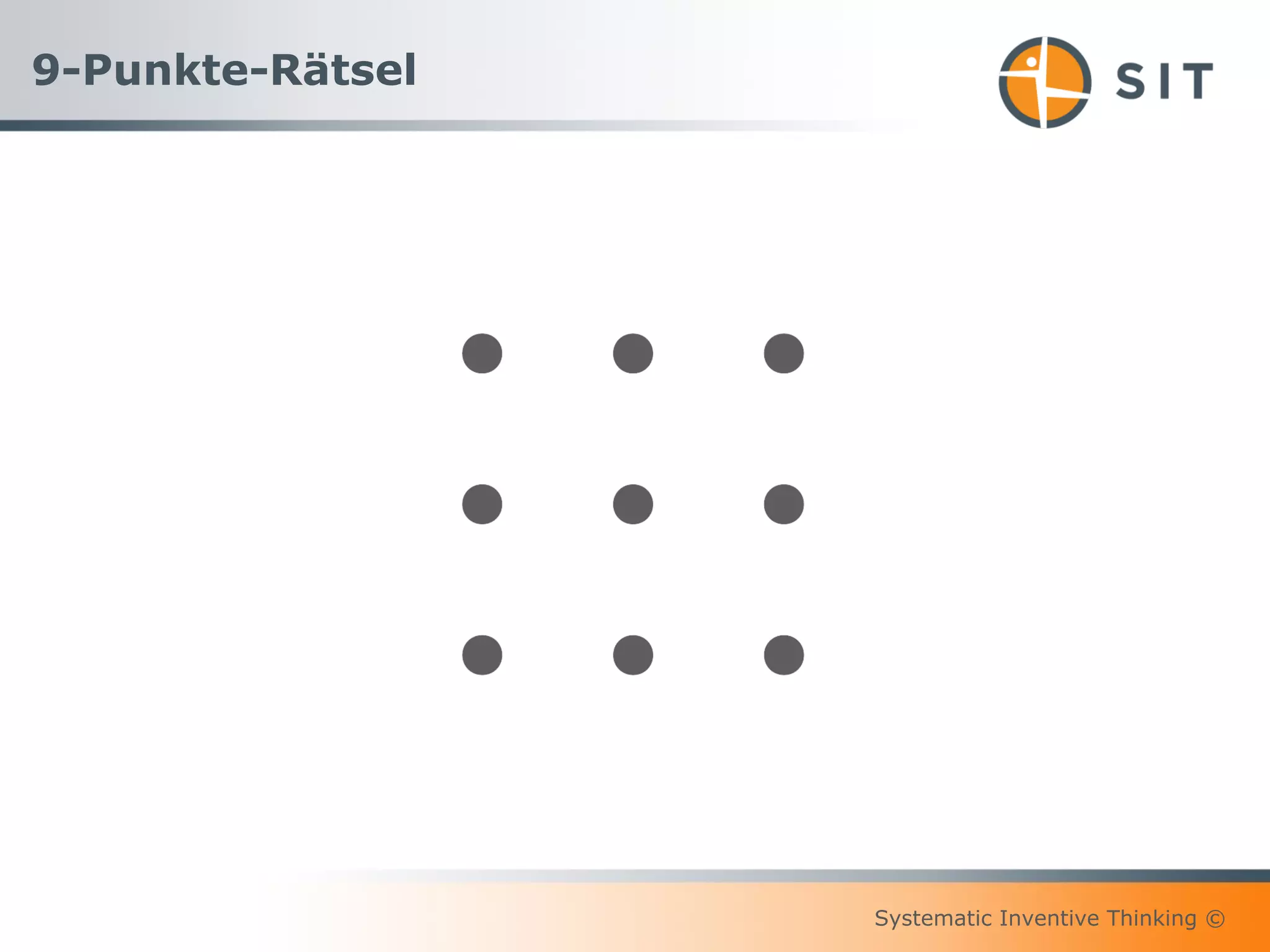
9-Punkte-Rätsel
Systematic Inventive Thinking ©
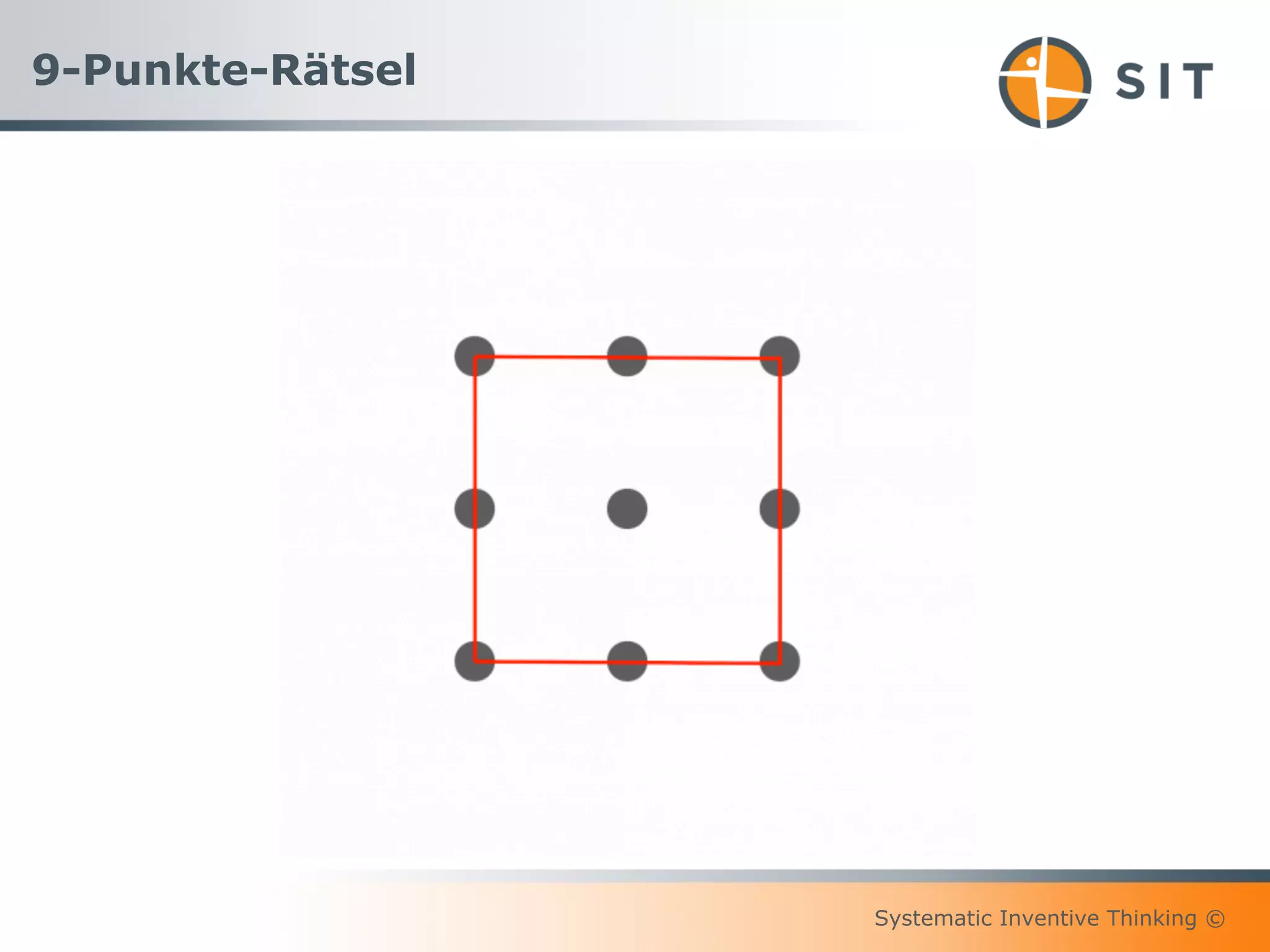
9-Punkte-Rätsel
Systematic Inventive Thinking ©
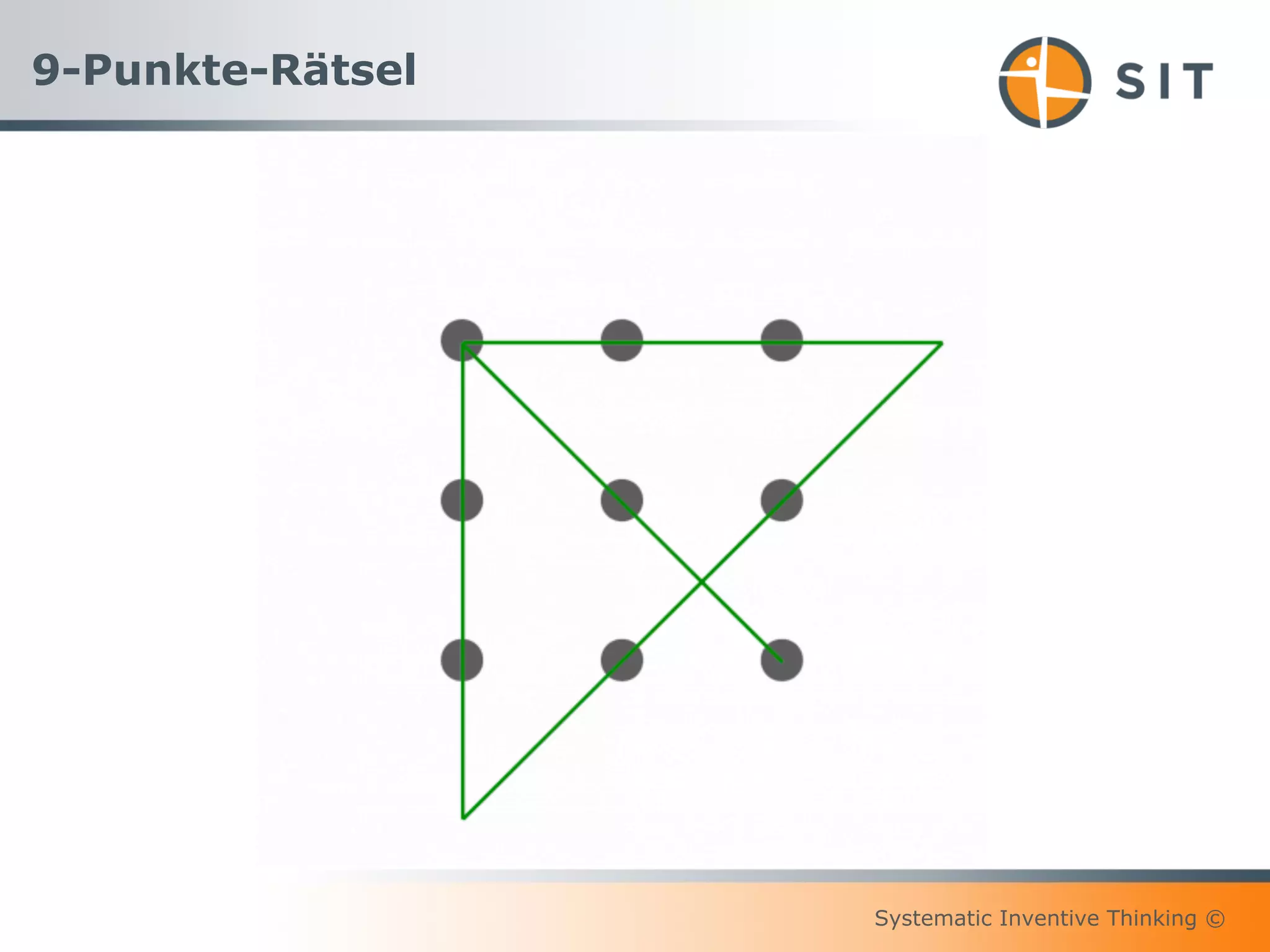
9-Punkte-Rätsel
Systematic Inventive Thinking ©
3-Ringe
Systematic Inventive Thinking ©
Kreativität
Systematic Inventive Thinking ©
Kreativität
“Crea(vity	
  is	
  a	
  divine	
  spark	
  that	
  may	
  not	
  be	
  
dismantled	
  and	
  examined	
  by	
  use	
  of	
  scien(fic	
  
tools”	
  	
  
(Carl	
  Popper)	
  	
  
Systematic Inventive Thinking ©
SIT Geschichte
Systematic Inventive Thinking ©
Kreativität
“I'll	
  be	
  more	
  enthusias(c	
  about	
  encouraging	
  
thinking	
  outside	
  the	
  box	
  when	
  there's	
  
evidence	
  of	
  any	
  thinking	
  going	
  on	
  inside	
  it.”	
  	
  
(Terry	
  PratcheF)	
  	
  
Systematic Inventive Thinking ©
Übung
Systematic Inventive Thinking ©
Film
Systematic Inventive Thinking ©
Dr. Ronald D. Finke, Ph.D.
Systematic Inventive Thinking ©
FFF
Current	
  Situa0on	
  
Product,	
  Service,	
  Process,	
  
Communica(on,	
  System...etc	
  
Virtual	
  Situa0on	
  
Benefit/Market	
  
	
  Iden(fy	
  customer	
  needs	
  
Challenges	
  
Technology,	
  Know-­‐How,	
  Ressources,	
  
etc…	
  
Adap0on	
  	
  
to	
  form	
  a	
  realis(c	
  idea	
  
SIT	
  Tools	
  
Manipula(on	
  
Idea!	
  
”Mechanical	
  
Process”	
  
F
O
R
M	
  
F
U
N
C	
  
T	
  
I	
  
O
N	
  
Marke3ng	
  
Feasibility	
  
Reality	
  Filter	
  
Subtrac(on	
  
Task	
  Unifica(on	
  
Mul(plica(on	
  
AFribute	
  
Dependeny	
  
Divison	
  
Systematic Inventive Thinking ©
Prof. Jacob Goldenberg
Systematic Inventive Thinking ©
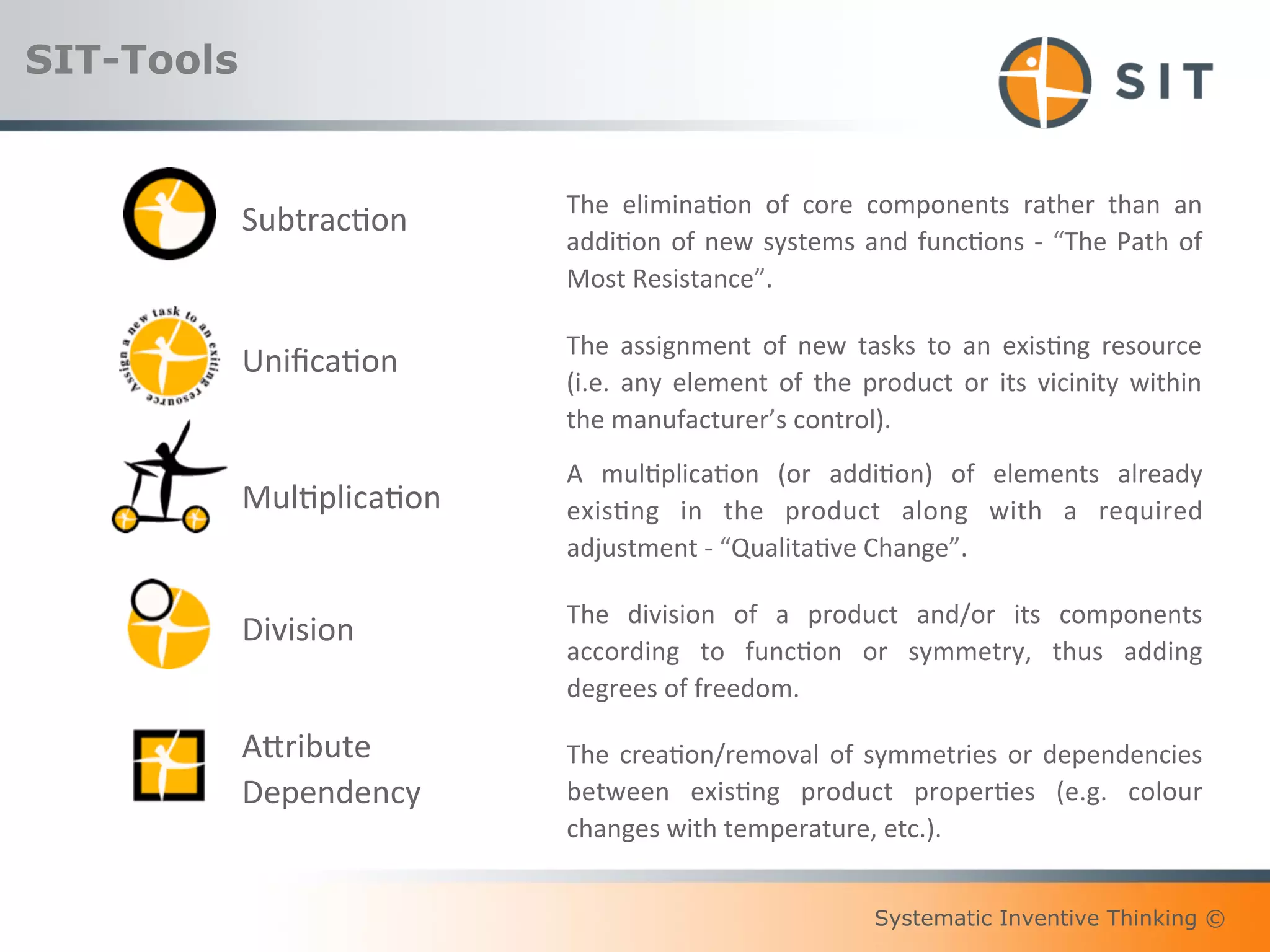
SIT-Tools
The	
  crea(on/removal	
  of	
  symmetries	
  or	
  dependencies	
  
between	
   exis(ng	
   product	
   proper(es	
   (e.g.	
   colour	
  
changes	
  with	
  temperature,	
  etc.).	
  
AFribute	
  
Dependency	
  
The	
   assignment	
   of	
   new	
   tasks	
   to	
   an	
   exis(ng	
   resource	
  
(i.e.	
   any	
   element	
   of	
   the	
   product	
   or	
   its	
   vicinity	
   within	
  
the	
  manufacturer’s	
  control).	
  
Unifica(on	
  
The	
   elimina(on	
   of	
   core	
   components	
   rather	
   than	
   an	
  
addi(on	
  of	
  new	
  systems	
  and	
  func(ons	
  -­‐	
  “The	
  Path	
  of	
  
Most	
  Resistance”.	
  
Subtrac(on	
  
A	
   mul(plica(on	
   (or	
   addi(on)	
   of	
   elements	
   already	
  
exis(ng	
   in	
   the	
   product	
   along	
   with	
   a	
   required	
  
adjustment	
  -­‐	
  “Qualita(ve	
  Change”.	
  
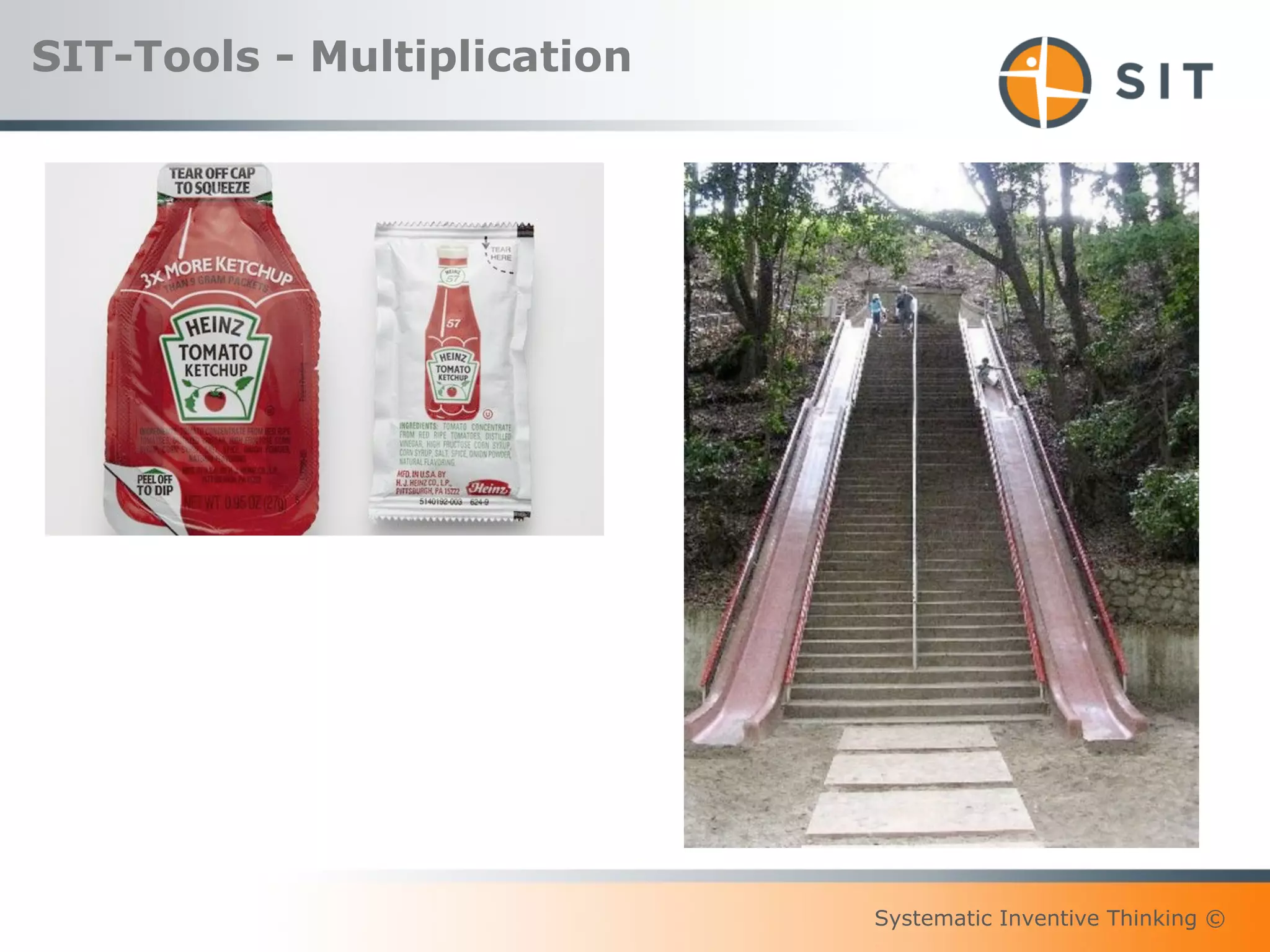
Mul(plica(on	
  
The	
   division	
   of	
   a	
   product	
   and/or	
   its	
   components	
  
according	
   to	
   func(on	
   or	
   symmetry,	
   thus	
   adding	
  
degrees	
  of	
  freedom.	
  
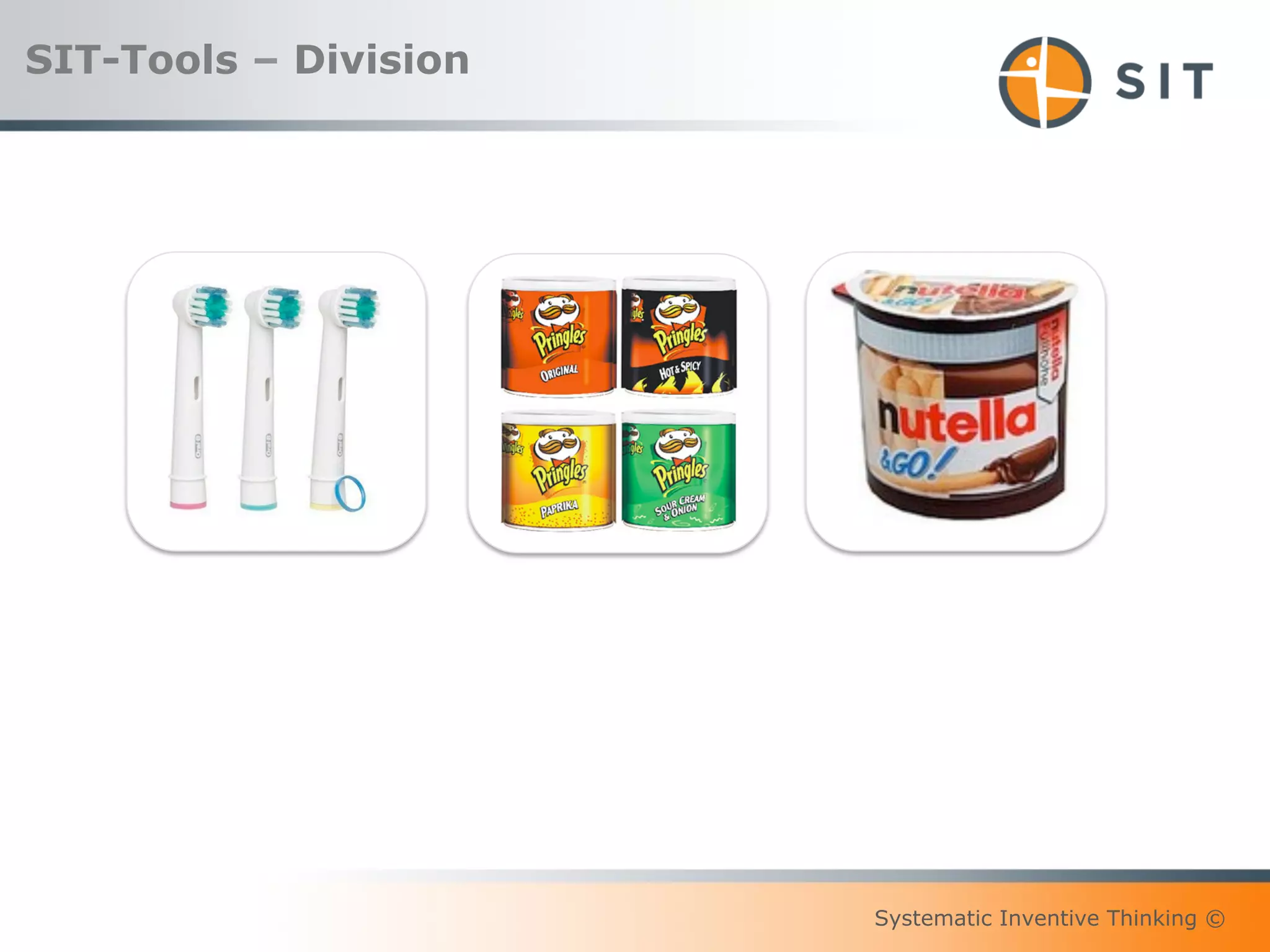
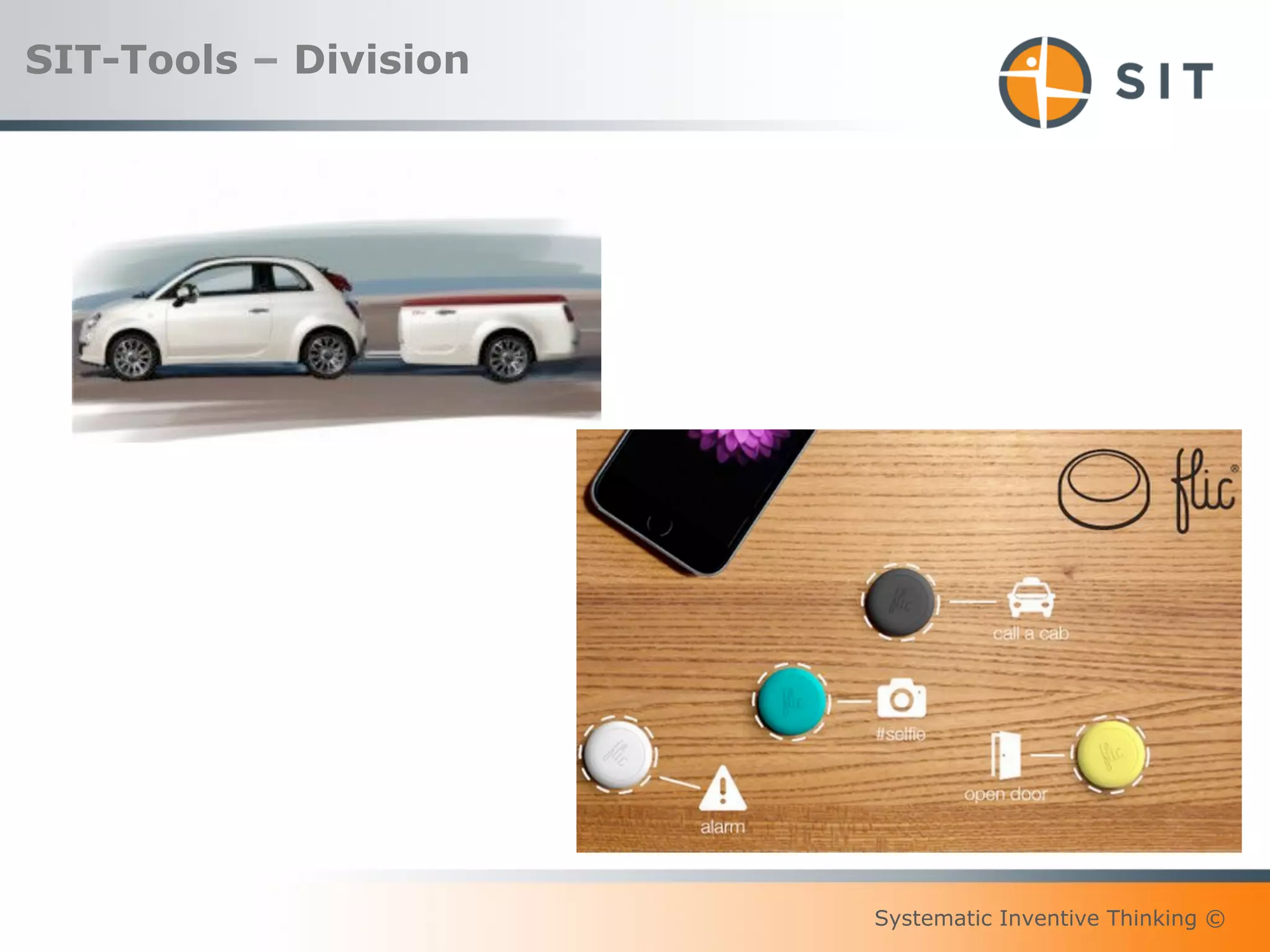
Division	
  
Systematic Inventive Thinking ©
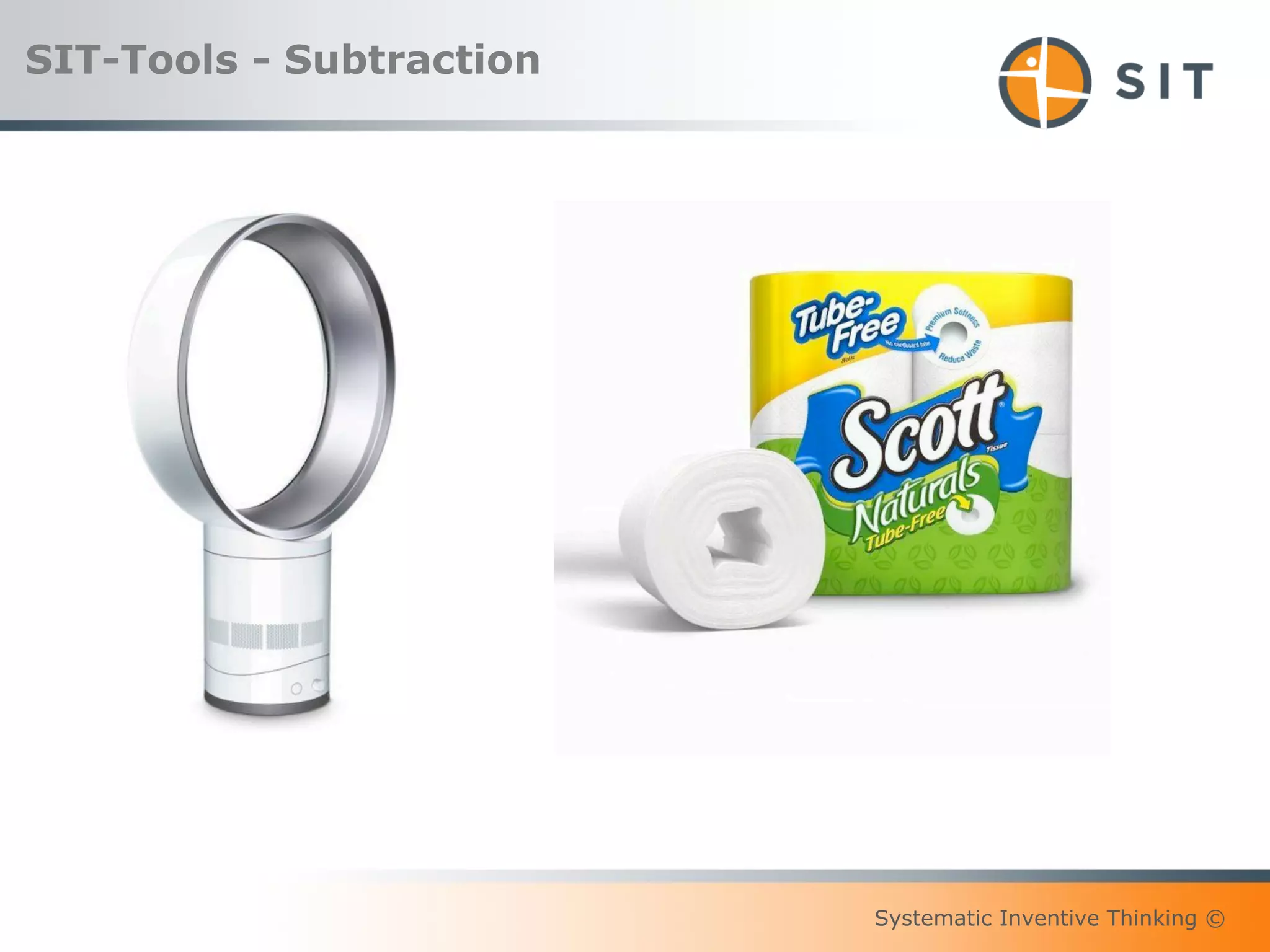
SIT-Tools - Subtraction
© Copyright 2010, SIT
S I T!
Deutschland!
DNA of successful innovation
1. SIT Tool - Subtraction
Systematic Inventive Thinking ©
SIT-Tools - Subtraction
Systematic Inventive Thinking ©
SIT Tools – Task Unification
yright 2010, SIT
S
Deu
Task Unification
Systematic Inventive Thinking ©
SIT Tools – Task Unification
Systematic Inventive Thinking ©
SIT Tools – Task Unification
Systematic Inventive Thinking ©
SIT-Tools - Multiplication
© Copyright 2010, SIT
S I T!
Deutschland!
Product examples for SIT Tool
Multiplication
Systematic Inventive Thinking ©
SIT-Tools - Multiplication
Systematic Inventive Thinking ©
SIT-Tools – Division
opyright 2010, SIT
S I
Deutschla
Division
Systematic Inventive Thinking ©
SIT-Tools – Division
Systematic Inventive Thinking ©
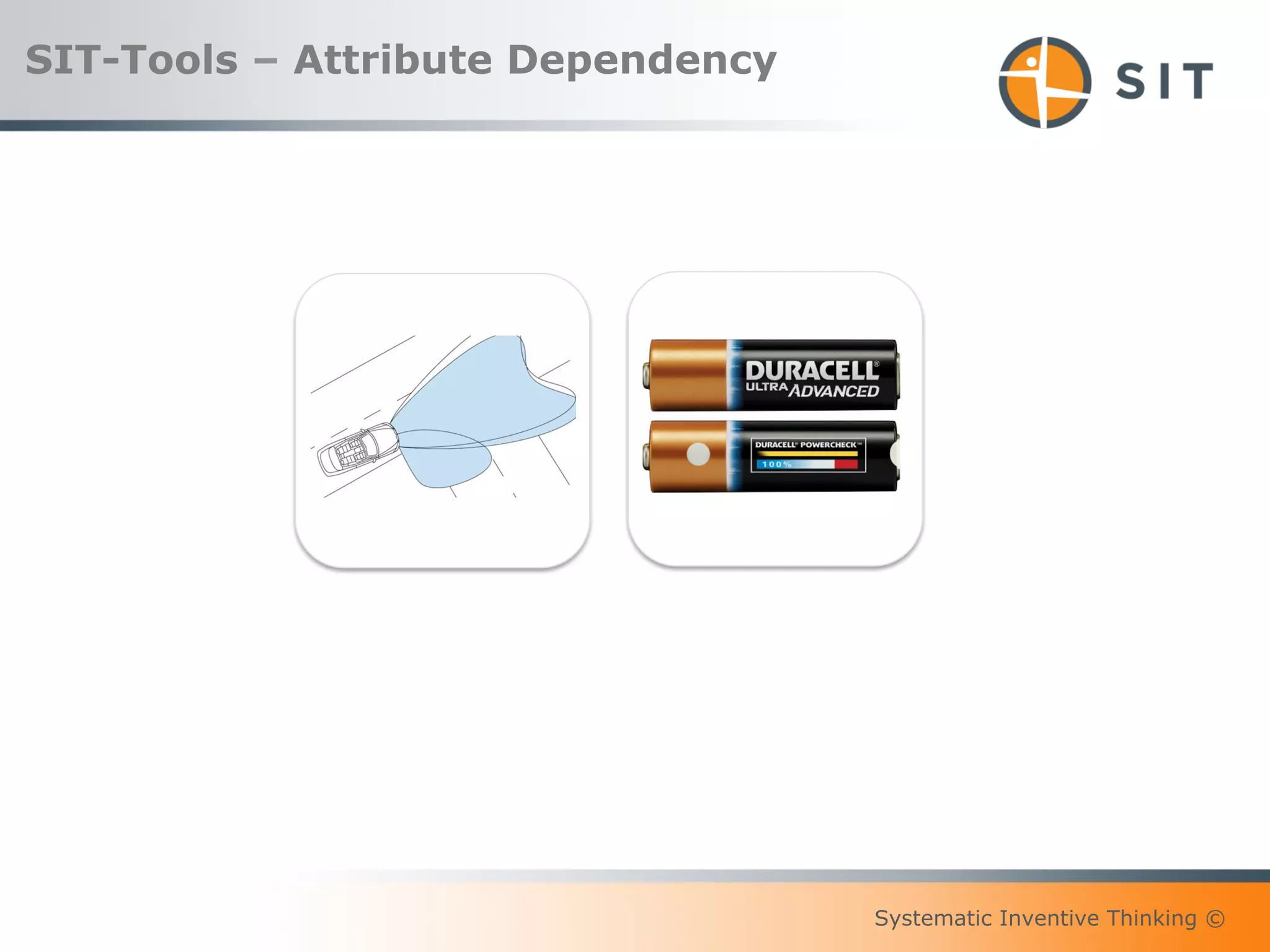
SIT-Tools – Attribute Dependency
S I T!
Deutschland!
Product examples for SIT Tool
Attribute Dependency
Systematic Inventive Thinking ©
SIT-Tools – Attribute Dependency
Systematic Inventive Thinking ©
SIT-Tools – Attribute Dependency
Systematic Inventive Thinking ©
Market Awareness
“If	
  I	
  had	
  asked	
  my	
  customers	
  what	
  they	
  
wanted,	
  they	
  would	
  have	
  said	
  faster	
  
horses.”	
  (Henry	
  Ford)	
  
•  Latent	
  need	
  
•  Failure	
  of	
  market	
  surveys	
  	
  
•  Crea(ve	
  &	
  novel	
  ideas	
  
•  Saturated	
  need	
  
•  Fierce	
  
compe((on	
  
•  ”Me-­‐too”	
  
products	
  
Market	
  Awareness	
  
Time	
  
Systematic Inventive Thinking ©
Innova0on	
  Sweet	
  Spot	
  
Near	
  Ideas	
  –	
  Small	
  changes	
  
Ideas	
  too	
  close	
  should	
  be	
  
brought	
  further	
  away	
  –	
  to	
  
sweet	
  spot	
  
Far	
  Ideas	
  –	
  Too	
  resource	
  
intensive.	
  Ideas	
  too	
  far	
  
should	
  be	
  brought	
  closer	
  –	
  to	
  
sweet	
  spot	
  
SIT	
  Principle:	
  
”Qualita(ve	
  Change”	
  -­‐	
  
pushing	
  ideas	
  further	
  
away	
  
SIT	
  Principle	
  
”Closed	
  World”	
  –	
  ensures	
  that	
  
ideas	
  are	
  not	
  too	
  far	
  away	
  
Focus	
  
Star(ng	
  
point	
  
Systematic Inventive Thinking ©
The SIT Onion - Tools
Tools	
  
Subtrac(on	
  
Task Unifica(on	
  
AFribute	
  Dependency	
  
Mul(plica(on	
  
Division	
  
Systematic Inventive Thinking ©
The SIT Onion - Skills on different Levels
Systematic Inventive Thinking ©
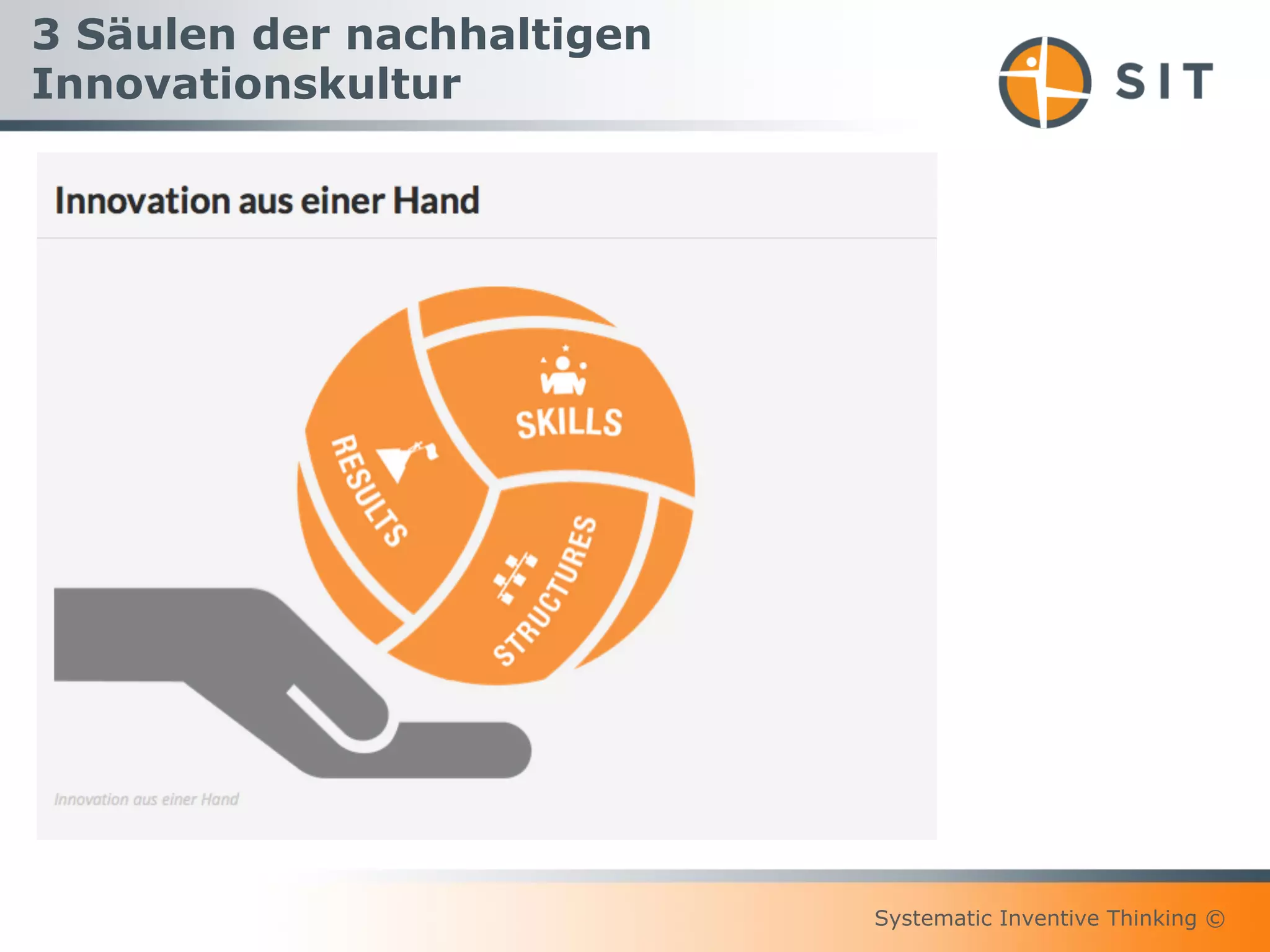
3 Säulen der nachhaltigen
Innovationskultur
Systematic Inventive Thinking ©
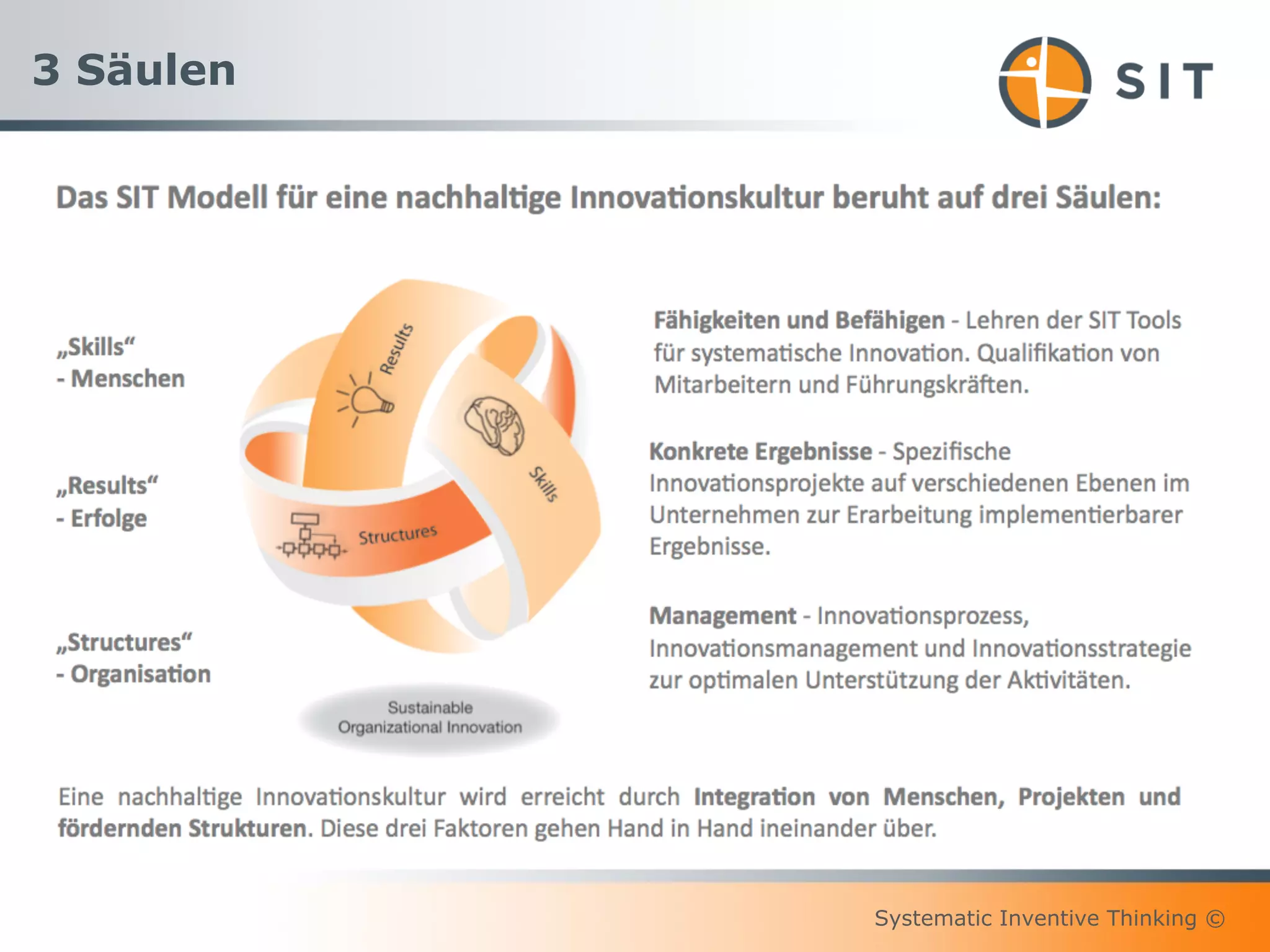
3 Säulen
Systematic Inventive Thinking ©
SIT Kunden
Systematic Inventive Thinking ©
Danke!
Dipl.-­‐Ing.	
  Philipp	
  Gasteiger	
  
philipp@sitgermany.com	
  

Systematische Innovation - 'Ideen finden' kann man lernen - Systematic Inventive Thinking

  • 1.
    Systema(c  Inven(ve  Thinking  Systematic Inventive Thinking © SIT Systematic Inventive Thinking
  • 2.
    Systematic Inventive Thinking© 9-Punkte-Rätsel
  • 3.
    Systematic Inventive Thinking© 9-Punkte-Rätsel
  • 4.
    Systematic Inventive Thinking© 9-Punkte-Rätsel
  • 5.
  • 6.
  • 7.
    Systematic Inventive Thinking© Kreativität “Crea(vity  is  a  divine  spark  that  may  not  be   dismantled  and  examined  by  use  of  scien(fic   tools”     (Carl  Popper)    
  • 8.
  • 9.
    Systematic Inventive Thinking© Kreativität “I'll  be  more  enthusias(c  about  encouraging   thinking  outside  the  box  when  there's   evidence  of  any  thinking  going  on  inside  it.”     (Terry  PratcheF)    
  • 10.
  • 11.
  • 12.
    Systematic Inventive Thinking© Dr. Ronald D. Finke, Ph.D.
  • 13.
    Systematic Inventive Thinking© FFF Current  Situa0on   Product,  Service,  Process,   Communica(on,  System...etc   Virtual  Situa0on   Benefit/Market    Iden(fy  customer  needs   Challenges   Technology,  Know-­‐How,  Ressources,   etc…   Adap0on     to  form  a  realis(c  idea   SIT  Tools   Manipula(on   Idea!   ”Mechanical   Process”   F O R M   F U N C   T   I   O N   Marke3ng   Feasibility   Reality  Filter   Subtrac(on   Task  Unifica(on   Mul(plica(on   AFribute   Dependeny   Divison  
  • 14.
    Systematic Inventive Thinking© Prof. Jacob Goldenberg
  • 15.
    Systematic Inventive Thinking© SIT-Tools The  crea(on/removal  of  symmetries  or  dependencies   between   exis(ng   product   proper(es   (e.g.   colour   changes  with  temperature,  etc.).   AFribute   Dependency   The   assignment   of   new   tasks   to   an   exis(ng   resource   (i.e.   any   element   of   the   product   or   its   vicinity   within   the  manufacturer’s  control).   Unifica(on   The   elimina(on   of   core   components   rather   than   an   addi(on  of  new  systems  and  func(ons  -­‐  “The  Path  of   Most  Resistance”.   Subtrac(on   A   mul(plica(on   (or   addi(on)   of   elements   already   exis(ng   in   the   product   along   with   a   required   adjustment  -­‐  “Qualita(ve  Change”.   Mul(plica(on   The   division   of   a   product   and/or   its   components   according   to   func(on   or   symmetry,   thus   adding   degrees  of  freedom.   Division  
  • 16.
    Systematic Inventive Thinking© SIT-Tools - Subtraction © Copyright 2010, SIT S I T! Deutschland! DNA of successful innovation 1. SIT Tool - Subtraction
  • 17.
    Systematic Inventive Thinking© SIT-Tools - Subtraction
  • 18.
    Systematic Inventive Thinking© SIT Tools – Task Unification yright 2010, SIT S Deu Task Unification
  • 19.
    Systematic Inventive Thinking© SIT Tools – Task Unification
  • 20.
    Systematic Inventive Thinking© SIT Tools – Task Unification
  • 21.
    Systematic Inventive Thinking© SIT-Tools - Multiplication © Copyright 2010, SIT S I T! Deutschland! Product examples for SIT Tool Multiplication
  • 22.
    Systematic Inventive Thinking© SIT-Tools - Multiplication
  • 23.
    Systematic Inventive Thinking© SIT-Tools – Division opyright 2010, SIT S I Deutschla Division
  • 24.
    Systematic Inventive Thinking© SIT-Tools – Division
  • 25.
    Systematic Inventive Thinking© SIT-Tools – Attribute Dependency S I T! Deutschland! Product examples for SIT Tool Attribute Dependency
  • 26.
    Systematic Inventive Thinking© SIT-Tools – Attribute Dependency
  • 27.
    Systematic Inventive Thinking© SIT-Tools – Attribute Dependency
  • 28.
    Systematic Inventive Thinking© Market Awareness “If  I  had  asked  my  customers  what  they   wanted,  they  would  have  said  faster   horses.”  (Henry  Ford)   •  Latent  need   •  Failure  of  market  surveys     •  Crea(ve  &  novel  ideas   •  Saturated  need   •  Fierce   compe((on   •  ”Me-­‐too”   products   Market  Awareness   Time  
  • 29.
    Systematic Inventive Thinking© Innova0on  Sweet  Spot   Near  Ideas  –  Small  changes   Ideas  too  close  should  be   brought  further  away  –  to   sweet  spot   Far  Ideas  –  Too  resource   intensive.  Ideas  too  far   should  be  brought  closer  –  to   sweet  spot   SIT  Principle:   ”Qualita(ve  Change”  -­‐   pushing  ideas  further   away   SIT  Principle   ”Closed  World”  –  ensures  that   ideas  are  not  too  far  away   Focus   Star(ng   point  
  • 30.
    Systematic Inventive Thinking© The SIT Onion - Tools Tools   Subtrac(on   Task Unifica(on   AFribute  Dependency   Mul(plica(on   Division  
  • 31.
    Systematic Inventive Thinking© The SIT Onion - Skills on different Levels
  • 32.
    Systematic Inventive Thinking© 3 Säulen der nachhaltigen Innovationskultur
  • 33.
  • 34.
  • 35.
    Systematic Inventive Thinking© Danke! Dipl.-­‐Ing.  Philipp  Gasteiger   philipp@sitgermany.com