TRIZ – Innovation Vishwanath Ramdas
Vishwanath Ramdas is … Visit him @  http://gopu44.googlepages.com Process and Business Consultant  Working in areas like ITSM, Software development, process consulting … Based in bangalore [India]
This presentation thanks http://Mazur.net/triz   www.Triz-journal.com
Traditional Approach to innovation Within the scheme of things  Look at analogous solutions to the problem @ hand  The standard approaches are random and pshychological dependent on past experience  Brain storming  Trial and error  This leads to …
Psychologically constrained approach
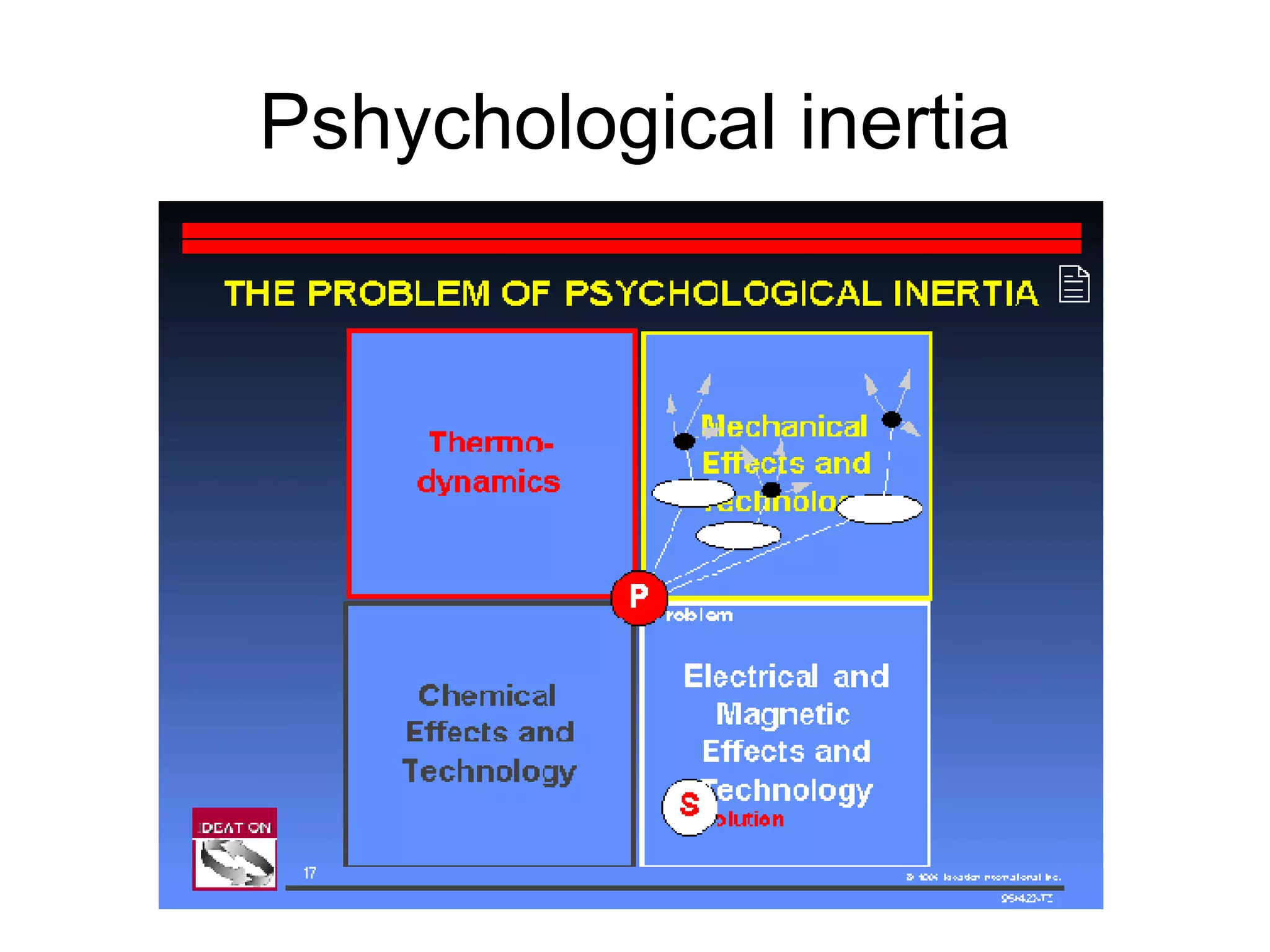
Pshychological inertia. Defined as the inability to go beyond the current realm of knowledge ( within individual or group)  While most solutions are to be found out there!!
Pshychological inertia
Althsuller - TRIZ BASIC PRE-REQS be a systematic, step-by-step procedure  be a guide through a broad solution space to direct to the ideal solution  be repeatable and reliable and not dependent on psychological tools  be able to access the body of inventive knowledge  be able to add to the body of inventive knowledge  be familiar enough to inventors by following the general approach to problem solving in figure 1.
Althsuller studied patents  200,000 ( by now it is 1.4 MM)  Found that only 40K where truly inventive The remaining only straight forward improvements He classified patents by approach and not subject matter to uncover the ideation process He found that true innovation strieved to overcome “CONTRADICTIONS” He also found that most inventions seemed to have similar patterns (40 of them!)
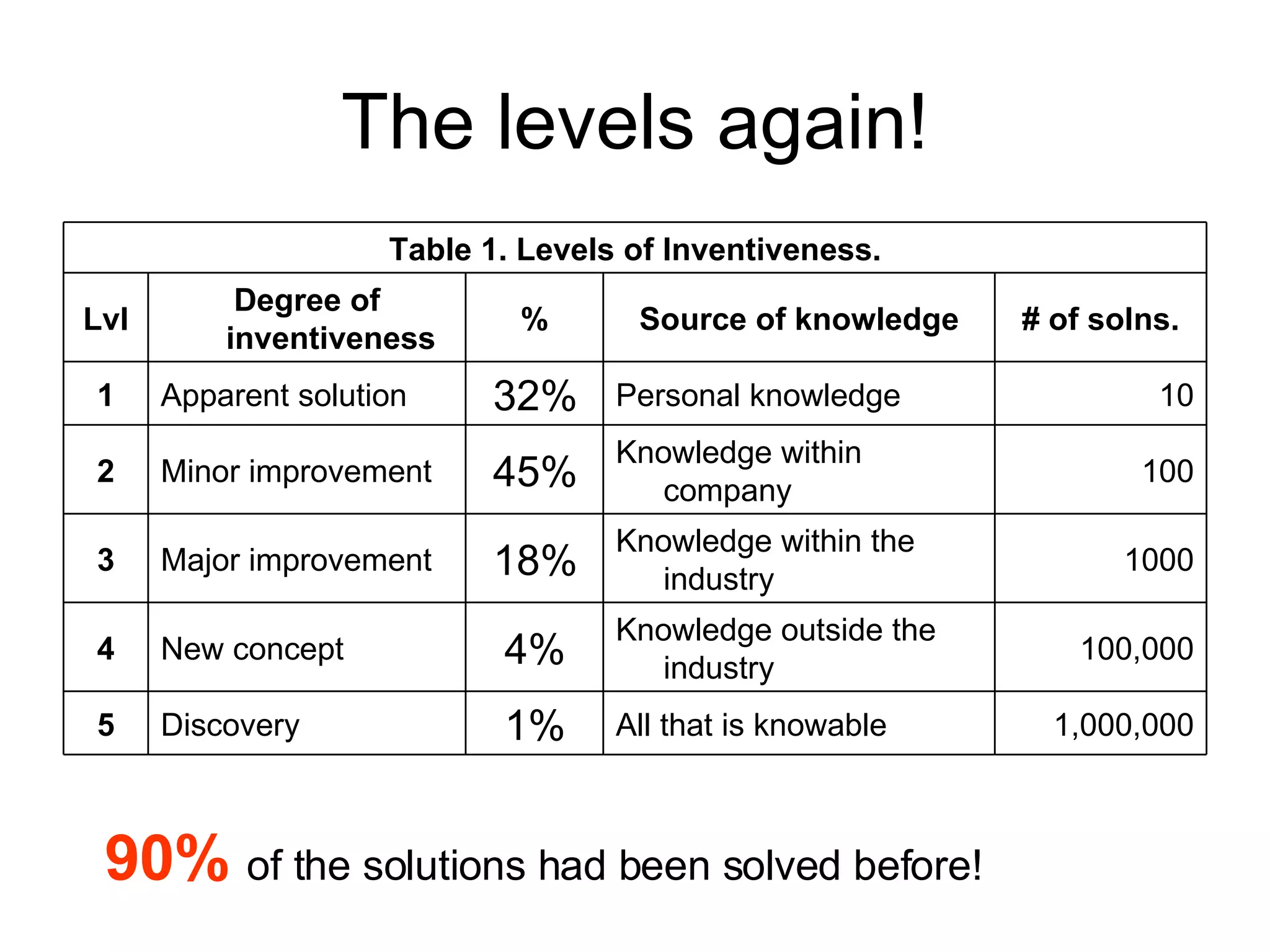
He classified the inventions by their import! Level one. Routine design problems solved by methods well known within the specialty. No invention needed. About 32% of the solutions fell into this level.  Level two. Minor improvements to an existing system, by methods known within the industry. Usually with some compromise. About 45% of the solutions fell into this level.  Level three. Fundamental improvement to an existing system, by methods known outside the industry. Contradictions resolved. About 18% of the solutions fell into this category.  Level four. A new generation that uses a new principle to perform the primary functions of the system. Solution found more in science than in technology. About 4% of the solutions fell into this category.  Level five. A rare scientific discovery or pioneering invention of essentially a new system. About 1% of the solutions fell into this category.
The levels again! 90%  of the solutions had been solved before! 1,000,000 All that is knowable  1% Discovery  5 100,000 Knowledge outside the industry  4% New concept  4 1000 Knowledge within the industry  18% Major improvement  3 100 Knowledge within company  45% Minor improvement  2 10 Personal knowledge  32% Apparent solution  1 # of solns. Source of knowledge % Degree of inventiveness Lvl Table 1. Levels of Inventiveness.
TRIZ – The Approach Step by baby step!
Law of increasing Ideality… Utility  divided by  Harmfulness Harm >> cost, footprint, energy consumed, pollution, danger, etc The faster you get there the more inventive you are! The evolution of the mechanical spring-driven watch into the electronic quartz crystal watch is an example of moving towards ideality.
TRIZ - Approach
The process steps Identifying My Problem. Formulate the problem: the Prism of TRIZ Search for Previously Well-Solved Problem Look for Analogous Solutions and Adapt to My Solution
Identifying My Problem Innovative Situation Questionnaire By Boris Zlotin and Alla Zusman perating environment, resource requirements, primary useful function, harmful effects, and ideal result.
Formulate the problem: the Prism of TRIZ Function Tree Definition Mind Map QFD  System – Sub and Super ! 39 characteristics that cause problem Define the contradictions  Root cause analysis (ishikawa)  Su-Field – Analysis for each component
39 factors Qualities – Static & In Motion (6*2 > 12) Dimension, area, volume, weight, durability, energy  Physical Qualities (7) Shape, strength, speed, pressure, force, brightness, temperature, power Performance Qualities Stability, reliability, control complexity, system complexity Product outcomes (6) Ease of use, ease of repair, harmful side fx, harmful factors, measurement accuracy, manufacturing accuracy Wastes (5) Time, effort, material, materials used, information Process Characteristics (8) Adaptability, manufacturability, productivity,, automation
Mind Map of Factors 39 conflicting parameters Static  Qualities Quality  in motion Phy. Qualities Wastes Processing Outcomes weight Dimension Area Volume Energy Durability weight Dimension Area Volume Energy Durability Force Pressure Temperature Brightness strength Shape Speed Information Material Usage of Mttl time effort Ease of Use Ease of  Repair Accuracy of  manufacture Accuracy of  measurement Reliability Harmful  Side effects Stability Manufacturability Productivity Adaptatbility Harmful  Factors System  complexity Control  complexity Automation Performance Qualities
Look for Analogous Solutions and Adapt to My Solution world wide patents 40 inventive principles  Altshuller - contradiction matrix 39 parameter pairs (39*38 > 1482) With the 40 inventive principles mapped into each cell
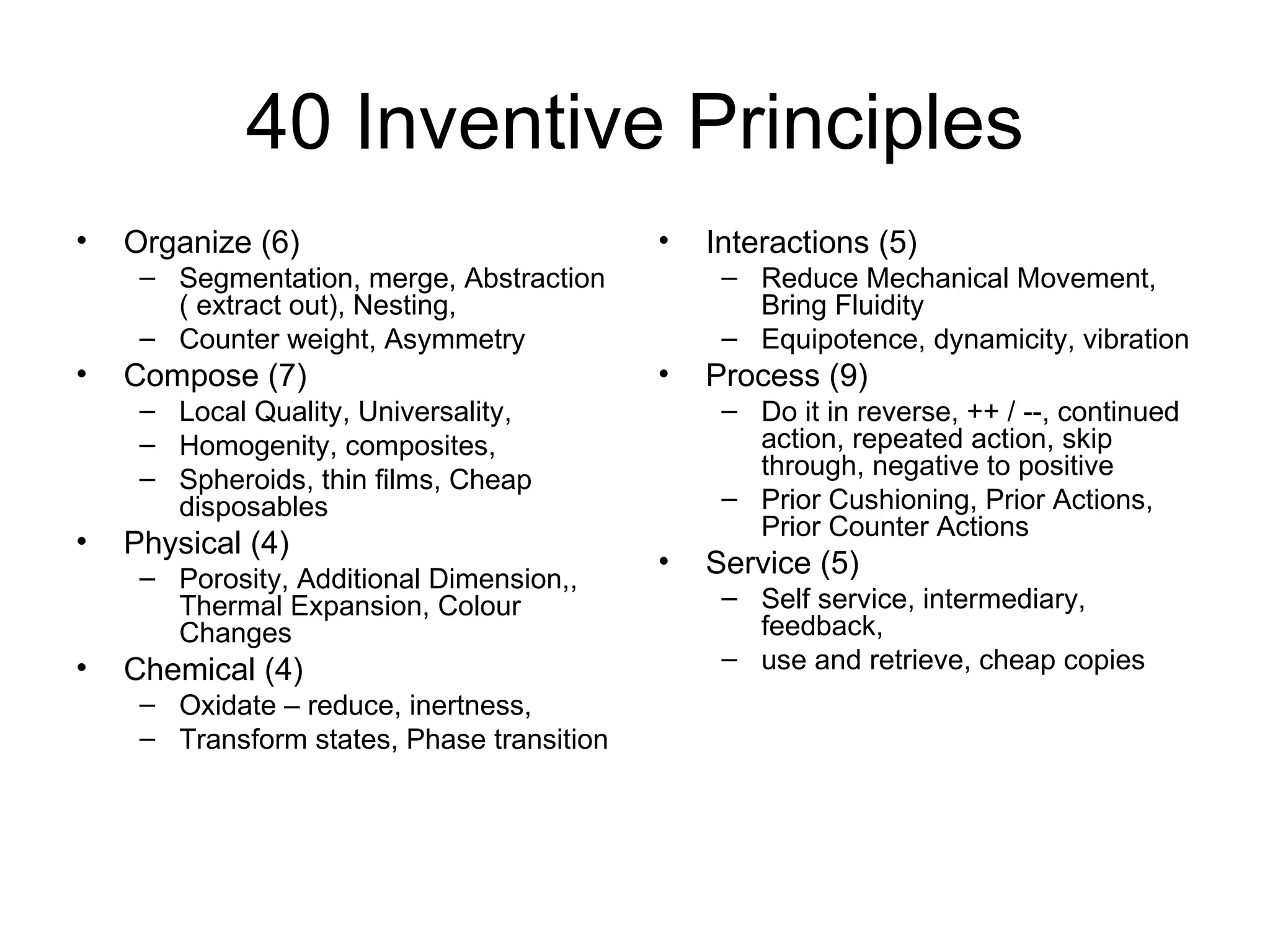
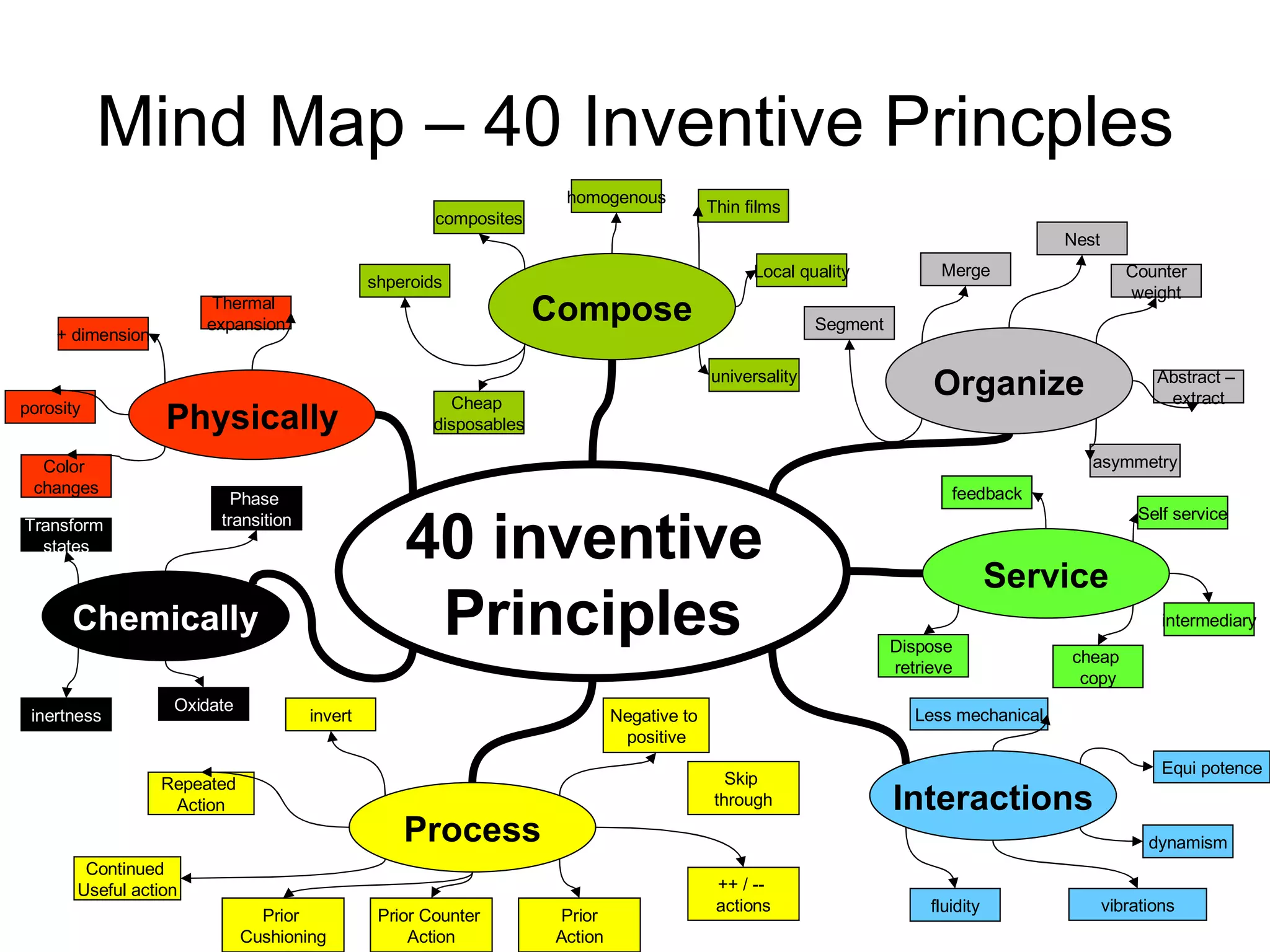
40 Inventive Principles Organize (6) Segmentation, merge, Abstraction ( extract out), Nesting,  Counter weight, Asymmetry Compose (7) Local Quality, Universality, Homogenity, composites, Spheroids, thin films, Cheap disposables Physical (4) Porosity, Additional Dimension,, Thermal Expansion, Colour Changes Chemical (4) Oxidate – reduce, inertness, Transform states, Phase transition Interactions (5) Reduce Mechanical Movement, Bring Fluidity Equipotence, dynamicity, vibration Process (9) Do it in reverse, ++ / --, continued action, repeated action, skip through, negative to positive Prior Cushioning, Prior Actions, Prior Counter Actions Service (5) Self service, intermediary, feedback,  use and retrieve, cheap copies
Mind Map – 40 Inventive Princples 40 inventive  Principles Organize Compose Physically Chemically Interactions Process Nest Segment Counter weight Abstract –  extract asymmetry Merge homogenous Thin films shperoids Local quality universality composites + dimension porosity Color  changes Thermal  expansion intermediary Transform  states inertness Oxidate Phase  transition invert Continued  Useful action Prior  Cushioning ++ / --  actions Self service Repeated  Action feedback vibrations dynamism Equi potence Negative to  positive Dispose  retrieve cheap  copy fluidity Service Prior Counter  Action Prior Action Skip  through Cheap  disposables Less mechanical
Identify my specific problem Patent database search
TRIZ - TRIX
ARIZ - Algorithm for Inventive Problem Solving Formulate the problem. Transform the problem into a model. Analyze the model. Resolve physical contradictions. Formulate ideal solution.
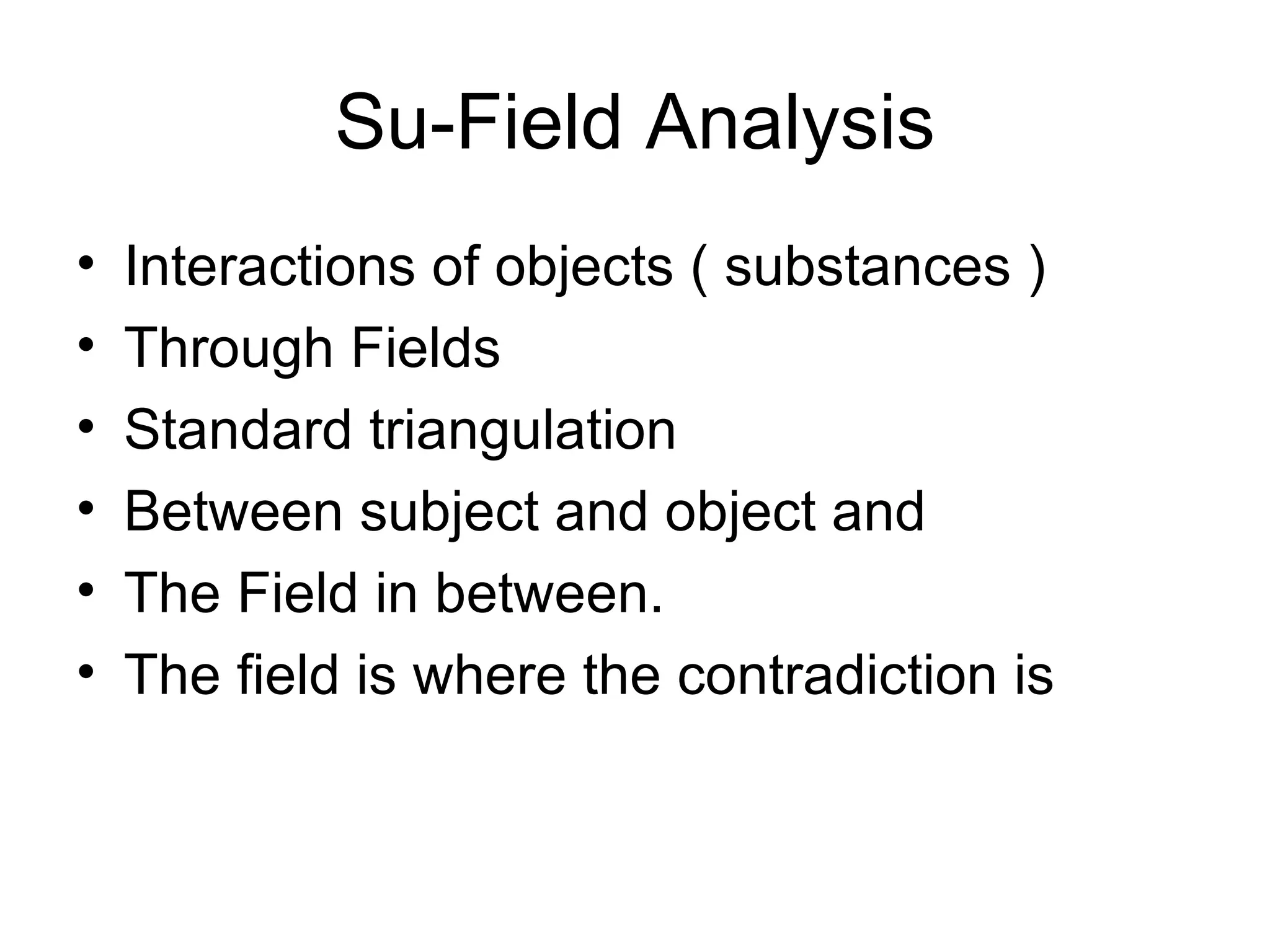
Su-Field Analysis Interactions of objects ( substances ) Through Fields Standard triangulation  Between subject and object and  The Field in between.  The field is where the contradiction is
Anticipatory Failure Determination (AFD) Failure factor analysis  ? FMEA/ QFD / Ishikawa?
Directed Product Evolution (DPE) Road map to the future! Following patterns Technology lifecycle Increasing IFR ( ideal final result) Increasing complexity followed by simplicity Uneven development of sub systems Matching mis-matching of parts  Macro to micro – ization  Increasing Dynamism and control  Reducing human intervention – automation
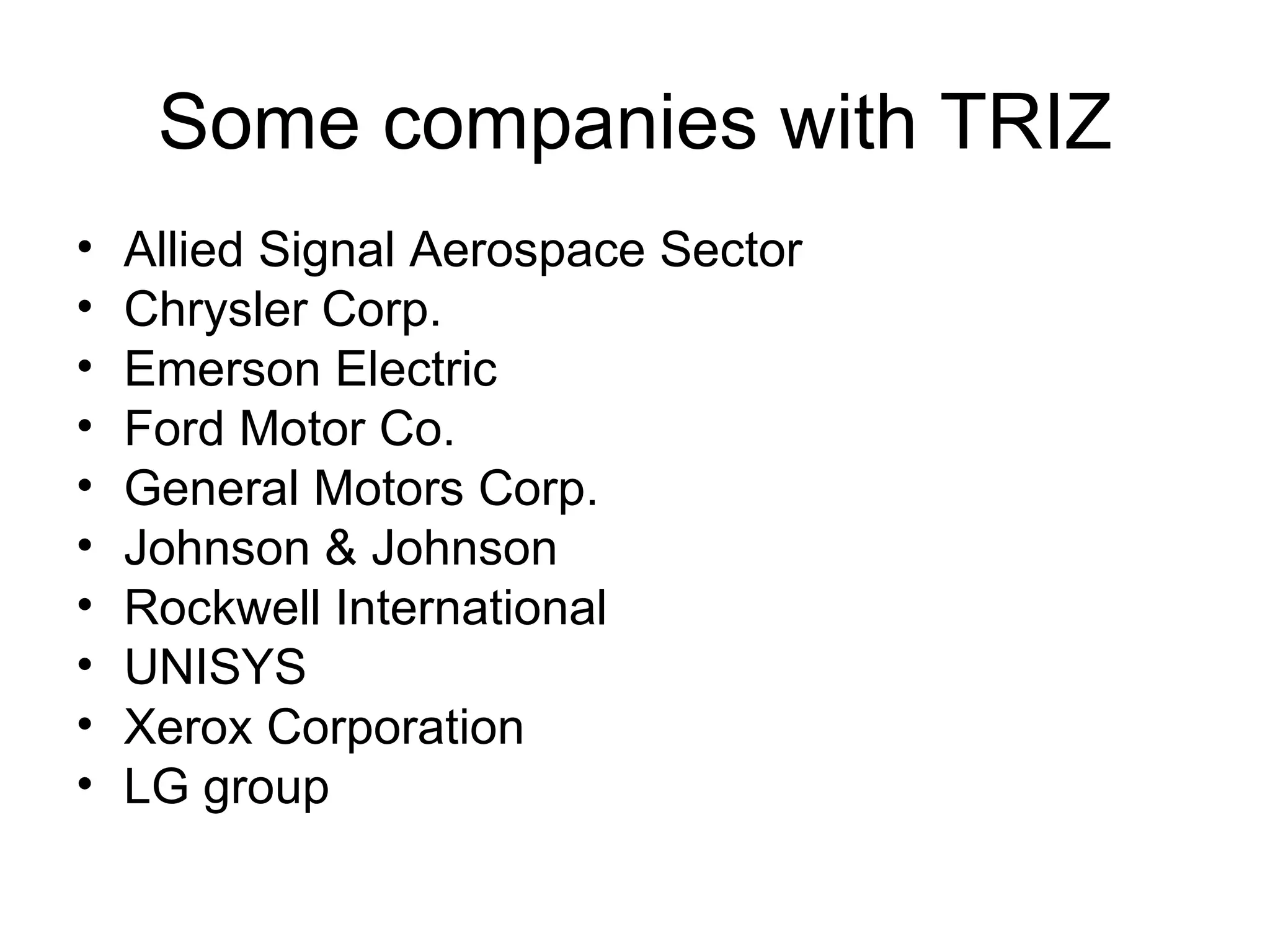
Some companies with TRIZ Allied Signal Aerospace Sector Chrysler Corp. Emerson Electric Ford Motor Co. General Motors Corp. Johnson & Johnson Rockwell International UNISYS Xerox Corporation  LG group
Thanks Again to  http:// Mazur.net/triz   www.Triz-journal.com

TRIZ by VIZ

  • 1.
    TRIZ – InnovationVishwanath Ramdas
  • 2.
    Vishwanath Ramdas is… Visit him @ http://gopu44.googlepages.com Process and Business Consultant Working in areas like ITSM, Software development, process consulting … Based in bangalore [India]
  • 3.
    This presentation thankshttp://Mazur.net/triz www.Triz-journal.com
  • 4.
    Traditional Approach toinnovation Within the scheme of things Look at analogous solutions to the problem @ hand The standard approaches are random and pshychological dependent on past experience Brain storming Trial and error This leads to …
  • 5.
  • 6.
    Pshychological inertia. Definedas the inability to go beyond the current realm of knowledge ( within individual or group) While most solutions are to be found out there!!
  • 7.
  • 8.
    Althsuller - TRIZBASIC PRE-REQS be a systematic, step-by-step procedure be a guide through a broad solution space to direct to the ideal solution be repeatable and reliable and not dependent on psychological tools be able to access the body of inventive knowledge be able to add to the body of inventive knowledge be familiar enough to inventors by following the general approach to problem solving in figure 1.
  • 9.
    Althsuller studied patents 200,000 ( by now it is 1.4 MM) Found that only 40K where truly inventive The remaining only straight forward improvements He classified patents by approach and not subject matter to uncover the ideation process He found that true innovation strieved to overcome “CONTRADICTIONS” He also found that most inventions seemed to have similar patterns (40 of them!)
  • 10.
    He classified theinventions by their import! Level one. Routine design problems solved by methods well known within the specialty. No invention needed. About 32% of the solutions fell into this level. Level two. Minor improvements to an existing system, by methods known within the industry. Usually with some compromise. About 45% of the solutions fell into this level. Level three. Fundamental improvement to an existing system, by methods known outside the industry. Contradictions resolved. About 18% of the solutions fell into this category. Level four. A new generation that uses a new principle to perform the primary functions of the system. Solution found more in science than in technology. About 4% of the solutions fell into this category. Level five. A rare scientific discovery or pioneering invention of essentially a new system. About 1% of the solutions fell into this category.
  • 11.
    The levels again!90% of the solutions had been solved before! 1,000,000 All that is knowable 1% Discovery 5 100,000 Knowledge outside the industry 4% New concept 4 1000 Knowledge within the industry 18% Major improvement 3 100 Knowledge within company 45% Minor improvement 2 10 Personal knowledge 32% Apparent solution 1 # of solns. Source of knowledge % Degree of inventiveness Lvl Table 1. Levels of Inventiveness.
  • 12.
    TRIZ – TheApproach Step by baby step!
  • 13.
    Law of increasingIdeality… Utility divided by Harmfulness Harm >> cost, footprint, energy consumed, pollution, danger, etc The faster you get there the more inventive you are! The evolution of the mechanical spring-driven watch into the electronic quartz crystal watch is an example of moving towards ideality.
  • 14.
  • 15.
    The process stepsIdentifying My Problem. Formulate the problem: the Prism of TRIZ Search for Previously Well-Solved Problem Look for Analogous Solutions and Adapt to My Solution
  • 16.
    Identifying My ProblemInnovative Situation Questionnaire By Boris Zlotin and Alla Zusman perating environment, resource requirements, primary useful function, harmful effects, and ideal result.
  • 17.
    Formulate the problem:the Prism of TRIZ Function Tree Definition Mind Map QFD System – Sub and Super ! 39 characteristics that cause problem Define the contradictions Root cause analysis (ishikawa) Su-Field – Analysis for each component
  • 18.
    39 factors Qualities– Static & In Motion (6*2 > 12) Dimension, area, volume, weight, durability, energy Physical Qualities (7) Shape, strength, speed, pressure, force, brightness, temperature, power Performance Qualities Stability, reliability, control complexity, system complexity Product outcomes (6) Ease of use, ease of repair, harmful side fx, harmful factors, measurement accuracy, manufacturing accuracy Wastes (5) Time, effort, material, materials used, information Process Characteristics (8) Adaptability, manufacturability, productivity,, automation
  • 19.
    Mind Map ofFactors 39 conflicting parameters Static Qualities Quality in motion Phy. Qualities Wastes Processing Outcomes weight Dimension Area Volume Energy Durability weight Dimension Area Volume Energy Durability Force Pressure Temperature Brightness strength Shape Speed Information Material Usage of Mttl time effort Ease of Use Ease of Repair Accuracy of manufacture Accuracy of measurement Reliability Harmful Side effects Stability Manufacturability Productivity Adaptatbility Harmful Factors System complexity Control complexity Automation Performance Qualities
  • 20.
    Look for AnalogousSolutions and Adapt to My Solution world wide patents 40 inventive principles Altshuller - contradiction matrix 39 parameter pairs (39*38 > 1482) With the 40 inventive principles mapped into each cell
  • 21.
    40 Inventive PrinciplesOrganize (6) Segmentation, merge, Abstraction ( extract out), Nesting, Counter weight, Asymmetry Compose (7) Local Quality, Universality, Homogenity, composites, Spheroids, thin films, Cheap disposables Physical (4) Porosity, Additional Dimension,, Thermal Expansion, Colour Changes Chemical (4) Oxidate – reduce, inertness, Transform states, Phase transition Interactions (5) Reduce Mechanical Movement, Bring Fluidity Equipotence, dynamicity, vibration Process (9) Do it in reverse, ++ / --, continued action, repeated action, skip through, negative to positive Prior Cushioning, Prior Actions, Prior Counter Actions Service (5) Self service, intermediary, feedback, use and retrieve, cheap copies
  • 22.
    Mind Map –40 Inventive Princples 40 inventive Principles Organize Compose Physically Chemically Interactions Process Nest Segment Counter weight Abstract – extract asymmetry Merge homogenous Thin films shperoids Local quality universality composites + dimension porosity Color changes Thermal expansion intermediary Transform states inertness Oxidate Phase transition invert Continued Useful action Prior Cushioning ++ / -- actions Self service Repeated Action feedback vibrations dynamism Equi potence Negative to positive Dispose retrieve cheap copy fluidity Service Prior Counter Action Prior Action Skip through Cheap disposables Less mechanical
  • 23.
    Identify my specificproblem Patent database search
  • 24.
  • 25.
    ARIZ - Algorithmfor Inventive Problem Solving Formulate the problem. Transform the problem into a model. Analyze the model. Resolve physical contradictions. Formulate ideal solution.
  • 26.
    Su-Field Analysis Interactionsof objects ( substances ) Through Fields Standard triangulation Between subject and object and The Field in between. The field is where the contradiction is
  • 27.
    Anticipatory Failure Determination(AFD) Failure factor analysis ? FMEA/ QFD / Ishikawa?
  • 28.
    Directed Product Evolution(DPE) Road map to the future! Following patterns Technology lifecycle Increasing IFR ( ideal final result) Increasing complexity followed by simplicity Uneven development of sub systems Matching mis-matching of parts Macro to micro – ization Increasing Dynamism and control Reducing human intervention – automation
  • 29.
    Some companies withTRIZ Allied Signal Aerospace Sector Chrysler Corp. Emerson Electric Ford Motor Co. General Motors Corp. Johnson & Johnson Rockwell International UNISYS Xerox Corporation LG group
  • 30.
    Thanks Again to http:// Mazur.net/triz www.Triz-journal.com