Chaos and Complexity  Applied to Business Kathryn Alexander Strategic Leadership Ethical Impact, LLC
Applying Theory Reality is more than it seems Seeing patterns, rhythms and cycles Similes and metaphors Increasing complexity requires better understanding © Kathryn Alexander. 2008
Scientific Concepts Wholes Composed of parts Can be taken apart Lose their essential nature Emergence Different characteristics at different levels of complexity Cognition Process-pattern-structure Self-Organization Co-Creation Open and closed boundaries Responsive relationship  © Kathryn Alexander. 2008
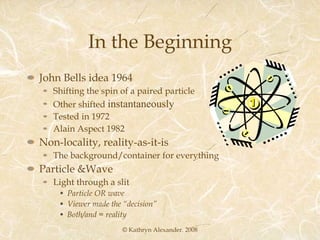
In the Beginning John Bells idea 1964 Shifting the spin of a paired particle Other shifted  instantaneously Tested in 1972 Alain Aspect 1982 Non-locality, reality-as-it-is The background/container for everything Particle &Wave Light through a slit Particle OR wave Viewer made the “decision” Both/and = reality © Kathryn Alexander. 2008
Emergence Different characteristics arise out of different levels of complexity Cognition is emergent out of complexity © Kathryn Alexander. 2008
Emergence & Cognition Life creates the conditions of its own existence  Primordial soup Living is the process of cognition Autoposis/self-making Boundaries Identity © Kathryn Alexander. 2008
Self-Organization Open systems Information Responsive relationship Tit for Tat = cooperation Bringing forth the world Autopoiesis - self-making Sensitivity to initial conditions Fluid & shifting structures Form  follows  function Size - limited by information flow and structure Relationship allows for co-creation Change/evolution Incremental- slow, small, constant Unnoticeable  Break-through/discontinuous Dramatic and untested © Kathryn Alexander. 2008
Co-Creation Process-pattern-structure People and organizations Fractals - self-similarity(cauliflower) Self-reference/reflection Complexity & stability is created by: Open systems to allow for Co-Creation which exists Far from equilibrium by using Thin range between order and chaos (life) Information & structure Feedback loops create stability Bifurcation - natural tendency to split Dissipative structures = self-organization (individuals, groups, ecologies) Period doubling - exponential factor (Lily pond is 1/2 full and the next period is completely full) © Kathryn Alexander. 2008
Creating Dynamic Wholes Responsiveness/communication, creates collaboration Tit for Tat Sensitivity to initial conditions = very different results, depending upon the beginning responses Self organization = increasing complexity = emergence (revealing implicate order) © Kathryn Alexander. 2008
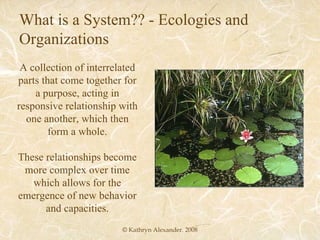
© Kathryn Alexander. 2008 What is a System?? - Ecologies and Organizations A collection of interrelated parts that come together for a purpose, acting in responsive relationship with one another, which then form a whole. These relationships become more complex over time which allows for the emergence of new behavior and capacities.
© Kathryn Alexander. 2008 Living Systems All living systems perform the following: Choice = decision process Pattern = many similar decisions Structure = consistently replicated patterns This is a description of self-organization
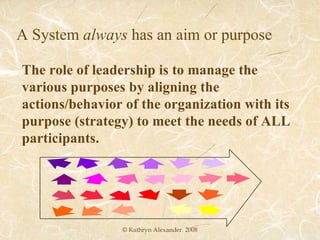
© Kathryn Alexander. 2008 A System  always  has an aim or purpose The role of leadership is to manage the various purposes by aligning the actions/behavior of the organization with its purpose (strategy) to meet the needs of ALL participants.
© Kathryn Alexander. 2008 Important Characteristics of  Living  Systems There is  always  an aim or purpose All systems are composed of interrelated parts/processes The parts are composed of interrelated parts/processes All parts effect the whole system BUT, not independently  and  not all the time Sub-optimization; the effectiveness of a few parts are gained, but the effectiveness of the whole is sacrificed
© Kathryn Alexander. 2008 Important Characteristics of  Living  Systems All living systems have boundaries All living systems self-organize Stability = “far from equilibrium” and is achieved through  feedback loops All living systems have input(s) and out put(s),  processes  have a beginning and an end All living systems are nested (i.e they fit inside of a larger system) What is the largest system?
© Kathryn Alexander. 2008 Relationship Means: A shift from focusing on structure to focusing on process. Form  follows  process. Structures need to change as the organism adapts.
Paradigm Shifts Changes in “reality” or understanding (discontinuous change) generate one of three responses Discount the data Distort the data Don’t see, hear, or  remember the data © Kathryn Alexander. 2008
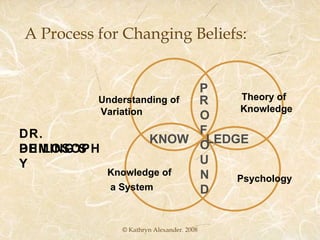
A Process for Changing Beliefs: © Kathryn Alexander. 2008 Understanding of Variation Knowledge of a System P R O F O U N D KNOW  LEDGE DR. DEMING'S PHILOSOPHY Psychology Theory of Knowledge
Systems Thinking © Kathryn Alexander. 2008 Has important lessons and tools for business Reveals hidden dynamics Is strategically relevant Is a key leadership skill Makes invisible connections visible Contact Us Ethical Impact, LLC 5505 Valmont Rd. Ste. #278 Boulder, CO 80301 www.ethicalimpact.com 888-331-7492 or 303-440-5833

Chaos Complexity Eillc

  • 1.
    Chaos and Complexity Applied to Business Kathryn Alexander Strategic Leadership Ethical Impact, LLC
  • 2.
    Applying Theory Realityis more than it seems Seeing patterns, rhythms and cycles Similes and metaphors Increasing complexity requires better understanding © Kathryn Alexander. 2008
  • 3.
    Scientific Concepts WholesComposed of parts Can be taken apart Lose their essential nature Emergence Different characteristics at different levels of complexity Cognition Process-pattern-structure Self-Organization Co-Creation Open and closed boundaries Responsive relationship © Kathryn Alexander. 2008
  • 4.
    In the BeginningJohn Bells idea 1964 Shifting the spin of a paired particle Other shifted instantaneously Tested in 1972 Alain Aspect 1982 Non-locality, reality-as-it-is The background/container for everything Particle &Wave Light through a slit Particle OR wave Viewer made the “decision” Both/and = reality © Kathryn Alexander. 2008
  • 5.
    Emergence Different characteristicsarise out of different levels of complexity Cognition is emergent out of complexity © Kathryn Alexander. 2008
  • 6.
    Emergence & CognitionLife creates the conditions of its own existence Primordial soup Living is the process of cognition Autoposis/self-making Boundaries Identity © Kathryn Alexander. 2008
  • 7.
    Self-Organization Open systemsInformation Responsive relationship Tit for Tat = cooperation Bringing forth the world Autopoiesis - self-making Sensitivity to initial conditions Fluid & shifting structures Form follows function Size - limited by information flow and structure Relationship allows for co-creation Change/evolution Incremental- slow, small, constant Unnoticeable Break-through/discontinuous Dramatic and untested © Kathryn Alexander. 2008
  • 8.
    Co-Creation Process-pattern-structure Peopleand organizations Fractals - self-similarity(cauliflower) Self-reference/reflection Complexity & stability is created by: Open systems to allow for Co-Creation which exists Far from equilibrium by using Thin range between order and chaos (life) Information & structure Feedback loops create stability Bifurcation - natural tendency to split Dissipative structures = self-organization (individuals, groups, ecologies) Period doubling - exponential factor (Lily pond is 1/2 full and the next period is completely full) © Kathryn Alexander. 2008
  • 9.
    Creating Dynamic WholesResponsiveness/communication, creates collaboration Tit for Tat Sensitivity to initial conditions = very different results, depending upon the beginning responses Self organization = increasing complexity = emergence (revealing implicate order) © Kathryn Alexander. 2008
  • 10.
    © Kathryn Alexander.2008 What is a System?? - Ecologies and Organizations A collection of interrelated parts that come together for a purpose, acting in responsive relationship with one another, which then form a whole. These relationships become more complex over time which allows for the emergence of new behavior and capacities.
  • 11.
    © Kathryn Alexander.2008 Living Systems All living systems perform the following: Choice = decision process Pattern = many similar decisions Structure = consistently replicated patterns This is a description of self-organization
  • 12.
    © Kathryn Alexander.2008 A System always has an aim or purpose The role of leadership is to manage the various purposes by aligning the actions/behavior of the organization with its purpose (strategy) to meet the needs of ALL participants.
  • 13.
    © Kathryn Alexander.2008 Important Characteristics of Living Systems There is always an aim or purpose All systems are composed of interrelated parts/processes The parts are composed of interrelated parts/processes All parts effect the whole system BUT, not independently and not all the time Sub-optimization; the effectiveness of a few parts are gained, but the effectiveness of the whole is sacrificed
  • 14.
    © Kathryn Alexander.2008 Important Characteristics of Living Systems All living systems have boundaries All living systems self-organize Stability = “far from equilibrium” and is achieved through feedback loops All living systems have input(s) and out put(s), processes have a beginning and an end All living systems are nested (i.e they fit inside of a larger system) What is the largest system?
  • 15.
    © Kathryn Alexander.2008 Relationship Means: A shift from focusing on structure to focusing on process. Form follows process. Structures need to change as the organism adapts.
  • 16.
    Paradigm Shifts Changesin “reality” or understanding (discontinuous change) generate one of three responses Discount the data Distort the data Don’t see, hear, or remember the data © Kathryn Alexander. 2008
  • 17.
    A Process forChanging Beliefs: © Kathryn Alexander. 2008 Understanding of Variation Knowledge of a System P R O F O U N D KNOW LEDGE DR. DEMING'S PHILOSOPHY Psychology Theory of Knowledge
  • 18.
    Systems Thinking ©Kathryn Alexander. 2008 Has important lessons and tools for business Reveals hidden dynamics Is strategically relevant Is a key leadership skill Makes invisible connections visible Contact Us Ethical Impact, LLC 5505 Valmont Rd. Ste. #278 Boulder, CO 80301 www.ethicalimpact.com 888-331-7492 or 303-440-5833