NYC Lean Kanban Meetup
Cynefin and Complexity: A Gentle Introduction
Jocko Selberg
@JockoSelberg
Jocko21@gmail.com
NYC Cynefin Group - Meetup
Oct 28, 2015
#nyclean
* Lean Coffee to follow talk – create your topics
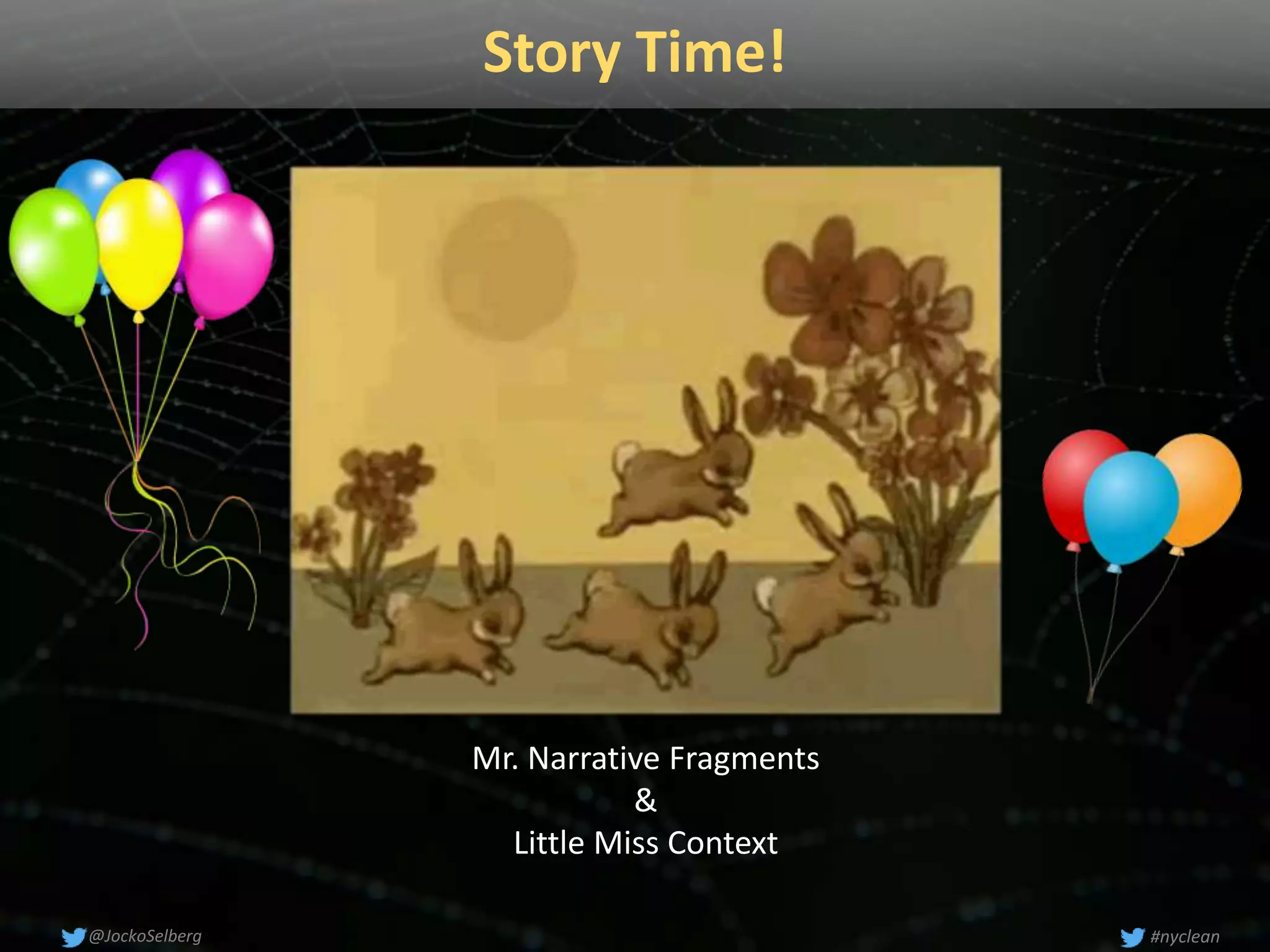
Story Time!
Mr. Narrative Fragments
&
Little Miss Context
#nyclean@JockoSelberg
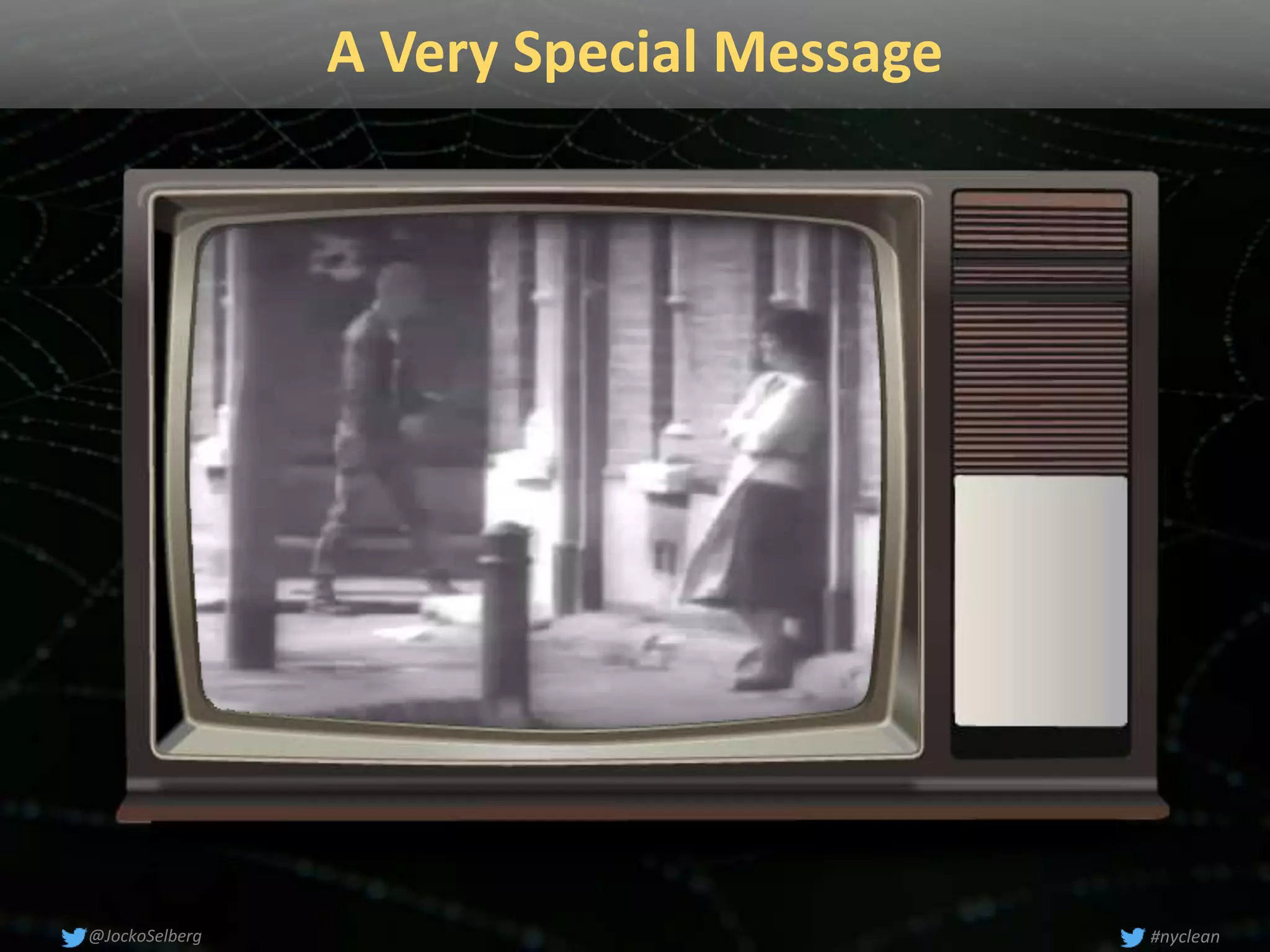
A Very Special Message
#nyclean@JockoSelberg
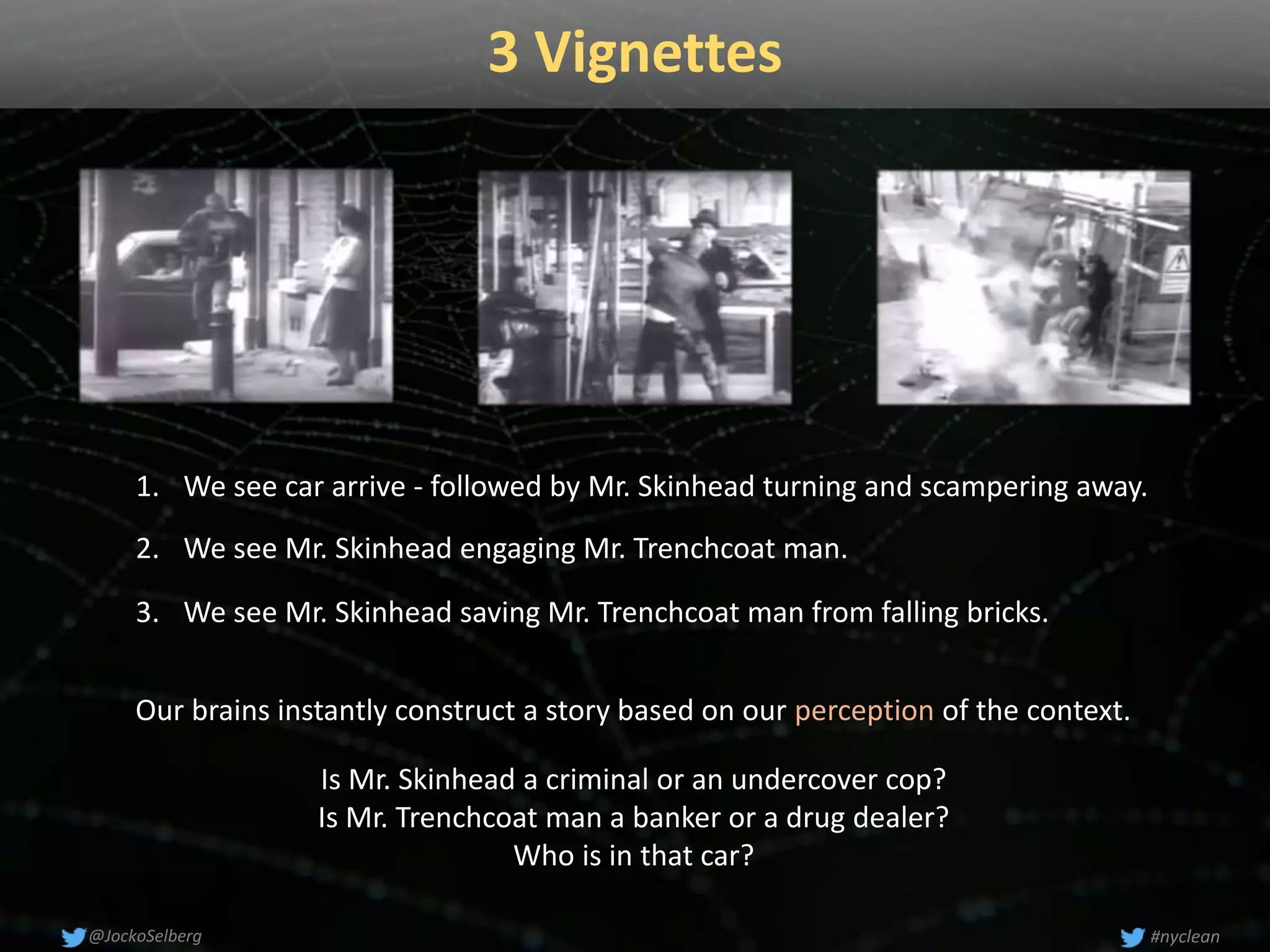
3 Vignettes
#nyclean@JockoSelberg
Our brains instantly construct a story based on our perception of the context.
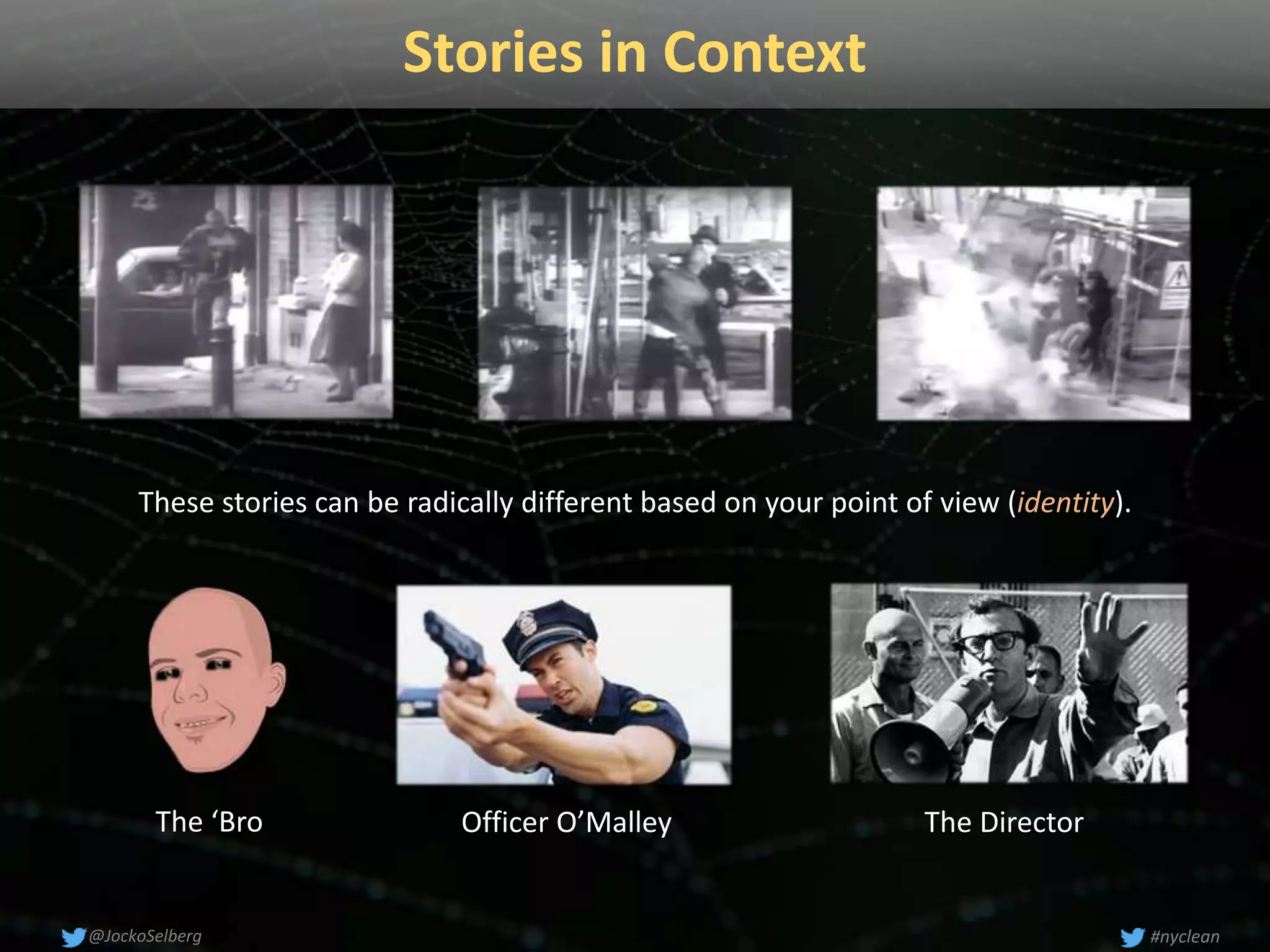
1. We see car arrive - followed by Mr. Skinhead turning and scampering away.
2. We see Mr. Skinhead engaging Mr. Trenchcoat man.
3. We see Mr. Skinhead saving Mr. Trenchcoat man from falling bricks.
Is Mr. Skinhead a criminal or an undercover cop?
Is Mr. Trenchcoat man a banker or a drug dealer?
Who is in that car?
Stories in Context
#nyclean@JockoSelberg
These stories can be radically different based on your point of view (identity).
The ‘Bro Officer O’Malley The Director
First-fit Pattern Matching
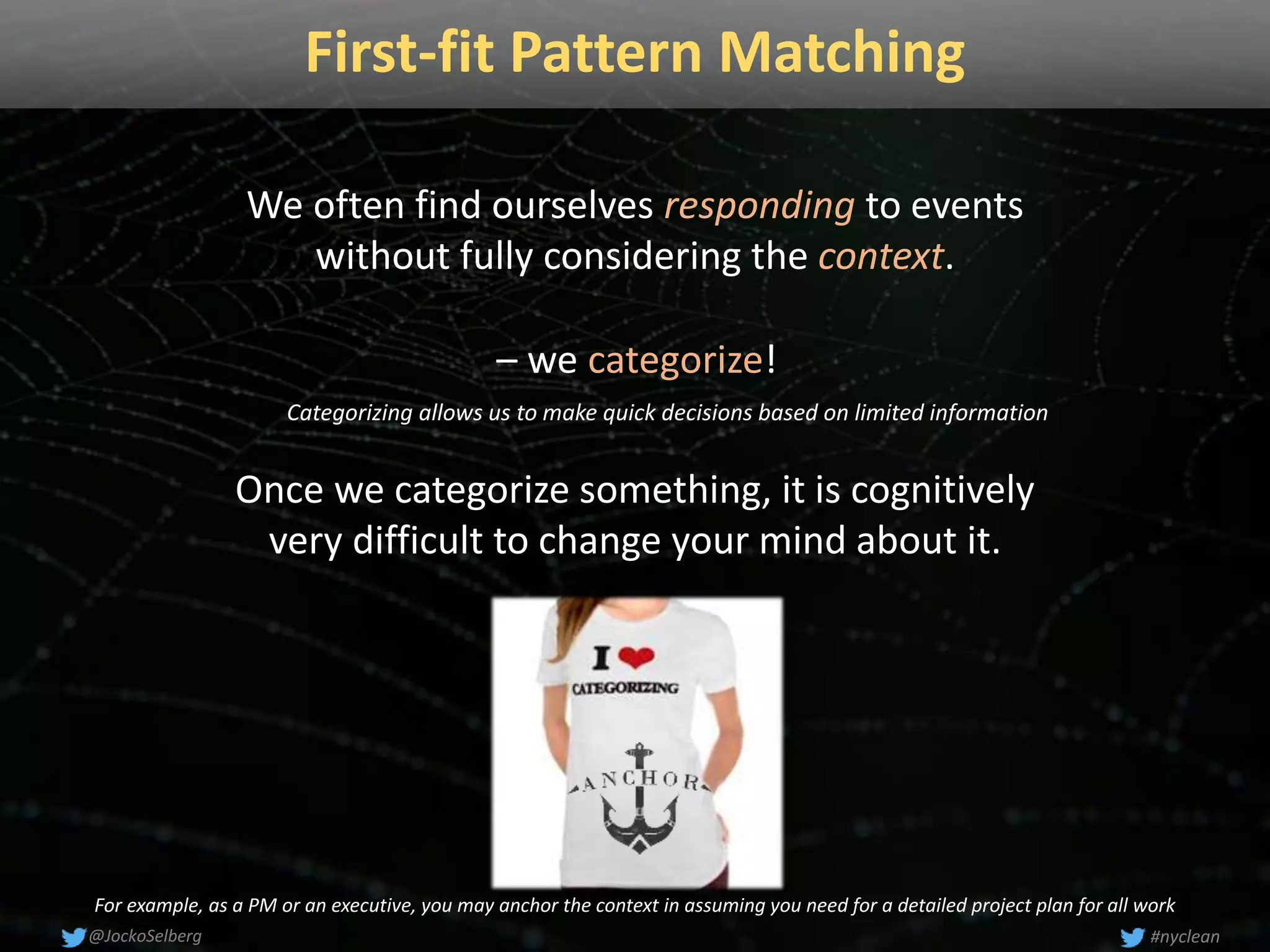
We often find ourselves responding to events
without fully considering the context.
Once we categorize something, it is cognitively
very difficult to change your mind about it.
– we categorize!
#nyclean@JockoSelberg
For example, as a PM or an executive, you may anchor the context in assuming you need for a detailed project plan for all work
Categorizing allows us to make quick decisions based on limited information
Sense & Respond
How can we make sense of a situation such that we can
respond intelligently given incomplete information?
(whenever a decision is required, we are ALWAYS limited by incomplete information)
#nyclean@JockoSelberg
Given the fact that we are very prone to categorizing everything…
Context is Everything
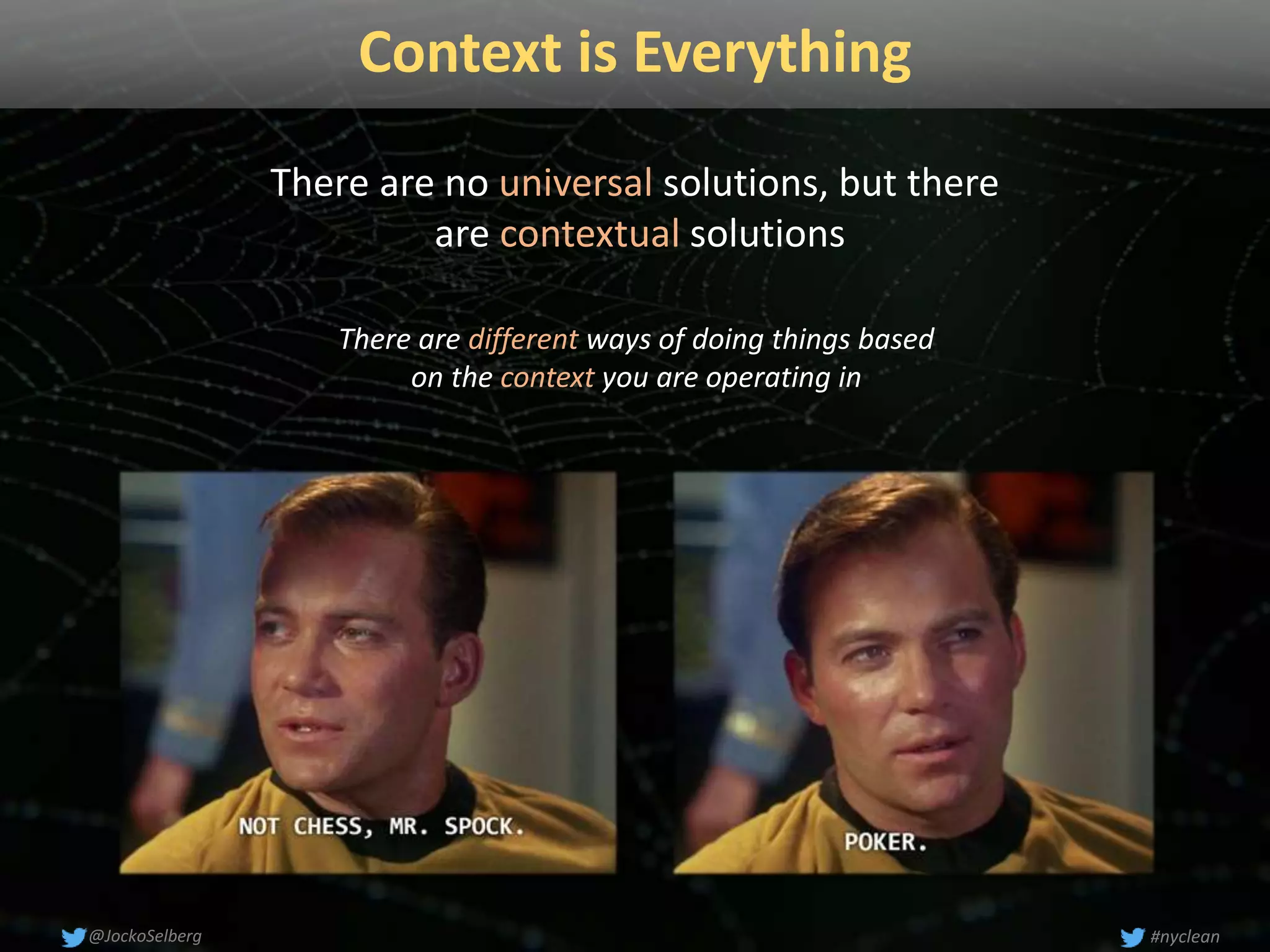
There are no universal solutions, but there
are contextual solutions
There are different ways of doing things based
on the context you are operating in
#nyclean@JockoSelberg
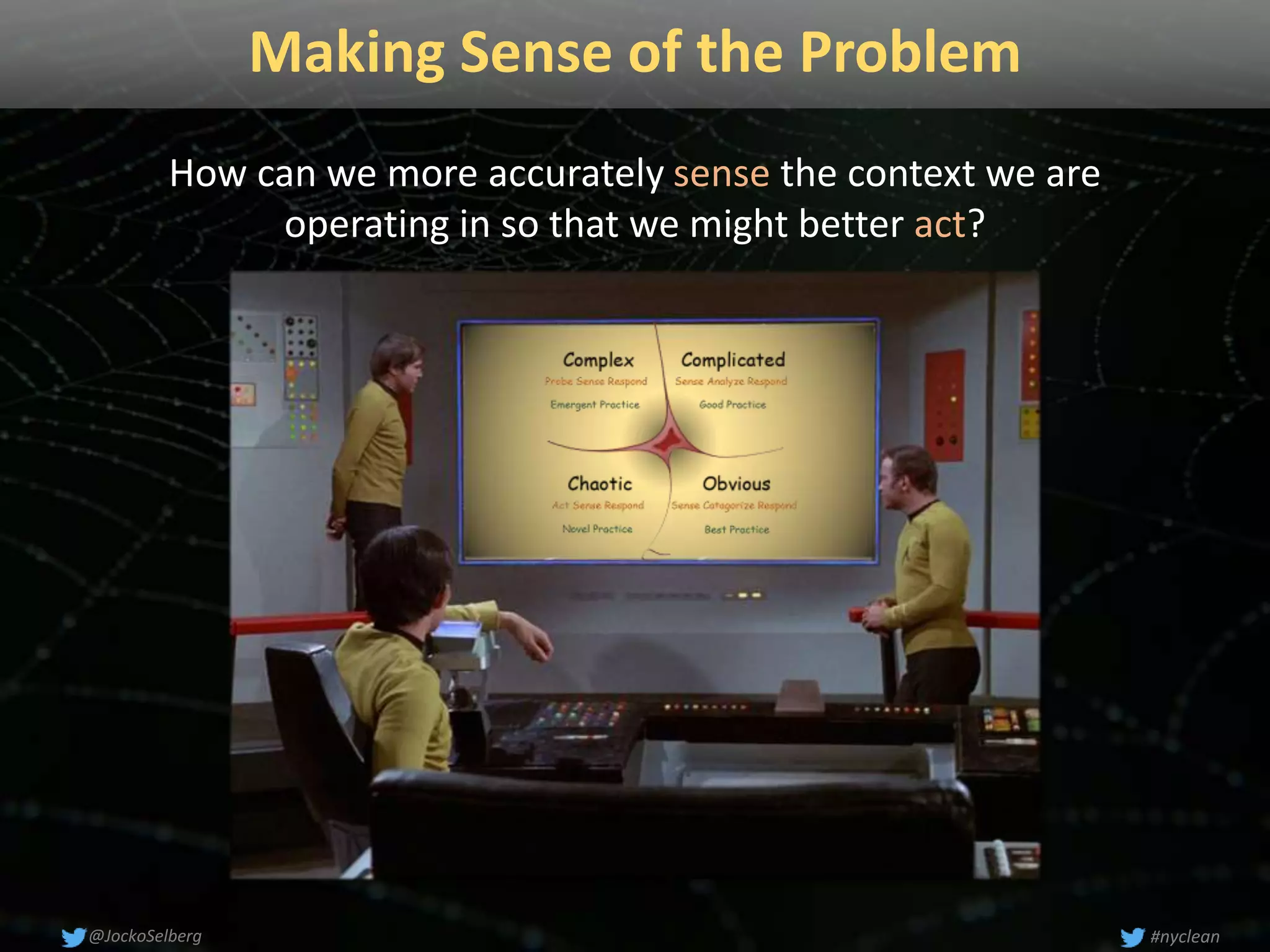
Making Sense of the Problem
How can we more accurately sense the context we are
operating in so that we might better act?
#nyclean@JockoSelberg
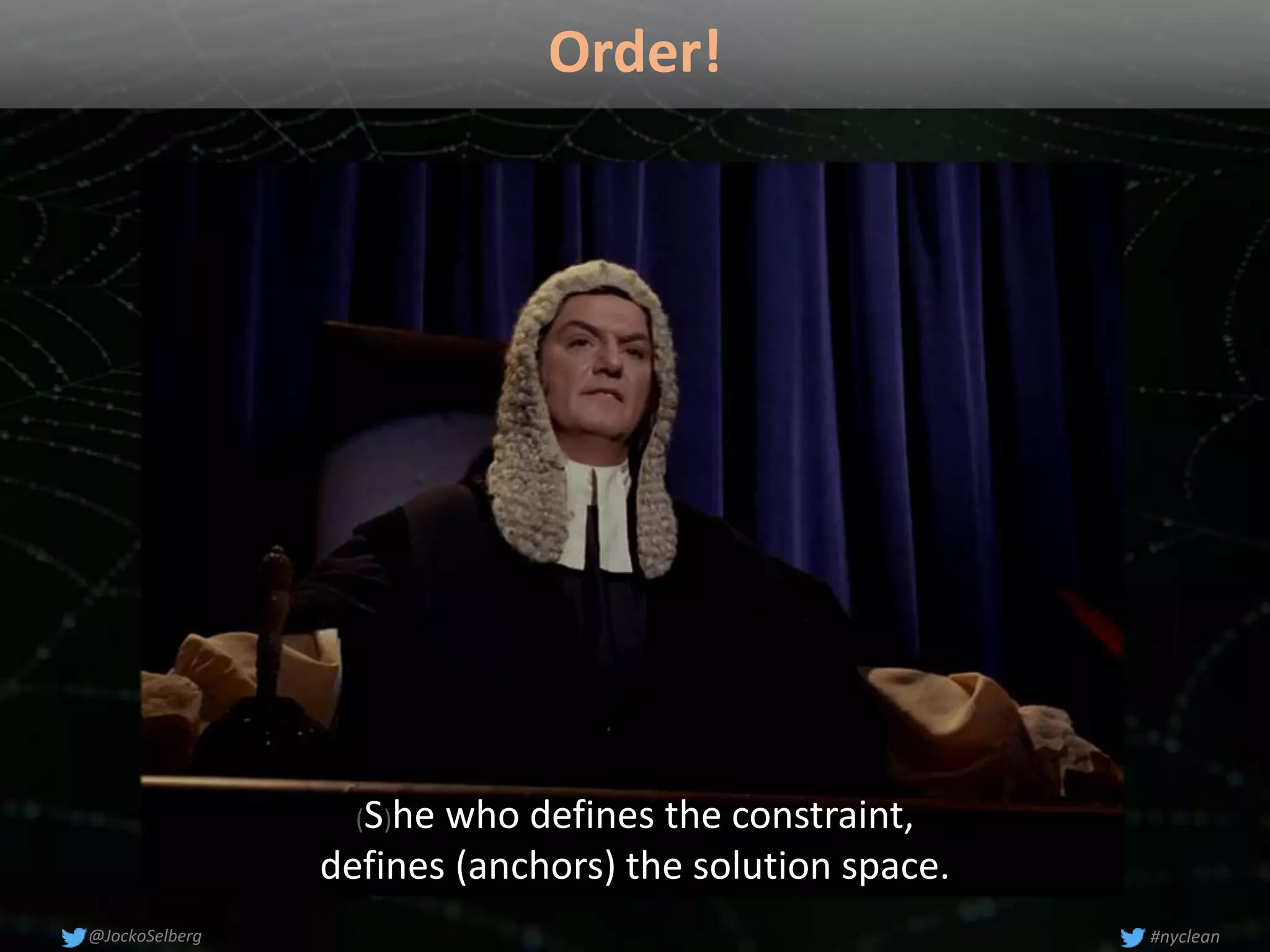
Order!
#nyclean@JockoSelberg
(S)he who defines the constraint,
defines (anchors) the solution space.
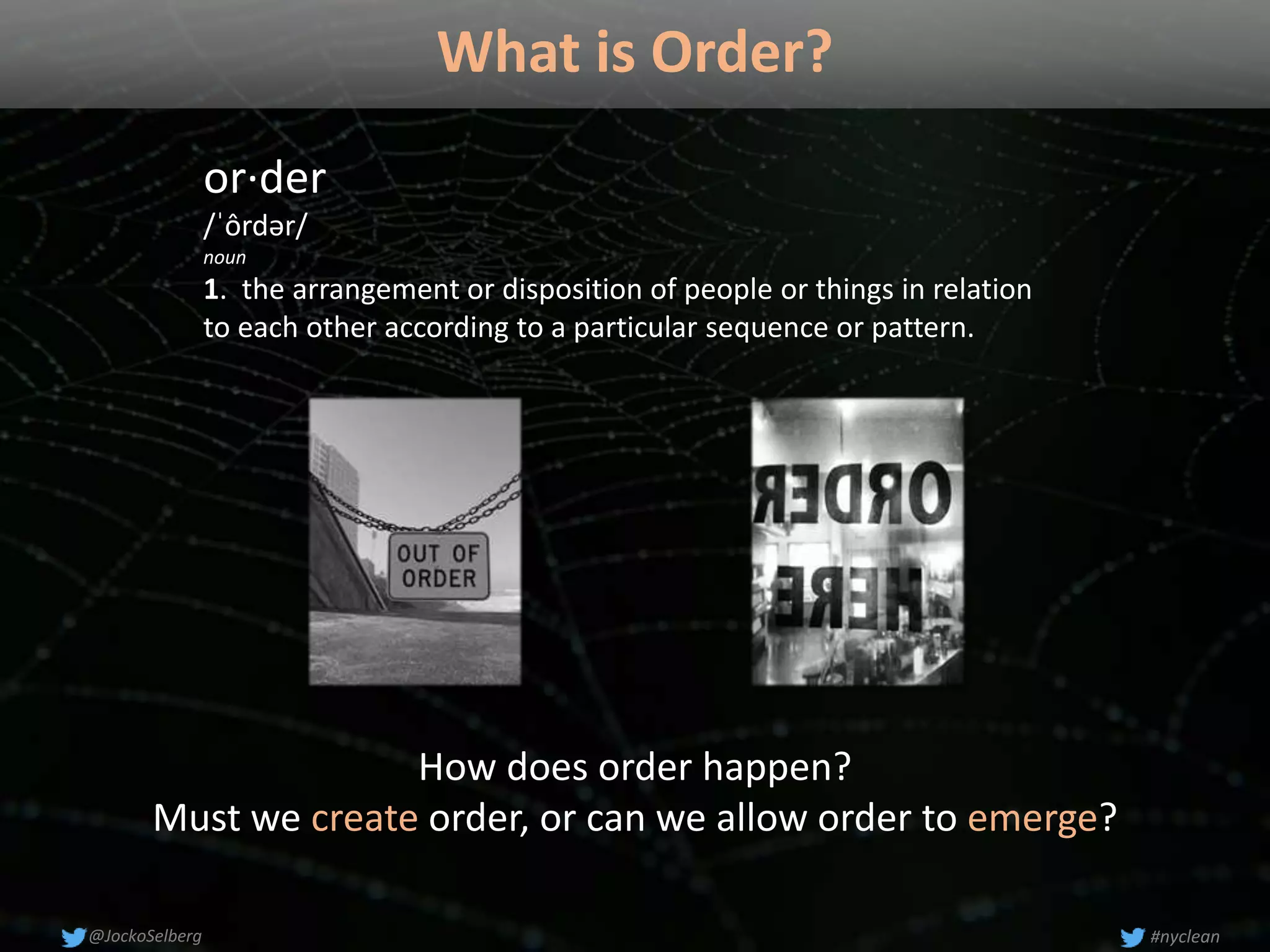
What is Order?
or·der
/ˈôrdər/
noun
1. the arrangement or disposition of people or things in relation
to each other according to a particular sequence or pattern.
How does order happen?
Must we create order, or can we allow order to emerge?
#nyclean@JockoSelberg
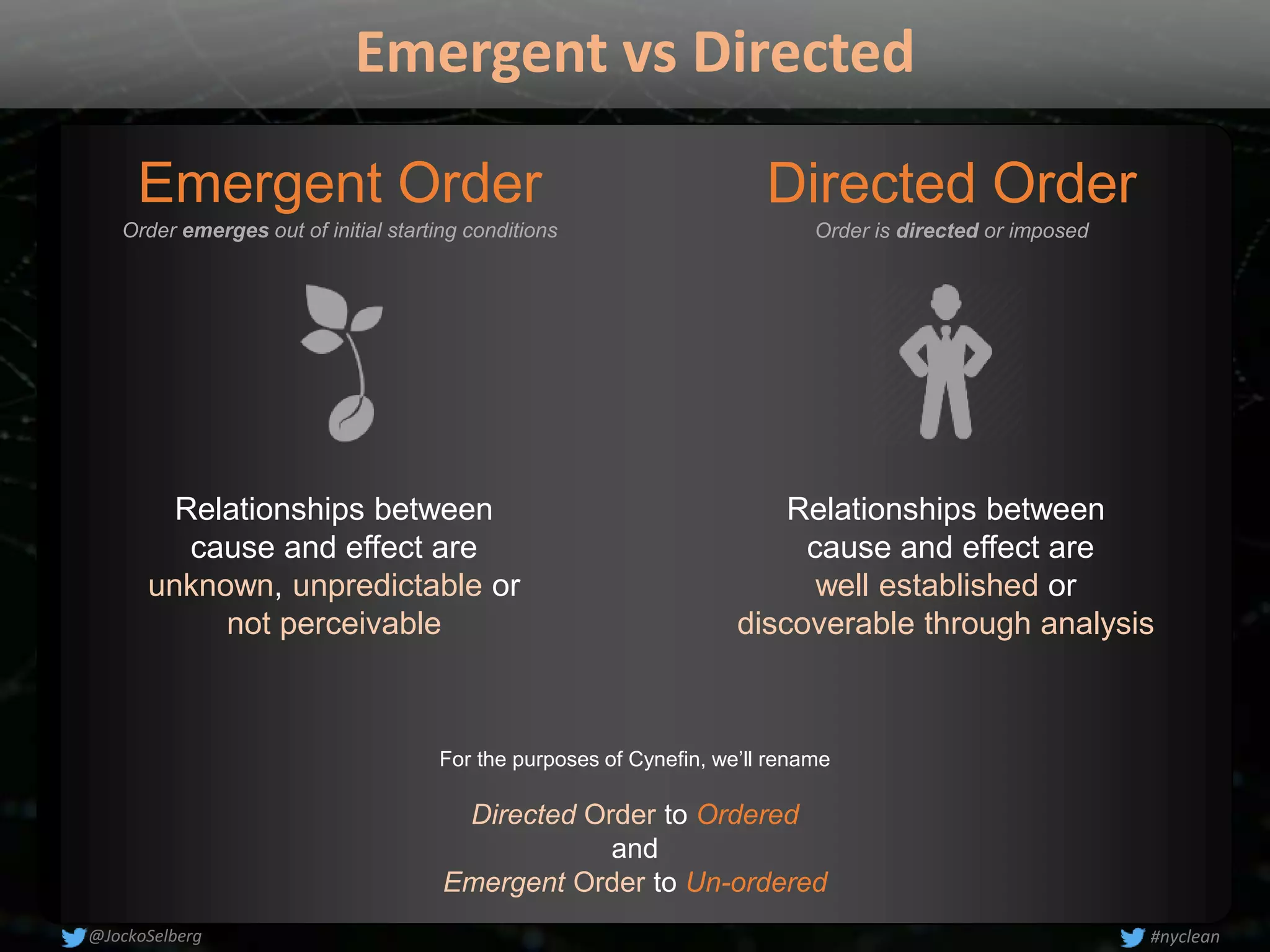
Emergent vs Directed
Emergent Order
Relationships between
cause and effect are
unknown, unpredictable or
not perceivable
Relationships between
cause and effect are
well established or
discoverable through analysis
Order emerges out of initial starting conditions
Directed Order
Order is directed or imposed
For the purposes of Cynefin, we’ll rename
Directed Order to Ordered
and
Emergent Order to Un-ordered
#nyclean@JockoSelberg
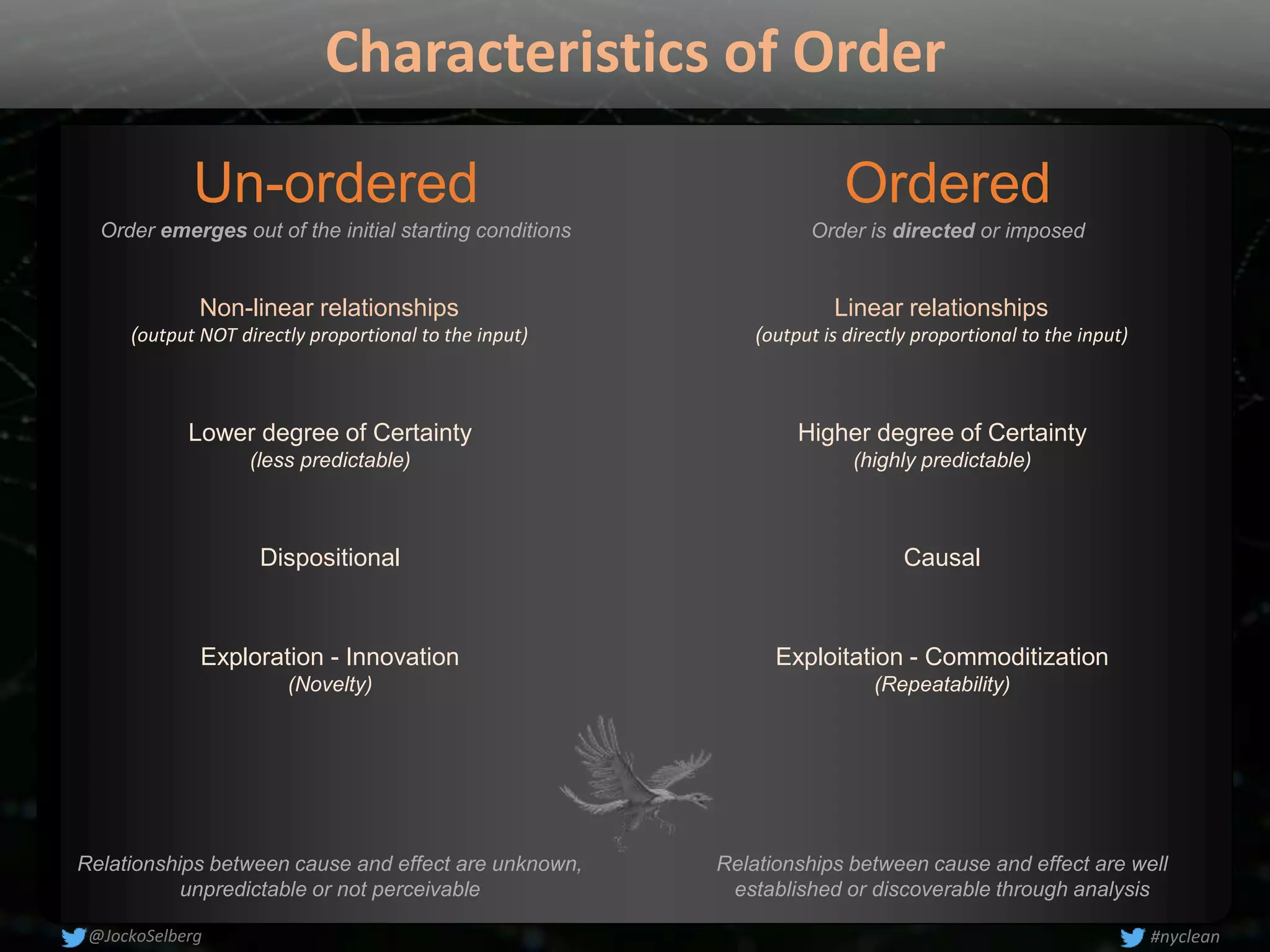
Characteristics of Order
Un-ordered
Relationships between cause and effect are unknown,
unpredictable or not perceivable
Relationships between cause and effect are well
established or discoverable through analysis
Order emerges out of the initial starting conditions
Ordered
Order is directed or imposed
Higher degree of Certainty
(highly predictable)
Lower degree of Certainty
(less predictable)
CausalDispositional
Linear relationships
(output is directly proportional to the input)
Non-linear relationships
(output NOT directly proportional to the input)
Exploitation - Commoditization
(Repeatability)
Exploration - Innovation
(Novelty)
#nyclean@JockoSelberg
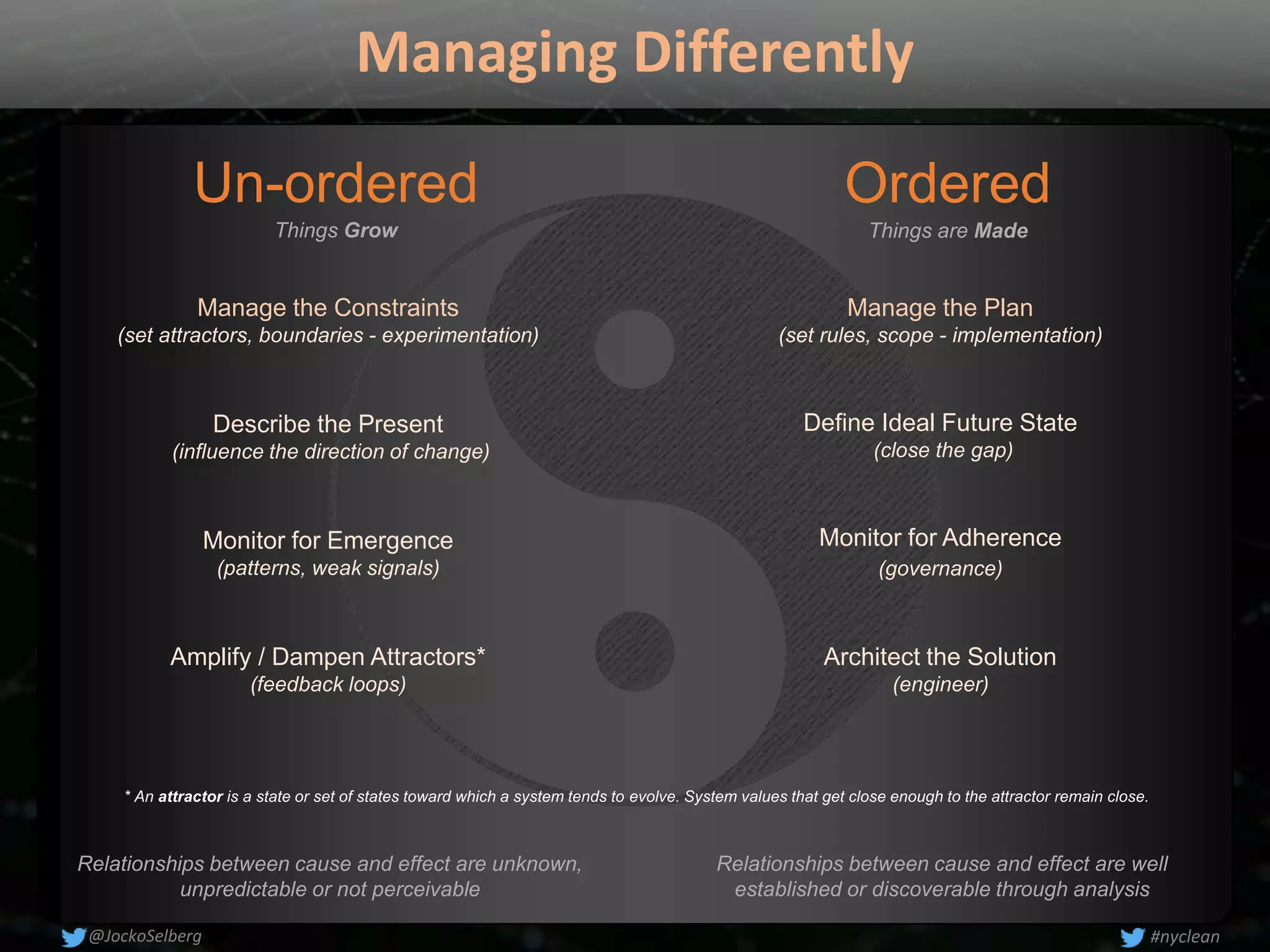
Managing Differently
Un-ordered
Relationships between cause and effect are unknown,
unpredictable or not perceivable
Relationships between cause and effect are well
established or discoverable through analysis
Things Grow
Ordered
Things are Made
Define Ideal Future State
(close the gap)
Describe the Present
(influence the direction of change)
Manage the Plan
(set rules, scope - implementation)
Manage the Constraints
(set attractors, boundaries - experimentation)
Monitor for Adherence
(governance)
Monitor for Emergence
(patterns, weak signals)
Architect the Solution
(engineer)
Amplify / Dampen Attractors*
(feedback loops)
#nyclean@JockoSelberg
* An attractor is a state or set of states toward which a system tends to evolve. System values that get close enough to the attractor remain close.
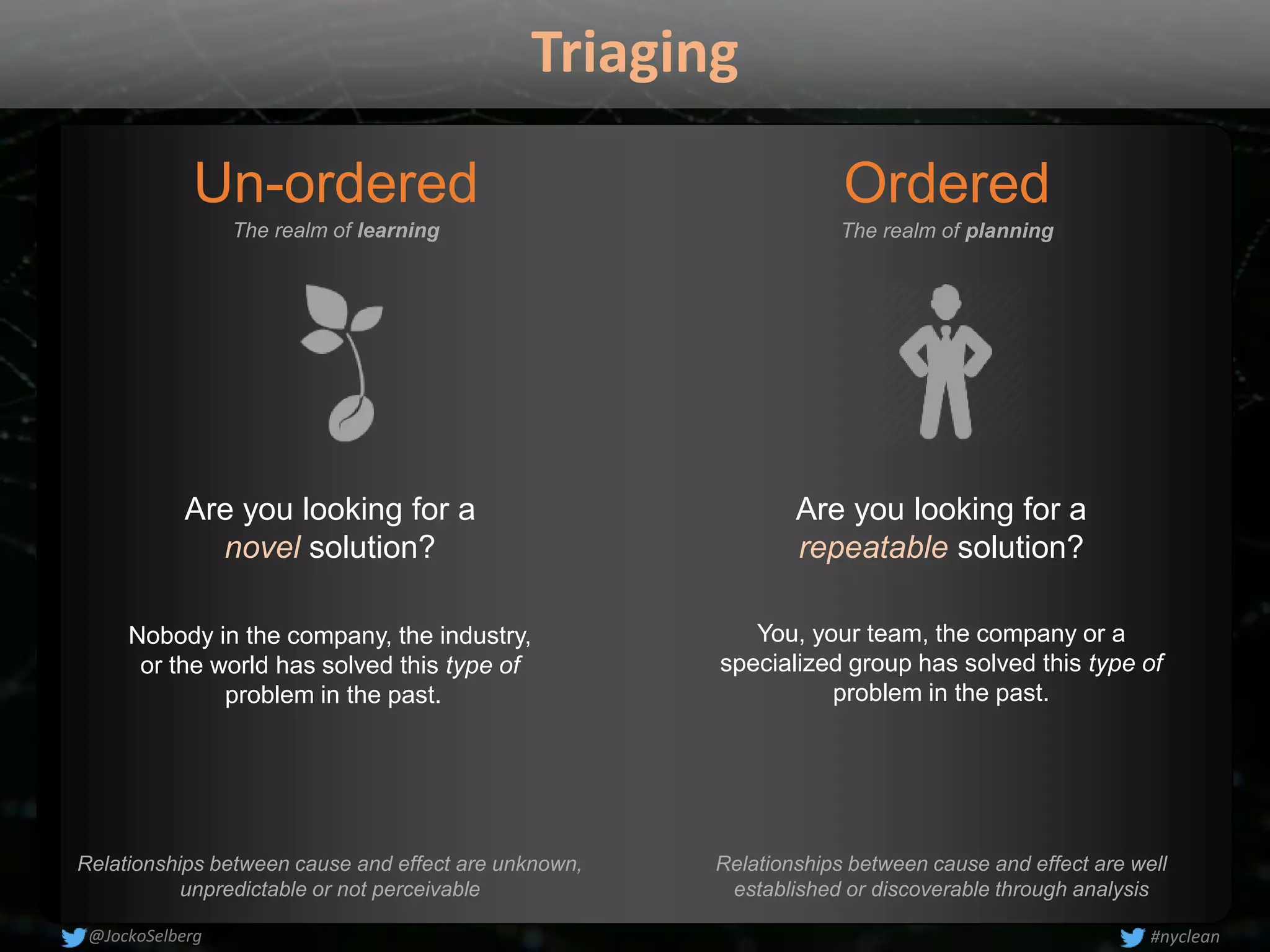
Triaging
Un-ordered
Relationships between cause and effect are unknown,
unpredictable or not perceivable
Relationships between cause and effect are well
established or discoverable through analysis
Are you looking for a
repeatable solution?
Are you looking for a
novel solution?
The realm of learning
Ordered
The realm of planning
Nobody in the company, the industry,
or the world has solved this type of
problem in the past.
You, your team, the company or a
specialized group has solved this type of
problem in the past.
#nyclean@JockoSelberg
Systems
#nyclean@JockoSelberg
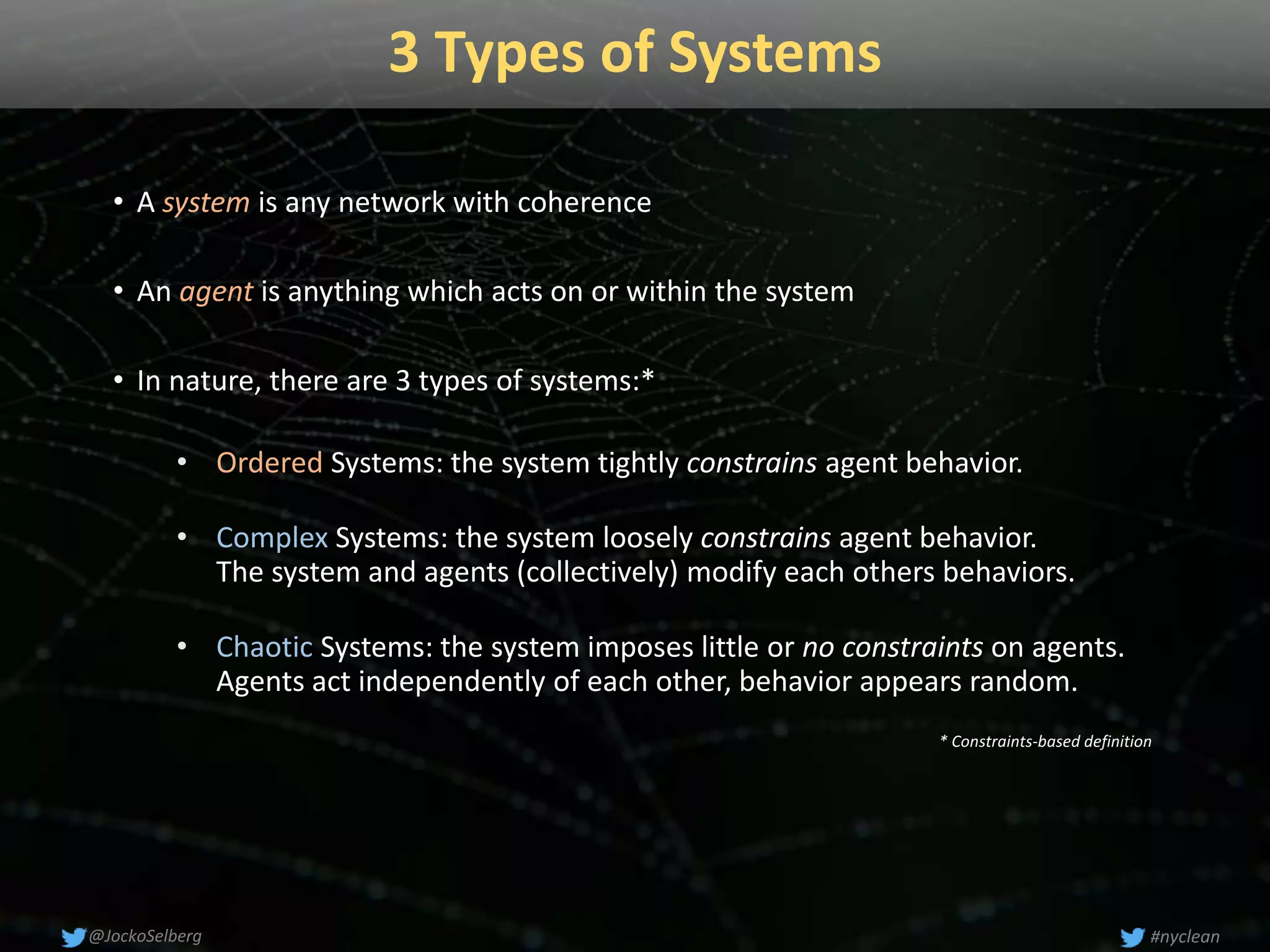
3 Types of Systems
• A system is any network with coherence
• An agent is anything which acts on or within the system
• In nature, there are 3 types of systems:*
• Ordered Systems: the system tightly constrains agent behavior.
• Complex Systems: the system loosely constrains agent behavior.
The system and agents (collectively) modify each others behaviors.
• Chaotic Systems: the system imposes little or no constraints on agents.
Agents act independently of each other, behavior appears random.
* Constraints-based definition
#nyclean@JockoSelberg
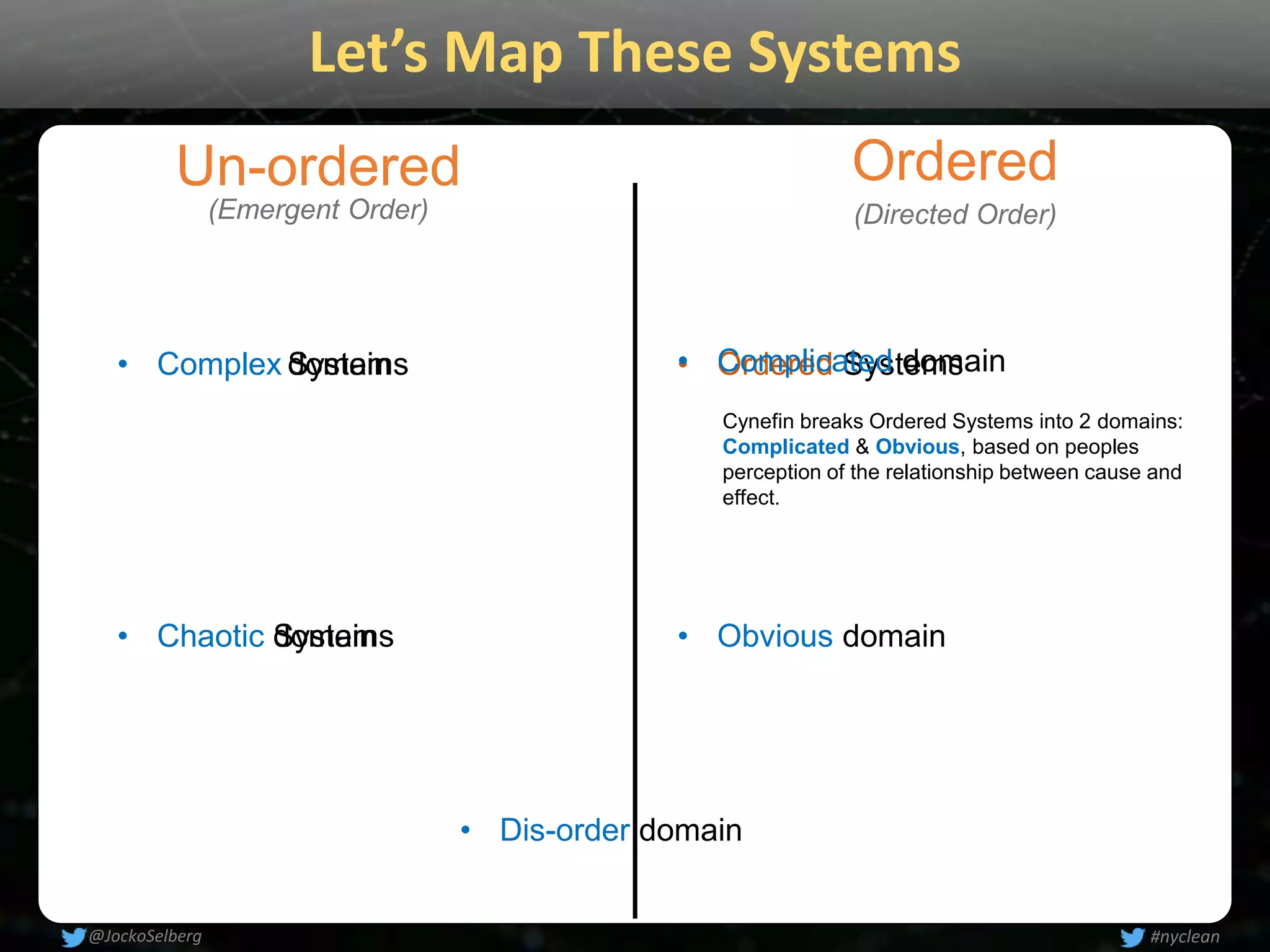
Let’s Map These Systems
Ordered
(Directed Order)
Un-ordered
(Emergent Order)
• Complex
• Chaotic
• Ordered Systems• Complicated domain
Cynefin breaks Ordered Systems into 2 domains:
Complicated & Obvious, based on peoples
perception of the relationship between cause and
effect.
• Obvious domain
• Dis-order domain
Systems
Systems
domain
domain
#nyclean@JockoSelberg
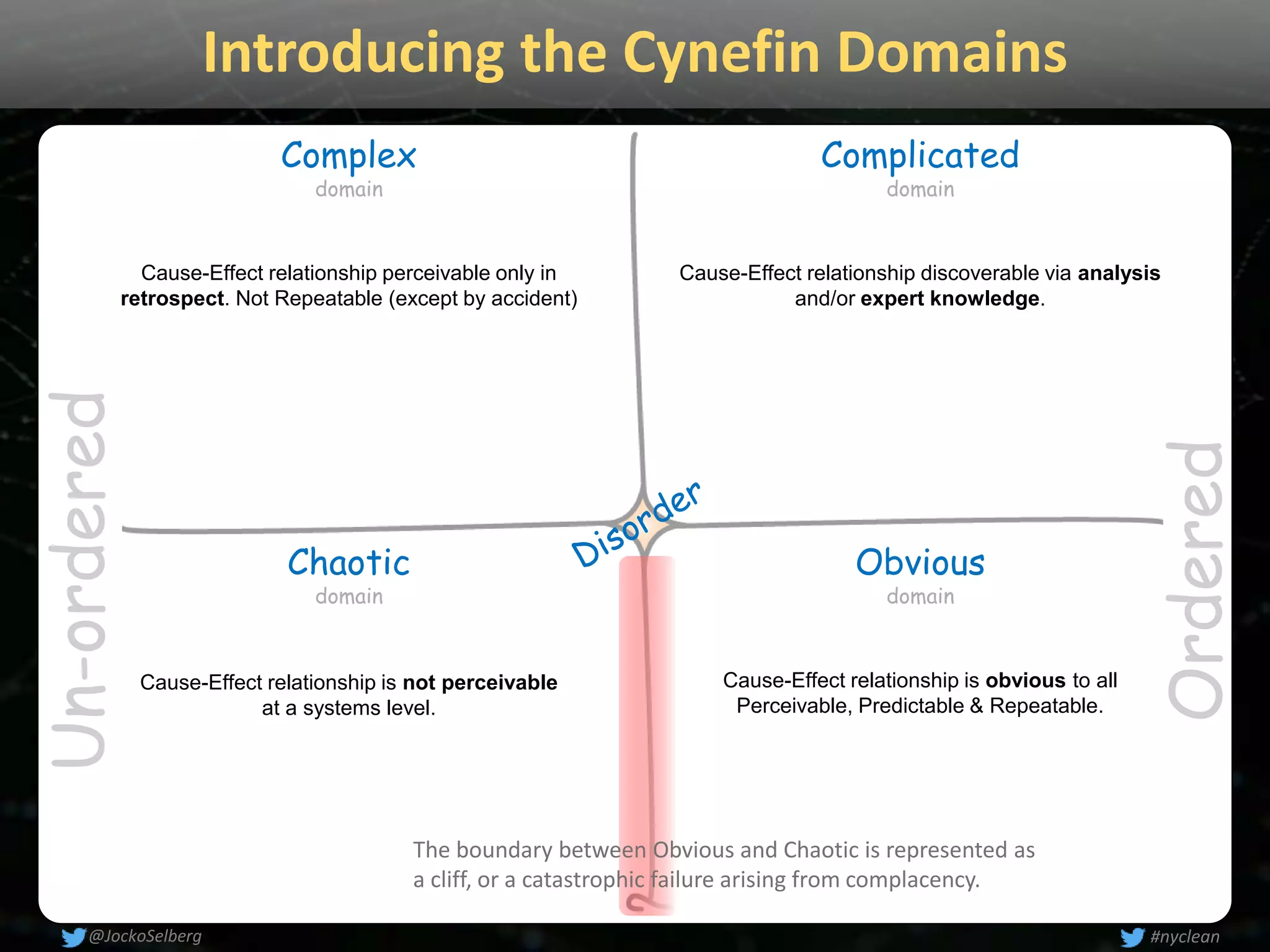
Chaotic
domain
Complicated
domain
Complex
domain
Obvious
domain
Un-ordered
Ordered
Cause-Effect relationship perceivable only in
retrospect. Not Repeatable (except by accident)
Cause-Effect relationship discoverable via analysis
and/or expert knowledge.
Cause-Effect relationship is not perceivable
at a systems level.
Cause-Effect relationship is obvious to all
Perceivable, Predictable & Repeatable.
Introducing the Cynefin Domains
The boundary between Obvious and Chaotic is represented as
a cliff, or a catastrophic failure arising from complacency.
#nyclean@JockoSelberg
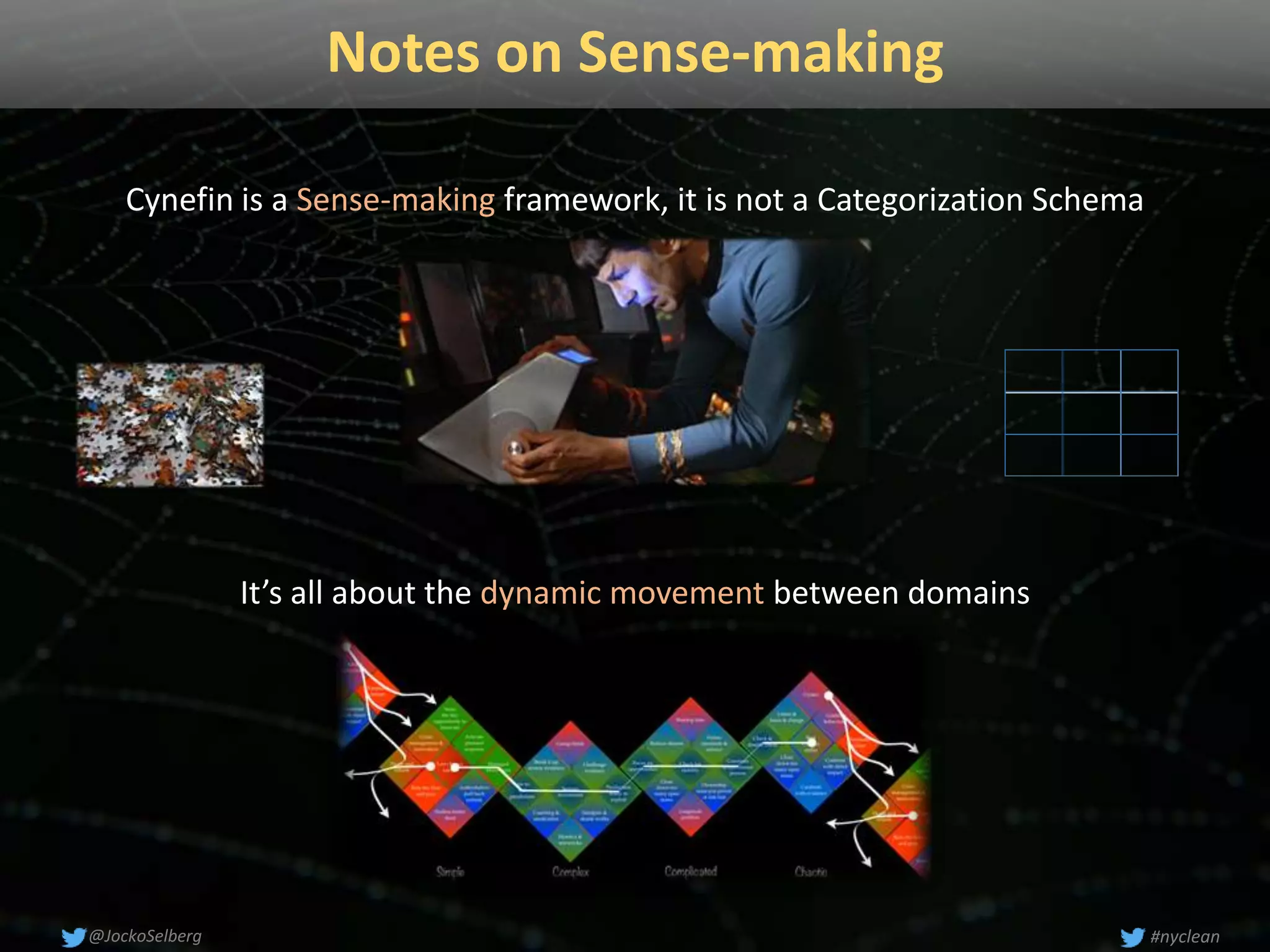
Notes on Sense-making
Cynefin is a Sense-making framework, it is not a Categorization Schema
It’s all about the dynamic movement between domains
#nyclean@JockoSelberg
Complexity 101
#nyclean@JockoSelberg
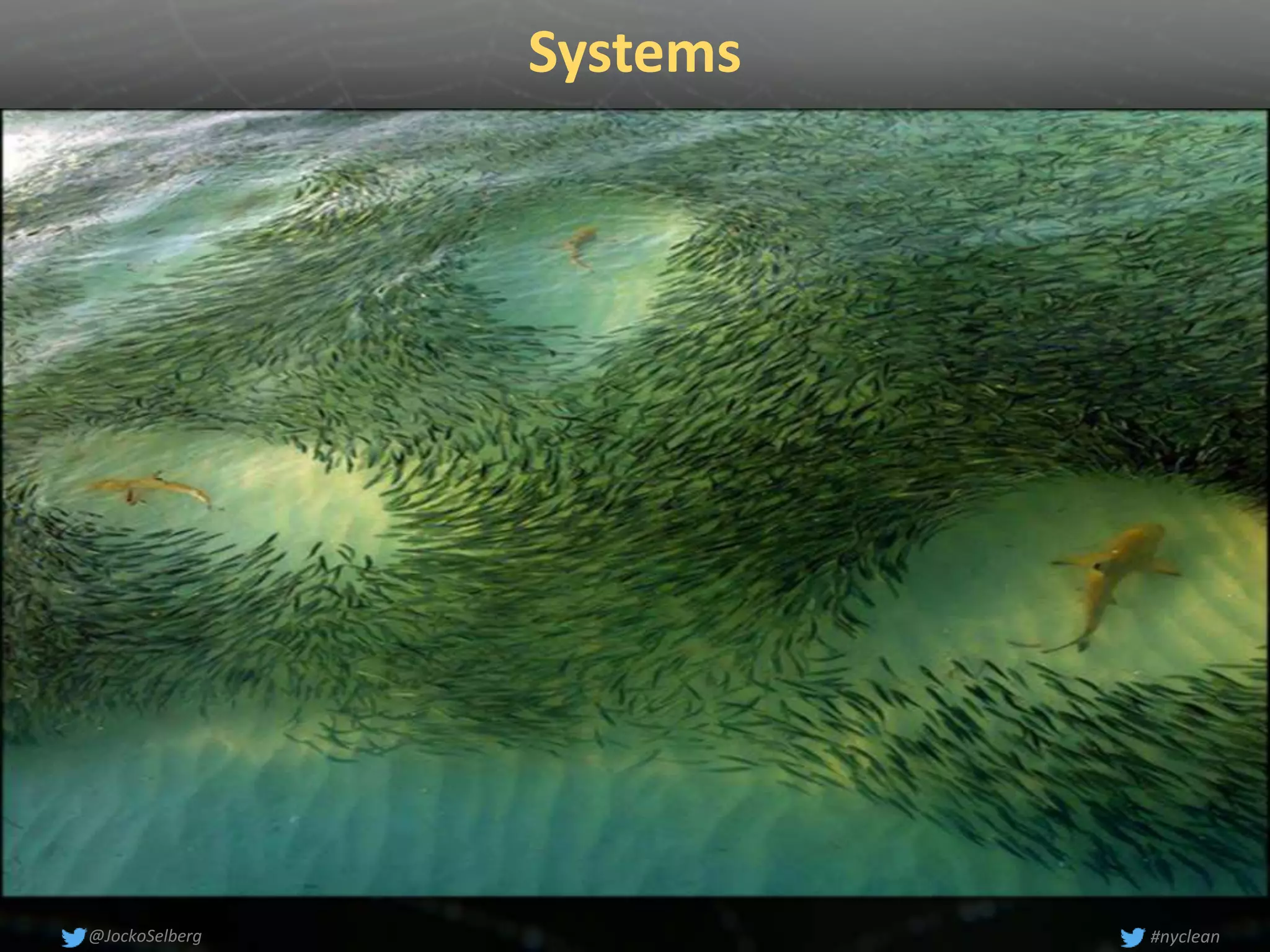
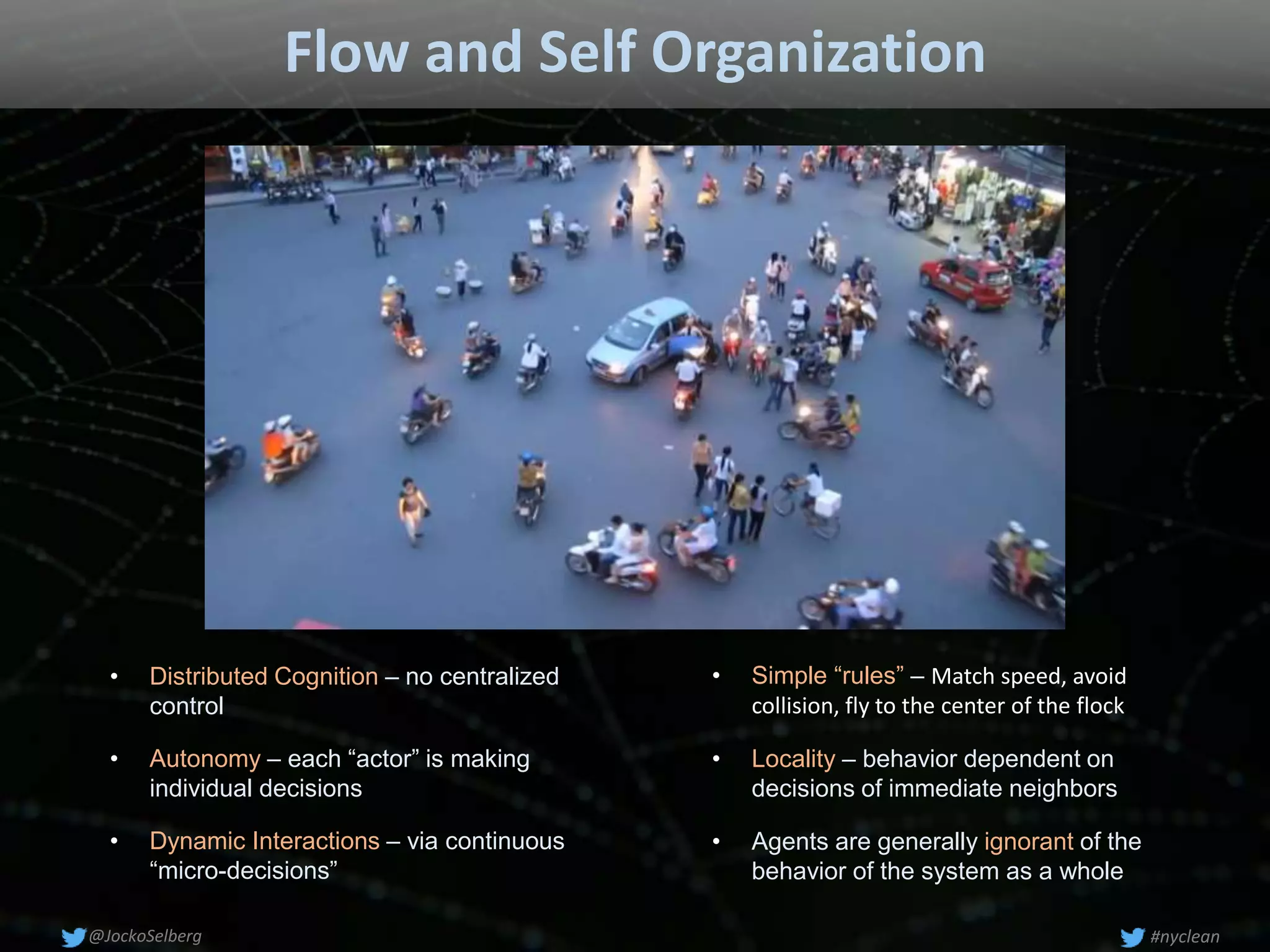
Flow and Self Organization
• Autonomy – each “actor” is making
individual decisions
• Locality – behavior dependent on
decisions of immediate neighbors
• Distributed Cognition – no centralized
control
• Dynamic Interactions – via continuous
“micro-decisions”
• Simple “rules” – Match speed, avoid
collision, fly to the center of the flock
• Agents are generally ignorant of the
behavior of the system as a whole
#nyclean@JockoSelberg
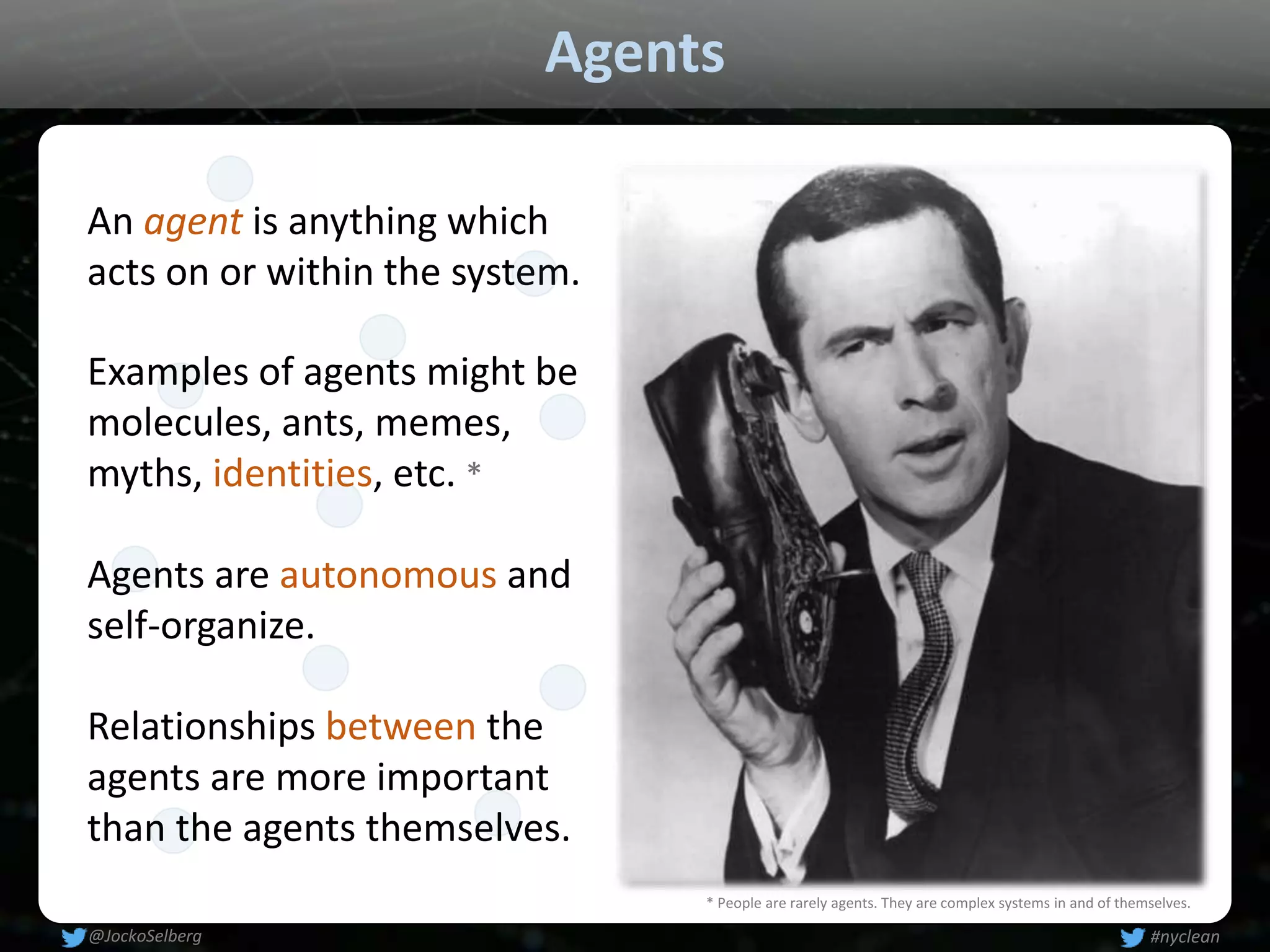
Agents
An agent is anything which
acts on or within the system.
Examples of agents might be
molecules, ants, memes,
myths, identities, etc. *
Relationships between the
agents are more important
than the agents themselves.
Agents are autonomous and
self-organize.
* People are rarely agents. They are complex systems in and of themselves.
#nyclean@JockoSelberg
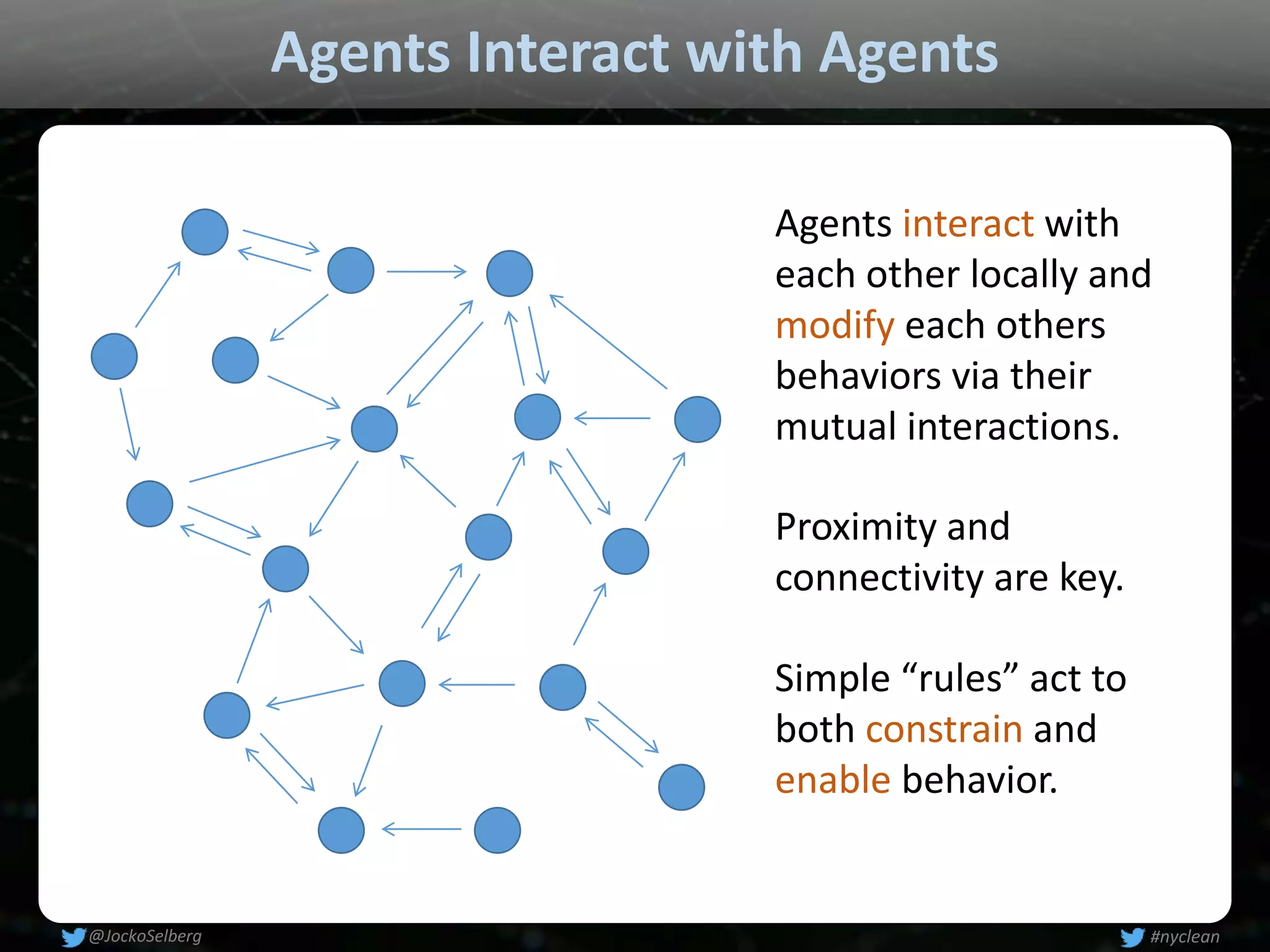
Agents Interact with Agents
Agents interact with
each other locally and
modify each others
behaviors via their
mutual interactions.
Proximity and
connectivity are key.
Simple “rules” act to
both constrain and
enable behavior.
#nyclean@JockoSelberg
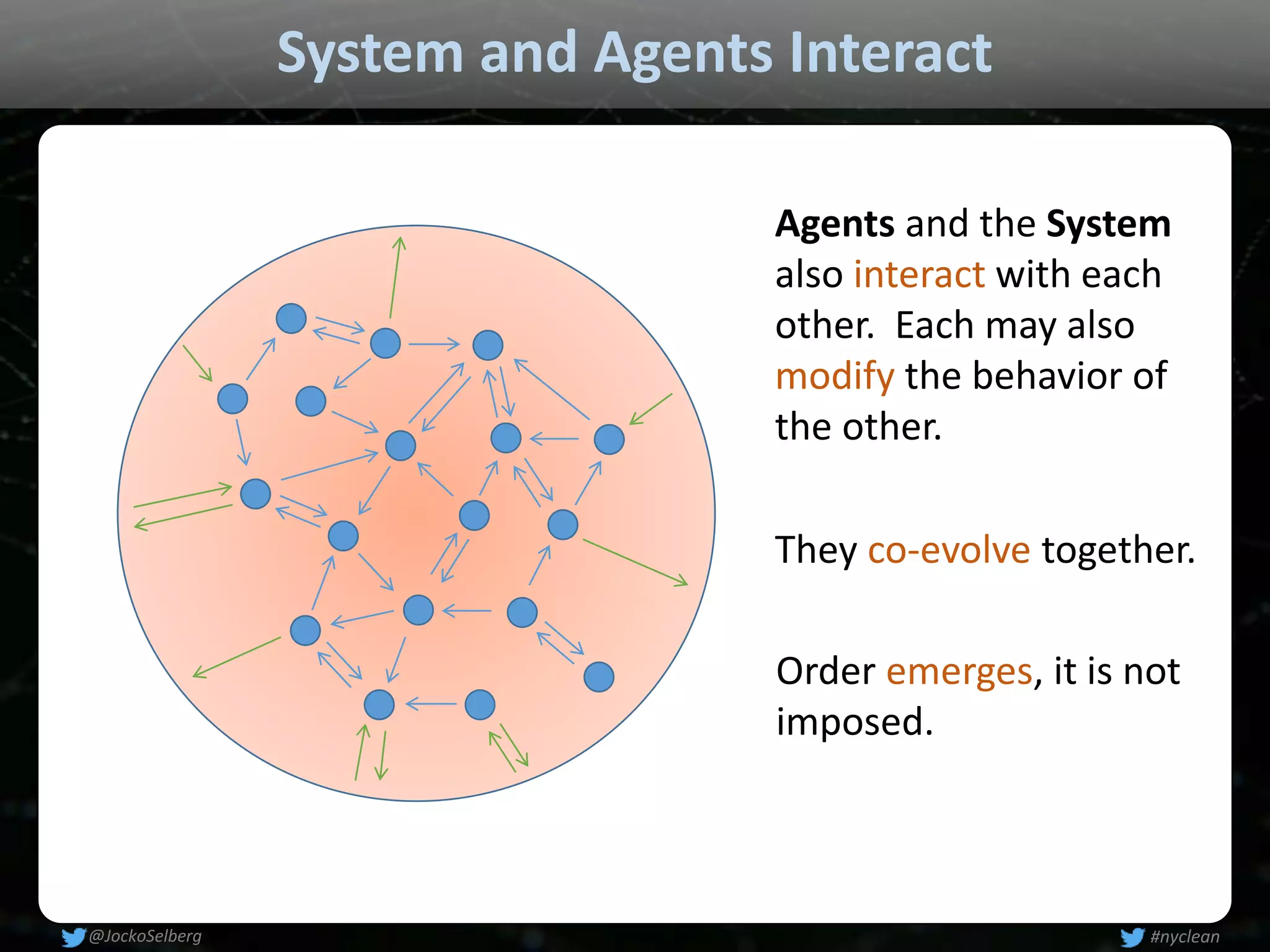
System and Agents Interact
Agents and the System
also interact with each
other. Each may also
modify the behavior of
the other.
They co-evolve together.
Order emerges, it is not
imposed.
#nyclean@JockoSelberg
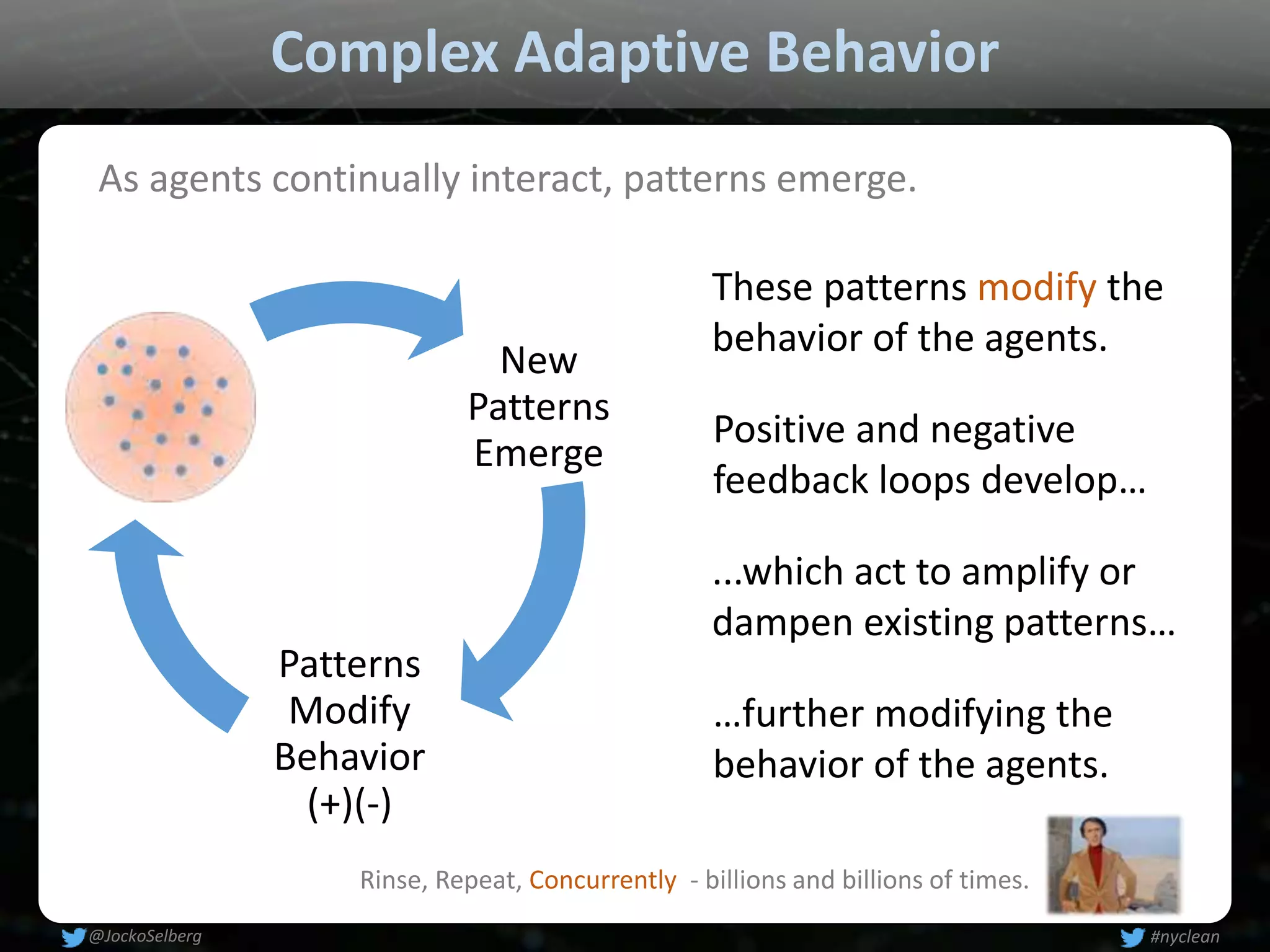
Complex Adaptive Behavior
New
Patterns
Emerge
Patterns
Modify
Behavior
(+)(-)
As agents continually interact, patterns emerge.
Positive and negative
feedback loops develop…
…further modifying the
behavior of the agents.
These patterns modify the
behavior of the agents.
...which act to amplify or
dampen existing patterns…
Rinse, Repeat, Concurrently - billions and billions of times.
#nyclean@JockoSelberg
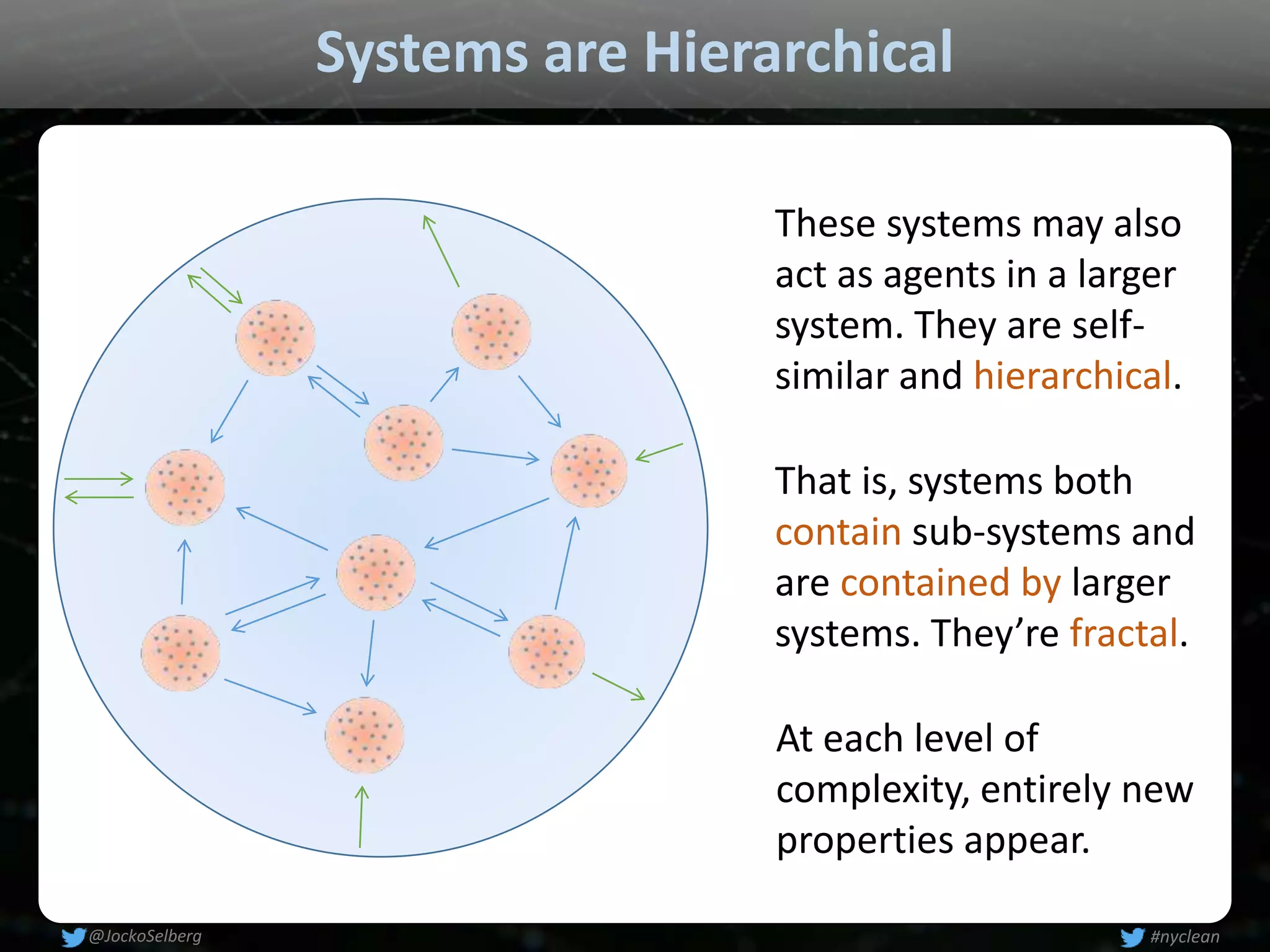
Systems are Hierarchical
These systems may also
act as agents in a larger
system. They are self-
similar and hierarchical.
That is, systems both
contain sub-systems and
are contained by larger
systems. They’re fractal.
At each level of
complexity, entirely new
properties appear.
#nyclean@JockoSelberg
Complexity in a Nutshell
• Systems are hierarchical – cells, organs, organisms, societies…
• Systems are dynamic – systems change in patterns over time
• Agents self-organize – There is no centralized control
• Order emerges – it is not imposed
• Multiple autonomous agents – interact with each other and the system
• Simple ”rules” (constraints) – produce complex interactions
• Systems and agents co-evolve
• Co-evolution is irreversible – There is only the current state*
#nyclean@JockoSelberg
* and its history – The present is informed by the past.
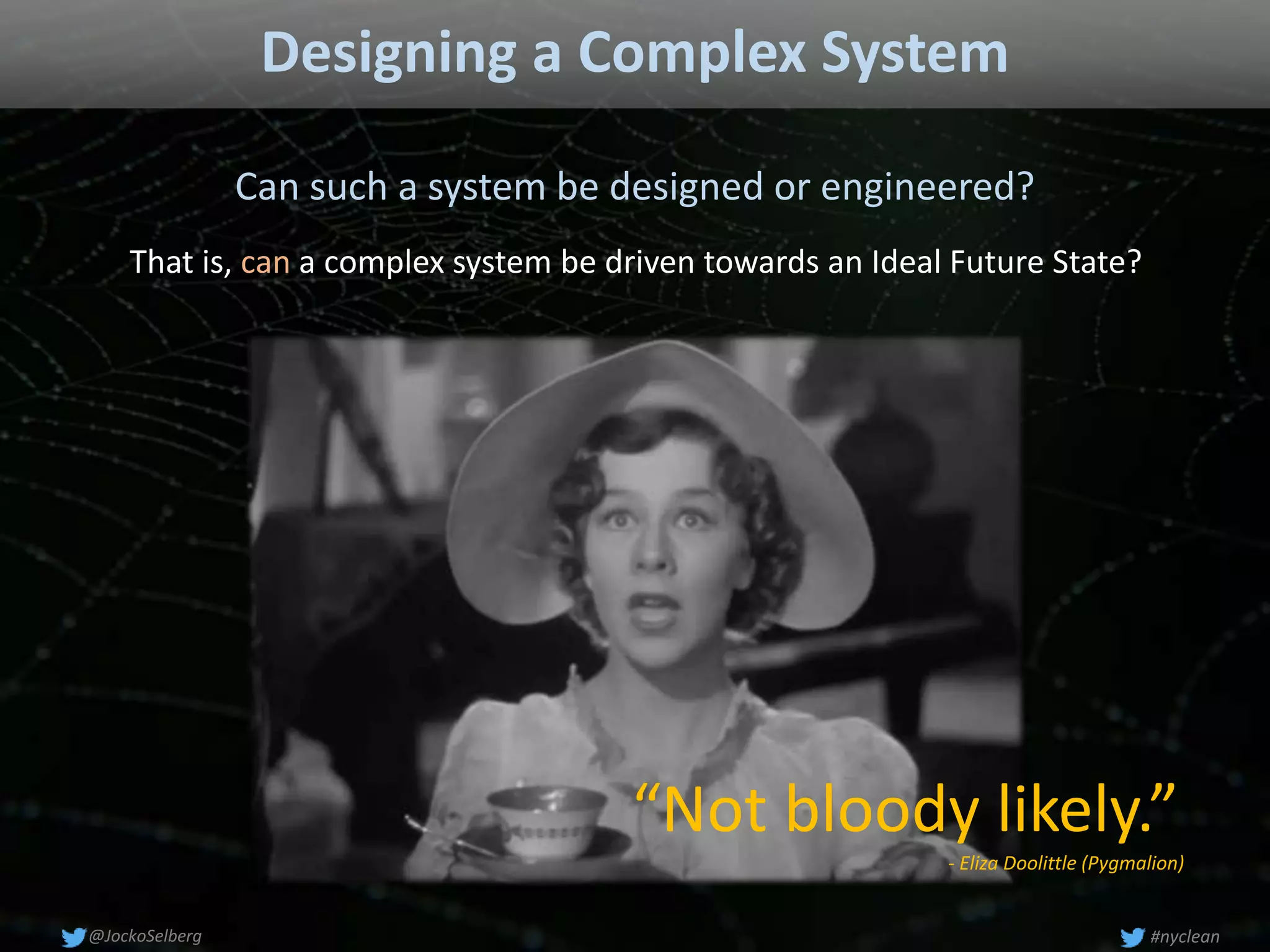
Designing a Complex System
Can such a system be designed or engineered?
“Not bloody likely.”
- Eliza Doolittle (Pygmalion)
That is, can a complex system be driven towards an Ideal Future State?
#nyclean@JockoSelberg
Why is This?
Complex systems are fundamentally different
• Small changes may produce massive impacts, or may do nothing at all
• You cannot know in advance which solution will work best because of
the dynamic nature of the network of interactions
• These systems evolve, there is no Ideal Future State to “achieve”
• These systems do not lend themselves to a reductionist approach
• There is only “fitness for purpose” within the “situated present”
#nyclean@JockoSelberg
Irony Alert – The present is generally more certain than the future
Working in Complex Systems…
…requires a shift in how we view our work at a systems level
• Monitor for emerging patterns, suppress the urge to categorize: Probe
• Identify patterns as they emerge (in real time)
• Seek opportunities that allow the system to move in a desirable direction
• Amplify / Dampen patterns rather than trying to drive system: Nudge
• Beneficial coherence can be amplified (within attractors)
• Negative coherence can be dampened by denying energy (resources)
• Manage the constraints rather than “the plan”: Bound
• Apply context sensitive constraints – the level of constraint is defined by the domain
• Manage via constant, small interactions - within boundaries
#nyclean@JockoSelberg
The only way to manage a complex adaptive system is by interacting with it
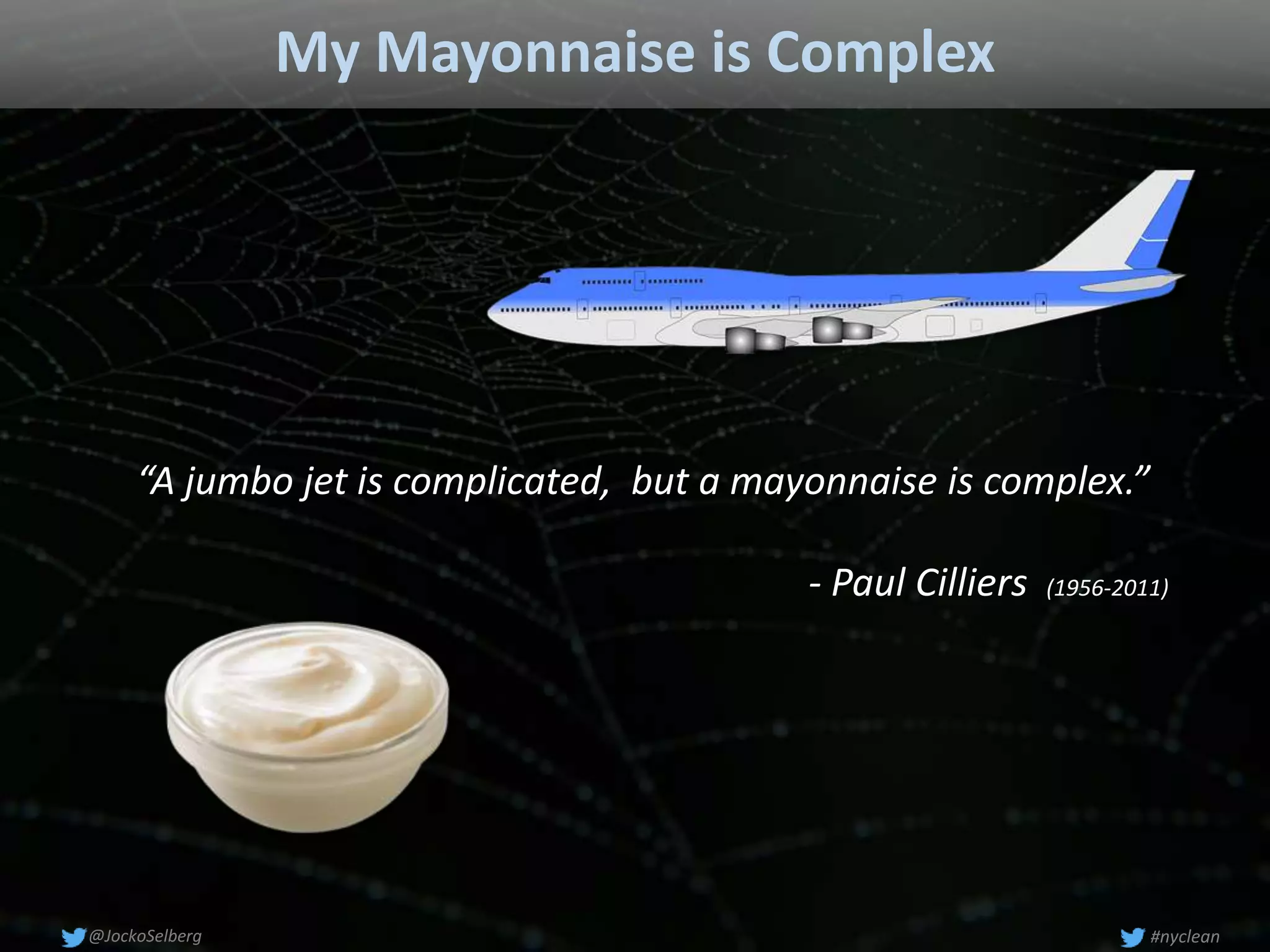
My Mayonnaise is Complex
“A jumbo jet is complicated, but a mayonnaise is complex.”
- Paul Cilliers (1956-2011)
#nyclean@JockoSelberg
Cynefin
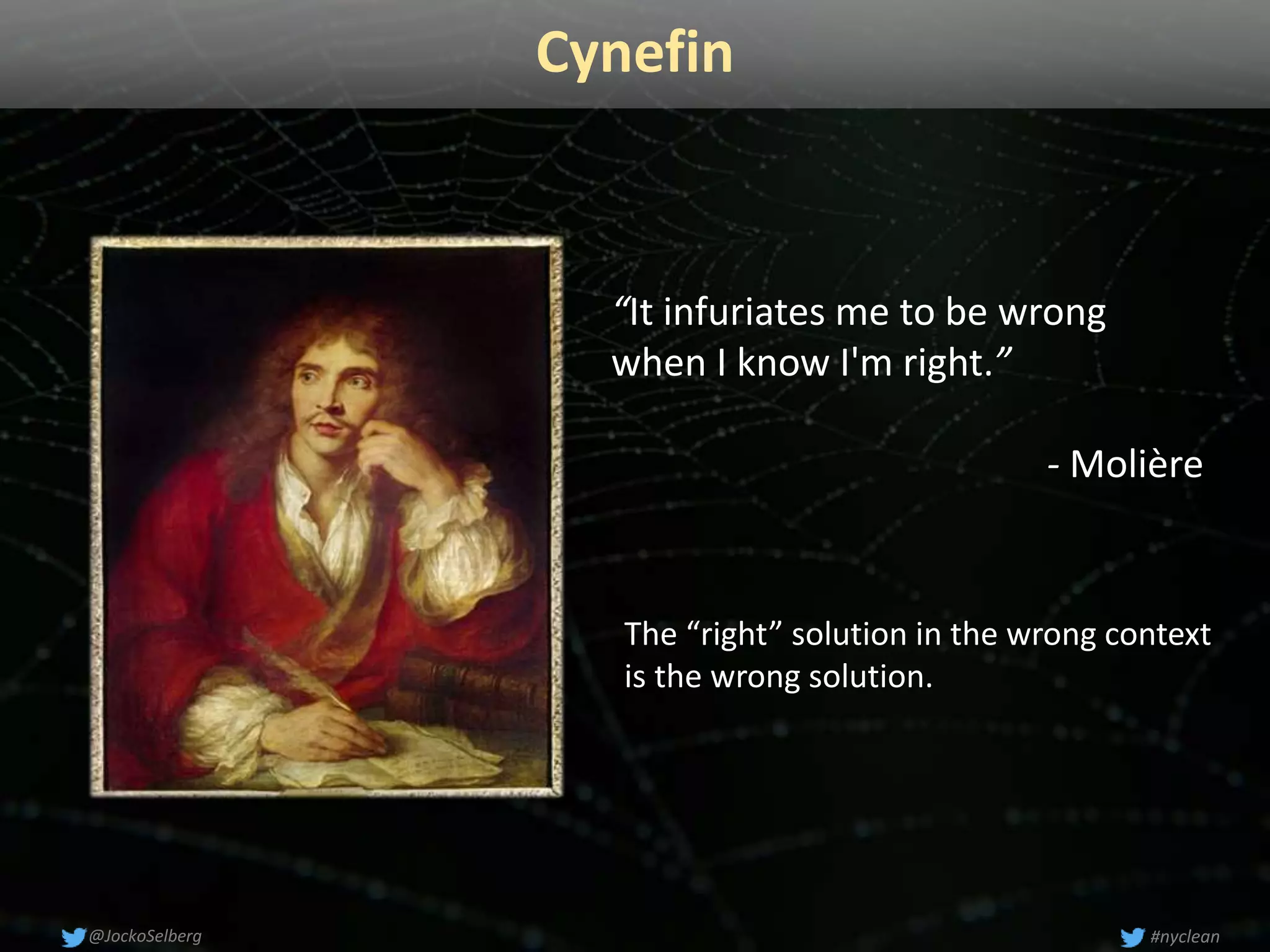
“It infuriates me to be wrong
when I know I'm right.”
- Molière
#nyclean@JockoSelberg
The “right” solution in the wrong context
is the wrong solution.
Knowns, Gnomes and Unknowns
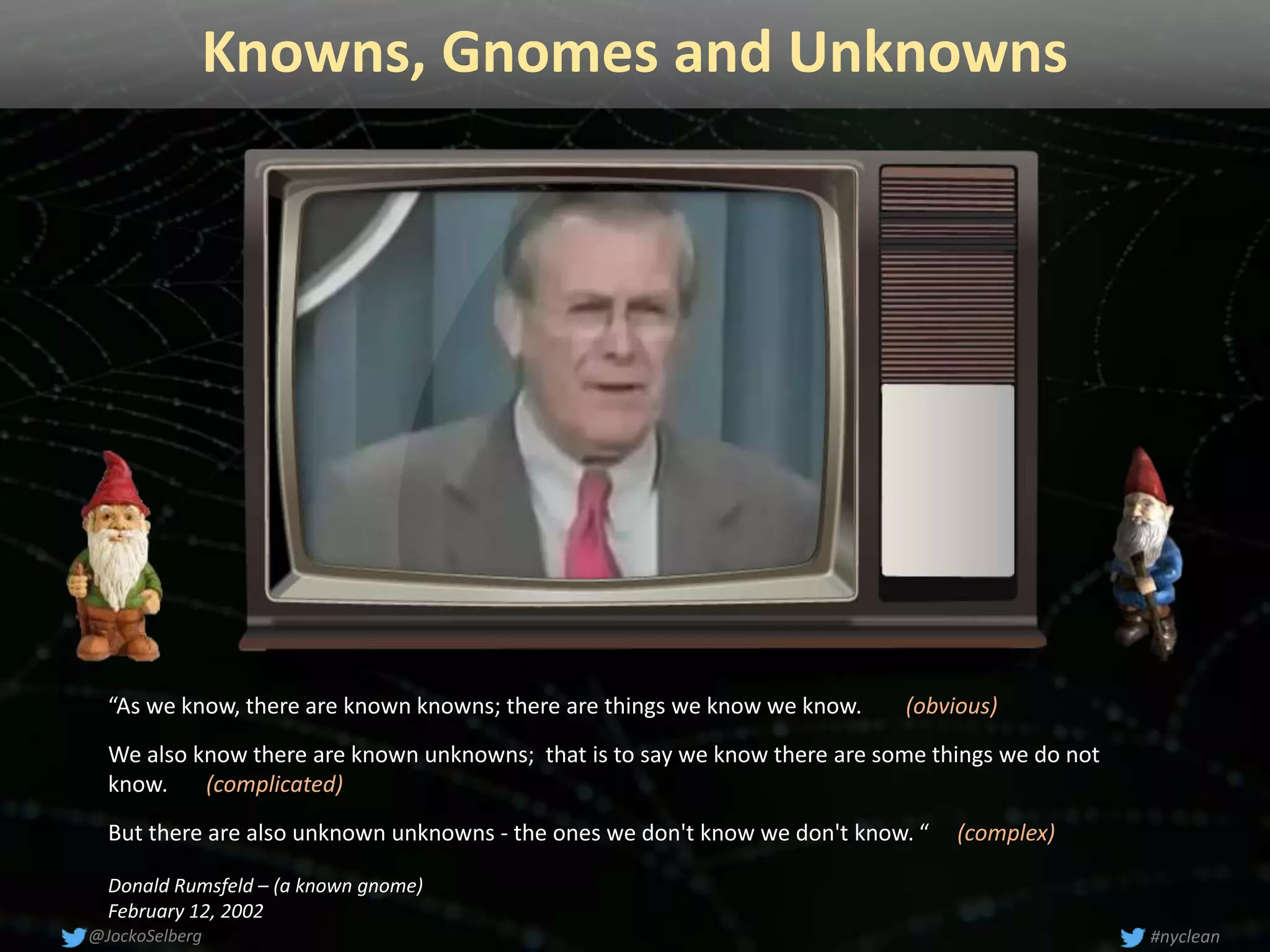
“As we know, there are known knowns; there are things we know we know. (obvious)
We also know there are known unknowns; that is to say we know there are some things we do not
know. (complicated)
But there are also unknown unknowns - the ones we don't know we don't know. “ (complex)
Donald Rumsfeld – (a known gnome)
February 12, 2002
#nyclean@JockoSelberg
Let’s Make Sense of This…
…using the Cynefin Framework
#nyclean@JockoSelberg
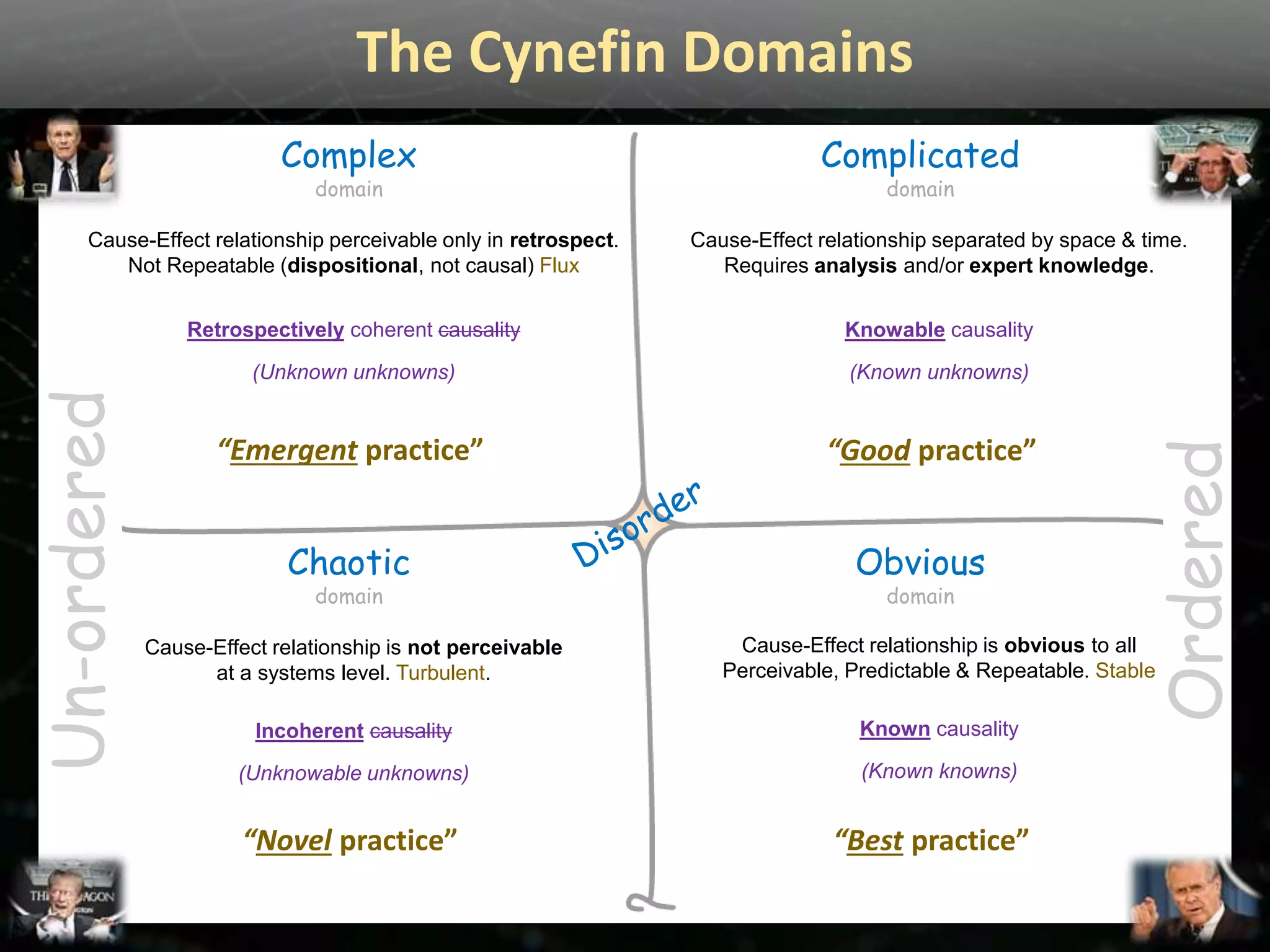
Chaotic
domain
Complicated
domain
Complex
domain
Obvious
domain
Un-ordered
Ordered
The Cynefin Domains
Cause-Effect relationship perceivable only in retrospect.
Not Repeatable (dispositional, not causal) Flux
Cause-Effect relationship separated by space & time.
Requires analysis and/or expert knowledge.
Cause-Effect relationship is not perceivable
at a systems level. Turbulent.
Cause-Effect relationship is obvious to all
Perceivable, Predictable & Repeatable. Stable
Retrospectively coherent causality
(Unknown unknowns)
Incoherent causality
(Unknowable unknowns)
Knowable causality
(Known unknowns)
Known causality
(Known knowns)
“Emergent practice” “Good practice”
“Novel practice” “Best practice”
Chaotic
ComplicatedComplex
Obvious
Un-ordered
Ordered
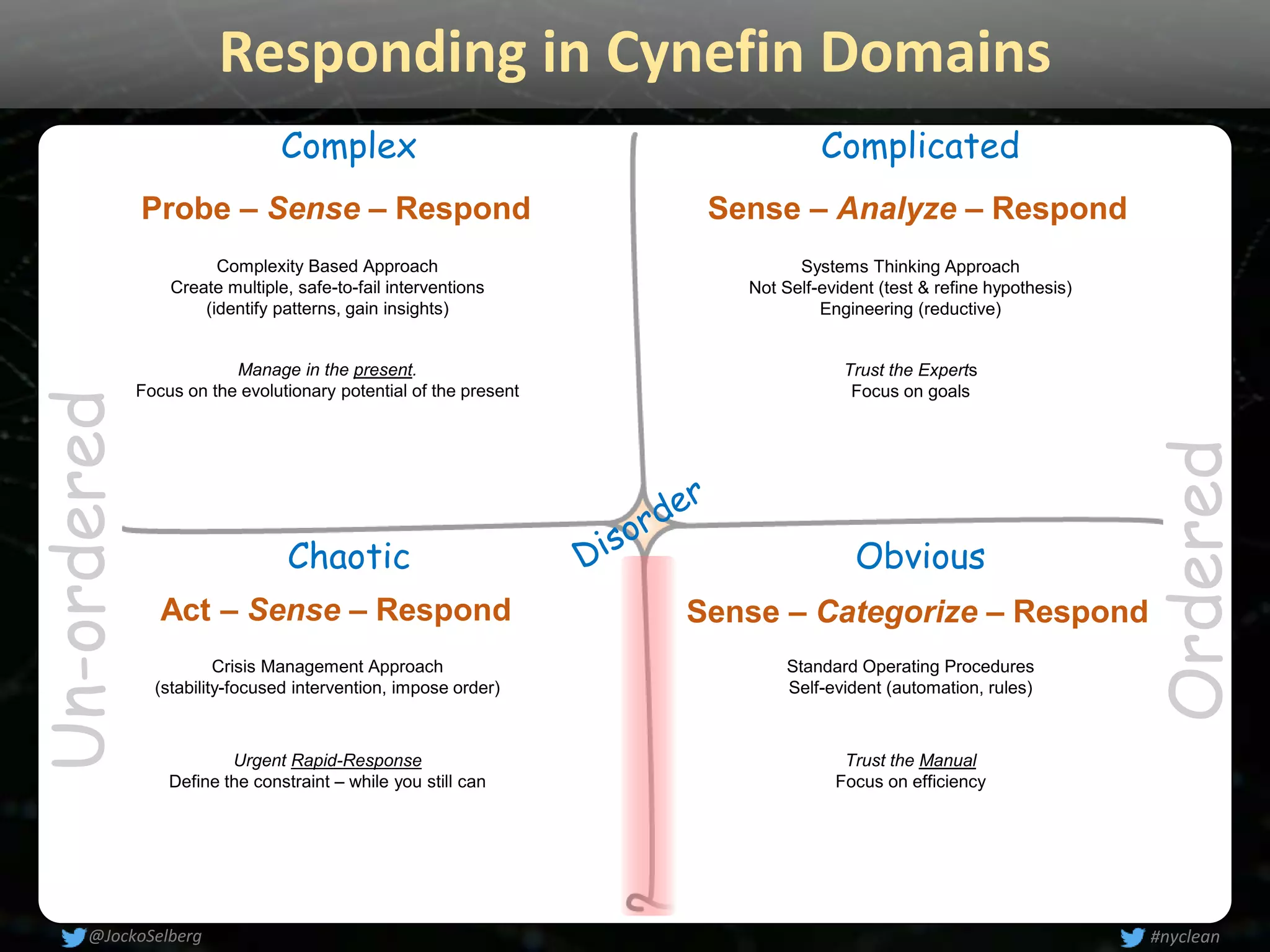
Responding in Cynefin Domains
Complexity Based Approach
Create multiple, safe-to-fail interventions
(identify patterns, gain insights)
Manage in the present.
Focus on the evolutionary potential of the present
Systems Thinking Approach
Not Self-evident (test & refine hypothesis)
Engineering (reductive)
Trust the Experts
Focus on goals
Crisis Management Approach
(stability-focused intervention, impose order)
Urgent Rapid-Response
Define the constraint – while you still can
Standard Operating Procedures
Self-evident (automation, rules)
Trust the Manual
Focus on efficiency
Sense – Analyze – Respond
Act – Sense – Respond Sense – Categorize – Respond
Probe – Sense – Respond
#nyclean@JockoSelberg
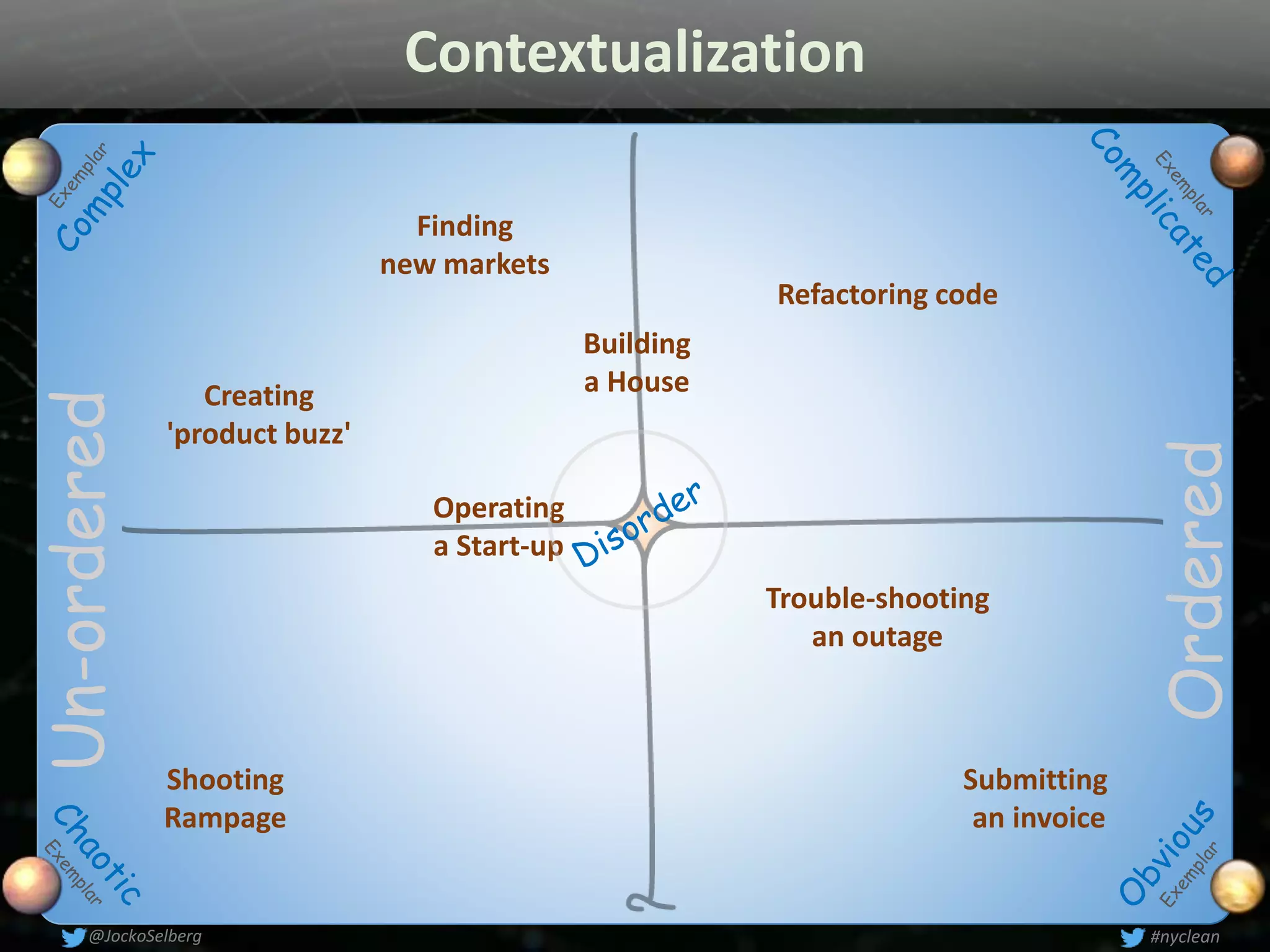
Contextualization
#nyclean@JockoSelberg
Un-ordered
Ordered
Contextualization
Submitting
an invoice
Refactoring code
Building
a House
Trouble-shooting
an outage
Operating
a Start-up
Creating
'product buzz'
Finding
new markets
Shooting
Rampage
#nyclean@JockoSelberg
Un-ordered
Ordered
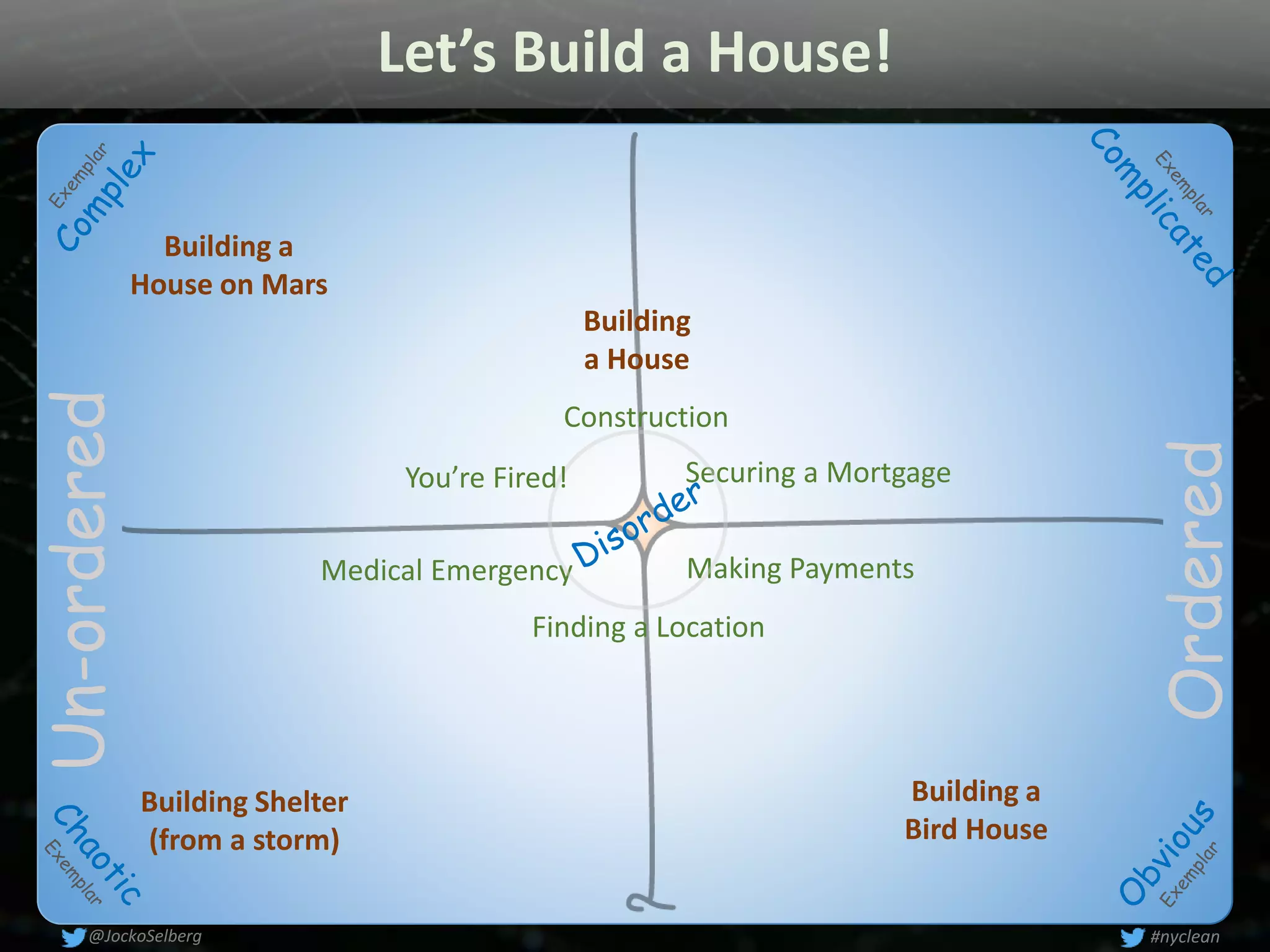
Let’s Build a House!
Building
a House
Finding a Location
Construction
Medical Emergency Making Payments
Securing a Mortgage
Building a
House on Mars
You’re Fired!
Building a
Bird House
Building Shelter
(from a storm)
#nyclean@JockoSelberg
Conclusion
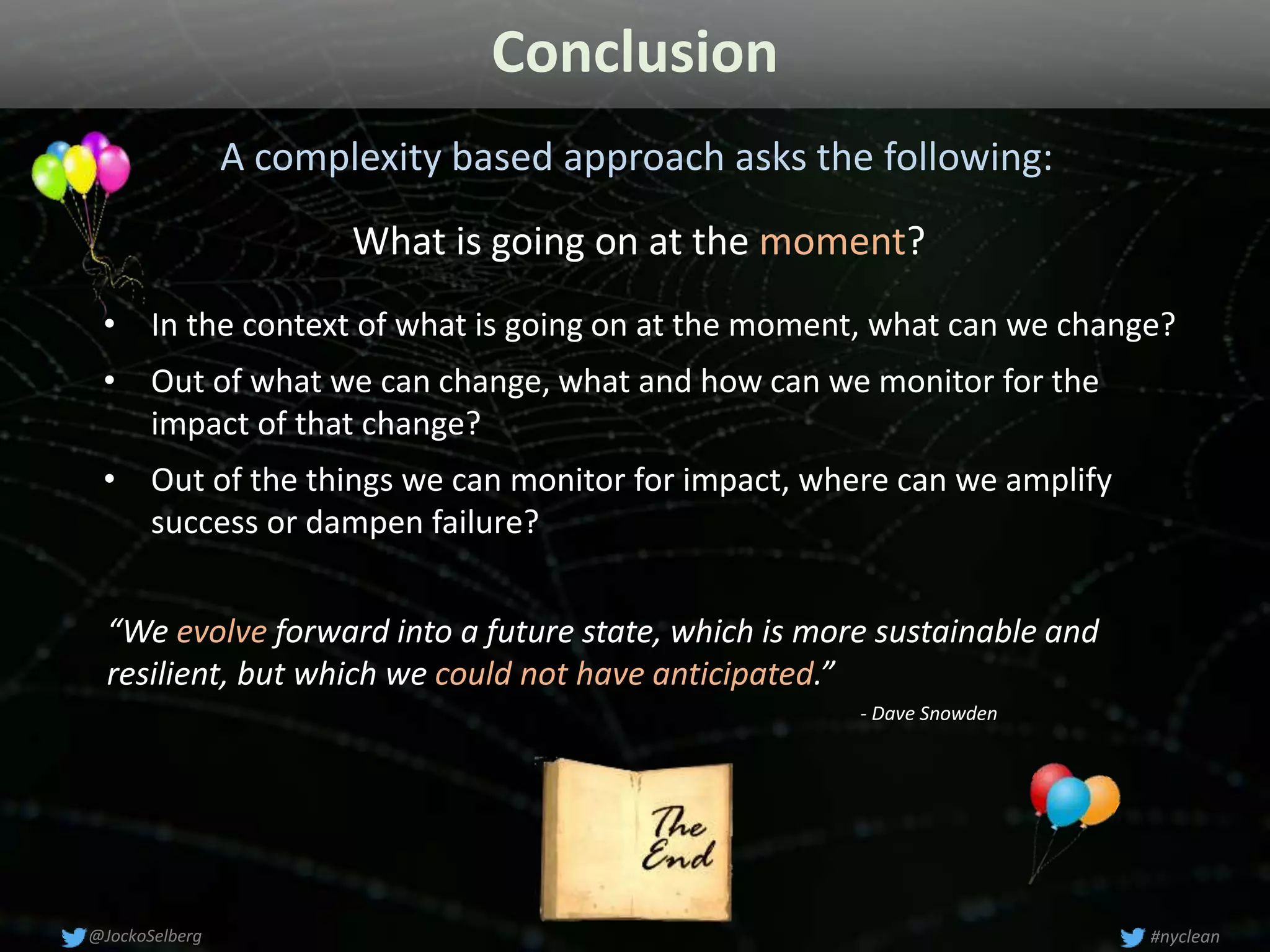
A complexity based approach asks the following:
• In the context of what is going on at the moment, what can we change?
• Out of what we can change, what and how can we monitor for the
impact of that change?
• Out of the things we can monitor for impact, where can we amplify
success or dampen failure?
#nyclean@JockoSelberg
What is going on at the moment?
“We evolve forward into a future state, which is more sustainable and
resilient, but which we could not have anticipated.”
- Dave Snowden
Thank You!
NYC Lean Kanban
MeetupSpecial Thanks to:
Dave Snowden
Jocko Selberg
@JockoSelberg
Jocko21@gmail.com
NYC Cynefin Group - Meetup

Cynefin and Complexity: A Gentle Introduction

  • 1.
    NYC Lean KanbanMeetup Cynefin and Complexity: A Gentle Introduction Jocko Selberg @JockoSelberg Jocko21@gmail.com NYC Cynefin Group - Meetup Oct 28, 2015 #nyclean * Lean Coffee to follow talk – create your topics
  • 2.
    Story Time! Mr. NarrativeFragments & Little Miss Context #nyclean@JockoSelberg
  • 3.
    A Very SpecialMessage #nyclean@JockoSelberg
  • 4.
    3 Vignettes #nyclean@JockoSelberg Our brainsinstantly construct a story based on our perception of the context. 1. We see car arrive - followed by Mr. Skinhead turning and scampering away. 2. We see Mr. Skinhead engaging Mr. Trenchcoat man. 3. We see Mr. Skinhead saving Mr. Trenchcoat man from falling bricks. Is Mr. Skinhead a criminal or an undercover cop? Is Mr. Trenchcoat man a banker or a drug dealer? Who is in that car?
  • 5.
    Stories in Context #nyclean@JockoSelberg Thesestories can be radically different based on your point of view (identity). The ‘Bro Officer O’Malley The Director
  • 6.
    First-fit Pattern Matching Weoften find ourselves responding to events without fully considering the context. Once we categorize something, it is cognitively very difficult to change your mind about it. – we categorize! #nyclean@JockoSelberg For example, as a PM or an executive, you may anchor the context in assuming you need for a detailed project plan for all work Categorizing allows us to make quick decisions based on limited information
  • 7.
    Sense & Respond Howcan we make sense of a situation such that we can respond intelligently given incomplete information? (whenever a decision is required, we are ALWAYS limited by incomplete information) #nyclean@JockoSelberg Given the fact that we are very prone to categorizing everything…
  • 8.
    Context is Everything Thereare no universal solutions, but there are contextual solutions There are different ways of doing things based on the context you are operating in #nyclean@JockoSelberg
  • 9.
    Making Sense ofthe Problem How can we more accurately sense the context we are operating in so that we might better act? #nyclean@JockoSelberg
  • 10.
    Order! #nyclean@JockoSelberg (S)he who definesthe constraint, defines (anchors) the solution space.
  • 11.
    What is Order? or·der /ˈôrdər/ noun 1.the arrangement or disposition of people or things in relation to each other according to a particular sequence or pattern. How does order happen? Must we create order, or can we allow order to emerge? #nyclean@JockoSelberg
  • 12.
    Emergent vs Directed EmergentOrder Relationships between cause and effect are unknown, unpredictable or not perceivable Relationships between cause and effect are well established or discoverable through analysis Order emerges out of initial starting conditions Directed Order Order is directed or imposed For the purposes of Cynefin, we’ll rename Directed Order to Ordered and Emergent Order to Un-ordered #nyclean@JockoSelberg
  • 13.
    Characteristics of Order Un-ordered Relationshipsbetween cause and effect are unknown, unpredictable or not perceivable Relationships between cause and effect are well established or discoverable through analysis Order emerges out of the initial starting conditions Ordered Order is directed or imposed Higher degree of Certainty (highly predictable) Lower degree of Certainty (less predictable) CausalDispositional Linear relationships (output is directly proportional to the input) Non-linear relationships (output NOT directly proportional to the input) Exploitation - Commoditization (Repeatability) Exploration - Innovation (Novelty) #nyclean@JockoSelberg
  • 14.
    Managing Differently Un-ordered Relationships betweencause and effect are unknown, unpredictable or not perceivable Relationships between cause and effect are well established or discoverable through analysis Things Grow Ordered Things are Made Define Ideal Future State (close the gap) Describe the Present (influence the direction of change) Manage the Plan (set rules, scope - implementation) Manage the Constraints (set attractors, boundaries - experimentation) Monitor for Adherence (governance) Monitor for Emergence (patterns, weak signals) Architect the Solution (engineer) Amplify / Dampen Attractors* (feedback loops) #nyclean@JockoSelberg * An attractor is a state or set of states toward which a system tends to evolve. System values that get close enough to the attractor remain close.
  • 15.
    Triaging Un-ordered Relationships between causeand effect are unknown, unpredictable or not perceivable Relationships between cause and effect are well established or discoverable through analysis Are you looking for a repeatable solution? Are you looking for a novel solution? The realm of learning Ordered The realm of planning Nobody in the company, the industry, or the world has solved this type of problem in the past. You, your team, the company or a specialized group has solved this type of problem in the past. #nyclean@JockoSelberg
  • 16.
  • 17.
    3 Types ofSystems • A system is any network with coherence • An agent is anything which acts on or within the system • In nature, there are 3 types of systems:* • Ordered Systems: the system tightly constrains agent behavior. • Complex Systems: the system loosely constrains agent behavior. The system and agents (collectively) modify each others behaviors. • Chaotic Systems: the system imposes little or no constraints on agents. Agents act independently of each other, behavior appears random. * Constraints-based definition #nyclean@JockoSelberg
  • 18.
    Let’s Map TheseSystems Ordered (Directed Order) Un-ordered (Emergent Order) • Complex • Chaotic • Ordered Systems• Complicated domain Cynefin breaks Ordered Systems into 2 domains: Complicated & Obvious, based on peoples perception of the relationship between cause and effect. • Obvious domain • Dis-order domain Systems Systems domain domain #nyclean@JockoSelberg
  • 19.
    Chaotic domain Complicated domain Complex domain Obvious domain Un-ordered Ordered Cause-Effect relationship perceivableonly in retrospect. Not Repeatable (except by accident) Cause-Effect relationship discoverable via analysis and/or expert knowledge. Cause-Effect relationship is not perceivable at a systems level. Cause-Effect relationship is obvious to all Perceivable, Predictable & Repeatable. Introducing the Cynefin Domains The boundary between Obvious and Chaotic is represented as a cliff, or a catastrophic failure arising from complacency. #nyclean@JockoSelberg
  • 20.
    Notes on Sense-making Cynefinis a Sense-making framework, it is not a Categorization Schema It’s all about the dynamic movement between domains #nyclean@JockoSelberg
  • 21.
  • 22.
    Flow and SelfOrganization • Autonomy – each “actor” is making individual decisions • Locality – behavior dependent on decisions of immediate neighbors • Distributed Cognition – no centralized control • Dynamic Interactions – via continuous “micro-decisions” • Simple “rules” – Match speed, avoid collision, fly to the center of the flock • Agents are generally ignorant of the behavior of the system as a whole #nyclean@JockoSelberg
  • 23.
    Agents An agent isanything which acts on or within the system. Examples of agents might be molecules, ants, memes, myths, identities, etc. * Relationships between the agents are more important than the agents themselves. Agents are autonomous and self-organize. * People are rarely agents. They are complex systems in and of themselves. #nyclean@JockoSelberg
  • 24.
    Agents Interact withAgents Agents interact with each other locally and modify each others behaviors via their mutual interactions. Proximity and connectivity are key. Simple “rules” act to both constrain and enable behavior. #nyclean@JockoSelberg
  • 25.
    System and AgentsInteract Agents and the System also interact with each other. Each may also modify the behavior of the other. They co-evolve together. Order emerges, it is not imposed. #nyclean@JockoSelberg
  • 26.
    Complex Adaptive Behavior New Patterns Emerge Patterns Modify Behavior (+)(-) Asagents continually interact, patterns emerge. Positive and negative feedback loops develop… …further modifying the behavior of the agents. These patterns modify the behavior of the agents. ...which act to amplify or dampen existing patterns… Rinse, Repeat, Concurrently - billions and billions of times. #nyclean@JockoSelberg
  • 27.
    Systems are Hierarchical Thesesystems may also act as agents in a larger system. They are self- similar and hierarchical. That is, systems both contain sub-systems and are contained by larger systems. They’re fractal. At each level of complexity, entirely new properties appear. #nyclean@JockoSelberg
  • 28.
    Complexity in aNutshell • Systems are hierarchical – cells, organs, organisms, societies… • Systems are dynamic – systems change in patterns over time • Agents self-organize – There is no centralized control • Order emerges – it is not imposed • Multiple autonomous agents – interact with each other and the system • Simple ”rules” (constraints) – produce complex interactions • Systems and agents co-evolve • Co-evolution is irreversible – There is only the current state* #nyclean@JockoSelberg * and its history – The present is informed by the past.
  • 29.
    Designing a ComplexSystem Can such a system be designed or engineered? “Not bloody likely.” - Eliza Doolittle (Pygmalion) That is, can a complex system be driven towards an Ideal Future State? #nyclean@JockoSelberg
  • 30.
    Why is This? Complexsystems are fundamentally different • Small changes may produce massive impacts, or may do nothing at all • You cannot know in advance which solution will work best because of the dynamic nature of the network of interactions • These systems evolve, there is no Ideal Future State to “achieve” • These systems do not lend themselves to a reductionist approach • There is only “fitness for purpose” within the “situated present” #nyclean@JockoSelberg Irony Alert – The present is generally more certain than the future
  • 31.
    Working in ComplexSystems… …requires a shift in how we view our work at a systems level • Monitor for emerging patterns, suppress the urge to categorize: Probe • Identify patterns as they emerge (in real time) • Seek opportunities that allow the system to move in a desirable direction • Amplify / Dampen patterns rather than trying to drive system: Nudge • Beneficial coherence can be amplified (within attractors) • Negative coherence can be dampened by denying energy (resources) • Manage the constraints rather than “the plan”: Bound • Apply context sensitive constraints – the level of constraint is defined by the domain • Manage via constant, small interactions - within boundaries #nyclean@JockoSelberg The only way to manage a complex adaptive system is by interacting with it
  • 32.
    My Mayonnaise isComplex “A jumbo jet is complicated, but a mayonnaise is complex.” - Paul Cilliers (1956-2011) #nyclean@JockoSelberg
  • 33.
    Cynefin “It infuriates meto be wrong when I know I'm right.” - Molière #nyclean@JockoSelberg The “right” solution in the wrong context is the wrong solution.
  • 34.
    Knowns, Gnomes andUnknowns “As we know, there are known knowns; there are things we know we know. (obvious) We also know there are known unknowns; that is to say we know there are some things we do not know. (complicated) But there are also unknown unknowns - the ones we don't know we don't know. “ (complex) Donald Rumsfeld – (a known gnome) February 12, 2002 #nyclean@JockoSelberg
  • 35.
    Let’s Make Senseof This… …using the Cynefin Framework #nyclean@JockoSelberg
  • 36.
    Chaotic domain Complicated domain Complex domain Obvious domain Un-ordered Ordered The Cynefin Domains Cause-Effectrelationship perceivable only in retrospect. Not Repeatable (dispositional, not causal) Flux Cause-Effect relationship separated by space & time. Requires analysis and/or expert knowledge. Cause-Effect relationship is not perceivable at a systems level. Turbulent. Cause-Effect relationship is obvious to all Perceivable, Predictable & Repeatable. Stable Retrospectively coherent causality (Unknown unknowns) Incoherent causality (Unknowable unknowns) Knowable causality (Known unknowns) Known causality (Known knowns) “Emergent practice” “Good practice” “Novel practice” “Best practice”
  • 37.
    Chaotic ComplicatedComplex Obvious Un-ordered Ordered Responding in CynefinDomains Complexity Based Approach Create multiple, safe-to-fail interventions (identify patterns, gain insights) Manage in the present. Focus on the evolutionary potential of the present Systems Thinking Approach Not Self-evident (test & refine hypothesis) Engineering (reductive) Trust the Experts Focus on goals Crisis Management Approach (stability-focused intervention, impose order) Urgent Rapid-Response Define the constraint – while you still can Standard Operating Procedures Self-evident (automation, rules) Trust the Manual Focus on efficiency Sense – Analyze – Respond Act – Sense – Respond Sense – Categorize – Respond Probe – Sense – Respond #nyclean@JockoSelberg
  • 38.
  • 39.
    Un-ordered Ordered Contextualization Submitting an invoice Refactoring code Building aHouse Trouble-shooting an outage Operating a Start-up Creating 'product buzz' Finding new markets Shooting Rampage #nyclean@JockoSelberg
  • 40.
    Un-ordered Ordered Let’s Build aHouse! Building a House Finding a Location Construction Medical Emergency Making Payments Securing a Mortgage Building a House on Mars You’re Fired! Building a Bird House Building Shelter (from a storm) #nyclean@JockoSelberg
  • 41.
    Conclusion A complexity basedapproach asks the following: • In the context of what is going on at the moment, what can we change? • Out of what we can change, what and how can we monitor for the impact of that change? • Out of the things we can monitor for impact, where can we amplify success or dampen failure? #nyclean@JockoSelberg What is going on at the moment? “We evolve forward into a future state, which is more sustainable and resilient, but which we could not have anticipated.” - Dave Snowden
  • 42.
    Thank You! NYC LeanKanban MeetupSpecial Thanks to: Dave Snowden Jocko Selberg @JockoSelberg Jocko21@gmail.com NYC Cynefin Group - Meetup

Editor's Notes

  • #5 There are basically 3 micro-narrative stories. We have no idea who these people are – but that doesn’t stop us from constructing a story. 1st story – who thought he was running away? Running towards something? Something else? 2nd Story – CONTEXT CHANGE - Who thought he was mugging trench-coat guy? Who thought he was helping? Something else? Who is this skinhead? Who is trench-coat guy? We don’t know, but that doesn’t stop us from constructing a story and setting a context for that story to live in - based on very limited information. 3rd Story – CONTEXT CHANGE – Finally, we see he was helping trench-coat guy. Was he?
  • #6 Skin head Police officer 4th Story – CONTEXT CHANGE – These are actor. This was scripted. Director
  • #13 The order we see around us is spontaneous, organic, emergent, rather than controlled, directed or managed. “Complex systems have propensities and dispositions, but no linear material cause”
  • #14 Linear: doubling one causes the other to double as well. Non-linear relationship the output is NOT directly proportional to the input a drug may be ineffective up until a certain threshold and then become effective - or, a drug may become progressively more helpful over a certain range, but then may become harmful Causal – Dispositional – has propensities, we can understand which direction a system might or might not evolve –but we can never have certainty
  • #15 an attractor is a state or set of states toward which a system tends to evolve, given a wide variety of starting conditions. System values that get close enough to the attractor values remain close even if slightly disturbed. Manage emergence (Snowden) – “Manage the Boundaries conditions, manage the probes, manage the emergence of beneficial coherence” - Emergence of beneficial coherence, within boundaries, within attractors. Weak signal detection – pay attention to the outliers – watch for emerging patterns
  • #16 Understanding is emergent. We don't start out knowing the solution. ~ @ourfounder #abe15
  • #18 A system is any network (or set of elements with relationships) with coherence (self-consistency / consistent with known fact)
  • #20 The fifth domain is Disorder, which is the state of not knowing what type of causality exists, in which state people will revert to their own comfort zone in making a decision. If you find yourself (or your boss) attempting to impose order on an un-ordered system (or problem) you are probably in the Disordered domain. Common example are detailed project plans in Product Development.
  • #21 Sense making is the way that people choose between multiple possible explanations in order to act or respond to the world around them. (the way we interpret the world and the way we act in it.)
  • #23 The methods and tools we currently have for decision-making (management systems) have evolved for ordered systems, not complex systems Boid’s algorithm
  • #24   Alicia Juarrero who famously said that “meaning exists in the gaps between things not the things themselves” Agent’s are Not People – Soylent Green is People – Don Adams
  • #25 Proximity and connectivity have high impact: which agents are interacting with which agents and why (attractors) is one of the ways we can manage in complexity In Human Complex Systems, simple rules is a bit of an over-statement (we are not ants) which doesn’t take into account intentionality and multiple identities (we often behave illogically) Continuous Interactions (parallelism)
  • #27 If the initial starting conditions were even slightly different, the patterns would develop differently Example might be crowd behavior – flow lines appear – Grand Central Station
  • #29 “The whole is greater than the sum of the parts”.
  • #31 Once a CAS has reached the state of being good enough, it will favor greater effectiveness over increased efficiency There are multiple “right” ways of doing things
  • #32 Shift - We manage the emergence of beneficial coherence, within attractors, within boundaries.  The only things we can manage are the probes, the boundaries and amplification/dampening of emergent patterns.
  • #33 ―It is important at this stage to note that there is a difference between complex and complicated? An example of a complicated system is a Boeing 747. It‘s big, and it‘s difficult to understand - but you can take it apart if you‘ve got the drawings and you can put it back together again. A complex system is like mayonnaise. Once you‘ve put the ingredients together, you can never get it back and you can never guarantee the same results. Complicated systems can be given exact descriptions whereas the complexity of a complex system always eludes such precision.  This distinction is neatly summed up by his often quoted remark “a jumbo jet is complicated but a mayonnaise is complex.”
  • #34 You can be right in one context, and terribly wrong in another Speaking of the right solution used in the wrong context - Behold: Rumsfeld
  • #37 Complex – not fore-seeable, but is dispositional
  • #38 Enabling Constraints - constraints modified by behavior. (sufficient constraint such that we have control, but not so much that you don’t have variation within the system)
  • #42 Cynefin can help us to understand when we might apply a complexity based approach, and when we might apply the more traditional “ordered” approach. Each approach has validity, but only when applied within the proper context.