






Design Tools for
Systems Thinking
25 September 2015 EuroIA 2015
@pvermaer
@2pk_koen
Introduction
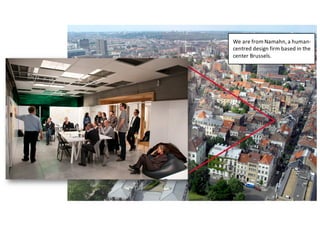
We are from Namahn, a human-
centred design firm based in the
center Brussels.
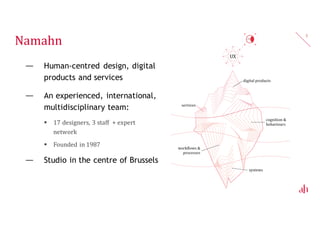
Namahn
— Human-centred design, digital
products and services
— An experienced, international,
multidisciplinary team:
 17 designers, 3 staff + expert
network
 Founded in 1987
— Studio in the centre of Brussels
3
“Every design is either an element of
a system or a system itself and is part of
ensuing causal entanglements”
(Nelson and Stolterman, 2012)
4
Agenda
— Introduction to systems thinking
— Design process
 Understand
 Explore
 Define
5
Introduction
7
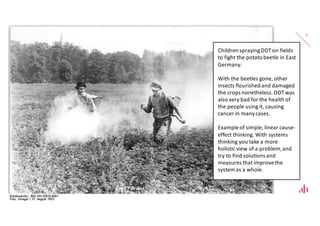
Children spraying DDT on fields
to fight the potato beetle in East
Germany.
With the beetles gone, other
insects flourished and damaged
the crops nonetheless. DDT was
also very bad for the health of
the people using it, causing
cancer in many cases.
Example of simple, linear cause-
effect thinking. With systems
thinking you take a more
holistic view of a problem, and
try to find solutions and
measures that improve the
system as a whole.
What is Systems Thinking?
“Systems Thinking looks at the whole of a system rather than
focusing on its individual parts, to better understand
complex phenomena.
Systems Thinking contrasts with analytic thinking: you solve
problems by going deeper, by looking at the greater whole
of a system and the relations between its elements, rather
than solving individual problems in a linear way via simple
cause and effect explanations.”
8
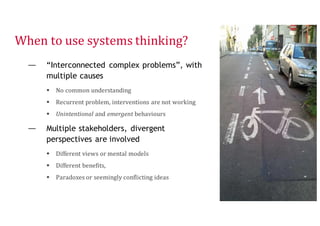
When to use systems thinking?
— “Interconnected complex problems”, with
multiple causes
 No common understanding
 Recurrent problem, interventions are not working
 Unintentional and emergent behaviours
— Multiple stakeholders, divergent
perspectives are involved
 Different views or mental models
 Different benefits,
 Paradoxes or seemingly conflicting ideas
9
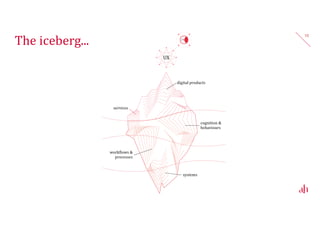
The iceberg...
10
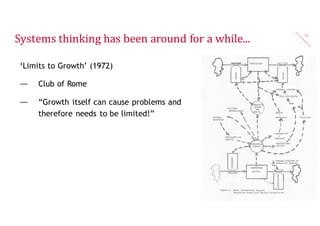
‘Limits to Growth’ (1972)
— Club of Rome
— “Growth itself can cause problems and
therefore needs to be limited!”
11
Systems thinking has been around for a while...
DISCLAIMER
12
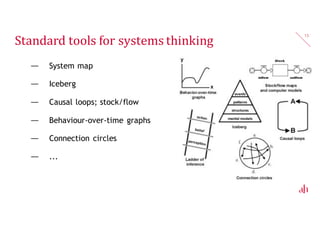
Standard tools for systems thinking
— System map
— Iceberg
— Causal loops; stock/flow
— Behaviour-over-time graphs
— Connection circles
— ...
13
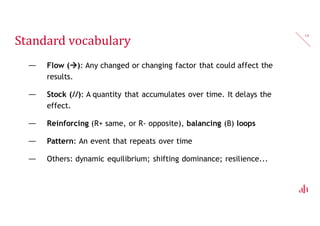
Standard vocabulary
— Flow (): Any changed or changing factor that could affect the
results.
— Stock (//): A quantity that accumulates over time. It delays the
effect.
— Reinforcing (R+ same, or R- opposite), balancing (B) loops
— Pattern: An event that repeats over time
— Others: dynamic equilibrium; shifting dominance; resilience...
14
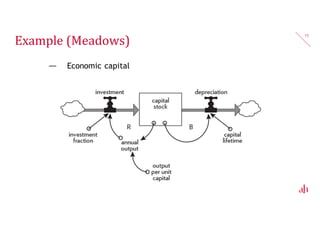
Example (Meadows)
— Economic capital
15
System thinker
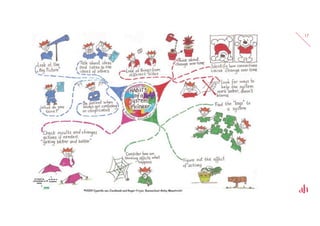
Habits of a system thinker?
 Look at the big picture
 Be patient when things get confusing or
complicated
 Look at things from different sides
 Think about change over time; identify how
connections cause change over time
16
http://watersfoundation.org/
 Don’t blame; look for ways to help the
system work better
 Find the keys to a system
 Figure out the effect of actions
17
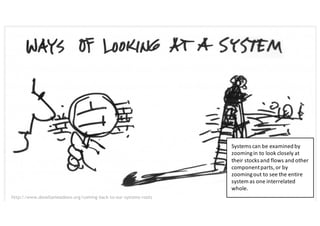
http://www.donellameadows.org/coming-back-to-our-systems-roots
Systems can be examined by
zooming in to look closely at
their stocks and flows and other
component parts, or by
zooming out to see the entire
system as one interrelated
whole.
Case: childhood obesity
The problem: childhood obesity
— September 2015 is Childhood Obesity Awareness Month
in US
— Obesity has doubled in children and quadrupled in
adolescents in the past 30 years (U.S.)
— Note: overweight versus obesity. Diagnosis based on BMI
— Health effects: short and long term
— Prevention?
19
Can systems thinking help to find solutions?
20
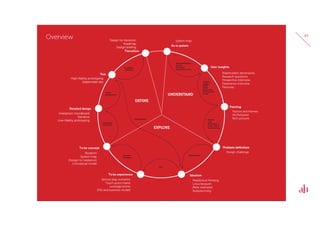
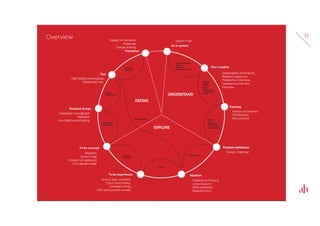
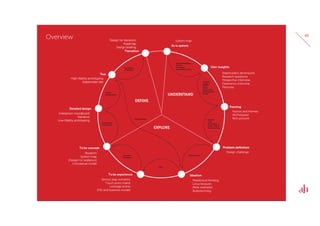
Design process
22
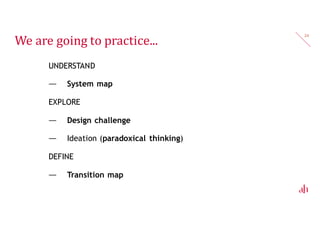
We are going to practice...
UNDERSTAND
— System map
EXPLORE
— Design challenge
— Ideation (paradoxical thinking)
DEFINE
— Transition map
23
Understand
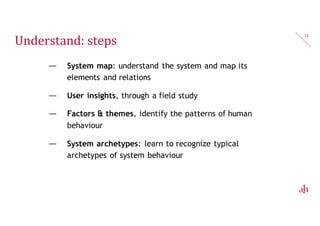
Understand: steps
— System map: understand the system and map its
elements and relations
— User insights, through a field study
— Factors & themes, identify the patterns of human
behaviour
— System archetypes: learn to recognize typical
archetypes of system behaviour
25
System map
System map
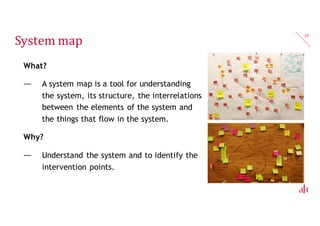
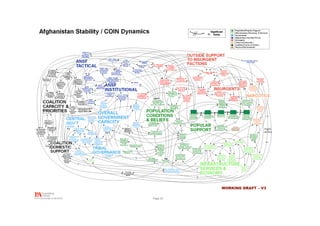
What?
— A system map is a tool for understanding
the system, its structure, the interrelations
between the elements of the system and
the things that flow in the system.
Why?
— Understand the system and to identify the
intervention points.
27
System Map: elements
31
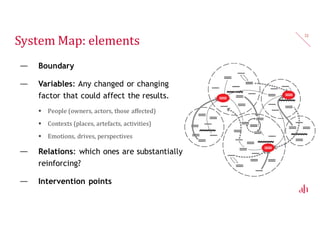
— Boundary
— Variables: Any changed or changing
factor that could affect the results.
 People (owners, actors, those affected)
 Contexts (places, artefacts, activities)
 Emotions, drives, perspectives
— Relations: which ones are substantially
reinforcing?
— Intervention points
Exercise: draw a system map for child obesity
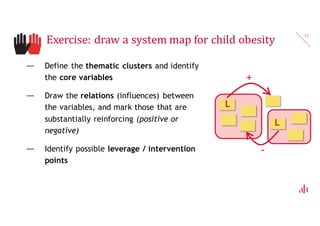
— Define the thematic clusters and identify
the core variables
— Draw the relations (influences) between
the variables, and mark those that are
substantially reinforcing (positive or
negative)
— Identify possible leverage / intervention
points
32
+
-
L
L
User insights
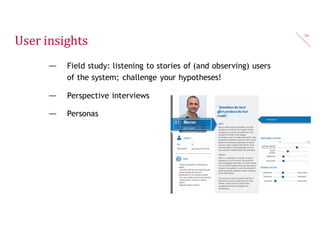
— Field study: listening to stories of (and observing) users
of the system; challenge your hypotheses!
— Perspective interviews
— Personas
33
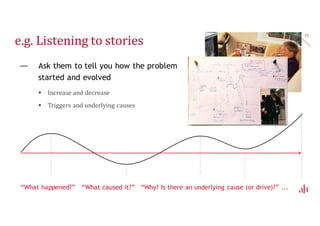
e.g. Listening to stories
— Ask them to tell you how the problem
started and evolved
 Increase and decrease
 Triggers and underlying causes
34
“What happened?” “What caused it?” “Why? Is there an underlying cause (or drive)?” ...
Exercise: system map (2)
— Review your draft version of the system map
 Variables you missed out on
 Connections you didn’t see at first
 New leverage points
35
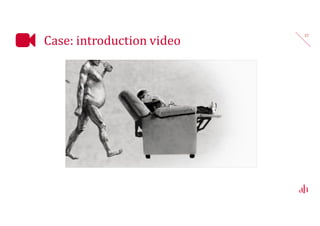
Case: introduction video
36
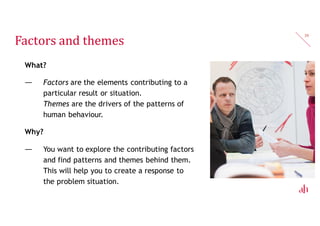
Factors and themes
Factors and themes
What?
— Factors are the elements contributing to a
particular result or situation.
Themes are the drivers of the patterns of
human behaviour.
Why?
— You want to explore the contributing factors
and find patterns and themes behind them.
This will help you to create a response to
the problem situation.
38
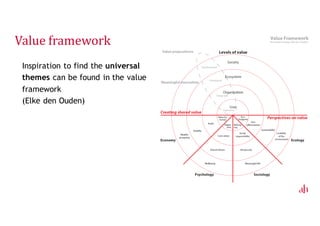
Value framework
Inspiration to find the universal
themes can be found in the value
framework
(Elke den Ouden)
39
System archetypes
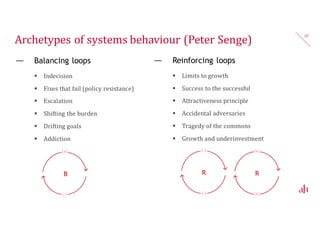
Archetypes of systems behaviour (Peter Senge)
41
— Reinforcing loops
 Limits to growth
 Success to the successful
 Attractiveness principle
 Accidental adversaries
 Tragedy of the commons
 Growth and underinvestment
— Balancing loops
 Indecision
 Fixes that fail (policy resistance)
 Escalation
 Shifting the burden
 Drifting goals
 Addiction
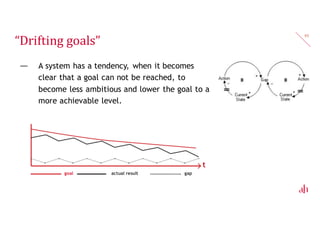
“Drifting goals”
— A system has a tendency, when it becomes
clear that a goal can not be reached, to
become less ambitious and lower the goal to a
more achievable level.
42
goal actual result gap
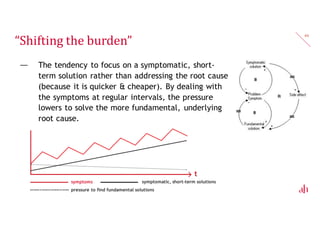
“Shifting the burden”
43
— The tendency to focus on a symptomatic, short-
term solution rather than addressing the root cause
(because it is quicker & cheaper). By dealing with
the symptoms at regular intervals, the pressure
lowers to solve the more fundamental, underlying
root cause.
symptoms symptomatic, short-term solutions
pressure to find fundamental solutions
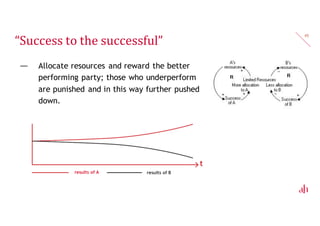
“Success to the successful”
— Allocate resources and reward the better
performing party; those who underperform
are punished and in this way further pushed
down.
44
results of A results of B
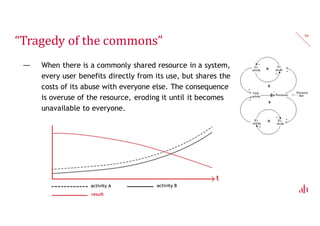
“Tragedy of the commons”
— When there is a commonly shared resource in a system,
every user benefits directly from its use, but shares the
costs of its abuse with everyone else. The consequence
is overuse of the resource, eroding it until it becomes
unavailable to everyone.
45
result
activity A activity B
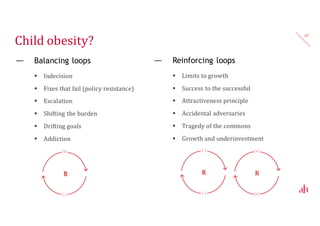
Child obesity?
46
— Reinforcing loops
 Limits to growth
 Success to the successful
 Attractiveness principle
 Accidental adversaries
 Tragedy of the commons
 Growth and underinvestment
— Balancing loops
 Indecision
 Fixes that fail (policy resistance)
 Escalation
 Shifting the burden
 Drifting goals
 Addiction
Explore
48
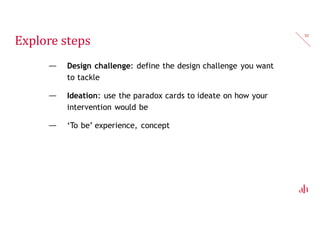
Explore steps
— Design challenge: define the design challenge you want
to tackle
— Ideation: use the paradox cards to ideate on how your
intervention would be
— ‘To be’ experience, concept
49
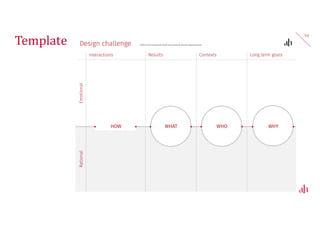
Design challenge
Formulating the design challenge
What?
— A design challenge is a (re-)formulation of your problem based on
all the insights that you have gathered. You decide what you want
to focus on, and you formulate what you wish to design in a single,
clear sentence.
Why?
— Set the scope – define the problem(s)/challenge(s) to solve in the
next phases.
How to choose?
— Impact? Accomplishable? How concrete can your solution be?
51
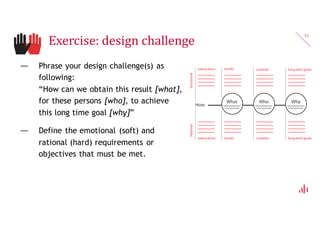
Exercise: design challenge
52
— Phrase your design challenge(s) as
following:
“How can we obtain this result [what],
for these persons [who], to achieve
this long time goal [why]”
— Define the emotional (soft) and
rational (hard) requirements or
objectives that must be met.
Ideation
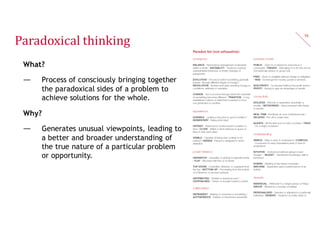
Paradoxical thinking
What?
— Process of consciously bringing together
the paradoxical sides of a problem to
achieve solutions for the whole.
Why?
— Generates unusual viewpoints, leading to
a better and broader understanding of
the true nature of a particular problem
or opportunity.
54
“The opposite of a fact is falsehood,
but the opposite of one profound truth
may very well be another profound truth.”
(Niels Bohr)
55
Applied to the child obesity case...
— Short versus long term (= time)
— Global versus local (= presence)
— Playful versus serious (= attitude)
— Easy-going versus disciplined (= culture)
56
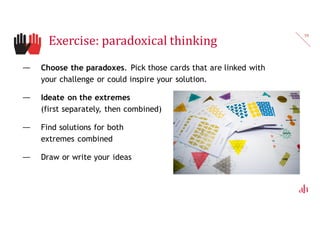
Exercise: paradoxical thinking
— Choose the paradoxes. Pick those cards that are linked with
your challenge or could inspire your solution.
— Ideate on the extremes
(first separately, then combined)
— Find solutions for both
extremes combined
— Draw or write your ideas
57
Define
59
Define steps
Plan the route you need to take in order to reach the
renewed system concept.
Define what is minimally needed and what could be an
interesting pilot.
Map the transition towards the desired future state by
planning all the design interventions and clarify how they
will help to reach that future state.
60
Transition map
Transition map
What?
— Map the transition towards the desired goal by adding all the
design interventions and how they will help reach that
specific goal.
Why?
— This helps you structure and helps you plan the interventions
in the system.
— E.g. if you want to teach kids better eating habits you can
start by having more fruit around first before you continue
rethinking the food offerings at school.
62
Transition map - steps
STEP 1
— Gather and list all your design interventions
— Group the interventions per theme
— Map the interventions in time by using the timeframe
from the roadmap
STEP 2
— Identify the gaps in your transition map, and add new
ideas/interventions to fill in these gaps
63
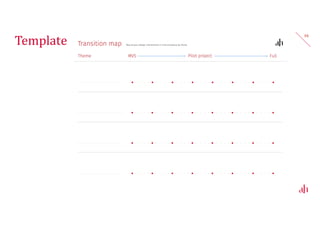
Template
64
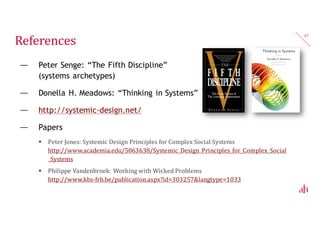
References
— Peter Senge: “The Fifth Discipline”
(systems archetypes)
— Donella H. Meadows: “Thinking in Systems”
— http://systemic-design.net/
— Papers
 Peter Jones: Systemic Design Principles for Complex Social Systems
http://www.academia.edu/5063638/Systemic_Design_Principles_for_Complex_Social
_Systems
 Philippe Vandenbroek: Working with Wicked Problems
http://www.kbs-frb.be/publication.aspx?id=303257&langtype=1033
65
Download tools
— http://bit.ly/euroia-system
— http://goo.gl/ZWvB8B
66
Thank you
@pvermaer
@2pk_koen

Design Tools for Systems Thinking

  • 1.
    Design Tools for SystemsThinking 25 September 2015 EuroIA 2015 @pvermaer @2pk_koen
  • 2.
    Introduction We are fromNamahn, a human- centred design firm based in the center Brussels.
  • 3.
    Namahn — Human-centred design,digital products and services — An experienced, international, multidisciplinary team:  17 designers, 3 staff + expert network  Founded in 1987 — Studio in the centre of Brussels 3
  • 4.
    “Every design iseither an element of a system or a system itself and is part of ensuing causal entanglements” (Nelson and Stolterman, 2012) 4
  • 5.
    Agenda — Introduction tosystems thinking — Design process  Understand  Explore  Define 5
  • 6.
  • 7.
    7 Children spraying DDTon fields to fight the potato beetle in East Germany. With the beetles gone, other insects flourished and damaged the crops nonetheless. DDT was also very bad for the health of the people using it, causing cancer in many cases. Example of simple, linear cause- effect thinking. With systems thinking you take a more holistic view of a problem, and try to find solutions and measures that improve the system as a whole.
  • 8.
    What is SystemsThinking? “Systems Thinking looks at the whole of a system rather than focusing on its individual parts, to better understand complex phenomena. Systems Thinking contrasts with analytic thinking: you solve problems by going deeper, by looking at the greater whole of a system and the relations between its elements, rather than solving individual problems in a linear way via simple cause and effect explanations.” 8
  • 9.
    When to usesystems thinking? — “Interconnected complex problems”, with multiple causes  No common understanding  Recurrent problem, interventions are not working  Unintentional and emergent behaviours — Multiple stakeholders, divergent perspectives are involved  Different views or mental models  Different benefits,  Paradoxes or seemingly conflicting ideas 9
  • 10.
  • 11.
    ‘Limits to Growth’(1972) — Club of Rome — “Growth itself can cause problems and therefore needs to be limited!” 11 Systems thinking has been around for a while...
  • 12.
  • 13.
    Standard tools forsystems thinking — System map — Iceberg — Causal loops; stock/flow — Behaviour-over-time graphs — Connection circles — ... 13
  • 14.
    Standard vocabulary — Flow(): Any changed or changing factor that could affect the results. — Stock (//): A quantity that accumulates over time. It delays the effect. — Reinforcing (R+ same, or R- opposite), balancing (B) loops — Pattern: An event that repeats over time — Others: dynamic equilibrium; shifting dominance; resilience... 14
  • 15.
  • 16.
    System thinker Habits ofa system thinker?  Look at the big picture  Be patient when things get confusing or complicated  Look at things from different sides  Think about change over time; identify how connections cause change over time 16 http://watersfoundation.org/  Don’t blame; look for ways to help the system work better  Find the keys to a system  Figure out the effect of actions
  • 17.
    17 http://www.donellameadows.org/coming-back-to-our-systems-roots Systems can beexamined by zooming in to look closely at their stocks and flows and other component parts, or by zooming out to see the entire system as one interrelated whole.
  • 18.
  • 19.
    The problem: childhoodobesity — September 2015 is Childhood Obesity Awareness Month in US — Obesity has doubled in children and quadrupled in adolescents in the past 30 years (U.S.) — Note: overweight versus obesity. Diagnosis based on BMI — Health effects: short and long term — Prevention? 19
  • 20.
    Can systems thinkinghelp to find solutions? 20
  • 21.
  • 22.
  • 23.
    We are goingto practice... UNDERSTAND — System map EXPLORE — Design challenge — Ideation (paradoxical thinking) DEFINE — Transition map 23
  • 24.
  • 25.
    Understand: steps — Systemmap: understand the system and map its elements and relations — User insights, through a field study — Factors & themes, identify the patterns of human behaviour — System archetypes: learn to recognize typical archetypes of system behaviour 25
  • 26.
  • 27.
    System map What? — Asystem map is a tool for understanding the system, its structure, the interrelations between the elements of the system and the things that flow in the system. Why? — Understand the system and to identify the intervention points. 27
  • 31.
    System Map: elements 31 —Boundary — Variables: Any changed or changing factor that could affect the results.  People (owners, actors, those affected)  Contexts (places, artefacts, activities)  Emotions, drives, perspectives — Relations: which ones are substantially reinforcing? — Intervention points
  • 32.
    Exercise: draw asystem map for child obesity — Define the thematic clusters and identify the core variables — Draw the relations (influences) between the variables, and mark those that are substantially reinforcing (positive or negative) — Identify possible leverage / intervention points 32 + - L L
  • 33.
    User insights — Fieldstudy: listening to stories of (and observing) users of the system; challenge your hypotheses! — Perspective interviews — Personas 33
  • 34.
    e.g. Listening tostories — Ask them to tell you how the problem started and evolved  Increase and decrease  Triggers and underlying causes 34 “What happened?” “What caused it?” “Why? Is there an underlying cause (or drive)?” ...
  • 35.
    Exercise: system map(2) — Review your draft version of the system map  Variables you missed out on  Connections you didn’t see at first  New leverage points 35
  • 36.
  • 37.
  • 38.
    Factors and themes What? —Factors are the elements contributing to a particular result or situation. Themes are the drivers of the patterns of human behaviour. Why? — You want to explore the contributing factors and find patterns and themes behind them. This will help you to create a response to the problem situation. 38
  • 39.
    Value framework Inspiration tofind the universal themes can be found in the value framework (Elke den Ouden) 39
  • 40.
  • 41.
    Archetypes of systemsbehaviour (Peter Senge) 41 — Reinforcing loops  Limits to growth  Success to the successful  Attractiveness principle  Accidental adversaries  Tragedy of the commons  Growth and underinvestment — Balancing loops  Indecision  Fixes that fail (policy resistance)  Escalation  Shifting the burden  Drifting goals  Addiction
  • 42.
    “Drifting goals” — Asystem has a tendency, when it becomes clear that a goal can not be reached, to become less ambitious and lower the goal to a more achievable level. 42 goal actual result gap
  • 43.
    “Shifting the burden” 43 —The tendency to focus on a symptomatic, short- term solution rather than addressing the root cause (because it is quicker & cheaper). By dealing with the symptoms at regular intervals, the pressure lowers to solve the more fundamental, underlying root cause. symptoms symptomatic, short-term solutions pressure to find fundamental solutions
  • 44.
    “Success to thesuccessful” — Allocate resources and reward the better performing party; those who underperform are punished and in this way further pushed down. 44 results of A results of B
  • 45.
    “Tragedy of thecommons” — When there is a commonly shared resource in a system, every user benefits directly from its use, but shares the costs of its abuse with everyone else. The consequence is overuse of the resource, eroding it until it becomes unavailable to everyone. 45 result activity A activity B
  • 46.
    Child obesity? 46 — Reinforcingloops  Limits to growth  Success to the successful  Attractiveness principle  Accidental adversaries  Tragedy of the commons  Growth and underinvestment — Balancing loops  Indecision  Fixes that fail (policy resistance)  Escalation  Shifting the burden  Drifting goals  Addiction
  • 47.
  • 48.
  • 49.
    Explore steps — Designchallenge: define the design challenge you want to tackle — Ideation: use the paradox cards to ideate on how your intervention would be — ‘To be’ experience, concept 49
  • 50.
  • 51.
    Formulating the designchallenge What? — A design challenge is a (re-)formulation of your problem based on all the insights that you have gathered. You decide what you want to focus on, and you formulate what you wish to design in a single, clear sentence. Why? — Set the scope – define the problem(s)/challenge(s) to solve in the next phases. How to choose? — Impact? Accomplishable? How concrete can your solution be? 51
  • 52.
    Exercise: design challenge 52 —Phrase your design challenge(s) as following: “How can we obtain this result [what], for these persons [who], to achieve this long time goal [why]” — Define the emotional (soft) and rational (hard) requirements or objectives that must be met.
  • 53.
  • 54.
    Paradoxical thinking What? — Processof consciously bringing together the paradoxical sides of a problem to achieve solutions for the whole. Why? — Generates unusual viewpoints, leading to a better and broader understanding of the true nature of a particular problem or opportunity. 54
  • 55.
    “The opposite ofa fact is falsehood, but the opposite of one profound truth may very well be another profound truth.” (Niels Bohr) 55
  • 56.
    Applied to thechild obesity case... — Short versus long term (= time) — Global versus local (= presence) — Playful versus serious (= attitude) — Easy-going versus disciplined (= culture) 56
  • 57.
    Exercise: paradoxical thinking —Choose the paradoxes. Pick those cards that are linked with your challenge or could inspire your solution. — Ideate on the extremes (first separately, then combined) — Find solutions for both extremes combined — Draw or write your ideas 57
  • 58.
  • 59.
  • 60.
    Define steps Plan theroute you need to take in order to reach the renewed system concept. Define what is minimally needed and what could be an interesting pilot. Map the transition towards the desired future state by planning all the design interventions and clarify how they will help to reach that future state. 60
  • 61.
  • 62.
    Transition map What? — Mapthe transition towards the desired goal by adding all the design interventions and how they will help reach that specific goal. Why? — This helps you structure and helps you plan the interventions in the system. — E.g. if you want to teach kids better eating habits you can start by having more fruit around first before you continue rethinking the food offerings at school. 62
  • 63.
    Transition map -steps STEP 1 — Gather and list all your design interventions — Group the interventions per theme — Map the interventions in time by using the timeframe from the roadmap STEP 2 — Identify the gaps in your transition map, and add new ideas/interventions to fill in these gaps 63
  • 64.
  • 65.
    References — Peter Senge:“The Fifth Discipline” (systems archetypes) — Donella H. Meadows: “Thinking in Systems” — http://systemic-design.net/ — Papers  Peter Jones: Systemic Design Principles for Complex Social Systems http://www.academia.edu/5063638/Systemic_Design_Principles_for_Complex_Social _Systems  Philippe Vandenbroek: Working with Wicked Problems http://www.kbs-frb.be/publication.aspx?id=303257&langtype=1033 65
  • 66.
  • 67.