Discovering the
World of
Complexity
Tathagat Varma
Technology Strategy & Business Operations, Walmart Labs
Doctoral Candidate (EFPM), Indian School of Business, Hyderabad
Contents
• Reductionism
• Simple vs Complicated vs
Complex
• Cynefin Framework
• What is Complexity?
• Complex Adaptive Systems
• Properties of CAS
• The Complexity Mindset
Descartes’ Reductionism
Reductionism is any of several
related philosophical ideas
regarding the associations
between phenomena which
can be described in terms of
other simpler or more
fundamental phenomena.[1]
It is also described as an
intellectual and philosophical
position that interprets a
complex system as the sum
of its parts.[2]
René Descartes, in De homine (1662), claimed that
non-human animals could be explained reductively
as automata; meaning essentially as more
mechanically complex versions of this Digesting
Duck
How can
we
explain
this?
https://youtu.be/V4f_1_r80RY
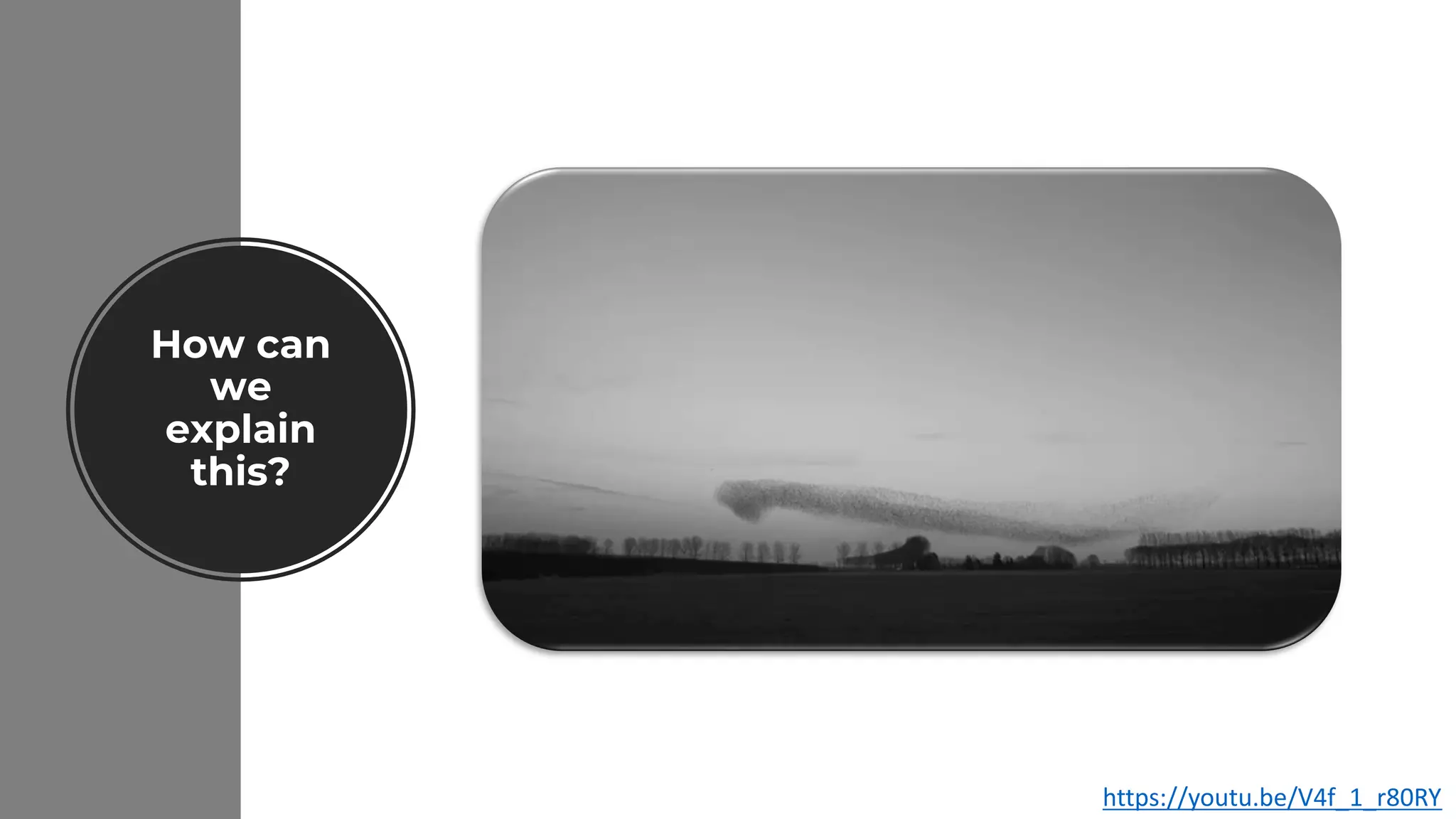
Simple
• easy to understand or do
• not difficult
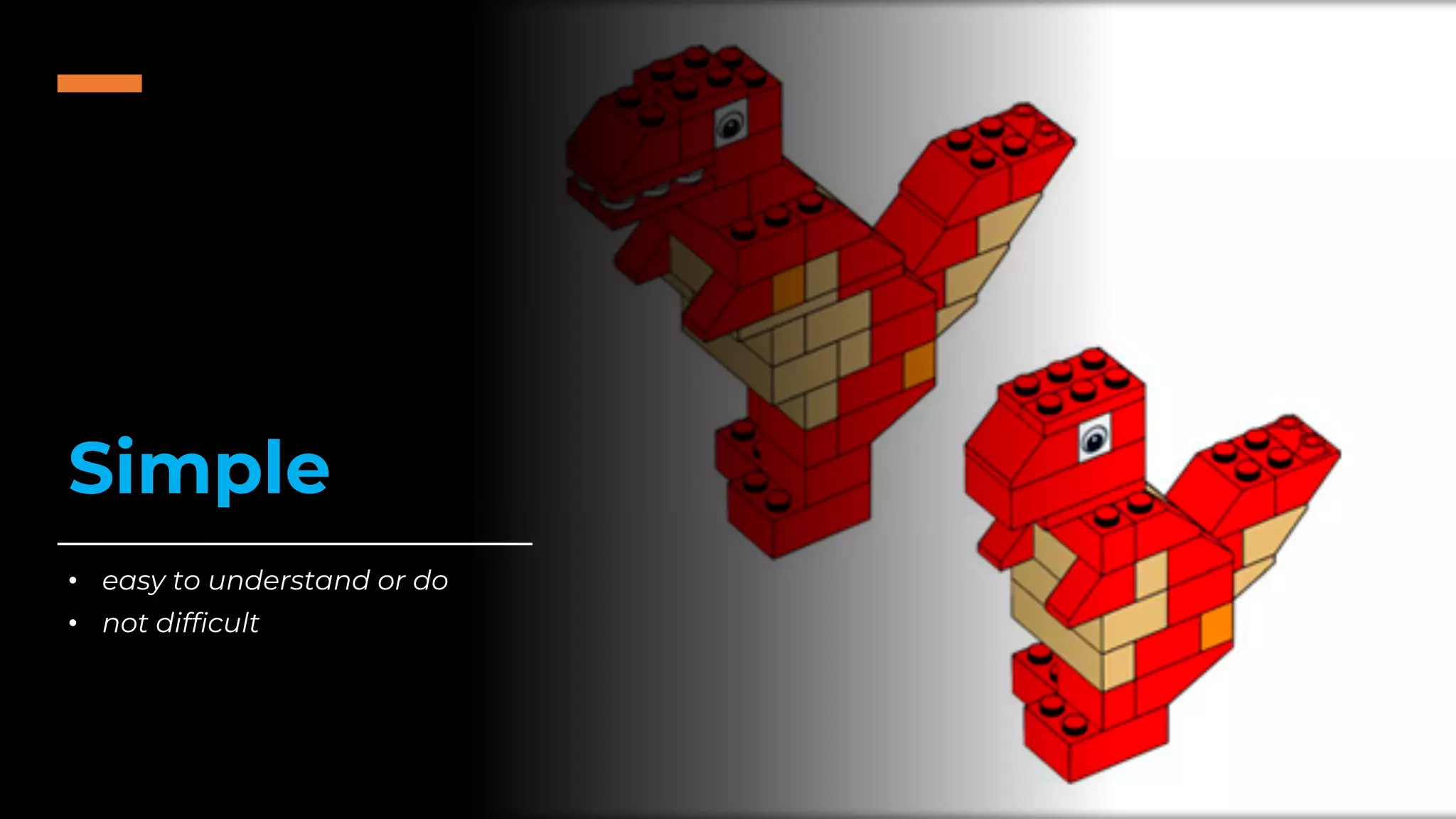
Complicated
Pic: https://www.gentlemansgazette.com/watch-parts-terms-functions-guide/
• Lot of intricately combined
parts
• Difficult or confusing to
analyze, understand, do or
explain
Complex
Pic: http://crispme.com/25-stunning-photographs-of-geometry-and-fractals-in-nature/
• Lot of different interrelated
parts
• Hard to separate, analyze,
understand, do or explain
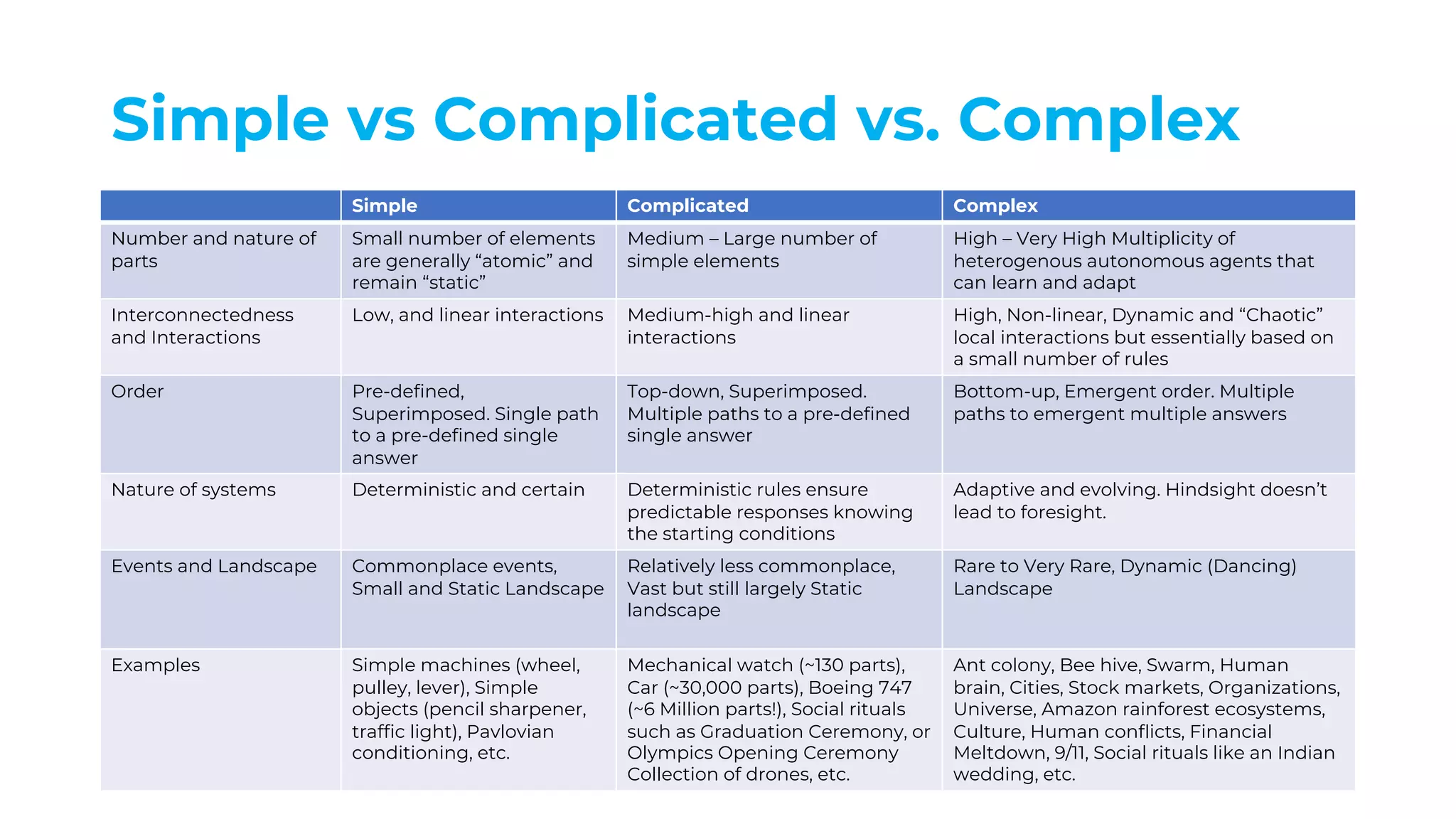
Simple vs Complicated vs. Complex
Simple Complicated Complex
Number and nature of
parts
Small number of elements
are generally “atomic” and
remain “static”
Medium – Large number of
simple elements
High – Very High Multiplicity of
heterogenous autonomous agents that
can learn and adapt
Interconnectedness
and Interactions
Low, and linear interactions Medium-high and linear
interactions
High, Non-linear, Dynamic and “Chaotic”
local interactions but essentially based on
a small number of rules
Order Pre-defined,
Superimposed. Single path
to a pre-defined single
answer
Top-down, Superimposed.
Multiple paths to a pre-defined
single answer
Bottom-up, Emergent order. Multiple
paths to emergent multiple answers
Nature of systems Deterministic and certain Deterministic rules ensure
predictable responses knowing
the starting conditions
Adaptive and evolving. Hindsight doesn’t
lead to foresight.
Events and Landscape Commonplace events,
Small and Static Landscape
Relatively less commonplace,
Vast but still largely Static
landscape
Rare to Very Rare, Dynamic (Dancing)
Landscape
Examples Simple machines (wheel,
pulley, lever), Simple
objects (pencil sharpener,
traffic light), Pavlovian
conditioning, etc.
Mechanical watch (~130 parts),
Car (~30,000 parts), Boeing 747
(~6 Million parts!), Social rituals
such as Graduation Ceremony, or
Olympics Opening Ceremony
Collection of drones, etc.
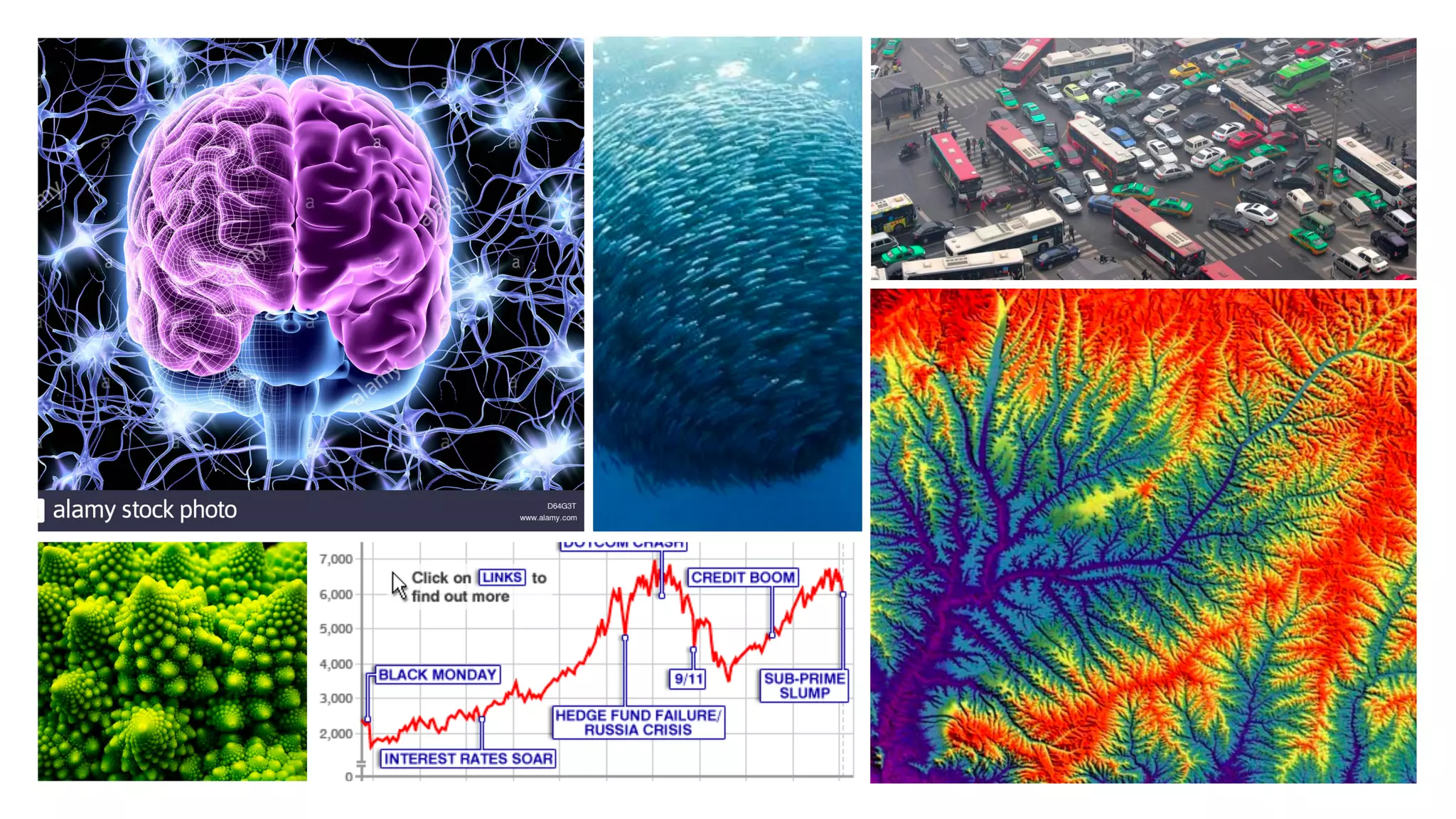
Ant colony, Bee hive, Swarm, Human
brain, Cities, Stock markets, Organizations,
Universe, Amazon rainforest ecosystems,
Culture, Human conflicts, Financial
Meltdown, 9/11, Social rituals like an Indian
wedding, etc.
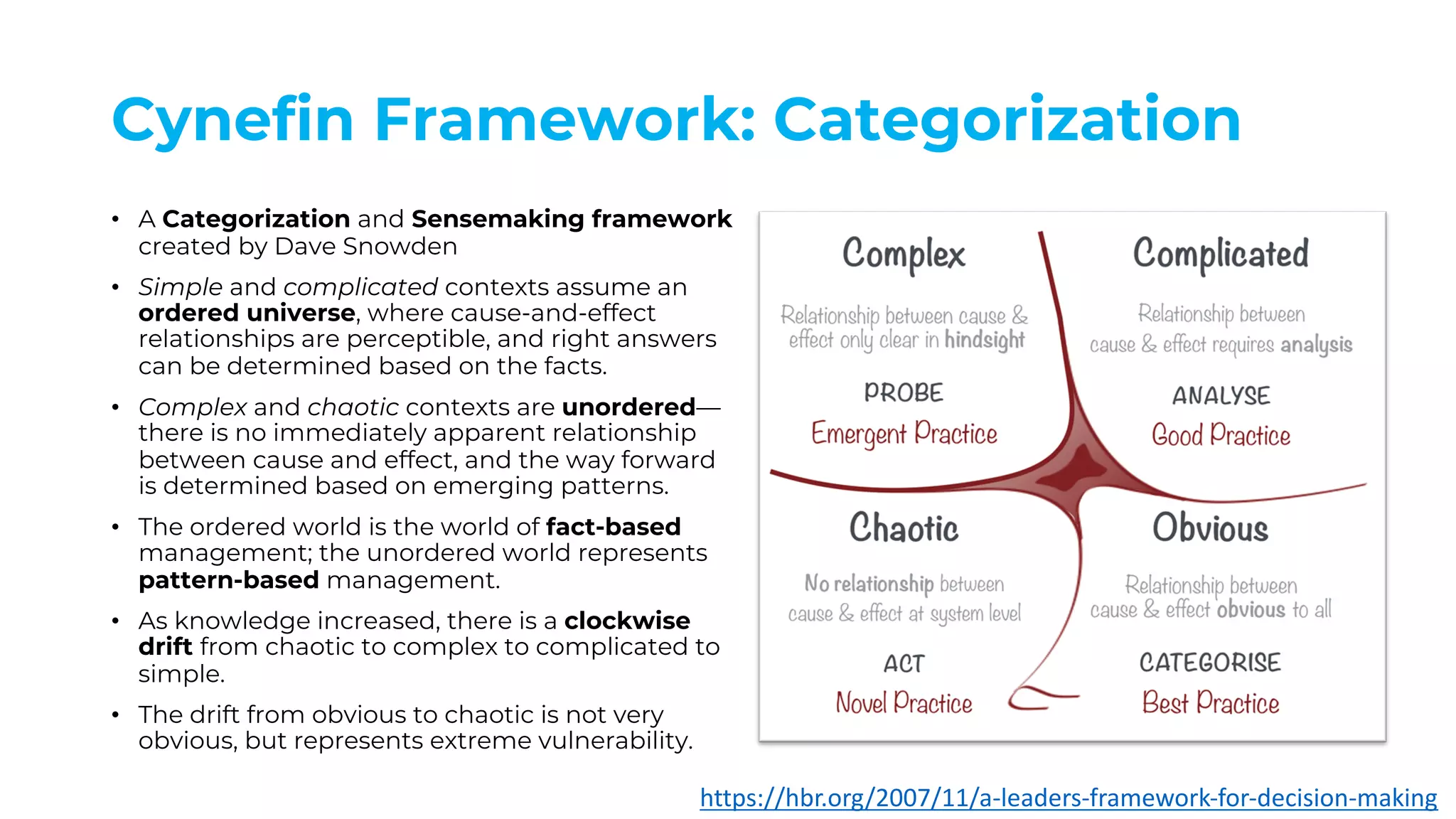
Cynefin Framework: Categorization
• A Categorization and Sensemaking framework
created by Dave Snowden
• Simple and complicated contexts assume an
ordered universe, where cause-and-effect
relationships are perceptible, and right answers
can be determined based on the facts.
• Complex and chaotic contexts are unordered—
there is no immediately apparent relationship
between cause and effect, and the way forward
is determined based on emerging patterns.
• The ordered world is the world of fact-based
management; the unordered world represents
pattern-based management.
• As knowledge increased, there is a clockwise
drift from chaotic to complex to complicated to
simple.
• The drift from obvious to chaotic is not very
obvious, but represents extreme vulnerability.
https://hbr.org/2007/11/a-leaders-framework-for-decision-making
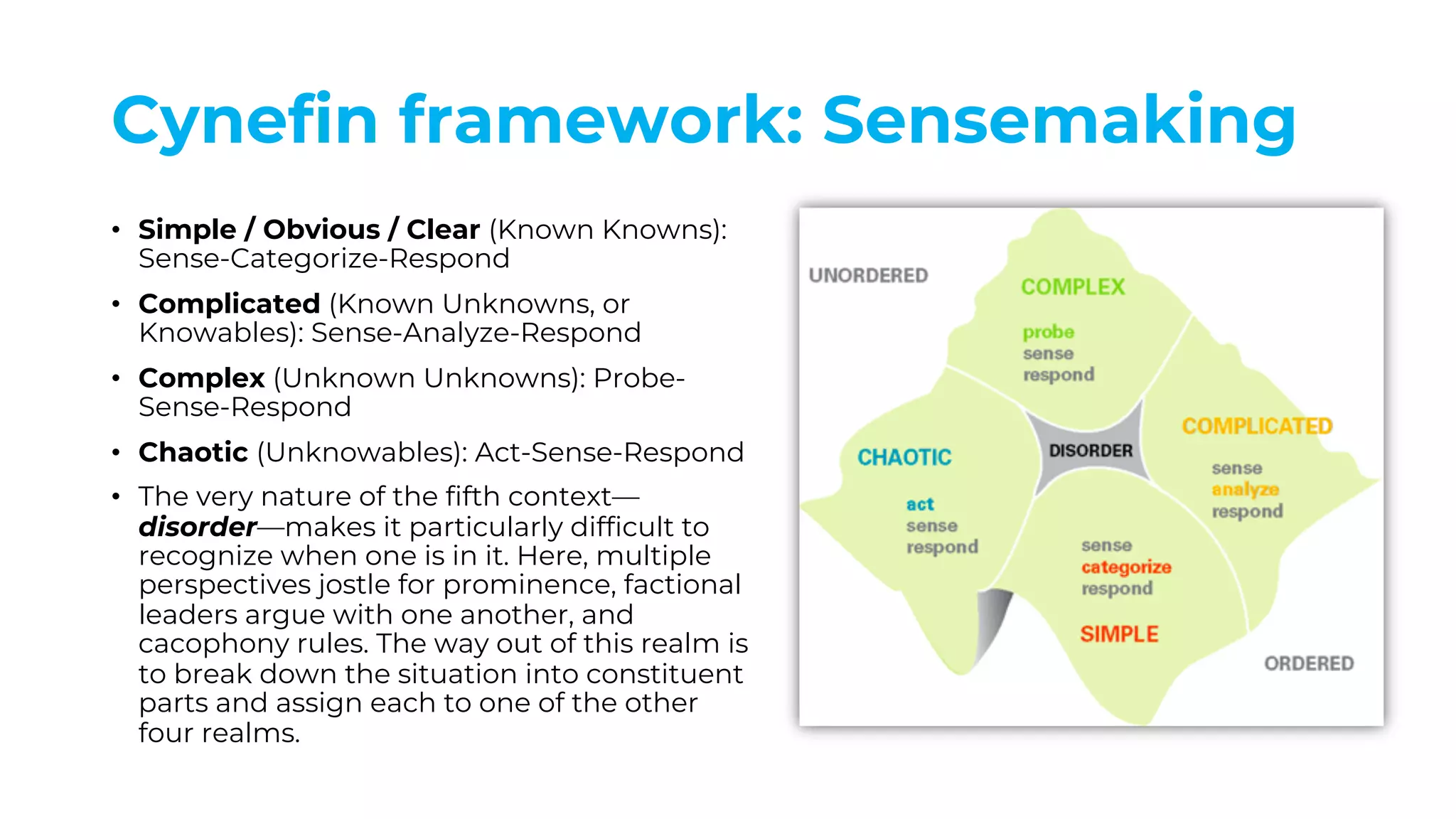
Cynefin framework: Sensemaking
• Simple / Obvious / Clear (Known Knowns):
Sense-Categorize-Respond
• Complicated (Known Unknowns, or
Knowables): Sense-Analyze-Respond
• Complex (Unknown Unknowns): Probe-
Sense-Respond
• Chaotic (Unknowables): Act-Sense-Respond
• The very nature of the fifth context—
disorder—makes it particularly difficult to
recognize when one is in it. Here, multiple
perspectives jostle for prominence, factional
leaders argue with one another, and
cacophony rules. The way out of this realm is
to break down the situation into constituent
parts and assign each to one of the other
four realms.
So, what is Complexity Science?
• Complexity characterises the behaviour of
a system or model whose components interact in
multiple ways and follow local rules, meaning there is no
reasonable higher instruction to define the various
possible interactions.[1]
• Sciences for the twenty first century – George Cowan,
Founder Sante Fe Institute
• “…a subject that’s still so new and so wide-ranging that
nobody knows quite how to define it, or even where
its boundaries lie.” - M. Mitchell Waldrop. “Complexity.”
Complexity is all
around us…
Complex Adaptive Systems
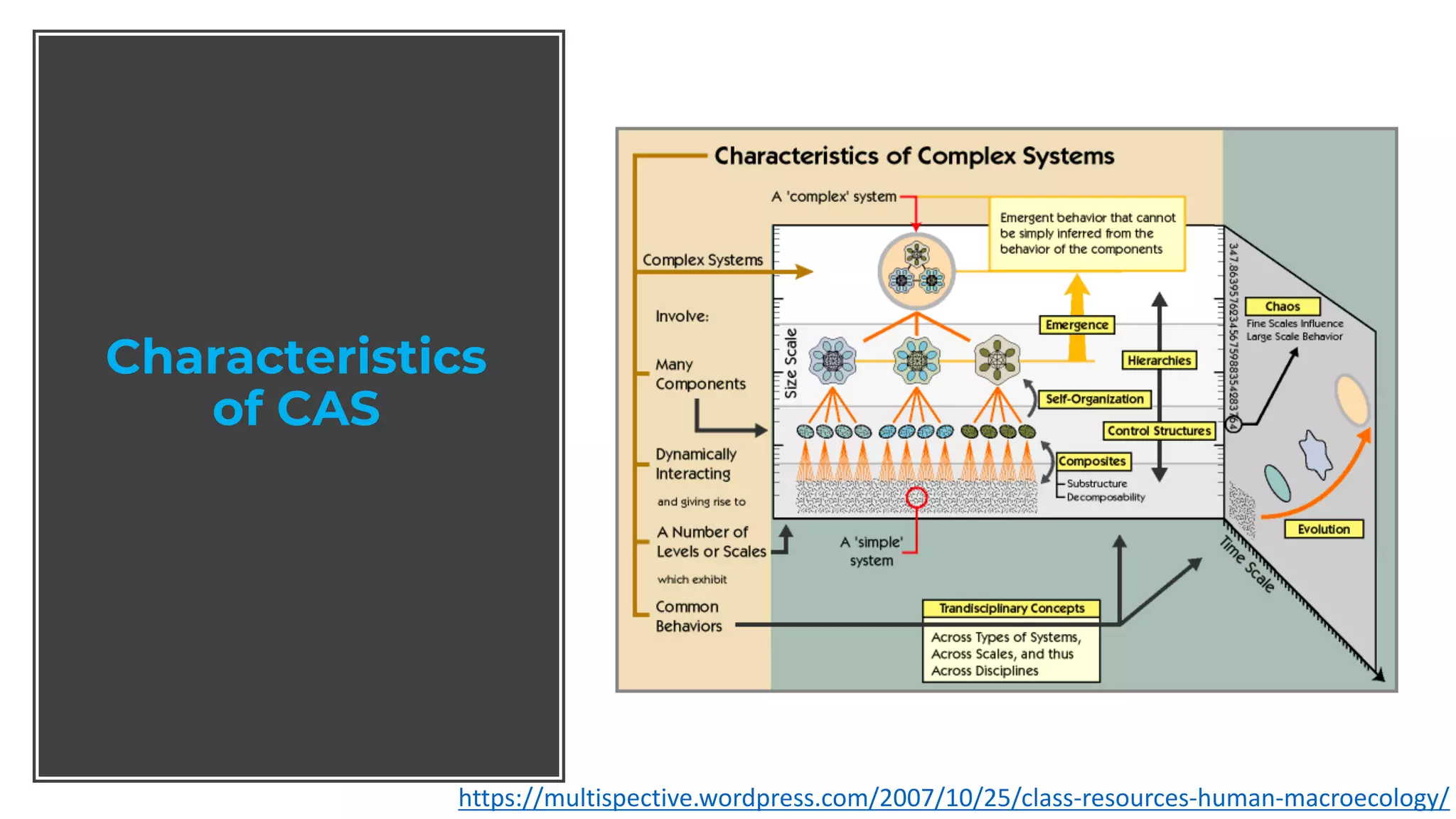
• A complex adaptive system is a system in which a perfect
understanding of the individual parts does not automatically
convey a perfect understanding of the whole system's
behavior.[1] In complex adaptive systems, the whole is more
complex than its parts,[2] and more complicated and meaningful
than the aggregate of its parts.
• They are complex in that they are dynamic networks of
interactions, and their relationships are not aggregations of the
individual static entities, i.e., the behavior of the ensemble is not
predicted by the behavior of the components.
• They are adaptive in that the individual and collective
behavior mutate and self-organize corresponding to the change-
initiating micro-event or collection of events.[5][6][1
Characteristics
of CAS
https://multispective.wordpress.com/2007/10/25/class-resources-human-macroecology/
Autonomous
Agents
There is no central control on
agents.
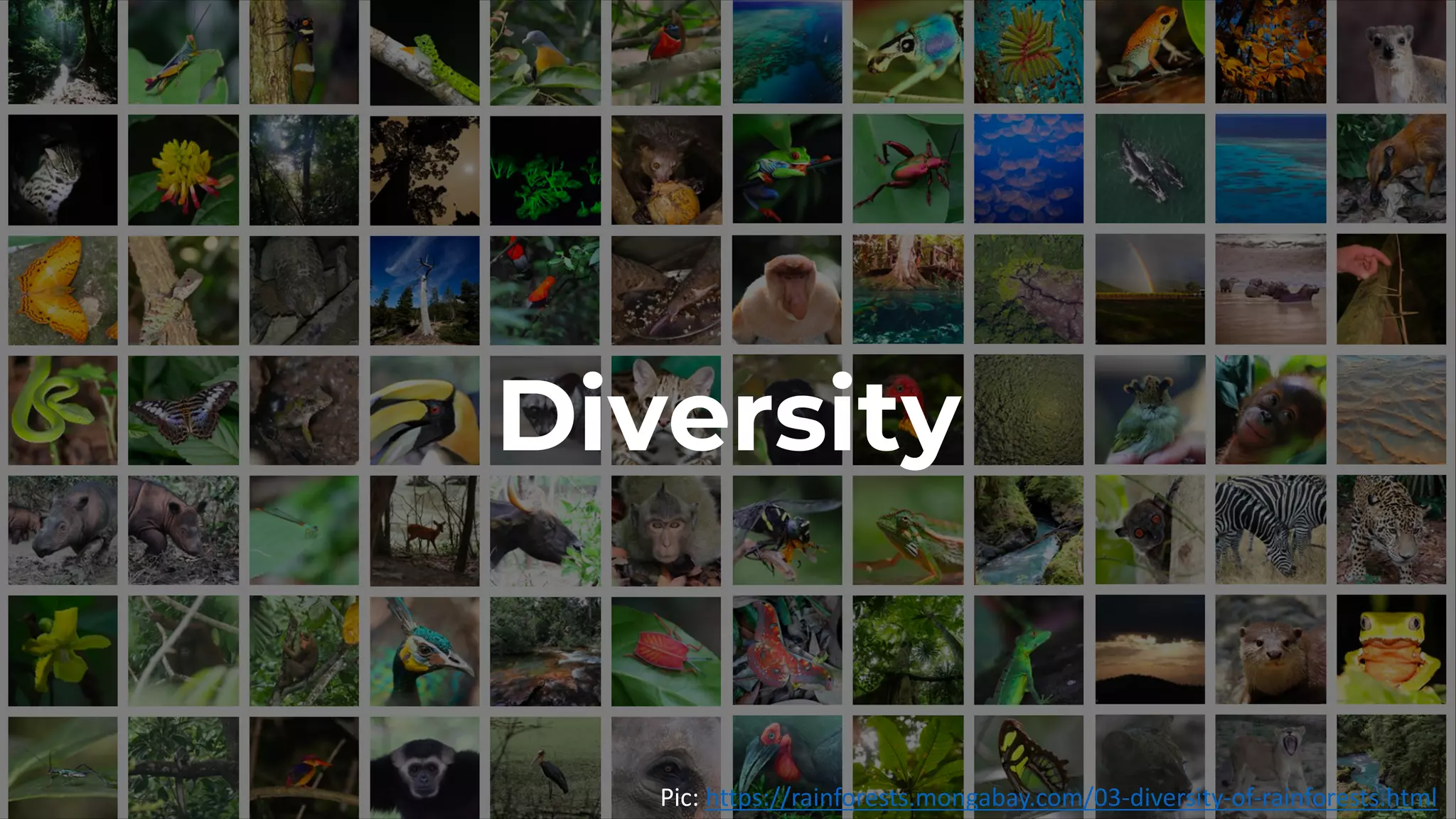
Diversity
Pic: https://rainforests.mongabay.com/03-diversity-of-rainforests.html
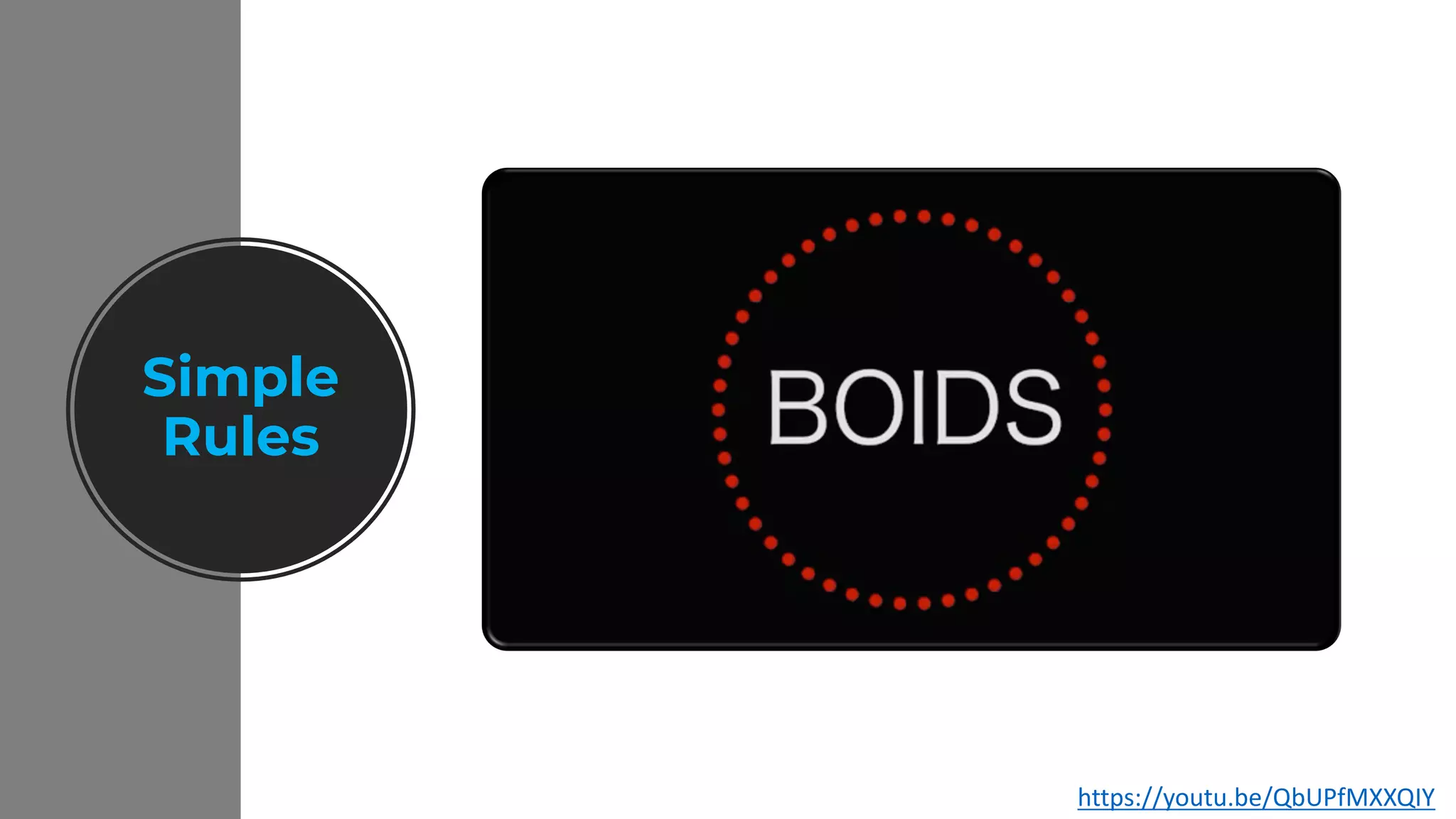
Simple
Rules
https://youtu.be/QbUPfMXXQIY
Hierarchy
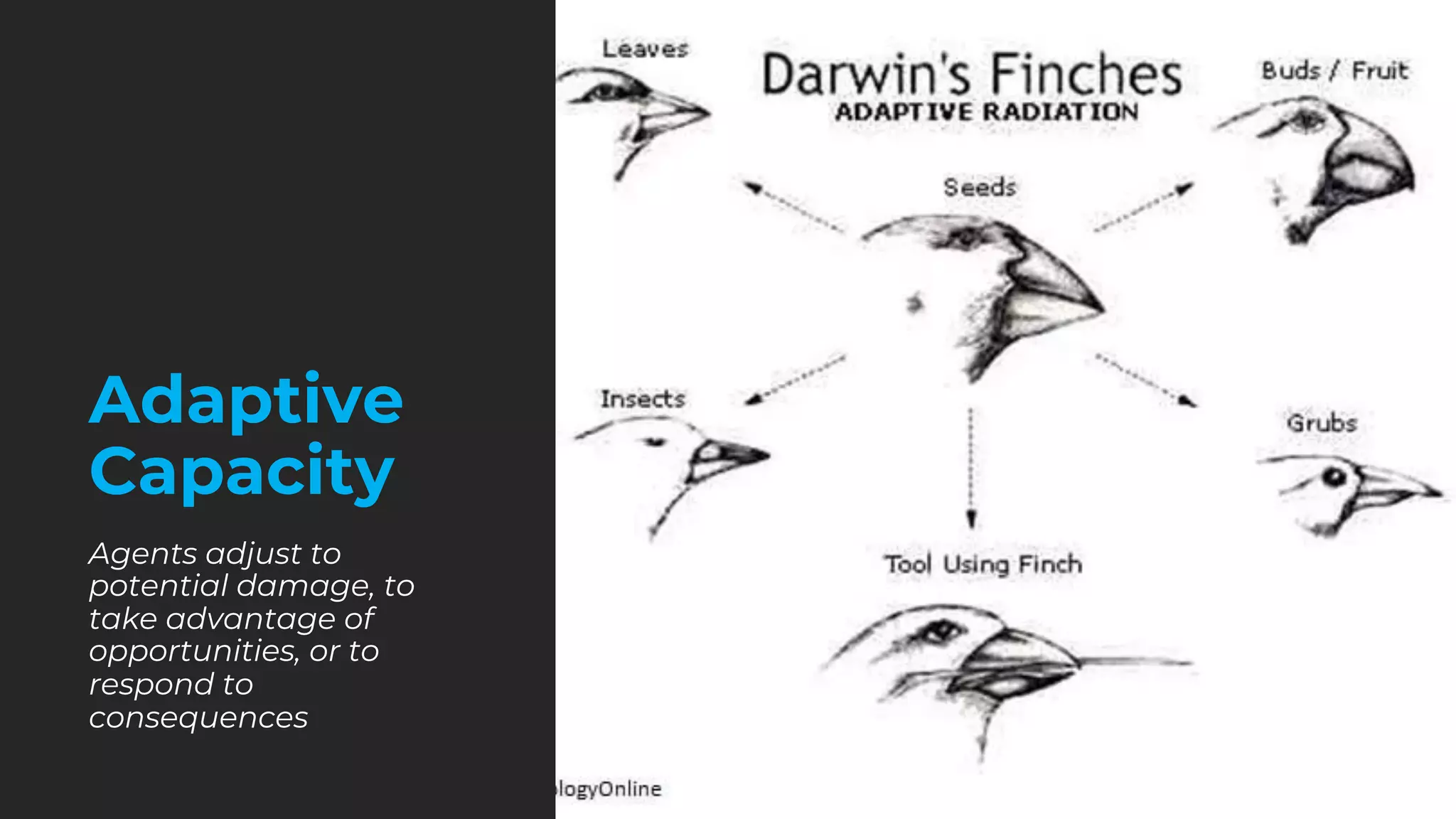
Adaptive
Capacity
Agents adjust to
potential damage, to
take advantage of
opportunities, or to
respond to
consequences
Self-
organization
A property displayed when
agents in a complex system
interact spontaneously without
any external control or a specific
top-down order
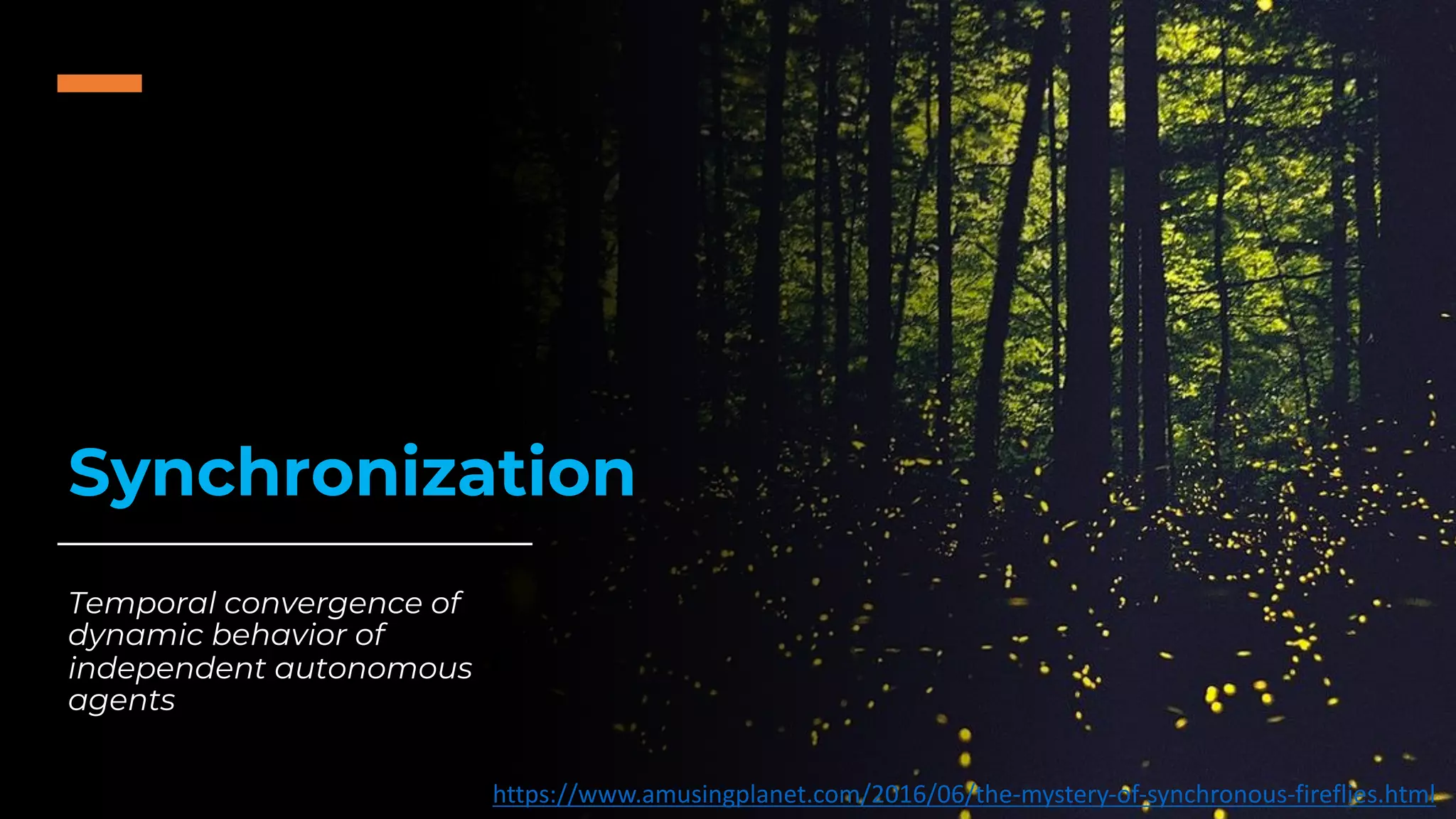
Synchronization
Temporal convergence of
dynamic behavior of
independent autonomous
agents
https://www.amusingplanet.com/2016/06/the-mystery-of-synchronous-fireflies.html
Phase
Transition
Non-linear transition from a
mere collection of agents to a
“super organism”
Emergence
Whole is greater than
sum of its parts
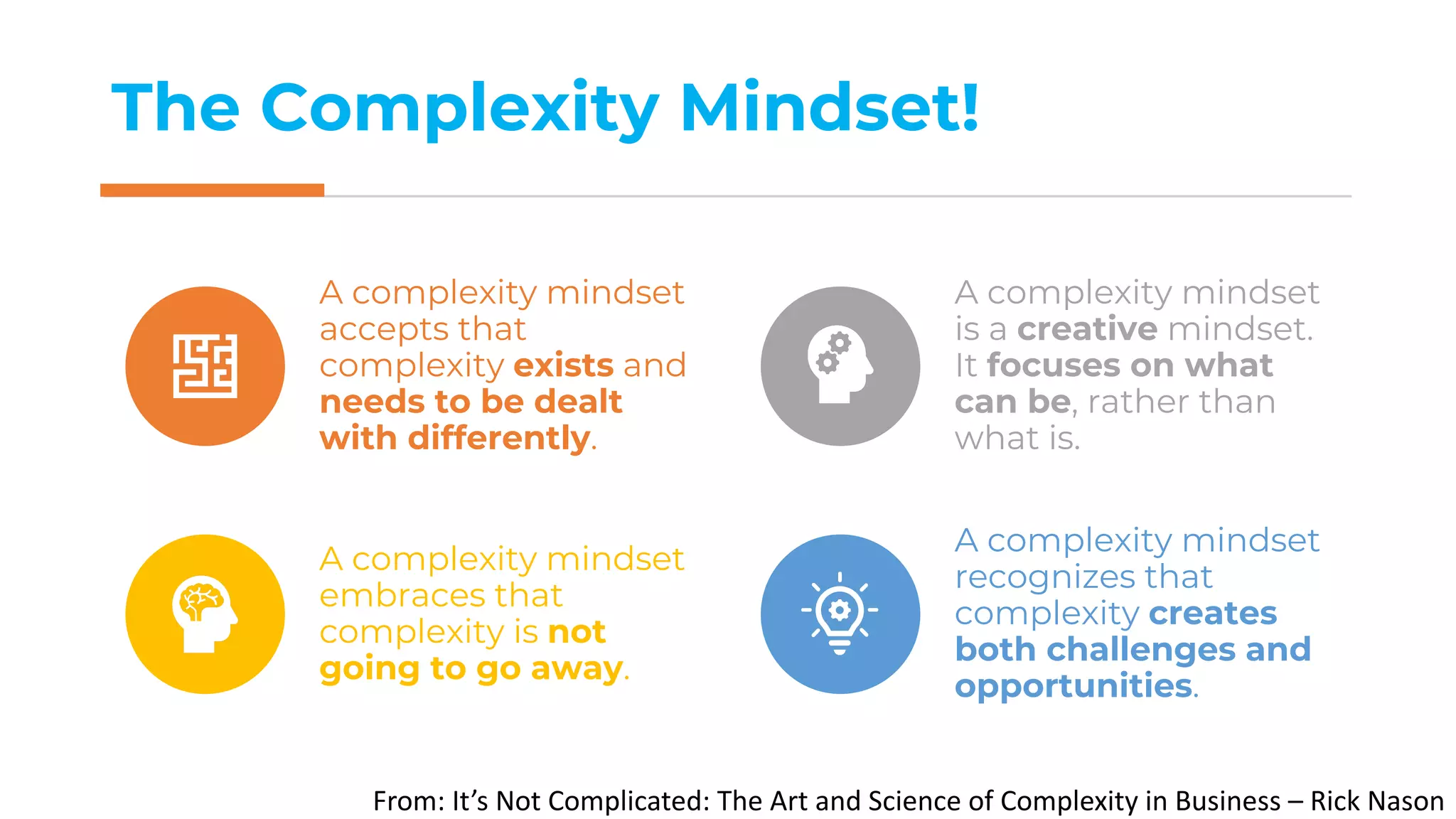
The Complexity Mindset!
From: It’s Not Complicated: The Art and Science of Complexity in Business – Rick Nason
A complexity mindset
accepts that
complexity exists and
needs to be dealt
with differently.
A complexity mindset
is a creative mindset.
It focuses on what
can be, rather than
what is.
A complexity mindset
embraces that
complexity is not
going to go away.
A complexity mindset
recognizes that
complexity creates
both challenges and
opportunities.
Recap
References
• Simple vs. Complicated vs. Complex vs. Chaotic – Michael Bykovski, Mar 3, 2020, https://medium.com/better-
programming/simple-vs-complicated-vs-complex-vs-chaos-737b5964849d
• Simple, Complicated, and Complex Systems – Brad Feld, Mar 28, 2019, https://feld.com/archives/2019/03/simple-
complicated-and-complex-systems.html
• The Critical Difference Between Complex and Complicated – Theodore Kinni, Jun 21, 2017,
https://sloanreview.mit.edu/article/the-critical-difference-between-complex-and-complicated/
• To Reduce Complexity in Your Company, Start with Pen and Paper – Rita Gunther McGrath, HBR, Aug 22, 2016,
https://hbr.org/2016/08/to-reduce-complexity-in-your-company-start-with-pen-and-paper
• Managing Complexity Is the Epic Battle Between Emergence and Entropy – Julian Binkinshaw, HBR, Nov 11, 2013,
https://hbr.org/2013/11/managing-complexity-is-the-epic-battle-between-emergence-and-entropy
• Why Managers Haven’t Embraced Complexity – Richard Straub, HBR, May 06, 2013, https://hbr.org/2013/05/why-
managers-havent-embraced-c
• Embracing Complexity – Tim Sullivan, HBR, Sep 2011, https://hbr.org/2011/09/embracing-complexity
• Learning to Live With Complexity – Gokce Sargut and Rita Gunther McGrath, HBR, Sep 2011,
https://hbr.org/2011/09/learning-to-live-with-complexity
• A Leader’s Framework for Decision Making – David J. Snowden and Mary E. Boone, HBR, Nov 2007,
https://hbr.org/2007/11/a-leaders-framework-for-decision-making
• Complex Adaptive systems – Wendell Jones, Oct 2003,
https://www.beyondintractability.org/essay/complex_adaptive_systems#narrow-body

Discovering the World of Complexity

  • 1.
    Discovering the World of Complexity TathagatVarma Technology Strategy & Business Operations, Walmart Labs Doctoral Candidate (EFPM), Indian School of Business, Hyderabad
  • 2.
    Contents • Reductionism • Simplevs Complicated vs Complex • Cynefin Framework • What is Complexity? • Complex Adaptive Systems • Properties of CAS • The Complexity Mindset
  • 3.
    Descartes’ Reductionism Reductionism isany of several related philosophical ideas regarding the associations between phenomena which can be described in terms of other simpler or more fundamental phenomena.[1] It is also described as an intellectual and philosophical position that interprets a complex system as the sum of its parts.[2] René Descartes, in De homine (1662), claimed that non-human animals could be explained reductively as automata; meaning essentially as more mechanically complex versions of this Digesting Duck
  • 4.
  • 5.
    Simple • easy tounderstand or do • not difficult
  • 6.
    Complicated Pic: https://www.gentlemansgazette.com/watch-parts-terms-functions-guide/ • Lotof intricately combined parts • Difficult or confusing to analyze, understand, do or explain
  • 7.
    Complex Pic: http://crispme.com/25-stunning-photographs-of-geometry-and-fractals-in-nature/ • Lotof different interrelated parts • Hard to separate, analyze, understand, do or explain
  • 8.
    Simple vs Complicatedvs. Complex Simple Complicated Complex Number and nature of parts Small number of elements are generally “atomic” and remain “static” Medium – Large number of simple elements High – Very High Multiplicity of heterogenous autonomous agents that can learn and adapt Interconnectedness and Interactions Low, and linear interactions Medium-high and linear interactions High, Non-linear, Dynamic and “Chaotic” local interactions but essentially based on a small number of rules Order Pre-defined, Superimposed. Single path to a pre-defined single answer Top-down, Superimposed. Multiple paths to a pre-defined single answer Bottom-up, Emergent order. Multiple paths to emergent multiple answers Nature of systems Deterministic and certain Deterministic rules ensure predictable responses knowing the starting conditions Adaptive and evolving. Hindsight doesn’t lead to foresight. Events and Landscape Commonplace events, Small and Static Landscape Relatively less commonplace, Vast but still largely Static landscape Rare to Very Rare, Dynamic (Dancing) Landscape Examples Simple machines (wheel, pulley, lever), Simple objects (pencil sharpener, traffic light), Pavlovian conditioning, etc. Mechanical watch (~130 parts), Car (~30,000 parts), Boeing 747 (~6 Million parts!), Social rituals such as Graduation Ceremony, or Olympics Opening Ceremony Collection of drones, etc. Ant colony, Bee hive, Swarm, Human brain, Cities, Stock markets, Organizations, Universe, Amazon rainforest ecosystems, Culture, Human conflicts, Financial Meltdown, 9/11, Social rituals like an Indian wedding, etc.
  • 9.
    Cynefin Framework: Categorization •A Categorization and Sensemaking framework created by Dave Snowden • Simple and complicated contexts assume an ordered universe, where cause-and-effect relationships are perceptible, and right answers can be determined based on the facts. • Complex and chaotic contexts are unordered— there is no immediately apparent relationship between cause and effect, and the way forward is determined based on emerging patterns. • The ordered world is the world of fact-based management; the unordered world represents pattern-based management. • As knowledge increased, there is a clockwise drift from chaotic to complex to complicated to simple. • The drift from obvious to chaotic is not very obvious, but represents extreme vulnerability. https://hbr.org/2007/11/a-leaders-framework-for-decision-making
  • 10.
    Cynefin framework: Sensemaking •Simple / Obvious / Clear (Known Knowns): Sense-Categorize-Respond • Complicated (Known Unknowns, or Knowables): Sense-Analyze-Respond • Complex (Unknown Unknowns): Probe- Sense-Respond • Chaotic (Unknowables): Act-Sense-Respond • The very nature of the fifth context— disorder—makes it particularly difficult to recognize when one is in it. Here, multiple perspectives jostle for prominence, factional leaders argue with one another, and cacophony rules. The way out of this realm is to break down the situation into constituent parts and assign each to one of the other four realms.
  • 11.
    So, what isComplexity Science? • Complexity characterises the behaviour of a system or model whose components interact in multiple ways and follow local rules, meaning there is no reasonable higher instruction to define the various possible interactions.[1] • Sciences for the twenty first century – George Cowan, Founder Sante Fe Institute • “…a subject that’s still so new and so wide-ranging that nobody knows quite how to define it, or even where its boundaries lie.” - M. Mitchell Waldrop. “Complexity.”
  • 12.
  • 14.
    Complex Adaptive Systems •A complex adaptive system is a system in which a perfect understanding of the individual parts does not automatically convey a perfect understanding of the whole system's behavior.[1] In complex adaptive systems, the whole is more complex than its parts,[2] and more complicated and meaningful than the aggregate of its parts. • They are complex in that they are dynamic networks of interactions, and their relationships are not aggregations of the individual static entities, i.e., the behavior of the ensemble is not predicted by the behavior of the components. • They are adaptive in that the individual and collective behavior mutate and self-organize corresponding to the change- initiating micro-event or collection of events.[5][6][1
  • 15.
  • 16.
    Autonomous Agents There is nocentral control on agents.
  • 17.
  • 18.
  • 19.
  • 20.
    Adaptive Capacity Agents adjust to potentialdamage, to take advantage of opportunities, or to respond to consequences
  • 21.
    Self- organization A property displayedwhen agents in a complex system interact spontaneously without any external control or a specific top-down order
  • 22.
    Synchronization Temporal convergence of dynamicbehavior of independent autonomous agents https://www.amusingplanet.com/2016/06/the-mystery-of-synchronous-fireflies.html
  • 23.
    Phase Transition Non-linear transition froma mere collection of agents to a “super organism”
  • 24.
    Emergence Whole is greaterthan sum of its parts
  • 25.
    The Complexity Mindset! From:It’s Not Complicated: The Art and Science of Complexity in Business – Rick Nason A complexity mindset accepts that complexity exists and needs to be dealt with differently. A complexity mindset is a creative mindset. It focuses on what can be, rather than what is. A complexity mindset embraces that complexity is not going to go away. A complexity mindset recognizes that complexity creates both challenges and opportunities.
  • 26.
  • 27.
    References • Simple vs.Complicated vs. Complex vs. Chaotic – Michael Bykovski, Mar 3, 2020, https://medium.com/better- programming/simple-vs-complicated-vs-complex-vs-chaos-737b5964849d • Simple, Complicated, and Complex Systems – Brad Feld, Mar 28, 2019, https://feld.com/archives/2019/03/simple- complicated-and-complex-systems.html • The Critical Difference Between Complex and Complicated – Theodore Kinni, Jun 21, 2017, https://sloanreview.mit.edu/article/the-critical-difference-between-complex-and-complicated/ • To Reduce Complexity in Your Company, Start with Pen and Paper – Rita Gunther McGrath, HBR, Aug 22, 2016, https://hbr.org/2016/08/to-reduce-complexity-in-your-company-start-with-pen-and-paper • Managing Complexity Is the Epic Battle Between Emergence and Entropy – Julian Binkinshaw, HBR, Nov 11, 2013, https://hbr.org/2013/11/managing-complexity-is-the-epic-battle-between-emergence-and-entropy • Why Managers Haven’t Embraced Complexity – Richard Straub, HBR, May 06, 2013, https://hbr.org/2013/05/why- managers-havent-embraced-c • Embracing Complexity – Tim Sullivan, HBR, Sep 2011, https://hbr.org/2011/09/embracing-complexity • Learning to Live With Complexity – Gokce Sargut and Rita Gunther McGrath, HBR, Sep 2011, https://hbr.org/2011/09/learning-to-live-with-complexity • A Leader’s Framework for Decision Making – David J. Snowden and Mary E. Boone, HBR, Nov 2007, https://hbr.org/2007/11/a-leaders-framework-for-decision-making • Complex Adaptive systems – Wendell Jones, Oct 2003, https://www.beyondintractability.org/essay/complex_adaptive_systems#narrow-body