Chapter 4
Carbon and the Molecular
Diversity of Life
Overview: Carbon—The Backbone of
Biological Molecules
• Although cells are 70–95% water, the rest
consists mostly of carbon-based compounds
• Carbon is unparalleled in its ability to form
large, complex, and diverse molecules
• Proteins, DNA, carbohydrates, and other
molecules that distinguish living matter are all
composed of carbon compounds
Concept 4.1: Organic chemistry is
the study of carbon compounds
• Organic compounds range from simple molecules to
colossal ones
• Most organic compounds contain hydrogen atoms in
addition to carbon atoms
• Vitalism, the idea that organic compounds arise only in
organisms, was disproved when chemists synthesized
the compounds
• Mechanism is the view that all natural phenomena are
governed by physical and chemical laws
1953—Stanley Miller
Concept 4.2: Carbon atoms can
form diverse molecules by bonding
to four other atoms (valence of 4)
• Electron configuration is the key to an atom’s
characteristics
• Electron configuration determines the kinds
and number of bonds an atom will form with
other atoms
The Formation of Bonds with
Carbon
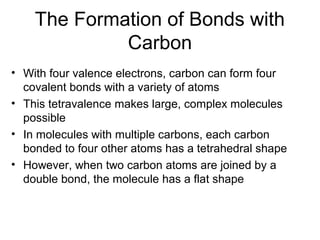
• With four valence electrons, carbon can form four
covalent bonds with a variety of atoms
• This tetravalence makes large, complex molecules
possible
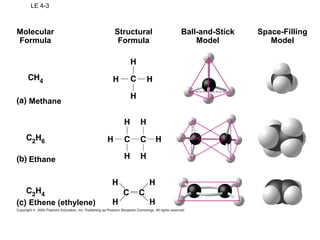
• In molecules with multiple carbons, each carbon
bonded to four other atoms has a tetrahedral shape
• However, when two carbon atoms are joined by a
double bond, the molecule has a flat shape
LE 4-3
Molecular
Formula
Structural
Formula
Ball-and-Stick
Model
Space-Filling
Model
Methane
Ethane
Ethene (ethylene)
• The electron configuration of carbon gives it
covalent compatibility with many different
elements
• The valences of carbon and its most frequent
partners (hydrogen, oxygen, and nitrogen) are
the “building code” that governs the
architecture of living molecules
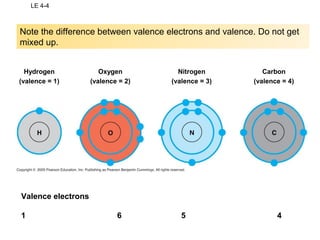
LE 4-4
Hydrogen
(valence = 1)
Oxygen
(valence = 2)
Nitrogen
(valence = 3)
Carbon
(valence = 4)
Valence electrons
1 6 5 4
Note the difference between valence electrons and valence. Do not get
mixed up.
Molecular Diversity Arising from
Carbon Skeleton Variation
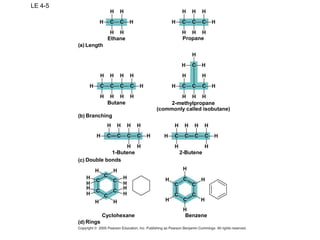
• Carbon chains form the skeletons of most
organic molecules
• Carbon chains vary in length and shape
LE 4-5
Length
Ethane Propane
Butane 2-methylpropane
(commonly called isobutane)
Branching
Double bonds
Rings
1-Butene 2-Butene
Cyclohexane Benzene
Hydrocarbons
• Hydrocarbons are organic molecules consisting
of only carbon and hydrogen
• Many organic molecules, such as fats, have
hydrocarbon components
• Hydrocarbons can undergo reactions that
release a large amount of energy
Figure 4.6
Nucleus
Fat droplets
(b) A fat molecule(a) Part of a human adipose cell
10 μm
Isomers
• Isomers are compounds with the same
molecular formula but different structures and
properties:
– Structural isomers have different covalent
arrangements of their atoms
– Geometric isomers have the same covalent
arrangements but differ in spatial arrangements
– Enantiomers are isomers that are mirror images
of each other
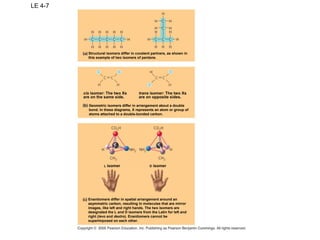
LE 4-7
Structural isomers differ in covalent partners, as shown in
this example of two isomers of pentane.
Geometric isomers differ in arrangement about a double
bond. In these diagrams, X represents an atom or group of
atoms attached to a double-bonded carbon.
cis isomer: The two Xs
are on the same side.
trans isomer: The two Xs
are on opposite sides.
L isomer D isomer
Enantiomers differ in spatial arrangement around an
asymmetric carbon, resulting in molecules that are mirror
images, like left and right hands. The two isomers are
designated the L and D isomers from the Latin for left and
right (levo and dextro). Enantiomers cannot be
superimposed on each other.
• Enantiomers are important in the
pharmaceutical industry
• Two enantiomers of a drug may have different
effects
• Differing effects of enantiomers demonstrate
that organisms are sensitive to even subtle
variations in molecules
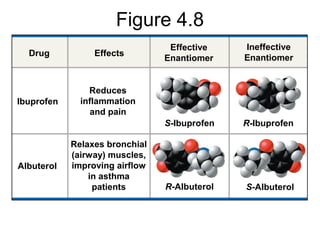
Figure 4.8
Drug Effects
Effective
Enantiomer
Ineffective
Enantiomer
Ibuprofen
Albuterol
Reduces
inflammation
and pain
Relaxes bronchial
(airway) muscles,
improving airflow
in asthma
patients
S-Ibuprofen
R-AIbuterol S-AIbuterol
R-Ibuprofen
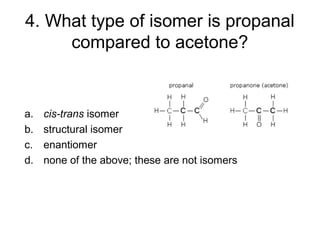
4. What type of isomer is propanal
compared to acetone?
a. cis-trans isomer
b. structural isomer
c. enantiomer
d. none of the above; these are not isomers
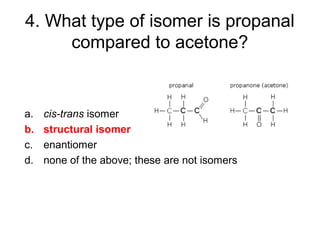
4. What type of isomer is propanal
compared to acetone?
a. cis-trans isomer
b. structural isomer
c. enantiomer
d. none of the above; these are not isomers
Concept 4.3: Functional groups are the
parts of molecules involved in chemical
reactions
• Distinctive properties of organic molecules
depend not only on the carbon skeleton but
also on the molecular components attached
to it
• Certain groups of atoms are often attached to
skeletons of organic molecules
The Functional Groups Most
Important in the Chemistry of Life
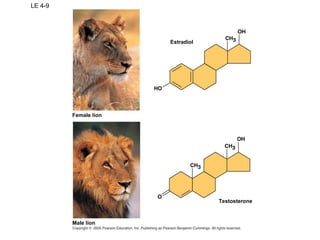
• Functional groups are the components of
organic molecules that are most commonly
involved in chemical reactions
• The number and arrangement of functional
groups give each molecule its unique
properties
LE 4-9
Estradiol
Testosterone
Male lion
Female lion
• The seven functional groups that are most
important in the chemistry of life
– Hydroxyl group
– Carbonyl group
– Carboxyl group
– Amino group
– Sulfhydryl group
– Phosphate group
– Methyl group
– also primary amide and acetyl
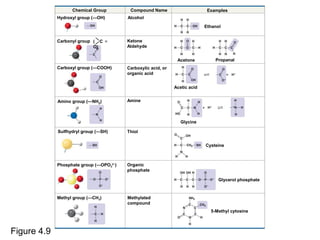
Figure 4.9
Chemical Group Compound Name Examples
Ethanol
PropanalAcetone
Acetic acid
Glycine
Cysteine
Glycerol phosphate
Organic
phosphate
Thiol
Amine
Carboxylic acid, or
organic acid
Ketone
Aldehyde
AlcoholHydroxyl group (—OH)
Carboxyl group (—COOH)
Amino group (—NH2)
Sulfhydryl group (—SH)
Phosphate group (—OPO3
2−
)
Methyl group (—CH3) Methylated
compound
5-Methyl cytosine
Carbonyl group ( C =
O)
——
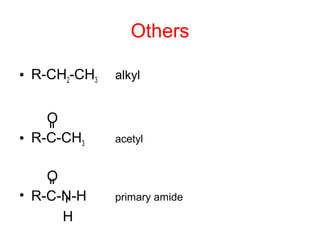
Others
• R-CH2-CH3 alkyl
O
• R-C-CH3 acetyl
O
• R-C-N-H primary amide
H
ATP: An Important Source of Energy
for Cellular Processes
• One phosphate molecule, adenosine
triphosphate (ATP), is the primary energy-
transferring molecule in the cell
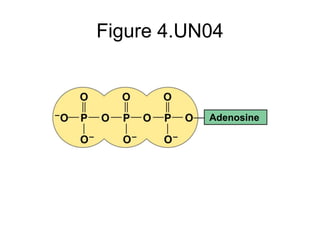
• ATP consists of an organic molecule called
adenosine attached to a string of three
phosphate groups
Figure 4.UN04
Adenosine
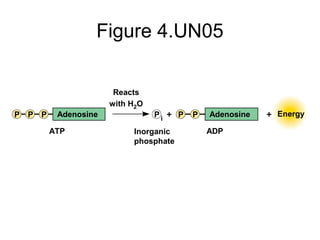
Figure 4.UN05
Reacts
with H2O
Inorganic
phosphate
ADP
EnergyAdenosine Adenosine
ATP
P P P P PP i
The Chemical Elements of Life:
A Review
• The versatility of carbon makes possible the
great diversity of organic molecules
• Variation at the molecular level lies at the
foundation of all biological diversity
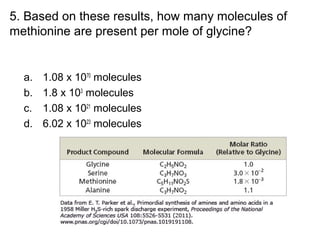
5. Based on these results, how many molecules of
methionine are present per mole of glycine?
a. 1.08 x 1070
molecules
b. 1.8 x 10³
molecules
c. 1.08 x 10²¹
molecules
d. 6.02 x 10²³
molecules
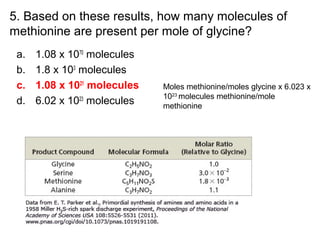
5. Based on these results, how many molecules of
methionine are present per mole of glycine?
a. 1.08 x 1070
molecules
b. 1.8 x 10³
molecules
c. 1.08 x 10²¹
molecules
d. 6.02 x 10²³
molecules
Moles methionine/moles glycine x 6.023 x
1023
molecules methionine/mole
methionine

Bio chapter 4 – Carbon

  • 1.
    Chapter 4 Carbon andthe Molecular Diversity of Life
  • 2.
    Overview: Carbon—The Backboneof Biological Molecules • Although cells are 70–95% water, the rest consists mostly of carbon-based compounds • Carbon is unparalleled in its ability to form large, complex, and diverse molecules • Proteins, DNA, carbohydrates, and other molecules that distinguish living matter are all composed of carbon compounds
  • 3.
    Concept 4.1: Organicchemistry is the study of carbon compounds • Organic compounds range from simple molecules to colossal ones • Most organic compounds contain hydrogen atoms in addition to carbon atoms • Vitalism, the idea that organic compounds arise only in organisms, was disproved when chemists synthesized the compounds • Mechanism is the view that all natural phenomena are governed by physical and chemical laws
  • 4.
  • 5.
    Concept 4.2: Carbonatoms can form diverse molecules by bonding to four other atoms (valence of 4) • Electron configuration is the key to an atom’s characteristics • Electron configuration determines the kinds and number of bonds an atom will form with other atoms
  • 6.
    The Formation ofBonds with Carbon • With four valence electrons, carbon can form four covalent bonds with a variety of atoms • This tetravalence makes large, complex molecules possible • In molecules with multiple carbons, each carbon bonded to four other atoms has a tetrahedral shape • However, when two carbon atoms are joined by a double bond, the molecule has a flat shape
  • 7.
  • 8.
    • The electronconfiguration of carbon gives it covalent compatibility with many different elements • The valences of carbon and its most frequent partners (hydrogen, oxygen, and nitrogen) are the “building code” that governs the architecture of living molecules
  • 9.
    LE 4-4 Hydrogen (valence =1) Oxygen (valence = 2) Nitrogen (valence = 3) Carbon (valence = 4) Valence electrons 1 6 5 4 Note the difference between valence electrons and valence. Do not get mixed up.
  • 10.
    Molecular Diversity Arisingfrom Carbon Skeleton Variation • Carbon chains form the skeletons of most organic molecules • Carbon chains vary in length and shape
  • 11.
    LE 4-5 Length Ethane Propane Butane2-methylpropane (commonly called isobutane) Branching Double bonds Rings 1-Butene 2-Butene Cyclohexane Benzene
  • 12.
    Hydrocarbons • Hydrocarbons areorganic molecules consisting of only carbon and hydrogen • Many organic molecules, such as fats, have hydrocarbon components • Hydrocarbons can undergo reactions that release a large amount of energy
  • 13.
    Figure 4.6 Nucleus Fat droplets (b)A fat molecule(a) Part of a human adipose cell 10 μm
  • 14.
    Isomers • Isomers arecompounds with the same molecular formula but different structures and properties: – Structural isomers have different covalent arrangements of their atoms – Geometric isomers have the same covalent arrangements but differ in spatial arrangements – Enantiomers are isomers that are mirror images of each other
  • 15.
    LE 4-7 Structural isomersdiffer in covalent partners, as shown in this example of two isomers of pentane. Geometric isomers differ in arrangement about a double bond. In these diagrams, X represents an atom or group of atoms attached to a double-bonded carbon. cis isomer: The two Xs are on the same side. trans isomer: The two Xs are on opposite sides. L isomer D isomer Enantiomers differ in spatial arrangement around an asymmetric carbon, resulting in molecules that are mirror images, like left and right hands. The two isomers are designated the L and D isomers from the Latin for left and right (levo and dextro). Enantiomers cannot be superimposed on each other.
  • 16.
    • Enantiomers areimportant in the pharmaceutical industry • Two enantiomers of a drug may have different effects • Differing effects of enantiomers demonstrate that organisms are sensitive to even subtle variations in molecules
  • 17.
    Figure 4.8 Drug Effects Effective Enantiomer Ineffective Enantiomer Ibuprofen Albuterol Reduces inflammation andpain Relaxes bronchial (airway) muscles, improving airflow in asthma patients S-Ibuprofen R-AIbuterol S-AIbuterol R-Ibuprofen
  • 18.
    4. What typeof isomer is propanal compared to acetone? a. cis-trans isomer b. structural isomer c. enantiomer d. none of the above; these are not isomers
  • 19.
    4. What typeof isomer is propanal compared to acetone? a. cis-trans isomer b. structural isomer c. enantiomer d. none of the above; these are not isomers
  • 20.
    Concept 4.3: Functionalgroups are the parts of molecules involved in chemical reactions • Distinctive properties of organic molecules depend not only on the carbon skeleton but also on the molecular components attached to it • Certain groups of atoms are often attached to skeletons of organic molecules
  • 21.
    The Functional GroupsMost Important in the Chemistry of Life • Functional groups are the components of organic molecules that are most commonly involved in chemical reactions • The number and arrangement of functional groups give each molecule its unique properties
  • 22.
  • 23.
    • The sevenfunctional groups that are most important in the chemistry of life – Hydroxyl group – Carbonyl group – Carboxyl group – Amino group – Sulfhydryl group – Phosphate group – Methyl group – also primary amide and acetyl
  • 24.
    Figure 4.9 Chemical GroupCompound Name Examples Ethanol PropanalAcetone Acetic acid Glycine Cysteine Glycerol phosphate Organic phosphate Thiol Amine Carboxylic acid, or organic acid Ketone Aldehyde AlcoholHydroxyl group (—OH) Carboxyl group (—COOH) Amino group (—NH2) Sulfhydryl group (—SH) Phosphate group (—OPO3 2− ) Methyl group (—CH3) Methylated compound 5-Methyl cytosine Carbonyl group ( C = O) ——
  • 25.
    Others • R-CH2-CH3 alkyl O •R-C-CH3 acetyl O • R-C-N-H primary amide H
  • 26.
    ATP: An ImportantSource of Energy for Cellular Processes • One phosphate molecule, adenosine triphosphate (ATP), is the primary energy- transferring molecule in the cell • ATP consists of an organic molecule called adenosine attached to a string of three phosphate groups
  • 27.
  • 28.
  • 29.
    The Chemical Elementsof Life: A Review • The versatility of carbon makes possible the great diversity of organic molecules • Variation at the molecular level lies at the foundation of all biological diversity
  • 30.
    5. Based onthese results, how many molecules of methionine are present per mole of glycine? a. 1.08 x 1070 molecules b. 1.8 x 10³ molecules c. 1.08 x 10²¹ molecules d. 6.02 x 10²³ molecules
  • 31.
    5. Based onthese results, how many molecules of methionine are present per mole of glycine? a. 1.08 x 1070 molecules b. 1.8 x 10³ molecules c. 1.08 x 10²¹ molecules d. 6.02 x 10²³ molecules Moles methionine/moles glycine x 6.023 x 10²³ molecules methionine/mole methionine

Editor's Notes

  • #14 Figure 4.6 The role of hydrocarbons in fats
  • #18 Figure 4.8 The pharmacological importance of enantiomers
  • #19 Answer: b
  • #20 Answer: b
  • #25 Figure 4.9 Some biologically important chemical groups
  • #28 Figure 4.UN04 In-text figure, ATP phosphate chain, p. 64
  • #29 Figure 4.UN05 In-text figure, ATP to ADP reaction, p. 64
  • #31 Answer: c
  • #32 Answer: c