1
PSYCHOLOGY
(8th Edition)
David Myers
PowerPoint Slides
Aneeq Ahmad
Henderson State University
Worth Publishers, © 2006
2
Focuses in Social Psychology
Social psychology scientifically studies how we
think about, influence, and relate to one another.
“We cannot live for ourselves alone.”
Herman Melville
Principles of Socio-Cultural Psych
1. Humans are social animals w/ need to belong
- Group individual influence is bidirectional
2. Culture influences behavior
3. We have individual identity and social self
4. People’s views of the world are resistant to
change
Pg. 101-102 Companion Book
3
4
Social Thinking
Social thinking involves thinking about others,
especially when they engage in doing things
that are unexpected.
1. Does his absenteeism signify illness,
laziness, or a stressful work atmosphere?
2. Was the horror of 9/11 the work of
crazed evil people or ordinary people
corrupted by life events?
Watch this video and explain the behavior
5
6
Attributing Behavior to Persons or to
Situations
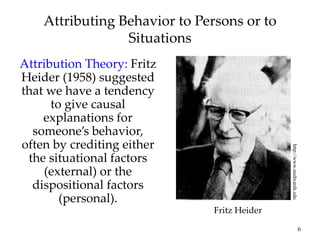
Attribution Theory: Fritz
Heider (1958) suggested
that we have a tendency
to give causal
explanations for
someone’s behavior,
often by crediting either
the situational factors
(external) or the
dispositional factors
(personal).
http://www.stedwards.edu
Fritz Heider
7
Attributing Behavior to Persons or to
Situations
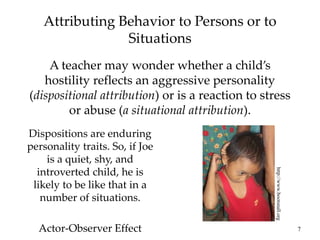
A teacher may wonder whether a child’s
hostility reflects an aggressive personality
(dispositional attribution) or is a reaction to stress
or abuse (a situational attribution).
http://www.bootsnall.org
Dispositions are enduring
personality traits. So, if Joe
is a quiet, shy, and
introverted child, he is
likely to be like that in a
number of situations.
Actor-Observer Effect
8
Fundamental Attribution Error
The tendency to overestimate the impact of
personal disposition and underestimate the
impact of the situations in analyzing the
behaviors of others leads to the fundamental
attribution error.
We see Joe as quiet, shy, and introverted most of
the time, but with friends he is very talkative,
loud, and extroverted.
Lee study on pg. 105 Companion Guide
Self-Serving Bias
• Take credit for your successes and credit
dispositional factors vs. dissociation from
failures and blame situational factors
• Defensive self-esteem is fragile and egotistic
whereas secure self-esteem is less fragile and
less dependent on external evaluation.
9
10
Attitude
A belief and feeling that predisposes a person to
respond in a particular way to objects, other
people, and events.
If we believe a person is mean, we may feel
dislike for the person and act in an unfriendly
manner.
11
Attitudes Can Affect Action
Our attitudes predict our behaviors imperfectly
because other factors, including the external
situation, also influence behavior.
Democratic leaders supported Bush’s attack on
Iraq under public pressure. However, they had
their private reservations.
Or did they?
Could it be that they actually changed based on
what they stood for publicly?
12
Attitudes Can Affect Action
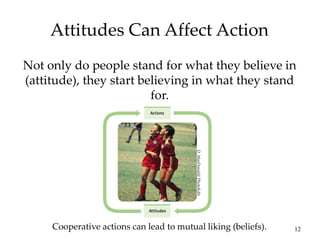
Not only do people stand for what they believe in
(attitude), they start believing in what they stand
for.
Cooperative actions can lead to mutual liking (beliefs).
D.
MacDonald/
PhotoEdit
13
Prejudice
Simply called “prejudgment,” a prejudice is an
unjustifiable (usually negative) attitude toward
a group and its members. Prejudice is often
directed towards different cultural, ethnic, or
gender groups.
1. Beliefs (stereotypes)
2. Emotions (hostility, envy, fear)
3. Predisposition to act (to discriminate)
Components of Prejudice
14
Reign of Prejudice
Prejudice works at the conscious and [more at]
the unconscious level. Therefore, prejudice is
more like a knee-jerk response than a conscious
decision.
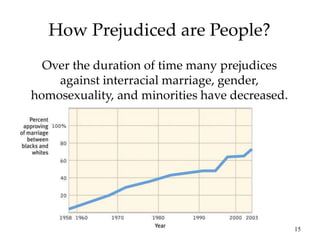
15
How Prejudiced are People?
Over the duration of time many prejudices
against interracial marriage, gender,
homosexuality, and minorities have decreased.
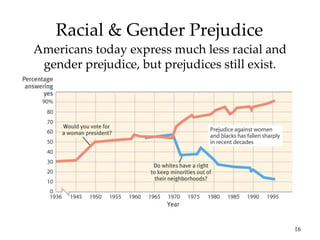
16
Racial & Gender Prejudice
Americans today express much less racial and
gender prejudice, but prejudices still exist.
17
Race
Nine out of ten white respondents were slow when
responding to words like “peace” or “paradise” when
they saw a black individual’s photo compared to a
white individual’s photo (Hugenberg & Bodenhausen,
2003).
Harvard IAT Test
Social Roots of Prejudice
• Social Identity Theory
• Purple Book pg. 150-157
18
19
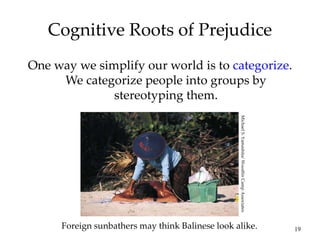
Cognitive Roots of Prejudice
One way we simplify our world is to categorize.
We categorize people into groups by
stereotyping them.
Foreign sunbathers may think Balinese look alike.
Michael
S.
Yamashita/
Woodfin
Camp
Associates
20
Compliance Techniques
In the Korean War, Chinese communists
solicited cooperation from US army prisoners
by asking them to carry out small errands. By
complying to small errands they were likely to
comply to larger ones.
Foot-in-the-Door Phenomenon: The tendency
for people who have first agreed to a small
request to comply later with a larger request.
Real World Applications?
21
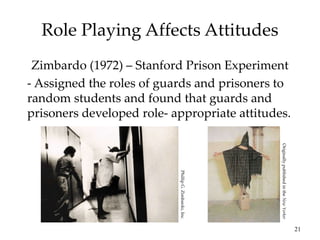
Role Playing Affects Attitudes
Zimbardo (1972) – Stanford Prison Experiment
- Assigned the roles of guards and prisoners to
random students and found that guards and
prisoners developed role- appropriate attitudes.
Originally
published
in
the
New
Yorker
Phillip
G.
Zimbardo,
Inc.
Abu Ghraib
The Lucifer Effect
“A celebration of the human mind’s infinite
capacity to make us behave kind or cruel, nice
or bad, etc.” – Dr. Phil Zimbardo
Seven social processes that grease the slippery
slope of evil:
1.Mindlessly taking the first small step
2.Dehumanization of others
3.De-individuation of self (anonymity)
23
Lucifer Effect
4. Diffusion of personal responsibility
5. Blind obedience to authority
6. Uncritical conformity to group norms
7. Passive tolerance of evil through inaction or
indifference and that particularly in new or
unfamiliar situations
24
• You volunteer to participate in a psychology
experiment.
• On arrival, you sit at a table and are asked to
undertake a series of dull, meaningless tasks (turning
pegs in a board) for approximately at hour.
• Afterward, the experimenter convinces you to write
an essay about the virtues of the tasks you had
performed by describing them as highly worthwhile,
interesting, and educational.
• You were paid either $1 or $20 to do this.
• You are then asked to privately rate your enjoyment
of the tasks on a questionnaire.
• After which amount do you believe your actual
enjoyment ratings would be higher – $1 or $20?
Why?
• Festinger & Carlsmith (1956)
26
Actions Can Affect Attitudes
Why do actions affect attitudes? One
explanation is that when our attitudes and
actions are opposed, we experience tension.
This is called cognitive dissonance.
To relieve ourselves of this tension we bring our
attitudes closer to our actions (Festinger, 1957).
27
Cognitive Dissonance
Daily Show – Stewart on
Republican Cognitive
Dissonance
http://www.cc.com/video-
clips/co5t5z/the-daily-
show-with-jon-stewart-
bad-credit
Trump vs. Trump
https://www.youtube.com/
watch?v=WpKiP_gmDS8
28
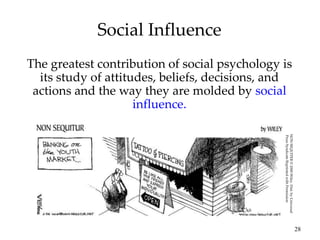
Social Influence
The greatest contribution of social psychology is
its study of attitudes, beliefs, decisions, and
actions and the way they are molded by social
influence.
NON
SEQUITER
©
2000
Wiley.
Dist.
by
Universal
Press
Syndicate
Reprinted
with
Permission
29
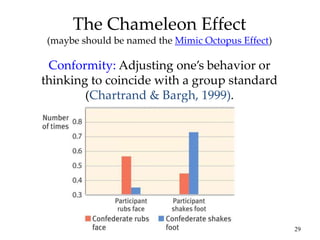
The Chameleon Effect
(maybe should be named the Mimic Octopus Effect)
Conformity: Adjusting one’s behavior or
thinking to coincide with a group standard
(Chartrand & Bargh, 1999).
30
Conformity & Obedience
Behavior is contagious, modeled by one
followed by another. We follow behavior of
others to conform.
Other behaviors may be an expression of
compliance (obedience) toward authority.
Conformity Obedience
31
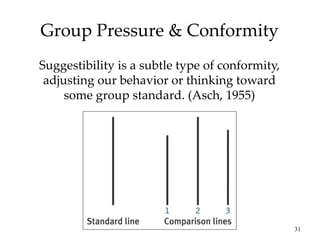
Group Pressure & Conformity
Suggestibility is a subtle type of conformity,
adjusting our behavior or thinking toward
some group standard. (Asch, 1955)
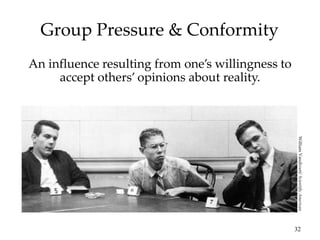
32
Group Pressure & Conformity
An influence resulting from one’s willingness to
accept others’ opinions about reality.
William
Vandivert/
Scientific
American
John Berry (1967)
• Variation of Asch to study whether conformity
rates among the Temne in Sierra Leone in Africa
and the Inuits of Baffin Island in Canada could be
linked to social norms and socialization practices.
• Results: the Temne, agricultural economy, high
conformity levels. They emphasize obedience in
child-rearing practices because the culture is
dependent on cooperation in farming.
• The Inuits are hunters and often hunt alone.
Child-rearing practices emphasize self-reliance.
This could perhaps explain why the Inuits tend to
conform less
33
34
Conditions that Strengthen Conformity
1. One is made to feel incompetent or insecure.
2. The group has at least three people.
3. The group is unanimous.
4. One admires the group’s status and
attractiveness.
5. One has no prior commitment or response.
6. The group observes one’s behavior.
7. One’s culture strongly encourages respect for a
social standard.
35
Reasons for Conformity
Normative Social Influence: Influence resulting
from a person’s desire to gain approval or avoid
rejection. A person may respect normative
behavior because there may be a severe price to
pay if not respected.
Informative Social Influence: The group may
provide valuable information, but stubborn
people will never listen to others.
36
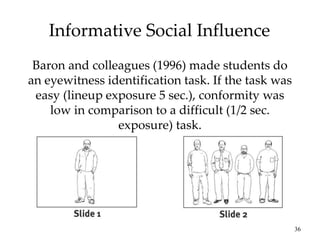
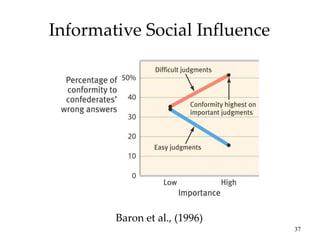
Informative Social Influence
Baron and colleagues (1996) made students do
an eyewitness identification task. If the task was
easy (lineup exposure 5 sec.), conformity was
low in comparison to a difficult (1/2 sec.
exposure) task.
37
Informative Social Influence
Baron et al., (1996)
38
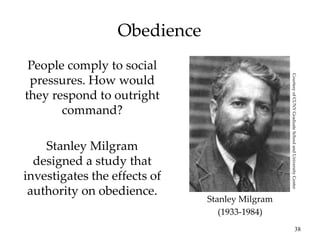
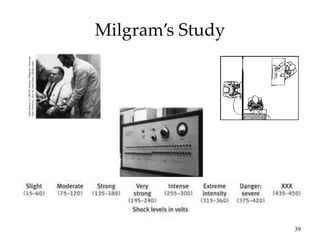
Obedience
People comply to social
pressures. How would
they respond to outright
command?
Stanley Milgram
designed a study that
investigates the effects of
authority on obedience.
Stanley Milgram
(1933-1984)
Courtesy
of
CUNY
Graduate
School
and
University
Center
39
Milgram’s Study
Both
Photos:
©
1965
By
Stanley
Miligram,
from
the
film
Obedience,
dist.
by
Penn
State,
Media
Sales
40
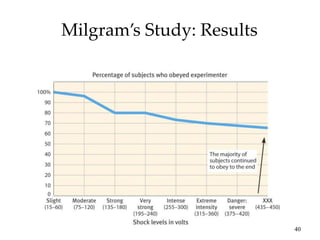
Milgram’s Study: Results
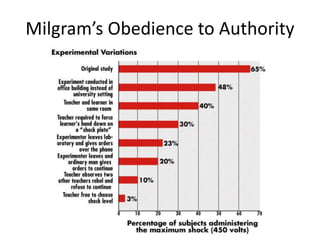
Milgram’s Obedience to Authority
42
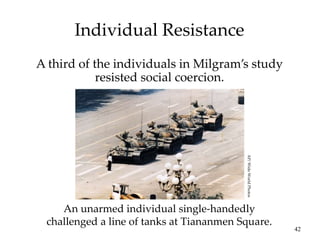
Individual Resistance
A third of the individuals in Milgram’s study
resisted social coercion.
An unarmed individual single-handedly
challenged a line of tanks at Tiananmen Square.
AP/
Wide
World
Photos
43
Lessons from the Conformity and
Obedience Studies
In both Asch's and Milgram's studies,
participants were pressured to follow their
standards and be responsive to others.
In Milgram’s study, participants were torn
between hearing the victims pleas and the
experimenter’s orders.
44
Group Influence
How do groups affect our behavior? Social
psychologists study various groups:
1. One person affecting another
2. Families
3. Teams
4. Committees
45
Individual Behavior in the Presence of
Others
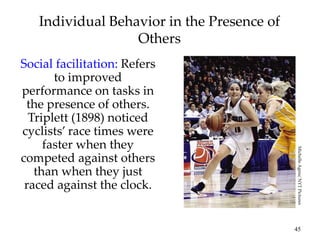
Social facilitation: Refers
to improved
performance on tasks in
the presence of others.
Triplett (1898) noticed
cyclists’ race times were
faster when they
competed against others
than when they just
raced against the clock.
Michelle
Agnis/
NYT
Pictures
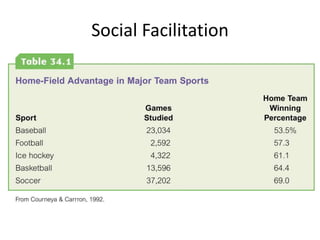
Social Facilitation
47
Social Loafing
The tendency of an individual in a group to
exert less effort toward attaining a common
goal than when tested individually (Latané,
1981).
48
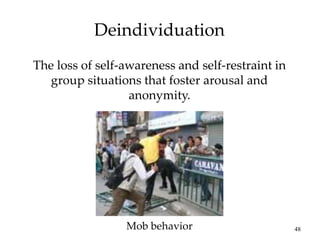
Deindividuation
The loss of self-awareness and self-restraint in
group situations that foster arousal and
anonymity.
Mob behavior
49
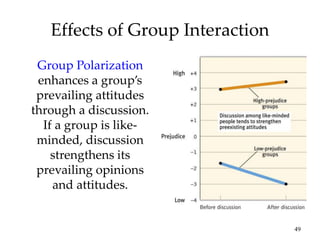
Effects of Group Interaction
Group Polarization
enhances a group’s
prevailing attitudes
through a discussion.
If a group is like-
minded, discussion
strengthens its
prevailing opinions
and attitudes.
50
Groupthink
A mode of thinking that occurs when the desire
for harmony in a decision-making group
overrides the realistic appraisal of alternatives.
Attack on Pearl Harbor
Kennedy and the Cuban Missile Crisis
Watergate Cover-up
Chernobyl Reactor Accident
51
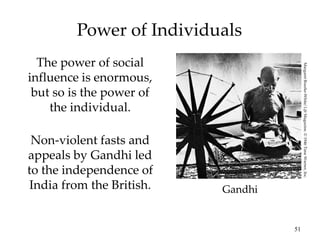
Power of Individuals
The power of social
influence is enormous,
but so is the power of
the individual.
Non-violent fasts and
appeals by Gandhi led
to the independence of
India from the British. Gandhi
Margaret
Bourke-White/
Life
Magazine.
©
1946
Time
Warner,
Inc.
52
Hindsight Bias
After learning an outcome, the tendency to
believe that we could have predicted it
beforehand may contribute to blaming the
victim and forming a prejudice against them.

socio-cultural_psych_2020.pptx

  • 1.
    1 PSYCHOLOGY (8th Edition) David Myers PowerPointSlides Aneeq Ahmad Henderson State University Worth Publishers, © 2006
  • 2.
    2 Focuses in SocialPsychology Social psychology scientifically studies how we think about, influence, and relate to one another. “We cannot live for ourselves alone.” Herman Melville
  • 3.
    Principles of Socio-CulturalPsych 1. Humans are social animals w/ need to belong - Group individual influence is bidirectional 2. Culture influences behavior 3. We have individual identity and social self 4. People’s views of the world are resistant to change Pg. 101-102 Companion Book 3
  • 4.
    4 Social Thinking Social thinkinginvolves thinking about others, especially when they engage in doing things that are unexpected. 1. Does his absenteeism signify illness, laziness, or a stressful work atmosphere? 2. Was the horror of 9/11 the work of crazed evil people or ordinary people corrupted by life events?
  • 5.
    Watch this videoand explain the behavior 5
  • 6.
    6 Attributing Behavior toPersons or to Situations Attribution Theory: Fritz Heider (1958) suggested that we have a tendency to give causal explanations for someone’s behavior, often by crediting either the situational factors (external) or the dispositional factors (personal). http://www.stedwards.edu Fritz Heider
  • 7.
    7 Attributing Behavior toPersons or to Situations A teacher may wonder whether a child’s hostility reflects an aggressive personality (dispositional attribution) or is a reaction to stress or abuse (a situational attribution). http://www.bootsnall.org Dispositions are enduring personality traits. So, if Joe is a quiet, shy, and introverted child, he is likely to be like that in a number of situations. Actor-Observer Effect
  • 8.
    8 Fundamental Attribution Error Thetendency to overestimate the impact of personal disposition and underestimate the impact of the situations in analyzing the behaviors of others leads to the fundamental attribution error. We see Joe as quiet, shy, and introverted most of the time, but with friends he is very talkative, loud, and extroverted. Lee study on pg. 105 Companion Guide
  • 9.
    Self-Serving Bias • Takecredit for your successes and credit dispositional factors vs. dissociation from failures and blame situational factors • Defensive self-esteem is fragile and egotistic whereas secure self-esteem is less fragile and less dependent on external evaluation. 9
  • 10.
    10 Attitude A belief andfeeling that predisposes a person to respond in a particular way to objects, other people, and events. If we believe a person is mean, we may feel dislike for the person and act in an unfriendly manner.
  • 11.
    11 Attitudes Can AffectAction Our attitudes predict our behaviors imperfectly because other factors, including the external situation, also influence behavior. Democratic leaders supported Bush’s attack on Iraq under public pressure. However, they had their private reservations. Or did they? Could it be that they actually changed based on what they stood for publicly?
  • 12.
    12 Attitudes Can AffectAction Not only do people stand for what they believe in (attitude), they start believing in what they stand for. Cooperative actions can lead to mutual liking (beliefs). D. MacDonald/ PhotoEdit
  • 13.
    13 Prejudice Simply called “prejudgment,”a prejudice is an unjustifiable (usually negative) attitude toward a group and its members. Prejudice is often directed towards different cultural, ethnic, or gender groups. 1. Beliefs (stereotypes) 2. Emotions (hostility, envy, fear) 3. Predisposition to act (to discriminate) Components of Prejudice
  • 14.
    14 Reign of Prejudice Prejudiceworks at the conscious and [more at] the unconscious level. Therefore, prejudice is more like a knee-jerk response than a conscious decision.
  • 15.
    15 How Prejudiced arePeople? Over the duration of time many prejudices against interracial marriage, gender, homosexuality, and minorities have decreased.
  • 16.
    16 Racial & GenderPrejudice Americans today express much less racial and gender prejudice, but prejudices still exist.
  • 17.
    17 Race Nine out often white respondents were slow when responding to words like “peace” or “paradise” when they saw a black individual’s photo compared to a white individual’s photo (Hugenberg & Bodenhausen, 2003). Harvard IAT Test
  • 18.
    Social Roots ofPrejudice • Social Identity Theory • Purple Book pg. 150-157 18
  • 19.
    19 Cognitive Roots ofPrejudice One way we simplify our world is to categorize. We categorize people into groups by stereotyping them. Foreign sunbathers may think Balinese look alike. Michael S. Yamashita/ Woodfin Camp Associates
  • 20.
    20 Compliance Techniques In theKorean War, Chinese communists solicited cooperation from US army prisoners by asking them to carry out small errands. By complying to small errands they were likely to comply to larger ones. Foot-in-the-Door Phenomenon: The tendency for people who have first agreed to a small request to comply later with a larger request. Real World Applications?
  • 21.
    21 Role Playing AffectsAttitudes Zimbardo (1972) – Stanford Prison Experiment - Assigned the roles of guards and prisoners to random students and found that guards and prisoners developed role- appropriate attitudes. Originally published in the New Yorker Phillip G. Zimbardo, Inc.
  • 22.
  • 23.
    The Lucifer Effect “Acelebration of the human mind’s infinite capacity to make us behave kind or cruel, nice or bad, etc.” – Dr. Phil Zimbardo Seven social processes that grease the slippery slope of evil: 1.Mindlessly taking the first small step 2.Dehumanization of others 3.De-individuation of self (anonymity) 23
  • 24.
    Lucifer Effect 4. Diffusionof personal responsibility 5. Blind obedience to authority 6. Uncritical conformity to group norms 7. Passive tolerance of evil through inaction or indifference and that particularly in new or unfamiliar situations 24
  • 25.
    • You volunteerto participate in a psychology experiment. • On arrival, you sit at a table and are asked to undertake a series of dull, meaningless tasks (turning pegs in a board) for approximately at hour. • Afterward, the experimenter convinces you to write an essay about the virtues of the tasks you had performed by describing them as highly worthwhile, interesting, and educational. • You were paid either $1 or $20 to do this. • You are then asked to privately rate your enjoyment of the tasks on a questionnaire. • After which amount do you believe your actual enjoyment ratings would be higher – $1 or $20? Why? • Festinger & Carlsmith (1956)
  • 26.
    26 Actions Can AffectAttitudes Why do actions affect attitudes? One explanation is that when our attitudes and actions are opposed, we experience tension. This is called cognitive dissonance. To relieve ourselves of this tension we bring our attitudes closer to our actions (Festinger, 1957).
  • 27.
    27 Cognitive Dissonance Daily Show– Stewart on Republican Cognitive Dissonance http://www.cc.com/video- clips/co5t5z/the-daily- show-with-jon-stewart- bad-credit Trump vs. Trump https://www.youtube.com/ watch?v=WpKiP_gmDS8
  • 28.
    28 Social Influence The greatestcontribution of social psychology is its study of attitudes, beliefs, decisions, and actions and the way they are molded by social influence. NON SEQUITER © 2000 Wiley. Dist. by Universal Press Syndicate Reprinted with Permission
  • 29.
    29 The Chameleon Effect (maybeshould be named the Mimic Octopus Effect) Conformity: Adjusting one’s behavior or thinking to coincide with a group standard (Chartrand & Bargh, 1999).
  • 30.
    30 Conformity & Obedience Behavioris contagious, modeled by one followed by another. We follow behavior of others to conform. Other behaviors may be an expression of compliance (obedience) toward authority. Conformity Obedience
  • 31.
    31 Group Pressure &Conformity Suggestibility is a subtle type of conformity, adjusting our behavior or thinking toward some group standard. (Asch, 1955)
  • 32.
    32 Group Pressure &Conformity An influence resulting from one’s willingness to accept others’ opinions about reality. William Vandivert/ Scientific American
  • 33.
    John Berry (1967) •Variation of Asch to study whether conformity rates among the Temne in Sierra Leone in Africa and the Inuits of Baffin Island in Canada could be linked to social norms and socialization practices. • Results: the Temne, agricultural economy, high conformity levels. They emphasize obedience in child-rearing practices because the culture is dependent on cooperation in farming. • The Inuits are hunters and often hunt alone. Child-rearing practices emphasize self-reliance. This could perhaps explain why the Inuits tend to conform less 33
  • 34.
    34 Conditions that StrengthenConformity 1. One is made to feel incompetent or insecure. 2. The group has at least three people. 3. The group is unanimous. 4. One admires the group’s status and attractiveness. 5. One has no prior commitment or response. 6. The group observes one’s behavior. 7. One’s culture strongly encourages respect for a social standard.
  • 35.
    35 Reasons for Conformity NormativeSocial Influence: Influence resulting from a person’s desire to gain approval or avoid rejection. A person may respect normative behavior because there may be a severe price to pay if not respected. Informative Social Influence: The group may provide valuable information, but stubborn people will never listen to others.
  • 36.
    36 Informative Social Influence Baronand colleagues (1996) made students do an eyewitness identification task. If the task was easy (lineup exposure 5 sec.), conformity was low in comparison to a difficult (1/2 sec. exposure) task.
  • 37.
  • 38.
    38 Obedience People comply tosocial pressures. How would they respond to outright command? Stanley Milgram designed a study that investigates the effects of authority on obedience. Stanley Milgram (1933-1984) Courtesy of CUNY Graduate School and University Center
  • 39.
  • 40.
  • 41.
  • 42.
    42 Individual Resistance A thirdof the individuals in Milgram’s study resisted social coercion. An unarmed individual single-handedly challenged a line of tanks at Tiananmen Square. AP/ Wide World Photos
  • 43.
    43 Lessons from theConformity and Obedience Studies In both Asch's and Milgram's studies, participants were pressured to follow their standards and be responsive to others. In Milgram’s study, participants were torn between hearing the victims pleas and the experimenter’s orders.
  • 44.
    44 Group Influence How dogroups affect our behavior? Social psychologists study various groups: 1. One person affecting another 2. Families 3. Teams 4. Committees
  • 45.
    45 Individual Behavior inthe Presence of Others Social facilitation: Refers to improved performance on tasks in the presence of others. Triplett (1898) noticed cyclists’ race times were faster when they competed against others than when they just raced against the clock. Michelle Agnis/ NYT Pictures
  • 46.
  • 47.
    47 Social Loafing The tendencyof an individual in a group to exert less effort toward attaining a common goal than when tested individually (Latané, 1981).
  • 48.
    48 Deindividuation The loss ofself-awareness and self-restraint in group situations that foster arousal and anonymity. Mob behavior
  • 49.
    49 Effects of GroupInteraction Group Polarization enhances a group’s prevailing attitudes through a discussion. If a group is like- minded, discussion strengthens its prevailing opinions and attitudes.
  • 50.
    50 Groupthink A mode ofthinking that occurs when the desire for harmony in a decision-making group overrides the realistic appraisal of alternatives. Attack on Pearl Harbor Kennedy and the Cuban Missile Crisis Watergate Cover-up Chernobyl Reactor Accident
  • 51.
    51 Power of Individuals Thepower of social influence is enormous, but so is the power of the individual. Non-violent fasts and appeals by Gandhi led to the independence of India from the British. Gandhi Margaret Bourke-White/ Life Magazine. © 1946 Time Warner, Inc.
  • 52.
    52 Hindsight Bias After learningan outcome, the tendency to believe that we could have predicted it beforehand may contribute to blaming the victim and forming a prejudice against them.