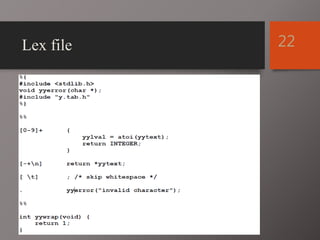
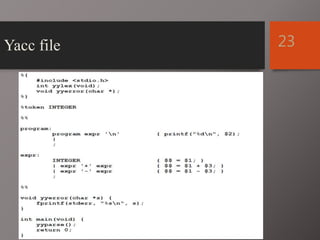
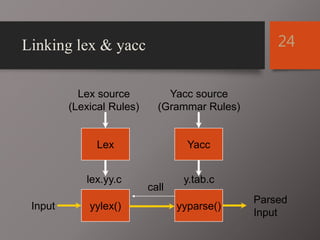
The document discusses Lex and Yacc, which are programs that generate lexical analyzers and parsers. Lex uses regular expressions to generate a scanner that tokenizes input into tokens, while Yacc uses context-free grammars to generate a parser that analyzes tokens based on syntax rules. The document provides examples of how Lex and Yacc can be used together, with Lex generating tokens from input that are then passed to a Yacc-generated parser to build a syntax tree based on the grammar.
Outline
• Lex :
•Theory
• Execution
• Example
• Yacc :
• Theory
• Description
• Example
• Lex & Yacc linking
2
3.
Lex
• lex isa program (generator) that generates lexical analyzers,
(widely used on Unix).
• It is mostly used with Yacc parser generator.
• Written by Eric Schmidt and Mike Lesk.
• It reads the input stream (specifying the lexical analyzer ) and
outputs source code implementing the lexical analyzer in the C
programming language.
• Lex will read patterns (regular expressions); then produces C
code for a lexical analyzer that scans for identifiers.
3
4.
Lex
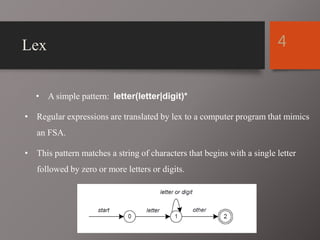
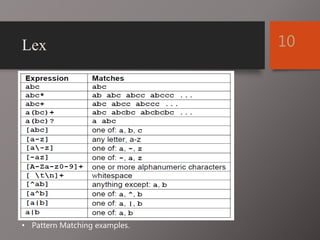
• A simplepattern: letter(letter|digit)*
• Regular expressions are translated by lex to a computer program that mimics
an FSA.
• This pattern matches a string of characters that begins with a single letter
followed by zero or more letters or digits.
4
5.
Lex
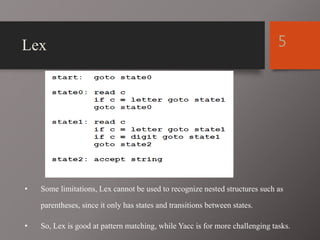
• Some limitations,Lex cannot be used to recognize nested structures such as
parentheses, since it only has states and transitions between states.
• So, Lex is good at pattern matching, while Yacc is for more challenging tasks.
5
6.
Lex
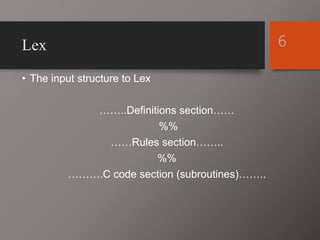
• The inputstructure to Lex
……..Definitions section……
%%
……Rules section……..
%%
……….C code section (subroutines)……..
6
7.
7Operators
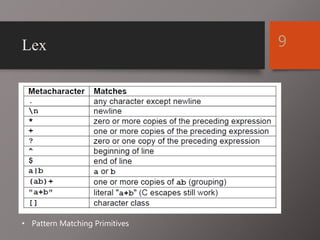
“ [] ^ - ? . * + | ( ) $ / { } % < >
• If they are to be used as text characters, an escape
should be used
$ = “$”
= “”
• Every character but blank, tab (t), newline (n) and
the list above is always a text character
8.
8Precedence of Operators
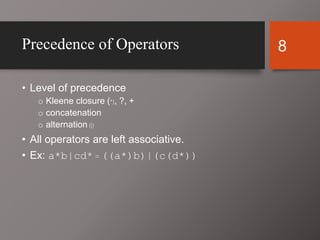
•Level of precedence
o Kleene closure (*), ?, +
o concatenation
o alternation (|)
• All operators are left associative.
• Ex: a*b|cd* = ((a*)b)|(c(d*))
Lex
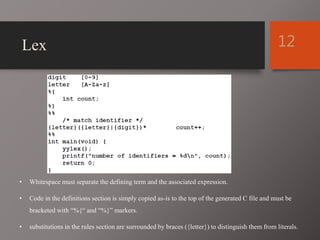
• Whitespace mustseparate the defining term and the associated expression.
• Code in the definitions section is simply copied as-is to the top of the generated C file and must be
bracketed with “%{“ and “%}” markers.
• substitutions in the rules section are surrounded by braces ({letter}) to distinguish them from literals.
12
13.
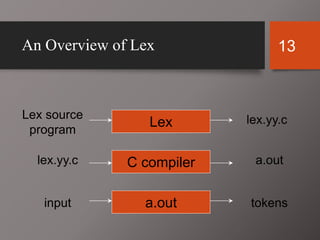
13An Overview ofLex
Lex
C compiler
a.out
Lex source
program
lex.yy.c
input
lex.yy.c
a.out
tokens
14.
14Usage
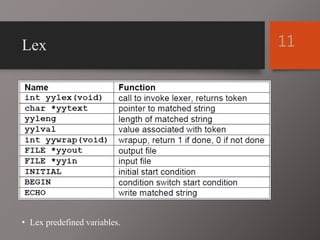
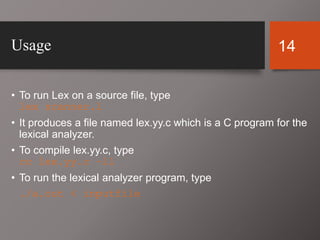
• To runLex on a source file, type
lex scanner.l
• It produces a file named lex.yy.c which is a C program for the
lexical analyzer.
• To compile lex.yy.c, type
cc lex.yy.c –ll
• To run the lexical analyzer program, type
./a.out < inputfile
Yacc - YetAnother Compiler-Compiler
• Yacc reads the grammar and generate C code for a parser .
• Grammars written in Backus Naur Form (BNF) .
• BNF grammar used to express context-free languages .
• e.g. to parse an expression, do reverse operation(reducing the expression)
• This known as bottom-up or shift-reduce parsing .
• Using stack for storing (LIFO).
16
17.
Yacc
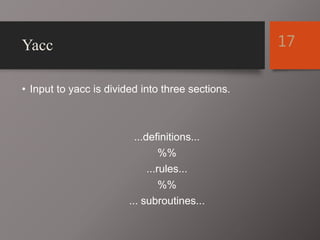
• Input toyacc is divided into three sections.
...definitions...
%%
...rules...
%%
... subroutines...
17
18.
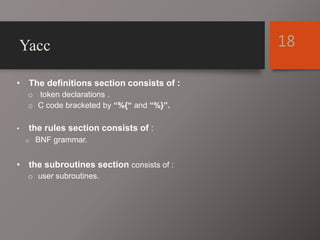
Yacc
• The definitionssection consists of :
o token declarations .
o C code bracketed by “%{“ and “%}”.
• the rules section consists of :
o BNF grammar.
• the subroutines section consists of :
o user subroutines.
18
19.
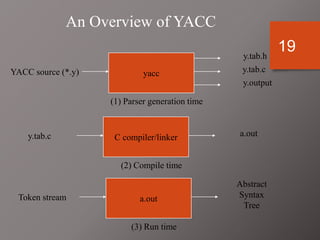
19
yacc
An Overview ofYACC
(1) Parser generation time
YACC source (*.y)
y.tab.h
y.tab.c
C compiler/linker
(2) Compile time
y.tab.c a.out
a.out
(3) Run time
Token stream
Abstract
Syntax
Tree
y.output
20.
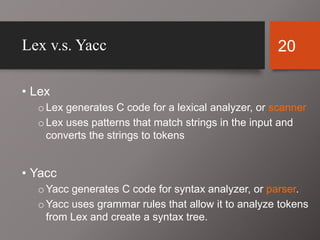
20Lex v.s. Yacc
•Lex
oLex generates C code for a lexical analyzer, or scanner
oLex uses patterns that match strings in the input and
converts the strings to tokens
• Yacc
oYacc generates C code for syntax analyzer, or parser.
oYacc uses grammar rules that allow it to analyze tokens
from Lex and create a syntax tree.
21.
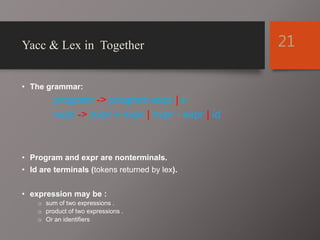
Yacc & Lexin Together
• The grammar:
program -> program expr | ε
expr -> expr + expr | expr - expr | id
• Program and expr are nonterminals.
• Id are terminals (tokens returned by lex).
• expression may be :
o sum of two expressions .
o product of two expressions .
o Or an identifiers
21