CV (Curriculum Vitae) Ch. Batbayar  04/25/2008
What a CV CV and Resume CV presentation Types of CV Why write CV CV tips
What is a CV? A presentation of your: Experience Accomplishments Professional Qualities Its appearance also tells about your: Attention to detail Thoroughness
Needed for… New Positions! Tenure or Advancement in University Usually accompanied by Statement of Purpose Or Cover and small research proposal
CV vs Resume’ CV Overall summary of all  Education Experience Used for applying for: Grants Fellowships Academic Teaching Academic Administration Tens of Pages, eventually Resume’ Tailored information Education Experience Used when applying for Specific job Public or private sector Information generally incomplete 1 to 2 pages
Example of CV vs Resume Example of a CV http://chronicle.com/jobs/99/12/99120301c_before.htm Example of a Resume from CV http://chronicle.com/jobs/99/12/99120301c_after.htm
CV presentation Concise and clear content – don’t waffle Use simple/plain, positive, active English Use correct spelling, punctuation and grammar Well laid out and split into sections – i.e. o Skills Profile o Education o Work Experience o Interests/Achievements Use bullet points and snappy text over long prose sentences No less than size 10 in a normal font, i.e. Arial or Times New Roman Maximum of 2 pages Use a computer and top quality paper
Types of CV Chronological 1. Provides all the information most employers want in a familiar format and demonstrates steady development in education and career. 2. Lists education and work experience by date with most recent  information first.
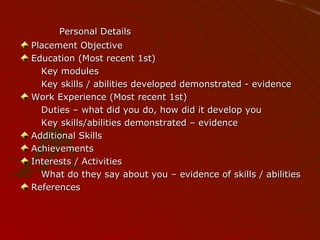
Personal Details Placement Objective Education (Most recent 1st) Key modules Key skills / abilities developed demonstrated - evidence Work Experience (Most recent 1st)  Duties – what did you do, how did it develop you Key skills/abilities demonstrated – evidence Additional Skills Achievements Interests / Activities What do they say about you – evidence of skills / abilities References
Skills-based 1. Same headings, different lay-out with targeted approach through skills matching.  2. Work experience details kept to a minimum 3. Useful for highlighting particular skills enabling the selector to understand the relevance of skills and experience and for distracting away from a varied career history
Why write CV In an increasingly competitive job market, a well-written resume or CV is a vital component in obtaining the right job and progressing in a career.  Curriculum Vitae (commonly abbreviated to CV) literally translated means "course of one's life".  In the UK Curriculum Vitae is the term usually used instead of resume whilst in the US a Curriculum Vitae refers to a fuller version of a resume.
Employers regularly receive many CVs for each available job and so having a professional quality CV is vital if you are not to be filtered out of the hiring process before even having an interview.   A professional CV is also vital during an interview as, for example, many interviews use your experience as detailed your CV by as a template for the interview, and so having one which focuses on your strengths and achievements is important.
Although there are many professional CV writing services who offer to tell you how to write a CV for a fee it is relatively easy to produce a decent CV yourself with a little effort.  The tips and samples on this site should help start you on the correct path to achieving a quality resume or CV.
CV tips Usually the best CV format is a reverse one in reverse chronological order:  Basic/contact information (name, address, email address, contact phone number).  Profile section detailing your experience and areas of proficiency.  Reverse chronological employment history emphasizing recent achievements.  Education (Recent graduates may put this at the top).
Use plain white paper and black ink. Use a clear font, ideally 10/12 point. Make headings bold and use space to break up the page. It makes the reader feel immediately negative towards you if they are confronted by a full page of small, tightly spaced text.  Although you may like unusual fonts and may be proud of your large clipart collection, many people will not share your views.  It is better when writing a CV to aim for a smart, professional look rather than a flash multi-coloured masterpiece.
What NOT to do: Don't  include: Birthday SS# Ethnic identity Political affiliation Religious preference Hobbies (maybe in students’…depends Marital status Sexual orientation Place of birth Photographs Physical: Height; Weight; and Health.
Thank you for  attention

9 Cv. Batbayr

  • 1.
    CV(Curriculum Vitae) Ch. Batbayar 04/25/2008
  • 2.
    What a CVCV and Resume CV presentation Types of CV Why write CV CV tips
  • 3.
    What is aCV? A presentation of your: Experience Accomplishments Professional Qualities Its appearance also tells about your: Attention to detail Thoroughness
  • 4.
    Needed for… NewPositions! Tenure or Advancement in University Usually accompanied by Statement of Purpose Or Cover and small research proposal
  • 5.
    CV vs Resume’CV Overall summary of all Education Experience Used for applying for: Grants Fellowships Academic Teaching Academic Administration Tens of Pages, eventually Resume’ Tailored information Education Experience Used when applying for Specific job Public or private sector Information generally incomplete 1 to 2 pages
  • 6.
    Example of CVvs Resume Example of a CV http://chronicle.com/jobs/99/12/99120301c_before.htm Example of a Resume from CV http://chronicle.com/jobs/99/12/99120301c_after.htm
  • 7.
    CV presentation Conciseand clear content – don’t waffle Use simple/plain, positive, active English Use correct spelling, punctuation and grammar Well laid out and split into sections – i.e. o Skills Profile o Education o Work Experience o Interests/Achievements Use bullet points and snappy text over long prose sentences No less than size 10 in a normal font, i.e. Arial or Times New Roman Maximum of 2 pages Use a computer and top quality paper
  • 8.
    Types of CVChronological 1. Provides all the information most employers want in a familiar format and demonstrates steady development in education and career. 2. Lists education and work experience by date with most recent information first.
  • 9.
    Personal Details PlacementObjective Education (Most recent 1st) Key modules Key skills / abilities developed demonstrated - evidence Work Experience (Most recent 1st) Duties – what did you do, how did it develop you Key skills/abilities demonstrated – evidence Additional Skills Achievements Interests / Activities What do they say about you – evidence of skills / abilities References
  • 10.
    Skills-based 1. Sameheadings, different lay-out with targeted approach through skills matching. 2. Work experience details kept to a minimum 3. Useful for highlighting particular skills enabling the selector to understand the relevance of skills and experience and for distracting away from a varied career history
  • 11.
    Why write CVIn an increasingly competitive job market, a well-written resume or CV is a vital component in obtaining the right job and progressing in a career. Curriculum Vitae (commonly abbreviated to CV) literally translated means "course of one's life".  In the UK Curriculum Vitae is the term usually used instead of resume whilst in the US a Curriculum Vitae refers to a fuller version of a resume.
  • 12.
    Employers regularly receivemany CVs for each available job and so having a professional quality CV is vital if you are not to be filtered out of the hiring process before even having an interview. A professional CV is also vital during an interview as, for example, many interviews use your experience as detailed your CV by as a template for the interview, and so having one which focuses on your strengths and achievements is important.
  • 13.
    Although there aremany professional CV writing services who offer to tell you how to write a CV for a fee it is relatively easy to produce a decent CV yourself with a little effort.  The tips and samples on this site should help start you on the correct path to achieving a quality resume or CV.
  • 14.
    CV tips Usuallythe best CV format is a reverse one in reverse chronological order: Basic/contact information (name, address, email address, contact phone number). Profile section detailing your experience and areas of proficiency. Reverse chronological employment history emphasizing recent achievements. Education (Recent graduates may put this at the top).
  • 15.
    Use plain whitepaper and black ink. Use a clear font, ideally 10/12 point. Make headings bold and use space to break up the page. It makes the reader feel immediately negative towards you if they are confronted by a full page of small, tightly spaced text. Although you may like unusual fonts and may be proud of your large clipart collection, many people will not share your views.  It is better when writing a CV to aim for a smart, professional look rather than a flash multi-coloured masterpiece.
  • 16.
    What NOT todo: Don't include: Birthday SS# Ethnic identity Political affiliation Religious preference Hobbies (maybe in students’…depends Marital status Sexual orientation Place of birth Photographs Physical: Height; Weight; and Health.
  • 17.
    Thank you for attention