

This document defines broadcasting and discusses its history and methods. It explains that broadcasting is the distribution of audio and video content to a dispersed audience using mass communication mediums like radio waves. Broadcasting began experimentally in the early 1900s and expanded with radio in the 1920s and television after World War II using new technologies. The document also outlines several economic models for broadcasting like commercial, public, and community models and distinguishes between recorded and live broadcasts.
• What isbroadcasting ?
*History of broadcasting
• Methods of broadcasting
• Economic models of
broadcasting
• Recorded broadcasts and live
broadcasts
3.
1 . Whatis broadcasting ?
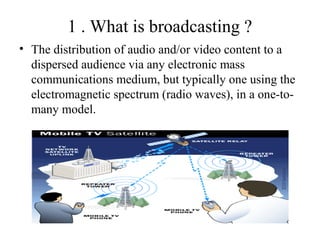
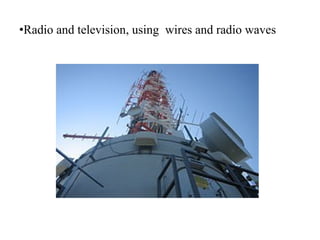
• The distribution of audio and/or video content to a
dispersed audience via any electronic mass
communications medium, but typically one using the
electromagnetic spectrum (radio waves), in a one-to-
many model.
*History
• Audio broadcastingbegan experimentally in the first
decade of the 20th century. By the early 1920s radio
broadcasting became a household medium, at first on
the AM band and later on FM . Television
broadcasting started experimentally in the 1920s and
became widespread after World War II, using VHF
and UHF spectrum.
6.
Satellite broadcasting wasinitiated in the 1960s
and moved into general industry usage in the
1970s, with DBS (Direct Broadcast Satellites)
emerging in the 1980s.
•Analog audio vs. HD Radio
•Analog television vs. Digital television
•Wireless
7.
• What isbroadcasting ?
*History of broadcasting
• Methods of broadcasting
• Economic models of
broadcasting
• Recorded broadcasts and live
broadcasts
8.
2 . Methodsof broadcasting
several methods used for broadcasting electronic media
audio and/or video to the general public:
•Cable radio (also called "cable FM", from 1928)
and cable television (from 1932)
•Radio broadcasting (experimentally from 1906,
commercially from 1920)
•Telephone broadcasting (1881–1932)
•Webcasting of video/television (1993) and audio/radio
(1994) streams
9.
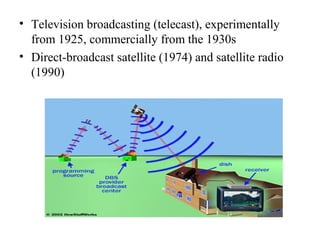
• Television broadcasting(telecast), experimentally
from 1925, commercially from the 1930s
• Direct-broadcast satellite (1974) and satellite radio
(1990)
10.
• What isbroadcasting ?
*History of broadcasting
• Methods of broadcasting
• Economic models of
broadcasting
• Recorded broadcasts and live
broadcasts
11.
3 . Economicmodels
Several means of providing financial support for
continuous broadcasting:
1.Commercial broadcasting
2.Public broadcasting
3. Community broadcasting
13.
• What isbroadcasting ?
*History of broadcasting
• Methods of broadcasting
• Economic models of
broadcasting
• Recorded broadcasts and live
broadcasts
14.
4 . Recordedbroadcasts and
broadcasts
• Broadcast
• If coming directly from the radio studio at a single
station or television station, it is simply sent through
the studio/transmitter link to the transmitter and
hence from the television antenna located on the radio
masts and towers out to the world.
15.
• “Broadcast network"; broadcast only via cable
television (cablecast) or satellite television that uses
a dish antenna.
• The term "broadcast television" can refer to
the television programs of such networks.
16.
ConclusionConclusion
• Public servicebroadcasting organizations can,
where these ingredients are guaranteed, make
a very significant contribution to the public’s right
to know and diverse and pluralistic broadcasting
to which citizens are entitled.
• Public service broadcasting organizations play
a unique and vital role is satisfying the public interest
and ensuring a free flow of information and ideas,
and governments and other public actors must be
urged to make a solid commitment to funding this
essential public resource.