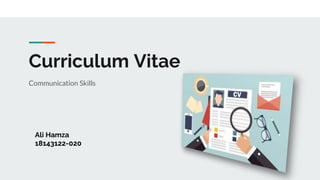
Curriculum Vitae
Communication Skills
Ali Hamza
18143122-020
What is a CV or Vita?
● A curriculum vitae, Latin for "course of life", often
shortened as CV or vita, is a written overview of
someone's life's work.
● CVs are the ‘First Impression’ in the selection process
that could land you on a new career path.
Introduction
● It is a summary of your career history, and the skills and experience you
have gained.
● Put as much effort into your CV as you do into your exams and
interview.
● It is your Opportunity to be in the spotlight.
Introduction
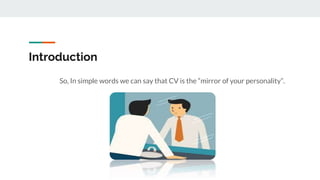
So, In simple words we can say that CV is the “mirror of your personality”.
Difference between CV and Resume?
● CV is longer (2 or more pages) and more detailed synopsis of your
background and skills.
● CV includes a summary of your educational and academic
backgrounds as well as teaching and research experience,
publications, presentations, awards, honors, affiliations and other
details.
● CV doesn’t consider the future goals as resume does.
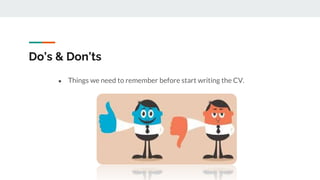
Do’s & Don’ts
● Things we need to remember before start writing the CV.
Do’s & Don’ts
Do’s
● Be brief, clear and concise
● Stress your accomplishments and skills, as well as experience
● Be neat and organized; direct the reader’s eye with format
● Use bold type to emphasize certain elements; use italics sparingly,
only to highlight
● Be consistent on format and tenses
Do’s & Don’ts
Do’s
● Concentrate on positives
● Use action words to describe your accomplishments
● Proofread carefully
● Use high quality matching paper
Do’s & Don’ts
Don’ts
● Use the pronoun “I”
● Use a font size smallerthan 10
● Include personal information such as marital status, health, age, place
of birth, etc.
● State salary requirements
Do’s & Don’ts
Don’ts
● Use nicknames
● Include a photograph
● Include any information that you cannot supply documentation or
explain
Types of CV
● Chronological
● Functional
● Hybrid
Chronological CV
● This is the CV format that is most commonly used by job hunters.
● It clearly lists your personal details work experience and academic
qualifications in reverse chronological order.
(It means your most recent jobs are at the top of your CV and your least
recent jobs are down below)
● It also contains details of education and qualifications, together with
hobbies.
Functional CV
● A Functional CV emphasizes your skills as opposed to your work
experience.
● A functional CV typically starts with a personal profile which
highlights the achievements, skills and personal qualities that you
possess.
Functional vs Chronological CV
● A Functional CV highlights a candidate's skills and is suitable for
inexperienced job seekers or applicants with limited experience in the
field they're entering.
● A Functional CV draws on skills gained during a candidate's studies,
and volunteer or part-time work.
● By contrast, A Chronological CV is designed for experienced
professionals.
Hybrid or Combination CV
● A Combination or Hybrid CV is where the Functional and
Chronological CVs meet.
● A Combination CV combines aspects of these two CV types, and is the
perfect option for accomplished job applicants as it allows them to
showcase their skills, education, work experience, and achievements.
● The Hybrid format is more detailed than the other CV types.
Targeted & Inventory CV
● Targeted CV focuses on particular objective and specific industry or
company. It highlights skills, qualifications and experience that match
the requirements of the advertised position.
● Inventory CV is used when sending your CV to various recruiters,
when you do not have a specific job objective. It is a more general
overview of your skills, achievements and qualifications.
Rules for Writing a CV
● There are no rules for CV writing.
● You can decide what to include in your CV and what to omit.
● CV’s must be short.
● Don’t write in sentences. List what you have done.
● But any potential employer need to know about following
requirements which selected as the sections of CV.
Personal Information
● Any potential employer will need to know:
o Full name
o Date of Birth
o Full Address and Post Code
o Contact Email & Phone Number
Career Objective
● It’s the first thing that shows on your CV.
● A statement is an essential part of standing out
from the crowd.
● It explains who you are, what you’re offering, and
what you’re looking for.
● Aim to prove why you’re suitable in one short and
succinct paragraph.
● Succinct paragraph is one which expressed “briefly
and clearly”.
Academic Information
● Your educational experience and achievements
should be listed here.
● Schools you have attended, including
universities, community colleges, technical
schools, etc.
● Along with the duration you attended the
institutes and the type of qualification with the
grades you achieved.
Skills
● The usual ones to mention are language( good
Conversational, Expert in different languages),
computing ( e.g. Good working knowledge), skills
like a graphic designer, a freelancer, An
Entrepreneur etc.
● But if you are a mature candidate or have lots of
relevant skills offer, a skill based CV may work
for you.
Achievements
● This is your chance to show how your previous
experience has given you the skills needed to
make you a suitable candidate.
● List all of your relevant skills and achievement
(backing them up with examples). And make it
clear how you would apply these to the new role
Skills: Example
● Target Job:
Call Centre Job
● Relevant Skills:
○ Excellent oral communication
○ Computer skills
○ Problem solving skills
○ Persuasive skills
Work Experience
● This section should include all of your relevant work
experience, listed with the most recent first.
● It includes
○ Your Job title
○ Name of the organization
○ Time in post
○ Your key responsibilities
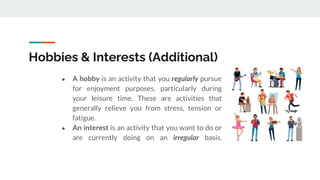
Hobbies & Interests (Additional)
● A hobby is an activity that you regularly pursue
for enjoyment purposes, particularly during
your leisure time. These are activities that
generally relieve you from stress, tension or
fatigue.
● An interest is an activity that you want to do or
are currently doing on an irregular basis.
Reference
● Your references are people, called referees,
who can testify about your character, skills and
abilities to prospective employers.
● Normally two referees are sufficient:
○ One from academic (perhaps your tutor or a
project supervisor) and
○ One from an employer (perhaps your last part-
time or summer job)
Tips
● A few tips for a good impression on employer:
○ Keep it simple
○ Mention relevant facts
○ Update your CV regularly
○ Keep your contact address always updated
○ Attach a Cover letter
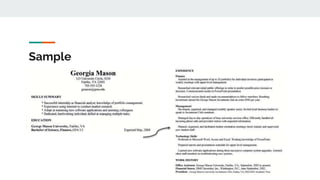
Sample
Curriculum vitae | What is CV? | How to write an Effective CV?

Curriculum vitae | What is CV? | How to write an Effective CV?

  • 1.
  • 2.
    What is aCV or Vita? ● A curriculum vitae, Latin for "course of life", often shortened as CV or vita, is a written overview of someone's life's work. ● CVs are the ‘First Impression’ in the selection process that could land you on a new career path.
  • 3.
    Introduction ● It isa summary of your career history, and the skills and experience you have gained. ● Put as much effort into your CV as you do into your exams and interview. ● It is your Opportunity to be in the spotlight.
  • 4.
    Introduction So, In simplewords we can say that CV is the “mirror of your personality”.
  • 5.
    Difference between CVand Resume? ● CV is longer (2 or more pages) and more detailed synopsis of your background and skills. ● CV includes a summary of your educational and academic backgrounds as well as teaching and research experience, publications, presentations, awards, honors, affiliations and other details. ● CV doesn’t consider the future goals as resume does.
  • 6.
    Do’s & Don’ts ●Things we need to remember before start writing the CV.
  • 7.
    Do’s & Don’ts Do’s ●Be brief, clear and concise ● Stress your accomplishments and skills, as well as experience ● Be neat and organized; direct the reader’s eye with format ● Use bold type to emphasize certain elements; use italics sparingly, only to highlight ● Be consistent on format and tenses
  • 8.
    Do’s & Don’ts Do’s ●Concentrate on positives ● Use action words to describe your accomplishments ● Proofread carefully ● Use high quality matching paper
  • 9.
    Do’s & Don’ts Don’ts ●Use the pronoun “I” ● Use a font size smallerthan 10 ● Include personal information such as marital status, health, age, place of birth, etc. ● State salary requirements
  • 10.
    Do’s & Don’ts Don’ts ●Use nicknames ● Include a photograph ● Include any information that you cannot supply documentation or explain
  • 11.
    Types of CV ●Chronological ● Functional ● Hybrid
  • 12.
    Chronological CV ● Thisis the CV format that is most commonly used by job hunters. ● It clearly lists your personal details work experience and academic qualifications in reverse chronological order. (It means your most recent jobs are at the top of your CV and your least recent jobs are down below) ● It also contains details of education and qualifications, together with hobbies.
  • 13.
    Functional CV ● AFunctional CV emphasizes your skills as opposed to your work experience. ● A functional CV typically starts with a personal profile which highlights the achievements, skills and personal qualities that you possess.
  • 14.
    Functional vs ChronologicalCV ● A Functional CV highlights a candidate's skills and is suitable for inexperienced job seekers or applicants with limited experience in the field they're entering. ● A Functional CV draws on skills gained during a candidate's studies, and volunteer or part-time work. ● By contrast, A Chronological CV is designed for experienced professionals.
  • 15.
    Hybrid or CombinationCV ● A Combination or Hybrid CV is where the Functional and Chronological CVs meet. ● A Combination CV combines aspects of these two CV types, and is the perfect option for accomplished job applicants as it allows them to showcase their skills, education, work experience, and achievements. ● The Hybrid format is more detailed than the other CV types.
  • 16.
    Targeted & InventoryCV ● Targeted CV focuses on particular objective and specific industry or company. It highlights skills, qualifications and experience that match the requirements of the advertised position. ● Inventory CV is used when sending your CV to various recruiters, when you do not have a specific job objective. It is a more general overview of your skills, achievements and qualifications.
  • 17.
    Rules for Writinga CV ● There are no rules for CV writing. ● You can decide what to include in your CV and what to omit. ● CV’s must be short. ● Don’t write in sentences. List what you have done. ● But any potential employer need to know about following requirements which selected as the sections of CV.
  • 18.
    Personal Information ● Anypotential employer will need to know: o Full name o Date of Birth o Full Address and Post Code o Contact Email & Phone Number
  • 19.
    Career Objective ● It’sthe first thing that shows on your CV. ● A statement is an essential part of standing out from the crowd. ● It explains who you are, what you’re offering, and what you’re looking for. ● Aim to prove why you’re suitable in one short and succinct paragraph. ● Succinct paragraph is one which expressed “briefly and clearly”.
  • 20.
    Academic Information ● Youreducational experience and achievements should be listed here. ● Schools you have attended, including universities, community colleges, technical schools, etc. ● Along with the duration you attended the institutes and the type of qualification with the grades you achieved.
  • 21.
    Skills ● The usualones to mention are language( good Conversational, Expert in different languages), computing ( e.g. Good working knowledge), skills like a graphic designer, a freelancer, An Entrepreneur etc. ● But if you are a mature candidate or have lots of relevant skills offer, a skill based CV may work for you.
  • 22.
    Achievements ● This isyour chance to show how your previous experience has given you the skills needed to make you a suitable candidate. ● List all of your relevant skills and achievement (backing them up with examples). And make it clear how you would apply these to the new role
  • 23.
    Skills: Example ● TargetJob: Call Centre Job ● Relevant Skills: ○ Excellent oral communication ○ Computer skills ○ Problem solving skills ○ Persuasive skills
  • 24.
    Work Experience ● Thissection should include all of your relevant work experience, listed with the most recent first. ● It includes ○ Your Job title ○ Name of the organization ○ Time in post ○ Your key responsibilities
  • 25.
    Hobbies & Interests(Additional) ● A hobby is an activity that you regularly pursue for enjoyment purposes, particularly during your leisure time. These are activities that generally relieve you from stress, tension or fatigue. ● An interest is an activity that you want to do or are currently doing on an irregular basis.
  • 26.
    Reference ● Your referencesare people, called referees, who can testify about your character, skills and abilities to prospective employers. ● Normally two referees are sufficient: ○ One from academic (perhaps your tutor or a project supervisor) and ○ One from an employer (perhaps your last part- time or summer job)
  • 27.
    Tips ● A fewtips for a good impression on employer: ○ Keep it simple ○ Mention relevant facts ○ Update your CV regularly ○ Keep your contact address always updated ○ Attach a Cover letter
  • 28.