Curriculum Vitae
Basic English
Presented by:
Nikita
Debora
Gracia
What is Curriculum Vitae?
A Curriculum Vitae is a marketing tool and may be one of the most important
documents you write in your professional life. A Curriculum Vitae (CV) is a summary of
your educational and academic background. It is the sum and substance of your work
history and education and indicates a particular career direction. It should
demonstrate credibility and be interesting. Because your CV is like a personal
advertisement, it should convince a potential employer that you are an outstanding
candidate for the job and that you will contribute to the organization. Your CV has to
sell you in short order. While you may have all the requirements for a particular
position, your CV is a failure if the employer does not instantly come to the conclusion
that you "have what it takes." The first hurdle your CV has to pass - whether it ends up
in the "consider file" or the "reject file" – may take less than thirty seconds. Your CV is
your ticket to an interview where you can sell yourself!
What are a CV for?
• A CV is a quite simply an ‘advert’ to sell yourself to an
employer.
• The purpose of your CV is to make you attractive,
interesting, worth considering to the company and to
receive a job interview.
• To outline your credentials for an academic position,
fellowship, or grant.
What are sections that should include in a
CV?
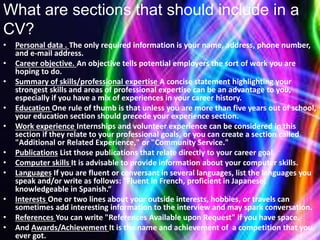
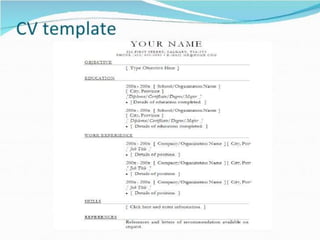
• Personal data . The only required information is your name, address, phone number,
and e-mail address.
• Career objective. An objective tells potential employers the sort of work you are
hoping to do.
• Summary of skills/professional expertise A concise statement highlighting your
strongest skills and areas of professional expertise can be an advantage to you,
especially if you have a mix of experiences in your career history.
• Education One rule of thumb is that unless you are more than five years out of school,
your education section should precede your experience section.
• Work experience Internships and volunteer experience can be considered in this
section if they relate to your professional goals, or you can create a section called
"Additional or Related Experience," or "Community Service."
• Publications List those publications that relate directly to your career goal.
• Computer skills It is advisable to provide information about your computer skills.
• Languages If you are fluent or conversant in several languages, list the languages you
speak and/or write as follows: "Fluent in French, proficient in Japanese,
knowledgeable in Spanish.“
• Interests One or two lines about your outside interests, hobbies, or travels can
sometimes add interesting information to the interview and may spark conversation.
• References You can write "References Available upon Request" if you have space.
• And Awards/Achievement It is the name and achievement of a competition that you
ever got.
Let’s Enjoy Our Activities!!
Quiz Bee
Make Your Own
Curriculum Vitae
QUIZ BEE
Answer The Question!!
1) What do you know about
Curriculum Vitae (CV) ?
(In your opinion)
Answer The Question!!
2) What is a CV for? [1]
Answer: A CV is a quite simply an ‘advert’ to sell yourself to
an employer.
Answer The Question!!
3) What is the purpose that people
usually make a curriculum vitae?
Answer: -The purpose of your CV is to make you
attractive, interesting, worth considering to the
company and to receive a job interview, or
- To outline your credentials for an academic
position, fellowship, or grant.
Answer The Question!!
4) List 5 sections that should
include in a curriculum vitae!
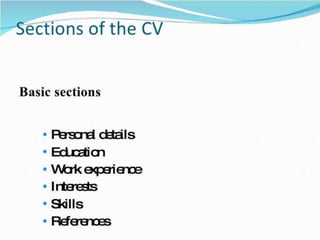
Answer: Personal data, career objective, skills, educations,
experiences, publication, languages, computer skills,
interests, awards/achievement, and references.
Answer The Question!!
5) What are the examples that
should include in personal data /
details? [4]
Answer: Name, Phone Number, Address, E-mail Address,
Gender, Nationality, etc.
Let’s Enjoy Our Activities!!
Quiz Bee
Make Your
Own Curriculum
Vitae
. . . . .
Let’s Enjoy Our Activities!!
Quiz Bee
Make Your Own
Curriculum Vitae
Source
• mailto:http://www.fip.org/files/ypg/Guides/YPG%2
0Guide%20to%20Writing%20a%20CV.pdf
• mailto:http://www.slideshare.net/first_suljee/cv-
2026435
• mailto:http://graduate.dartmouth.edu/careers/serv
ices/vita.html
Curriculum vitae

Curriculum vitae

  • 1.
  • 2.
    What is CurriculumVitae? A Curriculum Vitae is a marketing tool and may be one of the most important documents you write in your professional life. A Curriculum Vitae (CV) is a summary of your educational and academic background. It is the sum and substance of your work history and education and indicates a particular career direction. It should demonstrate credibility and be interesting. Because your CV is like a personal advertisement, it should convince a potential employer that you are an outstanding candidate for the job and that you will contribute to the organization. Your CV has to sell you in short order. While you may have all the requirements for a particular position, your CV is a failure if the employer does not instantly come to the conclusion that you "have what it takes." The first hurdle your CV has to pass - whether it ends up in the "consider file" or the "reject file" – may take less than thirty seconds. Your CV is your ticket to an interview where you can sell yourself!
  • 3.
    What are aCV for? • A CV is a quite simply an ‘advert’ to sell yourself to an employer. • The purpose of your CV is to make you attractive, interesting, worth considering to the company and to receive a job interview. • To outline your credentials for an academic position, fellowship, or grant.
  • 4.
    What are sectionsthat should include in a CV? • Personal data . The only required information is your name, address, phone number, and e-mail address. • Career objective. An objective tells potential employers the sort of work you are hoping to do. • Summary of skills/professional expertise A concise statement highlighting your strongest skills and areas of professional expertise can be an advantage to you, especially if you have a mix of experiences in your career history. • Education One rule of thumb is that unless you are more than five years out of school, your education section should precede your experience section. • Work experience Internships and volunteer experience can be considered in this section if they relate to your professional goals, or you can create a section called "Additional or Related Experience," or "Community Service." • Publications List those publications that relate directly to your career goal. • Computer skills It is advisable to provide information about your computer skills. • Languages If you are fluent or conversant in several languages, list the languages you speak and/or write as follows: "Fluent in French, proficient in Japanese, knowledgeable in Spanish.“ • Interests One or two lines about your outside interests, hobbies, or travels can sometimes add interesting information to the interview and may spark conversation. • References You can write "References Available upon Request" if you have space. • And Awards/Achievement It is the name and achievement of a competition that you ever got.
  • 7.
    Let’s Enjoy OurActivities!! Quiz Bee Make Your Own Curriculum Vitae
  • 8.
  • 9.
    Answer The Question!! 1)What do you know about Curriculum Vitae (CV) ? (In your opinion)
  • 10.
    Answer The Question!! 2)What is a CV for? [1] Answer: A CV is a quite simply an ‘advert’ to sell yourself to an employer.
  • 11.
    Answer The Question!! 3)What is the purpose that people usually make a curriculum vitae? Answer: -The purpose of your CV is to make you attractive, interesting, worth considering to the company and to receive a job interview, or - To outline your credentials for an academic position, fellowship, or grant.
  • 12.
    Answer The Question!! 4)List 5 sections that should include in a curriculum vitae! Answer: Personal data, career objective, skills, educations, experiences, publication, languages, computer skills, interests, awards/achievement, and references.
  • 13.
    Answer The Question!! 5)What are the examples that should include in personal data / details? [4] Answer: Name, Phone Number, Address, E-mail Address, Gender, Nationality, etc.
  • 14.
    Let’s Enjoy OurActivities!! Quiz Bee Make Your Own Curriculum Vitae
  • 15.
    . . .. .
  • 16.
    Let’s Enjoy OurActivities!! Quiz Bee Make Your Own Curriculum Vitae
  • 17.