Resume/Curriculum Vitae
Satabdi
What is a Resume?
• The goal of a resume is to make an individual stand out from the
competition.
• A resume,is a brief document typically not longer than one page or in
other words resume is a summary of one’s qualifications,skills and
achievements.
• The intention of the document is that the targeted reader should not
hang over your document for very long.
Why you need a resume?
• It is marketing tool.
• To obtain an interview not a job.
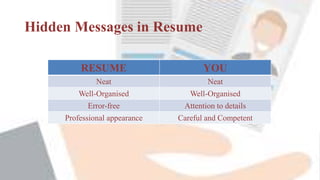
Hidden Messages in Resume
RESUME YOU
Neat Neat
Well-Organised Well-Organised
Error-free Attention to details
Professional appearance Careful and Competent
Types of Resume
• Chronological resume
• Functional resume
• Combination resume
• Targeted resume
Contd…
1. Chronological Resume
• Your work history is listed in order, according to dates. Begin with
your most current position and end with the earliest.
• Many employers prefer this type because it gives them an overview of
your experience.
• This basic resume type is best for those people with a solid
employment background who have no lapses in their work history.
• It is also beneficial if most of your experience coincides with the job
you are interested in.
• Generally, the last 10-15 years should be listed on the resume.
Contd…
2. Functional Resume
• Focuses on your skills and experience and de-emphasizes your work
history.
• This resume type is preferable if you have lapses in employment. The
gaps could occur for any number of reasons such as raising a family,
illness, or job loss.
• It is also beneficial for new graduates who have limited employment
experience or people who are in the middle of a career change.
Contd…
3. Combination resume
• Highlights both-Skills and Traits and provide a chronological listing of
your work experience.
• Gives you a flexible platform to list your workplace assets and show what
kind of employee you are.
• List the most recent or advanced degrees first and work in reverse order. If
there are older courses that are more specific to the position, list them first.
• You don’t have to list graduation dates, but if you graduated summa cum
laude (highest distinction), or have achieved other high scholastic honors,
don’t be modest about listing them. This will set you apart from other
applicants.
Contd…
4. Targeted resume
• Customized and specific to the position you want.
• Your work history, abilities, and education are reflections of the job
requirements.
Tips for writing resume
1. Keep it professional: You should
use a common font, such as Times New Roman, Ariel, Tahoma, or Calibri. The
standard font size is 10 to 12 point font. Keep at least a 1″ margin.
2. Keep it brief: One
page is more effective.
3. List specific skills:
List additional proficient skills, such as speaking another language, technical
skills, teaching skills, etc. Share special interests that are specific to the position
you want.
4. Update regularly:
Review your resume every few months. If you have obtained new skills or more
education, you should update it. Your resume will then be current if, and when,
you need it again.
What is CV?
• A CV (Curriculum Vitæ, which means course of life in Latin) is an in-
depth document that can be laid out over two or more pages and it
contains a high level of detail about your achievements.
• The CV covers your education as well as any other accomplishments
like publications, awards, honours etc.
• The document tends to be organised chronologically and should make
it easy to get an overview of an individual’s full working career.
Types of CV
• A Chronological (or traditional) CV
• A Skills-based (or functional) CV
Contd…
1. Chronological CV:
• This type of CV lists your details, under appropriate headings, starting with
the most recent.
• This format of CV can suit best if you:-
i. have experience and skills that closely relate to the job you're applying
for
ii. want to emphasize career progression
iii. have had mainly continuous employment with no gaps.
[If you want to use this format and have gaps in your work history, give
an appropriate reason for them.]
Contd…
2. Skill-based or Functional CV:
• This type of CV emphasises your skills and personal qualities rather than
your employment history.
• This format can suit best if you:-
i. are changing career and want to show employers how transferable skills
gained in other types of employment will be relevant for the post
ii. have extensive gaps in your employment history, because they are not as
prominent as they would be in a date-listed order in a chronological CV.
Be prepared though to explain any gaps at interview
iii. have had a series of short term paid or voluntary roles; this format
enables you to group together related skills and achievements gained
from these.
Other types of CV
1. Hybrid CV:
• A hybrid CV is a mix of the chronological and the skills-based/functional
CVs.
• Combines an ordered layout with more emphasis on achievements and skills
found in the skills-based, rather than on responsibilities.
• The hybrid CV can be a good option if you want to draw attention to
specific skills or achievements that would help you stand out as a candidate.
2. Technical CV:
• Mostly needed for IT roles.
• Provides a format for highlighting specific technical skills relevant to the
role (eg: programming languages, systems, platforms) alongside the all-
important ‘soft-skills’ that all employers are looking for.
Contd…
3. Creative industries CV:
• Can be suitable for some roles in creative and artistic sectors such as marketing,
design or journalism where it could help you stand out from the crowd.
• It can demonstrate your design skills and creativity in a way that a potential
employer can see and feel.
4. Video CV:
• Whilst these are more popular in customer-facing and creative roles, a video CV
could get you noticed by employers in any sector.
5. Academic CV:
• If you wish to apply for research posts in academia, you’ll need to produce an
academic CV.
• Even if you intend to apply for research vacancies in other types of organization
you'll require an academic CV that emphasizes your research and related skills.
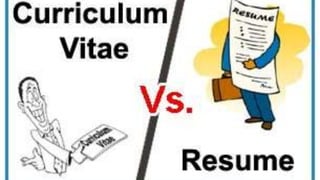
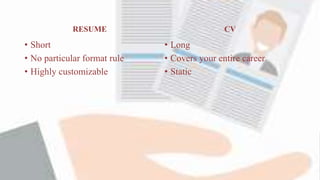
RESUME
• Short
• No particular format rule
• Highly customizable
CV
• Long
• Covers your entire career
• Static
THANKYOU

Resume vs cv

  • 1.
  • 2.
    What is aResume? • The goal of a resume is to make an individual stand out from the competition. • A resume,is a brief document typically not longer than one page or in other words resume is a summary of one’s qualifications,skills and achievements. • The intention of the document is that the targeted reader should not hang over your document for very long.
  • 3.
    Why you needa resume? • It is marketing tool. • To obtain an interview not a job.
  • 4.
    Hidden Messages inResume RESUME YOU Neat Neat Well-Organised Well-Organised Error-free Attention to details Professional appearance Careful and Competent
  • 5.
    Types of Resume •Chronological resume • Functional resume • Combination resume • Targeted resume
  • 6.
    Contd… 1. Chronological Resume •Your work history is listed in order, according to dates. Begin with your most current position and end with the earliest. • Many employers prefer this type because it gives them an overview of your experience. • This basic resume type is best for those people with a solid employment background who have no lapses in their work history. • It is also beneficial if most of your experience coincides with the job you are interested in. • Generally, the last 10-15 years should be listed on the resume.
  • 7.
    Contd… 2. Functional Resume •Focuses on your skills and experience and de-emphasizes your work history. • This resume type is preferable if you have lapses in employment. The gaps could occur for any number of reasons such as raising a family, illness, or job loss. • It is also beneficial for new graduates who have limited employment experience or people who are in the middle of a career change.
  • 8.
    Contd… 3. Combination resume •Highlights both-Skills and Traits and provide a chronological listing of your work experience. • Gives you a flexible platform to list your workplace assets and show what kind of employee you are. • List the most recent or advanced degrees first and work in reverse order. If there are older courses that are more specific to the position, list them first. • You don’t have to list graduation dates, but if you graduated summa cum laude (highest distinction), or have achieved other high scholastic honors, don’t be modest about listing them. This will set you apart from other applicants.
  • 9.
    Contd… 4. Targeted resume •Customized and specific to the position you want. • Your work history, abilities, and education are reflections of the job requirements.
  • 10.
    Tips for writingresume 1. Keep it professional: You should use a common font, such as Times New Roman, Ariel, Tahoma, or Calibri. The standard font size is 10 to 12 point font. Keep at least a 1″ margin. 2. Keep it brief: One page is more effective. 3. List specific skills: List additional proficient skills, such as speaking another language, technical skills, teaching skills, etc. Share special interests that are specific to the position you want. 4. Update regularly: Review your resume every few months. If you have obtained new skills or more education, you should update it. Your resume will then be current if, and when, you need it again.
  • 11.
    What is CV? •A CV (Curriculum Vitæ, which means course of life in Latin) is an in- depth document that can be laid out over two or more pages and it contains a high level of detail about your achievements. • The CV covers your education as well as any other accomplishments like publications, awards, honours etc. • The document tends to be organised chronologically and should make it easy to get an overview of an individual’s full working career.
  • 12.
    Types of CV •A Chronological (or traditional) CV • A Skills-based (or functional) CV
  • 13.
    Contd… 1. Chronological CV: •This type of CV lists your details, under appropriate headings, starting with the most recent. • This format of CV can suit best if you:- i. have experience and skills that closely relate to the job you're applying for ii. want to emphasize career progression iii. have had mainly continuous employment with no gaps. [If you want to use this format and have gaps in your work history, give an appropriate reason for them.]
  • 14.
    Contd… 2. Skill-based orFunctional CV: • This type of CV emphasises your skills and personal qualities rather than your employment history. • This format can suit best if you:- i. are changing career and want to show employers how transferable skills gained in other types of employment will be relevant for the post ii. have extensive gaps in your employment history, because they are not as prominent as they would be in a date-listed order in a chronological CV. Be prepared though to explain any gaps at interview iii. have had a series of short term paid or voluntary roles; this format enables you to group together related skills and achievements gained from these.
  • 15.
    Other types ofCV 1. Hybrid CV: • A hybrid CV is a mix of the chronological and the skills-based/functional CVs. • Combines an ordered layout with more emphasis on achievements and skills found in the skills-based, rather than on responsibilities. • The hybrid CV can be a good option if you want to draw attention to specific skills or achievements that would help you stand out as a candidate. 2. Technical CV: • Mostly needed for IT roles. • Provides a format for highlighting specific technical skills relevant to the role (eg: programming languages, systems, platforms) alongside the all- important ‘soft-skills’ that all employers are looking for.
  • 16.
    Contd… 3. Creative industriesCV: • Can be suitable for some roles in creative and artistic sectors such as marketing, design or journalism where it could help you stand out from the crowd. • It can demonstrate your design skills and creativity in a way that a potential employer can see and feel. 4. Video CV: • Whilst these are more popular in customer-facing and creative roles, a video CV could get you noticed by employers in any sector. 5. Academic CV: • If you wish to apply for research posts in academia, you’ll need to produce an academic CV. • Even if you intend to apply for research vacancies in other types of organization you'll require an academic CV that emphasizes your research and related skills.
  • 18.
    RESUME • Short • Noparticular format rule • Highly customizable CV • Long • Covers your entire career • Static
  • 19.