
How to write a contemporary CV?
Agenda
What is CV?
Why do you need CV?
CV Layout
CV Do’s
CV Don’ts
What is CV?
A document that enables you to show a potential internship provider or employer
that your skills, knowledge and experience are just what they are looking for.
Curriculum Vitae (or “CV”), Origin is Latin- “course of one’s life”.. A CV offers a
snapshot of who you are. Think about the first page of a book - it either holds your
attention or it doesn't
Treat your CV as an advertisement for you and be sure to thoroughly "sell" yourself by
highlighting all of your skills and strengths relevant to the position for which you are
applying
Types of Curriculum Vitae
Organizes employment and volunteer experiences chronologically with the most
recent information first.
Pros and Cons:
 Good for demonstrating growth in a single profession: job titles and
organizations are emphasized and responsibilities and accomplishments are
described in detail.
 This format is suitable for individuals with continuous work experience who
have not had frequent job changes or prolonged periods of unemployment.
 It is not always the best choice for students right out of school.
Chronological
Types of Curriculum Vitae
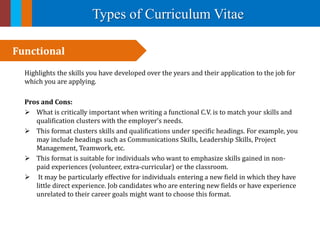
Highlights the skills you have developed over the years and their application to the job for
which you are applying.
Pros and Cons:
 What is critically important when writing a functional C.V. is to match your skills and
qualification clusters with the employer’s needs.
 This format clusters skills and qualifications under specific headings. For example, you
may include headings such as Communications Skills, Leadership Skills, Project
Management, Teamwork, etc.
 This format is suitable for individuals who want to emphasize skills gained in non-
paid experiences (volunteer, extra-curricular) or the classroom.
 It may be particularly effective for individuals entering a new field in which they have
little direct experience. Job candidates who are entering new fields or have experience
unrelated to their career goals might want to choose this format.
Functional
Types of Curriculum Vitae
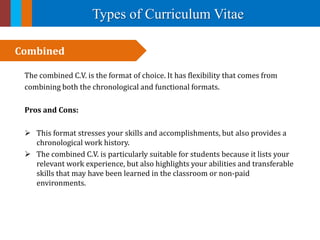
The combined C.V. is the format of choice. It has flexibility that comes from
combining both the chronological and functional formats.
Pros and Cons:
 This format stresses your skills and accomplishments, but also provides a
chronological work history.
 The combined C.V. is particularly suitable for students because it lists your
relevant work experience, but also highlights your abilities and transferable
skills that may have been learned in the classroom or non-paid
environments.
Combined
Starting points…
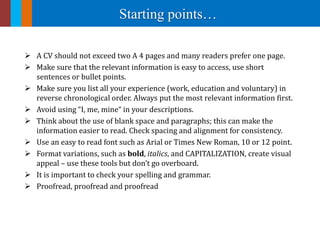
 A CV should not exceed two A 4 pages and many readers prefer one page.
 Make sure that the relevant information is easy to access, use short
sentences or bullet points.
 Make sure you list all your experience (work, education and voluntary) in
reverse chronological order. Always put the most relevant information first.
 Avoid using “I, me, mine“ in your descriptions.
 Think about the use of blank space and paragraphs; this can make the
information easier to read. Check spacing and alignment for consistency.
 Use an easy to read font such as Arial or Times New Roman, 10 or 12 point.
 Format variations, such as bold, italics, and CAPITALIZATION, create visual
appeal – use these tools but don’t go overboard.
 It is important to check your spelling and grammar.
 Proofread, proofread and proofread
Don’t forget…
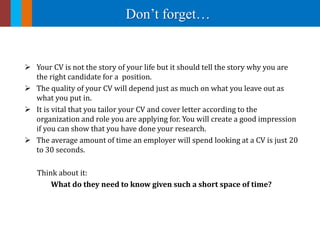
 Your CV is not the story of your life but it should tell the story why you are
the right candidate for a position.
 The quality of your CV will depend just as much on what you leave out as
what you put in.
 It is vital that you tailor your CV and cover letter according to the
organization and role you are applying for. You will create a good impression
if you can show that you have done your research.
 The average amount of time an employer will spend looking at a CV is just 20
to 30 seconds.
Think about it:
What do they need to know given such a short space of time?
Most frequently-asked CV questions…
 Length?
 Content?
 Sections?
 Appearance?
 Objective?
 Features?
 Typing?
 Paper?
 Scanning?
 Internet?
 Critiques?
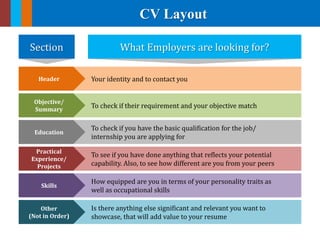
CV Layout
Section What Employers are looking for?
Your identity and to contact you
To check if their requirement and your objective match
To check if you have the basic qualification for the job/
internship you are applying for
To see if you have done anything that reflects your potential
capability. Also, to see how different are you from your peers
How equipped are you in terms of your personality traits as
well as occupational skills
Is there anything else significant and relevant you want to
showcase, that will add value to your resume
Header
Objective/
Summary
Education
Practical
Experience/
Projects
Skills
Other
(Not in Order)
CV Layout
Optional parts
 Memberships/Honors/Awards
 Achievements
 Projects
 Publications/presentations
 Relevant coursework
 Languages
 Interest/Activities
 Volunteer work
 Additional section
 Personal website
Personal details
This includes…
 Full name
 permanent address
 Phone number
 E-mail address
 Optional website address
Optional parts:
Personal profiles and when these are used?
 Father's name
 Photographs
 Nationality
 Religion
 Genders
 Health status
 Marital and parental status
 Date of birth
Sample
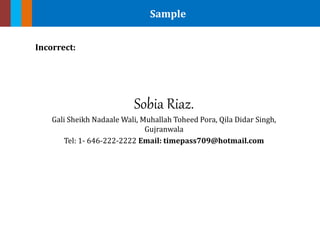
Incorrect:
Sobia Riaz.
Gali Sheikh Nadaale Wali, Muhallah Toheed Pora, Qila Didar Singh,
Gujranwala
Tel: 1- 646-222-2222 Email: timepass709@hotmail.com
Sample
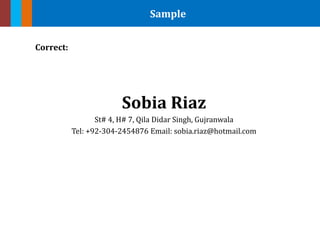
Correct:
Sobia Riaz
St# 4, H# 7, Qila Didar Singh, Gujranwala
Tel: +92-304-2454876 Email: sobia.riaz@hotmail.com
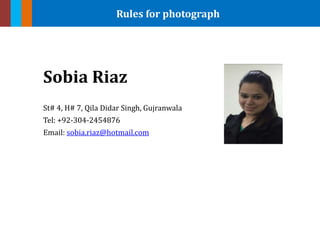
Rules for photograph
Sobia Riaz
St# 4, H# 7, Qila Didar Singh, Gujranwala
Tel: +92-304-2454876
Email: sobia.riaz@hotmail.com
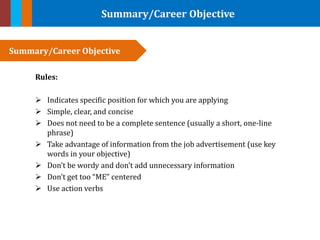
Summary/Career Objective
Rules:
 Indicates specific position for which you are applying
 Simple, clear, and concise
 Does not need to be a complete sentence (usually a short, one-line
phrase)
 Take advantage of information from the job advertisement (use key
words in your objective)
 Don’t be wordy and don’t add unnecessary information
 Don’t get too “ME” centered
 Use action verbs
Summary/Career Objective
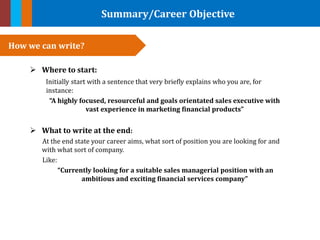
 Where to start:
Initially start with a sentence that very briefly explains who you are, for
instance:
“A highly focused, resourceful and goals orientated sales executive with
vast experience in marketing financial products”
 What to write at the end:
At the end state your career aims, what sort of position you are looking for and
with what sort of company.
Like:
“Currently looking for a suitable sales managerial position with an
ambitious and exciting financial services company”
How we can write?
Summary/Career Objective
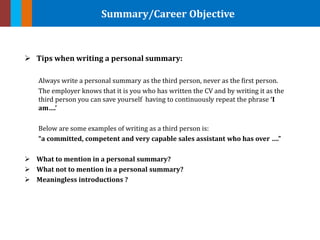
 Tips when writing a personal summary:
Always write a personal summary as the third person, never as the first person.
The employer knows that it is you who has written the CV and by writing it as the
third person you can save yourself having to continuously repeat the phrase ‘I
am….’
Below are some examples of writing as a third person is:
“a committed, competent and very capable sales assistant who has over ….”
 What to mention in a personal summary?
 What not to mention in a personal summary?
 Meaningless introductions ?
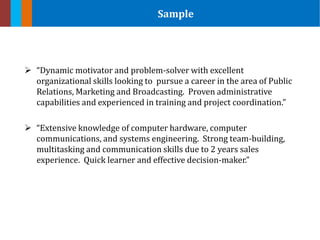
Sample
 “Dynamic motivator and problem-solver with excellent
organizational skills looking to pursue a career in the area of Public
Relations, Marketing and Broadcasting. Proven administrative
capabilities and experienced in training and project coordination.”
 “Extensive knowledge of computer hardware, computer
communications, and systems engineering. Strong team-building,
multitasking and communication skills due to 2 years sales
experience. Quick learner and effective decision-maker.”
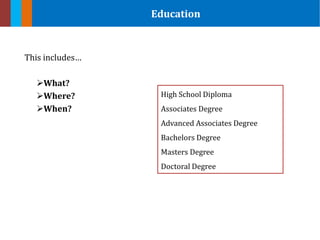
Education
This includes…
What?
Where?
When?
High School Diploma
Associates Degree
Advanced Associates Degree
Bachelors Degree
Masters Degree
Doctoral Degree
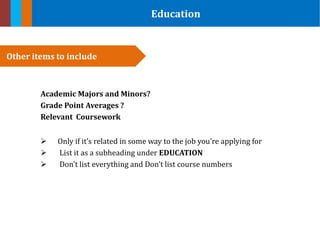
Education
Academic Majors and Minors?
Grade Point Averages ?
Relevant Coursework
 Only if it’s related in some way to the job you’re applying for
 List it as a subheading under EDUCATION
 Don’t list everything and Don’t list course numbers
Other items to include
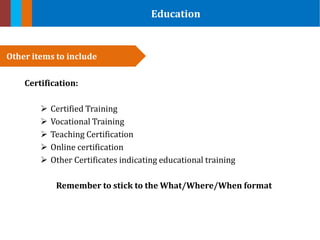
Education
Certification:
 Certified Training
 Vocational Training
 Teaching Certification
 Online certification
 Other Certificates indicating educational training
Remember to stick to the What/Where/When format
Other items to include
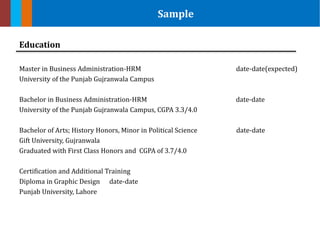
Sample
Education
Master in Business Administration-HRM date-date(expected)
University of the Punjab Gujranwala Campus
Bachelor in Business Administration-HRM date-date
University of the Punjab Gujranwala Campus, CGPA 3.3/4.0
Bachelor of Arts; History Honors, Minor in Political Science date-date
Gift University, Gujranwala
Graduated with First Class Honors and CGPA of 3.7/4.0
Certification and Additional Training
Diploma in Graphic Design date-date
Punjab University, Lahore
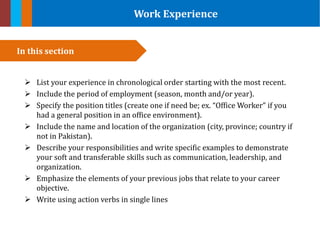
Work Experience
 List your experience in chronological order starting with the most recent.
 Include the period of employment (season, month and/or year).
 Specify the position titles (create one if need be; ex. “Office Worker” if you
had a general position in an office environment).
 Include the name and location of the organization (city, province; country if
not in Pakistan).
 Describe your responsibilities and write specific examples to demonstrate
your soft and transferable skills such as communication, leadership, and
organization.
 Emphasize the elements of your previous jobs that relate to your career
objective.
 Write using action verbs in single lines
In this section
Work Experience
 This section is the single most important place to sell yourself to a potential
employer.
 With so many to read, employers often skim CV, looking for:
– Key job titles
– Specific skills
– Relevant qualifications
 Stick to the What/Where/When format.
 The skills you include on your CV should be connected to the skills required
in the job you are seeking.
In this section
Work Experience
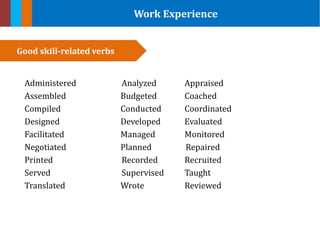
Administered Analyzed Appraised
Assembled Budgeted Coached
Compiled Conducted Coordinated
Designed Developed Evaluated
Facilitated Managed Monitored
Negotiated Planned Repaired
Printed Recorded Recruited
Served Supervised Taught
Translated Wrote Reviewed
Good skill-related verbs
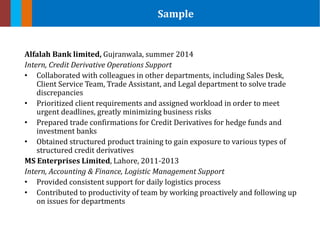
Alfalah Bank limited, Gujranwala, summer 2014
Intern, Credit Derivative Operations Support
• Collaborated with colleagues in other departments, including Sales Desk,
Client Service Team, Trade Assistant, and Legal department to solve trade
discrepancies
• Prioritized client requirements and assigned workload in order to meet
urgent deadlines, greatly minimizing business risks
• Prepared trade confirmations for Credit Derivatives for hedge funds and
investment banks
• Obtained structured product training to gain exposure to various types of
structured credit derivatives
MS Enterprises Limited, Lahore, 2011-2013
Intern, Accounting & Finance, Logistic Management Support
• Provided consistent support for daily logistics process
• Contributed to productivity of team by working proactively and following up
on issues for departments
Sample
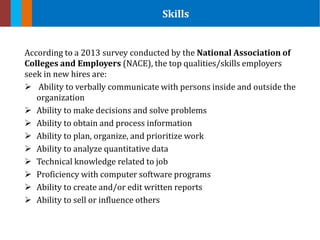
According to a 2013 survey conducted by the National Association of
Colleges and Employers (NACE), the top qualities/skills employers
seek in new hires are:
 Ability to verbally communicate with persons inside and outside the
organization
 Ability to make decisions and solve problems
 Ability to obtain and process information
 Ability to plan, organize, and prioritize work
 Ability to analyze quantitative data
 Technical knowledge related to job
 Proficiency with computer software programs
 Ability to create and/or edit written reports
 Ability to sell or influence others
Skills
Questions can be used to trigger your memory of past
achievements:
 Did you receive some form of recognition (award, title, trophy, etc.)?
 Did you intervene in a situation that could have become a serious
problem had you not detected it?
 Did you make a suggestion that was adopted by your classmates,
team or coworkers?
 Did you accomplish a task using less than the usual resources?
 Did you satisfy a particularly difficult client?
 Did you initiate something?
 Have you trained or taught people?
Achievements
To help you identify your achievements, you could use the S.T.A.R.
technique:
Situation
 Provide a brief overview of the situation.
Task
 Outline the specific task or responsibility you were asked to
accomplish.
Action
 Explain the action or activities you took and why.
Result
 Describe the positive result or outcome of your actions
Achievements
Quantify your achievements:
If possible, apply specific numbers to any listed achievement. It is
because numbers are indication for a success.
For instance:
 If you saved time, write how much time you saved – Time is money.
 If you improved annual sales, provide figures to showcase the
revenue increase.
 If you improved QA, provide numbers – good quality saves money
Achievements
Extra-Curricular Activities, Interests, and
Volunteer Experience
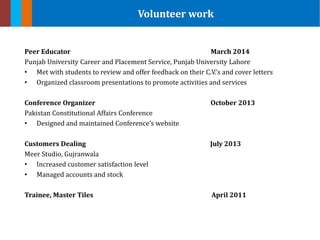
Peer Educator March 2014
Punjab University Career and Placement Service, Punjab University Lahore
• Met with students to review and offer feedback on their C.V.’s and cover letters
• Organized classroom presentations to promote activities and services
Conference Organizer October 2013
Pakistan Constitutional Affairs Conference
• Designed and maintained Conference’s website
Customers Dealing July 2013
Meer Studio, Gujranwala
• Increased customer satisfaction level
• Managed accounts and stock
Trainee, Master Tiles April 2011
Volunteer work
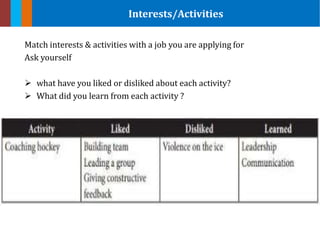
Match interests & activities with a job you are applying for
Ask yourself
 what have you liked or disliked about each activity?
 What did you learn from each activity ?
Interests/Activities
Possible Additional Sections
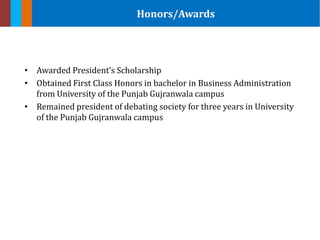
• Awarded President’s Scholarship
• Obtained First Class Honors in bachelor in Business Administration
from University of the Punjab Gujranwala campus
• Remained president of debating society for three years in University
of the Punjab Gujranwala campus
Honors/Awards
“Available on Request”
 Create a list of references on a separate page
 Always ask first
 Use professional information, not personal
 List Name, title, organization, address, and contact info.
 Do not ask family or friends, but consider employers, professors, scout
leaders, clergy who know you well enough to address your talents and
attributes as an employee, student or good citizen
 Keep them updated on your job hunt.
References
Importance of good grammar in a CV
 Weak vocabulary can get your CV rejected easily
 Certain rules are applicable for professional writing
 CV is supposed to be polished and formal
 Strong writing skills are valuable in CV
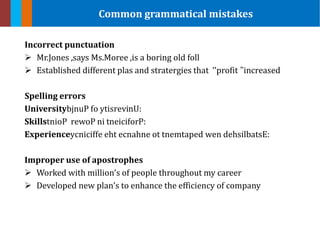
Incorrect punctuation
 Mr.Jones ,says Ms.Moree ,is a boring old foll
 Established different plas and stratergies that ’’profit ’’increased
Spelling errors
University ytisrevinU:bjnuP fo
SkillstnioP rewoP ni tneiciforP:
Experience eht ecnahne ot tnemtaped wen dehsilbatsE:ycniciffe
Improper use of apostrophes
 Worked with million’s of people throughout my career
 Developed new plan’s to enhance the efficiency of company
Common grammatical mistakes
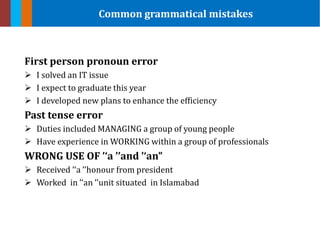
First person pronoun error
 I solved an IT issue
 I expect to graduate this year
 I developed new plans to enhance the efficiency
Past tense error
 Duties included MANAGING a group of young people
 Have experience in WORKING within a group of professionals
WRONG USE OF ’‘a ’’and ’‘an”
 Received ’‘a ’’honour from president
 Worked in ’‘an ’’unit situated in Islamabad
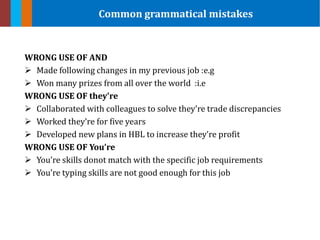
Common grammatical mistakes
WRONG USE OF AND
 Made following changes in my previous job :e.g
 Won many prizes from all over the world :i.e
WRONG USE OF they’re
 Collaborated with colleagues to solve they’re trade discrepancies
 Worked they’re for five years
 Developed new plans in HBL to increase they’re profit
WRONG USE OF You’re
 You’re skills donot match with the specific job requirements
 You’re typing skills are not good enough for this job
Common grammatical mistakes
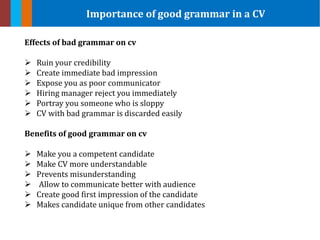
Effects of bad grammar on cv
 Ruin your credibility
 Create immediate bad impression
 Expose you as poor communicator
 Hiring manager reject you immediately
 Portray you someone who is sloppy
 CV with bad grammar is discarded easily
Benefits of good grammar on cv
 Make you a competent candidate
 Make CV more understandable
 Prevents misunderstanding
 Allow to communicate better with audience
 Create good first impression of the candidate
 Makes candidate unique from other candidates
Importance of good grammar in a CV
Dealing with different circumstances
 Is your experience hard to summarize?
 Is there is something in your background that is difficult to portray in a
positive light?
 Are there situations where you fear prejudice?
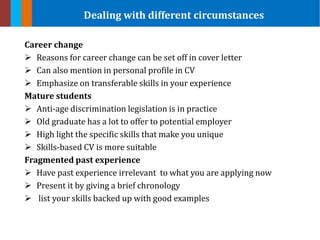
Career change
 Reasons for career change can be set off in cover letter
 Can also mention in personal profile in CV
 Emphasize on transferable skills in your experience
Mature students
 Anti-age discrimination legislation is in practice
 Old graduate has a lot to offer to potential employer
 High light the specific skills that make you unique
 Skills-based CV is more suitable
Fragmented past experience
 Have past experience irrelevant to what you are applying now
 Present it by giving a brief chronology
 list your skills backed up with good examples
Dealing with different circumstances
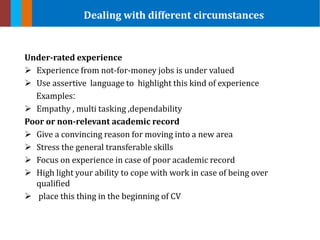
Under-rated experience
 Experience from not-for-money jobs is under valued
 Use assertive language to highlight this kind of experience
Examples:
 Empathy , multi tasking ,dependability
Poor or non-relevant academic record
 Give a convincing reason for moving into a new area
 Stress the general transferable skills
 Focus on experience in case of poor academic record
 High light your ability to cope with work in case of being over
qualified
 place this thing in the beginning of CV
Dealing with different circumstances
Situations where you fear prejudice
 Disability or poor health
 Mental health
 Unemployment
 Work permit required
 Criminal record
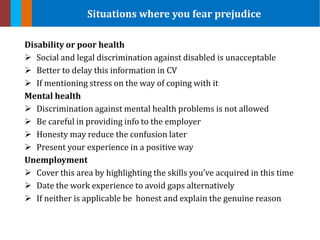
Disability or poor health
 Social and legal discrimination against disabled is unacceptable
 Better to delay this information in CV
 If mentioning stress on the way of coping with it
Mental health
 Discrimination against mental health problems is not allowed
 Be careful in providing info to the employer
 Honesty may reduce the confusion later
 Present your experience in a positive way
Unemployment
 Cover this area by highlighting the skills you’ve acquired in this time
 Date the work experience to avoid gaps alternatively
 If neither is applicable be honest and explain the genuine reason
Situations where you fear prejudice
Lying in your CV
Consequences can lead to
 Immediately rejected
 Name potentially blacklisted by prominent companies
 Immediate dismissal
 Humiliation
 Prosecution
 Imprisonment
Why some people falsify their CVs?
 Securing an interview
 Omitting certain key facts, white lies, small fibs
 Evidence to back up your claims during or after the interview
Lying in your CV
 Falsifying educational qualifications
 Hiding career gaps
 Dates of employment
 Being fired from a previous job
 Inflating a previous job title or position
 Levels of responsibility in previous employment
 Hiding criminal records or prison sentences
 Exaggerating the salary of a previous job
 Work experience and skill sets
 Reasons for leaving previous employment
 Lying about your age
 Personal interests and hobbies
 Ability to speak a foreign language
Most common falsehoods in CV
Employers can catch out candidates inflated their CV
 Hire specialist companies to conduct background checks
 Ask for proof of your claims i.e. documentation, original certificates
etc.
 Ask probing questions and thereby catch out an applicant may have
stated something on their CV but at an interview say something
entirely different
 Write to your previous employers
 Carry out CRB (Criminal Reference Bureau) checks
 Mandatory checks by employers
 Worst case scenarios
 Honesty is best practice
Lying in your CV
How to send CV electronically
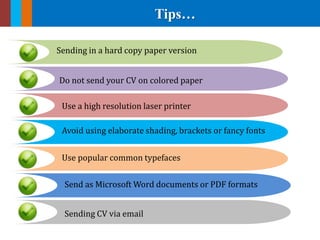
Tips…
Sending in a hard copy paper version
Avoid using elaborate shading, brackets or fancy fonts
Use popular common typefaces
Do not send your CV on colored paper
Send as Microsoft Word documents or PDF formats
Use a high resolution laser printer
Sending CV via email
 When you‘re first starting out, use social media as a research tool to
follow people and companies.
 When you‘re ready, connect with professionals and use social media
to establish your credibility, promote yourself and demonstrate your
skills, values, and professionalism.
 Tweeting, blogging and commenting on blogs or LinkedIn about
things you know can build your online credibility
Online tools you can use in creating an online presence
 LinkedIn
 Twitter
 Blogging
 Online Portfolio/Personal Website
Create an Effective Online Presence
ANY QUESTION?
THANK YOU

how to write contemporary cv

  • 2.
    How to writea contemporary CV?
  • 3.
    Agenda What is CV? Whydo you need CV? CV Layout CV Do’s CV Don’ts
  • 4.
    What is CV? Adocument that enables you to show a potential internship provider or employer that your skills, knowledge and experience are just what they are looking for. Curriculum Vitae (or “CV”), Origin is Latin- “course of one’s life”.. A CV offers a snapshot of who you are. Think about the first page of a book - it either holds your attention or it doesn't Treat your CV as an advertisement for you and be sure to thoroughly "sell" yourself by highlighting all of your skills and strengths relevant to the position for which you are applying
  • 5.
    Types of CurriculumVitae Organizes employment and volunteer experiences chronologically with the most recent information first. Pros and Cons:  Good for demonstrating growth in a single profession: job titles and organizations are emphasized and responsibilities and accomplishments are described in detail.  This format is suitable for individuals with continuous work experience who have not had frequent job changes or prolonged periods of unemployment.  It is not always the best choice for students right out of school. Chronological
  • 6.
    Types of CurriculumVitae Highlights the skills you have developed over the years and their application to the job for which you are applying. Pros and Cons:  What is critically important when writing a functional C.V. is to match your skills and qualification clusters with the employer’s needs.  This format clusters skills and qualifications under specific headings. For example, you may include headings such as Communications Skills, Leadership Skills, Project Management, Teamwork, etc.  This format is suitable for individuals who want to emphasize skills gained in non- paid experiences (volunteer, extra-curricular) or the classroom.  It may be particularly effective for individuals entering a new field in which they have little direct experience. Job candidates who are entering new fields or have experience unrelated to their career goals might want to choose this format. Functional
  • 7.
    Types of CurriculumVitae The combined C.V. is the format of choice. It has flexibility that comes from combining both the chronological and functional formats. Pros and Cons:  This format stresses your skills and accomplishments, but also provides a chronological work history.  The combined C.V. is particularly suitable for students because it lists your relevant work experience, but also highlights your abilities and transferable skills that may have been learned in the classroom or non-paid environments. Combined
  • 8.
    Starting points…  ACV should not exceed two A 4 pages and many readers prefer one page.  Make sure that the relevant information is easy to access, use short sentences or bullet points.  Make sure you list all your experience (work, education and voluntary) in reverse chronological order. Always put the most relevant information first.  Avoid using “I, me, mine“ in your descriptions.  Think about the use of blank space and paragraphs; this can make the information easier to read. Check spacing and alignment for consistency.  Use an easy to read font such as Arial or Times New Roman, 10 or 12 point.  Format variations, such as bold, italics, and CAPITALIZATION, create visual appeal – use these tools but don’t go overboard.  It is important to check your spelling and grammar.  Proofread, proofread and proofread
  • 9.
    Don’t forget…  YourCV is not the story of your life but it should tell the story why you are the right candidate for a position.  The quality of your CV will depend just as much on what you leave out as what you put in.  It is vital that you tailor your CV and cover letter according to the organization and role you are applying for. You will create a good impression if you can show that you have done your research.  The average amount of time an employer will spend looking at a CV is just 20 to 30 seconds. Think about it: What do they need to know given such a short space of time?
  • 10.
    Most frequently-asked CVquestions…  Length?  Content?  Sections?  Appearance?  Objective?  Features?  Typing?  Paper?  Scanning?  Internet?  Critiques?
  • 11.
    CV Layout Section WhatEmployers are looking for? Your identity and to contact you To check if their requirement and your objective match To check if you have the basic qualification for the job/ internship you are applying for To see if you have done anything that reflects your potential capability. Also, to see how different are you from your peers How equipped are you in terms of your personality traits as well as occupational skills Is there anything else significant and relevant you want to showcase, that will add value to your resume Header Objective/ Summary Education Practical Experience/ Projects Skills Other (Not in Order)
  • 12.
    CV Layout Optional parts Memberships/Honors/Awards  Achievements  Projects  Publications/presentations  Relevant coursework  Languages  Interest/Activities  Volunteer work  Additional section  Personal website
  • 13.
    Personal details This includes… Full name  permanent address  Phone number  E-mail address  Optional website address Optional parts: Personal profiles and when these are used?  Father's name  Photographs  Nationality  Religion  Genders  Health status  Marital and parental status  Date of birth
  • 14.
    Sample Incorrect: Sobia Riaz. Gali SheikhNadaale Wali, Muhallah Toheed Pora, Qila Didar Singh, Gujranwala Tel: 1- 646-222-2222 Email: timepass709@hotmail.com
  • 15.
    Sample Correct: Sobia Riaz St# 4,H# 7, Qila Didar Singh, Gujranwala Tel: +92-304-2454876 Email: sobia.riaz@hotmail.com
  • 16.
    Rules for photograph SobiaRiaz St# 4, H# 7, Qila Didar Singh, Gujranwala Tel: +92-304-2454876 Email: sobia.riaz@hotmail.com
  • 17.
    Summary/Career Objective Rules:  Indicatesspecific position for which you are applying  Simple, clear, and concise  Does not need to be a complete sentence (usually a short, one-line phrase)  Take advantage of information from the job advertisement (use key words in your objective)  Don’t be wordy and don’t add unnecessary information  Don’t get too “ME” centered  Use action verbs Summary/Career Objective
  • 18.
    Summary/Career Objective  Whereto start: Initially start with a sentence that very briefly explains who you are, for instance: “A highly focused, resourceful and goals orientated sales executive with vast experience in marketing financial products”  What to write at the end: At the end state your career aims, what sort of position you are looking for and with what sort of company. Like: “Currently looking for a suitable sales managerial position with an ambitious and exciting financial services company” How we can write?
  • 19.
    Summary/Career Objective  Tipswhen writing a personal summary: Always write a personal summary as the third person, never as the first person. The employer knows that it is you who has written the CV and by writing it as the third person you can save yourself having to continuously repeat the phrase ‘I am….’ Below are some examples of writing as a third person is: “a committed, competent and very capable sales assistant who has over ….”  What to mention in a personal summary?  What not to mention in a personal summary?  Meaningless introductions ?
  • 20.
    Sample  “Dynamic motivatorand problem-solver with excellent organizational skills looking to pursue a career in the area of Public Relations, Marketing and Broadcasting. Proven administrative capabilities and experienced in training and project coordination.”  “Extensive knowledge of computer hardware, computer communications, and systems engineering. Strong team-building, multitasking and communication skills due to 2 years sales experience. Quick learner and effective decision-maker.”
  • 21.
    Education This includes… What? Where? When? High SchoolDiploma Associates Degree Advanced Associates Degree Bachelors Degree Masters Degree Doctoral Degree
  • 22.
    Education Academic Majors andMinors? Grade Point Averages ? Relevant Coursework  Only if it’s related in some way to the job you’re applying for  List it as a subheading under EDUCATION  Don’t list everything and Don’t list course numbers Other items to include
  • 23.
    Education Certification:  Certified Training Vocational Training  Teaching Certification  Online certification  Other Certificates indicating educational training Remember to stick to the What/Where/When format Other items to include
  • 24.
    Sample Education Master in BusinessAdministration-HRM date-date(expected) University of the Punjab Gujranwala Campus Bachelor in Business Administration-HRM date-date University of the Punjab Gujranwala Campus, CGPA 3.3/4.0 Bachelor of Arts; History Honors, Minor in Political Science date-date Gift University, Gujranwala Graduated with First Class Honors and CGPA of 3.7/4.0 Certification and Additional Training Diploma in Graphic Design date-date Punjab University, Lahore
  • 25.
    Work Experience  Listyour experience in chronological order starting with the most recent.  Include the period of employment (season, month and/or year).  Specify the position titles (create one if need be; ex. “Office Worker” if you had a general position in an office environment).  Include the name and location of the organization (city, province; country if not in Pakistan).  Describe your responsibilities and write specific examples to demonstrate your soft and transferable skills such as communication, leadership, and organization.  Emphasize the elements of your previous jobs that relate to your career objective.  Write using action verbs in single lines In this section
  • 26.
    Work Experience  Thissection is the single most important place to sell yourself to a potential employer.  With so many to read, employers often skim CV, looking for: – Key job titles – Specific skills – Relevant qualifications  Stick to the What/Where/When format.  The skills you include on your CV should be connected to the skills required in the job you are seeking. In this section
  • 27.
    Work Experience Administered AnalyzedAppraised Assembled Budgeted Coached Compiled Conducted Coordinated Designed Developed Evaluated Facilitated Managed Monitored Negotiated Planned Repaired Printed Recorded Recruited Served Supervised Taught Translated Wrote Reviewed Good skill-related verbs
  • 28.
    Alfalah Bank limited,Gujranwala, summer 2014 Intern, Credit Derivative Operations Support • Collaborated with colleagues in other departments, including Sales Desk, Client Service Team, Trade Assistant, and Legal department to solve trade discrepancies • Prioritized client requirements and assigned workload in order to meet urgent deadlines, greatly minimizing business risks • Prepared trade confirmations for Credit Derivatives for hedge funds and investment banks • Obtained structured product training to gain exposure to various types of structured credit derivatives MS Enterprises Limited, Lahore, 2011-2013 Intern, Accounting & Finance, Logistic Management Support • Provided consistent support for daily logistics process • Contributed to productivity of team by working proactively and following up on issues for departments Sample
  • 29.
    According to a2013 survey conducted by the National Association of Colleges and Employers (NACE), the top qualities/skills employers seek in new hires are:  Ability to verbally communicate with persons inside and outside the organization  Ability to make decisions and solve problems  Ability to obtain and process information  Ability to plan, organize, and prioritize work  Ability to analyze quantitative data  Technical knowledge related to job  Proficiency with computer software programs  Ability to create and/or edit written reports  Ability to sell or influence others Skills
  • 30.
    Questions can beused to trigger your memory of past achievements:  Did you receive some form of recognition (award, title, trophy, etc.)?  Did you intervene in a situation that could have become a serious problem had you not detected it?  Did you make a suggestion that was adopted by your classmates, team or coworkers?  Did you accomplish a task using less than the usual resources?  Did you satisfy a particularly difficult client?  Did you initiate something?  Have you trained or taught people? Achievements
  • 31.
    To help youidentify your achievements, you could use the S.T.A.R. technique: Situation  Provide a brief overview of the situation. Task  Outline the specific task or responsibility you were asked to accomplish. Action  Explain the action or activities you took and why. Result  Describe the positive result or outcome of your actions Achievements
  • 32.
    Quantify your achievements: Ifpossible, apply specific numbers to any listed achievement. It is because numbers are indication for a success. For instance:  If you saved time, write how much time you saved – Time is money.  If you improved annual sales, provide figures to showcase the revenue increase.  If you improved QA, provide numbers – good quality saves money Achievements
  • 33.
  • 34.
    Peer Educator March2014 Punjab University Career and Placement Service, Punjab University Lahore • Met with students to review and offer feedback on their C.V.’s and cover letters • Organized classroom presentations to promote activities and services Conference Organizer October 2013 Pakistan Constitutional Affairs Conference • Designed and maintained Conference’s website Customers Dealing July 2013 Meer Studio, Gujranwala • Increased customer satisfaction level • Managed accounts and stock Trainee, Master Tiles April 2011 Volunteer work
  • 35.
    Match interests &activities with a job you are applying for Ask yourself  what have you liked or disliked about each activity?  What did you learn from each activity ? Interests/Activities
  • 36.
  • 37.
    • Awarded President’sScholarship • Obtained First Class Honors in bachelor in Business Administration from University of the Punjab Gujranwala campus • Remained president of debating society for three years in University of the Punjab Gujranwala campus Honors/Awards
  • 38.
    “Available on Request” Create a list of references on a separate page  Always ask first  Use professional information, not personal  List Name, title, organization, address, and contact info.  Do not ask family or friends, but consider employers, professors, scout leaders, clergy who know you well enough to address your talents and attributes as an employee, student or good citizen  Keep them updated on your job hunt. References
  • 39.
    Importance of goodgrammar in a CV  Weak vocabulary can get your CV rejected easily  Certain rules are applicable for professional writing  CV is supposed to be polished and formal  Strong writing skills are valuable in CV
  • 40.
    Incorrect punctuation  Mr.Jones,says Ms.Moree ,is a boring old foll  Established different plas and stratergies that ’’profit ’’increased Spelling errors University ytisrevinU:bjnuP fo SkillstnioP rewoP ni tneiciforP: Experience eht ecnahne ot tnemtaped wen dehsilbatsE:ycniciffe Improper use of apostrophes  Worked with million’s of people throughout my career  Developed new plan’s to enhance the efficiency of company Common grammatical mistakes
  • 41.
    First person pronounerror  I solved an IT issue  I expect to graduate this year  I developed new plans to enhance the efficiency Past tense error  Duties included MANAGING a group of young people  Have experience in WORKING within a group of professionals WRONG USE OF ’‘a ’’and ’‘an”  Received ’‘a ’’honour from president  Worked in ’‘an ’’unit situated in Islamabad Common grammatical mistakes
  • 42.
    WRONG USE OFAND  Made following changes in my previous job :e.g  Won many prizes from all over the world :i.e WRONG USE OF they’re  Collaborated with colleagues to solve they’re trade discrepancies  Worked they’re for five years  Developed new plans in HBL to increase they’re profit WRONG USE OF You’re  You’re skills donot match with the specific job requirements  You’re typing skills are not good enough for this job Common grammatical mistakes
  • 43.
    Effects of badgrammar on cv  Ruin your credibility  Create immediate bad impression  Expose you as poor communicator  Hiring manager reject you immediately  Portray you someone who is sloppy  CV with bad grammar is discarded easily Benefits of good grammar on cv  Make you a competent candidate  Make CV more understandable  Prevents misunderstanding  Allow to communicate better with audience  Create good first impression of the candidate  Makes candidate unique from other candidates Importance of good grammar in a CV
  • 44.
    Dealing with differentcircumstances  Is your experience hard to summarize?  Is there is something in your background that is difficult to portray in a positive light?  Are there situations where you fear prejudice?
  • 45.
    Career change  Reasonsfor career change can be set off in cover letter  Can also mention in personal profile in CV  Emphasize on transferable skills in your experience Mature students  Anti-age discrimination legislation is in practice  Old graduate has a lot to offer to potential employer  High light the specific skills that make you unique  Skills-based CV is more suitable Fragmented past experience  Have past experience irrelevant to what you are applying now  Present it by giving a brief chronology  list your skills backed up with good examples Dealing with different circumstances
  • 46.
    Under-rated experience  Experiencefrom not-for-money jobs is under valued  Use assertive language to highlight this kind of experience Examples:  Empathy , multi tasking ,dependability Poor or non-relevant academic record  Give a convincing reason for moving into a new area  Stress the general transferable skills  Focus on experience in case of poor academic record  High light your ability to cope with work in case of being over qualified  place this thing in the beginning of CV Dealing with different circumstances
  • 47.
    Situations where youfear prejudice  Disability or poor health  Mental health  Unemployment  Work permit required  Criminal record
  • 48.
    Disability or poorhealth  Social and legal discrimination against disabled is unacceptable  Better to delay this information in CV  If mentioning stress on the way of coping with it Mental health  Discrimination against mental health problems is not allowed  Be careful in providing info to the employer  Honesty may reduce the confusion later  Present your experience in a positive way Unemployment  Cover this area by highlighting the skills you’ve acquired in this time  Date the work experience to avoid gaps alternatively  If neither is applicable be honest and explain the genuine reason Situations where you fear prejudice
  • 49.
  • 50.
    Consequences can leadto  Immediately rejected  Name potentially blacklisted by prominent companies  Immediate dismissal  Humiliation  Prosecution  Imprisonment Why some people falsify their CVs?  Securing an interview  Omitting certain key facts, white lies, small fibs  Evidence to back up your claims during or after the interview Lying in your CV
  • 51.
     Falsifying educationalqualifications  Hiding career gaps  Dates of employment  Being fired from a previous job  Inflating a previous job title or position  Levels of responsibility in previous employment  Hiding criminal records or prison sentences  Exaggerating the salary of a previous job  Work experience and skill sets  Reasons for leaving previous employment  Lying about your age  Personal interests and hobbies  Ability to speak a foreign language Most common falsehoods in CV
  • 52.
    Employers can catchout candidates inflated their CV  Hire specialist companies to conduct background checks  Ask for proof of your claims i.e. documentation, original certificates etc.  Ask probing questions and thereby catch out an applicant may have stated something on their CV but at an interview say something entirely different  Write to your previous employers  Carry out CRB (Criminal Reference Bureau) checks  Mandatory checks by employers  Worst case scenarios  Honesty is best practice Lying in your CV
  • 53.
    How to sendCV electronically
  • 54.
    Tips… Sending in ahard copy paper version Avoid using elaborate shading, brackets or fancy fonts Use popular common typefaces Do not send your CV on colored paper Send as Microsoft Word documents or PDF formats Use a high resolution laser printer Sending CV via email
  • 55.
     When you‘refirst starting out, use social media as a research tool to follow people and companies.  When you‘re ready, connect with professionals and use social media to establish your credibility, promote yourself and demonstrate your skills, values, and professionalism.  Tweeting, blogging and commenting on blogs or LinkedIn about things you know can build your online credibility Online tools you can use in creating an online presence  LinkedIn  Twitter  Blogging  Online Portfolio/Personal Website Create an Effective Online Presence
  • 56.
  • 57.