What Database is
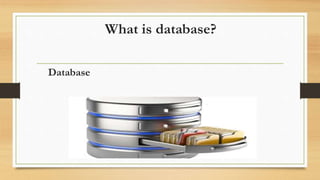
Database
CONTENT
• What database is
• Why to use database?
• How to use database?
Database
What is database?
Database management system
• A database management system (DBMS) is a computer
software application that interacts with the user, other applications, and
the database itself to capture and analyze data.
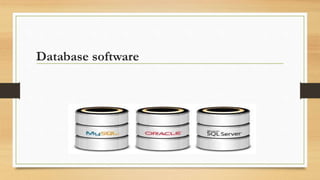
Database software
Why to use database?
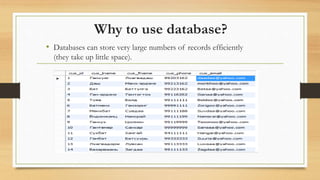
• Databases can store very large numbers of records efficiently
(they take up little space).
Why to use database?
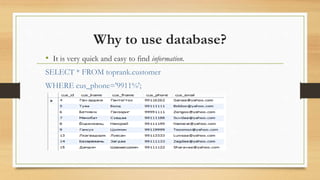
• It is very quick and easy to find information.
SELECT * FROM toprank.customer
WHERE cus_phone='9911%';
Why use database?
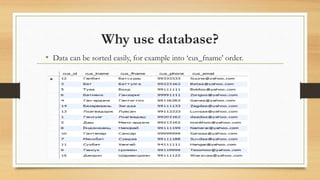
• Data can be sorted easily, for example into ‘cus_fname' order.
Why to use database?
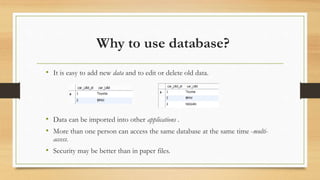
• It is easy to add new data and to edit or delete old data.
• Data can be imported into other applications .
• More than one person can access the same database at the same time -multi-
access.
• Security may be better than in paper files.
How to use database
• When a database holds details about people, it's likely to include their
first name, surname and their date of birth. In addition to this,
specialist information is stored depending on the database's intended use.
• The police have details of all known criminals in a database, crimes
they've comitted.
• Schools use a database to store details about their pupils, how many
days they've been off school sick.
How to use database
• A hospital will store details of all its patients in a database, eg a history
of their health issues.
• The Government uses a database to store records of people's income
tax payments.
• A database is used to keep track of all the drivers in central London
who have (or haven't) paid the Congestion Charge.
Database organization
• Tables Records and Fields
A database is collection of entities or tables.
Database organization
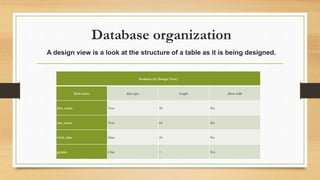
A design view is a look at the structure of a table as it is being designed.
Students (in Design View)
field name data type length allow nulls
first_name Text 32 No
last_name Text 64 No
birth_date Date 10 No
gender Char 1 Yes
Database organization
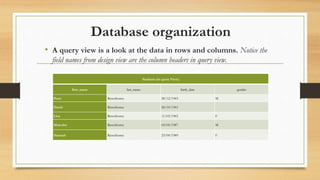
• A query view is a look at the data in rows and columns. Notice the
field names from design view are the column headers in query view.
Students (in query View)
first_name last_name birth_date gender
Peter Rawsthorne 28/12/1963 M
David Rawsthorne 26/10/1961
Lisa Rawsthorne 11/03/1965 F
Malcolm Rawsthorne 03/05/1987 M
Hannah Rawsthorne 23/09/1989 F
Database organization
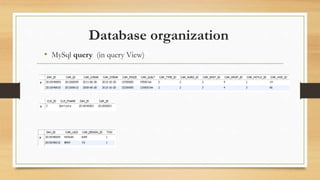
• MySql query (in query View)
Database security
• Database security deals with all various aspects of protecting the
database content, its owners, and its users. It ranges from protection
from intentional unauthorized database uses to unintentional database
accesses by unauthorized entities (e.g., a person or a computer
program).
Conclusion
• А database is an organized collection of data. Databases can store
information about people, products, orders, or anything else.
• Some of the more popular database software applications include
desktop solutions like Microsoft Access and FileMaker Pro and server
solutions like MySQL, Microsoft SQL Server and Oracle.
• Databases can store very large numbers of records efficiently
Any questions ?
Thank you 

23.database

  • 1.
  • 2.
    Database CONTENT • What databaseis • Why to use database? • How to use database?
  • 3.
  • 4.
    Database management system •A database management system (DBMS) is a computer software application that interacts with the user, other applications, and the database itself to capture and analyze data.
  • 5.
  • 6.
    Why to usedatabase? • Databases can store very large numbers of records efficiently (they take up little space).
  • 7.
    Why to usedatabase? • It is very quick and easy to find information. SELECT * FROM toprank.customer WHERE cus_phone='9911%';
  • 8.
    Why use database? •Data can be sorted easily, for example into ‘cus_fname' order.
  • 9.
    Why to usedatabase? • It is easy to add new data and to edit or delete old data. • Data can be imported into other applications . • More than one person can access the same database at the same time -multi- access. • Security may be better than in paper files.
  • 10.
    How to usedatabase • When a database holds details about people, it's likely to include their first name, surname and their date of birth. In addition to this, specialist information is stored depending on the database's intended use. • The police have details of all known criminals in a database, crimes they've comitted. • Schools use a database to store details about their pupils, how many days they've been off school sick.
  • 11.
    How to usedatabase • A hospital will store details of all its patients in a database, eg a history of their health issues. • The Government uses a database to store records of people's income tax payments. • A database is used to keep track of all the drivers in central London who have (or haven't) paid the Congestion Charge.
  • 12.
    Database organization • TablesRecords and Fields A database is collection of entities or tables.
  • 13.
    Database organization A designview is a look at the structure of a table as it is being designed. Students (in Design View) field name data type length allow nulls first_name Text 32 No last_name Text 64 No birth_date Date 10 No gender Char 1 Yes
  • 14.
    Database organization • Aquery view is a look at the data in rows and columns. Notice the field names from design view are the column headers in query view. Students (in query View) first_name last_name birth_date gender Peter Rawsthorne 28/12/1963 M David Rawsthorne 26/10/1961 Lisa Rawsthorne 11/03/1965 F Malcolm Rawsthorne 03/05/1987 M Hannah Rawsthorne 23/09/1989 F
  • 15.
    Database organization • MySqlquery (in query View)
  • 16.
    Database security • Databasesecurity deals with all various aspects of protecting the database content, its owners, and its users. It ranges from protection from intentional unauthorized database uses to unintentional database accesses by unauthorized entities (e.g., a person or a computer program).
  • 17.
    Conclusion • А databaseis an organized collection of data. Databases can store information about people, products, orders, or anything else. • Some of the more popular database software applications include desktop solutions like Microsoft Access and FileMaker Pro and server solutions like MySQL, Microsoft SQL Server and Oracle. • Databases can store very large numbers of records efficiently
  • 18.
  • 19.