MATH 3 - MODULE 6
Honors Topics
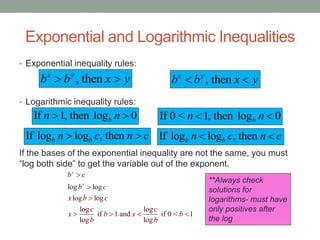
Exponential and Logarithmic Inequalities
• Exponential inequality rules:
• Logarithmic inequality rules:
If the bases of the exponential inequality are not the same, you must
“log both side” to get the variable out of the exponent.
, thenx y
b b x y  , thenx y
b b x y 
If 1, then log 0bn n  If 0 < 1, then log 0bn n 
log log
log log
log log
if 1 and if 0 < 1
log log
x
x
b c
b c
x b c
c c
x b x b
b b



   
If log log , thenb bn c n c  If log log , thenb bn c n c 
**Always check
solutions for
logarithms- must have
only positives after
the log
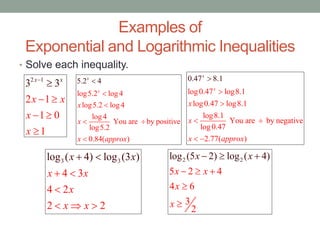
Examples of
Exponential and Logarithmic Inequalities
• Solve each inequality.
2 1
2 1
1
1
3
0
3 x x
x x
x
x

 
 


log5.2 log 4
log5.2 log 4
log 4
You are by positive
log
5.
5.2
0.84 )
2 4
(
x
x
x
x
x approx




 
log0.47 log8.1
log0.47 log8.1
log8.1
You are by n
0
egative
log0.
.47 8.
47
2.77( )
1x
x
x
x
x approx


 
 

3 3log ( 4) log (3 )
4 3
4 2
2 2
x x
x x
x
x x
 



 
 2 2log (5 2) log ( 4
5 2 4
4 6
)
3
2
x x
x
x
x
x
  



 
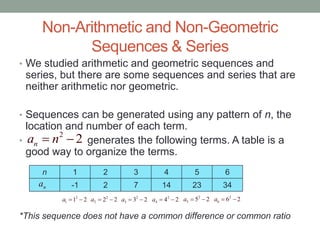
Non-Arithmetic and Non-Geometric
Sequences & Series
• We studied arithmetic and geometric sequences and
series, but there are some sequences and series that are
neither arithmetic nor geometric.
• Sequences can be generated using any pattern of n, the
location and number of each term.
• generates the following terms. A table is a
good way to organize the terms.
*This sequence does not have a common difference or common ratio
2
2na n 
n 1 2 3 4 5 6
-1 2 7 14 23 34na
2
3 3 2a  2
2 2 2a  2
1 1 2a   2
4 4 2a   2
5 5 2a   2
6 6 2a  
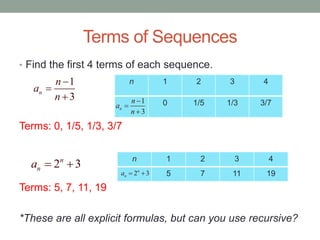
Terms of Sequences
• Find the first 4 terms of each sequence.
Terms: 0, 1/5, 1/3, 3/7
Terms: 5, 7, 11, 19
*These are all explicit formulas, but can you use recursive?
1
3
n
n
a
n



n 1 2 3 4
0 1/5 1/3 3/71
3
n
n
a
n



2 3n
na  
n 1 2 3 4
5 7 11 192 3n
na  
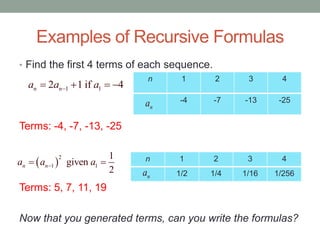
Examples of Recursive Formulas
• Find the first 4 terms of each sequence.
Terms: -4, -7, -13, -25
Terms: 5, 7, 11, 19
Now that you generated terms, can you write the formulas?
n 1 2 3 4
-4 -7 -13 -25
na
 
2
1 1
1
given
2
n na a a  n 1 2 3 4
1/2 1/4 1/16 1/256
1 12 1 if 4n na a a   
na
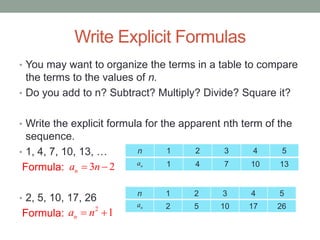
Write Explicit Formulas
• You may want to organize the terms in a table to compare
the terms to the values of n.
• Do you add to n? Subtract? Multiply? Divide? Square it?
• Write the explicit formula for the apparent nth term of the
sequence.
• 1, 4, 7, 10, 13, …
Formula:
• 2, 5, 10, 17, 26
Formula:
n 1 2 3 4 5
1 4 7 10 13na
3 2na n 
n 1 2 3 4 5
2 5 10 17 26na
2
1na n 
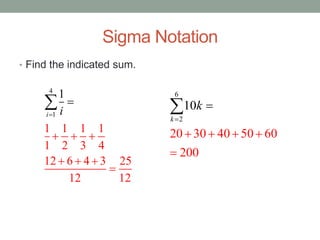
Sigma Notation
• Find the indicated sum.
4
1
1 1 1 1
1 2 3 4
12 6 4 3 25
12 1
1
2
i i
  
  


6
2
20 30 40 50 60
200
10
k
k

   



Module 6 Mastery

  • 1.
    MATH 3 -MODULE 6 Honors Topics
  • 2.
    Exponential and LogarithmicInequalities • Exponential inequality rules: • Logarithmic inequality rules: If the bases of the exponential inequality are not the same, you must “log both side” to get the variable out of the exponent. , thenx y b b x y  , thenx y b b x y  If 1, then log 0bn n  If 0 < 1, then log 0bn n  log log log log log log if 1 and if 0 < 1 log log x x b c b c x b c c c x b x b b b        If log log , thenb bn c n c  If log log , thenb bn c n c  **Always check solutions for logarithms- must have only positives after the log
  • 3.
    Examples of Exponential andLogarithmic Inequalities • Solve each inequality. 2 1 2 1 1 1 3 0 3 x x x x x x        log5.2 log 4 log5.2 log 4 log 4 You are by positive log 5. 5.2 0.84 ) 2 4 ( x x x x x approx       log0.47 log8.1 log0.47 log8.1 log8.1 You are by n 0 egative log0. .47 8. 47 2.77( ) 1x x x x x approx        3 3log ( 4) log (3 ) 4 3 4 2 2 2 x x x x x x x         2 2log (5 2) log ( 4 5 2 4 4 6 ) 3 2 x x x x x x        
  • 4.
    Non-Arithmetic and Non-Geometric Sequences& Series • We studied arithmetic and geometric sequences and series, but there are some sequences and series that are neither arithmetic nor geometric. • Sequences can be generated using any pattern of n, the location and number of each term. • generates the following terms. A table is a good way to organize the terms. *This sequence does not have a common difference or common ratio 2 2na n  n 1 2 3 4 5 6 -1 2 7 14 23 34na 2 3 3 2a  2 2 2 2a  2 1 1 2a   2 4 4 2a   2 5 5 2a   2 6 6 2a  
  • 5.
    Terms of Sequences •Find the first 4 terms of each sequence. Terms: 0, 1/5, 1/3, 3/7 Terms: 5, 7, 11, 19 *These are all explicit formulas, but can you use recursive? 1 3 n n a n    n 1 2 3 4 0 1/5 1/3 3/71 3 n n a n    2 3n na   n 1 2 3 4 5 7 11 192 3n na  
  • 6.
    Examples of RecursiveFormulas • Find the first 4 terms of each sequence. Terms: -4, -7, -13, -25 Terms: 5, 7, 11, 19 Now that you generated terms, can you write the formulas? n 1 2 3 4 -4 -7 -13 -25 na   2 1 1 1 given 2 n na a a  n 1 2 3 4 1/2 1/4 1/16 1/256 1 12 1 if 4n na a a    na
  • 7.
    Write Explicit Formulas •You may want to organize the terms in a table to compare the terms to the values of n. • Do you add to n? Subtract? Multiply? Divide? Square it? • Write the explicit formula for the apparent nth term of the sequence. • 1, 4, 7, 10, 13, … Formula: • 2, 5, 10, 17, 26 Formula: n 1 2 3 4 5 1 4 7 10 13na 3 2na n  n 1 2 3 4 5 2 5 10 17 26na 2 1na n 
  • 8.
    Sigma Notation • Findthe indicated sum. 4 1 1 1 1 1 1 2 3 4 12 6 4 3 25 12 1 1 2 i i         6 2 20 30 40 50 60 200 10 k k       