IRON - DEFICIENCY ANEMIA IN
CHILDREN
By assistant of the Pediatric department ChonkoevaAikerim
Definition
Anemia - abnormal low hemoglobin,
hematocrit or RBC count, lower than
the age-adjusted reference range for
healthy children.
Most studies showed this cutoff point
to be around 11 g/dl (-2SD below the
mean).
Definition
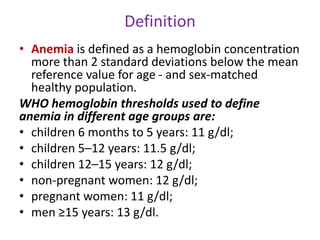
• Anemia is defined as a hemoglobin concentration
more than 2 standard deviations below the mean
reference value for age - and sex-matched
healthy population.
WHO hemoglobin thresholds used to define
anemia in different age groups are:
• children 6 months to 5 years: 11 g/dl;
• children 5–12 years: 11.5 g/dl;
• children 12–15 years: 12 g/dl;
• non-pregnant women: 12 g/dl;
• pregnant women: 11 g/dl;
• men ≥15 years: 13 g/dl.
Definition
• Iron deficiency is the most common
micronutrient deficiency worldwide and one
of the most important public health problems,
affecting approximately 25% of the world’s
population according to the World Health
Organization (WHO).
Epidemiology
• Approximately 8% of toddlers in the US have iron
deficiency, and 2–3% have iron deficiency anemia (IDA).
• 16% of adolescent girls have iron deficiency, and 3% have
IDA.
• Among American females aged 12–15 years, the incidence
of iron deficiency was 9% and the incidence of IDA was 2%;
in the age group 16–19 years, the incidence was 11 and 3%,
respectively.
• A full-term newborn infant contains about 0.5 g of iron,
compared to 5 g of iron in adults. This change in quantity of
iron from birth to adulthood means that an average of 0.8
mg of iron must be absorbed each day during the 1st 15 yr
of life.
Epidemiology
• Adolescent athletes, vegetarians, adolescents with
chronic illnesses, heavy menstrual blood loss (>80
ml/month), or children who are underweighted or
malnourished are at higher risk for iron deficiency and
IDA, and they should also have laboratory screening for
anemia.
• In developing countries, where diets do not contain
sufficient red meat, IDA is approximately seven times
more frequent than in Europe or North America.
• The prevalence of iron deficiency exceeds 50% in
countries with limited food and nutrient sources, such
as most countries in Africa, Southeast Asia, and Latin
America.
General information
• Iron is a chemical element with the symbol Fe+
(from Latin: ferrum) and atomic number 26.
• Iron forms compounds mainly in two oxidation
states. Traditionally, Fe+2 compounds are called
ferrous , and Fe+3 compounds – ferric.
• Iron is among the abundant minerals on earth.
• Of the 87 elements in the earth’s crust, Iron
constitutes 5.6% and ranks fourth behind
Oxygen (46.4%), Silicon (28.4%) and Aluminum
(8.3%).
General information
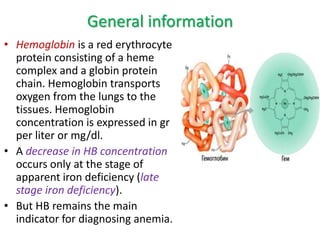
• Hemoglobin is a red erythrocyte
protein consisting of a heme
complex and a globin protein
chain. Hemoglobin transports
oxygen from the lungs to the
tissues. Hemoglobin
concentration is expressed in gr
per liter or mg/dl.
• A decrease in HB concentration
occurs only at the stage of
apparent iron deficiency (late
stage iron deficiency).
• But HB remains the main
indicator for diagnosing anemia.
General information
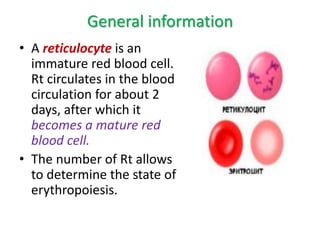
• A reticulocyte is an
immature red blood cell.
Rt circulates in the blood
circulation for about 2
days, after which it
becomes a mature red
blood cell.
• The number of Rt allows
to determine the state of
erythropoiesis.
Characteristics
• Iron deficiency is a condition when the body
lacks sufficient iron to maintain normal
physiological functions.
• It is defined as decreased total body iron or, in
some cases, by serum ferritin level <12 mg/l in
children up to 5 years and <15 mg/l in children
5 years and older.
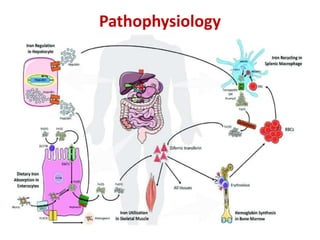
Pathophysiology
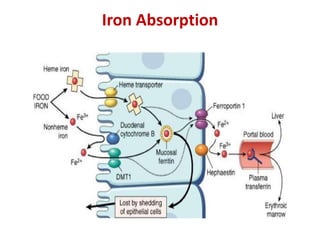
Iron Absorption
DIETARY IRON
• There are 2 types of iron in the diet; haem
(heme) iron and non-haem iron
• Haem iron is present in Hb containing animal
food like meat, liver & spleen
• Non-haem iron is obtained from cereals,
vegetables & beans
• Cow’s milk is a poor source of iron, hence
breast-fed babies need iron supplements.
Iron Absorption
• Haem iron is not affected by ingestion of other
food items.
• It has constant absorption rate of 20-30%
which is little affected by the iron balance of the
subject.
• The haem molecule is absorbed intact and the
iron is released in the mucosal cells.
Iron Absorption
• The absorption of non-haem iron varies
greatly from 2% to 100% because it is strongly
influenced by:
 The iron status of the body
 The solubility of iron salts
 Integrity of gut mucosa
 Presence of absorption inhibitors or facilitators
INHIBITORS OF IRON ABSORPTION
• Food with polyphenol compounds
 Cereals like sorghum & oats
 Vegetables such as spices
 Beverages like tea, coffee, cocoa and
wine.
A single cup of tea taken with meal
reduces iron absorption by up to
11%.
Some fruits inhibit the absorption
of iron although they are rich in
ascorbic acid because of their high
phenol content e.g. strawberry
banana and melon.
Promoters of Iron Absorption
• Foods containing ascorbic acid like citrus fruits,
broccoli & other dark green vegetables because
ascorbic acid reduces iron from ferric (Fe+++) to
ferrous (Fe++) forms, which increases its
absorption.
• Foods containing muscle protein enhance iron
absorption due to the effect of cysteine
containing peptides released from partially
digested meat, which reduces ferric to ferrous
salts and form soluble iron complexes.
IRON TRANSPORT
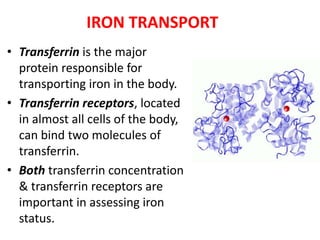
• Transferrin is the major
protein responsible for
transporting iron in the body.
• Transferrin receptors, located
in almost all cells of the body,
can bind two molecules of
transferrin.
• Both transferrin concentration
& transferrin receptors are
important in assessing iron
status.
STORAGE OF IRON
• Tissues with higher requirement for iron (bone
marrow, liver & placenta) contain more
transferrin receptors.
• Once in tissues, iron is stored as ferritin &
hemosiderin compounds, which are present in
the liver, RE cells & bone marrow.
• The amount of iron in the storage
compartment depends on iron balance
(positive or negative).
• Ferritin level reflects amount of stored iron in
the body & is important in assessing ID.
ROLE OF IRON IN THE BODY
Iron have several vital functions
• Carrier of oxygen from lung to tissues
• Transport of electrons within cells
• Co-factor of essential enzymatic reactions:
 Neurotransmission
 Synthesis of steroid hormones
 Synthesis of bile salts
 Detoxification processes in the liver
Daily requirement(RDA)
• Male: 0.5-1 mg
• Female during reproductive life : 1.5-2 mg
• Pregnant women: 1.5-2.5 mg
• Children : 0.5 mg/day
• Daily dietary requirement near 10 times more
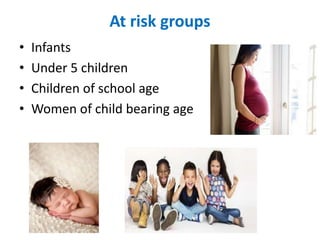
At risk groups
• Infants
• Under 5 children
• Children of school age
• Women of child bearing age
Risk factors (Reasons)
• Perinatal risk factors:
 maternal iron deficiency
 pre-maturity
 administration of erythropoietin for anemia of
prematurity
 fetal-maternal hemorrhage
 twin-twin transfusion syndrome
 other perinatal hemorrhagic events
 insufficient intake of dietary iron during early infancy
 delayed clamping of the umbilical cord (approximately
120–180 seconds after delivery) can improve the
amount of iron and significantly reduce the risk of IDA
Risk factors (Reasons)
• Dietary factors. The most common factors are:
poor iron intake
decreased iron absorption
consumption of unmodified cow’s milk before
12 months of age
occult intestinal blood loss due to cow’s milk
protein-induced colitis.
Risk factors (Reasons)
• Gastrointestinal disease:
celiac disease
Crohn disease
Giardiasis
resection of the proximal small intestine
• cow’s milk protein-induced colitis
• inflammatory bowel disease (IBD)
• duodenal/gastric ulcers
• chronic use of non-steroidal anti-inflammatory
drugs or aspirin.
Physiological anemia
• At birth, normal full-term infants have higher hemoglobin
(Hb) levels and RBCs than do older children and adults.
However, within the 1st wk of life, a progressive decline in
Hb level begins and then persists for 6-8 wk. The resulting
anemia is known as the physiological anemia of infancy.
• In all, this “anemia” should be viewed as a physiologic
adaptation to extrauterine life, reflecting the excess oxygen
delivery relative to tissue oxygen requirements.
• There is no hematologic problem, and no therapy is
required unless physiologic anemia of infancy is
exacerbated by other ongoing processes.
• The majority of healthy infants have iron stores of about 80
mg/kg, and 2/3 of total iron is bound in hemoglobin
molecules. Normal hemoglobin concentration is 15–17 g/dl.
Healthy infants have enough body iron for the first 5–6
months of life.
Physiological anemia
• Premature infants also develop a physiologic
anemia, known as physiologic anemia of
prematurity . The Hb decline is both more
extreme and more rapid.
• Hb levels of 7-9 g/dL usually are reached by 3-
6 wk of age, and levels may be even lower in
very small premature infants.
Clinical Manifestations
• Most children with iron-deficiency anemia are
asymptomatic and are identified by routine laboratory
screening at 9-12 mo of age.
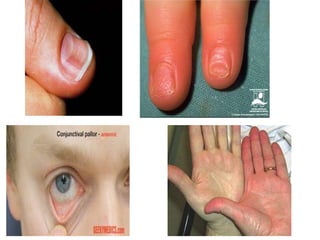
• Nonspecific pallor of the mucous membranes.
• Signs of epithelial tissues:
 Koilonychia
 glossitis, and angular stomatitis.
• Neurodevelopmental signs and symptoms: impaired
psychomotor and/or mental development, headache,
irritability
• Effects on immunity and susceptibility to infection
• decreased exercise capacity, weakness, pica and/or
pagophagia, and restless leg syndrome in older children
• Beeturia
Clinical Manifestations
• Severe form of IDA:
poor feeding
irritability, lethargy
tachypnea, and cardiomegaly
hypotension
tachypnea, respiratory distress
splenomegaly
Stages of iron deficiency: Laboratory test results help
stage iron deficiency anemia.
Diagnosis of IDA
1. Clinical sings
2. Lab’s tests: Peripheral Blood Components
Important! Different values dependent on age!
• RBC
• HB - low (< 11.0 g/dl)
• MCV is low – 80 – 100 fl/L (mean erythrocyte
volume), MCH (mean eryhtrocyte hemoglobin)
• RDW - high RWD (eryhtrocyte distribution width,
anisocytosis)
• High erythrocyte protoporphyrin
• Reticulocyte count – low
3. Stools for the presence of occult blood.
Diagnosis of IDA
• MCV for characterize Anemia (the average
volume of a single RBC).
Low(<70 fl)
*Hypochromic/Microcytic
-Iron deficiency anemia
-Thalassemia
-Sideroblastic anemia
-Chronic infection
-Lead poisoning
-Inborn errors of Fe metabolism
-Severe malnutrition
-Copper deficiency
Diagnosis of IDA
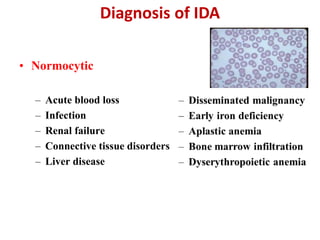
• Normocytic
– Acute blood loss
– Infection
– Renal failure
– Connective tissue disorders
– Liver disease
Iron Deficiency Anemia
*characteristics of peripheral blood smear
– microcytic
– hypochromic
*MCV and Hgb– decreased (Hgb<12g/L)
– Ferritin – decreased (<13mg/dL)
– TIBC - high
-Serum iron –decreased (N 50-150 µg/dL)
Iron deficiency develops in the body in
three stages
1.Prelatent stage: Iron stores are lowered or
absent, serum iron concentration, hemoglobin
and hematocrit are normal. This stage of iron
deficiency is manifested with reduction or
absence of bone marrow iron stores and
reduced serum ferritin level.
2. Latent stage: serum iron (SI) and transferrin
saturation are reduced in addition to reduced
iron stores. Hemoglobin and hematocrit are
within normal limits.
3. Marked IDA: In addition to the depletion
of iron stores, serum iron and transferrin
saturation hemoglobin and hematocrit levels are
reduced.
Prevention and Treatment of
IDA in children
Management of IDA
• Blood transfusion if heart failure is eminent
• IV or IM iron in severe cases
• Oral iron 3-6 mg Fe/kg/day
• Treat underlying cause
• Dietary education
Treatment
• Oral iron treatment is preferred primarily
because it is economical and has few side
effects.
• The most commonly used oral +2 ferrous iron
preparations include ferrous sulphate, ferrous
gluconate, ferrous fumarate and ferrous
succinate.
Treatment
• Ferrous sulphate is still the most commonly
used preparation;
• Absorption of ferrous sulphate is very well
and its bioavailability is high, but it may have
side effects including irritation in the
gastrointestinal system, constipation, nausea,
vomiting and epigastric pain.
Treatment
• Signs observed in patients including restlessness,
loss of appetite and fatigue rapidly disappear
with initiation of treatment.
• An increase in the reticulocyte count is expected
on the 7–19th days of treatment.
• If an increase of 1 g/dL or more is observed in Hb
after ten days, the diagnosis is correct.
• In this case, treatment can be continued for at
least 2 months to fill iron stores. The treatment
period should not exceed 5 months.
Treatment
• Parenteral iron treatment can be
administered when oral iron treatment can
not be tolerated, in cases where anemia
should be corrected rapidly and in
gastrointestinal absorption disorders including
celiac disease or inflammatory bowel
disease.
Treatment
Parenteral therapy (IM,IV)
– indications
• poor compliance
• severe bowel disease
• intolerance of oral iron
• chronic hemorrhage
• acute diarrhea disorder
PREVENTION OF IDA
• Dietary modification
• Food fortification
• Iron supplementation
PREVENTION OF IDA
• Diet & nutrition education
• eat more fruits and vegetable
• no coffee or tea with meals
• reduce phytic content of cereals and legumes
by fermentation
PREVENTION OF IDA
• Short term approach:
- supplementation with iron tablets.
• Long-term approach:
- food fortification with iron either for the whole
population (blanket fortification) or for specific
target groups like infants. It requires no
cooperation from users unlike taking iron
supplements.
THANK YOU!

Deficiency anemia By CA.pptx

  • 1.
    IRON - DEFICIENCYANEMIA IN CHILDREN By assistant of the Pediatric department ChonkoevaAikerim
  • 2.
    Definition Anemia - abnormallow hemoglobin, hematocrit or RBC count, lower than the age-adjusted reference range for healthy children. Most studies showed this cutoff point to be around 11 g/dl (-2SD below the mean).
  • 3.
    Definition • Anemia isdefined as a hemoglobin concentration more than 2 standard deviations below the mean reference value for age - and sex-matched healthy population. WHO hemoglobin thresholds used to define anemia in different age groups are: • children 6 months to 5 years: 11 g/dl; • children 5–12 years: 11.5 g/dl; • children 12–15 years: 12 g/dl; • non-pregnant women: 12 g/dl; • pregnant women: 11 g/dl; • men ≥15 years: 13 g/dl.
  • 4.
    Definition • Iron deficiencyis the most common micronutrient deficiency worldwide and one of the most important public health problems, affecting approximately 25% of the world’s population according to the World Health Organization (WHO).
  • 5.
    Epidemiology • Approximately 8%of toddlers in the US have iron deficiency, and 2–3% have iron deficiency anemia (IDA). • 16% of adolescent girls have iron deficiency, and 3% have IDA. • Among American females aged 12–15 years, the incidence of iron deficiency was 9% and the incidence of IDA was 2%; in the age group 16–19 years, the incidence was 11 and 3%, respectively. • A full-term newborn infant contains about 0.5 g of iron, compared to 5 g of iron in adults. This change in quantity of iron from birth to adulthood means that an average of 0.8 mg of iron must be absorbed each day during the 1st 15 yr of life.
  • 6.
    Epidemiology • Adolescent athletes,vegetarians, adolescents with chronic illnesses, heavy menstrual blood loss (>80 ml/month), or children who are underweighted or malnourished are at higher risk for iron deficiency and IDA, and they should also have laboratory screening for anemia. • In developing countries, where diets do not contain sufficient red meat, IDA is approximately seven times more frequent than in Europe or North America. • The prevalence of iron deficiency exceeds 50% in countries with limited food and nutrient sources, such as most countries in Africa, Southeast Asia, and Latin America.
  • 7.
    General information • Ironis a chemical element with the symbol Fe+ (from Latin: ferrum) and atomic number 26. • Iron forms compounds mainly in two oxidation states. Traditionally, Fe+2 compounds are called ferrous , and Fe+3 compounds – ferric. • Iron is among the abundant minerals on earth. • Of the 87 elements in the earth’s crust, Iron constitutes 5.6% and ranks fourth behind Oxygen (46.4%), Silicon (28.4%) and Aluminum (8.3%).
  • 8.
    General information • Hemoglobinis a red erythrocyte protein consisting of a heme complex and a globin protein chain. Hemoglobin transports oxygen from the lungs to the tissues. Hemoglobin concentration is expressed in gr per liter or mg/dl. • A decrease in HB concentration occurs only at the stage of apparent iron deficiency (late stage iron deficiency). • But HB remains the main indicator for diagnosing anemia.
  • 9.
    General information • Areticulocyte is an immature red blood cell. Rt circulates in the blood circulation for about 2 days, after which it becomes a mature red blood cell. • The number of Rt allows to determine the state of erythropoiesis.
  • 10.
    Characteristics • Iron deficiencyis a condition when the body lacks sufficient iron to maintain normal physiological functions. • It is defined as decreased total body iron or, in some cases, by serum ferritin level <12 mg/l in children up to 5 years and <15 mg/l in children 5 years and older.
  • 11.
  • 12.
  • 13.
    DIETARY IRON • Thereare 2 types of iron in the diet; haem (heme) iron and non-haem iron • Haem iron is present in Hb containing animal food like meat, liver & spleen • Non-haem iron is obtained from cereals, vegetables & beans • Cow’s milk is a poor source of iron, hence breast-fed babies need iron supplements.
  • 14.
    Iron Absorption • Haemiron is not affected by ingestion of other food items. • It has constant absorption rate of 20-30% which is little affected by the iron balance of the subject. • The haem molecule is absorbed intact and the iron is released in the mucosal cells.
  • 15.
    Iron Absorption • Theabsorption of non-haem iron varies greatly from 2% to 100% because it is strongly influenced by:  The iron status of the body  The solubility of iron salts  Integrity of gut mucosa  Presence of absorption inhibitors or facilitators
  • 16.
    INHIBITORS OF IRONABSORPTION • Food with polyphenol compounds  Cereals like sorghum & oats  Vegetables such as spices  Beverages like tea, coffee, cocoa and wine. A single cup of tea taken with meal reduces iron absorption by up to 11%. Some fruits inhibit the absorption of iron although they are rich in ascorbic acid because of their high phenol content e.g. strawberry banana and melon.
  • 17.
    Promoters of IronAbsorption • Foods containing ascorbic acid like citrus fruits, broccoli & other dark green vegetables because ascorbic acid reduces iron from ferric (Fe+++) to ferrous (Fe++) forms, which increases its absorption. • Foods containing muscle protein enhance iron absorption due to the effect of cysteine containing peptides released from partially digested meat, which reduces ferric to ferrous salts and form soluble iron complexes.
  • 18.
    IRON TRANSPORT • Transferrinis the major protein responsible for transporting iron in the body. • Transferrin receptors, located in almost all cells of the body, can bind two molecules of transferrin. • Both transferrin concentration & transferrin receptors are important in assessing iron status.
  • 19.
    STORAGE OF IRON •Tissues with higher requirement for iron (bone marrow, liver & placenta) contain more transferrin receptors. • Once in tissues, iron is stored as ferritin & hemosiderin compounds, which are present in the liver, RE cells & bone marrow. • The amount of iron in the storage compartment depends on iron balance (positive or negative). • Ferritin level reflects amount of stored iron in the body & is important in assessing ID.
  • 20.
    ROLE OF IRONIN THE BODY Iron have several vital functions • Carrier of oxygen from lung to tissues • Transport of electrons within cells • Co-factor of essential enzymatic reactions:  Neurotransmission  Synthesis of steroid hormones  Synthesis of bile salts  Detoxification processes in the liver
  • 21.
    Daily requirement(RDA) • Male:0.5-1 mg • Female during reproductive life : 1.5-2 mg • Pregnant women: 1.5-2.5 mg • Children : 0.5 mg/day • Daily dietary requirement near 10 times more
  • 22.
    At risk groups •Infants • Under 5 children • Children of school age • Women of child bearing age
  • 23.
    Risk factors (Reasons) •Perinatal risk factors:  maternal iron deficiency  pre-maturity  administration of erythropoietin for anemia of prematurity  fetal-maternal hemorrhage  twin-twin transfusion syndrome  other perinatal hemorrhagic events  insufficient intake of dietary iron during early infancy  delayed clamping of the umbilical cord (approximately 120–180 seconds after delivery) can improve the amount of iron and significantly reduce the risk of IDA
  • 24.
    Risk factors (Reasons) •Dietary factors. The most common factors are: poor iron intake decreased iron absorption consumption of unmodified cow’s milk before 12 months of age occult intestinal blood loss due to cow’s milk protein-induced colitis.
  • 25.
    Risk factors (Reasons) •Gastrointestinal disease: celiac disease Crohn disease Giardiasis resection of the proximal small intestine • cow’s milk protein-induced colitis • inflammatory bowel disease (IBD) • duodenal/gastric ulcers • chronic use of non-steroidal anti-inflammatory drugs or aspirin.
  • 26.
    Physiological anemia • Atbirth, normal full-term infants have higher hemoglobin (Hb) levels and RBCs than do older children and adults. However, within the 1st wk of life, a progressive decline in Hb level begins and then persists for 6-8 wk. The resulting anemia is known as the physiological anemia of infancy. • In all, this “anemia” should be viewed as a physiologic adaptation to extrauterine life, reflecting the excess oxygen delivery relative to tissue oxygen requirements. • There is no hematologic problem, and no therapy is required unless physiologic anemia of infancy is exacerbated by other ongoing processes. • The majority of healthy infants have iron stores of about 80 mg/kg, and 2/3 of total iron is bound in hemoglobin molecules. Normal hemoglobin concentration is 15–17 g/dl. Healthy infants have enough body iron for the first 5–6 months of life.
  • 27.
    Physiological anemia • Prematureinfants also develop a physiologic anemia, known as physiologic anemia of prematurity . The Hb decline is both more extreme and more rapid. • Hb levels of 7-9 g/dL usually are reached by 3- 6 wk of age, and levels may be even lower in very small premature infants.
  • 28.
    Clinical Manifestations • Mostchildren with iron-deficiency anemia are asymptomatic and are identified by routine laboratory screening at 9-12 mo of age. • Nonspecific pallor of the mucous membranes. • Signs of epithelial tissues:  Koilonychia  glossitis, and angular stomatitis. • Neurodevelopmental signs and symptoms: impaired psychomotor and/or mental development, headache, irritability • Effects on immunity and susceptibility to infection • decreased exercise capacity, weakness, pica and/or pagophagia, and restless leg syndrome in older children • Beeturia
  • 30.
    Clinical Manifestations • Severeform of IDA: poor feeding irritability, lethargy tachypnea, and cardiomegaly hypotension tachypnea, respiratory distress splenomegaly
  • 31.
    Stages of irondeficiency: Laboratory test results help stage iron deficiency anemia.
  • 32.
    Diagnosis of IDA 1.Clinical sings 2. Lab’s tests: Peripheral Blood Components Important! Different values dependent on age! • RBC • HB - low (< 11.0 g/dl) • MCV is low – 80 – 100 fl/L (mean erythrocyte volume), MCH (mean eryhtrocyte hemoglobin) • RDW - high RWD (eryhtrocyte distribution width, anisocytosis) • High erythrocyte protoporphyrin • Reticulocyte count – low 3. Stools for the presence of occult blood.
  • 33.
    Diagnosis of IDA •MCV for characterize Anemia (the average volume of a single RBC). Low(<70 fl) *Hypochromic/Microcytic -Iron deficiency anemia -Thalassemia -Sideroblastic anemia -Chronic infection -Lead poisoning -Inborn errors of Fe metabolism -Severe malnutrition -Copper deficiency
  • 34.
    Diagnosis of IDA •Normocytic – Acute blood loss – Infection – Renal failure – Connective tissue disorders – Liver disease
  • 35.
    Iron Deficiency Anemia *characteristicsof peripheral blood smear – microcytic – hypochromic *MCV and Hgb– decreased (Hgb<12g/L) – Ferritin – decreased (<13mg/dL) – TIBC - high -Serum iron –decreased (N 50-150 µg/dL)
  • 36.
    Iron deficiency developsin the body in three stages 1.Prelatent stage: Iron stores are lowered or absent, serum iron concentration, hemoglobin and hematocrit are normal. This stage of iron deficiency is manifested with reduction or absence of bone marrow iron stores and reduced serum ferritin level.
  • 37.
    2. Latent stage:serum iron (SI) and transferrin saturation are reduced in addition to reduced iron stores. Hemoglobin and hematocrit are within normal limits. 3. Marked IDA: In addition to the depletion of iron stores, serum iron and transferrin saturation hemoglobin and hematocrit levels are reduced.
  • 38.
    Prevention and Treatmentof IDA in children
  • 39.
    Management of IDA •Blood transfusion if heart failure is eminent • IV or IM iron in severe cases • Oral iron 3-6 mg Fe/kg/day • Treat underlying cause • Dietary education
  • 40.
    Treatment • Oral irontreatment is preferred primarily because it is economical and has few side effects. • The most commonly used oral +2 ferrous iron preparations include ferrous sulphate, ferrous gluconate, ferrous fumarate and ferrous succinate.
  • 41.
    Treatment • Ferrous sulphateis still the most commonly used preparation; • Absorption of ferrous sulphate is very well and its bioavailability is high, but it may have side effects including irritation in the gastrointestinal system, constipation, nausea, vomiting and epigastric pain.
  • 42.
    Treatment • Signs observedin patients including restlessness, loss of appetite and fatigue rapidly disappear with initiation of treatment. • An increase in the reticulocyte count is expected on the 7–19th days of treatment. • If an increase of 1 g/dL or more is observed in Hb after ten days, the diagnosis is correct. • In this case, treatment can be continued for at least 2 months to fill iron stores. The treatment period should not exceed 5 months.
  • 43.
    Treatment • Parenteral irontreatment can be administered when oral iron treatment can not be tolerated, in cases where anemia should be corrected rapidly and in gastrointestinal absorption disorders including celiac disease or inflammatory bowel disease.
  • 44.
    Treatment Parenteral therapy (IM,IV) –indications • poor compliance • severe bowel disease • intolerance of oral iron • chronic hemorrhage • acute diarrhea disorder
  • 45.
    PREVENTION OF IDA •Dietary modification • Food fortification • Iron supplementation
  • 46.
    PREVENTION OF IDA •Diet & nutrition education • eat more fruits and vegetable • no coffee or tea with meals • reduce phytic content of cereals and legumes by fermentation
  • 47.
    PREVENTION OF IDA •Short term approach: - supplementation with iron tablets. • Long-term approach: - food fortification with iron either for the whole population (blanket fortification) or for specific target groups like infants. It requires no cooperation from users unlike taking iron supplements.
  • 48.