Neuro-ophthalmology
DR SAMAR FATIMA
Assistant Professor
BUMDC
Optic nerve diseases
Optic nerve : consists of axons that arise from the ganglion
cells, optic chiasm is its ending
Sheaths of optic nerve : the fibrous wrapping that
ensheathe the optic nerve are continuous with the
meninges——dura 、 arachnoid and pia mater ;
Optic nerve diseases
Etiology :
• 1.inflammation : optic neuritis
• 2.Diseases of blood vessel : ischemic
optic neuropathy
• 3.Tumor : optic
glioma 、 meningioma of optic nerve
Optic neuritis
• Definition: Optic neuritis is
inflammation 、 disintegration and
demyelinaton of the optic nerve.
• Classify according to site :
Optic papillitis : often seen in children
Retrobulbar neuritis : often seen in
youth
Optic neuritis
Etiology :
• Myelinoclasis : multiple sclerosis,optic
neuromyelitis.
• Childhood Infections :
measles 、 parotitis.
• Infection of meninges 、 orbit or nasal
sinus.
• Infection of eyeball : retinitis 、 uveitis
• Idiopathic :
Optic neuritis
Clinical manifestations :
• Vision : acute visual loss about 1
week after onset.
• flare , orbital pain, the pain is
exacerbated by eye movement.
• Occasionally Uhthoff's sign
(visual deficit with exercise or
increase in body temperature).
• Pupil: relative afferent pupillary
defect (RAPD).
Optic neuritis
Clinical manifestations :
• Fundus: Swollen disc with or without
peripapillary flame-shaped hemorrhages.
Fundus is normal in retrobulbar optic neuritis
• Visual field:
central scotoma,
concentric loss.
• VEP: abnormal.
Optic neuritis
Differential diagnosis :
• 1.Ischemic optic neuropathy
• 2.Leber’s optic neuropathy
• 3.Toxic or metabolic optic
neuropathy
Treatment :
• 1.Corticosteroid :
• 2.VitamineB , Vasodilator :
Anterior ischemic optic neuropathy
Definition: Anterior ischemic optic
neuropathy is characterized by
pallid disk swelling associated
with acute loss of vision. The
disorder is due to occlusion or
decreased perfusion of the short
posterior ciliary arteries.
Anterior ischemic optic neuropathy
Etiology :
1.Local vascular lesion of papilla
2.Hypotension of eye or total body
3.Blood viscosity ↑
4.High
5.Ocular hypertension
Anterior ischemic optic neuropathy
Clinical manifestation:
symptoms : sudden 、 painless 、 nonprogressive visual
loss.
signs :
vision : moderate loss
pupil : afferent pupillary defect
Fundus: pale disc swelling often involving only a
segment of the disc, flame-shaped hemorrhages,
optic atrophy after the edema resolves
Visual field: altitudinal or central visual field defect
Clinical types :
Areritic Anterior ischemic optic neuropathy: due to
giant cell arteritis :
nonAreritic Anterior ischemic optic neuropathy 50
~ 60 years
Anterior ischemic optic neuropathy
Differential diagnosis :
 Optic neuritis :
 Kennedy syndrom :
Treatment :
Treat systemic disease
General application of corticosteroid
vasodilator
Decrease IOP
Optic nerve sheath decompression
• Definition :Optic atrophy is a nonspecific
response to optic nerve (retina to lateral geniculate
body) damage from any cause.
• Etiology :
– Intracranial hypertension or inflammation
– Retinopathy
– Optic neuropathy
– Compressive lesion
– Trauma
– Metabolic
– Hereditary
– Nutrient
Optic atrophy
Normal fudus Optic atrophy
Optic atrophy
Classification due to lesion site of fundus and
optic nerve :
• Primary optic atrophy : or descending
optic atrophy
• Secondary optic atrophy : or ascending
optic atrophy
Clinical manifestation :
Visual loss significantly , visual
field concentric constriction
Optic atrophy
Optic atrophy
Primary optic
atrophy
Secondary optic
atrophy
Etiology Damage of visual
path behind
cribriform plate
Lesions of optic disc
、 retina and choroid,
et al.
Optic papilla pale , clear
border 、 screen
mes can be seen
in cup
Gray-white 、 dirty
dark , border not
clear 、 physiological
depression disappear
Vessel of
retina
normal Narrow
artery , vessel with
sheath
Diagnosis :
• According to fudus ,visual
acuity,visual field,VEP,CT,MRI et
al.
Treatment :
• Treat primary disease
• Assistant treatment : neurotrophic
medicine and vasodilator
Optic atrophy
Etiology :
1.intracranial :
tumor 、 hemorrhage 、 edema 、 abscess
2.Intraorbital :
tumor 、 inflammation 、 Grave’s disease
3.intraocular : ocular hypotension 、 uveitis
4.Systemic disease : diabetes
mellitus 、 leukemia 、 malignant
hypertension 、 pulmonary heart disease.
Papilledema
Papilledema
Pathogenesis :
• Intracranial hypertension
• The theory of axoplasma
flow
Clinical manifestaton :
• Symptoms : Episodes of
transient, often bilateral, visual
loss associated with psychiatric
symptoms
• Visual field : Enlarged
physiological blind spot, lately
concentric loss
Papilledema
Papilledema
Fundus : four stages
1. Early stage: hyperemic disc with blurring
of the disc margin, peripapillary retinal
hemorrhages
2. Advanced stage: Bilaterally swollen,
hyperemic discs with flame-like retinal
hemorrhages 、 cotton-wool
spots 、 macular hemorrhage and
exudation.
3. Chronic stage : prominence of disc, cup
disappear , and hard exudation
4. Atrophic stage : pale papilla , gliosis
Papilledema
Differential diagnosis :
• Optic neuronitis
• puedopapilledema
• Leber’s optic neuropathy
• Ischemic optic neuropathy
Treatment :
• Treat according to causes :
• treat according to symptoms : optic
nerve sheath decompression
Papilledema
Optic glioma
Meningioma of optic nerve
Papillary angioma
Papillary melanoma
Tumor of optic nerve
Papillary melanoma Papillary angioma
Tumor of optic nerve
Optic glioma
 Optic nerve hypoplasia
 Optic pit
 Optic disc drusen
 Coloboma of optic nerve
 Morning-glory syndrome
Abnormal development of optic disc
Optic pit
Abnormal development of optic disc
Morning-glory syndrome
Visual pathway :
Include:
retina 、
optic nerve 、
optic chiasma 、
optic tract 、
lateral geniculate
body 、
optic radiation
occipital cortex.
Optic chiasma and visual pathway diseases
Character: Hemianopia
homonymous hemianopsia
heteronymous hemianopsia
Optic chiasma and visual pathway diseases
Hemianopia : blindness in one-half
of the field of vision of one or both
eyes, is the characteristic of visual
pathway lesions.
Anatomical position of optic chiasma :
the optic chiasma is variably situated near the
top of the diaphragm of the sella turcica, the lamina
terminalis forms the anterior wall of the third
ventricle, the internal carotid A. lie just laterally,
adjacent to the cavernous sinuses.
Etiology :
most diseases that affect the chiasma are
neoplastic, most common is pituitary tumors, next
are tuberculum sella
meningioma 、 craniopharyngioma 、 anterior
communicating aneurysm 、 tumor of third
ventricle.
Optic chiasma lesions
Clinical manifestation :
 Blurred vision : bilateral, simultaneously
or by turns
 Defect of visual field : bitemporal
hemianopsia , early, these defects are
typically incomplete and are often
asymmetric.
 Abnormal ocular movement : tumor offend
cavernous sinus or superior orbital fissure
 optic atrophy
 Symptoms of the primary disease
Treatment :
treat primary disease.
Optic chiasma lesions
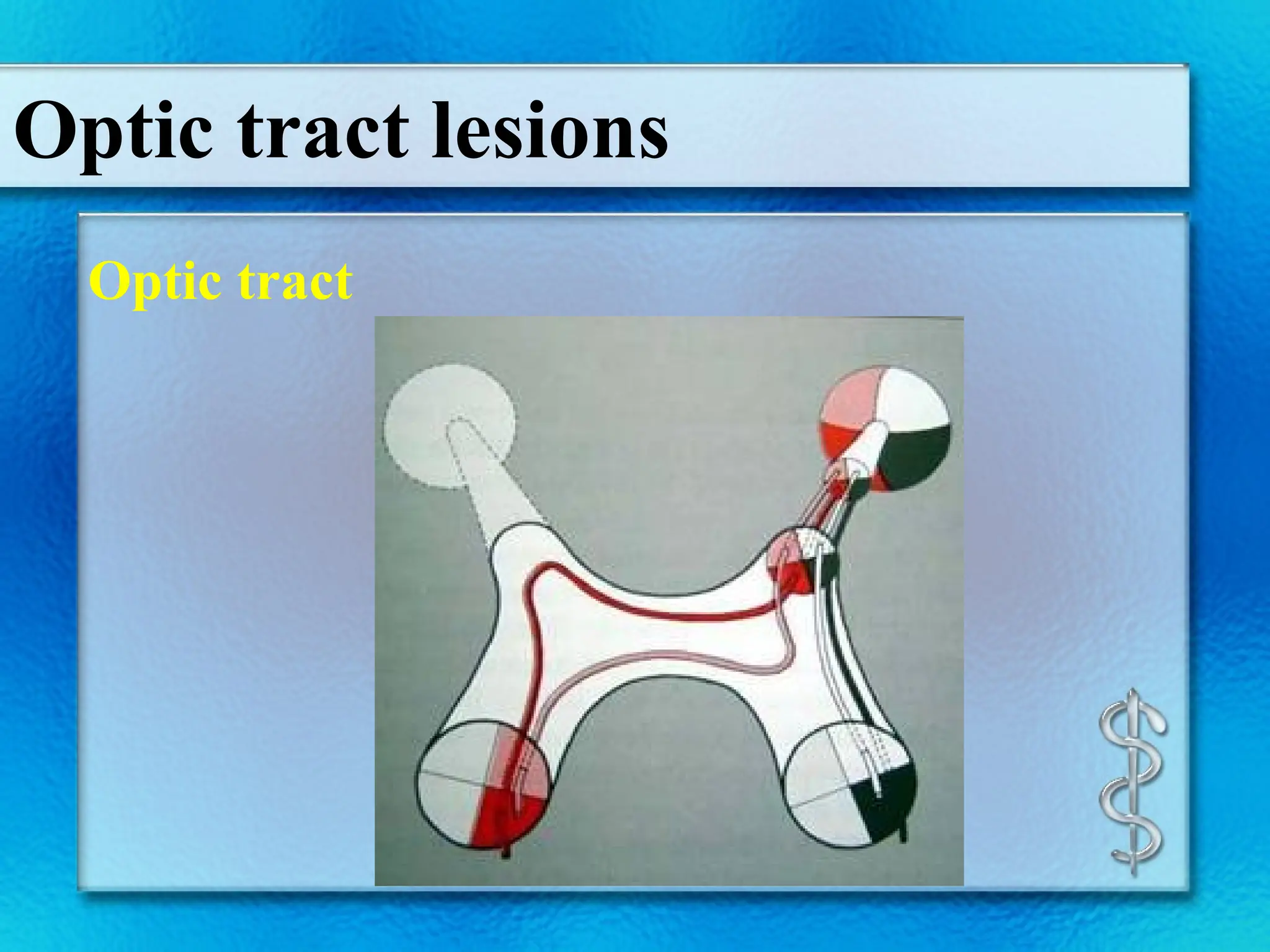
• Contralateral of lesion 、 bilateral
homonymous hemianopia.
• Wernicke’s hemianopia tonic
pupil: when hemianopia side retina
exposed to slit light , pupil doesn’t
constrict.
• Lately, secondary optic atrophy
may occur.
Optic tract lesions
Optic tract
Optic tract lesions
Lateral geniculate body lesions
 Contralateral of
lesion 、 bilateral
homonymous hemianopia.
 Lately, secondary optic
atrophy may occur.
Optic radiation lesions
 Congruous bilateral homonymous
hemianopia
 Macular sparing
 Temporal crescent-shaped visual field loss
 No optic atrophy and Wernicke’s
hemianopia tonic pupil
 Accompany with symptoms of cerebrum
lesion
Occipital lobe lesions
Character: congruous bilateral homonymous
hemianopia with sparing of the macula. No optic
atrophy and Wernicke’s hemianopia tonic pupil.
No phycotic symptoms.
Cortical blindness : Bilateral occipital lobe
infarctions
• Bilateral complete or severe loss of vision
• Normal pupillary responses
• Normal fundus and VEP
Thank you!

OPtic nerve OK Neuro-ophthalmology for MBBs

  • 1.
  • 2.
    Optic nerve diseases Opticnerve : consists of axons that arise from the ganglion cells, optic chiasm is its ending Sheaths of optic nerve : the fibrous wrapping that ensheathe the optic nerve are continuous with the meninges——dura 、 arachnoid and pia mater ;
  • 3.
  • 4.
    Optic nerve diseases Etiology: • 1.inflammation : optic neuritis • 2.Diseases of blood vessel : ischemic optic neuropathy • 3.Tumor : optic glioma 、 meningioma of optic nerve
  • 5.
    Optic neuritis • Definition:Optic neuritis is inflammation 、 disintegration and demyelinaton of the optic nerve. • Classify according to site : Optic papillitis : often seen in children Retrobulbar neuritis : often seen in youth
  • 6.
    Optic neuritis Etiology : •Myelinoclasis : multiple sclerosis,optic neuromyelitis. • Childhood Infections : measles 、 parotitis. • Infection of meninges 、 orbit or nasal sinus. • Infection of eyeball : retinitis 、 uveitis • Idiopathic :
  • 7.
    Optic neuritis Clinical manifestations: • Vision : acute visual loss about 1 week after onset. • flare , orbital pain, the pain is exacerbated by eye movement. • Occasionally Uhthoff's sign (visual deficit with exercise or increase in body temperature). • Pupil: relative afferent pupillary defect (RAPD).
  • 8.
    Optic neuritis Clinical manifestations: • Fundus: Swollen disc with or without peripapillary flame-shaped hemorrhages. Fundus is normal in retrobulbar optic neuritis • Visual field: central scotoma, concentric loss. • VEP: abnormal.
  • 9.
    Optic neuritis Differential diagnosis: • 1.Ischemic optic neuropathy • 2.Leber’s optic neuropathy • 3.Toxic or metabolic optic neuropathy Treatment : • 1.Corticosteroid : • 2.VitamineB , Vasodilator :
  • 10.
    Anterior ischemic opticneuropathy Definition: Anterior ischemic optic neuropathy is characterized by pallid disk swelling associated with acute loss of vision. The disorder is due to occlusion or decreased perfusion of the short posterior ciliary arteries.
  • 11.
    Anterior ischemic opticneuropathy Etiology : 1.Local vascular lesion of papilla 2.Hypotension of eye or total body 3.Blood viscosity ↑ 4.High 5.Ocular hypertension
  • 12.
    Anterior ischemic opticneuropathy Clinical manifestation: symptoms : sudden 、 painless 、 nonprogressive visual loss. signs : vision : moderate loss pupil : afferent pupillary defect Fundus: pale disc swelling often involving only a segment of the disc, flame-shaped hemorrhages, optic atrophy after the edema resolves Visual field: altitudinal or central visual field defect Clinical types : Areritic Anterior ischemic optic neuropathy: due to giant cell arteritis : nonAreritic Anterior ischemic optic neuropathy 50 ~ 60 years
  • 13.
    Anterior ischemic opticneuropathy Differential diagnosis :  Optic neuritis :  Kennedy syndrom : Treatment : Treat systemic disease General application of corticosteroid vasodilator Decrease IOP Optic nerve sheath decompression
  • 14.
    • Definition :Opticatrophy is a nonspecific response to optic nerve (retina to lateral geniculate body) damage from any cause. • Etiology : – Intracranial hypertension or inflammation – Retinopathy – Optic neuropathy – Compressive lesion – Trauma – Metabolic – Hereditary – Nutrient Optic atrophy
  • 15.
    Normal fudus Opticatrophy Optic atrophy
  • 16.
    Classification due tolesion site of fundus and optic nerve : • Primary optic atrophy : or descending optic atrophy • Secondary optic atrophy : or ascending optic atrophy Clinical manifestation : Visual loss significantly , visual field concentric constriction Optic atrophy
  • 17.
    Optic atrophy Primary optic atrophy Secondaryoptic atrophy Etiology Damage of visual path behind cribriform plate Lesions of optic disc 、 retina and choroid, et al. Optic papilla pale , clear border 、 screen mes can be seen in cup Gray-white 、 dirty dark , border not clear 、 physiological depression disappear Vessel of retina normal Narrow artery , vessel with sheath
  • 18.
    Diagnosis : • Accordingto fudus ,visual acuity,visual field,VEP,CT,MRI et al. Treatment : • Treat primary disease • Assistant treatment : neurotrophic medicine and vasodilator Optic atrophy
  • 19.
    Etiology : 1.intracranial : tumor、 hemorrhage 、 edema 、 abscess 2.Intraorbital : tumor 、 inflammation 、 Grave’s disease 3.intraocular : ocular hypotension 、 uveitis 4.Systemic disease : diabetes mellitus 、 leukemia 、 malignant hypertension 、 pulmonary heart disease. Papilledema
  • 20.
    Papilledema Pathogenesis : • Intracranialhypertension • The theory of axoplasma flow
  • 21.
    Clinical manifestaton : •Symptoms : Episodes of transient, often bilateral, visual loss associated with psychiatric symptoms • Visual field : Enlarged physiological blind spot, lately concentric loss Papilledema
  • 22.
  • 23.
    Fundus : fourstages 1. Early stage: hyperemic disc with blurring of the disc margin, peripapillary retinal hemorrhages 2. Advanced stage: Bilaterally swollen, hyperemic discs with flame-like retinal hemorrhages 、 cotton-wool spots 、 macular hemorrhage and exudation. 3. Chronic stage : prominence of disc, cup disappear , and hard exudation 4. Atrophic stage : pale papilla , gliosis Papilledema
  • 24.
    Differential diagnosis : •Optic neuronitis • puedopapilledema • Leber’s optic neuropathy • Ischemic optic neuropathy Treatment : • Treat according to causes : • treat according to symptoms : optic nerve sheath decompression Papilledema
  • 25.
    Optic glioma Meningioma ofoptic nerve Papillary angioma Papillary melanoma Tumor of optic nerve
  • 26.
    Papillary melanoma Papillaryangioma Tumor of optic nerve
  • 27.
    Tumor of opticnerve Optic glioma
  • 28.
     Optic nervehypoplasia  Optic pit  Optic disc drusen  Coloboma of optic nerve  Morning-glory syndrome Abnormal development of optic disc
  • 29.
    Abnormal development ofoptic disc Optic pit
  • 30.
    Abnormal development ofoptic disc Morning-glory syndrome
  • 31.
    Visual pathway : Include: retina、 optic nerve 、 optic chiasma 、 optic tract 、 lateral geniculate body 、 optic radiation occipital cortex. Optic chiasma and visual pathway diseases
  • 32.
    Character: Hemianopia homonymous hemianopsia heteronymoushemianopsia Optic chiasma and visual pathway diseases Hemianopia : blindness in one-half of the field of vision of one or both eyes, is the characteristic of visual pathway lesions.
  • 33.
    Anatomical position ofoptic chiasma : the optic chiasma is variably situated near the top of the diaphragm of the sella turcica, the lamina terminalis forms the anterior wall of the third ventricle, the internal carotid A. lie just laterally, adjacent to the cavernous sinuses. Etiology : most diseases that affect the chiasma are neoplastic, most common is pituitary tumors, next are tuberculum sella meningioma 、 craniopharyngioma 、 anterior communicating aneurysm 、 tumor of third ventricle. Optic chiasma lesions
  • 34.
    Clinical manifestation : Blurred vision : bilateral, simultaneously or by turns  Defect of visual field : bitemporal hemianopsia , early, these defects are typically incomplete and are often asymmetric.  Abnormal ocular movement : tumor offend cavernous sinus or superior orbital fissure  optic atrophy  Symptoms of the primary disease Treatment : treat primary disease. Optic chiasma lesions
  • 35.
    • Contralateral oflesion 、 bilateral homonymous hemianopia. • Wernicke’s hemianopia tonic pupil: when hemianopia side retina exposed to slit light , pupil doesn’t constrict. • Lately, secondary optic atrophy may occur. Optic tract lesions
  • 36.
  • 37.
    Lateral geniculate bodylesions  Contralateral of lesion 、 bilateral homonymous hemianopia.  Lately, secondary optic atrophy may occur.
  • 38.
    Optic radiation lesions Congruous bilateral homonymous hemianopia  Macular sparing  Temporal crescent-shaped visual field loss  No optic atrophy and Wernicke’s hemianopia tonic pupil  Accompany with symptoms of cerebrum lesion
  • 39.
    Occipital lobe lesions Character:congruous bilateral homonymous hemianopia with sparing of the macula. No optic atrophy and Wernicke’s hemianopia tonic pupil. No phycotic symptoms. Cortical blindness : Bilateral occipital lobe infarctions • Bilateral complete or severe loss of vision • Normal pupillary responses • Normal fundus and VEP
  • 40.

Editor's Notes