VENUS
INTERNATIONAL
College Of
Technology
BHOYAN RATHOD, GANDHINGAR.
A presentation on : HYDRO POWER
PLANT
 Name : Amitabh Shukla
 Enrolment no. : 120810111010
 Branch : EC (4th Sem.)
 Subject : Energy Systems
How dose a hydro power plant
works?
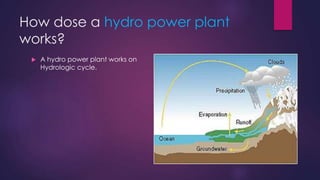
 A hydro power plant works on
Hydrologic cycle.
How dose a hydro power plant
works? (cont..)
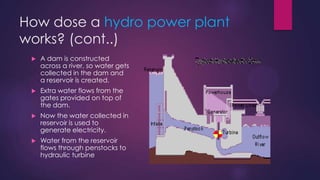
 A dam is constructed
across a river, so water gets
collected in the dam and
a reservoir is created.
 Extra water flows from the
gates provided on top of
the dam.
 Now the water collected in
reservoir is used to
generate electricity.
 Water from the reservoir
flows through penstocks to
hydraulic turbine
How dose a hydro power plant
works? (cont..)
 During this process its potential energy is converted into kinectic
energy.
 This high velocity jets of water strikes the hydraulic turbine and
kinetic energy is converted into mechanical energy.
 Turbine is connected to a alternator (A.C. generator).
 This alternator converts mechanical energy into electrical energy of
electricity.
 Power generated is transmitted over power lines to many parts of
country.
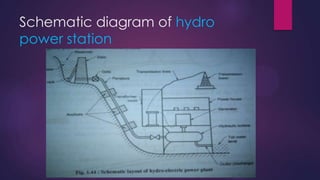
Schematic diagram of hydro
power station
Types of hydro power plant
 Types of plant means types of dams.
 Some of the types are listed below
 Arch
 Gravity
 Buttress
 Embankment or Earth
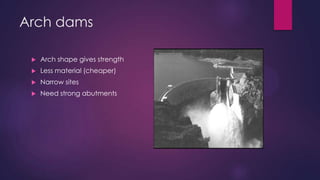
Arch dams
 Arch shape gives strength
 Less material (cheaper)
 Narrow sites
 Need strong abutments
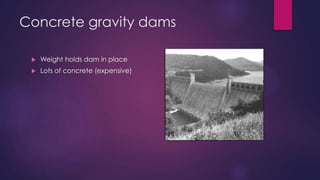
Concrete gravity dams
 Weight holds dam in place
 Lots of concrete (expensive)
Buttress dams
 Face is held up by a series of
supports
 Flat or curved face
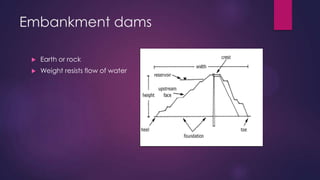
Embankment dams
 Earth or rock
 Weight resists flow of water
Sizes of power plant
 Definitions may vary.
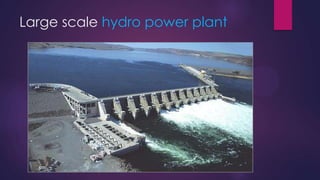
 Large plants : capacity >30 MW
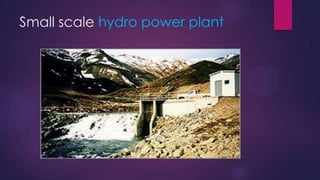
 Small Plants : capacity b/w 100 kW to 30 MW
 Micro Plants : capacity up to 100 kW
Large scale hydro power plant
Small scale hydro power plant
Micro hydro power plant
Generating technologies
 Types of Hydro Turbines:
 Impulse turbines
 Pelton Wheel
 Cross Flow Turbines
 Reaction turbines
 Propeller Turbines : Bulb turbine, Straflo, Tube Turbine,
Kaplan Turbine
 Francis Turbines
 Kinetic Turbines
Impulse turbine
 Uses the velocity of the water to move the runner and discharges to atmospheric
pressure.
 The water stream hits each bucket on the runner.
 No suction downside, water flows out through turbine housing after hitting.
 High head, low flow applications.
 Types : Pelton wheel, Cross Flow
Palton wheels
 Nozzles direct forceful streams of
water against a series of spoon-
shaped buckets mounted around the
edge of a wheel.
 Each bucket reverses the flow of
water and this impulse spins the
turbine.
Palton wheel (cont..)
 Suited for high head, low flow
sites.
 The largest units can be up to
200 MW.
 Can operate with heads as
small as 15 meters and as high
as 1,800 meters.
Reaction turbines
 Combined action of pressure and moving water.
 Runner placed directly in the water stream flowing over the blades rather than
striking each individually.
 lower head and higher flows than compared with the impulse turbines.
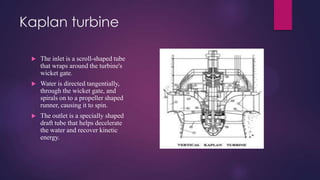
Kaplan turbine
 The inlet is a scroll-shaped tube
that wraps around the turbine's
wicket gate.
 Water is directed tangentially,
through the wicket gate, and
spirals on to a propeller shaped
runner, causing it to spin.
 The outlet is a specially shaped
draft tube that helps decelerate
the water and recover kinetic
energy.
Francis turbine
 The inlet is spiral shaped.
 Guide vanes direct the water
tangentially to the runner.
 This radial flow acts on the
runner vanes, causing the runner
to spin.
 The guide vanes (or wicket
gate) may be adjustable to allow
efficient turbine operation for a
range of water flow conditions.
Francis turbine (cont..)
 Best suited for sites with high
flows and low to medium head.
 Efficiency of 90%.
 expensive to design,
manufacture and install, but
operate for decades
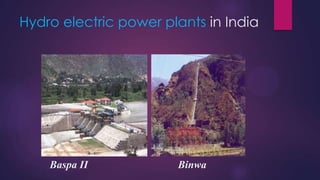
Hydro electric power plants in India
Baspa II Binwa
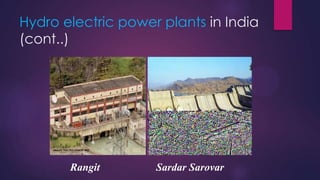
Hydro electric power plants in India
(cont..)
Rangit Sardar Sarovar
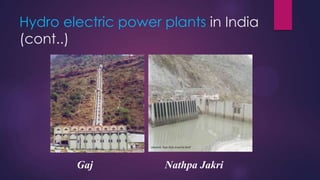
Hydro electric power plants in India
(cont..)
Gaj Nathpa Jakri
Advantages
 Though its capital cost is comparatively high but its operation cost is
much less. Due to this the cost of power generation per unit is low.
 These plants are more reliable.
 Starting and stopping of these plants takes short time compared to
steam and nuclear power plants.
 These power plants don’t have ash disposal and nuclear waste
disposal problems.
 The life expectancy is higher. Its about 50 years.
 These plants have high efficiency over wide range of loads s
compared to other plants.
Advantages (cont..)
 These plants requires less supervising staff.
 These plants can be used for irrigation, transportation, fisheries and
tourism and flood control purposes in addition to power generation.
Disadvantages
 The total power developed depends on total amount of water
supplied, thus it depends on rainfall.
 These plants are generally located far away from load centres,
hence, it requires long transmission lines. It increases the cost of
transmission lines and increases losses.
 Time required developing these plants is high.
Other problems
 Many fishes require flowing water for reproduction and cannot adapt to stagnant
resulting in the reduction in its population.
 Heating of the reservoirs may lead to decrease in the dissolved oxygen levels.
 The point of confluence of fresh water with salt water is a breeding ground for
several aquatic life forms. The reduction in run-off to the sea results in reduction
in their life forms.
 Other water-borne diseases like malaria, river-blindness become prevalent.
Methods to alleviate the negative
impacts
 Creation of ecological reserves.
 Limiting dam construction to allow substantial free flowing water.
 Building sluice gates and passes that help prevent fishes getting trapped.
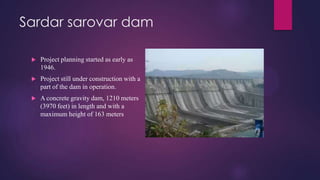
Sardar sarovar dam
 Project planning started as early as
1946.
 Project still under construction with a
part of the dam in operation.
 A concrete gravity dam, 1210 meters
(3970 feet) in length and with a
maximum height of 163 meters
Sardar sarovar dam
 The gross storage capacity of the reservoir is 0.95 M. ha.m. (7.7 MAF) while live
storage capacity is 0.58 M.ha.m. (4.75 MAF).
 The total project cost was estimated at Rs. 49 billion at 1987 price levels.
 There are two power houses project- 1200 MW River Bed Power House and 250
MW Canal Head Power House. Power benefits are shared among Madhya
Pradesh, Maharashtra and Gujarat in the ratio of 57:27:16 respectively.
Environmental protection measures
 About 14000 ha of land has been afforested to compensate for the submergence of
4523 ha of land.
 Formation of co-operatives, extensive training to the fisherman, providing
infrastructure such as fish landing sites, cold storage and transportation etc.
 Surveillance & Control of Water related diseases and communicable diseases.
 Extension of Shoolpaneshwar sanctuary to cover an area of 607 sq.km.
THANKS

Hydro power plant

  • 1.
  • 2.
    A presentation on: HYDRO POWER PLANT  Name : Amitabh Shukla  Enrolment no. : 120810111010  Branch : EC (4th Sem.)  Subject : Energy Systems
  • 3.
    How dose ahydro power plant works?  A hydro power plant works on Hydrologic cycle.
  • 4.
    How dose ahydro power plant works? (cont..)  A dam is constructed across a river, so water gets collected in the dam and a reservoir is created.  Extra water flows from the gates provided on top of the dam.  Now the water collected in reservoir is used to generate electricity.  Water from the reservoir flows through penstocks to hydraulic turbine
  • 5.
    How dose ahydro power plant works? (cont..)  During this process its potential energy is converted into kinectic energy.  This high velocity jets of water strikes the hydraulic turbine and kinetic energy is converted into mechanical energy.  Turbine is connected to a alternator (A.C. generator).  This alternator converts mechanical energy into electrical energy of electricity.  Power generated is transmitted over power lines to many parts of country.
  • 6.
    Schematic diagram ofhydro power station
  • 7.
    Types of hydropower plant  Types of plant means types of dams.  Some of the types are listed below  Arch  Gravity  Buttress  Embankment or Earth
  • 8.
    Arch dams  Archshape gives strength  Less material (cheaper)  Narrow sites  Need strong abutments
  • 9.
    Concrete gravity dams Weight holds dam in place  Lots of concrete (expensive)
  • 10.
    Buttress dams  Faceis held up by a series of supports  Flat or curved face
  • 11.
    Embankment dams  Earthor rock  Weight resists flow of water
  • 12.
    Sizes of powerplant  Definitions may vary.  Large plants : capacity >30 MW  Small Plants : capacity b/w 100 kW to 30 MW  Micro Plants : capacity up to 100 kW
  • 13.
    Large scale hydropower plant
  • 14.
    Small scale hydropower plant
  • 15.
  • 16.
    Generating technologies  Typesof Hydro Turbines:  Impulse turbines  Pelton Wheel  Cross Flow Turbines  Reaction turbines  Propeller Turbines : Bulb turbine, Straflo, Tube Turbine, Kaplan Turbine  Francis Turbines  Kinetic Turbines
  • 17.
    Impulse turbine  Usesthe velocity of the water to move the runner and discharges to atmospheric pressure.  The water stream hits each bucket on the runner.  No suction downside, water flows out through turbine housing after hitting.  High head, low flow applications.  Types : Pelton wheel, Cross Flow
  • 18.
    Palton wheels  Nozzlesdirect forceful streams of water against a series of spoon- shaped buckets mounted around the edge of a wheel.  Each bucket reverses the flow of water and this impulse spins the turbine.
  • 19.
    Palton wheel (cont..) Suited for high head, low flow sites.  The largest units can be up to 200 MW.  Can operate with heads as small as 15 meters and as high as 1,800 meters.
  • 20.
    Reaction turbines  Combinedaction of pressure and moving water.  Runner placed directly in the water stream flowing over the blades rather than striking each individually.  lower head and higher flows than compared with the impulse turbines.
  • 21.
    Kaplan turbine  Theinlet is a scroll-shaped tube that wraps around the turbine's wicket gate.  Water is directed tangentially, through the wicket gate, and spirals on to a propeller shaped runner, causing it to spin.  The outlet is a specially shaped draft tube that helps decelerate the water and recover kinetic energy.
  • 22.
    Francis turbine  Theinlet is spiral shaped.  Guide vanes direct the water tangentially to the runner.  This radial flow acts on the runner vanes, causing the runner to spin.  The guide vanes (or wicket gate) may be adjustable to allow efficient turbine operation for a range of water flow conditions.
  • 23.
    Francis turbine (cont..) Best suited for sites with high flows and low to medium head.  Efficiency of 90%.  expensive to design, manufacture and install, but operate for decades
  • 24.
    Hydro electric powerplants in India Baspa II Binwa
  • 25.
    Hydro electric powerplants in India (cont..) Rangit Sardar Sarovar
  • 26.
    Hydro electric powerplants in India (cont..) Gaj Nathpa Jakri
  • 27.
    Advantages  Though itscapital cost is comparatively high but its operation cost is much less. Due to this the cost of power generation per unit is low.  These plants are more reliable.  Starting and stopping of these plants takes short time compared to steam and nuclear power plants.  These power plants don’t have ash disposal and nuclear waste disposal problems.  The life expectancy is higher. Its about 50 years.  These plants have high efficiency over wide range of loads s compared to other plants.
  • 28.
    Advantages (cont..)  Theseplants requires less supervising staff.  These plants can be used for irrigation, transportation, fisheries and tourism and flood control purposes in addition to power generation.
  • 29.
    Disadvantages  The totalpower developed depends on total amount of water supplied, thus it depends on rainfall.  These plants are generally located far away from load centres, hence, it requires long transmission lines. It increases the cost of transmission lines and increases losses.  Time required developing these plants is high.
  • 30.
    Other problems  Manyfishes require flowing water for reproduction and cannot adapt to stagnant resulting in the reduction in its population.  Heating of the reservoirs may lead to decrease in the dissolved oxygen levels.  The point of confluence of fresh water with salt water is a breeding ground for several aquatic life forms. The reduction in run-off to the sea results in reduction in their life forms.  Other water-borne diseases like malaria, river-blindness become prevalent.
  • 31.
    Methods to alleviatethe negative impacts  Creation of ecological reserves.  Limiting dam construction to allow substantial free flowing water.  Building sluice gates and passes that help prevent fishes getting trapped.
  • 32.
    Sardar sarovar dam Project planning started as early as 1946.  Project still under construction with a part of the dam in operation.  A concrete gravity dam, 1210 meters (3970 feet) in length and with a maximum height of 163 meters
  • 33.
    Sardar sarovar dam The gross storage capacity of the reservoir is 0.95 M. ha.m. (7.7 MAF) while live storage capacity is 0.58 M.ha.m. (4.75 MAF).  The total project cost was estimated at Rs. 49 billion at 1987 price levels.  There are two power houses project- 1200 MW River Bed Power House and 250 MW Canal Head Power House. Power benefits are shared among Madhya Pradesh, Maharashtra and Gujarat in the ratio of 57:27:16 respectively.
  • 34.
    Environmental protection measures About 14000 ha of land has been afforested to compensate for the submergence of 4523 ha of land.  Formation of co-operatives, extensive training to the fisherman, providing infrastructure such as fish landing sites, cold storage and transportation etc.  Surveillance & Control of Water related diseases and communicable diseases.  Extension of Shoolpaneshwar sanctuary to cover an area of 607 sq.km.
  • 35.