Technical Seminar Report On “ 8087 NUMERCAL DATA PROCESSOR”   submitted by  Siba Prasad Mohanty  EC200118338  under the guidance of Mr. M. Suresh
INTRODUCTION 8087 NDP (numerical data processor) is also known as math co-processor which is used in parallel with the main processor for number crunching applications, which would otherwise require complex programming.  It is also faster than 8086/8088 processor in performing mathematical computation. It has its own specialized instruction sets to handle mathematical programs.
LIMITATIONS OF PRESENT PROCESSORS General processors need complex programming to do mathematical calculations. Use of high level language. A library of floating point object has to be obtained from the manufacturer.
8087 NDP It is a processor which works in parallel with the main processor.  It has its own set of specialized instructions. The number crunching part of the program is executed by 8087. Instruction for 8087 are written in the main program interspersed with the 8086 instructions. All the 8087 instruction codes have 11011 as the most significant bits of their first code byte.
8087 DATA TYPES Binary Integers Packed Decimal Numbers Real Numbers Temporary Real Format
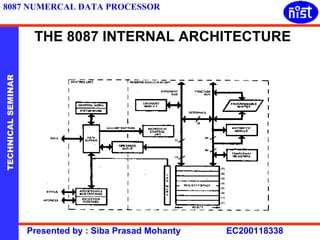
THE 8087 INTERNAL ARCHITECTURE
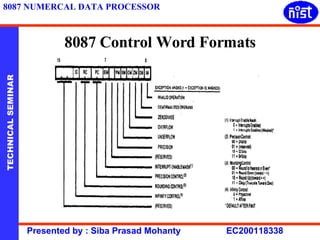
8087 Control Word Formats
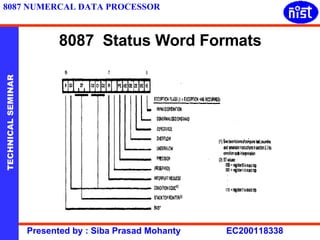
8087  Status Word Formats
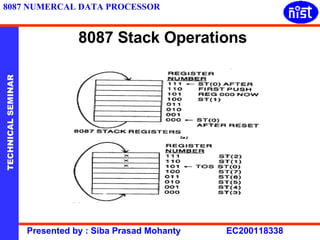
8087 Stack Operations
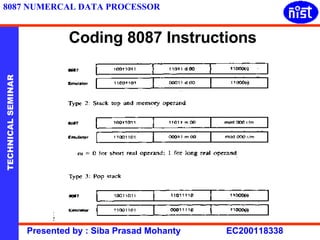
Coding 8087 Instructions
8087 Instruction Descriptions Data Transfer Instructions Real Transfers Integer Transfers Packed Decimal Transfers Arithmetic Instructions Addition Subtraction Reversed Subtraction Multiplication Division Reversed Division
Other Arithmetic Operations Compare Instructions Transcendental (Trigonometric and Exponential) Instructions Processor Control Instructions
CONCLUSION 8087 NDP is an actual processor and is used in parallel with the main processor. It is mostly used in business applications. The machine that we see in the grocery stores which gives us our bill uses 8087. Though many manufactures have their variety of numerical data processor, they have the same architecture.
Thank You

8087 Data Processor

  • 1.
    Technical Seminar ReportOn “ 8087 NUMERCAL DATA PROCESSOR” submitted by Siba Prasad Mohanty EC200118338 under the guidance of Mr. M. Suresh
  • 2.
    INTRODUCTION 8087 NDP(numerical data processor) is also known as math co-processor which is used in parallel with the main processor for number crunching applications, which would otherwise require complex programming. It is also faster than 8086/8088 processor in performing mathematical computation. It has its own specialized instruction sets to handle mathematical programs.
  • 3.
    LIMITATIONS OF PRESENTPROCESSORS General processors need complex programming to do mathematical calculations. Use of high level language. A library of floating point object has to be obtained from the manufacturer.
  • 4.
    8087 NDP Itis a processor which works in parallel with the main processor. It has its own set of specialized instructions. The number crunching part of the program is executed by 8087. Instruction for 8087 are written in the main program interspersed with the 8086 instructions. All the 8087 instruction codes have 11011 as the most significant bits of their first code byte.
  • 5.
    8087 DATA TYPESBinary Integers Packed Decimal Numbers Real Numbers Temporary Real Format
  • 6.
    THE 8087 INTERNALARCHITECTURE
  • 7.
  • 8.
    8087 StatusWord Formats
  • 9.
  • 10.
  • 11.
    8087 Instruction DescriptionsData Transfer Instructions Real Transfers Integer Transfers Packed Decimal Transfers Arithmetic Instructions Addition Subtraction Reversed Subtraction Multiplication Division Reversed Division
  • 12.
    Other Arithmetic OperationsCompare Instructions Transcendental (Trigonometric and Exponential) Instructions Processor Control Instructions
  • 13.
    CONCLUSION 8087 NDPis an actual processor and is used in parallel with the main processor. It is mostly used in business applications. The machine that we see in the grocery stores which gives us our bill uses 8087. Though many manufactures have their variety of numerical data processor, they have the same architecture.
  • 14.