Coprocessor
History Of Coprocessor
Coprocessors for floating-point arithmetic
first appeared in desktop computers in the
1970s and became common throughout
the 1980s and into the early 1990s. Early
8-bit and 16-bit processors used software
to carry out
floating-point arithmetic operations.
What is Coprocessor
A coprocessor is a special set of circuits in
a microcomputer that is designed to
manipulate numbers or perform some
other specialized function more quickly
than the basic microprocessor circuits
could perform the same task.
Coprocessor
Processor
Coprocessor
Coprocessor
**Not only extends the capabilities of the
host computer but also increases the
processing rate of the system
**The Coprocessor concept is widely used
with typical 32-bit microprocessor such as
Motorola 68020 and Intel 80386
Why Coprocessor is used?
The large calculation computation is not
possible by 8085,8086…..
For Example:
*Floating point arithmetic, graphics, signal
=====processing, string processing ……..
* Such functions as square root, sine,
cosine, and ===logarithms are not directly
available in a ===general purpose
processor
To eliminate this problem Coprocessor is
=====used
How Coprocessor is interface
with main processor ?
There are two process
1. Intelligent monitor interface
2 . Special signal interface
Intelligent monitor interface
When instruction is flow to main processor
by BUS , the Coprocessor monitoring the
instruction. Some operation will be failed
in this operation is performed by
Coprocessor
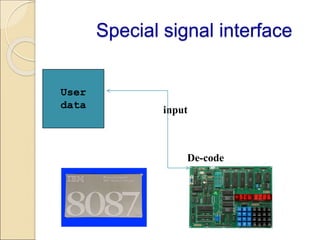
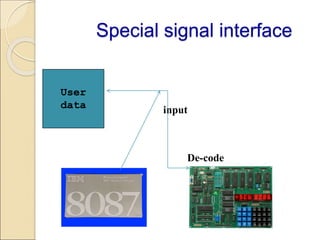
Special signal interface
User
data input
De-code
Special signal interface
User
data input
De-code
Special signal interface
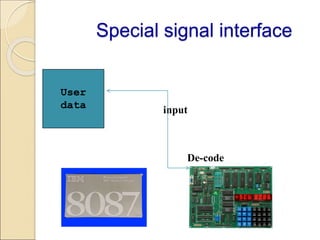
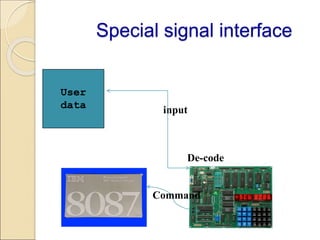
When the main processor executes a
instruction, it decodes the instruction and
write a command in the command register
specifying the operation required by the
Coprocessor. Coprocessor performed
operation this operation and provide this
result
Special signal interface
User
data input
De-code
Special signal interface
User
data input
De-code
Command
Coprocessor and Peripherals
*A Coprocessor is a device that has the
capability of communicating with the main
processor.
*The Coprocessor also adds additional
instructions , registers, and data types that
are not directly supported by the main
processor.
*The Coprocessor provide capabilities to
the user.
Coprocessor and Peripherals
*On the other hand it communicate throw
the use of interface resistance
*It is not possible to calculate computation
*It is only used i/o operation
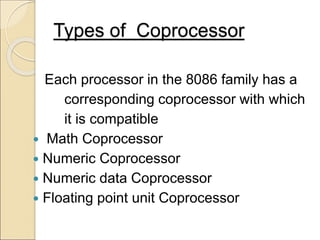
Types of Coprocessor
Each processor in the 8086 family has a
corresponding coprocessor with which
it is compatible
 Math Coprocessor
 Numeric Coprocessor
 Numeric data Coprocessor
 Floating point unit Coprocessor
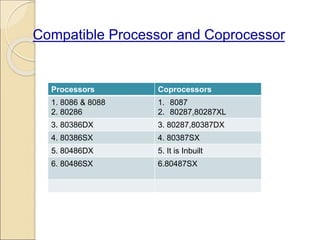
Compatible Processor and Coprocessor
Processors Coprocessors
1. 8086 & 8088
2. 80286
1. 8087
2. 80287,80287XL
3. 80386DX 3. 80287,80387DX
4. 80386SX 4. 80387SX
5. 80486DX 5. It is Inbuilt
6. 80486SX 6.80487SX
INTERFACING OF main processor AND
coprocessor
 Multiplexed address-data bus lines are
connected directly from main processor to
coprocessor.
 The status lines and the queue status
lines are connected directly from main
processor to coprocessor.
 BUSY signal of coprocessor is
connected to TEST pin of main processor
.
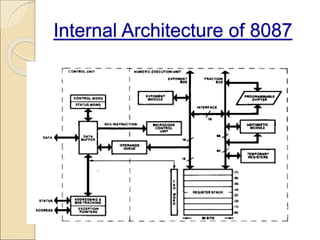
Architecture of 8087
 ** Control Unit
 ** Execution Unit
Control Unit
 It interfaces coprocessor to the
microprocessor system bus.
 It also synchronize the operation of the
coprocessor and the microprocessor.
Numeric Execution Unit
 This unit is responsible for executing all
coprocessor instructions.
 It has an 8 register stack that holds the
operands for instructions and result of
instructions.
 The stack contains 8 registers that are
80-bits wide.
About 8087 Coprocessor
*When an 8087 is present in a
microcomputer system, it adds 68 numeric
processing instructions and 80 bit register
to the microprocessor’s register set.
*Bus support 7 data types which include
16,32 and 64 bit integer 32,64, and 80 bit
floating point and 18-digit BCD operands.
*It includes several arithmetic, trigonometric
,exponential , and algorithmic instruction
etc.
Internal Architecture of 8087
About 80287 Coprocessor
**80287 is an enhanced 8087 that extends the
80286 microprocessor.
**It is designed using HMOS technology.
**The 80287 expands the 80286 data types to
include 32,64, and 80 bit floating point 32,64
integer and 18 digit BCD operands.
About 80287 Coprocessor
* Upon reset, it operates in real address
mode.
* It can be placed in protected address
mode and cannot be placed back to real
address mode unless reset.
About 80387 Coprocessor
*80387 is a numeric coprocessor that
extends the 80386 processor with floating-
point, extended integer, and BCD data
types. The 80387 includes 32, 64 and 80
bit floating point, and 64-bit integers, and
18-digit BCD operands.
*The 80387 includes three functional units
that can operate in parallel.
*All communication between the 80386 and
80387 is transparent to application
software

3. Coprocessor.ppt

  • 1.
  • 2.
    History Of Coprocessor Coprocessorsfor floating-point arithmetic first appeared in desktop computers in the 1970s and became common throughout the 1980s and into the early 1990s. Early 8-bit and 16-bit processors used software to carry out floating-point arithmetic operations.
  • 3.
    What is Coprocessor Acoprocessor is a special set of circuits in a microcomputer that is designed to manipulate numbers or perform some other specialized function more quickly than the basic microprocessor circuits could perform the same task.
  • 4.
  • 5.
    Coprocessor **Not only extendsthe capabilities of the host computer but also increases the processing rate of the system **The Coprocessor concept is widely used with typical 32-bit microprocessor such as Motorola 68020 and Intel 80386
  • 6.
    Why Coprocessor isused? The large calculation computation is not possible by 8085,8086….. For Example: *Floating point arithmetic, graphics, signal =====processing, string processing …….. * Such functions as square root, sine, cosine, and ===logarithms are not directly available in a ===general purpose processor To eliminate this problem Coprocessor is =====used
  • 7.
    How Coprocessor isinterface with main processor ? There are two process 1. Intelligent monitor interface 2 . Special signal interface
  • 8.
    Intelligent monitor interface Wheninstruction is flow to main processor by BUS , the Coprocessor monitoring the instruction. Some operation will be failed in this operation is performed by Coprocessor
  • 9.
  • 10.
  • 11.
    Special signal interface Whenthe main processor executes a instruction, it decodes the instruction and write a command in the command register specifying the operation required by the Coprocessor. Coprocessor performed operation this operation and provide this result
  • 12.
  • 13.
  • 14.
    Coprocessor and Peripherals *ACoprocessor is a device that has the capability of communicating with the main processor. *The Coprocessor also adds additional instructions , registers, and data types that are not directly supported by the main processor. *The Coprocessor provide capabilities to the user.
  • 15.
    Coprocessor and Peripherals *Onthe other hand it communicate throw the use of interface resistance *It is not possible to calculate computation *It is only used i/o operation
  • 16.
    Types of Coprocessor Eachprocessor in the 8086 family has a corresponding coprocessor with which it is compatible  Math Coprocessor  Numeric Coprocessor  Numeric data Coprocessor  Floating point unit Coprocessor
  • 17.
    Compatible Processor andCoprocessor Processors Coprocessors 1. 8086 & 8088 2. 80286 1. 8087 2. 80287,80287XL 3. 80386DX 3. 80287,80387DX 4. 80386SX 4. 80387SX 5. 80486DX 5. It is Inbuilt 6. 80486SX 6.80487SX
  • 18.
    INTERFACING OF mainprocessor AND coprocessor  Multiplexed address-data bus lines are connected directly from main processor to coprocessor.  The status lines and the queue status lines are connected directly from main processor to coprocessor.  BUSY signal of coprocessor is connected to TEST pin of main processor .
  • 19.
    Architecture of 8087 ** Control Unit  ** Execution Unit
  • 20.
    Control Unit  Itinterfaces coprocessor to the microprocessor system bus.  It also synchronize the operation of the coprocessor and the microprocessor.
  • 21.
    Numeric Execution Unit This unit is responsible for executing all coprocessor instructions.  It has an 8 register stack that holds the operands for instructions and result of instructions.  The stack contains 8 registers that are 80-bits wide.
  • 22.
    About 8087 Coprocessor *Whenan 8087 is present in a microcomputer system, it adds 68 numeric processing instructions and 80 bit register to the microprocessor’s register set. *Bus support 7 data types which include 16,32 and 64 bit integer 32,64, and 80 bit floating point and 18-digit BCD operands. *It includes several arithmetic, trigonometric ,exponential , and algorithmic instruction etc.
  • 23.
  • 24.
    About 80287 Coprocessor **80287is an enhanced 8087 that extends the 80286 microprocessor. **It is designed using HMOS technology. **The 80287 expands the 80286 data types to include 32,64, and 80 bit floating point 32,64 integer and 18 digit BCD operands.
  • 25.
    About 80287 Coprocessor *Upon reset, it operates in real address mode. * It can be placed in protected address mode and cannot be placed back to real address mode unless reset.
  • 26.
    About 80387 Coprocessor *80387is a numeric coprocessor that extends the 80386 processor with floating- point, extended integer, and BCD data types. The 80387 includes 32, 64 and 80 bit floating point, and 64-bit integers, and 18-digit BCD operands. *The 80387 includes three functional units that can operate in parallel. *All communication between the 80386 and 80387 is transparent to application software