SARS COV- 2
Pathogenesis, Laboratory Diagnosis,
Management and Prophylaxis
OUTLINE
• Introduction
• Pathogenesis
• Laboratory diagnosis
• Management
• Prophylaxis
Introduction
• SARS-CoV-2,the causative agent of COVID-19, a newly emergent coronavirus.
• First detected in Wuhan, China, in December 2019.
• Order Nidovirales, Family Coronaviridae , Subfamily Coronavirinae, genus
coronavirus
• 4genera(α coronavirus, β coronavirus, γ coronavirus, δ coronavirus)
• SARS CoV 2 strain comes under the genera β coronavirus subgenus
sarbecovirus.
• In December 2019, China reported an outbreak of pneumonia of unknown
causes in Wuhan, the capital city of Hubei province
• Earlier, 2019–novel Coronavirus (2019–nCoV)
• On February 11, 2020, ICTV renamed as SARS–CoV2 (genome resembled to
SARS-CoV)
• WHO named the resultant disease as Coronavirus disease (COVID-19)
• WHO designated SARS-CoV-2 a Public Health Emergency of International
Concern on January 30, 2020, and pandemic on March 11, 2020
Epidemiology
• On January 11, the first case was reported outside mainland China in Thailand.
• Within months, the disease spread to all the continents except Antarctica.
• India reported its first case on January 30, 2020 in Kerala.
• The first COVID-19 related death in India was reported on March 12, 2020.
• By the second week of April, the disease spread to all states in India except
Sikkim.
• Pandemic occurred in 3 waves, first around September 2020,second in April
2021, third in January 2022.
• On 25th March 2020, Govt of india declared a country wide lockdown till 31st
march, which was extended upto 14th April 2020,
• Further extended to 3rd may then upto 17th may 2020- covers 4 phases of
lockdown f/w gradual un-lockdown in the country, spread in 6 phases(one
month each) upto 30th november2020.
• Aarogya setu app: Launched by the GOI on 2nd April 2020(location based
surveillance app)
Morphology
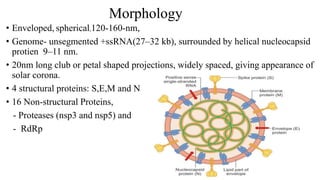
• Enveloped, spherical,120-160-nm,
• Genome- unsegmented +ssRNA(27–32 kb), surrounded by helical nucleocapsid
protien 9–11 nm.
• 20nm long club or petal shaped projections, widely spaced, giving appearance of
solar corona.
• 4 structural proteins: S,E,M and N
• 16 Non-structural Proteins,
- Proteases (nsp3 and nsp5) and
- RdRp
Variants of SARS-CoV-2: (Variants of concern)
1) B.1.1.7 (Alpha)-First detected in the U.K. in September 2020,
• N501Y mutation in the RBD region of the Spike protein.
• Enhance binding b/w the SARS-CoV-2 Spike protein and the human ACE2
receptor,
2) B.1.351 (Beta)- Arose in South Africa, both the E484K and N501Y mutations.
3) P.1 (Gamma)-Emerged in Brazil; detected in the USA by the end of Jan 2021.
• Three (K417T, E484K, and N501Y) within the RBD of Spike.
• E484K- affect the ability of antibodies to recognize and neutralize the virus.
4) B.1.617.2 (Delta): “double mutant” variant,
• First identified in India in December 2020 (second wave)
• L452R- Stabilize the interaction between the spike protein and the host cell -
increase infectivity
• E484 mutation, higher infectivity and transmission rates.
5) B.1.1.529 (Omicron): Have high transmissibility but produced less severe
symptoms and hospitalization.
• In India 3rd wave was largely attributed by this variant.
• Mode of transmission- By droplet borne infection, either directly or indirectly,
through fomites.
• Airborne transmission can occur during medical procedure.
• Risk factor-
-Advanced age
-Male sex
- Preexisting comorbidities
- Elevated body mass index
- Substance use, such as alcohol, opioid, or cocaine use disorder, and current or
former smoking both increase risk.
- Pregnant women
Pathogenesis
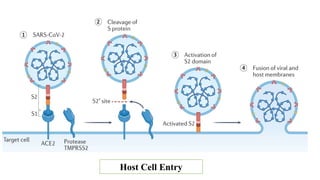
Host Cell Entry
• Course of infection goes through the following stages –
- Viral invasion and replication,
- Dysregulated immune response,
- Multiple organ damage and recovery.
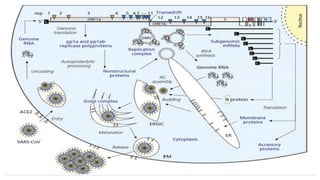
• Virus enters the host cells, replicates, assembles and is released extracellularly to
target cells, damage and destruction of alveolar epithelial cells.
• At the same time,large number of PAMP and DAMP molecules are released -
stimulate the innate immune response, release large quantities of cytokines,
chemokines, proteases and free radicals, ARDS, sepsis and MODS
Clinical presentation-
• IP- 2 to 14 days.
• Fever is probably one of the most common
• Dry cough
• Anosmia or hyposmia and loss of taste
• Anorexia
• Myalgia and dyspnea
• Gastrointestinal symptoms included diarrhea, abdominal pain, and
vomiting/nausea
Clinical Severity:
oAsymptomatic
oMild disease/ILI ((influenza-like illness) -Have fever, cough, sore throat,
malaise, headache.
oModerate disease/Pneumonia- ILI plus any one:
1) Respiratory rate ≥ 24/min, breathlessness
2) SpO2: 90% to ≤ 93% on room air
oSevere disease/SARI/Severe Pneumonia-Pneumonia plus any one:
1)Respiratory rate ≥ 24/min,breathlessness
2)SpO2: 90% to ≤ 93% on room air
oCritical- Respiratory failure, Septic shock, and/or Multiorgan failure
Laboratory diagnosis
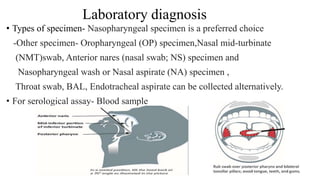
• Types of specimen- Nasopharyngeal specimen is a preferred choice
-Other specimen- Oropharyngeal (OP) specimen,Nasal mid-turbinate
(NMT)swab, Anterior nares (nasal swab; NS) specimen and
Nasopharyngeal wash or Nasal aspirate (NA) specimen ,
Throat swab, BAL, Endotracheal aspirate can be collected alternatively.
• For serological assay- Blood sample
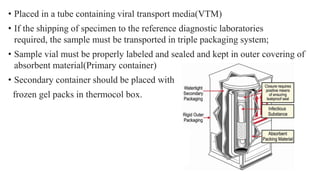
• Placed in a tube containing viral transport media(VTM)
• If the shipping of specimen to the reference diagnostic laboratories
required, the sample must be transported in triple packaging system;
• Sample vial must be properly labeled and sealed and kept in outer covering of
absorbent material(Primary container)
• Secondary container should be placed with
frozen gel packs in thermocol box.
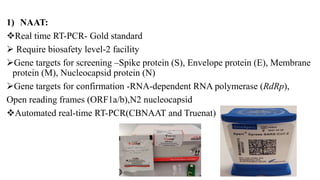
1) NAAT:
Real time RT-PCR- Gold standard
 Require biosafety level-2 facility
Gene targets for screening –Spike protein (S), Envelope protein (E), Membrane
protein (M), Nucleocapsid protein (N)
Gene targets for confirmation -RNA-dependent RNA polymerase (RdRp),
Open reading frames (ORF1a/b),N2 nucleocapsid
Automated real-time RT-PCR(CBNAAT and Truenat)
2)Antigen detection assay: Point-of-care test; detects
nucleocapsid protein antigen in nasopharyngeal swab
3)Antibody (IgG) detection assay: Used for serosurveillance
and survey in high-risk and vulnerable group; not for clinical diagnosis
4)Sequencing: To determine mutations in the viral genome
5)Viral culture: Used for research purpose
- Require biosafety level-3 facility
6)Nonspecific tests include:
Radiology (chest CT scan): Ground-glass appearance
Biomarkers: IL-6, D-dimer, Elevated serum ferritin, Elevated C-reactive
protein
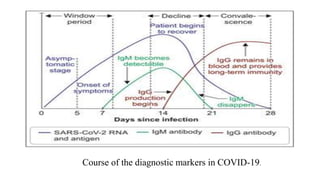
Course of the diagnostic markers in COVID-19.
7)LAMP TEST(Loop Mediated isothermal amplification):
• Developed by Tsugunori Notomi at Eikens chemicals, Tokyo, Japan.
• Having higher sensitivity and specificity than traditional PCR.
• Approved for Covid diagnosis in India as Lume-NCoV Kits from Agappe
Diagnostic Kochi,Kerala.
8) CRISPR (Clustered Regularly Inter Spaced Short Palindromic Repeats):
• Developed in the USA as the ‘Sherlock’ test.
• The test developed in India based on this named ‘FELUDA’.
• Commercially launched in India by Tata medical diagnostics as ‘TataMD
CHECK CRISPR test’
• Test uses CAS9 protein to find and bind to target RNA.
• Coupled with paper strip chemistry to allow a visual reading.
Management
• No definitive therapy
• Symptomatic management-In patients with severe respiratory distress
oSupplemental oxygen therapy is given immediately
oHigh-flow nasal cannula oxygenation (HFNO)
oNon-invasive mechanical ventilation
oMechanical ventilation: In patients with moderate or severe ARDS, higher
PEEP (positive end-expiratory pressure) instead of lower PEEP is suggested.
• Management of septic shock by—vasopressors, fluid replacement by
crystalloids such as normal saline and Ringer’s lactate
• Convalescent plasma therapy
• Drugs-Remdesivir, Tocilizumab, Hydroxychloroquine (HCQ)
Prophylaxis
• WHO recommends protective measures to help prevent the spread of the disease
-Wearing mask
- Frequent hand washing,
- Avoiding touching of eyes, nose or mouth,
- Maintaining a distance of at least 1 m between people,
- Practicing respiratory hygiene,
• Chemoprophylaxis- Hydroxychloroquine
Types of vaccines :
-Inactivated or live-attenuated - Covaxin, CoroVac and BBIBP-CorV
- Protein subunit based - Novavax, Epi Vac Corona
- mRNA based - Moderna, Pfizer–BioNTech (BNT162b2)
-Viral vector: ( recombinant adenovirus with a SARS-COV-2 gene ) - Covishield,
Oxford-Astrazeneca, Sputnik V and Johnson & Johnson COVID -19 vaccine
Covaxin: code name is BBV152.
- Prepared by Hyderabad- based Bharat Biotech International Ltd. in
collaboration with the National Institute of Virology (NIV) and ICMR
-effectiveness - 78-81%.
- administered in two doses (4-6weeks apart) by IM route
Covishield:code name AZD1222, prepared by Serum Institute of India, in
collaboration with University of Oxford and AstraZeneca pharmaceuticals,
UK.
- Effectiveness 90%
- Based on non-replicating adenovirus vector (modified Chimpanzee
adenovirus, ChAdOx1) expressing spike protein.
- Administered in two doses (12-16weeks apart) by IM route.
Sputnik V, by the code name rAd26-S and rAd5-S, was developed by
Gamaleya Research Institute of Epidemiology and Microbiology, which
involves an interval gap of 21 days between the two doses.
- Effectiveness 92.2%
• CoWIN (Covid Vaccine Intelligence Network)- Indian government web portal
for Covid 19 vaccination registration and also for obtaining the certificate after
vaccination.
REFERENCES:
• Medical Microbiology – 28th edition, Jawetz, Melnick & Adelberg’s
• Ananthanarayan and Paniker’s Textbook of Microbiology – 8th edition
• Park's textbook of preventive & social medicine, 26TH edition
• Apurba Sanker Sastry, Sandhya Bhat Essentials of Medical Microbiology, 3rd Edition
• Kumar KSR, Mufti SS, Sarathy V, Hazarika D, Naik R. An Update on Advances in COVID-19
Laboratory Diagnosis and Testing Guidelines in India. Front Public Health. 2021 Mar 4;9:568603. doi:
10.3389/fpubh.2021.568603. PMID: 33748054; PMCID: PMC7969786.
• Aleem A, Akbar Samad AB, Vaqar S. Emerging Variants of SARS-CoV-2 and Novel Therapeutics
Against Coronavirus (COVID-19). 2023 May 8. In: StatPearls [Internet]. Treasure Island (FL): StatPearls
Publishing; 2023 Jan–. PMID: 34033342.
• Mukim M, Sharma P, Patweker M, Patweker F, Kukkar R, Patel R. Covid-19 Vaccines Available in India.
Comb Chem High Throughput Screen. 2022;25(14):2391-2397. doi:
10.2174/1386207325666220315115953. PMID: 35293291.
8.SARS COV-2.pptx LAB DIAGNOSIS PROPHYLAXIS

8.SARS COV-2.pptx LAB DIAGNOSIS PROPHYLAXIS

  • 1.
    SARS COV- 2 Pathogenesis,Laboratory Diagnosis, Management and Prophylaxis
  • 2.
    OUTLINE • Introduction • Pathogenesis •Laboratory diagnosis • Management • Prophylaxis
  • 3.
    Introduction • SARS-CoV-2,the causativeagent of COVID-19, a newly emergent coronavirus. • First detected in Wuhan, China, in December 2019. • Order Nidovirales, Family Coronaviridae , Subfamily Coronavirinae, genus coronavirus • 4genera(α coronavirus, β coronavirus, γ coronavirus, δ coronavirus) • SARS CoV 2 strain comes under the genera β coronavirus subgenus sarbecovirus.
  • 4.
    • In December2019, China reported an outbreak of pneumonia of unknown causes in Wuhan, the capital city of Hubei province • Earlier, 2019–novel Coronavirus (2019–nCoV) • On February 11, 2020, ICTV renamed as SARS–CoV2 (genome resembled to SARS-CoV) • WHO named the resultant disease as Coronavirus disease (COVID-19) • WHO designated SARS-CoV-2 a Public Health Emergency of International Concern on January 30, 2020, and pandemic on March 11, 2020 Epidemiology
  • 5.
    • On January11, the first case was reported outside mainland China in Thailand. • Within months, the disease spread to all the continents except Antarctica. • India reported its first case on January 30, 2020 in Kerala. • The first COVID-19 related death in India was reported on March 12, 2020. • By the second week of April, the disease spread to all states in India except Sikkim. • Pandemic occurred in 3 waves, first around September 2020,second in April 2021, third in January 2022.
  • 6.
    • On 25thMarch 2020, Govt of india declared a country wide lockdown till 31st march, which was extended upto 14th April 2020, • Further extended to 3rd may then upto 17th may 2020- covers 4 phases of lockdown f/w gradual un-lockdown in the country, spread in 6 phases(one month each) upto 30th november2020. • Aarogya setu app: Launched by the GOI on 2nd April 2020(location based surveillance app)
  • 7.
    Morphology • Enveloped, spherical,120-160-nm, •Genome- unsegmented +ssRNA(27–32 kb), surrounded by helical nucleocapsid protien 9–11 nm. • 20nm long club or petal shaped projections, widely spaced, giving appearance of solar corona. • 4 structural proteins: S,E,M and N • 16 Non-structural Proteins, - Proteases (nsp3 and nsp5) and - RdRp
  • 8.
    Variants of SARS-CoV-2:(Variants of concern) 1) B.1.1.7 (Alpha)-First detected in the U.K. in September 2020, • N501Y mutation in the RBD region of the Spike protein. • Enhance binding b/w the SARS-CoV-2 Spike protein and the human ACE2 receptor, 2) B.1.351 (Beta)- Arose in South Africa, both the E484K and N501Y mutations. 3) P.1 (Gamma)-Emerged in Brazil; detected in the USA by the end of Jan 2021. • Three (K417T, E484K, and N501Y) within the RBD of Spike. • E484K- affect the ability of antibodies to recognize and neutralize the virus.
  • 9.
    4) B.1.617.2 (Delta):“double mutant” variant, • First identified in India in December 2020 (second wave) • L452R- Stabilize the interaction between the spike protein and the host cell - increase infectivity • E484 mutation, higher infectivity and transmission rates. 5) B.1.1.529 (Omicron): Have high transmissibility but produced less severe symptoms and hospitalization. • In India 3rd wave was largely attributed by this variant.
  • 10.
    • Mode oftransmission- By droplet borne infection, either directly or indirectly, through fomites. • Airborne transmission can occur during medical procedure. • Risk factor- -Advanced age -Male sex - Preexisting comorbidities - Elevated body mass index - Substance use, such as alcohol, opioid, or cocaine use disorder, and current or former smoking both increase risk. - Pregnant women Pathogenesis
  • 11.
  • 13.
    • Course ofinfection goes through the following stages – - Viral invasion and replication, - Dysregulated immune response, - Multiple organ damage and recovery. • Virus enters the host cells, replicates, assembles and is released extracellularly to target cells, damage and destruction of alveolar epithelial cells. • At the same time,large number of PAMP and DAMP molecules are released - stimulate the innate immune response, release large quantities of cytokines, chemokines, proteases and free radicals, ARDS, sepsis and MODS
  • 14.
    Clinical presentation- • IP-2 to 14 days. • Fever is probably one of the most common • Dry cough • Anosmia or hyposmia and loss of taste • Anorexia • Myalgia and dyspnea • Gastrointestinal symptoms included diarrhea, abdominal pain, and vomiting/nausea
  • 15.
    Clinical Severity: oAsymptomatic oMild disease/ILI((influenza-like illness) -Have fever, cough, sore throat, malaise, headache. oModerate disease/Pneumonia- ILI plus any one: 1) Respiratory rate ≥ 24/min, breathlessness 2) SpO2: 90% to ≤ 93% on room air oSevere disease/SARI/Severe Pneumonia-Pneumonia plus any one: 1)Respiratory rate ≥ 24/min,breathlessness 2)SpO2: 90% to ≤ 93% on room air oCritical- Respiratory failure, Septic shock, and/or Multiorgan failure
  • 16.
    Laboratory diagnosis • Typesof specimen- Nasopharyngeal specimen is a preferred choice -Other specimen- Oropharyngeal (OP) specimen,Nasal mid-turbinate (NMT)swab, Anterior nares (nasal swab; NS) specimen and Nasopharyngeal wash or Nasal aspirate (NA) specimen , Throat swab, BAL, Endotracheal aspirate can be collected alternatively. • For serological assay- Blood sample
  • 17.
    • Placed ina tube containing viral transport media(VTM) • If the shipping of specimen to the reference diagnostic laboratories required, the sample must be transported in triple packaging system; • Sample vial must be properly labeled and sealed and kept in outer covering of absorbent material(Primary container) • Secondary container should be placed with frozen gel packs in thermocol box.
  • 18.
    1) NAAT: Real timeRT-PCR- Gold standard  Require biosafety level-2 facility Gene targets for screening –Spike protein (S), Envelope protein (E), Membrane protein (M), Nucleocapsid protein (N) Gene targets for confirmation -RNA-dependent RNA polymerase (RdRp), Open reading frames (ORF1a/b),N2 nucleocapsid Automated real-time RT-PCR(CBNAAT and Truenat)
  • 19.
    2)Antigen detection assay:Point-of-care test; detects nucleocapsid protein antigen in nasopharyngeal swab 3)Antibody (IgG) detection assay: Used for serosurveillance and survey in high-risk and vulnerable group; not for clinical diagnosis 4)Sequencing: To determine mutations in the viral genome 5)Viral culture: Used for research purpose - Require biosafety level-3 facility 6)Nonspecific tests include: Radiology (chest CT scan): Ground-glass appearance Biomarkers: IL-6, D-dimer, Elevated serum ferritin, Elevated C-reactive protein
  • 20.
    Course of thediagnostic markers in COVID-19.
  • 21.
    7)LAMP TEST(Loop Mediatedisothermal amplification): • Developed by Tsugunori Notomi at Eikens chemicals, Tokyo, Japan. • Having higher sensitivity and specificity than traditional PCR. • Approved for Covid diagnosis in India as Lume-NCoV Kits from Agappe Diagnostic Kochi,Kerala. 8) CRISPR (Clustered Regularly Inter Spaced Short Palindromic Repeats): • Developed in the USA as the ‘Sherlock’ test. • The test developed in India based on this named ‘FELUDA’. • Commercially launched in India by Tata medical diagnostics as ‘TataMD CHECK CRISPR test’ • Test uses CAS9 protein to find and bind to target RNA. • Coupled with paper strip chemistry to allow a visual reading.
  • 22.
    Management • No definitivetherapy • Symptomatic management-In patients with severe respiratory distress oSupplemental oxygen therapy is given immediately oHigh-flow nasal cannula oxygenation (HFNO) oNon-invasive mechanical ventilation oMechanical ventilation: In patients with moderate or severe ARDS, higher PEEP (positive end-expiratory pressure) instead of lower PEEP is suggested. • Management of septic shock by—vasopressors, fluid replacement by crystalloids such as normal saline and Ringer’s lactate • Convalescent plasma therapy • Drugs-Remdesivir, Tocilizumab, Hydroxychloroquine (HCQ)
  • 23.
    Prophylaxis • WHO recommendsprotective measures to help prevent the spread of the disease -Wearing mask - Frequent hand washing, - Avoiding touching of eyes, nose or mouth, - Maintaining a distance of at least 1 m between people, - Practicing respiratory hygiene, • Chemoprophylaxis- Hydroxychloroquine
  • 24.
    Types of vaccines: -Inactivated or live-attenuated - Covaxin, CoroVac and BBIBP-CorV - Protein subunit based - Novavax, Epi Vac Corona - mRNA based - Moderna, Pfizer–BioNTech (BNT162b2) -Viral vector: ( recombinant adenovirus with a SARS-COV-2 gene ) - Covishield, Oxford-Astrazeneca, Sputnik V and Johnson & Johnson COVID -19 vaccine
  • 25.
    Covaxin: code nameis BBV152. - Prepared by Hyderabad- based Bharat Biotech International Ltd. in collaboration with the National Institute of Virology (NIV) and ICMR -effectiveness - 78-81%. - administered in two doses (4-6weeks apart) by IM route Covishield:code name AZD1222, prepared by Serum Institute of India, in collaboration with University of Oxford and AstraZeneca pharmaceuticals, UK. - Effectiveness 90% - Based on non-replicating adenovirus vector (modified Chimpanzee adenovirus, ChAdOx1) expressing spike protein. - Administered in two doses (12-16weeks apart) by IM route.
  • 26.
    Sputnik V, bythe code name rAd26-S and rAd5-S, was developed by Gamaleya Research Institute of Epidemiology and Microbiology, which involves an interval gap of 21 days between the two doses. - Effectiveness 92.2% • CoWIN (Covid Vaccine Intelligence Network)- Indian government web portal for Covid 19 vaccination registration and also for obtaining the certificate after vaccination.
  • 27.
    REFERENCES: • Medical Microbiology– 28th edition, Jawetz, Melnick & Adelberg’s • Ananthanarayan and Paniker’s Textbook of Microbiology – 8th edition • Park's textbook of preventive & social medicine, 26TH edition • Apurba Sanker Sastry, Sandhya Bhat Essentials of Medical Microbiology, 3rd Edition • Kumar KSR, Mufti SS, Sarathy V, Hazarika D, Naik R. An Update on Advances in COVID-19 Laboratory Diagnosis and Testing Guidelines in India. Front Public Health. 2021 Mar 4;9:568603. doi: 10.3389/fpubh.2021.568603. PMID: 33748054; PMCID: PMC7969786. • Aleem A, Akbar Samad AB, Vaqar S. Emerging Variants of SARS-CoV-2 and Novel Therapeutics Against Coronavirus (COVID-19). 2023 May 8. In: StatPearls [Internet]. Treasure Island (FL): StatPearls Publishing; 2023 Jan–. PMID: 34033342. • Mukim M, Sharma P, Patweker M, Patweker F, Kukkar R, Patel R. Covid-19 Vaccines Available in India. Comb Chem High Throughput Screen. 2022;25(14):2391-2397. doi: 10.2174/1386207325666220315115953. PMID: 35293291.

Editor's Notes

  • #4 Hcov- NL63 2)HCOV 229E 3)HCOV OC43 4)HCOV HKU1
  • #5 nternational Committee on Taxonomy of Viruses
  • #6 PARK 191 Asia, Africa, North America, South America, Antarctica, Europe, and Australia
  • #8 RdRp- RNA dependent RNA polymerase, heip in viral replication and assembly process JAWETZ 618, TOPLEY 5452
  • #9 receptor‐binding domain (RBD)
  • #12 After attachment, host cell‐surface proteases such as TMPRSS2 (transmembrane serine protease 2) act on a critical cleavage site on S2-results in membrane fusion and viral infection.
  • #13 Following virus entry-uncoating of (genomic Rna)-translated into pp1a & pp1ab and then assembled into replication complex with virus induced double membrane vesicles-subsequently dis complex replicate and synthesise subgenomic mrna-encode structural & accessory protein-newly formed virus particles r assembeled by ergic-then virus particle are budded & released intoextracellular Proinflamatory marker- IL1,6,8 ,10&TNF, Inflamatory Marker-d dimer,ferritin,crp
  • #14 pathogen associated molecular pattern , damage associated molecular pattern Multiple Organ Dysfunction Syndrome 
  • #15 ACE-2 receptors- highly expressed on the epithelial cells of oral mucosa-In lungs, ACE-2 receptors are highly expressed on type-II alveolar cells-Damage to the type-II alveolar cells leads to reduced production of pulmonary surfactants-alveoli tend to collapse
  • #18 vtm- saline solution,phosphate buffer saline, or fetal bovine serum,bactericidal drug streptomycin penicilline
  • #21 Igm positive (usually after 5 days of infection)and starts to decline by 3rd week and subsequently becomes undetectable
  • #24 JAWETS 619
  • #25 Sinopharm Beijing Bio-Institute of Biological Products