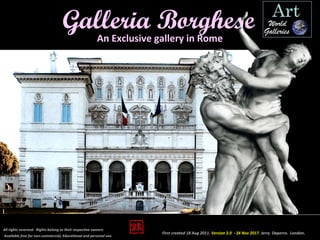
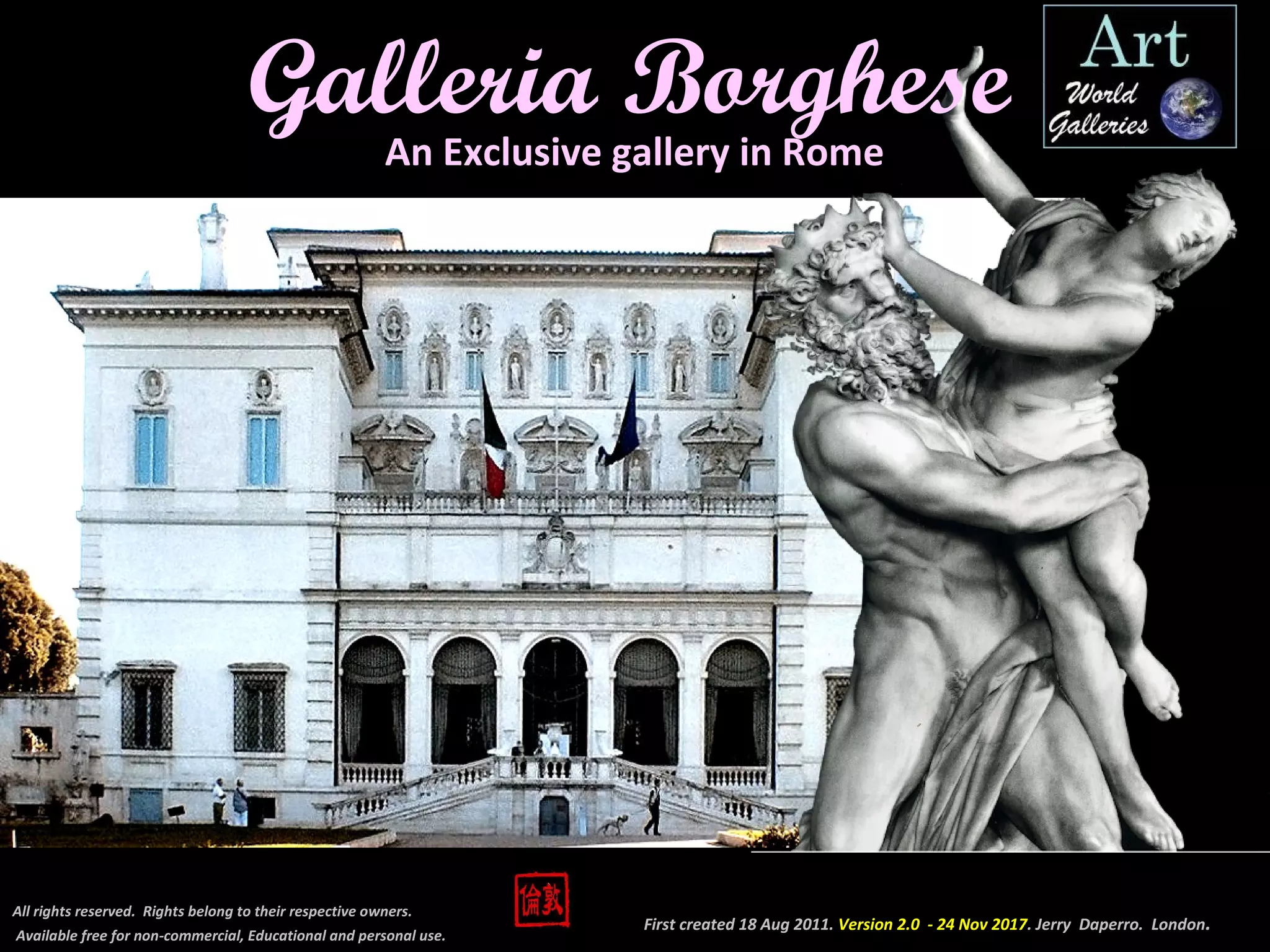
An Exclusive gallery in Rome
First created 18 Aug 2011. Version 2.0 - 24 Nov 2017. Jerry Daperro. London.
All rights reserved. Rights belong to their respective owners.
Available free for non-commercial, Educational and personal use.
Galleria Borghese
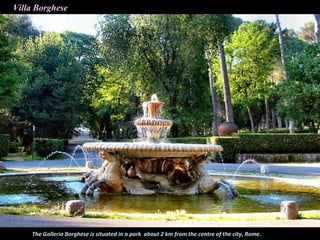
Villa Borghese
Park
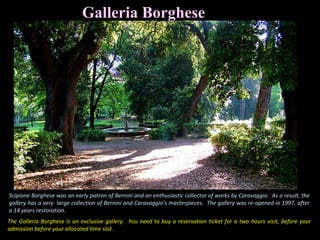
The Galleria Borghese is situated in a park about 2 km from the centre of the city, Rome.
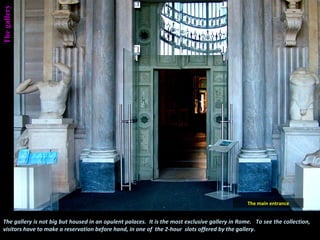
The gallery is not big but housed in an opulent palaces. It is the most exclusive gallery in Rome. To see the collection,
visitors have to make a reservation before hand, in one of the 2-hour slots offered by the gallery.
Thegallery
The main entrance
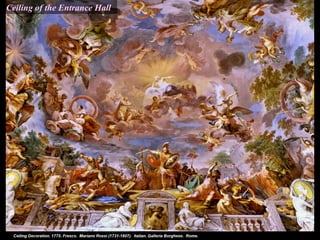
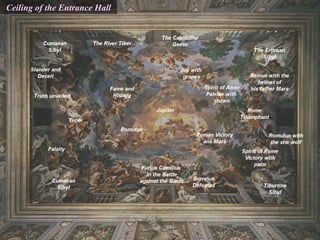
Ceiling of the Entrance Hall
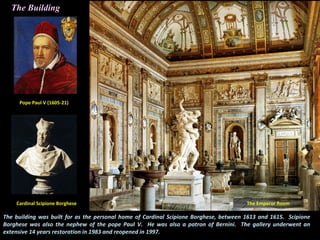
The building was built for as the personal home of Cardinal Scipione Borghese, between 1613 and 1615. Scipione
Borghese was also the nephew of the pope Paul V. He was also a patron of Bernini. The gallery underwent an
extensive 14 years restoration in 1983 and reopened in 1997.
The Building
Cardinal Scipione Borghese
Pope Paul V (1605-21)
The Emperor Room
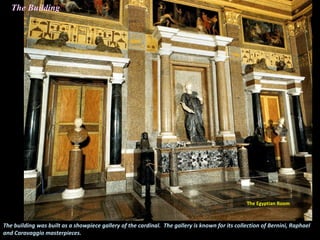
The building was built as a showpiece gallery of the cardinal. The gallery is known for its collection of Bernini, Raphael
and Caravaggio masterpieces.
The Egyptian Room
The Building
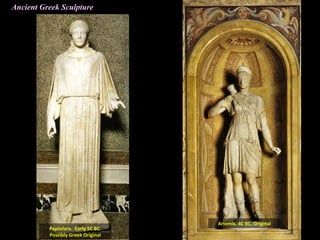
Ancient Greek Sculpture
Artemis. 4C BC. Original
Peplofora. Early 5C BC.
Possibly Greek Original
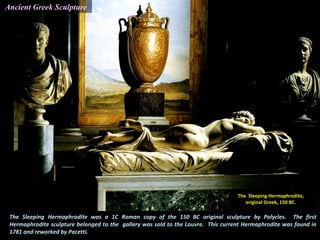
The Sleeping Hermaphrodite was a 1C Roman copy of the 150 BC original sculpture by Polycles. The first
Hermaphrodite sculpture belonged to the gallery was sold to the Louvre. This current Hermaphrodite was found in
1781 and reworked by Pacetti.
The Sleeping Hermaphrodite,
original Greek, 150 BC.
Ancient Greek Sculpture
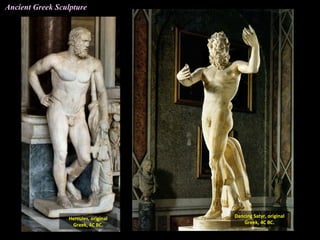
Dancing Satyr, original
Greek, 4C BC.
Hercules, original
Greek, 4C BC.
Ancient Greek Sculpture
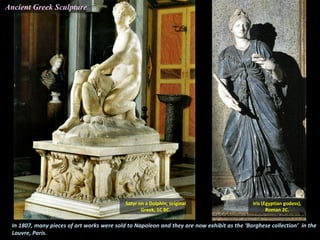
In 1807, many pieces of art works were sold to Napoleon and they are now exhibit as the ‘Borghese collection’ in the
Louvre, Paris.
Satyr on a Dolphin, original
Greek, 1C BC.
Iris (Egyptian godess),
Roman 2C.
Ancient Greek Sculpture
Raphael
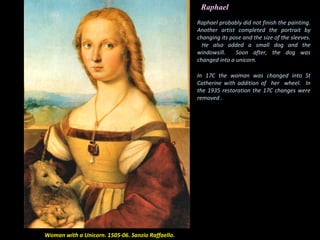
Woman with a Unicorn. 1505-06. Sanzio Raffaello.
Raphael probably did not finish the painting.
Another artist completed the portrait by
changing its pose and the size of the sleeves.
He also added a small dog and the
windowsill. Soon after, the dog was
changed into a unicorn.
In 17C the woman was changed into St
Catherine with addition of her wheel. In
the 1935 restoration the 17C changes were
removed .
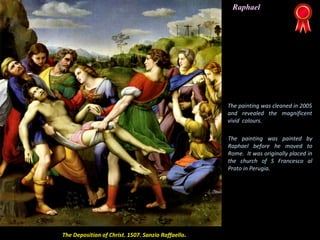
The Deposition of Christ. 1507. Sanzio Raffaello.
The painting was cleaned in 2005
and revealed the magnificent
vivid colours.
The painting was painted by
Raphael before he moved to
Rome. It was originally placed in
the church of S Francesco al
Prato in Perugia.
Raphael
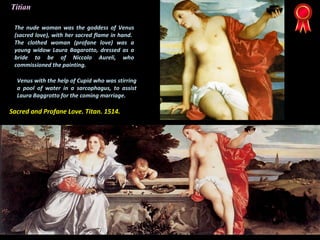
Sacred and Profane Love. Titan. 1514.
The nude woman was the goddess of Venus
(sacred love), with her sacred flame in hand.
The clothed woman (profane love) was a
young widow Laura Bagarotto, dressed as a
bride to be of Niccolo Aureli, who
commissioned the painting.
Venus with the help of Cupid who was stirring
a pool of water in a sarcophagus, to assist
Laura Baggrotto for the coming marriage.
Titian
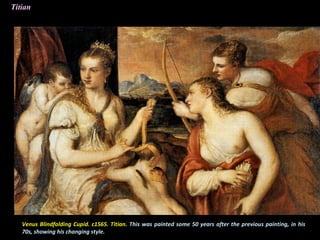
Venus Blindfolding Cupid. c1565. Titian. This was painted some 50 years after the previous painting, in his
70s, showing his changing style.
Titian
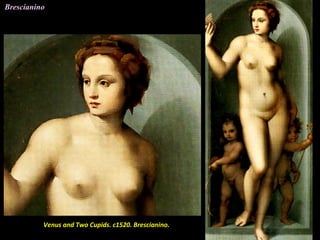
Venus and Two Cupids. c1520. Brescianino.
Brescianino
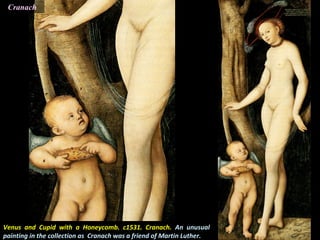
Venus and Cupid with a Honeycomb. c1531. Cranach. An unusual
painting in the collection as Cranach was a friend of Martin Luther.
Cranach
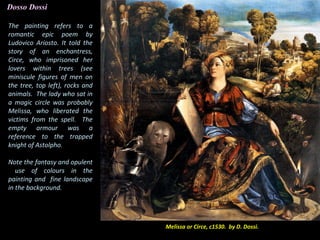
The painting refers to a
romantic epic poem by
Ludovico Ariosto. It told the
story of an enchantress,
Circe, who imprisoned her
lovers within trees (see
miniscule figures of men on
the tree, top left), rocks and
animals. The lady who sat in
a magic circle was probably
Melissa, who liberated the
victims from the spell. The
empty armour was a
reference to the trapped
knight of Astolpho.
Melissa or Circe, c1530. by D. Dossi.
Note the fantasy and opulent
use of colours in the
painting and fine landscape
in the background.
Dosso Dossi
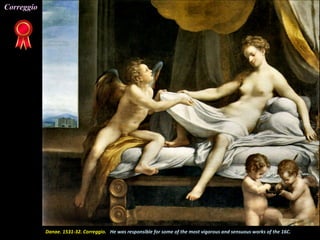
Danae. 1531-32. Correggio. He was responsible for some of the most vigorous and sensuous works of the 16C.
Correggio
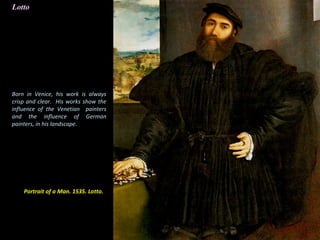
Portrait of a Man. 1535. Lotto.
Lotto
Born in Venice, his work is always
crisp and clear. His works show the
influence of the Venetian painters
and the influence of German
painters, in his landscape.
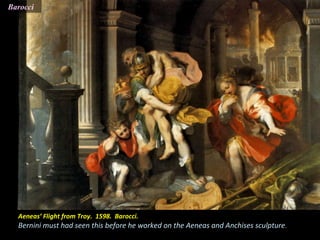
Aeneas’ Flight from Troy. 1598. Barocci.
Bernini must had seen this before he worked on the Aeneas and Anchises sculpture.
Barocci
Bassano
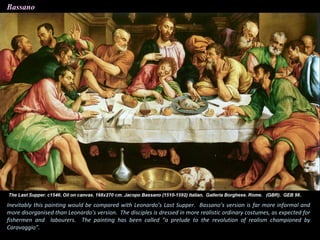
Inevitably this painting would be compared with Leonardo’s Last Supper. Bassano’s version is far more informal and
more disorganised than Leonardo’s version. The disciples is dressed in more realistic ordinary costumes, as expected for
fishermen and labourers. The painting has been called “a prelude to the revolution of realism championed by
Caravaggio”.
Vittore Carpaccio
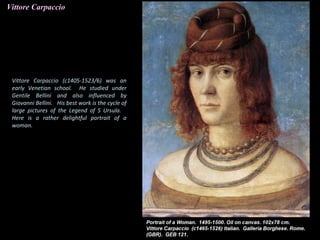
Vittore Carpaccio (c1405-1523/6) was an
early Venetian school. He studied under
Gentile Bellini and also influenced by
Giovanni Bellini. His best work is the cycle of
large pictures of the Legend of S Ursula.
Here is a rather delightful portrait of a
woman.
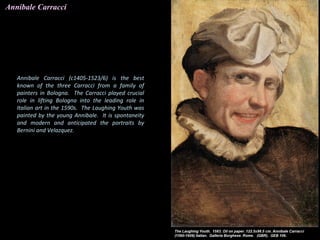
Annibale Carracci
Annibale Carracci (c1405-1523/6) is the best
known of the three Carracci from a family of
painters in Bologna. The Carracci played crucial
role in lifting Bologna into the leading role in
Italian art in the 1590s. The Laughing Youth was
painted by the young Annibale. It is spontaneity
and modern and anticipated the portraits by
Bernini and Velazquez.
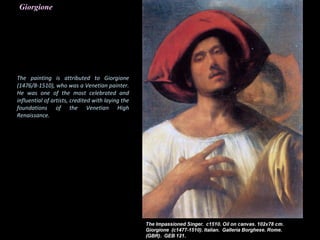
Giorgione
The painting is attributed to Giorgione
(1476/8-1510), who was a Venetian painter.
He was one of the most celebrated and
influential of artists, credited with laying the
foundations of the Venetian High
Renaissance.
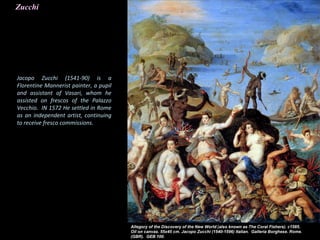
Zucchi
Jacopo Zucchi (1541-90) is a
Florentine Mannerist painter, a pupil
and assistant of Vasari, whom he
assisted on frescos of the Palazzo
Vecchio. IN 1572 He settled in Rome
as an independent artist, continuing
to receive fresco commissions.
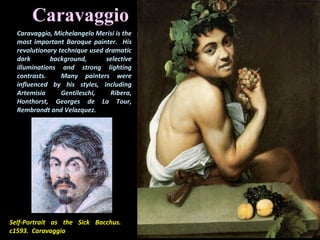
Self-Portrait as the Sick Bacchus.
c1593. Caravaggio
Caravaggio
Caravaggio, Michelangelo Merisi is the
most important Baroque painter. His
revolutionary technique used dramatic
dark background, selective
illuminations and strong lighting
contrasts. Many painters were
influenced by his styles, including
Artemisia Gentileschi, Ribera,
Honthorst, Georges de La Tour,
Rembrandt and Velazquez.
Caravaggio
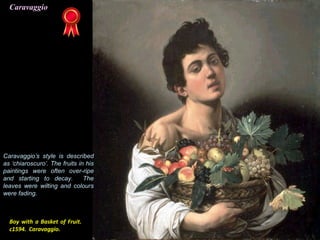
Boy with a Basket of Fruit.
c1594. Caravaggio.
Caravaggio’s style is described
as ‘chiaroscuro’. The fruits in his
paintings were often over-ripe
and starting to decay. The
leaves were wilting and colours
were fading.
Caravaggio
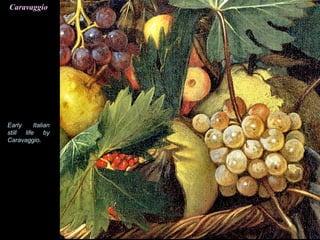
Early Italian
still life by
Caravaggio.
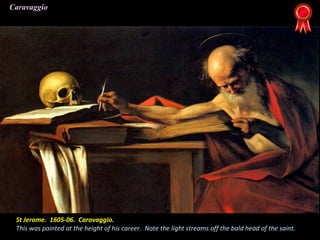
St Jerome. 1605-06. Caravaggio.
This was painted at the height of his career. Note the light streams off the bald head of the saint.
Caravaggio
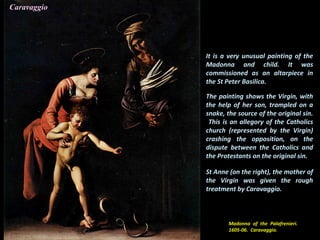
Madonna of the Palafrenieri.
1605-06. Caravaggio.
It is a very unusual painting of the
Madonna and child. It was
commissioned as an altarpiece in
the St Peter Basilica.
The painting shows the Virgin, with
the help of her son, trampled on a
snake, the source of the original sin.
This is an allegory of the Catholics
church (represented by the Virgin)
crashing the opposition, on the
dispute between the Catholics and
the Protestants on the original sin.
St Anne (on the right), the mother of
the Virgin was given the rough
treatment by Caravaggio.
Caravaggio
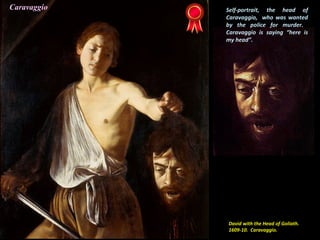
David with the Head of Goliath.
1609-10. Caravaggio.
Self-portrait, the head of
Caravaggio, who was wanted
by the police for murder.
Caravaggio is saying “here is
my head”.
Caravaggio
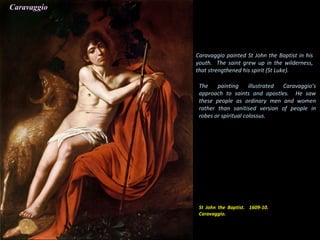
St John the Baptist. 1609-10.
Caravaggio.
Caravaggio painted St John the Baptist in his
youth. The saint grew up in the wilderness,
that strengthened his spirit (St Luke).
The painting illustrated Caravaggio’s
approach to saints and apostles. He saw
these people as ordinary men and women
rather than sanitised version of people in
robes or spiritual colossus.
Caravaggio
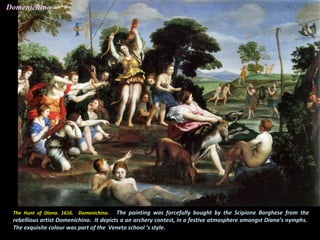
The Hunt of Diana. 1616. Domenichino. The painting was forcefully bought by the Scipione Borghese from the
rebellious artist Domenichino. It depicts a an archery contest, in a festive atmosphere amongst Diana’s nymphs.
The exquisite colour was part of the Veneto school ‘s style.
Domenichino
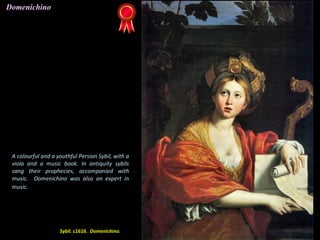
Sybil. c1616. Domenichino.
A colourful and a youthful Persian Sybil, with a
viola and a music book. In antiquity sybils
sang their prophecies, accompanied with
music. Domenichino was also an expert in
music.
Domenichino
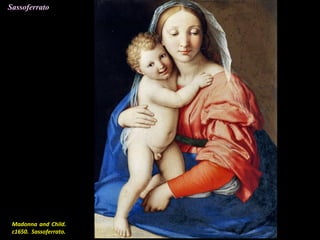
Madonna and Child.
c1650. Sassoferrato.
Sassoferrato
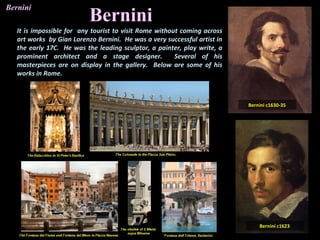
Bernini c1623
Bernini c1630-35
Bernini
Bernini
It is impossible for any tourist to visit Rome without coming across
art works by Gian Lorenzo Bernini. He was a very successful artist in
the early 17C. He was the leading sculptor, a painter, play write, a
prominent architect and a stage designer. Several of his
masterpieces are on display in the gallery. Below are some of his
works in Rome.
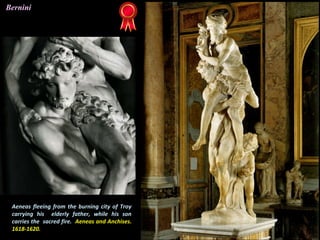
Aeneas fleeing from the burning city of Troy
carrying his elderly father, while his son
carries the sacred fire. Aeneas and Anchises.
1618-1620.
Bernini
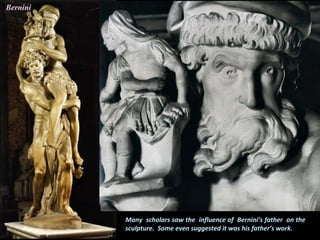
Many scholars saw the influence of Bernini’s father on the
sculpture. Some even suggested it was his father’s work.
Bernini
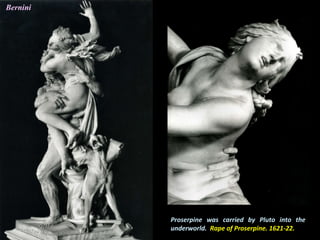
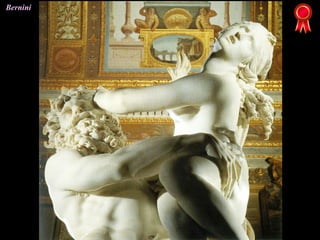
Proserpine was carried by Pluto into the
underworld. Rape of Proserpine. 1621-22.
Bernini
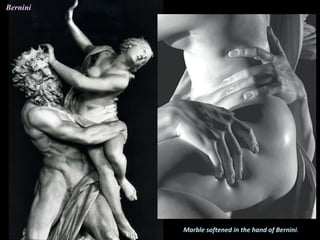
Marble softened in the hand of Bernini.
Bernini
Bernini
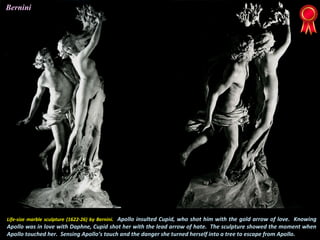
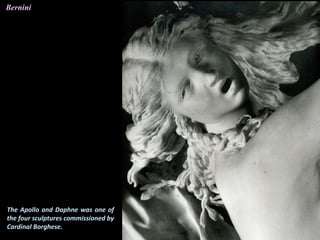
Life-size marble sculpture (1622-26) by Bernini. Apollo insulted Cupid, who shot him with the gold arrow of love. Knowing
Apollo was in love with Daphne, Cupid shot her with the lead arrow of hate. The sculpture showed the moment when
Apollo touched her. Sensing Apollo’s touch and the danger she turned herself into a tree to escape from Apollo.
Bernini
The Apollo and Daphne was one of
the four sculptures commissioned by
Cardinal Borghese.
Bernini
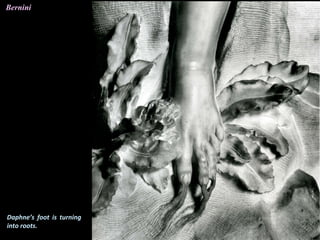
Daphne’s foot is turning
into roots.
Bernini
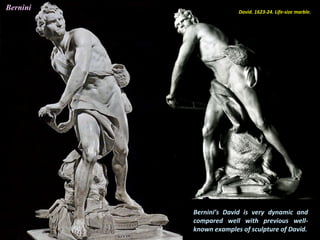
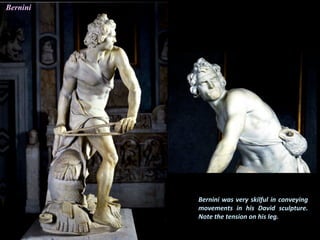
Bernini’s David is very dynamic and
compared well with previous well-
known examples of sculpture of David.
David. 1623-24. Life-size marble.
Bernini
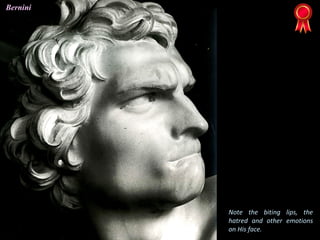
Note the biting lips, the
hatred and other emotions
on His face.
Bernini
Bernini was very skilful in conveying
movements in his David sculpture.
Note the tension on his leg.
Bernini
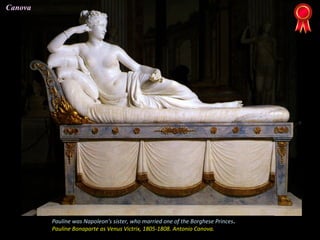
Pauline was Napoleon’s sister, who married one of the Borghese Princes.
Pauline Bonaparte as Venus Victrix, 1805-1808. Antonio Canova.
Canova
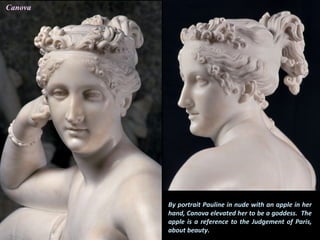
By portrait Pauline in nude with an apple in her
hand, Canova elevated her to be a goddess. The
apple is a reference to the Judgement of Paris,
about beauty.
Canova
Landi
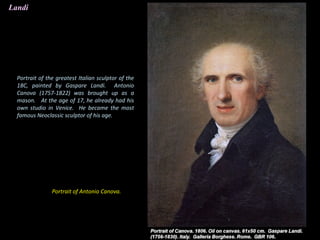
Portrait of Antonio Canova.
Portrait of the greatest Italian sculptor of the
18C, painted by Gaspare Landi. Antonio
Canova (1757-1822) was brought up as a
mason. At the age of 17, he already had his
own studio in Venice. He became the most
famous Neoclassic sculptor of his age.
Galleria Borghese
The Galleria Borghese is an exclusive gallery. You need to buy a reservation ticket for a two hours visit, before your
admission before your allocated time slot.
Scipione Borghese was an early patron of Bernini and an enthusiastic collector of works by Caravaggio. As a result, the
gallery has a very large collection of Bernini and Caravaggio’s masterpieces. The gallery was re-opened in 1997, after
a 14 years restoration.
Music – Roxane’s Veil performed by Vanessa Mae
and composed by Vangelis.
All rights reserved. Rights belong to their respective owners. Available
free for non-commercial and personal use.
The End
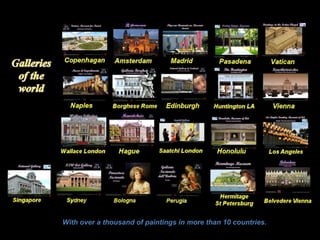
With over a thousand of paintings in more than 10 countries.

Galleria Borghese, Rome 2.0

  • 1.
    An Exclusive galleryin Rome First created 18 Aug 2011. Version 2.0 - 24 Nov 2017. Jerry Daperro. London. All rights reserved. Rights belong to their respective owners. Available free for non-commercial, Educational and personal use. Galleria Borghese
  • 2.
    Villa Borghese Park The GalleriaBorghese is situated in a park about 2 km from the centre of the city, Rome.
  • 3.
    The gallery isnot big but housed in an opulent palaces. It is the most exclusive gallery in Rome. To see the collection, visitors have to make a reservation before hand, in one of the 2-hour slots offered by the gallery. Thegallery The main entrance
  • 4.
    Ceiling of theEntrance Hall
  • 5.
    Ceiling of theEntrance Hall
  • 6.
    The building wasbuilt for as the personal home of Cardinal Scipione Borghese, between 1613 and 1615. Scipione Borghese was also the nephew of the pope Paul V. He was also a patron of Bernini. The gallery underwent an extensive 14 years restoration in 1983 and reopened in 1997. The Building Cardinal Scipione Borghese Pope Paul V (1605-21) The Emperor Room
  • 7.
    The building wasbuilt as a showpiece gallery of the cardinal. The gallery is known for its collection of Bernini, Raphael and Caravaggio masterpieces. The Egyptian Room The Building
  • 8.
    Ancient Greek Sculpture Artemis.4C BC. Original Peplofora. Early 5C BC. Possibly Greek Original
  • 9.
    The Sleeping Hermaphroditewas a 1C Roman copy of the 150 BC original sculpture by Polycles. The first Hermaphrodite sculpture belonged to the gallery was sold to the Louvre. This current Hermaphrodite was found in 1781 and reworked by Pacetti. The Sleeping Hermaphrodite, original Greek, 150 BC. Ancient Greek Sculpture
  • 10.
    Dancing Satyr, original Greek,4C BC. Hercules, original Greek, 4C BC. Ancient Greek Sculpture
  • 11.
    In 1807, manypieces of art works were sold to Napoleon and they are now exhibit as the ‘Borghese collection’ in the Louvre, Paris. Satyr on a Dolphin, original Greek, 1C BC. Iris (Egyptian godess), Roman 2C. Ancient Greek Sculpture
  • 12.
    Raphael Woman with aUnicorn. 1505-06. Sanzio Raffaello. Raphael probably did not finish the painting. Another artist completed the portrait by changing its pose and the size of the sleeves. He also added a small dog and the windowsill. Soon after, the dog was changed into a unicorn. In 17C the woman was changed into St Catherine with addition of her wheel. In the 1935 restoration the 17C changes were removed .
  • 13.
    The Deposition ofChrist. 1507. Sanzio Raffaello. The painting was cleaned in 2005 and revealed the magnificent vivid colours. The painting was painted by Raphael before he moved to Rome. It was originally placed in the church of S Francesco al Prato in Perugia. Raphael
  • 14.
    Sacred and ProfaneLove. Titan. 1514. The nude woman was the goddess of Venus (sacred love), with her sacred flame in hand. The clothed woman (profane love) was a young widow Laura Bagarotto, dressed as a bride to be of Niccolo Aureli, who commissioned the painting. Venus with the help of Cupid who was stirring a pool of water in a sarcophagus, to assist Laura Baggrotto for the coming marriage. Titian
  • 15.
    Venus Blindfolding Cupid.c1565. Titian. This was painted some 50 years after the previous painting, in his 70s, showing his changing style. Titian
  • 16.
    Venus and TwoCupids. c1520. Brescianino. Brescianino
  • 17.
    Venus and Cupidwith a Honeycomb. c1531. Cranach. An unusual painting in the collection as Cranach was a friend of Martin Luther. Cranach
  • 18.
    The painting refersto a romantic epic poem by Ludovico Ariosto. It told the story of an enchantress, Circe, who imprisoned her lovers within trees (see miniscule figures of men on the tree, top left), rocks and animals. The lady who sat in a magic circle was probably Melissa, who liberated the victims from the spell. The empty armour was a reference to the trapped knight of Astolpho. Melissa or Circe, c1530. by D. Dossi. Note the fantasy and opulent use of colours in the painting and fine landscape in the background. Dosso Dossi
  • 19.
    Danae. 1531-32. Correggio.He was responsible for some of the most vigorous and sensuous works of the 16C. Correggio
  • 20.
    Portrait of aMan. 1535. Lotto. Lotto Born in Venice, his work is always crisp and clear. His works show the influence of the Venetian painters and the influence of German painters, in his landscape.
  • 21.
    Aeneas’ Flight fromTroy. 1598. Barocci. Bernini must had seen this before he worked on the Aeneas and Anchises sculpture. Barocci
  • 22.
    Bassano Inevitably this paintingwould be compared with Leonardo’s Last Supper. Bassano’s version is far more informal and more disorganised than Leonardo’s version. The disciples is dressed in more realistic ordinary costumes, as expected for fishermen and labourers. The painting has been called “a prelude to the revolution of realism championed by Caravaggio”.
  • 23.
    Vittore Carpaccio Vittore Carpaccio(c1405-1523/6) was an early Venetian school. He studied under Gentile Bellini and also influenced by Giovanni Bellini. His best work is the cycle of large pictures of the Legend of S Ursula. Here is a rather delightful portrait of a woman.
  • 24.
    Annibale Carracci Annibale Carracci(c1405-1523/6) is the best known of the three Carracci from a family of painters in Bologna. The Carracci played crucial role in lifting Bologna into the leading role in Italian art in the 1590s. The Laughing Youth was painted by the young Annibale. It is spontaneity and modern and anticipated the portraits by Bernini and Velazquez.
  • 25.
    Giorgione The painting isattributed to Giorgione (1476/8-1510), who was a Venetian painter. He was one of the most celebrated and influential of artists, credited with laying the foundations of the Venetian High Renaissance.
  • 26.
    Zucchi Jacopo Zucchi (1541-90)is a Florentine Mannerist painter, a pupil and assistant of Vasari, whom he assisted on frescos of the Palazzo Vecchio. IN 1572 He settled in Rome as an independent artist, continuing to receive fresco commissions.
  • 27.
    Self-Portrait as theSick Bacchus. c1593. Caravaggio Caravaggio Caravaggio, Michelangelo Merisi is the most important Baroque painter. His revolutionary technique used dramatic dark background, selective illuminations and strong lighting contrasts. Many painters were influenced by his styles, including Artemisia Gentileschi, Ribera, Honthorst, Georges de La Tour, Rembrandt and Velazquez.
  • 28.
    Caravaggio Boy with aBasket of Fruit. c1594. Caravaggio. Caravaggio’s style is described as ‘chiaroscuro’. The fruits in his paintings were often over-ripe and starting to decay. The leaves were wilting and colours were fading.
  • 29.
  • 30.
    St Jerome. 1605-06.Caravaggio. This was painted at the height of his career. Note the light streams off the bald head of the saint. Caravaggio
  • 31.
    Madonna of thePalafrenieri. 1605-06. Caravaggio. It is a very unusual painting of the Madonna and child. It was commissioned as an altarpiece in the St Peter Basilica. The painting shows the Virgin, with the help of her son, trampled on a snake, the source of the original sin. This is an allegory of the Catholics church (represented by the Virgin) crashing the opposition, on the dispute between the Catholics and the Protestants on the original sin. St Anne (on the right), the mother of the Virgin was given the rough treatment by Caravaggio. Caravaggio
  • 32.
    David with theHead of Goliath. 1609-10. Caravaggio. Self-portrait, the head of Caravaggio, who was wanted by the police for murder. Caravaggio is saying “here is my head”. Caravaggio
  • 33.
    St John theBaptist. 1609-10. Caravaggio. Caravaggio painted St John the Baptist in his youth. The saint grew up in the wilderness, that strengthened his spirit (St Luke). The painting illustrated Caravaggio’s approach to saints and apostles. He saw these people as ordinary men and women rather than sanitised version of people in robes or spiritual colossus. Caravaggio
  • 34.
    The Hunt ofDiana. 1616. Domenichino. The painting was forcefully bought by the Scipione Borghese from the rebellious artist Domenichino. It depicts a an archery contest, in a festive atmosphere amongst Diana’s nymphs. The exquisite colour was part of the Veneto school ‘s style. Domenichino
  • 35.
    Sybil. c1616. Domenichino. Acolourful and a youthful Persian Sybil, with a viola and a music book. In antiquity sybils sang their prophecies, accompanied with music. Domenichino was also an expert in music. Domenichino
  • 36.
    Madonna and Child. c1650.Sassoferrato. Sassoferrato
  • 37.
    Bernini c1623 Bernini c1630-35 Bernini Bernini Itis impossible for any tourist to visit Rome without coming across art works by Gian Lorenzo Bernini. He was a very successful artist in the early 17C. He was the leading sculptor, a painter, play write, a prominent architect and a stage designer. Several of his masterpieces are on display in the gallery. Below are some of his works in Rome.
  • 38.
    Aeneas fleeing fromthe burning city of Troy carrying his elderly father, while his son carries the sacred fire. Aeneas and Anchises. 1618-1620. Bernini
  • 39.
    Many scholars sawthe influence of Bernini’s father on the sculpture. Some even suggested it was his father’s work. Bernini
  • 40.
    Proserpine was carriedby Pluto into the underworld. Rape of Proserpine. 1621-22. Bernini
  • 41.
    Marble softened inthe hand of Bernini. Bernini
  • 42.
  • 43.
    Life-size marble sculpture(1622-26) by Bernini. Apollo insulted Cupid, who shot him with the gold arrow of love. Knowing Apollo was in love with Daphne, Cupid shot her with the lead arrow of hate. The sculpture showed the moment when Apollo touched her. Sensing Apollo’s touch and the danger she turned herself into a tree to escape from Apollo. Bernini
  • 44.
    The Apollo andDaphne was one of the four sculptures commissioned by Cardinal Borghese. Bernini
  • 45.
    Daphne’s foot isturning into roots. Bernini
  • 46.
    Bernini’s David isvery dynamic and compared well with previous well- known examples of sculpture of David. David. 1623-24. Life-size marble. Bernini
  • 47.
    Note the bitinglips, the hatred and other emotions on His face. Bernini
  • 48.
    Bernini was veryskilful in conveying movements in his David sculpture. Note the tension on his leg. Bernini
  • 49.
    Pauline was Napoleon’ssister, who married one of the Borghese Princes. Pauline Bonaparte as Venus Victrix, 1805-1808. Antonio Canova. Canova
  • 50.
    By portrait Paulinein nude with an apple in her hand, Canova elevated her to be a goddess. The apple is a reference to the Judgement of Paris, about beauty. Canova
  • 51.
    Landi Portrait of AntonioCanova. Portrait of the greatest Italian sculptor of the 18C, painted by Gaspare Landi. Antonio Canova (1757-1822) was brought up as a mason. At the age of 17, he already had his own studio in Venice. He became the most famous Neoclassic sculptor of his age.
  • 52.
    Galleria Borghese The GalleriaBorghese is an exclusive gallery. You need to buy a reservation ticket for a two hours visit, before your admission before your allocated time slot. Scipione Borghese was an early patron of Bernini and an enthusiastic collector of works by Caravaggio. As a result, the gallery has a very large collection of Bernini and Caravaggio’s masterpieces. The gallery was re-opened in 1997, after a 14 years restoration.
  • 53.
    Music – Roxane’sVeil performed by Vanessa Mae and composed by Vangelis. All rights reserved. Rights belong to their respective owners. Available free for non-commercial and personal use. The End
  • 54.
    With over athousand of paintings in more than 10 countries.

Editor's Notes

  • #2 The Galleria Borghese is the home of an extraordinary collections of large number of unique masterpieces, dating from antiquity. In 1807 nearly all the archaeological collection was sold by Camillo Borghese to his brother-in-law, Napoleon, becoming an essential part of the Louvre collection in Paris. Some of the pieces sold have been replaced by later acquisitions. The gallery is uniquely located in the middle of a park, serenely blending architecture and nature. Recent restoration, which took over a decade of work, of the build was completed in 1997. Among it collections are half a dozen of paintings by the young Caravaggio, Titan’s painting of ‘Sacred and Profane Love’. Several works by Raphael, some of the best sculpture by Bernini, include the David, Apollo and Daphine etc. It is one of the world most exclusive gallery.
  • #54 Second version 24 Nov 2017, included half a dozen of new slides and minor changes to conform to recent standards First version published on Authorsteeam 17.5.2011 and later on Slideboom