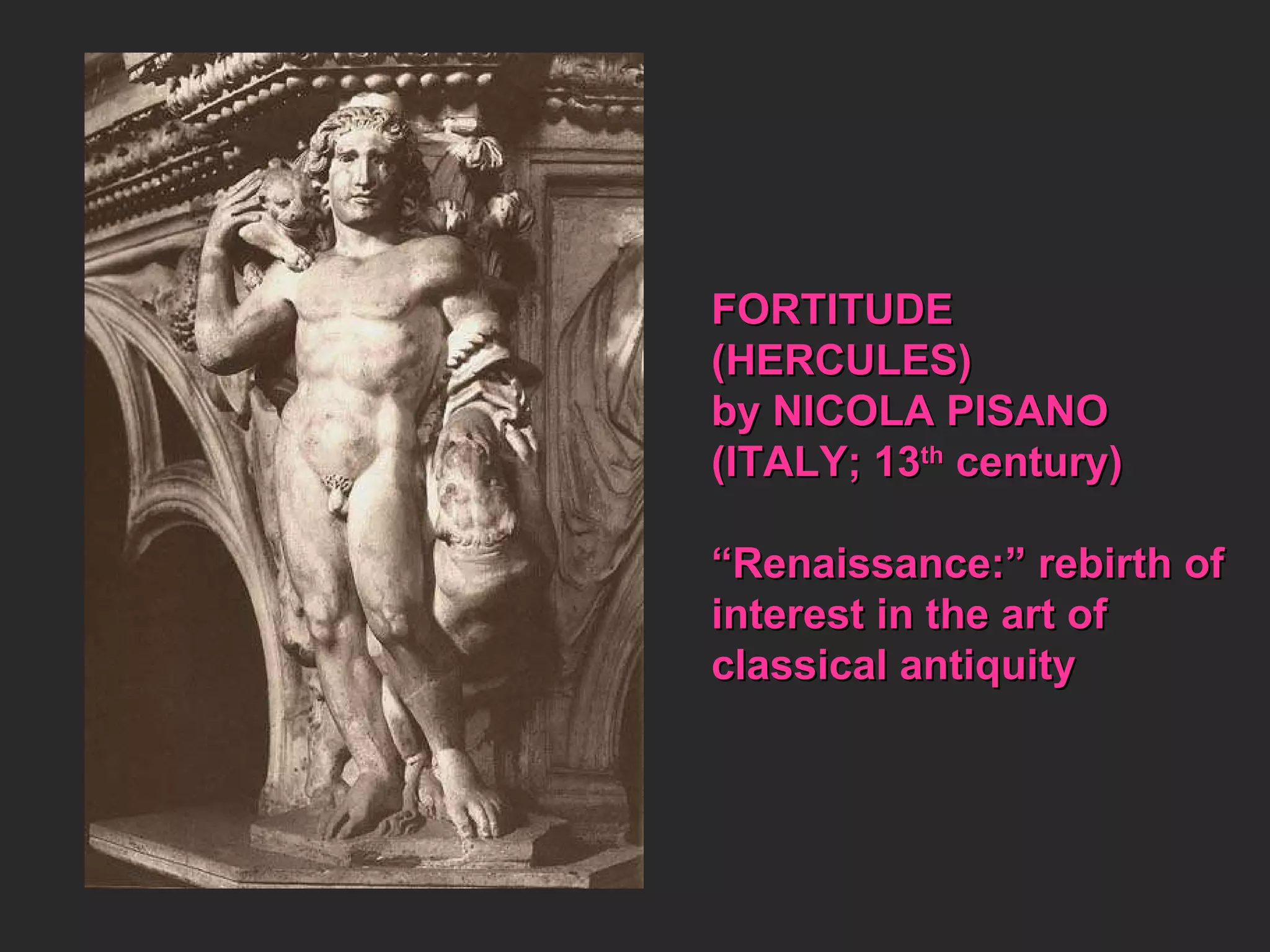
FORTITUDE  (HERCULES) by NICOLA PISANO (ITALY; 13 th  century) “ Renaissance:” rebirth of interest in the art of  classical antiquity
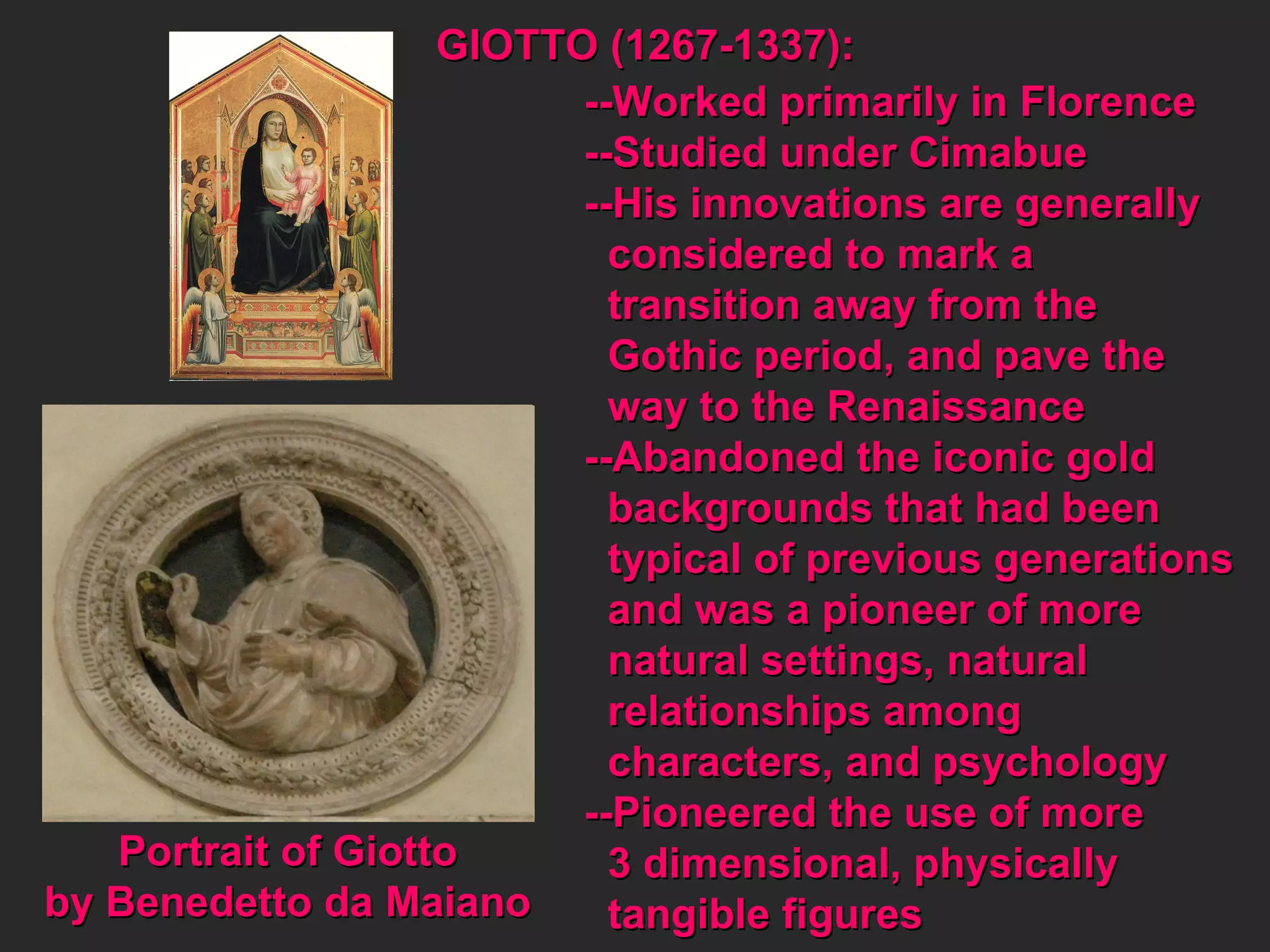
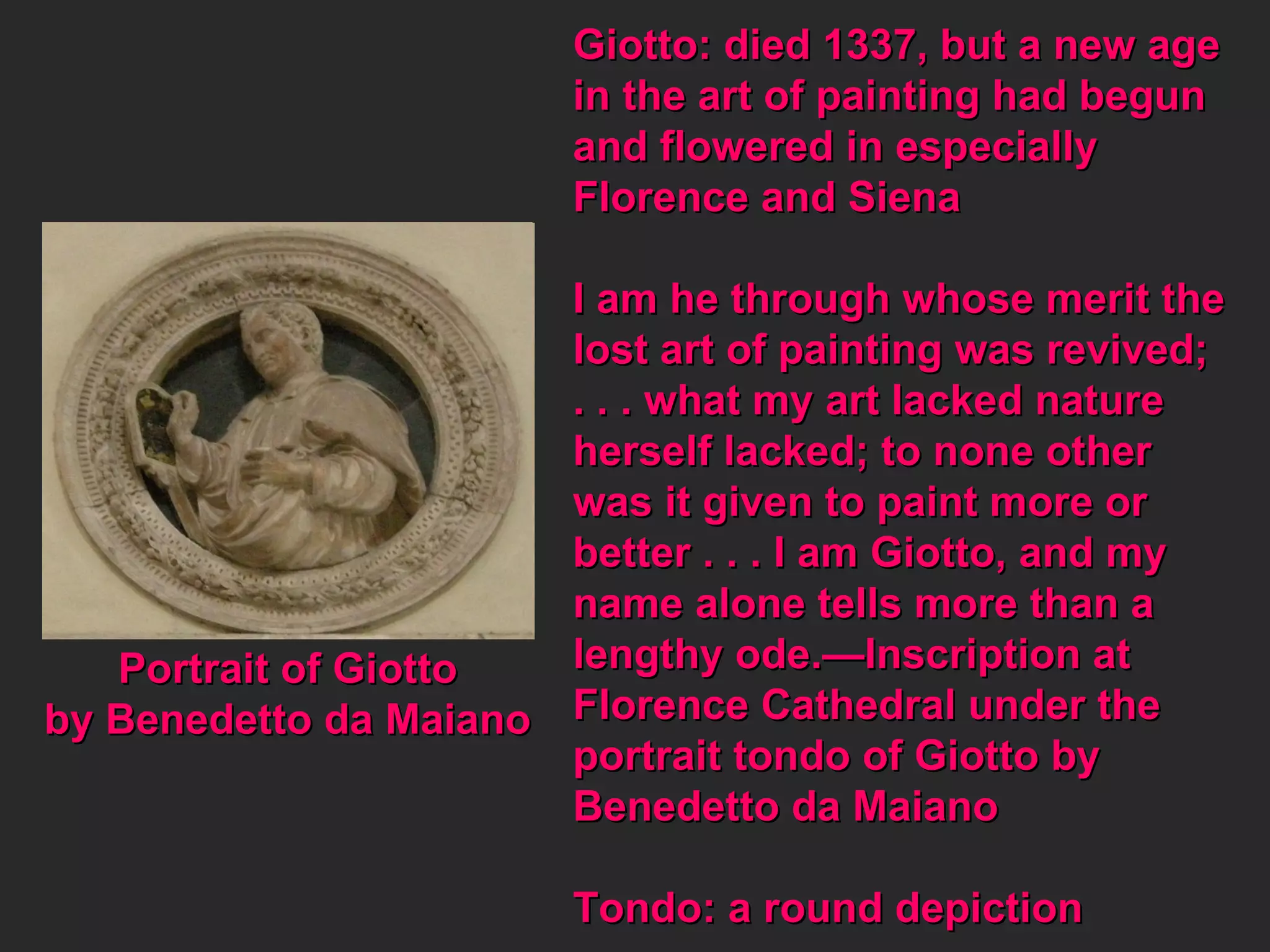
GIOTTO (1267-1337): Portrait of Giotto by Benedetto da Maiano --Worked primarily in Florence --Studied under Cimabue --His innovations are generally considered to mark a  transition away from the  Gothic period, and pave the way to the Renaissance --Abandoned the iconic gold backgrounds that had been typical of previous generations and was a pioneer of more natural settings, natural  relationships among  characters, and psychology --Pioneered the use of more 3 dimensional, physically tangible figures
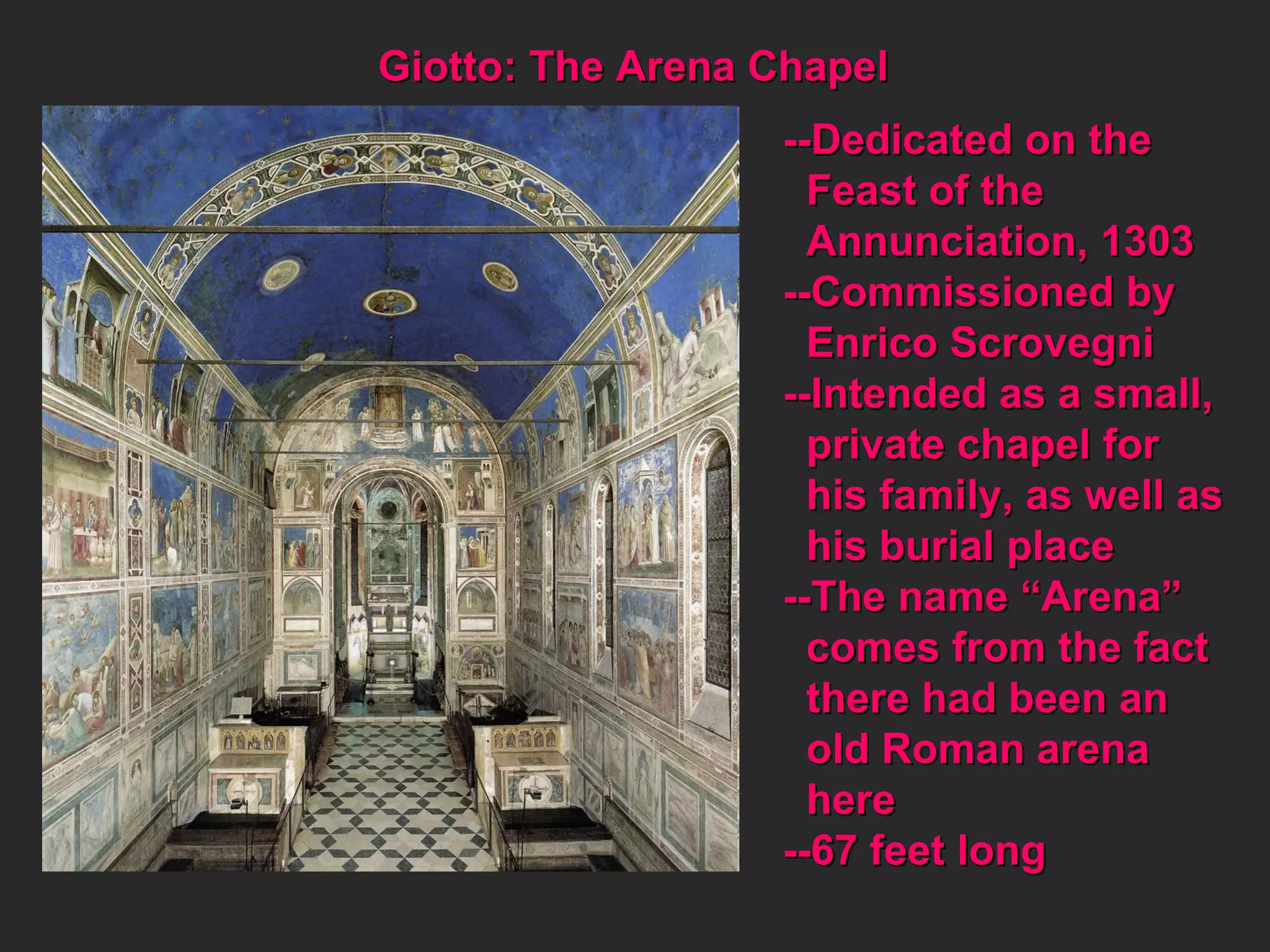
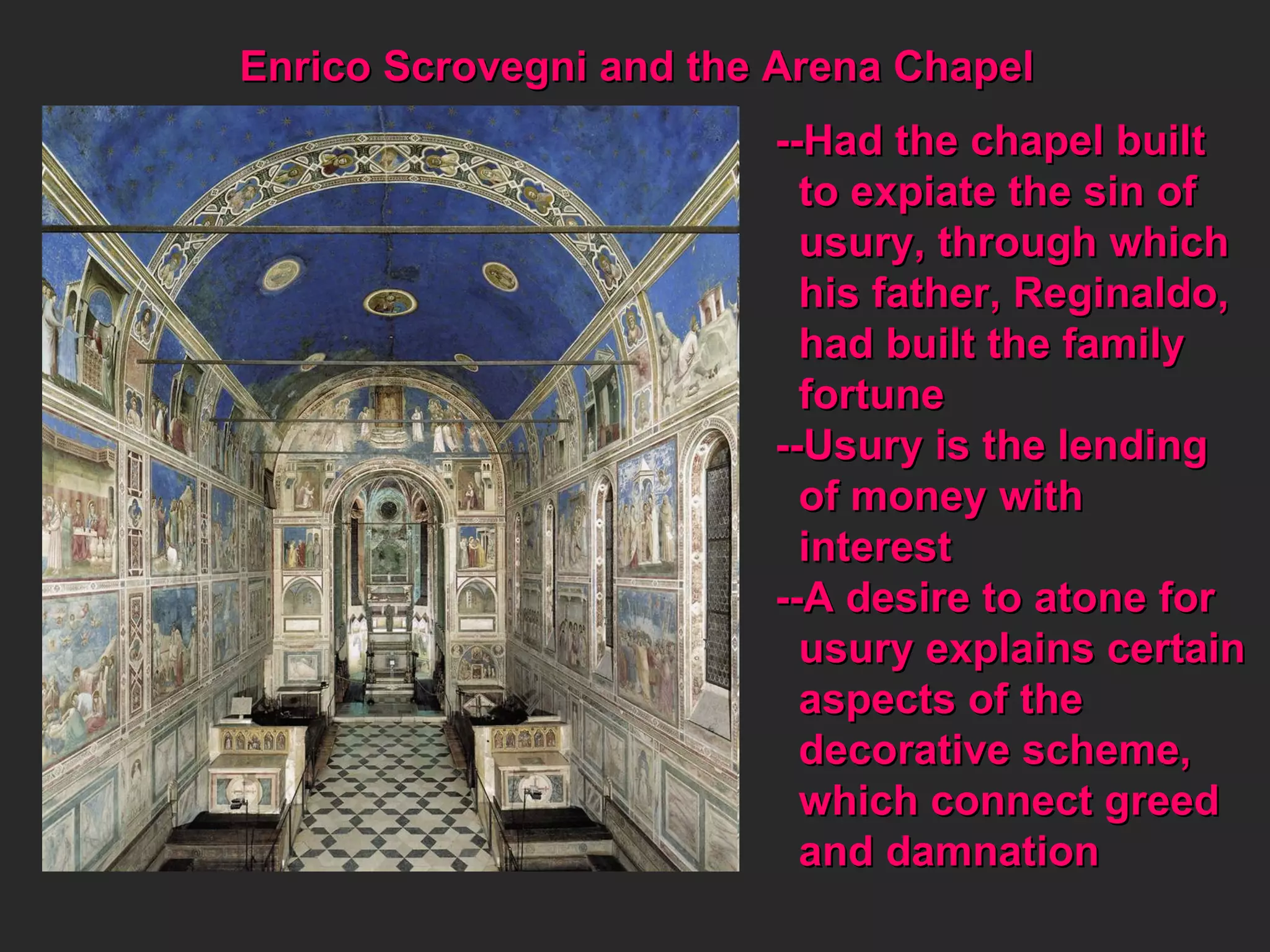
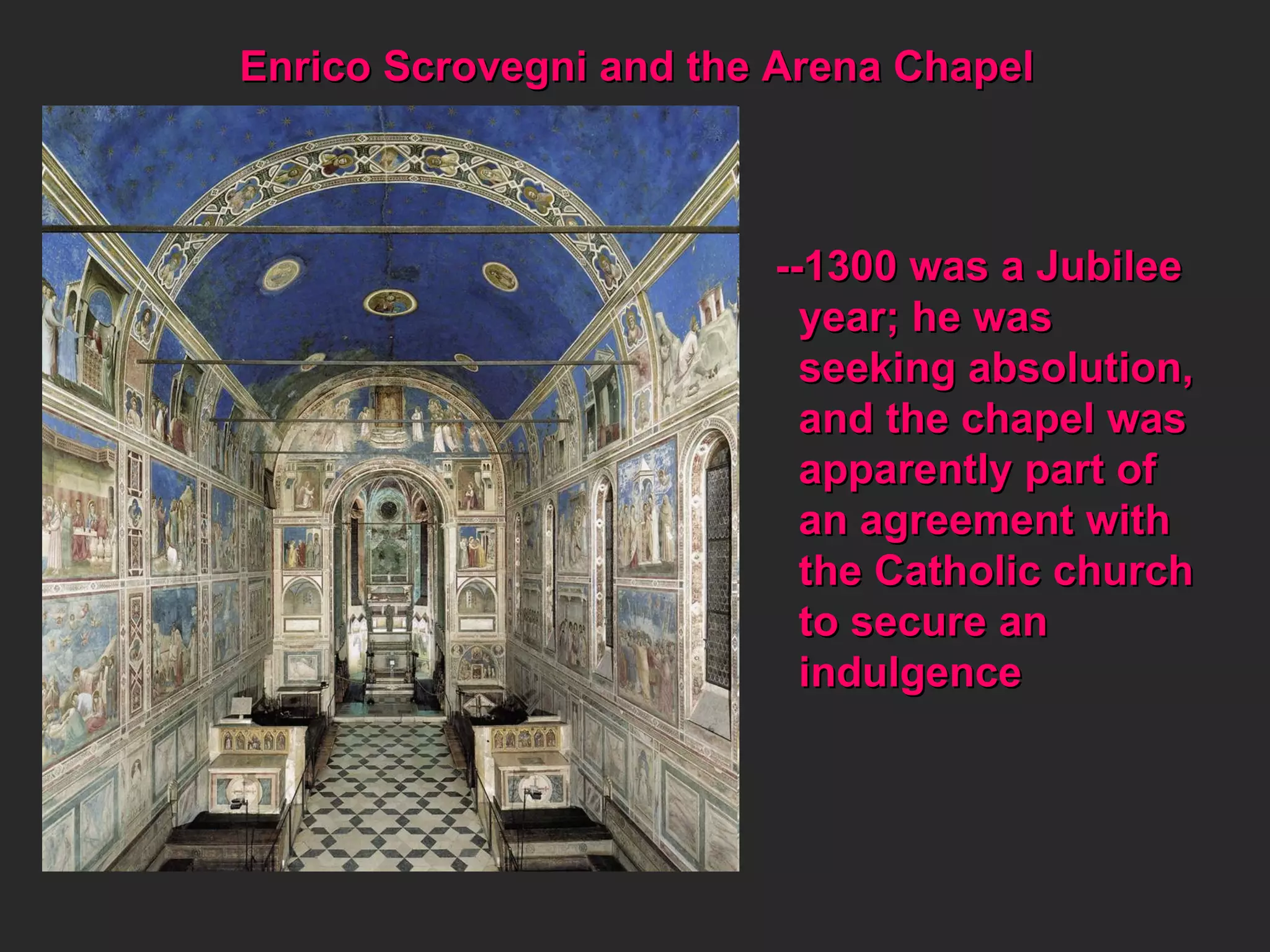
Giotto: The Arena Chapel --Dedicated on the  Feast of the  Annunciation, 1303 --Commissioned by Enrico Scrovegni --Intended as a small, private chapel for his family, as well as his burial place --The name “Arena” comes from the fact there had been an  old Roman arena here --67 feet long
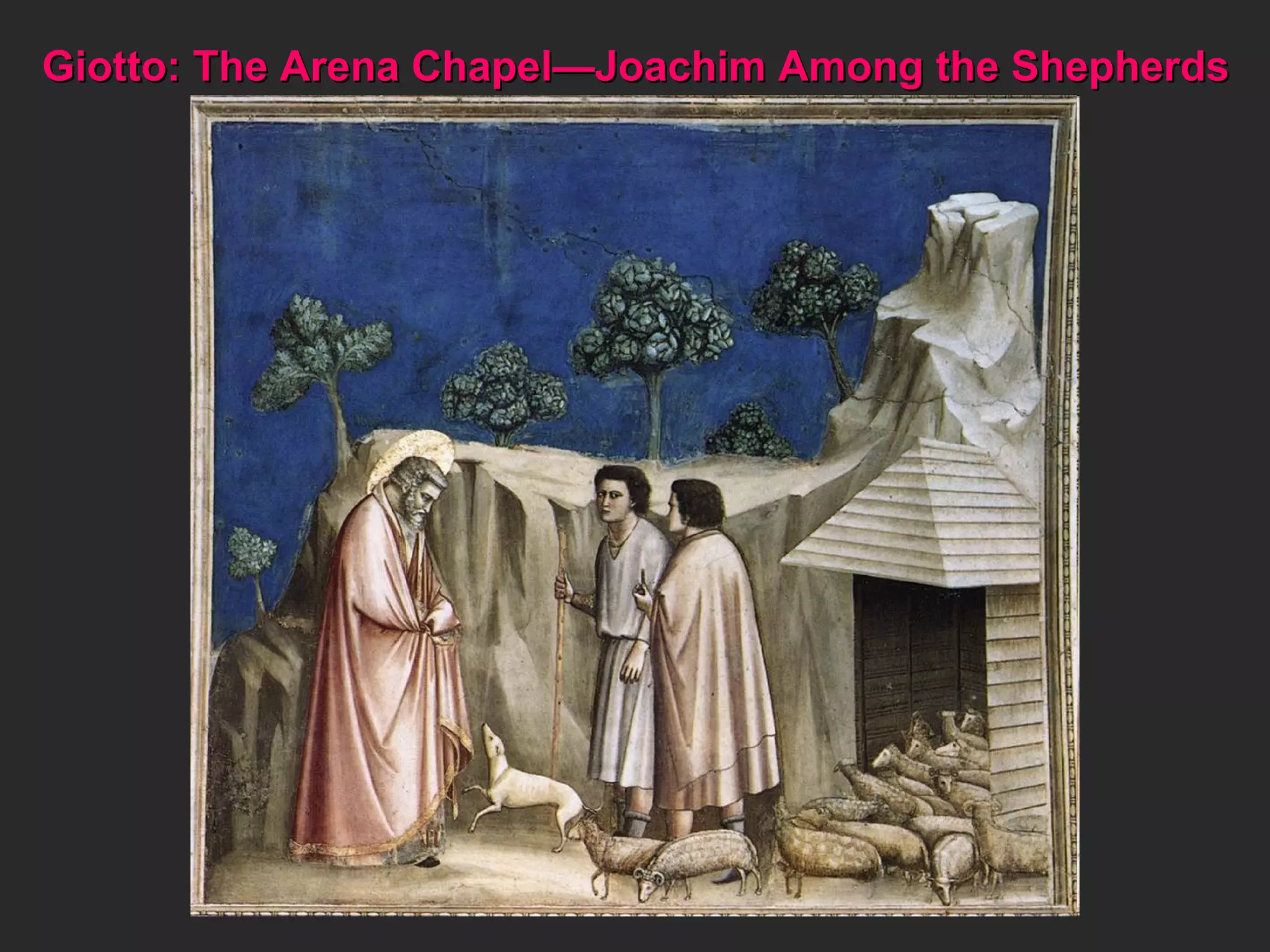
Giotto: The Arena Chapel—Joachim Among the Shepherds
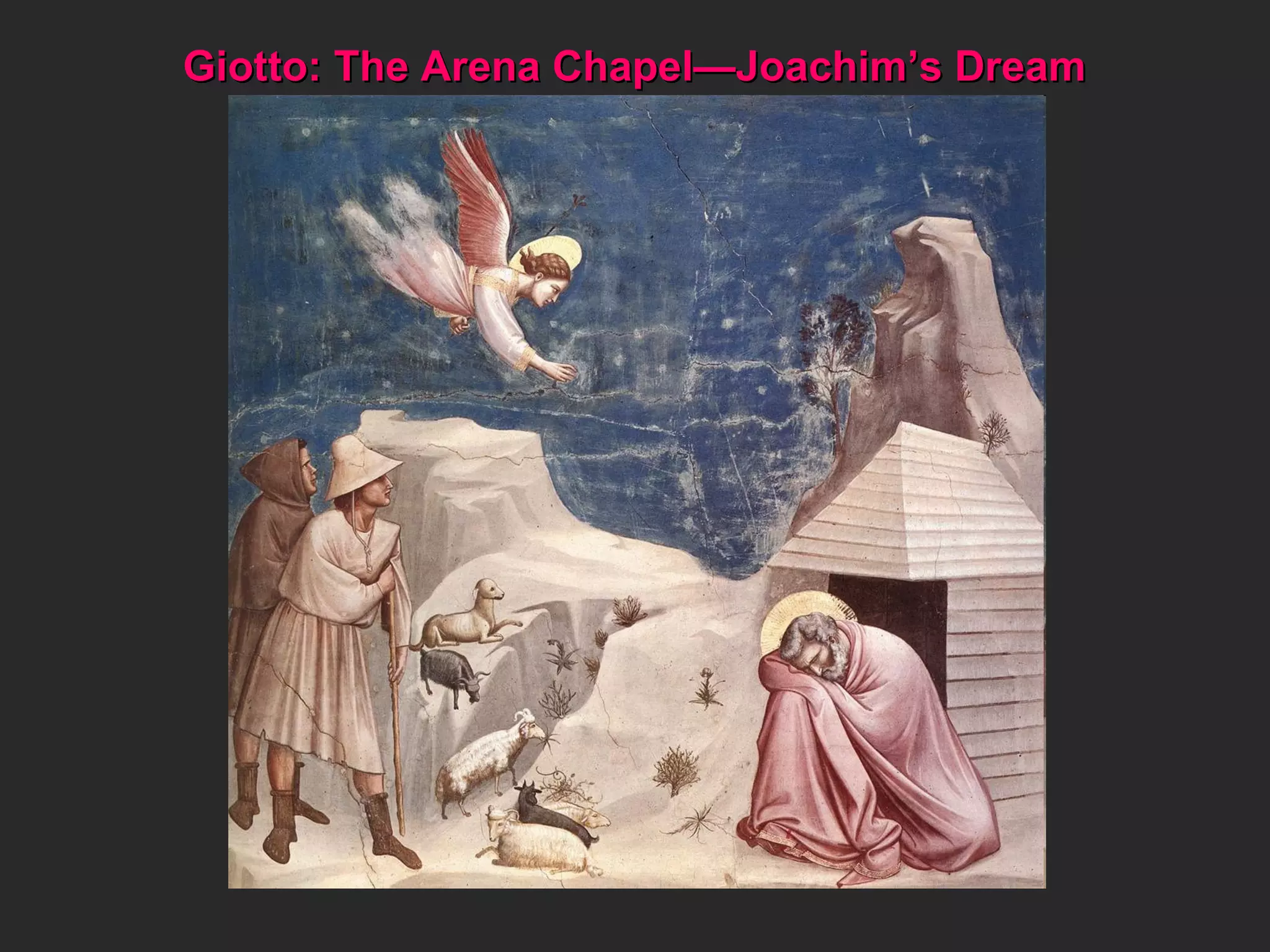
Giotto: The Arena Chapel—Joachim’s Dream
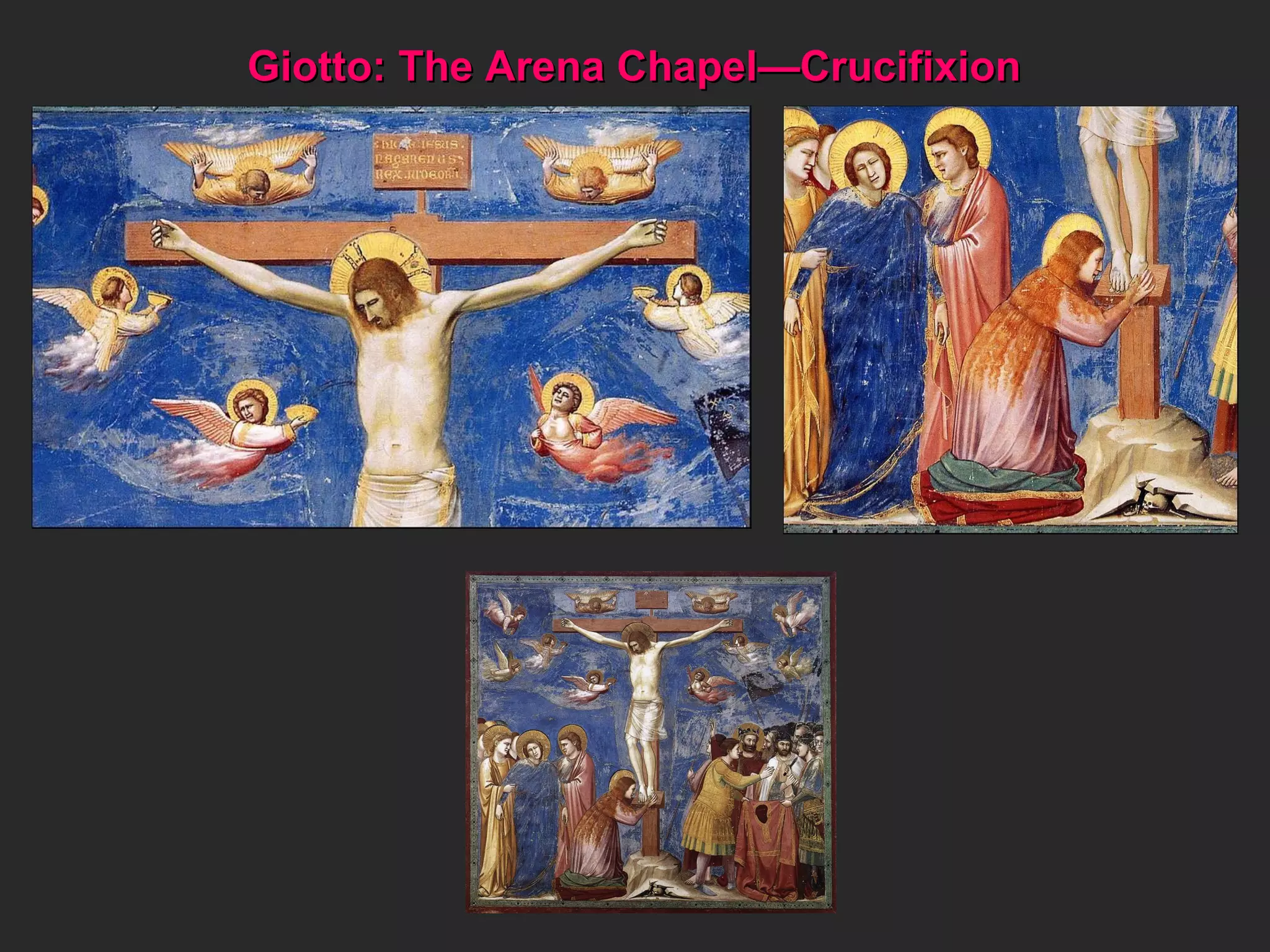
Giotto: The Arena Chapel—Crucifixion
Enrico Scrovegni and the Arena Chapel --Had the chapel built  to expiate the sin of  usury, through which his father, Reginaldo, had built the family fortune --Usury is the lending  of money with  interest --A desire to atone for  usury explains certain  aspects of the  decorative scheme,  which connect greed  and damnation
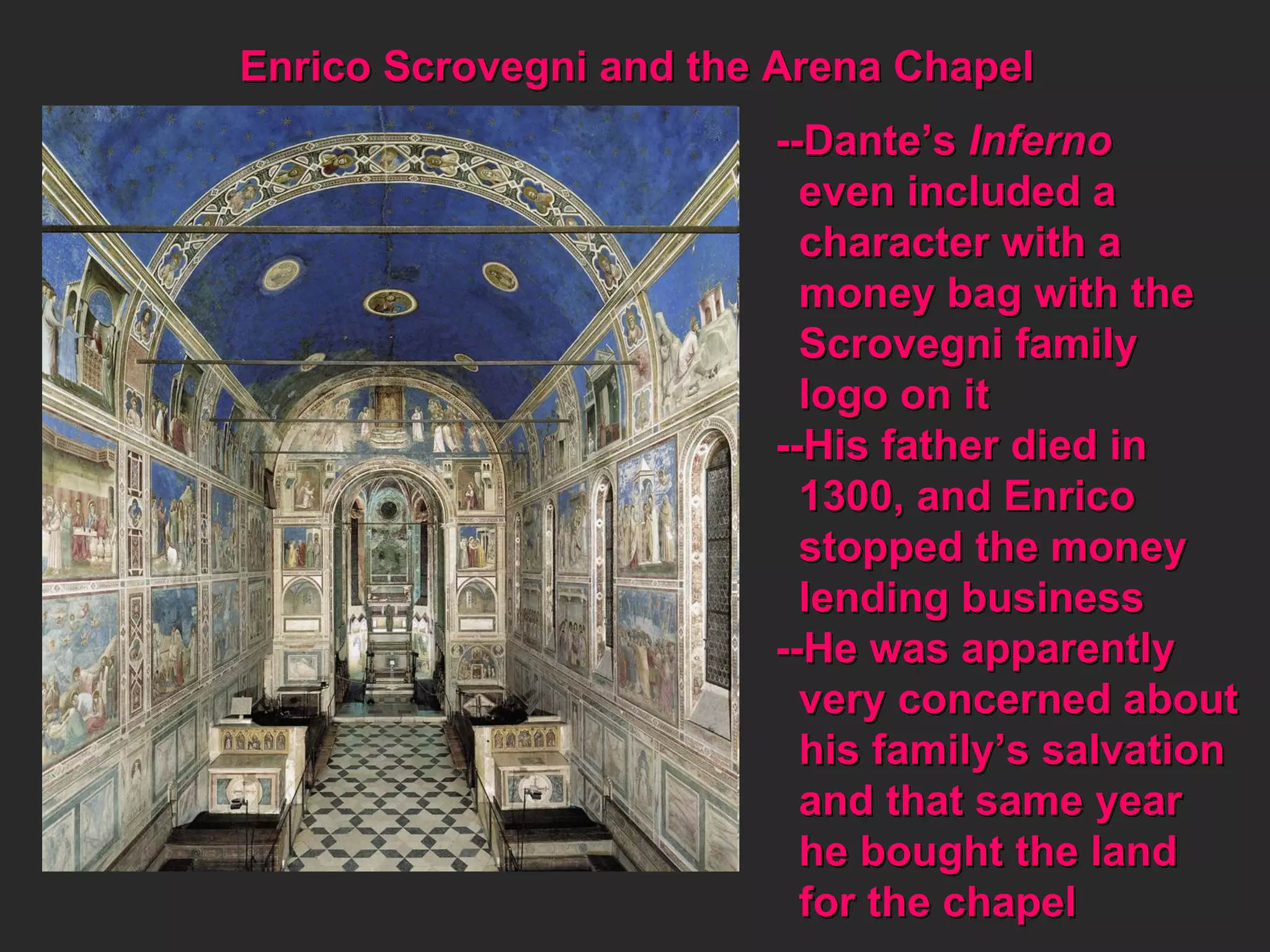
Enrico Scrovegni and the Arena Chapel --Dante’s  Inferno even included a  character with a  money bag with the Scrovegni family logo on it --His father died in 1300, and Enrico  stopped the money lending business --He was apparently very concerned about his family’s salvation and that same year he bought the land for the chapel
Enrico Scrovegni and the Arena Chapel --1300 was a Jubilee year; he was  seeking absolution, and the chapel was apparently part of  an agreement with the Catholic church to secure an  indulgence
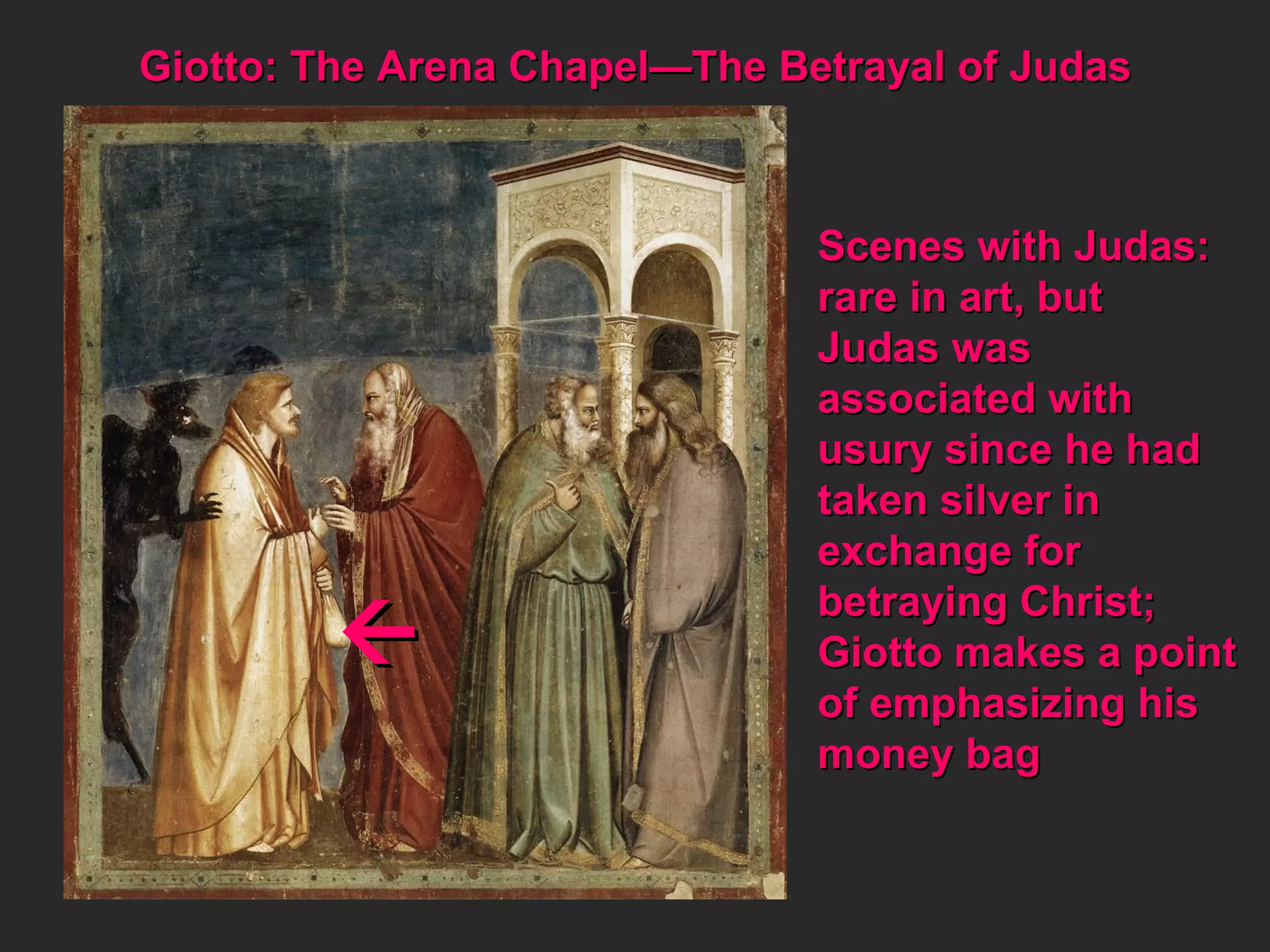
Giotto: The Arena Chapel—The Betrayal of Judas Scenes with Judas: rare in art, but  Judas was  associated with  usury since he had taken silver in  exchange for  betraying Christ; Giotto makes a point of emphasizing his money bag 
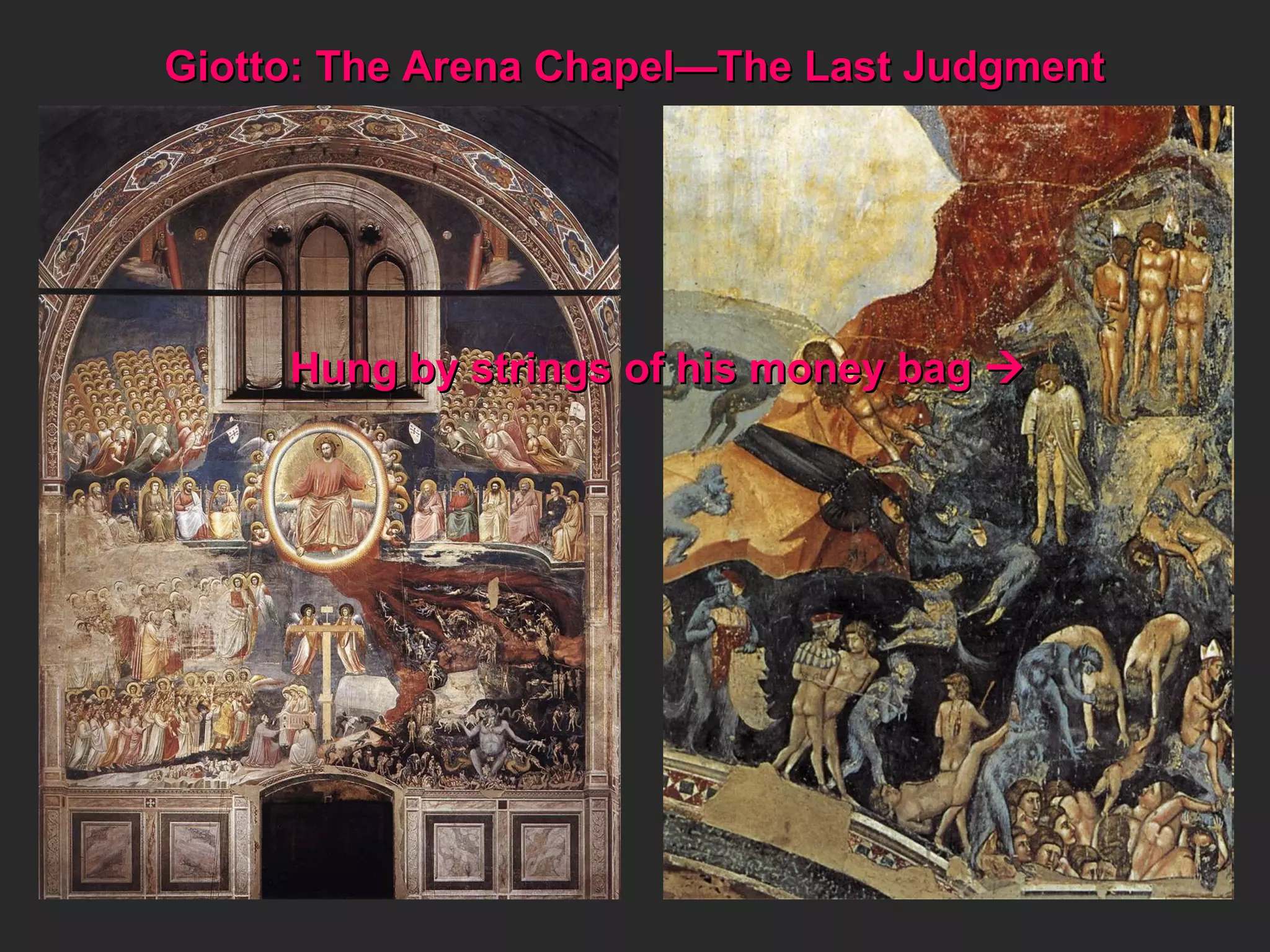
Giotto: The Arena Chapel—The Last Judgment Hung by strings of his money bag  
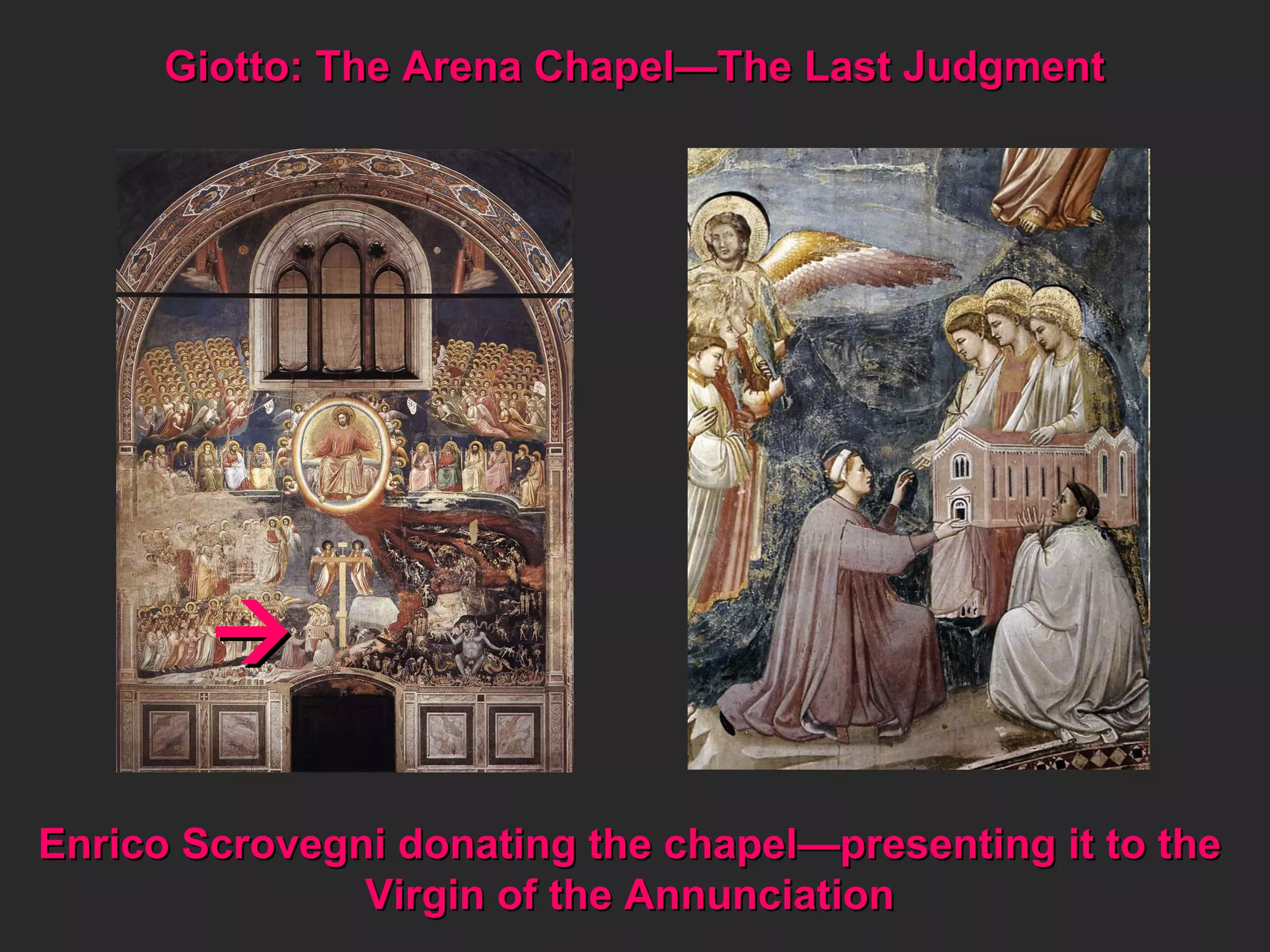
Giotto: The Arena Chapel—The Last Judgment  Enrico Scrovegni donating the chapel—presenting it to the Virgin of the Annunciation
Portrait of Giotto by Benedetto da Maiano Giotto: died 1337, but a new age  in the art of painting had begun and flowered in especially  Florence and Siena I am he through whose merit the lost art of painting was revived; . . . what my art lacked nature  herself lacked; to none other  was it given to paint more or better . . . I am Giotto, and my  name alone tells more than a lengthy ode.—Inscription at Florence Cathedral under the  portrait tondo of Giotto by Benedetto da Maiano Tondo: a round depiction
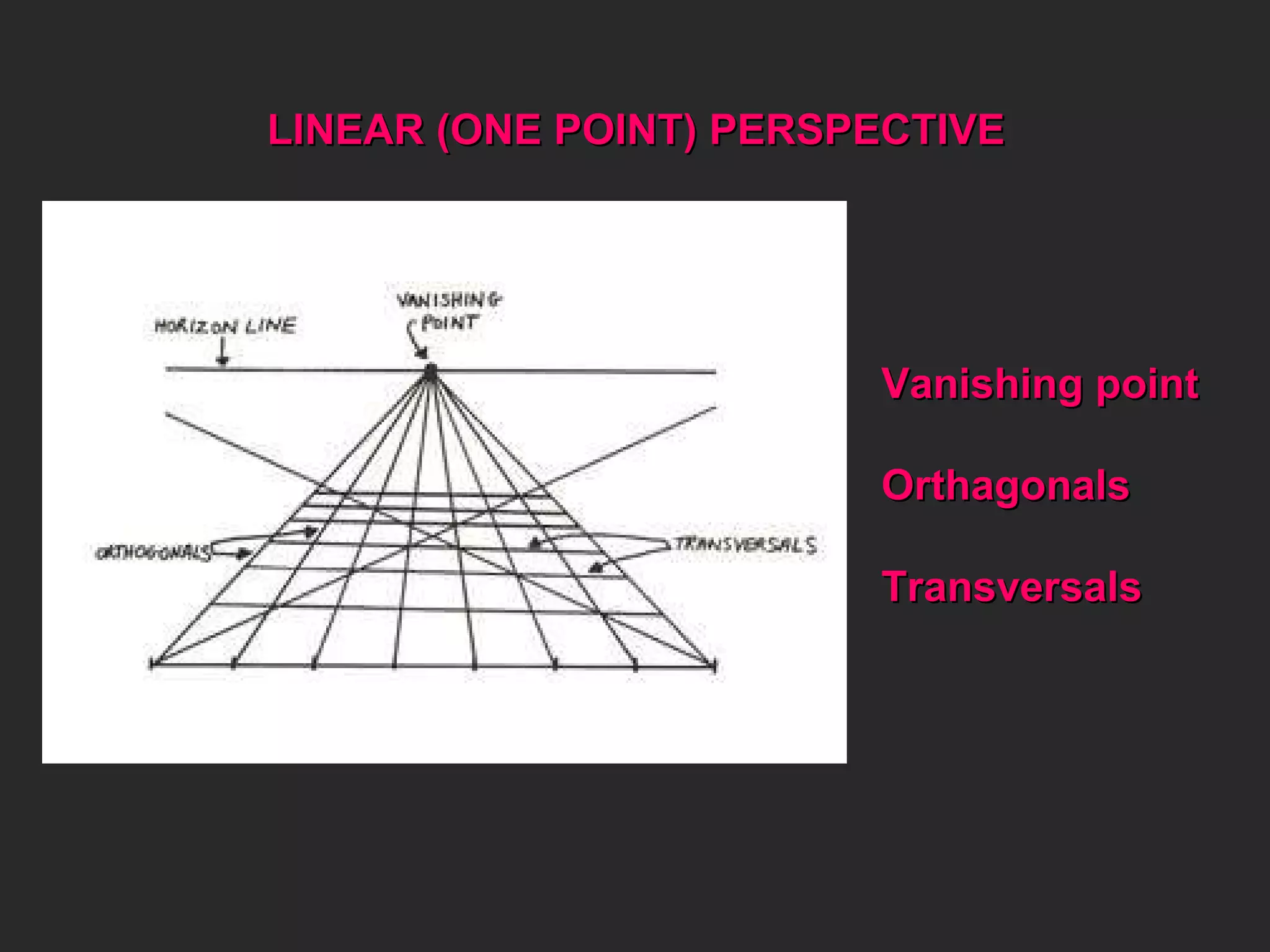
LINEAR (ONE POINT) PERSPECTIVE  Vanishing point  Orthagonals Transversals
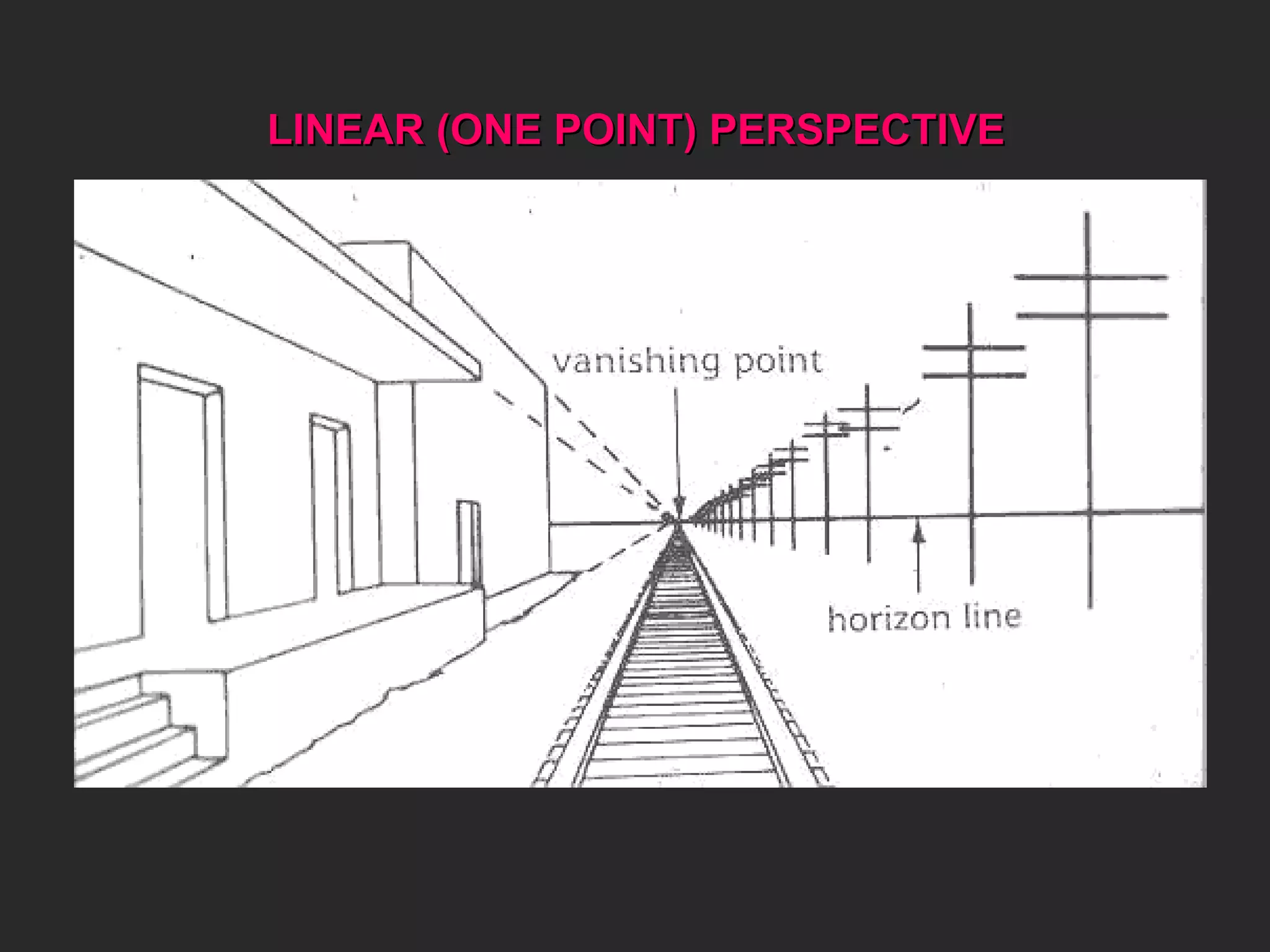
LINEAR (ONE POINT) PERSPECTIVE
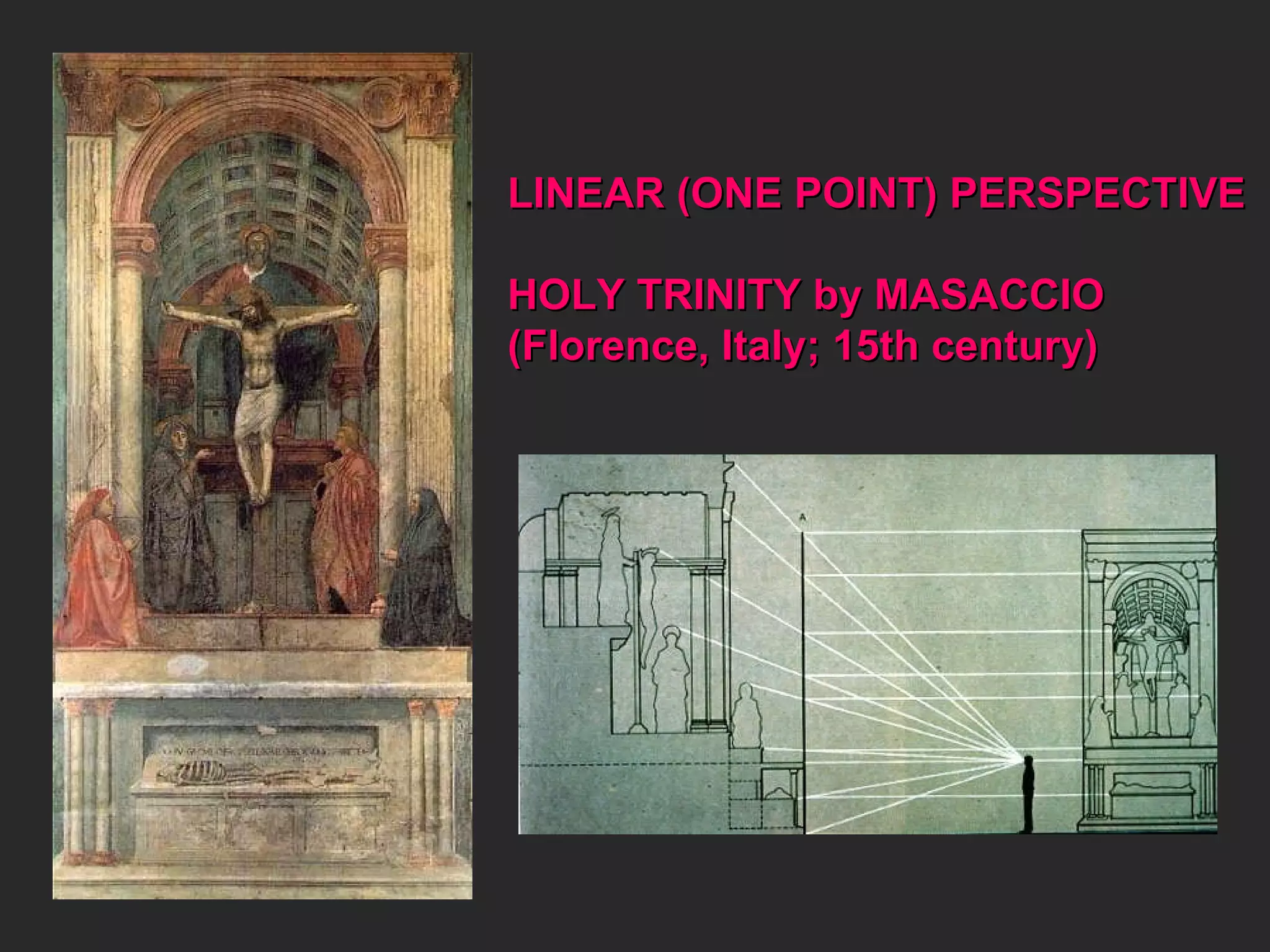
LINEAR (ONE POINT) PERSPECTIVE  HOLY TRINITY by MASACCIO  (Florence, Italy; 15th century)
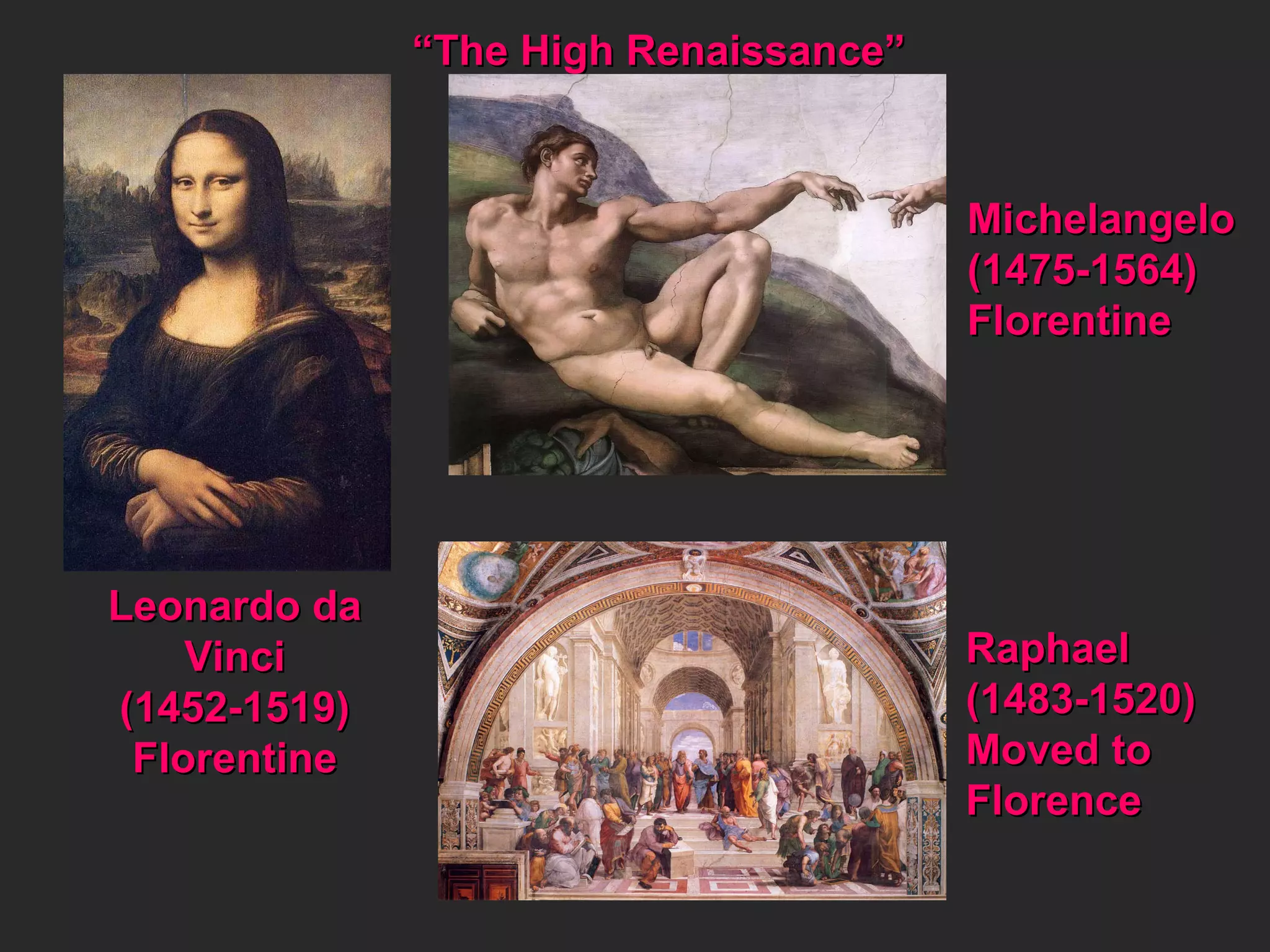
“ The High Renaissance” Leonardo da Vinci (1452-1519) Florentine Michelangelo (1475-1564) Florentine Raphael (1483-1520) Moved to Florence
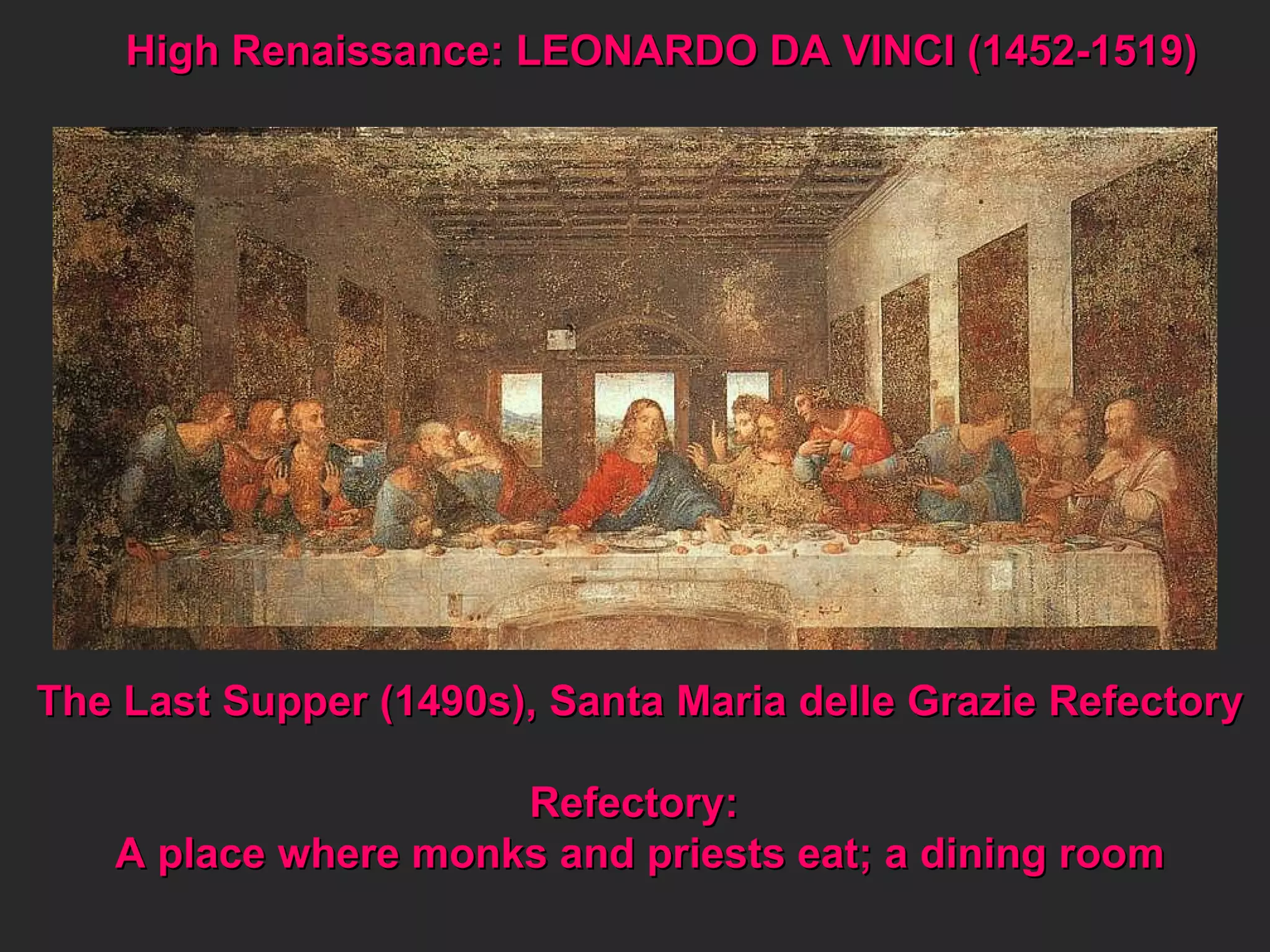
High Renaissance: LEONARDO DA VINCI (1452-1519) The Last Supper (1490s), Santa Maria delle Grazie Refectory Refectory:  A place where monks and priests eat; a dining room
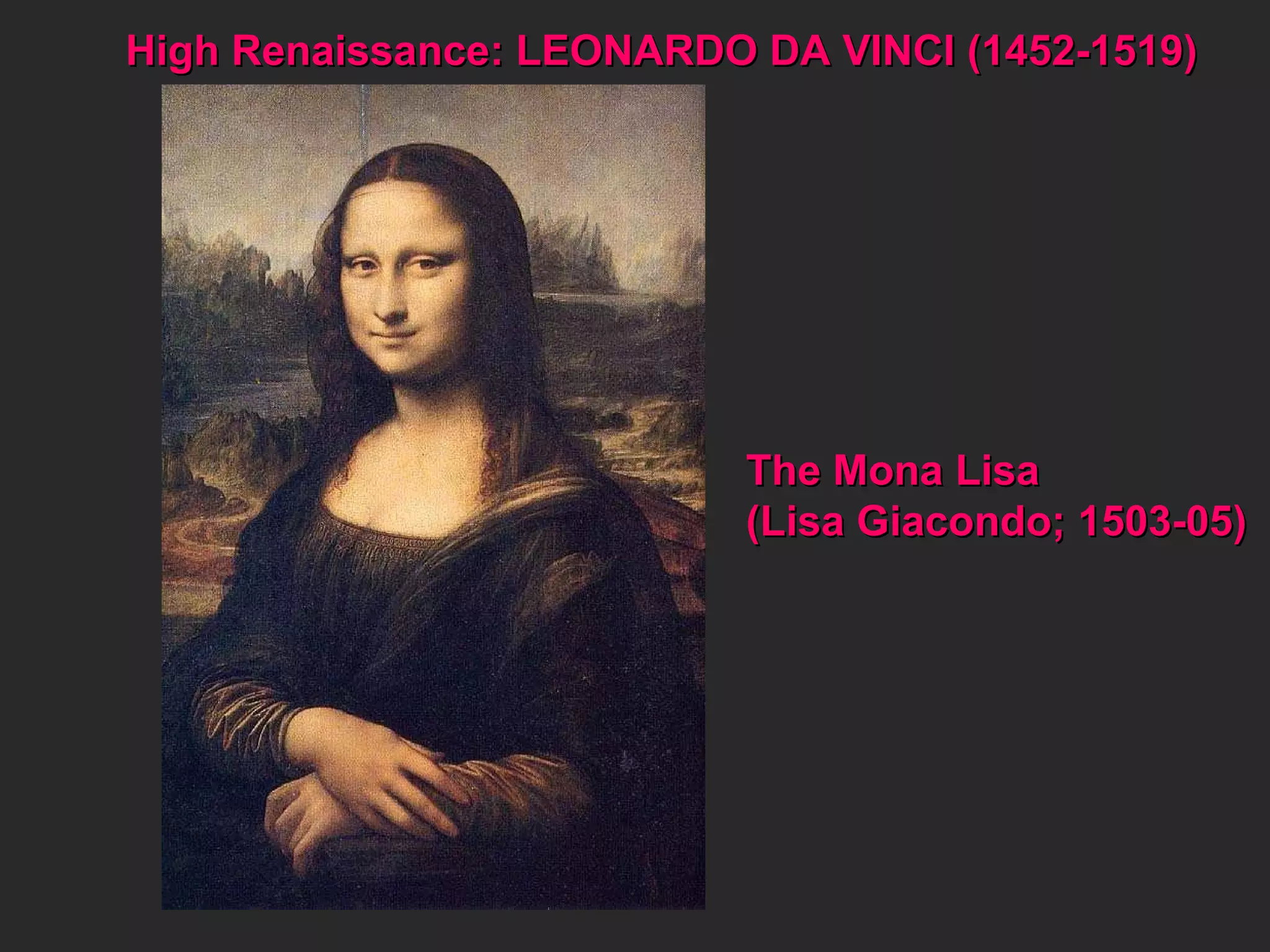
High Renaissance: LEONARDO DA VINCI (1452-1519) The Mona Lisa  (Lisa Giacondo; 1503-05)
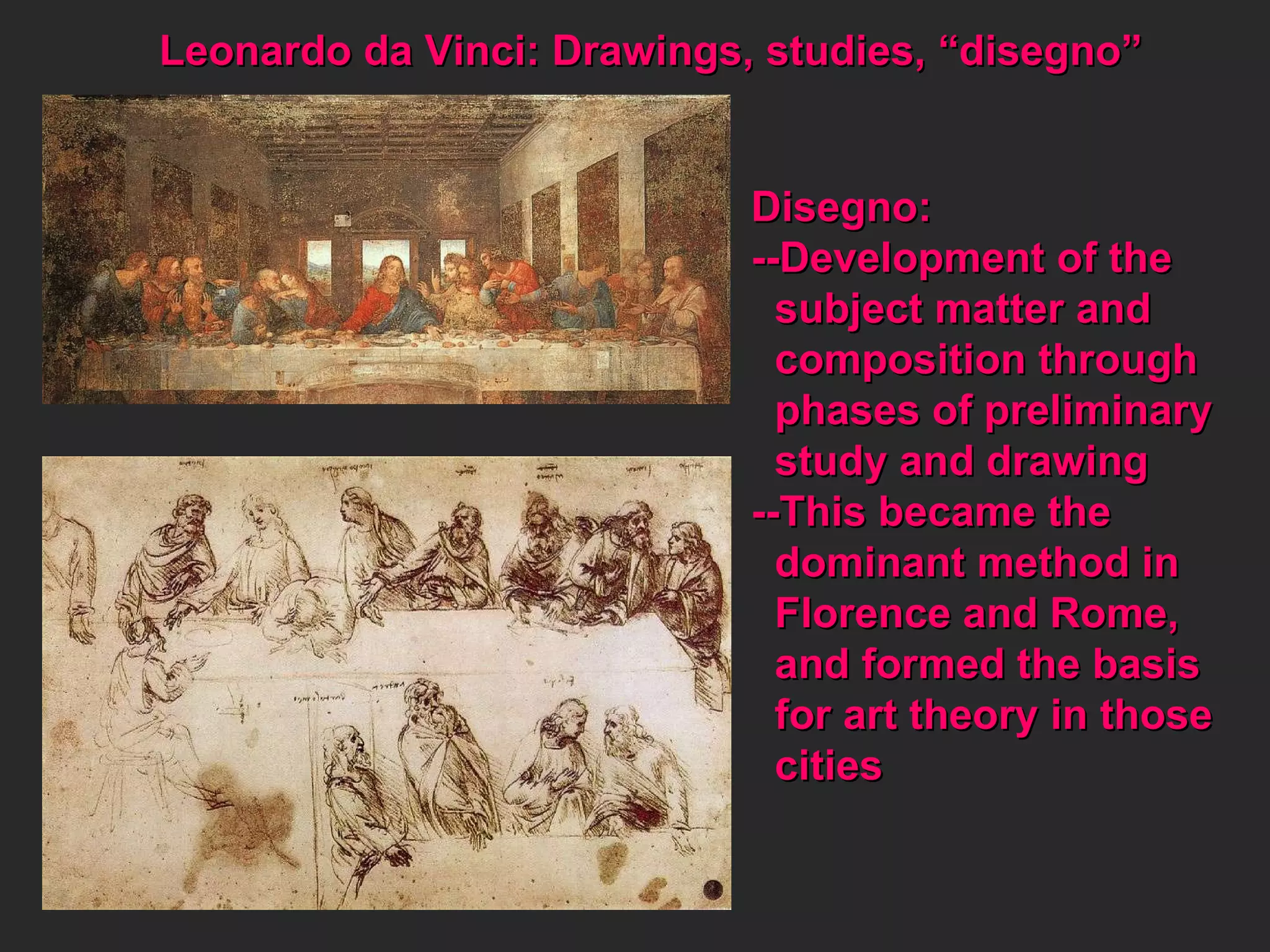
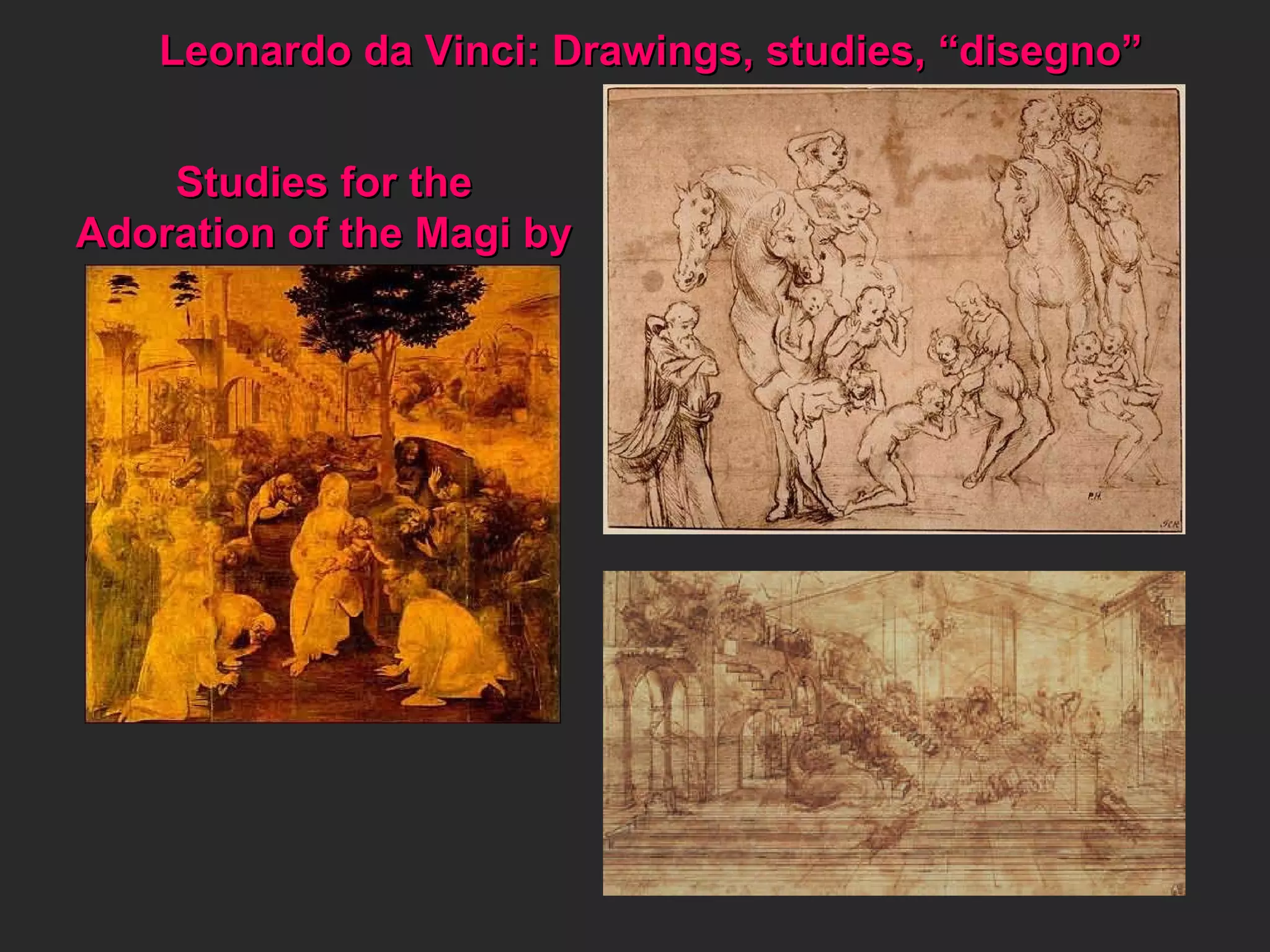
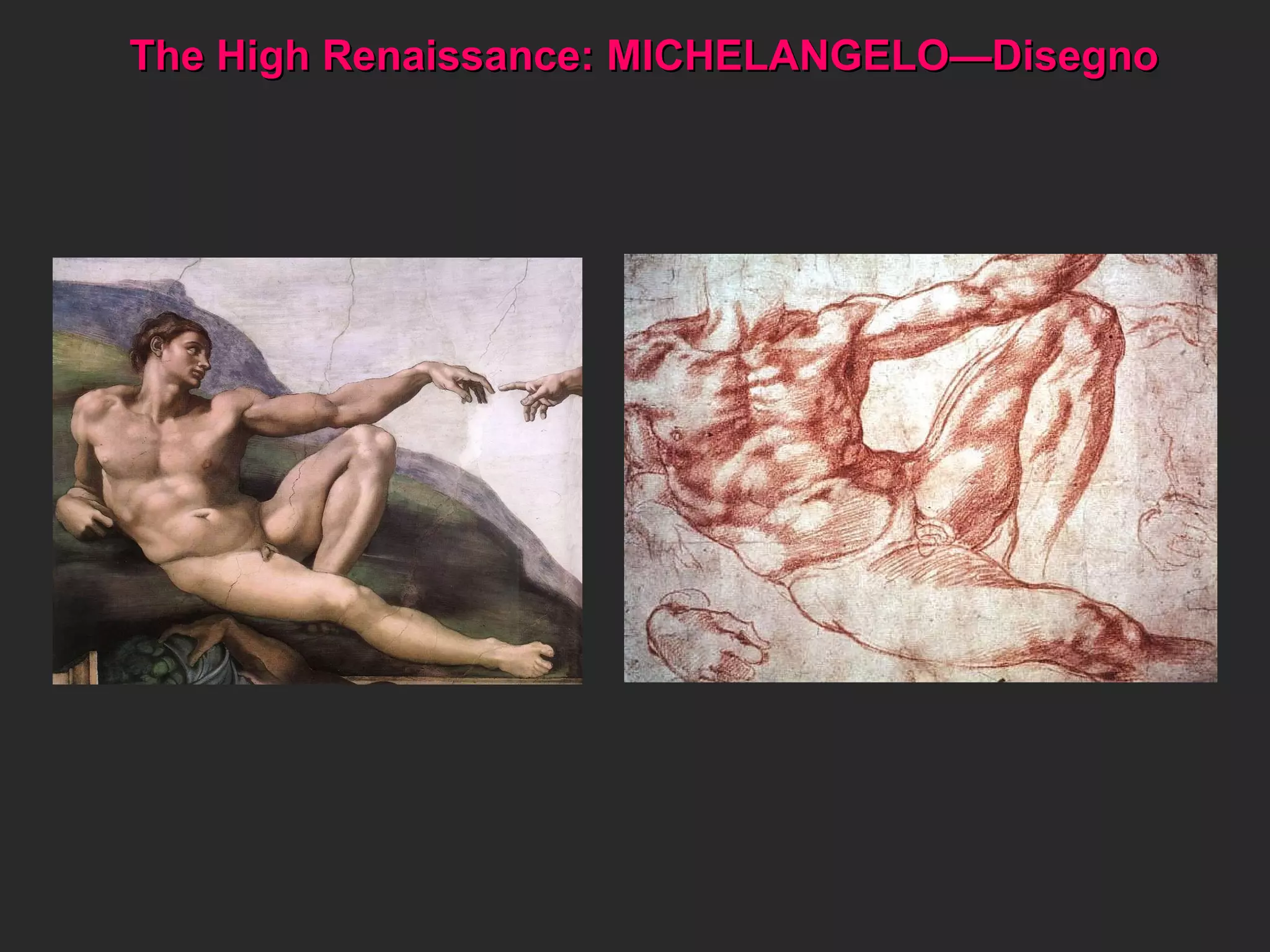
Leonardo da Vinci: Drawings, studies, “disegno” Disegno: --Development of the subject matter and composition through phases of preliminary study and drawing --This became the dominant method in Florence and Rome,  and formed the basis for art theory in those cities
Studies for the Adoration of the Magi by Leonardo da Vinci: Drawings, studies, “disegno”
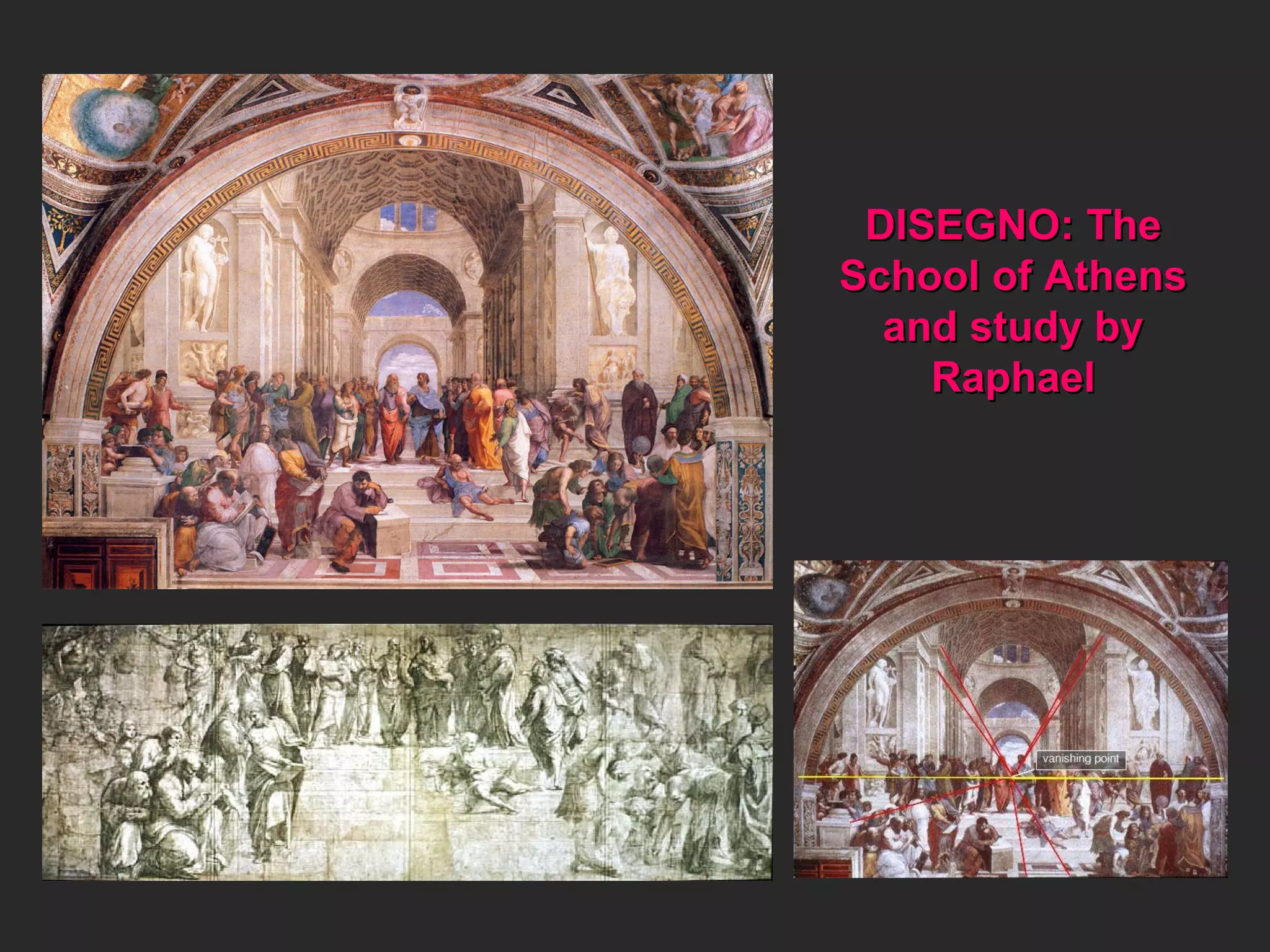
DISEGNO: The School of Athens and study by Raphael
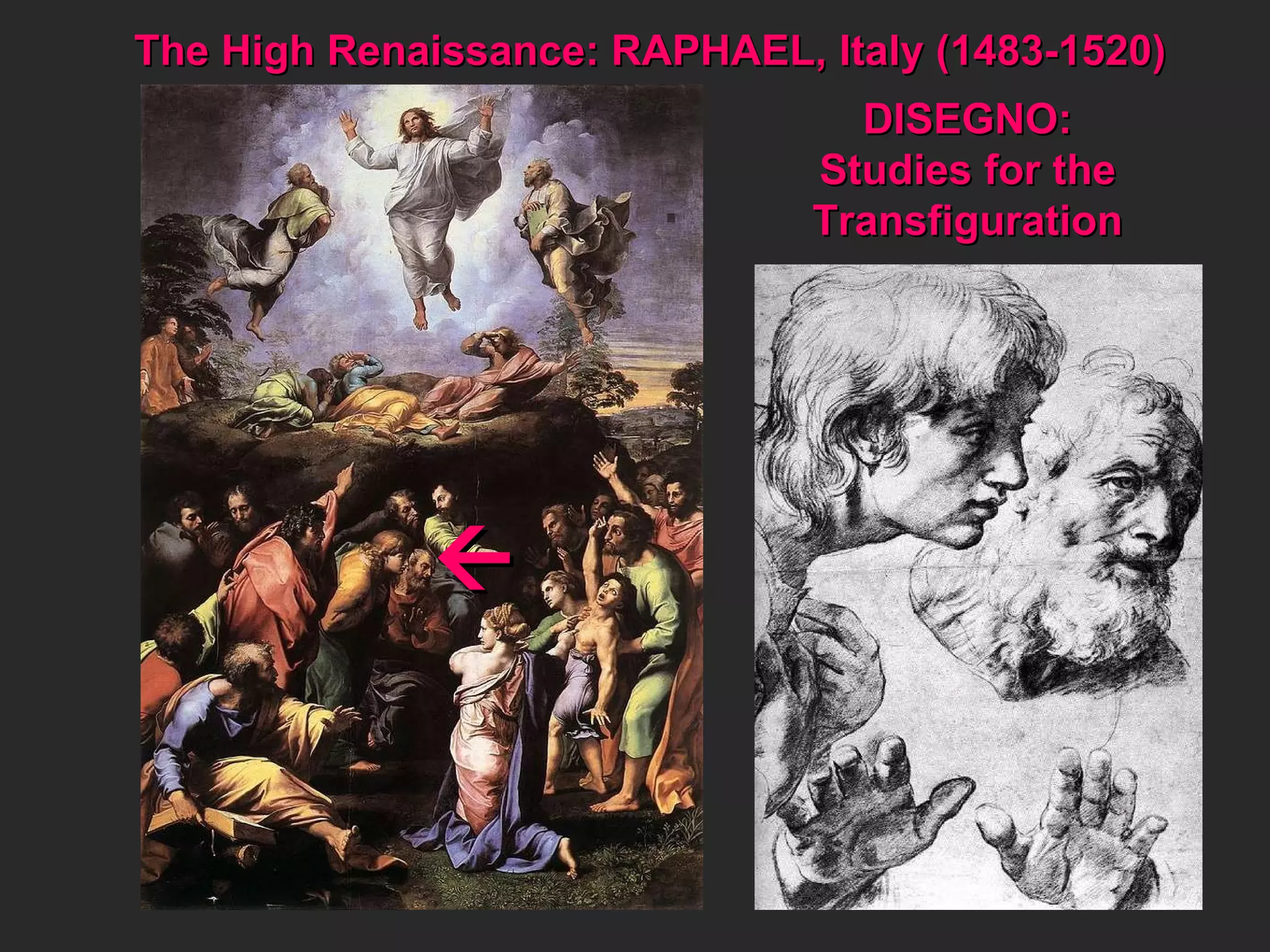
DISEGNO: Studies for the Transfiguration The High Renaissance: RAPHAEL, Italy (1483-1520) 
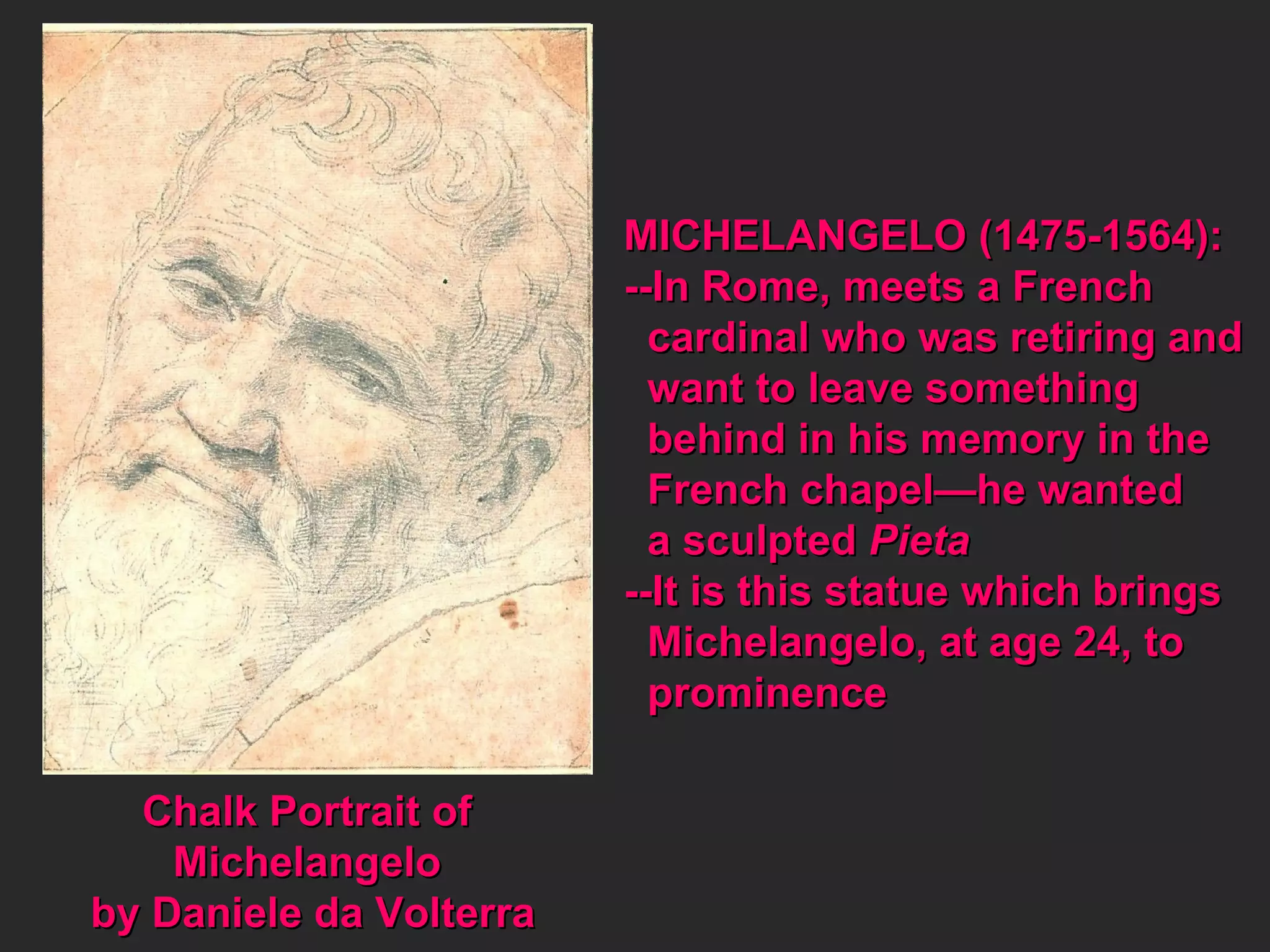
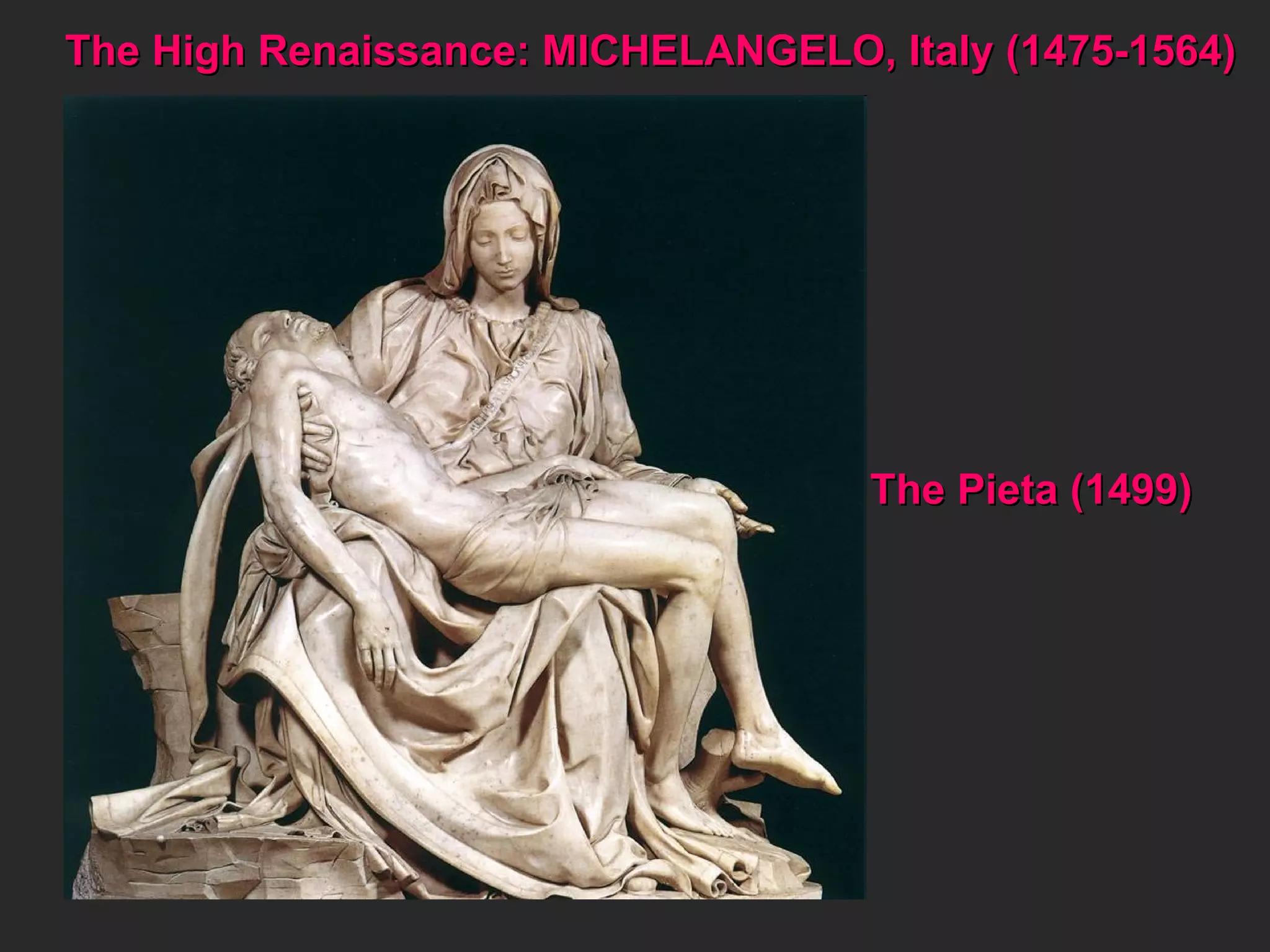
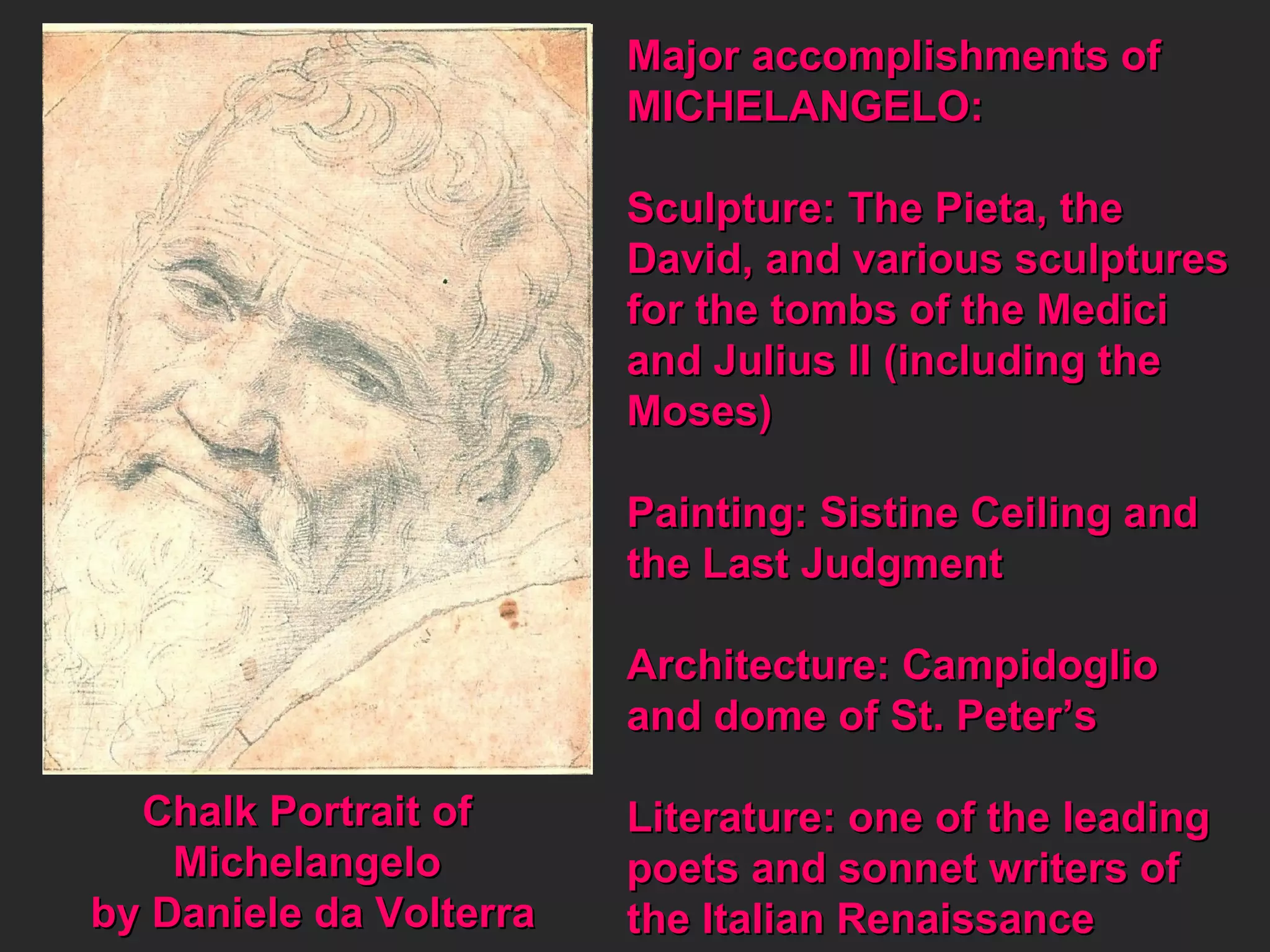
Chalk Portrait of  Michelangelo  by Daniele da Volterra MICHELANGELO (1475-1564): --In Rome, meets a French cardinal who was retiring and want to leave something  behind in his memory in the French chapel—he wanted  a sculpted  Pieta --It is this statue which brings Michelangelo, at age 24, to  prominence
The High Renaissance: MICHELANGELO, Italy (1475-1564) The Pieta (1499)
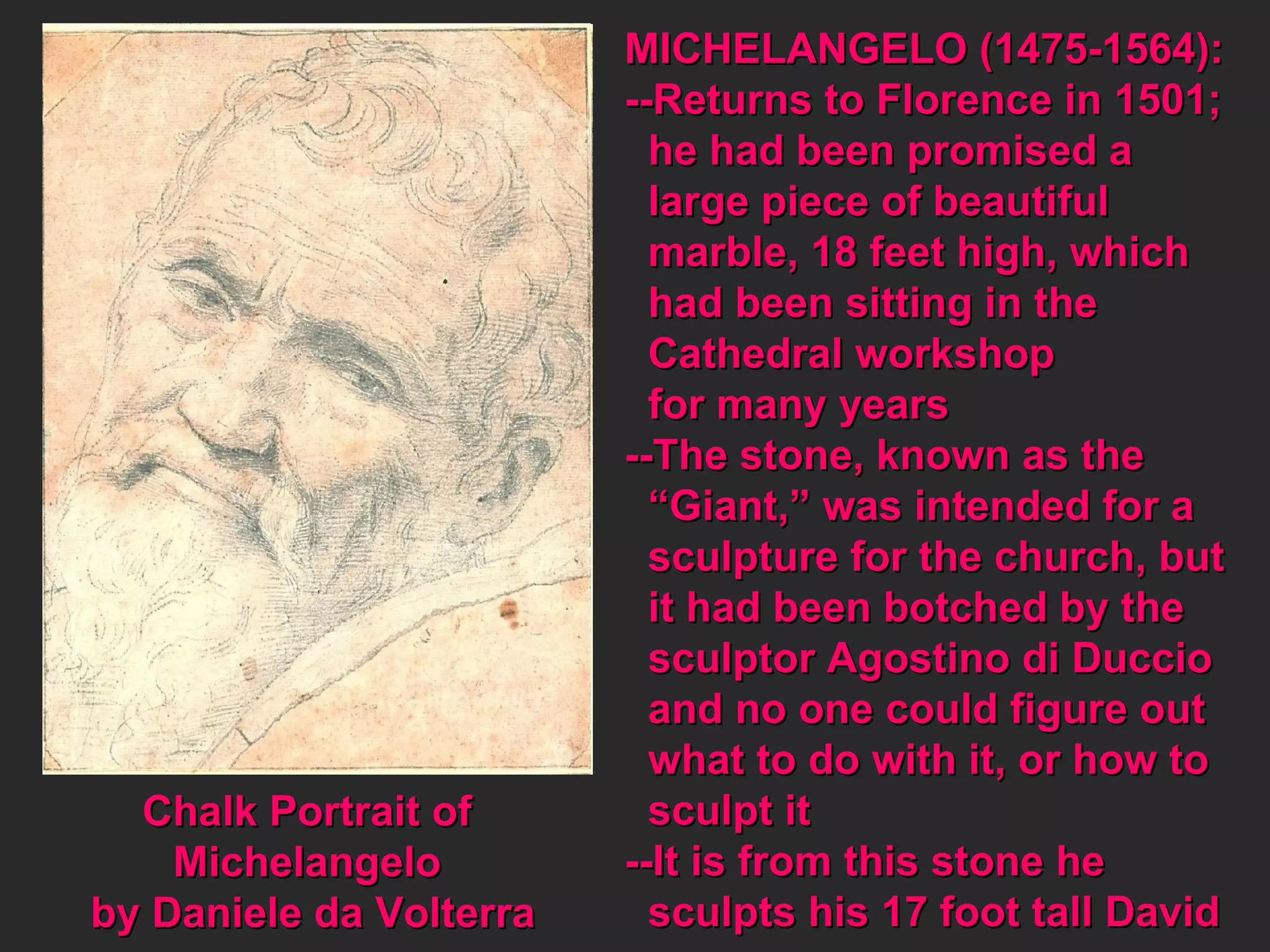
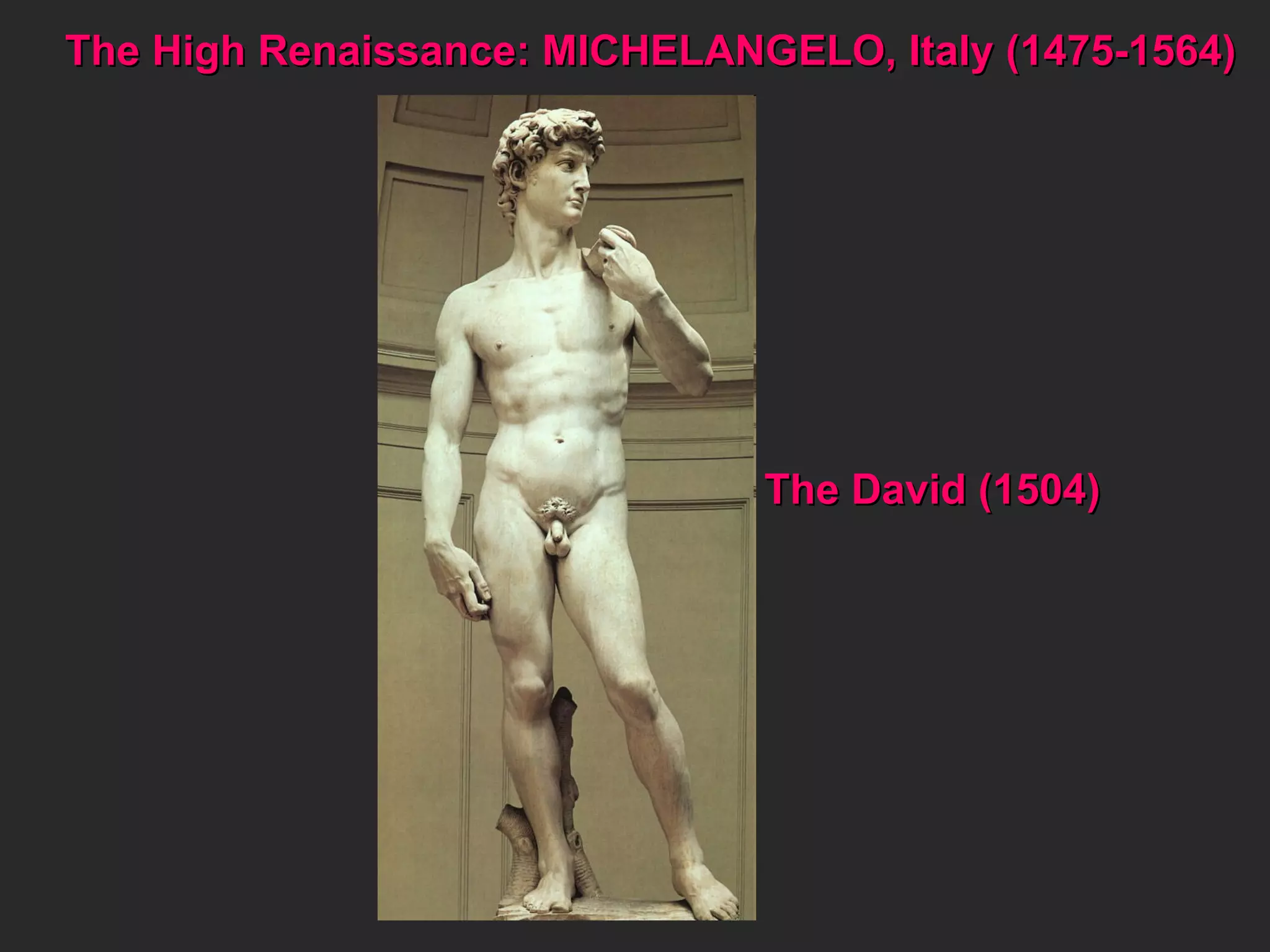
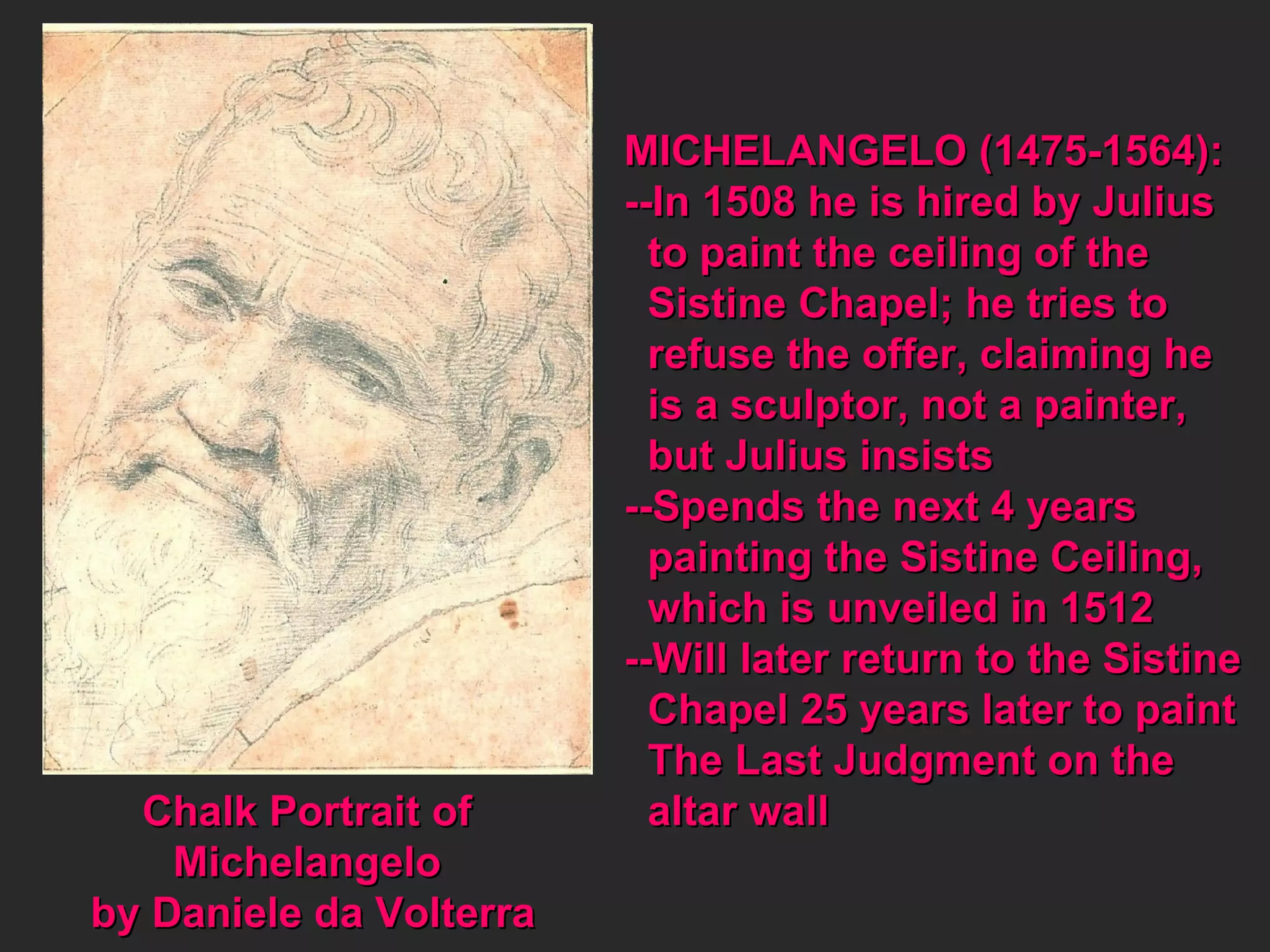
Chalk Portrait of  Michelangelo  by Daniele da Volterra MICHELANGELO (1475-1564): --Returns to Florence in 1501; he had been promised a large piece of beautiful marble, 18 feet high, which had been sitting in the  Cathedral workshop  for many years --The stone, known as the  “ Giant,” was intended for a sculpture for the church, but it had been botched by the sculptor Agostino di Duccio and no one could figure out what to do with it, or how to sculpt it --It is from this stone he sculpts his 17 foot tall David
The High Renaissance: MICHELANGELO, Italy (1475-1564) The David (1504)
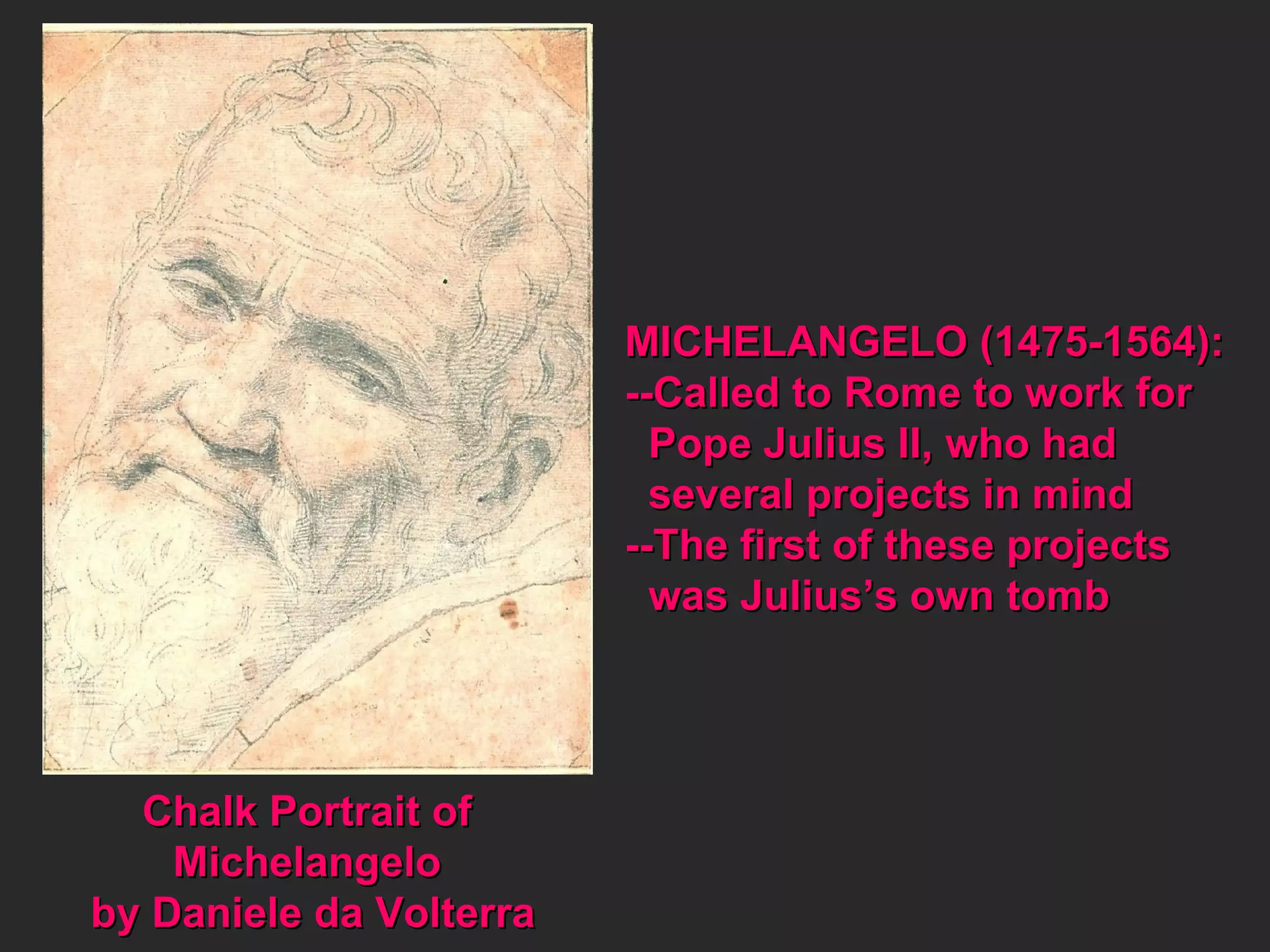
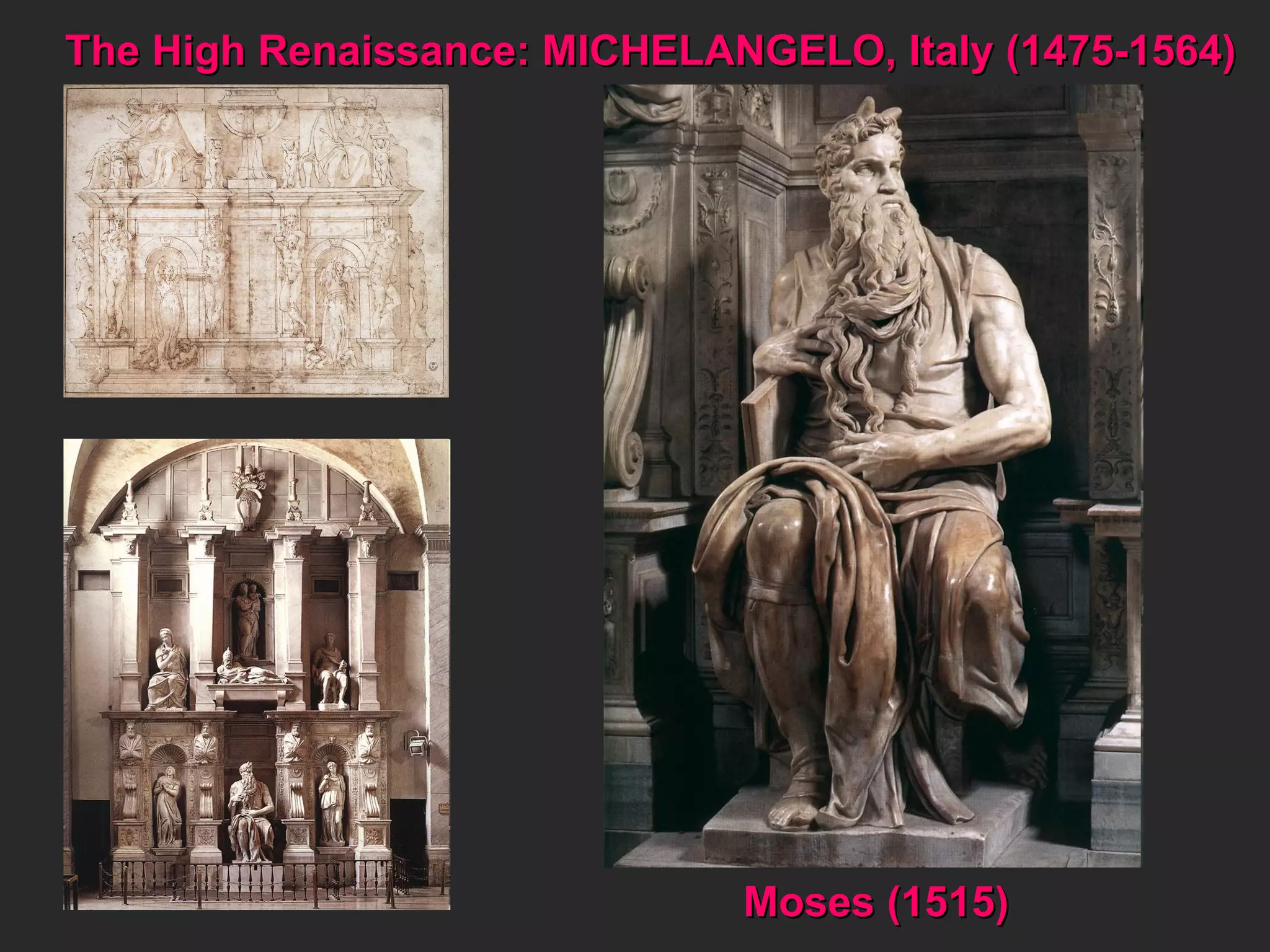
Chalk Portrait of  Michelangelo  by Daniele da Volterra MICHELANGELO (1475-1564): --Called to Rome to work for Pope Julius II, who had  several projects in mind --The first of these projects was Julius’s own tomb
The High Renaissance: MICHELANGELO, Italy (1475-1564) Moses (1515)
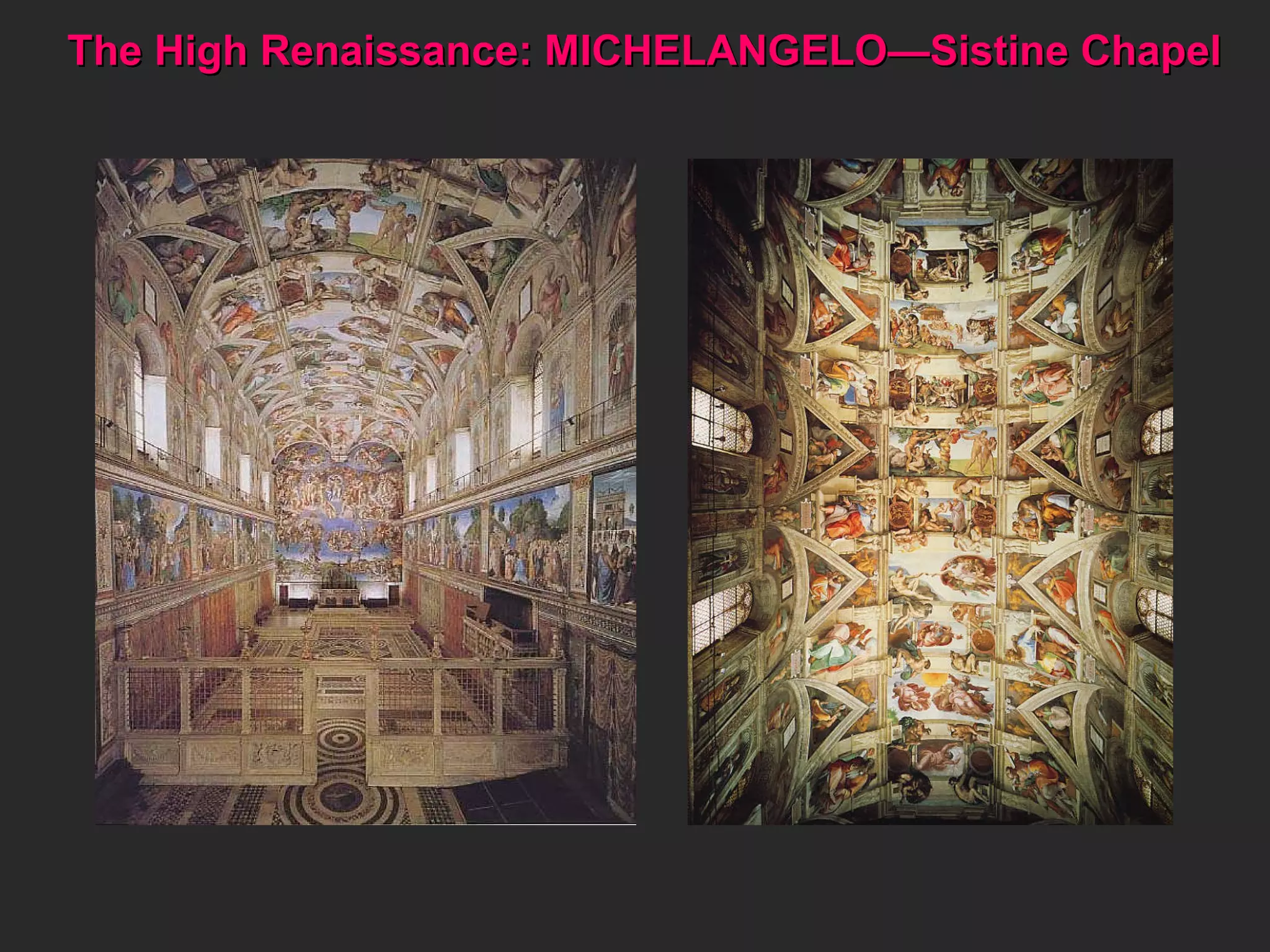
Chalk Portrait of  Michelangelo  by Daniele da Volterra MICHELANGELO (1475-1564): --In 1508 he is hired by Julius to paint the ceiling of the  Sistine Chapel; he tries to refuse the offer, claiming he  is a sculptor, not a painter,  but Julius insists --Spends the next 4 years  painting the Sistine Ceiling, which is unveiled in 1512 --Will later return to the Sistine Chapel 25 years later to paint  The Last Judgment on the  altar wall
The High Renaissance: MICHELANGELO—Sistine Chapel
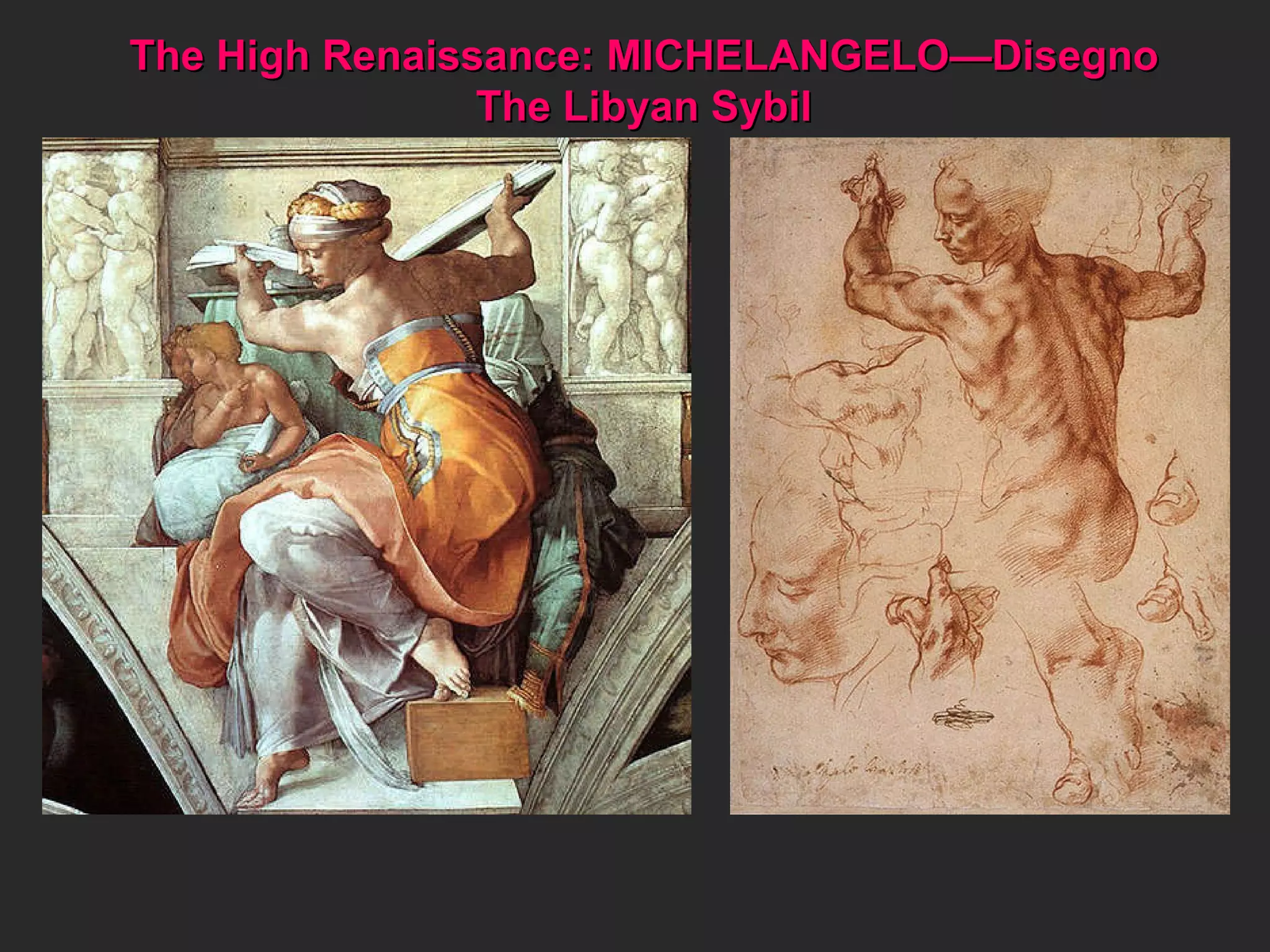
The High Renaissance: MICHELANGELO—Disegno
The High Renaissance: MICHELANGELO—Disegno  The Libyan Sybil
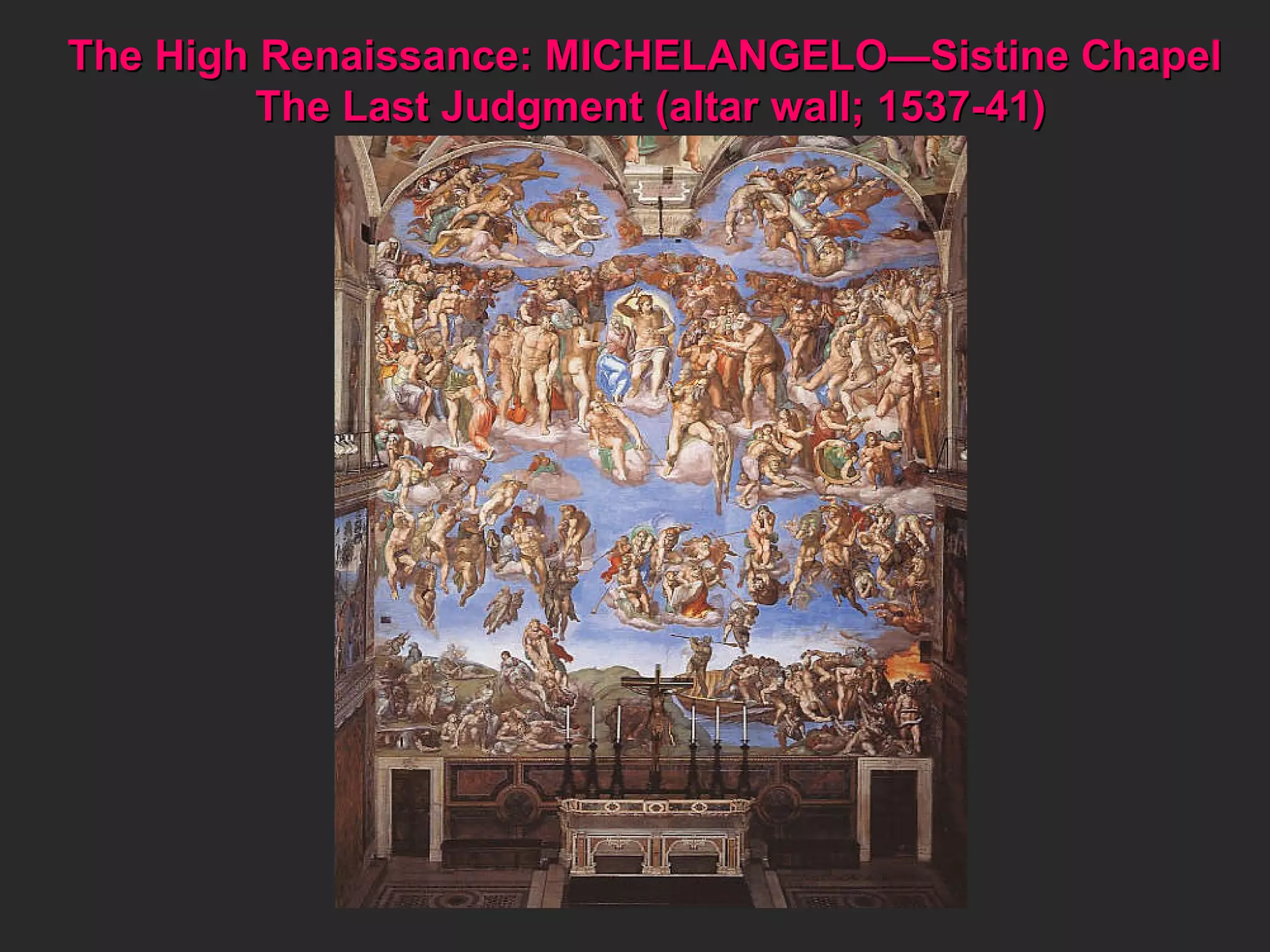
The High Renaissance: MICHELANGELO—Sistine Chapel  The Last Judgment (altar wall; 1537-41)
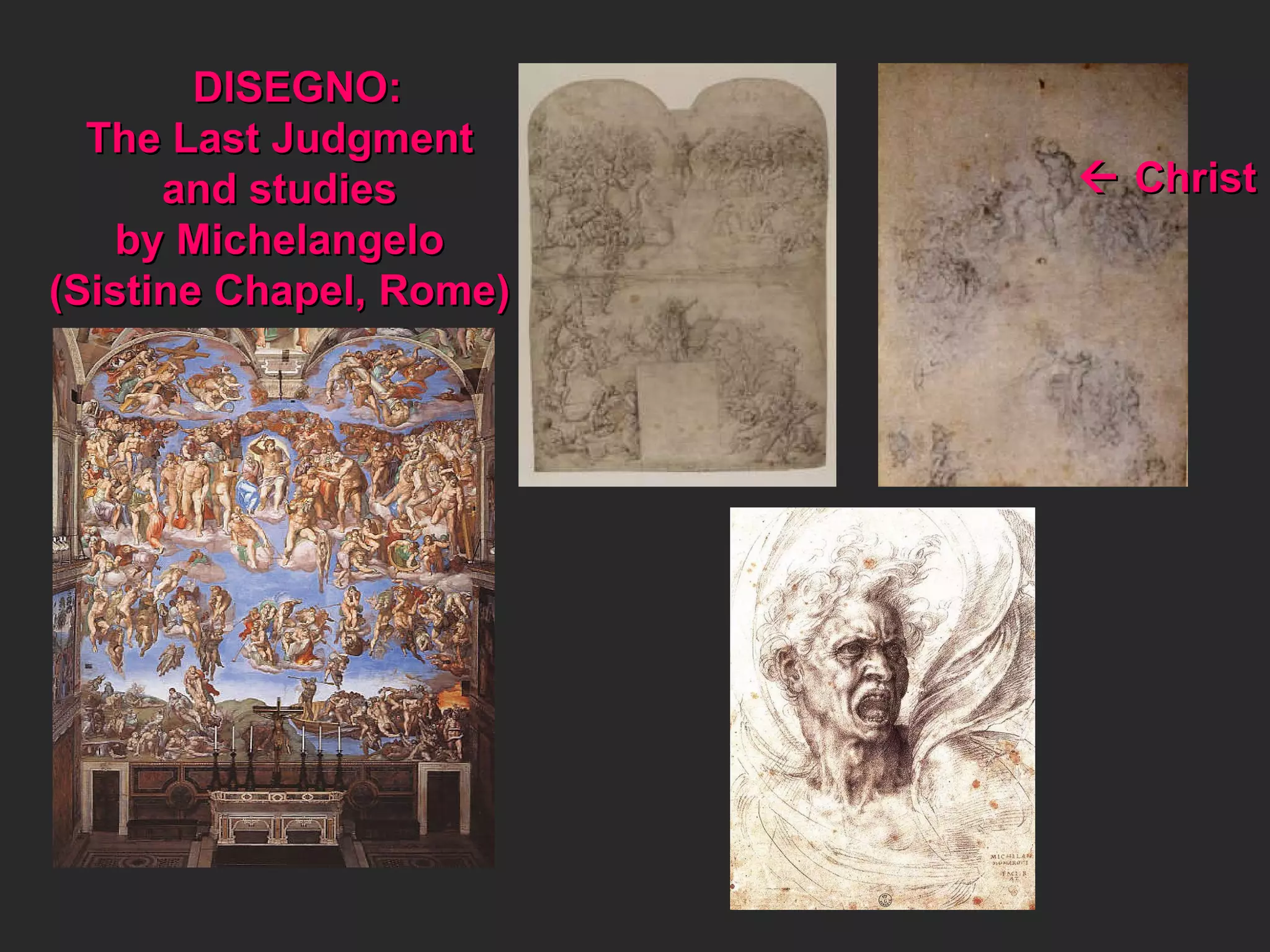
DISEGNO: The Last Judgment  and studies  by Michelangelo  (Sistine Chapel, Rome)     Christ
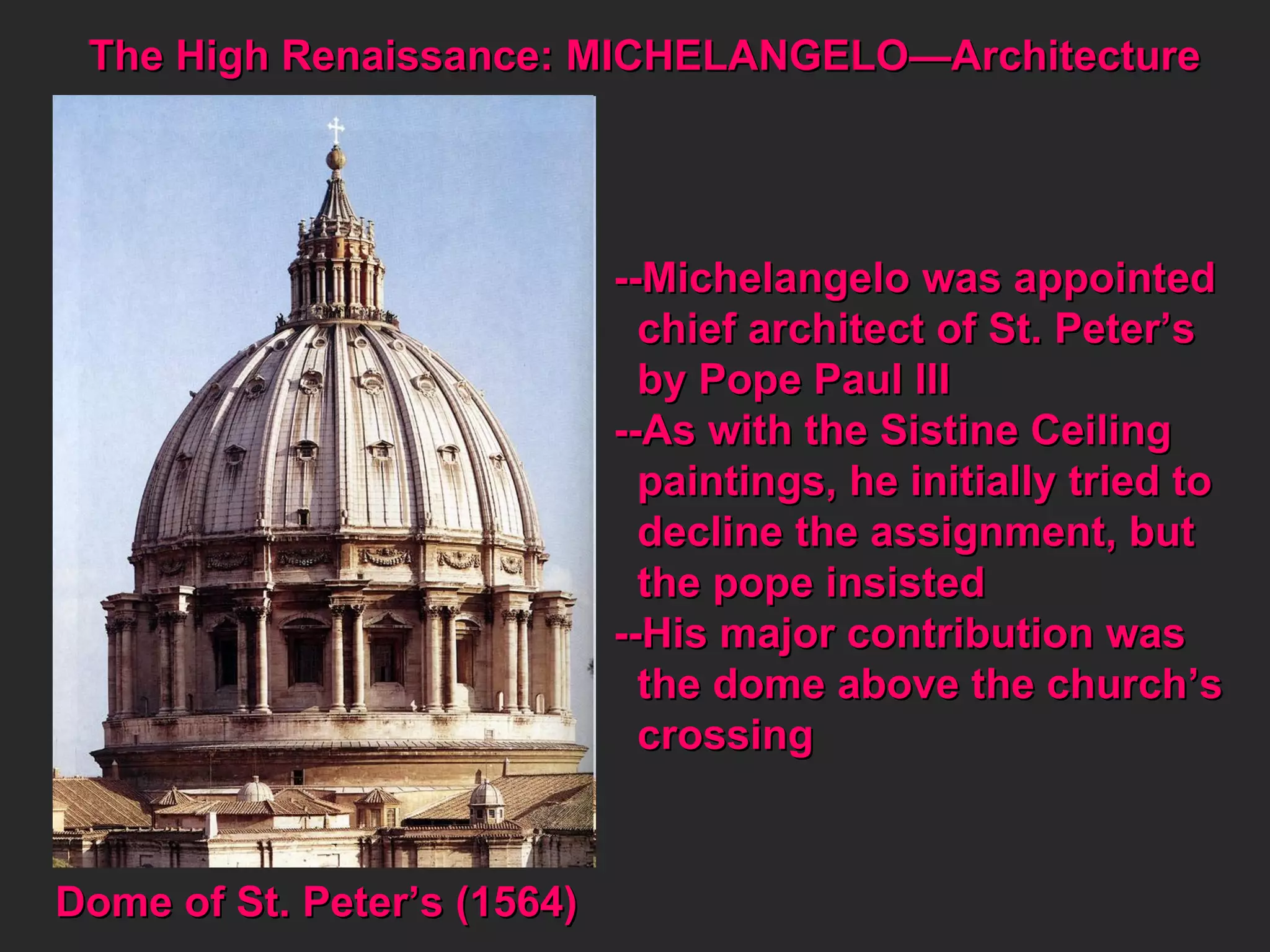
The High Renaissance: MICHELANGELO—Architecture  Dome of St. Peter’s (1564) --Michelangelo was appointed chief architect of St. Peter’s by Pope Paul III --As with the Sistine Ceiling  paintings, he initially tried to decline the assignment, but the pope insisted --His major contribution was the dome above the church’s crossing
Chalk Portrait of  Michelangelo  by Daniele da Volterra Major accomplishments of MICHELANGELO: Sculpture: The Pieta, the  David, and various sculptures for the tombs of the Medici and Julius II (including the Moses) Painting: Sistine Ceiling and the Last Judgment Architecture: Campidoglio  and dome of St. Peter’s Literature: one of the leading poets and sonnet writers of the Italian Renaissance
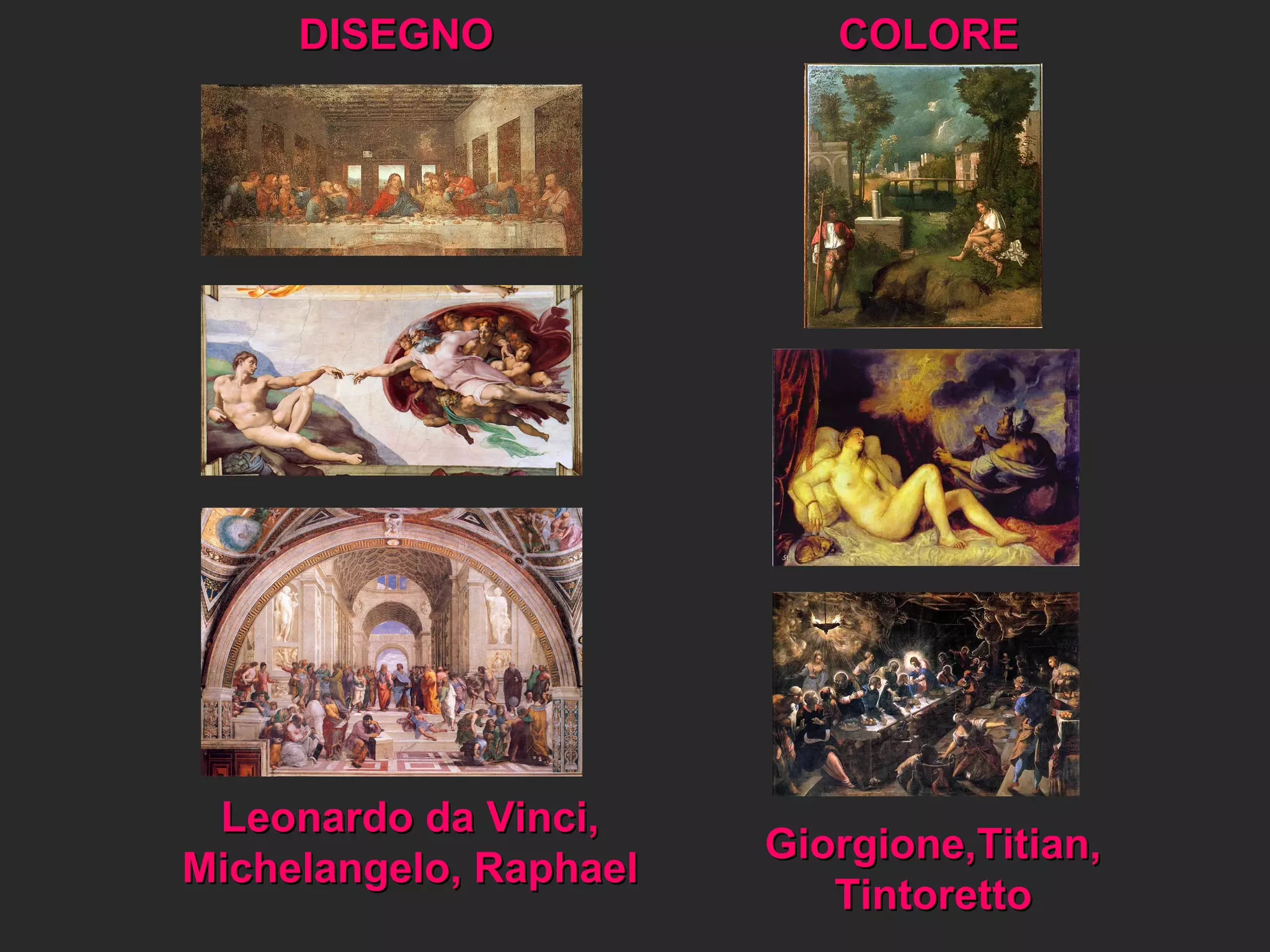
DISEGNO  COLORE Leonardo da Vinci, Michelangelo, Raphael Giorgione,Titian, Tintoretto
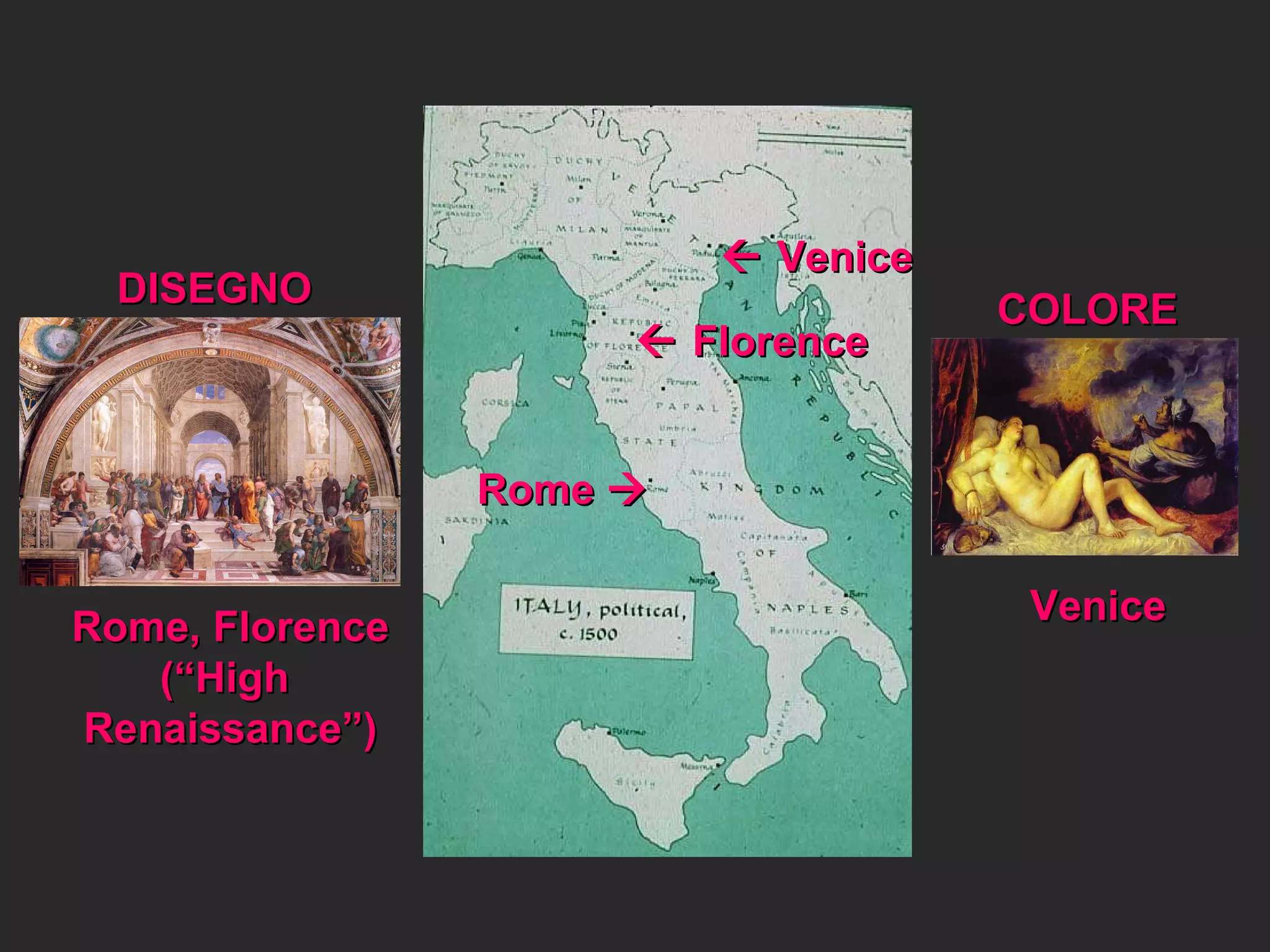
DISEGNO  COLORE Rome, Florence (“High  Renaissance”) Venice     Venice  Rome      Florence
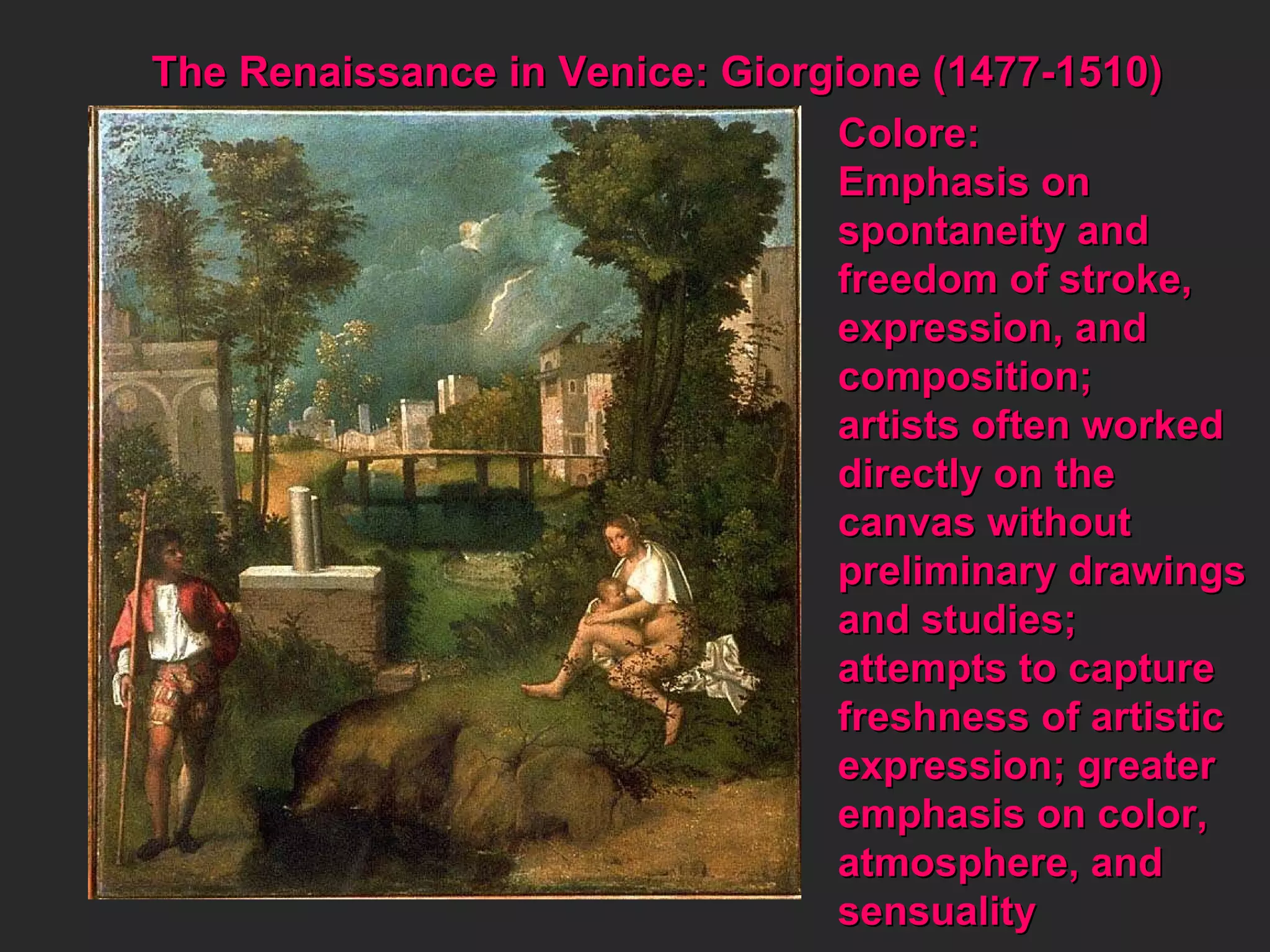
Colore: Emphasis on  spontaneity and freedom of stroke, expression, and  composition; artists often worked directly on the canvas without  preliminary drawings and studies;  attempts to capture freshness of artistic expression; greater emphasis on color, atmosphere, and sensuality The Renaissance in Venice: Giorgione (1477-1510)
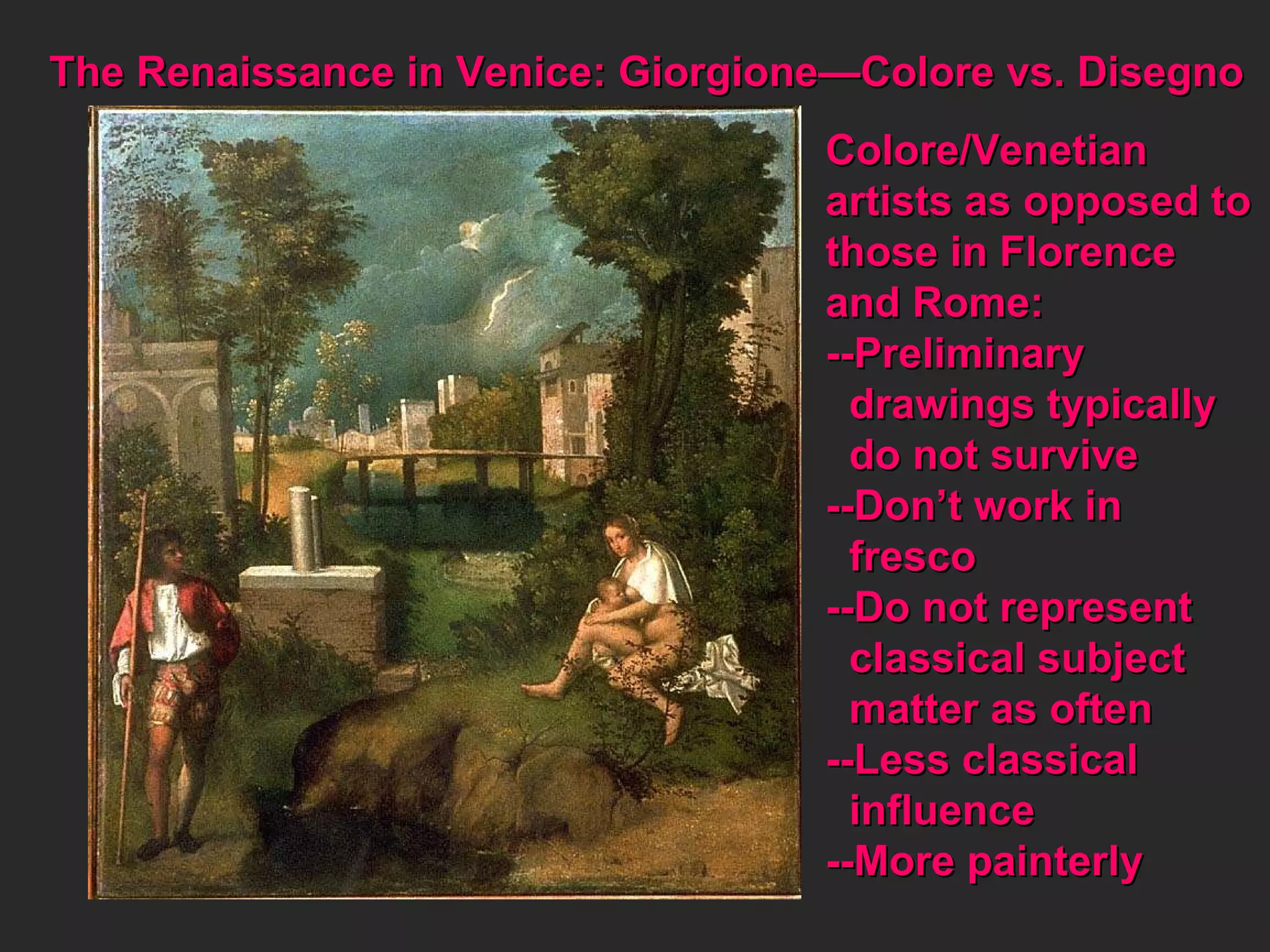
The Renaissance in Venice: Giorgione—Colore vs. Disegno  Colore/Venetian  artists as opposed to those in Florence and Rome: --Preliminary  drawings typically do not survive --Don’t work in  fresco --Do not represent classical subject matter as often --Less classical influence --More painterly
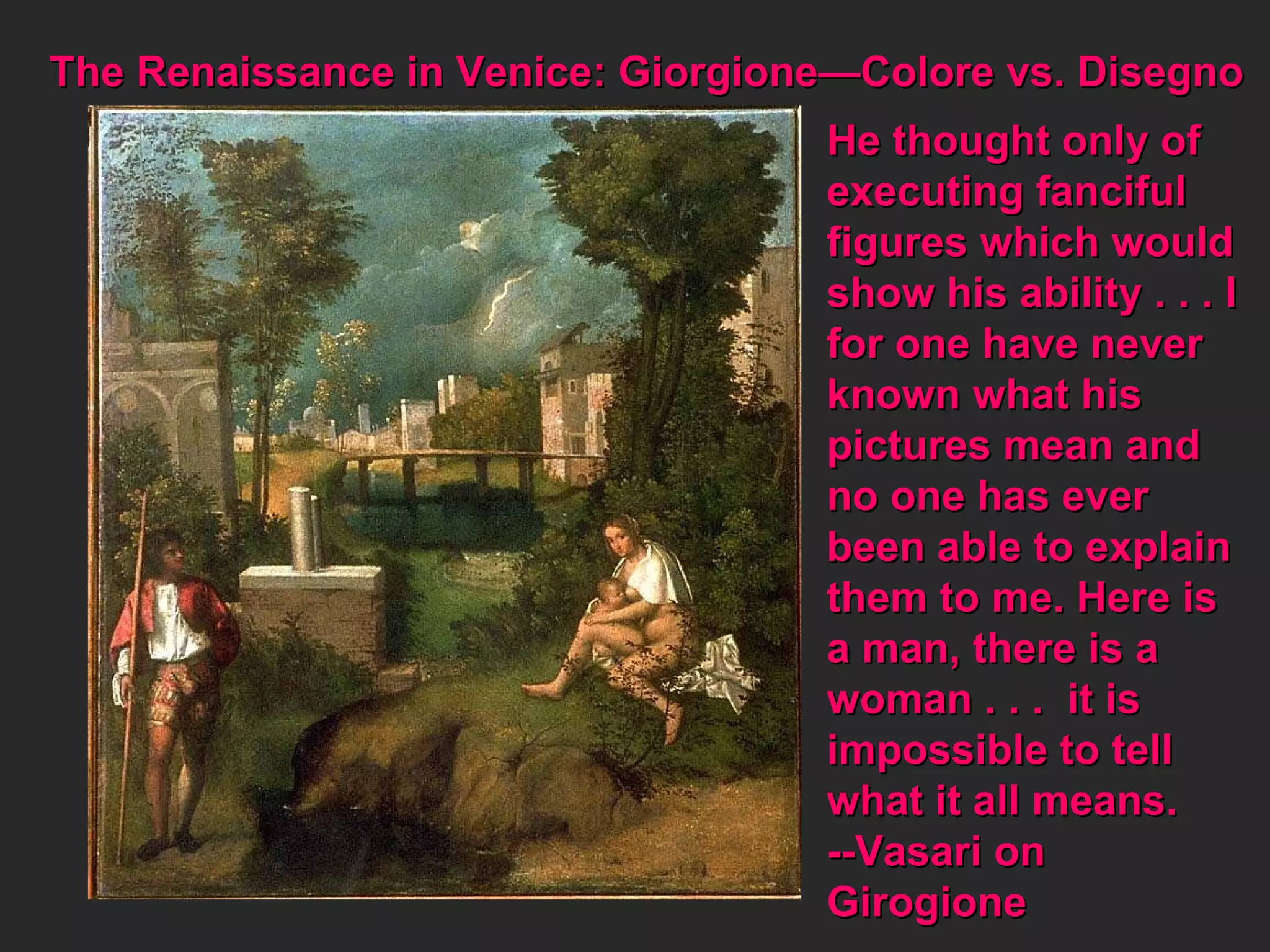
The Renaissance in Venice: Giorgione—Colore vs. Disegno  He thought only of  executing fanciful figures which would show his ability . . . I for one have never known what his pictures mean and  no one has ever  been able to explain them to me. Here is  a man, there is a  woman . . .  it is  impossible to tell what it all means. --Vasari on  Girogione
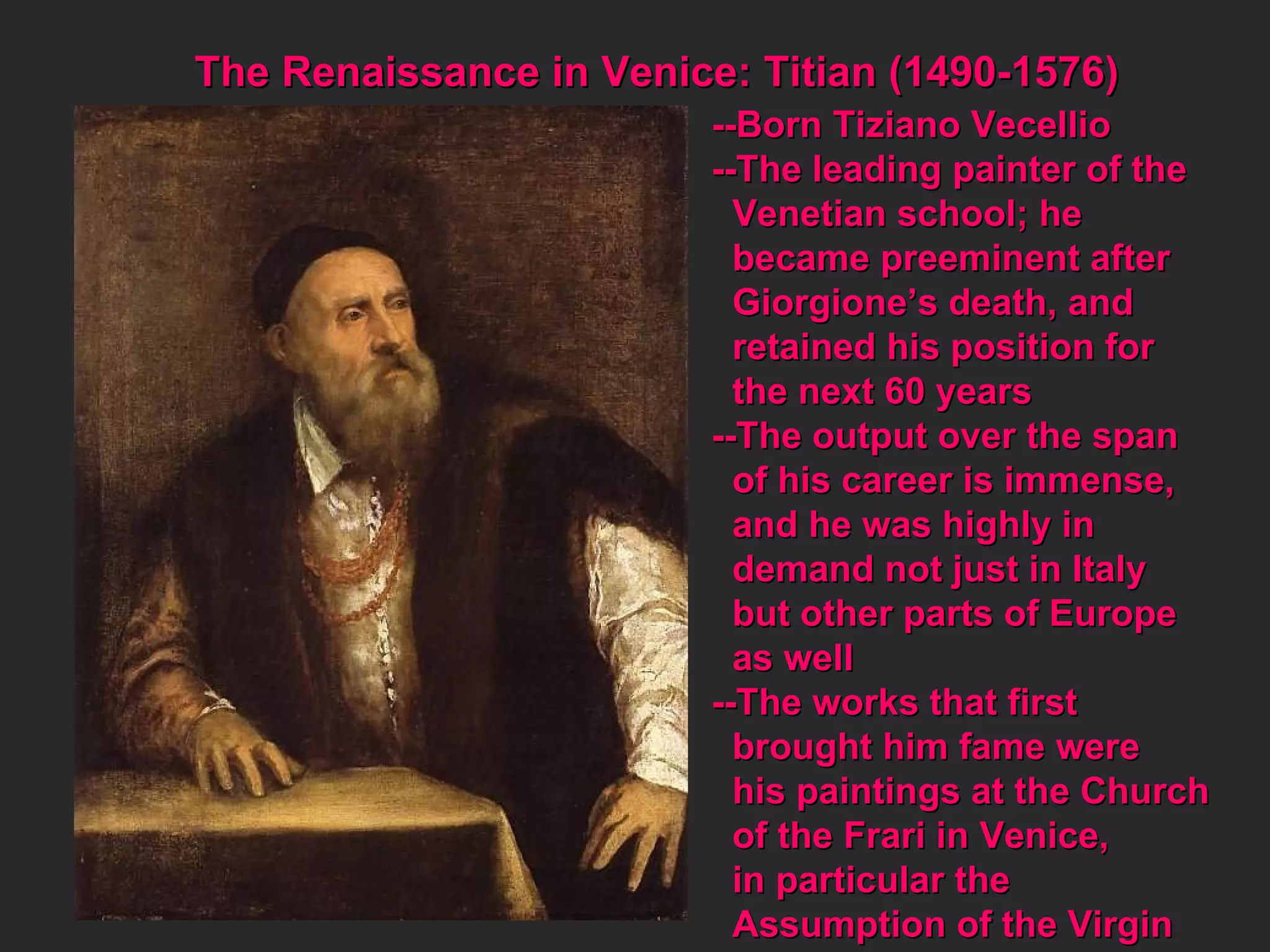
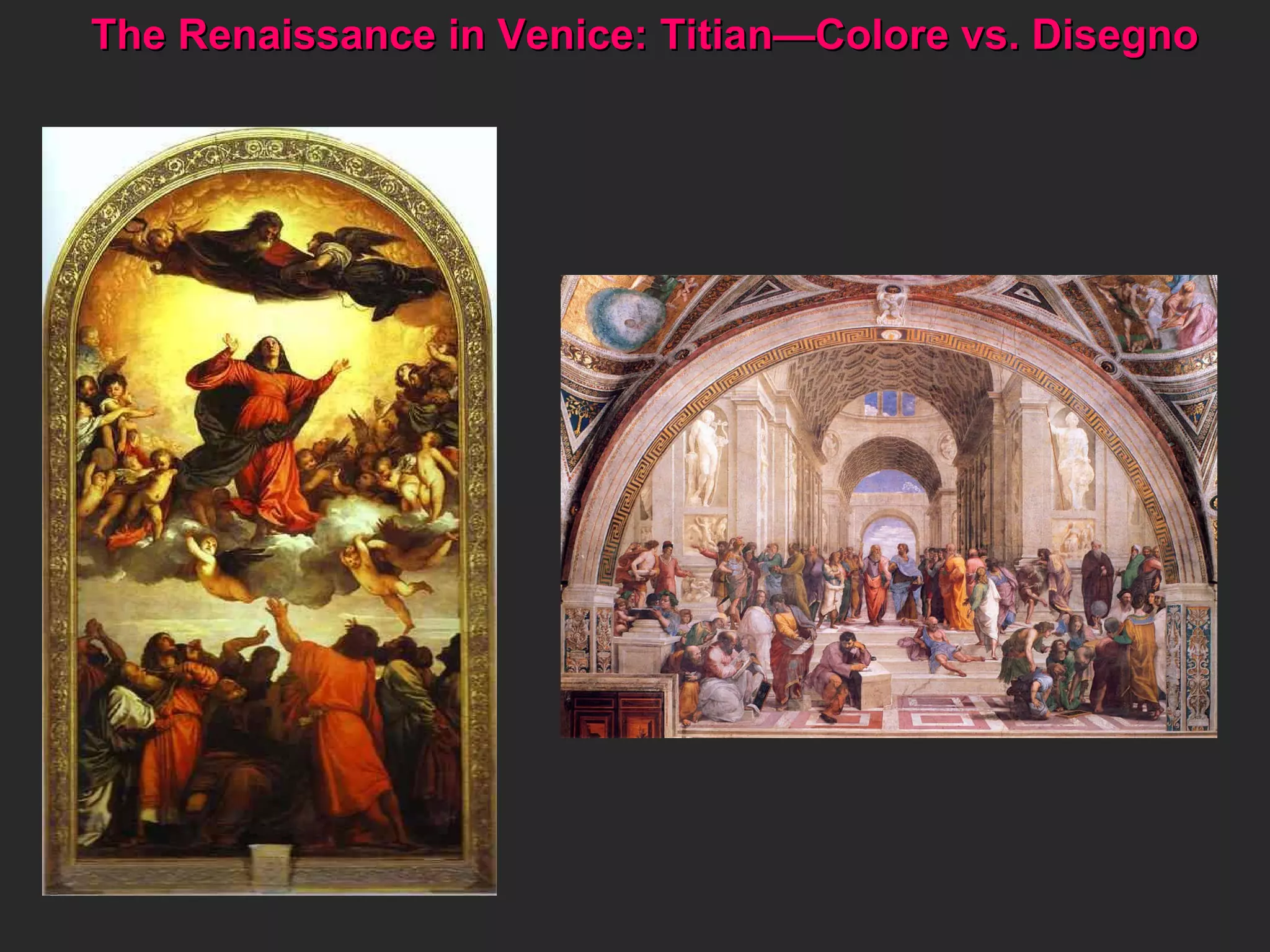
--Born Tiziano Vecellio --The leading painter of the Venetian school; he  became preeminent after Giorgione’s death, and  retained his position for the next 60 years --The output over the span  of his career is immense, and he was highly in demand not just in Italy but other parts of Europe as well --The works that first  brought him fame were his paintings at the Church of the Frari in Venice,  in particular the  Assumption of the Virgin The Renaissance in Venice: Titian (1490-1576)
The Renaissance in Venice: Titian—Colore vs. Disegno
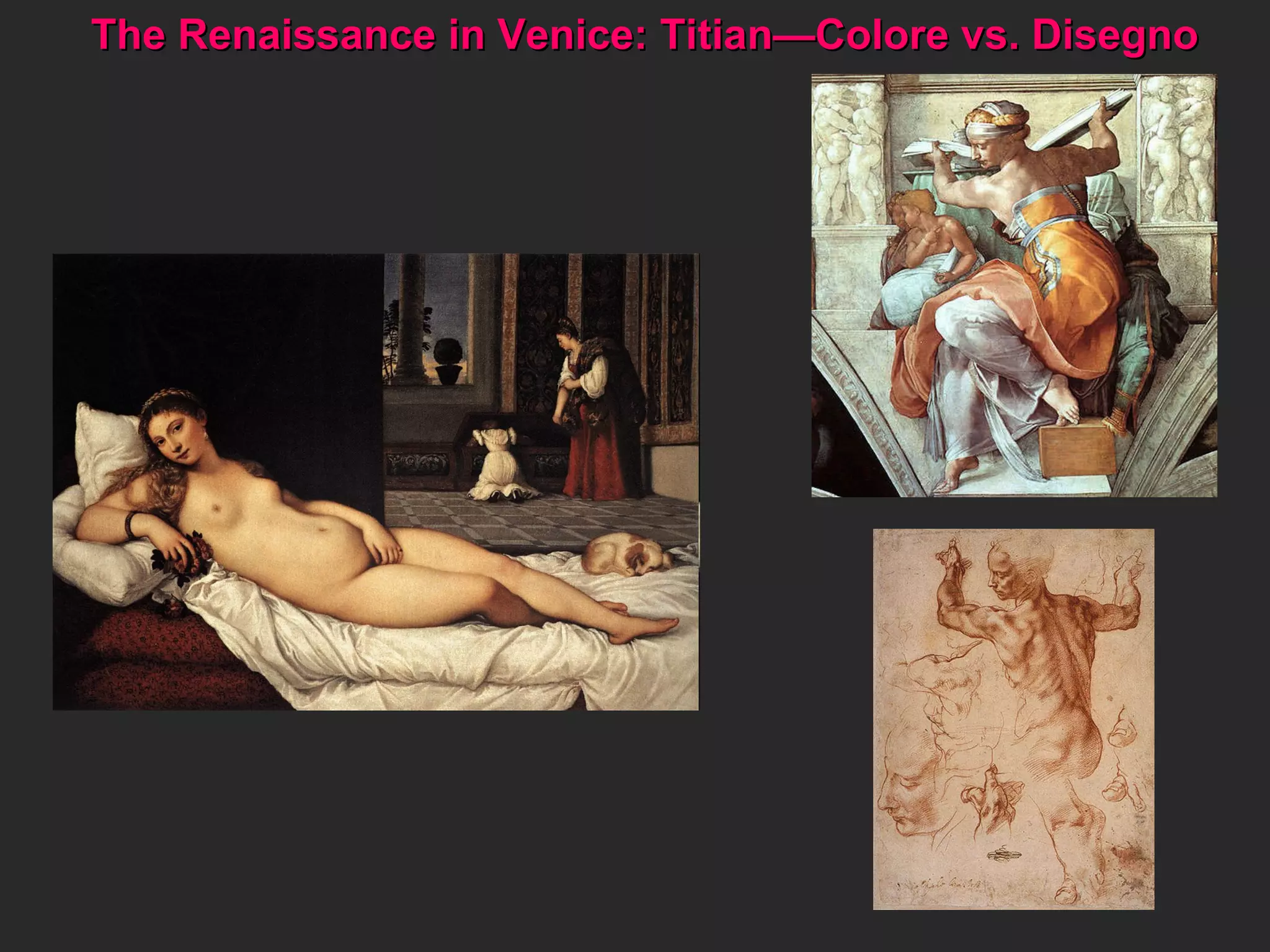
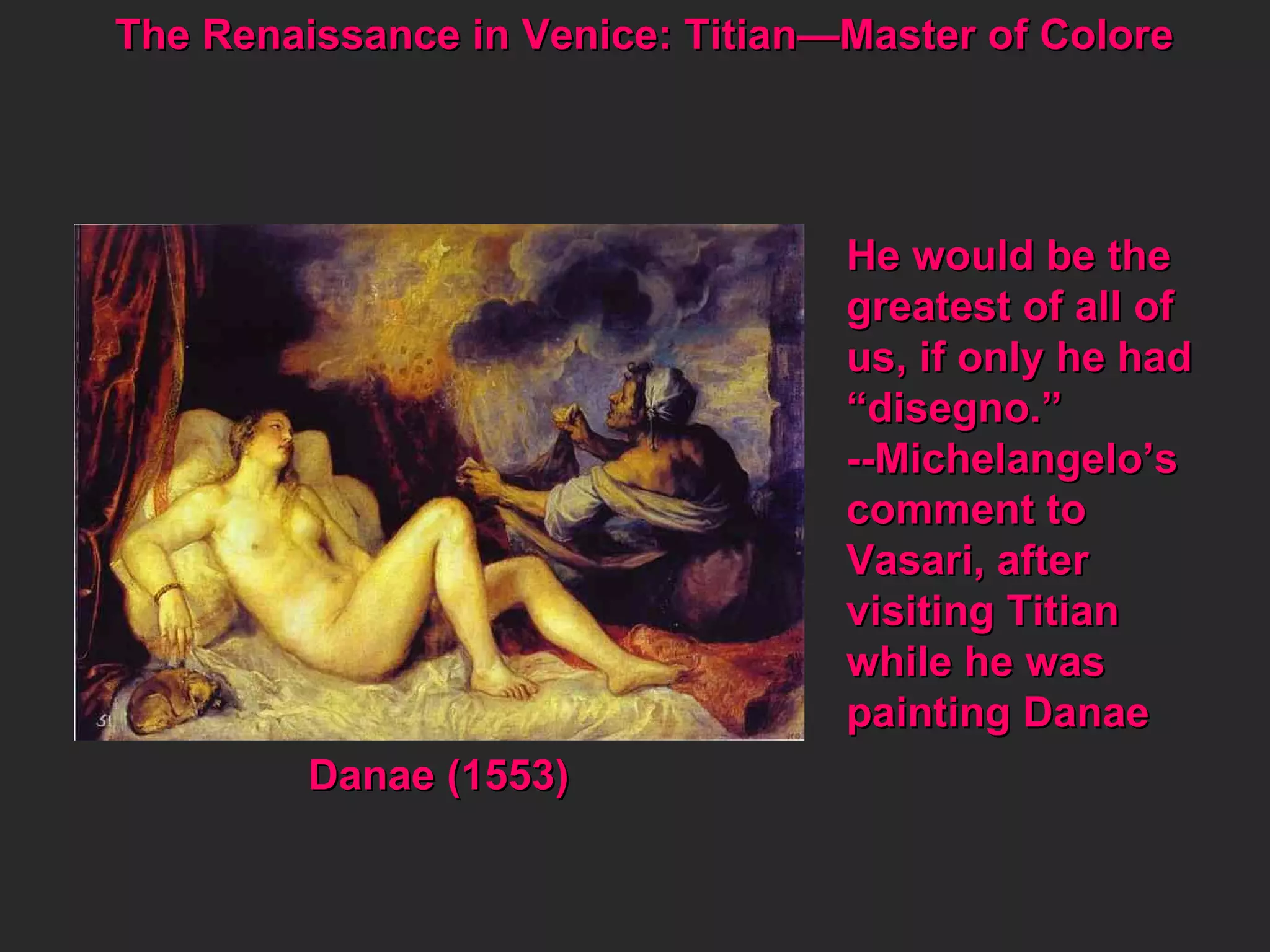
The Renaissance in Venice: Titian—Master of Colore  He would be the greatest of all of us, if only he had “ disegno.” --Michelangelo’s comment to Vasari, after  visiting Titian  while he was  painting Danae Danae (1553)
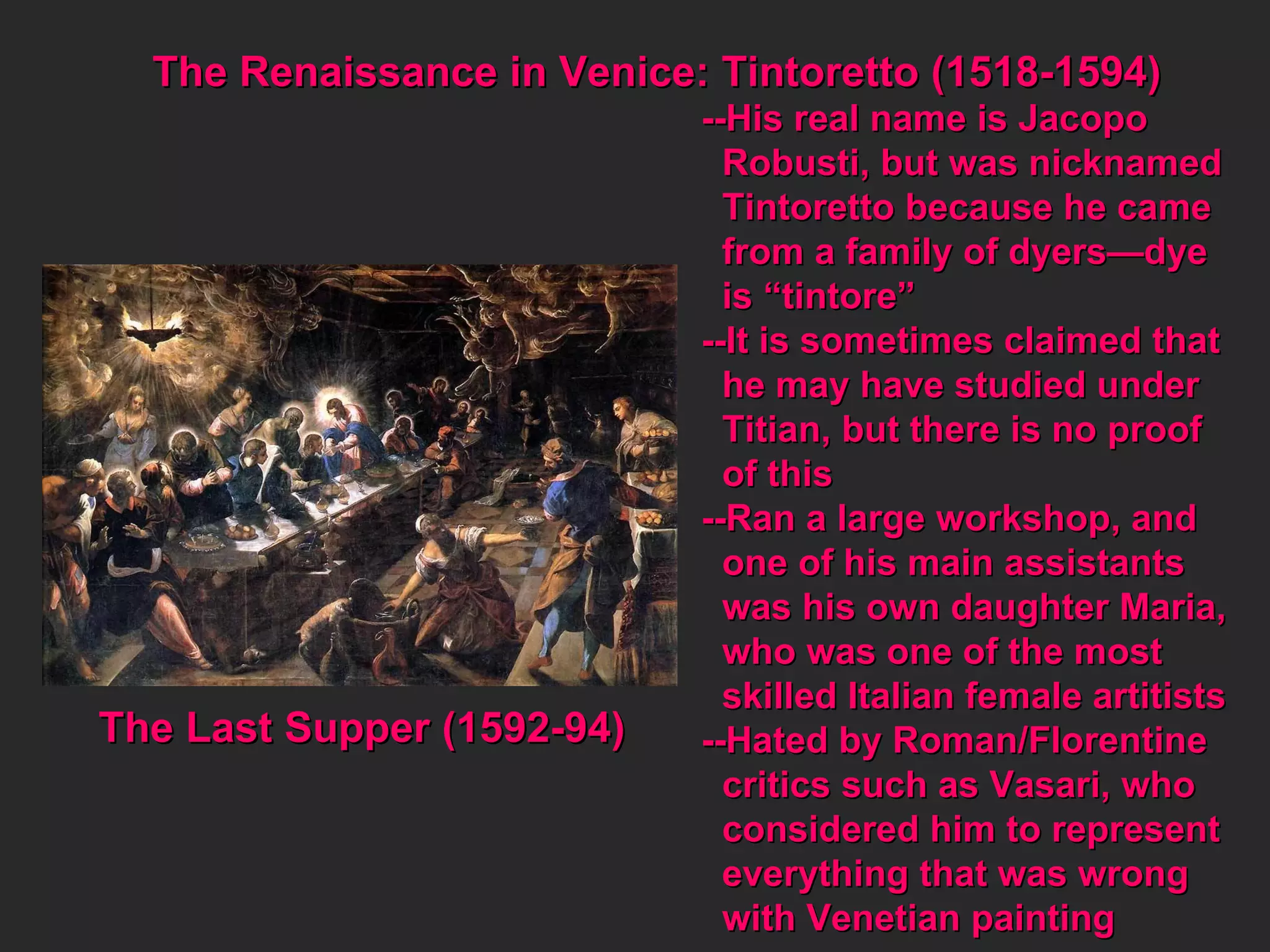
The Renaissance in Venice: Tintoretto (1518-1594) --His real name is Jacopo Robusti, but was nicknamed Tintoretto because he came from a family of dyers—dye  is “tintore” --It is sometimes claimed that he may have studied under Titian, but there is no proof  of this --Ran a large workshop, and  one of his main assistants was his own daughter Maria, who was one of the most  skilled Italian female artitists --Hated by Roman/Florentine critics such as Vasari, who considered him to represent everything that was wrong  with Venetian painting The Last Supper (1592-94)
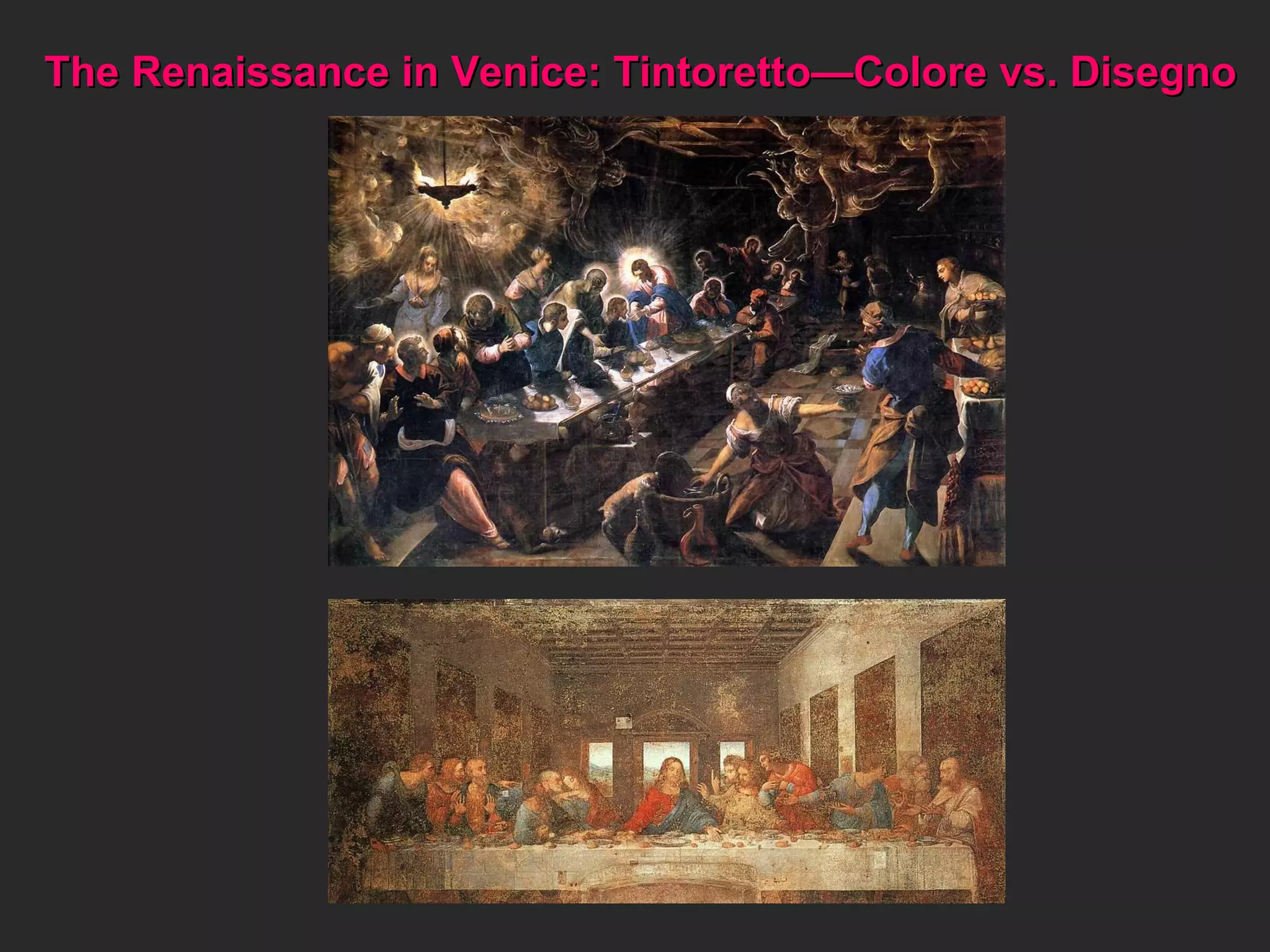
The Renaissance in Venice: Tintoretto—Colore vs. Disegno
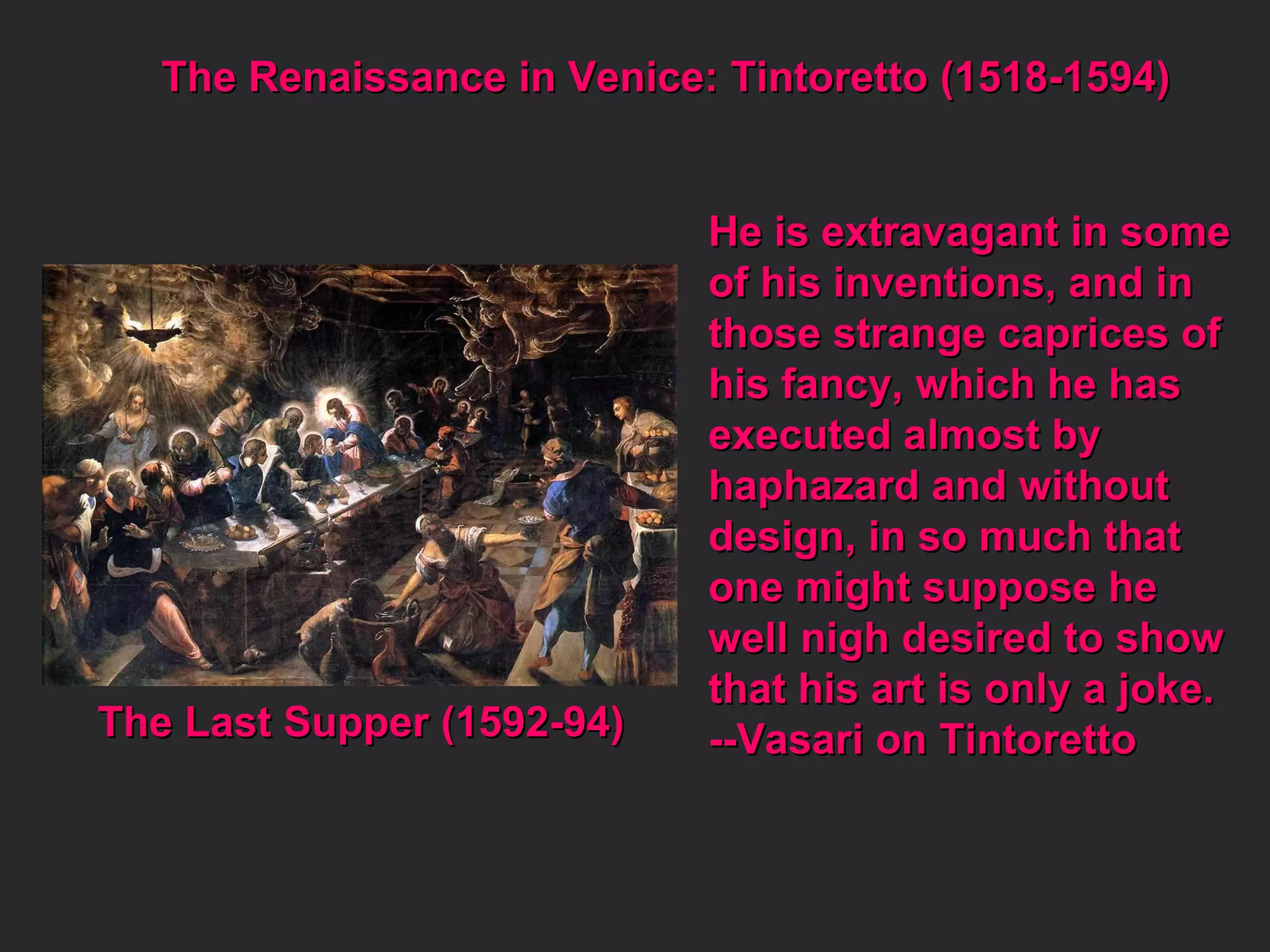
The Renaissance in Venice: Tintoretto (1518-1594) The Last Supper (1592-94) He is extravagant in some of his inventions, and in  those strange caprices of his fancy, which he has executed almost by  haphazard and without design, in so much that one might suppose he  well nigh desired to show  that his art is only a joke. --Vasari on Tintoretto
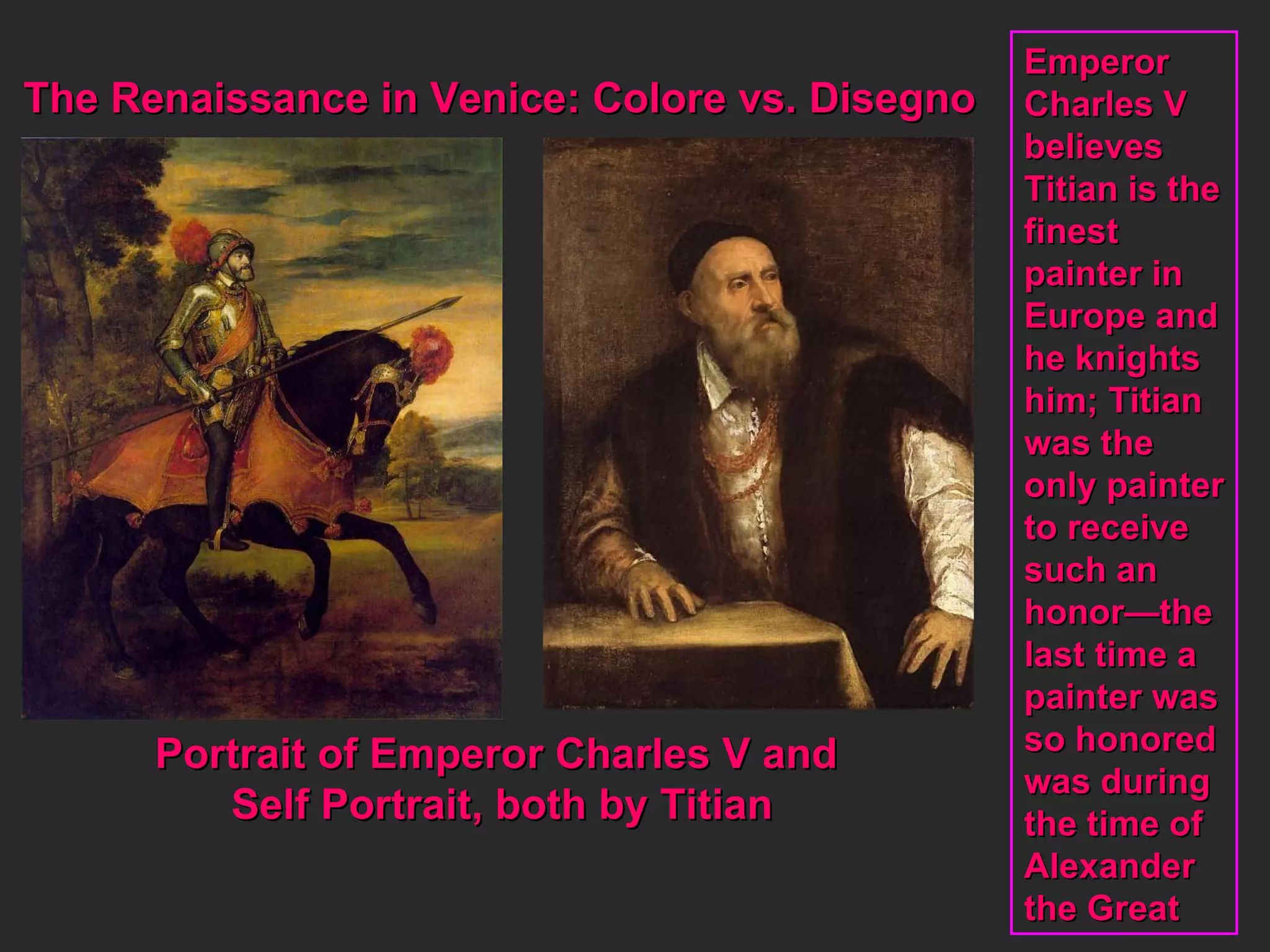
The Renaissance in Venice: Colore vs. Disegno Portrait of Emperor Charles V and  Self Portrait, both by Titian Emperor Charles V  believes Titian is the finest  painter in  Europe and he knights him; Titian was the  only painter to receive such an honor—the last time a  painter was so honored was during the time of  Alexander  the Great

Week 1 Review Done S P R

  • 1.
    FORTITUDE (HERCULES)by NICOLA PISANO (ITALY; 13 th century) “ Renaissance:” rebirth of interest in the art of classical antiquity
  • 2.
    GIOTTO (1267-1337): Portraitof Giotto by Benedetto da Maiano --Worked primarily in Florence --Studied under Cimabue --His innovations are generally considered to mark a transition away from the Gothic period, and pave the way to the Renaissance --Abandoned the iconic gold backgrounds that had been typical of previous generations and was a pioneer of more natural settings, natural relationships among characters, and psychology --Pioneered the use of more 3 dimensional, physically tangible figures
  • 3.
    Giotto: The ArenaChapel --Dedicated on the Feast of the Annunciation, 1303 --Commissioned by Enrico Scrovegni --Intended as a small, private chapel for his family, as well as his burial place --The name “Arena” comes from the fact there had been an old Roman arena here --67 feet long
  • 4.
    Giotto: The ArenaChapel—Joachim Among the Shepherds
  • 5.
    Giotto: The ArenaChapel—Joachim’s Dream
  • 6.
    Giotto: The ArenaChapel—Crucifixion
  • 7.
    Enrico Scrovegni andthe Arena Chapel --Had the chapel built to expiate the sin of usury, through which his father, Reginaldo, had built the family fortune --Usury is the lending of money with interest --A desire to atone for usury explains certain aspects of the decorative scheme, which connect greed and damnation
  • 8.
    Enrico Scrovegni andthe Arena Chapel --Dante’s Inferno even included a character with a money bag with the Scrovegni family logo on it --His father died in 1300, and Enrico stopped the money lending business --He was apparently very concerned about his family’s salvation and that same year he bought the land for the chapel
  • 9.
    Enrico Scrovegni andthe Arena Chapel --1300 was a Jubilee year; he was seeking absolution, and the chapel was apparently part of an agreement with the Catholic church to secure an indulgence
  • 10.
    Giotto: The ArenaChapel—The Betrayal of Judas Scenes with Judas: rare in art, but Judas was associated with usury since he had taken silver in exchange for betraying Christ; Giotto makes a point of emphasizing his money bag 
  • 11.
    Giotto: The ArenaChapel—The Last Judgment Hung by strings of his money bag 
  • 12.
    Giotto: The ArenaChapel—The Last Judgment  Enrico Scrovegni donating the chapel—presenting it to the Virgin of the Annunciation
  • 13.
    Portrait of Giottoby Benedetto da Maiano Giotto: died 1337, but a new age in the art of painting had begun and flowered in especially Florence and Siena I am he through whose merit the lost art of painting was revived; . . . what my art lacked nature herself lacked; to none other was it given to paint more or better . . . I am Giotto, and my name alone tells more than a lengthy ode.—Inscription at Florence Cathedral under the portrait tondo of Giotto by Benedetto da Maiano Tondo: a round depiction
  • 14.
    LINEAR (ONE POINT)PERSPECTIVE Vanishing point Orthagonals Transversals
  • 15.
    LINEAR (ONE POINT)PERSPECTIVE
  • 16.
    LINEAR (ONE POINT)PERSPECTIVE HOLY TRINITY by MASACCIO (Florence, Italy; 15th century)
  • 17.
    “ The HighRenaissance” Leonardo da Vinci (1452-1519) Florentine Michelangelo (1475-1564) Florentine Raphael (1483-1520) Moved to Florence
  • 18.
    High Renaissance: LEONARDODA VINCI (1452-1519) The Last Supper (1490s), Santa Maria delle Grazie Refectory Refectory: A place where monks and priests eat; a dining room
  • 19.
    High Renaissance: LEONARDODA VINCI (1452-1519) The Mona Lisa (Lisa Giacondo; 1503-05)
  • 20.
    Leonardo da Vinci:Drawings, studies, “disegno” Disegno: --Development of the subject matter and composition through phases of preliminary study and drawing --This became the dominant method in Florence and Rome, and formed the basis for art theory in those cities
  • 21.
    Studies for theAdoration of the Magi by Leonardo da Vinci: Drawings, studies, “disegno”
  • 22.
    DISEGNO: The Schoolof Athens and study by Raphael
  • 23.
    DISEGNO: Studies forthe Transfiguration The High Renaissance: RAPHAEL, Italy (1483-1520) 
  • 24.
    Chalk Portrait of Michelangelo by Daniele da Volterra MICHELANGELO (1475-1564): --In Rome, meets a French cardinal who was retiring and want to leave something behind in his memory in the French chapel—he wanted a sculpted Pieta --It is this statue which brings Michelangelo, at age 24, to prominence
  • 25.
    The High Renaissance:MICHELANGELO, Italy (1475-1564) The Pieta (1499)
  • 26.
    Chalk Portrait of Michelangelo by Daniele da Volterra MICHELANGELO (1475-1564): --Returns to Florence in 1501; he had been promised a large piece of beautiful marble, 18 feet high, which had been sitting in the Cathedral workshop for many years --The stone, known as the “ Giant,” was intended for a sculpture for the church, but it had been botched by the sculptor Agostino di Duccio and no one could figure out what to do with it, or how to sculpt it --It is from this stone he sculpts his 17 foot tall David
  • 27.
    The High Renaissance:MICHELANGELO, Italy (1475-1564) The David (1504)
  • 28.
    Chalk Portrait of Michelangelo by Daniele da Volterra MICHELANGELO (1475-1564): --Called to Rome to work for Pope Julius II, who had several projects in mind --The first of these projects was Julius’s own tomb
  • 29.
    The High Renaissance:MICHELANGELO, Italy (1475-1564) Moses (1515)
  • 30.
    Chalk Portrait of Michelangelo by Daniele da Volterra MICHELANGELO (1475-1564): --In 1508 he is hired by Julius to paint the ceiling of the Sistine Chapel; he tries to refuse the offer, claiming he is a sculptor, not a painter, but Julius insists --Spends the next 4 years painting the Sistine Ceiling, which is unveiled in 1512 --Will later return to the Sistine Chapel 25 years later to paint The Last Judgment on the altar wall
  • 31.
    The High Renaissance:MICHELANGELO—Sistine Chapel
  • 32.
    The High Renaissance:MICHELANGELO—Disegno
  • 33.
    The High Renaissance:MICHELANGELO—Disegno The Libyan Sybil
  • 34.
    The High Renaissance:MICHELANGELO—Sistine Chapel The Last Judgment (altar wall; 1537-41)
  • 35.
    DISEGNO: The LastJudgment and studies by Michelangelo (Sistine Chapel, Rome)  Christ
  • 36.
    The High Renaissance:MICHELANGELO—Architecture Dome of St. Peter’s (1564) --Michelangelo was appointed chief architect of St. Peter’s by Pope Paul III --As with the Sistine Ceiling paintings, he initially tried to decline the assignment, but the pope insisted --His major contribution was the dome above the church’s crossing
  • 37.
    Chalk Portrait of Michelangelo by Daniele da Volterra Major accomplishments of MICHELANGELO: Sculpture: The Pieta, the David, and various sculptures for the tombs of the Medici and Julius II (including the Moses) Painting: Sistine Ceiling and the Last Judgment Architecture: Campidoglio and dome of St. Peter’s Literature: one of the leading poets and sonnet writers of the Italian Renaissance
  • 38.
    DISEGNO COLORELeonardo da Vinci, Michelangelo, Raphael Giorgione,Titian, Tintoretto
  • 39.
    DISEGNO COLORERome, Florence (“High Renaissance”) Venice  Venice Rome   Florence
  • 40.
    Colore: Emphasis on spontaneity and freedom of stroke, expression, and composition; artists often worked directly on the canvas without preliminary drawings and studies; attempts to capture freshness of artistic expression; greater emphasis on color, atmosphere, and sensuality The Renaissance in Venice: Giorgione (1477-1510)
  • 41.
    The Renaissance inVenice: Giorgione—Colore vs. Disegno Colore/Venetian artists as opposed to those in Florence and Rome: --Preliminary drawings typically do not survive --Don’t work in fresco --Do not represent classical subject matter as often --Less classical influence --More painterly
  • 42.
    The Renaissance inVenice: Giorgione—Colore vs. Disegno He thought only of executing fanciful figures which would show his ability . . . I for one have never known what his pictures mean and no one has ever been able to explain them to me. Here is a man, there is a woman . . . it is impossible to tell what it all means. --Vasari on Girogione
  • 43.
    --Born Tiziano Vecellio--The leading painter of the Venetian school; he became preeminent after Giorgione’s death, and retained his position for the next 60 years --The output over the span of his career is immense, and he was highly in demand not just in Italy but other parts of Europe as well --The works that first brought him fame were his paintings at the Church of the Frari in Venice, in particular the Assumption of the Virgin The Renaissance in Venice: Titian (1490-1576)
  • 44.
    The Renaissance inVenice: Titian—Colore vs. Disegno
  • 45.
    The Renaissance inVenice: Titian—Colore vs. Disegno
  • 46.
    The Renaissance inVenice: Titian—Master of Colore He would be the greatest of all of us, if only he had “ disegno.” --Michelangelo’s comment to Vasari, after visiting Titian while he was painting Danae Danae (1553)
  • 47.
    The Renaissance inVenice: Tintoretto (1518-1594) --His real name is Jacopo Robusti, but was nicknamed Tintoretto because he came from a family of dyers—dye is “tintore” --It is sometimes claimed that he may have studied under Titian, but there is no proof of this --Ran a large workshop, and one of his main assistants was his own daughter Maria, who was one of the most skilled Italian female artitists --Hated by Roman/Florentine critics such as Vasari, who considered him to represent everything that was wrong with Venetian painting The Last Supper (1592-94)
  • 48.
    The Renaissance inVenice: Tintoretto—Colore vs. Disegno
  • 49.
    The Renaissance inVenice: Tintoretto (1518-1594) The Last Supper (1592-94) He is extravagant in some of his inventions, and in those strange caprices of his fancy, which he has executed almost by haphazard and without design, in so much that one might suppose he well nigh desired to show that his art is only a joke. --Vasari on Tintoretto
  • 50.
    The Renaissance inVenice: Colore vs. Disegno Portrait of Emperor Charles V and Self Portrait, both by Titian Emperor Charles V believes Titian is the finest painter in Europe and he knights him; Titian was the only painter to receive such an honor—the last time a painter was so honored was during the time of Alexander the Great

Editor's Notes

  • #3 KNOWN FOR HIS BIZARRE SENSE OF HUMOR—IN THE SHOP, CIMABUE TOOK A BREAK, GIOTTO PAINTED A FLY ON THE NOSE OF ONE OF THE FIGURES, SO REALISTIC THAT CIMABUE CAME BACK IN AND STARTED TRYING TO BRUSH IT OFF, ONLY TO FINALLY REALIZE IT WASN’T REAL
  • #5 Joachim had been rejected, but eventually will reunite with st anne then mary born at start of next cycle then life of christ
  • #6 Joachim had been rejected, but eventually will reunite with st anne then mary born at start of next cycle then life of christ
  • #21 Primary to disegno approach is drawing, and leo one of great draftsmen of alltime
  • #46 the warmth of his colors would make him one of the great painters of sensuous nudes, really visceral, sensual style
  • #50 But the straight lines are not the point here—incredible power, drama, atmospher