Avoiding Plagiarism
       in Research
        Prof. Dr. Khalid Mahmood
Department of Library and Information Science
          University of the Punjab
             Lahore, PAKISTAN


                                            1
Plagiarism – Definition

   Taking and using the thoughts, writings,
    and inventions of another person as one's
    own

   Using someone’s ideas without citing or
    quoting; thereby, receiving credit for
    someone else’s intellectual effort


                                                2
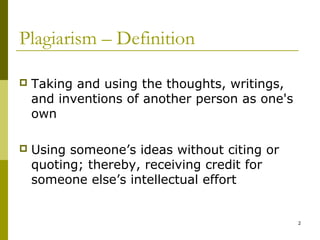
How serious is the problem?
“A study of almost 4,500 students at 25 schools,
  suggests cheating is . . . a significant problem in
  high school - 74% of the respondents admitted to
  one or more instances of serious test cheating
  and 72% admitted to serious cheating on
  written assignments. Over half of the
  students admitted they have engaged in
  some level of plagiarism on written
  assignments using the Internet.”
Based on the research of Donald L. McCabe, Rutgers University
Source: “CIA Research.” Center for Academic Integrity, Duke University,
   2003.


                                                                          3
Why is this a problem?
   For the student
       failure to achieve academic learning outcomes
       treated as academic misconduct
   For the teacher
       a waste of time
   For the institution
       threat to reputation and value of degrees
       Quality assurance, regulations, and legislative
        context

                                                          4
Forms of plagiarism

   Copying from a single source

   Copying from several sources

   Paraphrasing

   Collusion

                                   5
How to avoid plagiarism
   Use quotes for

       Information that comes directly from any
        source

       Words, spoken or written, that you use directly
        from another person

   Make sure you document the source

                                                      6
How to avoid plagiarism
   Paraphrase

       Write the information in your own words, but
        do not change its meaning or intention

       Because you are using someone else’s idea,
        always mention the source even if you use
        your own words


                                                       7
Common knowledge
   Any information, fact, or statement that is
    widespread and known by a variety of people is
    considered common knowledge
       John Adams was the second president of USA
       The Japanese attacked Pearl Harbor on December 7,
        1941


   There is no need to give credit to information that
    is of common knowledge


                                                            8
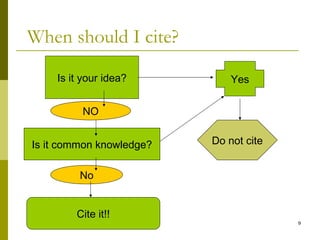
When should I cite?

    Is it your idea?          Yes


         NO


Is it common knowledge?   Do not cite


         No


        Cite it!!
                                        9
Accidental plagiarism
Using words from another source without
 indicating where they came from.

   Ways to avoid accidental plagiarism:
     Careful note taking
     A clear understanding of the rules for
      quoting, paraphrasing, and summarizing
      sources


                                           10
When in doubt, cite.


                       11
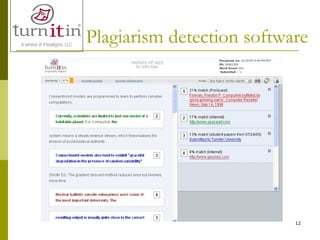
Plagiarism detection software


                           12
Penalties for teachers, researchers and staff
   Dismissal from service
   Demotion to the next lower grade
   Warning
   Freezing of research grants
   Promotions/annual increments of the offender may be
    stopped
   University may debar the offender from sponsorship of
    research funding, travel grant, supervision of Ph.D.
    students, scholarship, fellowship or any other funded
    program
   Offender may be “Black Listed” and may NOT be eligible for
    employment in any academic / research organization
   Notification of “Black Listing” of the author may be
    published in the print media or may be publicized on
    different websites
                                                             13
Penalties for students
   Expelled/ rusticated from the University and from joining
    any institution of Higher Education in Pakistan
   Relegated to a lower class
   Given a failure grade in the subject
   Fined an amount
   Given a written warning if the offence is minor and is
    committed for the first time
   Degree may be withdrawn
   Notification of plagiarism by the author may be published in
    the print media or may be publicized on different websites
   University may debar the offender from sponsorship of
    research funding, travel grant, scholarship, fellowship or
    any other funded program


                                                               14
Good luck


            15

8 avoiding plagiarism-khalid

  • 1.
    Avoiding Plagiarism in Research Prof. Dr. Khalid Mahmood Department of Library and Information Science University of the Punjab Lahore, PAKISTAN 1
  • 2.
    Plagiarism – Definition  Taking and using the thoughts, writings, and inventions of another person as one's own  Using someone’s ideas without citing or quoting; thereby, receiving credit for someone else’s intellectual effort 2
  • 3.
    How serious isthe problem? “A study of almost 4,500 students at 25 schools, suggests cheating is . . . a significant problem in high school - 74% of the respondents admitted to one or more instances of serious test cheating and 72% admitted to serious cheating on written assignments. Over half of the students admitted they have engaged in some level of plagiarism on written assignments using the Internet.” Based on the research of Donald L. McCabe, Rutgers University Source: “CIA Research.” Center for Academic Integrity, Duke University, 2003. 3
  • 4.
    Why is thisa problem?  For the student  failure to achieve academic learning outcomes  treated as academic misconduct  For the teacher  a waste of time  For the institution  threat to reputation and value of degrees  Quality assurance, regulations, and legislative context 4
  • 5.
    Forms of plagiarism  Copying from a single source  Copying from several sources  Paraphrasing  Collusion 5
  • 6.
    How to avoidplagiarism  Use quotes for  Information that comes directly from any source  Words, spoken or written, that you use directly from another person  Make sure you document the source 6
  • 7.
    How to avoidplagiarism  Paraphrase  Write the information in your own words, but do not change its meaning or intention  Because you are using someone else’s idea, always mention the source even if you use your own words 7
  • 8.
    Common knowledge  Any information, fact, or statement that is widespread and known by a variety of people is considered common knowledge  John Adams was the second president of USA  The Japanese attacked Pearl Harbor on December 7, 1941  There is no need to give credit to information that is of common knowledge 8
  • 9.
    When should Icite? Is it your idea? Yes NO Is it common knowledge? Do not cite No Cite it!! 9
  • 10.
    Accidental plagiarism Using wordsfrom another source without indicating where they came from.  Ways to avoid accidental plagiarism:  Careful note taking  A clear understanding of the rules for quoting, paraphrasing, and summarizing sources 10
  • 11.
  • 12.
  • 13.
    Penalties for teachers,researchers and staff  Dismissal from service  Demotion to the next lower grade  Warning  Freezing of research grants  Promotions/annual increments of the offender may be stopped  University may debar the offender from sponsorship of research funding, travel grant, supervision of Ph.D. students, scholarship, fellowship or any other funded program  Offender may be “Black Listed” and may NOT be eligible for employment in any academic / research organization  Notification of “Black Listing” of the author may be published in the print media or may be publicized on different websites 13
  • 14.
    Penalties for students  Expelled/ rusticated from the University and from joining any institution of Higher Education in Pakistan  Relegated to a lower class  Given a failure grade in the subject  Fined an amount  Given a written warning if the offence is minor and is committed for the first time  Degree may be withdrawn  Notification of plagiarism by the author may be published in the print media or may be publicized on different websites  University may debar the offender from sponsorship of research funding, travel grant, scholarship, fellowship or any other funded program 14
  • 15.