
ALTMETRICS
BY
SHUVRA GHOSH
ROLL NO. – 07
DEPARTMENT OF LIBRARY AND INFORMATION SCIENCE
GUIDED BY: PROF. SUNIL KUMAR CHATTERJEE
INTRODUCTION
Citation has been the widely accepted metrics of impact of a scientific
publication for decades. In today’s modern era of analytics, electronics, and
scholarly competition, metrics are an important part of the everyday lives.
From researchers applying for federal grants to faculty members preparing
their tenure and promotion files, metrics have become an increasingly
visible part of how academics and administrators are expected, if not
required, to talk about impact and value. Research has changed drastically
over the last fifteen years with advances in information technology, so have
the qualifications for what constitutes a useful impact metric begun to
evolve and expand with changes in scholarly communication. Of these
expansions, the most significant is arguably the development of altmetrics,
which constitutes a strictly twenty-first-century approach to impact
measurement that relies heavily on the connection between scholarly
activity and the opportunities afforded by the Social Web.
WHAT IS ALTMETRICS?
 The term almetrics was coined by Jason Priem in
2010, as a generalization of article level metrics, and
rooted in the twitter #almetrics hashtag.
 Altmetric is the study of new metrics for analysing
and informing scholarship based on the social web.
SOME DEFINITIONS
 According to Adie, Euan the founder of Altmetric.com; “Altmetrics
indicate the quantity and quality of online attention in multiple channels,
including social media, blog posts, and news coverage”.
 According to Australian Open Access Support Group (AOASG),
Altmetrics are quantitative indicators of public reach and influence it
provides a more comprehensive understanding of impact across sectors,
including public impact.
 Alternative metrics (called altmetrics to distinguish them from
bibliometrics) are considered an interesting option for assessing the
social impact of research, as they offer new ways to measure (public)
engagement with research output.
 Altmetrics is a term to describe web-based metrics for the impact of
scholarly material, with an emphasis on social media outlets as sources
of data.
WHAT ALTMETRICS MEASURE?
Altmetrics measure
 the number of times a research output
 get cited, tweeted about, liked, shared, bookmarked,
viewed, downloaded, mentioned, favourite,
reviewed, or discussed on various kind of web
platforms.
 It harvests those web influence data from a wide
variety of web sources and platforms including open
access journal platforms, scholarly citation
databases, web-based research sharing services, and
social media.
ALTMETRICS COLLECTS DATA
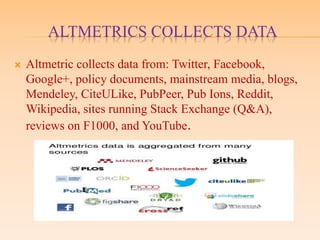
 Altmetric collects data from: Twitter, Facebook,
Google+, policy documents, mainstream media, blogs,
Mendeley, CiteULike, PubPeer, Pub Ions, Reddit,
Wikipedia, sites running Stack Exchange (Q&A),
reviews on F1000, and YouTube.
ALTMETRICS CLASSIFICATION
Altmetrics are a very broad group of metrics, capturing
various parts of impact a paper or work can have. A
classification of altmetrics was proposed by ImpactStory in
September 2012, and a very similar classification is used by
the Public Library of Science:
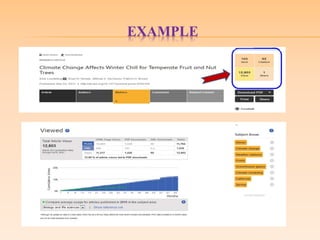
 Viewed – HTML views and PDF downloads
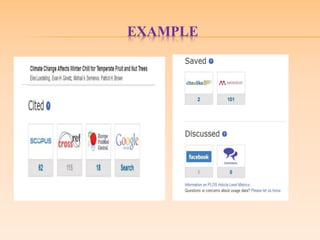
 Discussed – journal comments, science blogs, Wikipedia,
Twitter, Facebook and other social media
 Saved – Mendeley, CiteULike and other social bookmarks
 Cited – citations in the scholarly literature, tracked by Web
of Science, Scopus, CrossRef and others
 Recommended – for example used by F1000Prime
EXAMPLE
EXAMPLE
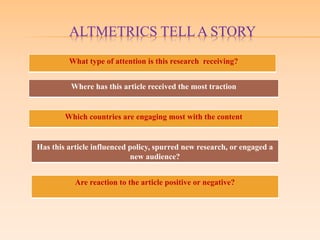
ALTMETRICS TELLA STORY
What type of attention is this research receiving?
Where has this article received the most traction
Which countries are engaging most with the content
Has this article influenced policy, spurred new research, or engaged a
new audience?
Are reaction to the article positive or negative?
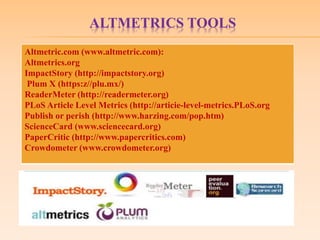
ALTMETRICS TOOLS
Altmetric.com (www.altmetric.com):
Altmetrics.org
ImpactStory (http://impactstory.org)
Plum X (https:z//plu.mx/)
ReaderMeter (http://readermeter.org)
PLoS Article Level Metrics (http://articie-level-metrics.PLoS.org
Publish or perish (http://www.harzing.com/pop.htm)
ScienceCard (www.sciencecard.org)
PaperCritic (http://www.papercritics.com)
Crowdometer (www.crowdometer.org)
ALTMETRIC.COM
 Altmetric.com (www.altmetric.com) born as a London based
start-up founded by Euan Adie in 2011.
 Their misson is “to make article level metrics easy”.
 The portal provides:
1. Explorer
2. Altmetric for Institution
3. Bookmarklet
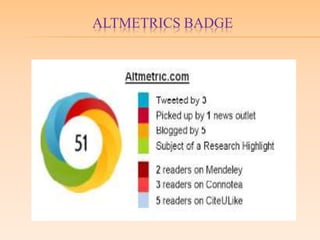
4. Badge
 Individual users and librarians can use Altmetric.com with a
free account, while a commercial licence is required in the
case of publishers, funders and Institutions.
ALTMETRICS BADGE
IMPACT STORY
(HTTPS://IMPACTSTORY.ORG/)
 Impact story is an open Source website that helps
researchers explore and share the online impact of their
research.
 The impact Story log In using only twitter and ORCID
account.
 Impact Story helps in creating author’s profile and adding
publication list through importing bibliographic records
from different sources such as Scopus database,
ORCID.org, GS citations, Slide Share Foundation net and
many others.
 The Impact story supported by the National Science and
Alfred P.sloan Foundation
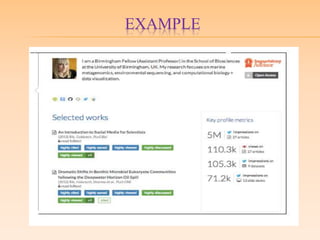
EXAMPLE
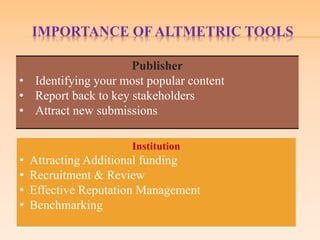
IMPORTANCE OFALTMETRIC TOOLS
Publisher
• Identifying your most popular content
• Report back to key stakeholders
• Attract new submissions
Institution
• Attracting Additional funding
• Recruitment & Review
• Effective Reputation Management
• Benchmarking
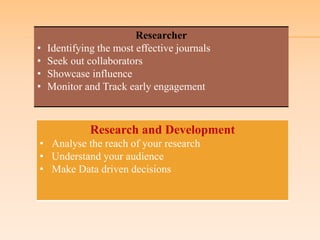
Researcher
• Identifying the most effective journals
• Seek out collaborators
• Showcase influence
• Monitor and Track early engagement
Research and Development
• Analyse the reach of your research
• Understand your audience
• Make Data driven decisions
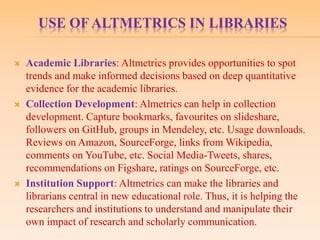
USE OF ALTMETRICS IN LIBRARIES
 Academic Libraries: Altmetrics provides opportunities to spot
trends and make informed decisions based on deep quantitative
evidence for the academic libraries.
 Collection Development: Almetrics can help in collection
development. Capture bookmarks, favourites on slideshare,
followers on GitHub, groups in Mendeley, etc. Usage downloads.
Reviews on Amazon, SourceForge, links from Wikipedia,
comments on YouTube, etc. Social Media-Tweets, shares,
recommendations on Figshare, ratings on SourceForge, etc.
 Institution Support: Altmetrics can make the libraries and
librarians central in new educational role. Thus, it is helping the
researchers and institutions to understand and manipulate their
own impact of research and scholarly communication.
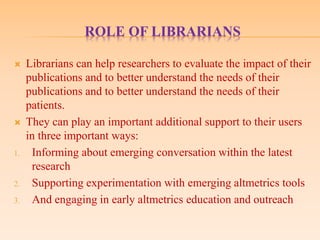
ROLE OF LIBRARIANS
 Librarians can help researchers to evaluate the impact of their
publications and to better understand the needs of their
patients.
 They can play an important additional support to their users
in three important ways:
1. Informing about emerging conversation within the latest
research
2. Supporting experimentation with emerging altmetrics tools
3. And engaging in early altmetrics education and outreach
ADVANTAGES OF ALTMETRICS
 A more nuanced understanding of impact, showing us
which scholarly products are read, discussed, saved and
recommended as well as cited.
 Often more timely data, showing evidence of impact in
days instead of years.
 A window on the impact of web-native scholarly
products like datasets, software, blog posts, videos and
more.
 Indications of impacts on diverse audiences including
scholars but also practitioners, clinicians, educators and
the general public.
DISADVANTAGES OF ALTMETRICS
 Altmetrics don’t tell the Whole story
 Like any metric, there’s a potential for gaming of
Altmetrics.
 Altmetrics are relatively new, more research into their
use is needed.
CONCLUSION
 The Altmetrics tool is boon for every researcher,
institution and publishers. Altmetrics is the only metrics
used in article level in the social networking
environment. Altmetrics is useful and may well be
considered reliable. It can represent an interesting and
relevant complement to citations. Hence Librarian and
Research Scholars should know about the altmetrics and
to identify the important research articles in respective
field. Librarians could play an active role.
THANK YOU

Altmetrics

  • 1.
    ALTMETRICS BY SHUVRA GHOSH ROLL NO.– 07 DEPARTMENT OF LIBRARY AND INFORMATION SCIENCE GUIDED BY: PROF. SUNIL KUMAR CHATTERJEE
  • 2.
    INTRODUCTION Citation has beenthe widely accepted metrics of impact of a scientific publication for decades. In today’s modern era of analytics, electronics, and scholarly competition, metrics are an important part of the everyday lives. From researchers applying for federal grants to faculty members preparing their tenure and promotion files, metrics have become an increasingly visible part of how academics and administrators are expected, if not required, to talk about impact and value. Research has changed drastically over the last fifteen years with advances in information technology, so have the qualifications for what constitutes a useful impact metric begun to evolve and expand with changes in scholarly communication. Of these expansions, the most significant is arguably the development of altmetrics, which constitutes a strictly twenty-first-century approach to impact measurement that relies heavily on the connection between scholarly activity and the opportunities afforded by the Social Web.
  • 3.
    WHAT IS ALTMETRICS? The term almetrics was coined by Jason Priem in 2010, as a generalization of article level metrics, and rooted in the twitter #almetrics hashtag.  Altmetric is the study of new metrics for analysing and informing scholarship based on the social web.
  • 4.
    SOME DEFINITIONS  Accordingto Adie, Euan the founder of Altmetric.com; “Altmetrics indicate the quantity and quality of online attention in multiple channels, including social media, blog posts, and news coverage”.  According to Australian Open Access Support Group (AOASG), Altmetrics are quantitative indicators of public reach and influence it provides a more comprehensive understanding of impact across sectors, including public impact.  Alternative metrics (called altmetrics to distinguish them from bibliometrics) are considered an interesting option for assessing the social impact of research, as they offer new ways to measure (public) engagement with research output.  Altmetrics is a term to describe web-based metrics for the impact of scholarly material, with an emphasis on social media outlets as sources of data.
  • 5.
    WHAT ALTMETRICS MEASURE? Altmetricsmeasure  the number of times a research output  get cited, tweeted about, liked, shared, bookmarked, viewed, downloaded, mentioned, favourite, reviewed, or discussed on various kind of web platforms.  It harvests those web influence data from a wide variety of web sources and platforms including open access journal platforms, scholarly citation databases, web-based research sharing services, and social media.
  • 6.
    ALTMETRICS COLLECTS DATA Altmetric collects data from: Twitter, Facebook, Google+, policy documents, mainstream media, blogs, Mendeley, CiteULike, PubPeer, Pub Ions, Reddit, Wikipedia, sites running Stack Exchange (Q&A), reviews on F1000, and YouTube.
  • 7.
    ALTMETRICS CLASSIFICATION Altmetrics area very broad group of metrics, capturing various parts of impact a paper or work can have. A classification of altmetrics was proposed by ImpactStory in September 2012, and a very similar classification is used by the Public Library of Science:  Viewed – HTML views and PDF downloads  Discussed – journal comments, science blogs, Wikipedia, Twitter, Facebook and other social media  Saved – Mendeley, CiteULike and other social bookmarks  Cited – citations in the scholarly literature, tracked by Web of Science, Scopus, CrossRef and others  Recommended – for example used by F1000Prime
  • 8.
  • 9.
  • 10.
    ALTMETRICS TELLA STORY Whattype of attention is this research receiving? Where has this article received the most traction Which countries are engaging most with the content Has this article influenced policy, spurred new research, or engaged a new audience? Are reaction to the article positive or negative?
  • 11.
    ALTMETRICS TOOLS Altmetric.com (www.altmetric.com): Altmetrics.org ImpactStory(http://impactstory.org) Plum X (https:z//plu.mx/) ReaderMeter (http://readermeter.org) PLoS Article Level Metrics (http://articie-level-metrics.PLoS.org Publish or perish (http://www.harzing.com/pop.htm) ScienceCard (www.sciencecard.org) PaperCritic (http://www.papercritics.com) Crowdometer (www.crowdometer.org)
  • 12.
    ALTMETRIC.COM  Altmetric.com (www.altmetric.com)born as a London based start-up founded by Euan Adie in 2011.  Their misson is “to make article level metrics easy”.  The portal provides: 1. Explorer 2. Altmetric for Institution 3. Bookmarklet 4. Badge  Individual users and librarians can use Altmetric.com with a free account, while a commercial licence is required in the case of publishers, funders and Institutions.
  • 13.
  • 14.
    IMPACT STORY (HTTPS://IMPACTSTORY.ORG/)  Impactstory is an open Source website that helps researchers explore and share the online impact of their research.  The impact Story log In using only twitter and ORCID account.  Impact Story helps in creating author’s profile and adding publication list through importing bibliographic records from different sources such as Scopus database, ORCID.org, GS citations, Slide Share Foundation net and many others.  The Impact story supported by the National Science and Alfred P.sloan Foundation
  • 15.
  • 16.
    IMPORTANCE OFALTMETRIC TOOLS Publisher •Identifying your most popular content • Report back to key stakeholders • Attract new submissions Institution • Attracting Additional funding • Recruitment & Review • Effective Reputation Management • Benchmarking
  • 17.
    Researcher • Identifying themost effective journals • Seek out collaborators • Showcase influence • Monitor and Track early engagement Research and Development • Analyse the reach of your research • Understand your audience • Make Data driven decisions
  • 18.
    USE OF ALTMETRICSIN LIBRARIES  Academic Libraries: Altmetrics provides opportunities to spot trends and make informed decisions based on deep quantitative evidence for the academic libraries.  Collection Development: Almetrics can help in collection development. Capture bookmarks, favourites on slideshare, followers on GitHub, groups in Mendeley, etc. Usage downloads. Reviews on Amazon, SourceForge, links from Wikipedia, comments on YouTube, etc. Social Media-Tweets, shares, recommendations on Figshare, ratings on SourceForge, etc.  Institution Support: Altmetrics can make the libraries and librarians central in new educational role. Thus, it is helping the researchers and institutions to understand and manipulate their own impact of research and scholarly communication.
  • 19.
    ROLE OF LIBRARIANS Librarians can help researchers to evaluate the impact of their publications and to better understand the needs of their publications and to better understand the needs of their patients.  They can play an important additional support to their users in three important ways: 1. Informing about emerging conversation within the latest research 2. Supporting experimentation with emerging altmetrics tools 3. And engaging in early altmetrics education and outreach
  • 20.
    ADVANTAGES OF ALTMETRICS A more nuanced understanding of impact, showing us which scholarly products are read, discussed, saved and recommended as well as cited.  Often more timely data, showing evidence of impact in days instead of years.  A window on the impact of web-native scholarly products like datasets, software, blog posts, videos and more.  Indications of impacts on diverse audiences including scholars but also practitioners, clinicians, educators and the general public.
  • 21.
    DISADVANTAGES OF ALTMETRICS Altmetrics don’t tell the Whole story  Like any metric, there’s a potential for gaming of Altmetrics.  Altmetrics are relatively new, more research into their use is needed.
  • 22.
    CONCLUSION  The Altmetricstool is boon for every researcher, institution and publishers. Altmetrics is the only metrics used in article level in the social networking environment. Altmetrics is useful and may well be considered reliable. It can represent an interesting and relevant complement to citations. Hence Librarian and Research Scholars should know about the altmetrics and to identify the important research articles in respective field. Librarians could play an active role.
  • 23.