Scholarly Publishing
Getting Published – tips and
tricks.
UQ Winter Scholars
Sharon Bunce, Elena Danilova, Alicia Dodemont
Scholarly Communication and Digitisation Services
2015
http://upload.wikimedia.org/wikipedia/commons/thumb/1/18/Water_drop_impact_on_a_water-surface
Scholarly Publishing
Getting Published Research Guide
http://guides.library.uq.edu.au/getting-published
Scholarly Publishing
Session Outline
1. Why publish?
2. The publishing process
3. Where do I start ? Where to publish
4. Writing support – writing resources, managing
references, peer review
5. Measuring your impact/promoting your paper
6. Copyright
7. Top tips/summary
8. Where to find resources
Scholarly Publishing
• Communicate new knowledge
• Increase the impact and visibility
of your research
• Establish/build your reputation
• Register research findings, their
timing & the person(s) responsible
• Preserve a record of the findings
for the long term
Why publish?
CC image: https://www.flickr.com/photos/njsouthall/5880919002;
Scholarly Publishing
The publishing process:
a publisher’s perspective
Scholarly Publishing
115
volumes
per year !
Scholarly Publishing
To be accepted, a paper must
Contribute to and
advance existing
knowledge
Common reasons for article rejection
• Lack of constructive arguments.
• Too many spelling or grammatical
errors.
• Poor structure.
• Not scholarly.
• Shallow lit review.
• Lack of reference to similar or
contrary research findings.
• Theoretically or methodologically
flawed
• Insignificant/small sample
• Not enough familiarity with the
journal.
• Too narrow/too broad
MethodConventions
ContextLitReview
Garcia, R. (2014). Simple guide to writing a journal article.
www.sagepub.co.uk
Scholarly Publishing
The publishing process:
researcher’s perspective
Research Writing Submission
Peer
Revie
w
Revisions Copy editing Publication
Rejected Rejected
Revisions,
revisions,
revisions.
KNOW your author
Responsibilities
CREATE Author ID account
CHOOSE a journal
READ Journal
Instructions For Authors
PROMOTE
your article in
UQeSpace and
beyond
OR
*Save a post-print version
of your manuscript
Scholarly Publishing
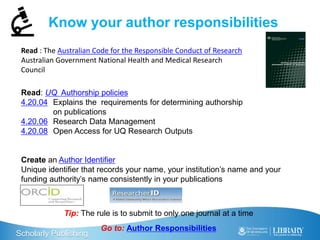
Know your author responsibilities
Read: UQ Authorship policies
4.20.04 Explains the requirements for determining authorship
on publications
4.20.06 Research Data Management
4.20.08 Open Access for UQ Research Outputs
Create an Author Identifier
Unique identifier that records your name, your institution’s name and your
funding authority’s name consistently in your publications
Tip: The rule is to submit to only one journal at a time
Go to: Author Responsibilities
Read : The Australian Code for the Responsible Conduct of Research
Australian Government National Health and Medical Research
Council
Scholarly Publishing
Where to publish?
Identify list of peer-reviewed journal titles Ulrich's
Access
How will you
make your
publication
available open
access?
UQ Open
Access Policy
Impact/prestige
• Journal impact factors
• Predatory Publishers
Aims/scope
• Discipline area
• Publishes
work you cite
• Audience
Likelihood of acceptance for ECRs.
READ journal publishing guidelines
Watch Prof. Matthew Brown talk about ACCESS to research
Scholarly Publishing
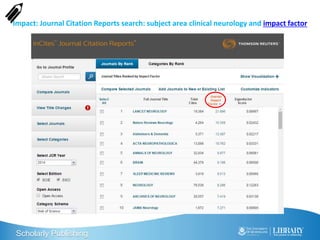
Impact: Journal Citation Reports search: subject area clinical neurology and impact factor
Scholarly Publishing
Access: Open Access
http://guides.library.uq.edu.au/open-access
• Open access (OA) is making research results freely
available to anyone with an internet connection
• OA Research is more discoverable and FREE for the user to
access and download
• Can apply to research outputs in the form of journal
articles, conference papers, data sets, software, books and
book chapters.
Scholarly Publishing
How is open access provided?
For publications……
1. Publish in an Open Access Journal
Where: OA journal or traditional journal
with OA option
Version: Published version
Cost: May include article processing
charge for authors * $
Access: free immediate access for all
UQ eSpace DOI Link to
published version for all users
2. Deposit of OA version in UQ eSpace
Where: institutional repository – (UQ
eSpace)
When: upon acceptance for
publication
Version: post-print or publishers pdf
Cost: free
Access: free access for all
access embargo may apply
Scholarly Publishing
What to publish
• Original research –
• Theses (qualitative or quantitative)
• Research project reports (Honours)
• Conference papers
• Literature reviews
• Systematic reviews
• Case studies
• Theoretical Analyses
• Response articles
• Book reviews
And many more…..
Image: ~Cyn~ , Creative Process Still Life, CC BY-NC-ND 2.0
Scholarly Publishing
What to Publish
Scholarly Publications > Thesis
You may choose to submit
your thesis as a
“Thesis by Publication”
Thesis Preparation - guidelines
(UQ Graduate School)
http://www.uq.edu.au/grad-school/thesis-preparation
Scholarly Publishing
What to Publish
Scholarly Publications > Thesis
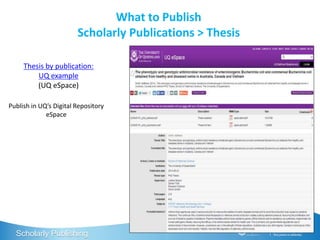
Thesis by publication:
UQ example
(UQ eSpace)
Publish in UQ’s Digital Repository
eSpace
Scholarly Publishing
What to Publish
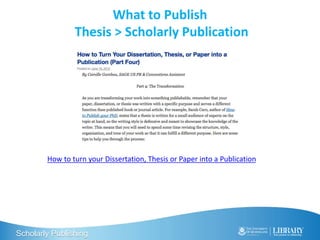
Thesis > Scholarly Publication
How to turn your Dissertation, Thesis or Paper into a Publication
Scholarly Publishing
The Writing Process
• Define your purpose
• Plan your research
• Create your outline
• Commit to a writing schedule
• Check the preferred writing / referencing style format
• Identify your audience write for them
• Seek feedback from other academics or your supervisor
• Write often
Writing tips from the Graduate School –
http://www.uq.edu.au/grad-school/events-skills-training-students
Choose your target journal
Scholarly Publishing
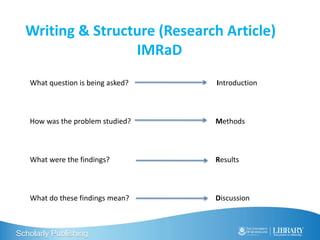
Writing & Structure (Research Article)
IMRaD
What question is being asked? Introduction
How was the problem studied? Methods
What were the findings? Results
What do these findings mean? Discussion
Scholarly Publishing
Resources for academic writing
http://www.phd2published.com/
https://www.coursera.org/courses http://www.editage.com/insights/#
Blog
Online courses Writing and publishing resources
Getting Published Research Guide
Student Services Website
UQ Course: Academic English & Thesis
writing for International Students
Scholarly Publishing
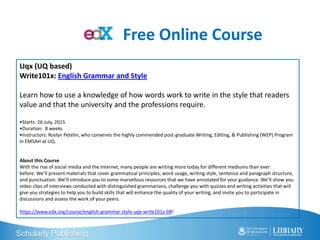
Uqx (UQ based)
Write101x: English Grammar and Style
Learn how to use a knowledge of how words work to write in the style that readers
value and that the university and the professions require.
•Starts: 26 July, 2015
•Duration: 8 weeks
•Instructors: Roslyn Petelin, who convenes the highly commended post-graduate Writing, Editing, & Publishing (WEP) Program
in EMSAH at UQ.
About this Course
With the rise of social media and the Internet, many people are writing more today for different mediums than ever
before. We’ll present materials that cover grammatical principles, word usage, writing style, sentence and paragraph structure,
and punctuation. We’ll introduce you to some marvellous resources that we have annotated for your guidance. We’ll show you
video clips of interviews conducted with distinguished grammarians, challenge you with quizzes and writing activities that will
give you strategies to help you to build skills that will enhance the quality of your writing, and invite you to participate in
discussions and assess the work of your peers.
https://www.edx.org/course/english-grammar-style-uqx-write101x-0#!
Free Online Course
Scholarly Publishing
Writing tips to help you along the way
• Target your journal early on and become
an expert in it.
• Create an outline for your paper and
then use it to write your prose
• Plan your writing time with a writing
diary – set-up time slots and match
these with your paper outline
• Work with a writing partner or set
up/join a writing group
Murray R. Writing for academic journals. 3rd edition.
Open University, 2013
Scholarly Publishing
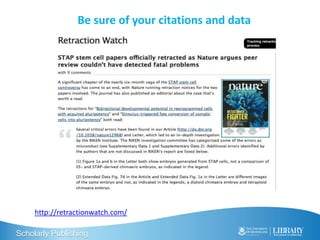
Be sure of your citations and data
http://retractionwatch.com/
Scholarly Publishing
Managing your references
Referencing software available via UQ Library
Free referencing managers available online include
• UQ Library Research Support referencing software page
• UQ Library referencing style guides
Scholarly Publishing
From submission to publication
Peer Review Process
• The peer review process is a form of quality assurance…..during this
process, experts in your field consider the merits of your work. They
provide journal editors with an impartial decision about whether or not to
publish, as well as how to improve an article already accepted for
publication (Boden).
Purpose:
• To help the editor decide whether to publish the paper.
• To help the authors improve the paper, whether or not the journal accepts it.
More information - http://guides.library.uq.edu.au/getting-published/peer-
review
Scholarly Publishing
•Reviewed by experts
in your discipline.
•Reviews may be
markedly different.
Receive peer
review
•Address each
suggestion/comment.
•Decide which changes
you are going to
make.
Address
comments •Manuscript may be
returned to you for
further revisions
•Seek clarification if
needed
Resubmit
revisions
Peer Review Process
Watch Dr. Tamara Davis talk about peer review.
Scholarly Publishing
Promote Your Paper – build your research
profile.
Make it discoverable
Why?
• Disseminate new knowledge
• Increase the impact and
visibility of your research
• Establish/build your reputation
• Be visible or vanish!
How?
Download
Scholarly Publishing
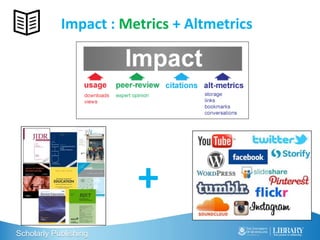
Impact : Metrics + Altmetrics
+
Scholarly Publishing
Make it happen!
Upload – into UQeSpace
https://espace.library.uq.edu.au/
UQ eSpace
UQ’s official digital
space for:
• the research
outputs
• the research
data
of staff and students
of UQ
Scholarly Publishing
Altmetrics tools in eSpace
Click here to read and download full
text
Downloads
Scholarly Publishing
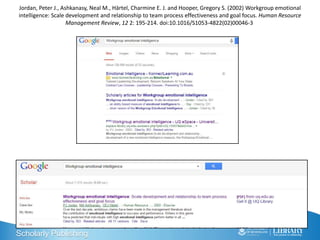
Jordan, Peter J., Ashkanasy, Neal M., Härtel, Charmine E. J. and Hooper, Gregory S. (2002) Workgroup emotional
intelligence: Scale development and relationship to team process effectiveness and goal focus. Human Resource
Management Review, 12 2: 195-214. doi:10.1016/S1053-4822(02)00046-3
Scholarly Publishing
What is Copyright?
• A type of intellectual property:
• Copyright
• Patents
• Trade marks
• Designs
• Copyright is a bundle of rights:
• Economic right
• Legal right
• Moral right
36
Scholarly Publishing
Top 5 Tips When Publishing
1. Know your obligations: You will be the copyright owner of your
own work BUT you still need to be aware of any contractual
obligations you may have.
2. Identify 3rd party materials and acknowledge: If you have used
3rd party material in your work, you may need permission to
reproduce this and will need to acknowledge the author.
3. Don’t rely on ‘fair dealing for research and study’: When
publishing a work, you will no longer be protected by ‘fair dealing
for research and study’.
4. Understand ‘fair dealing for criticism and review’: Know what
‘fair dealing for criticism and review’ means and how it applies to
your work.
5. Know what ‘publishing’ means: ‘Publishing’ includes hardcopy
journal/book; e-journal; and web.
37
Scholarly Publishing
• Create an Author Identifier Account
• Read Journal Instructions for Authors
• Submit article to suitable/appropriate journal –
consider impact, access, scope.
• Know your authorship responsibilities.
• Write often, every day if possible, at least 15 mins
• Seek feedback from peers, mentors, supervisor
• Master your Referencing Manager from the start!
• Promote your article – be visible or vanish!
Tips for Publishing – a Summary
Scholarly Publishing
Publisher Resources
http://www.elsevier.com/journal-authors/home#find-a-journal
https://us.sagepub.com/en-us/nam/journal-author-gateway
https://us.sagepub.com/sites/default/files/how_to_get_published.pdf
http://www.elsevier.com/connect/videos/tutorials
Elsevier – How to publish in Scholarly Journals
http://www.elsevier.com/__data/assets/pdf_file/0003/91173/Brochure_UPP_
April2015.pdf
Elsevier – Getting your Paper Noticed
http://www.elsevier.com/connect/tutorial-getting-your-paper-noticed
Scholarly Publishing
Contacts
Sharon Bunce – s.bunce@library.uq.edu.au
Elena Danilova – e.danilova@library.uq.edu.au
Alicia Dodemont – a.dodemont@library.uq.edu.au

Getting Published in academic journals: tips and tricks. 2015

  • 1.
    Scholarly Publishing Getting Published– tips and tricks. UQ Winter Scholars Sharon Bunce, Elena Danilova, Alicia Dodemont Scholarly Communication and Digitisation Services 2015 http://upload.wikimedia.org/wikipedia/commons/thumb/1/18/Water_drop_impact_on_a_water-surface
  • 2.
    Scholarly Publishing Getting PublishedResearch Guide http://guides.library.uq.edu.au/getting-published
  • 3.
    Scholarly Publishing Session Outline 1.Why publish? 2. The publishing process 3. Where do I start ? Where to publish 4. Writing support – writing resources, managing references, peer review 5. Measuring your impact/promoting your paper 6. Copyright 7. Top tips/summary 8. Where to find resources
  • 4.
    Scholarly Publishing • Communicatenew knowledge • Increase the impact and visibility of your research • Establish/build your reputation • Register research findings, their timing & the person(s) responsible • Preserve a record of the findings for the long term Why publish? CC image: https://www.flickr.com/photos/njsouthall/5880919002;
  • 5.
    Scholarly Publishing The publishingprocess: a publisher’s perspective
  • 6.
  • 7.
    Scholarly Publishing To beaccepted, a paper must Contribute to and advance existing knowledge Common reasons for article rejection • Lack of constructive arguments. • Too many spelling or grammatical errors. • Poor structure. • Not scholarly. • Shallow lit review. • Lack of reference to similar or contrary research findings. • Theoretically or methodologically flawed • Insignificant/small sample • Not enough familiarity with the journal. • Too narrow/too broad MethodConventions ContextLitReview Garcia, R. (2014). Simple guide to writing a journal article. www.sagepub.co.uk
  • 8.
    Scholarly Publishing The publishingprocess: researcher’s perspective Research Writing Submission Peer Revie w Revisions Copy editing Publication Rejected Rejected Revisions, revisions, revisions. KNOW your author Responsibilities CREATE Author ID account CHOOSE a journal READ Journal Instructions For Authors PROMOTE your article in UQeSpace and beyond OR *Save a post-print version of your manuscript
  • 9.
    Scholarly Publishing Know yourauthor responsibilities Read: UQ Authorship policies 4.20.04 Explains the requirements for determining authorship on publications 4.20.06 Research Data Management 4.20.08 Open Access for UQ Research Outputs Create an Author Identifier Unique identifier that records your name, your institution’s name and your funding authority’s name consistently in your publications Tip: The rule is to submit to only one journal at a time Go to: Author Responsibilities Read : The Australian Code for the Responsible Conduct of Research Australian Government National Health and Medical Research Council
  • 10.
    Scholarly Publishing Where topublish? Identify list of peer-reviewed journal titles Ulrich's Access How will you make your publication available open access? UQ Open Access Policy Impact/prestige • Journal impact factors • Predatory Publishers Aims/scope • Discipline area • Publishes work you cite • Audience Likelihood of acceptance for ECRs. READ journal publishing guidelines Watch Prof. Matthew Brown talk about ACCESS to research
  • 11.
    Scholarly Publishing Impact: JournalCitation Reports search: subject area clinical neurology and impact factor
  • 12.
    Scholarly Publishing Access: OpenAccess http://guides.library.uq.edu.au/open-access • Open access (OA) is making research results freely available to anyone with an internet connection • OA Research is more discoverable and FREE for the user to access and download • Can apply to research outputs in the form of journal articles, conference papers, data sets, software, books and book chapters.
  • 13.
    Scholarly Publishing How isopen access provided? For publications…… 1. Publish in an Open Access Journal Where: OA journal or traditional journal with OA option Version: Published version Cost: May include article processing charge for authors * $ Access: free immediate access for all UQ eSpace DOI Link to published version for all users 2. Deposit of OA version in UQ eSpace Where: institutional repository – (UQ eSpace) When: upon acceptance for publication Version: post-print or publishers pdf Cost: free Access: free access for all access embargo may apply
  • 14.
    Scholarly Publishing What topublish • Original research – • Theses (qualitative or quantitative) • Research project reports (Honours) • Conference papers • Literature reviews • Systematic reviews • Case studies • Theoretical Analyses • Response articles • Book reviews And many more….. Image: ~Cyn~ , Creative Process Still Life, CC BY-NC-ND 2.0
  • 15.
    Scholarly Publishing What toPublish Scholarly Publications > Thesis You may choose to submit your thesis as a “Thesis by Publication” Thesis Preparation - guidelines (UQ Graduate School) http://www.uq.edu.au/grad-school/thesis-preparation
  • 16.
    Scholarly Publishing What toPublish Scholarly Publications > Thesis Thesis by publication: UQ example (UQ eSpace) Publish in UQ’s Digital Repository eSpace
  • 17.
    Scholarly Publishing What toPublish Thesis > Scholarly Publication How to turn your Dissertation, Thesis or Paper into a Publication
  • 18.
    Scholarly Publishing The WritingProcess • Define your purpose • Plan your research • Create your outline • Commit to a writing schedule • Check the preferred writing / referencing style format • Identify your audience write for them • Seek feedback from other academics or your supervisor • Write often Writing tips from the Graduate School – http://www.uq.edu.au/grad-school/events-skills-training-students Choose your target journal
  • 19.
    Scholarly Publishing Writing &Structure (Research Article) IMRaD What question is being asked? Introduction How was the problem studied? Methods What were the findings? Results What do these findings mean? Discussion
  • 20.
    Scholarly Publishing Resources foracademic writing http://www.phd2published.com/ https://www.coursera.org/courses http://www.editage.com/insights/# Blog Online courses Writing and publishing resources Getting Published Research Guide Student Services Website UQ Course: Academic English & Thesis writing for International Students
  • 21.
    Scholarly Publishing Uqx (UQbased) Write101x: English Grammar and Style Learn how to use a knowledge of how words work to write in the style that readers value and that the university and the professions require. •Starts: 26 July, 2015 •Duration: 8 weeks •Instructors: Roslyn Petelin, who convenes the highly commended post-graduate Writing, Editing, & Publishing (WEP) Program in EMSAH at UQ. About this Course With the rise of social media and the Internet, many people are writing more today for different mediums than ever before. We’ll present materials that cover grammatical principles, word usage, writing style, sentence and paragraph structure, and punctuation. We’ll introduce you to some marvellous resources that we have annotated for your guidance. We’ll show you video clips of interviews conducted with distinguished grammarians, challenge you with quizzes and writing activities that will give you strategies to help you to build skills that will enhance the quality of your writing, and invite you to participate in discussions and assess the work of your peers. https://www.edx.org/course/english-grammar-style-uqx-write101x-0#! Free Online Course
  • 22.
    Scholarly Publishing Writing tipsto help you along the way • Target your journal early on and become an expert in it. • Create an outline for your paper and then use it to write your prose • Plan your writing time with a writing diary – set-up time slots and match these with your paper outline • Work with a writing partner or set up/join a writing group Murray R. Writing for academic journals. 3rd edition. Open University, 2013
  • 23.
    Scholarly Publishing Be sureof your citations and data http://retractionwatch.com/
  • 24.
    Scholarly Publishing Managing yourreferences Referencing software available via UQ Library Free referencing managers available online include • UQ Library Research Support referencing software page • UQ Library referencing style guides
  • 25.
    Scholarly Publishing From submissionto publication Peer Review Process • The peer review process is a form of quality assurance…..during this process, experts in your field consider the merits of your work. They provide journal editors with an impartial decision about whether or not to publish, as well as how to improve an article already accepted for publication (Boden). Purpose: • To help the editor decide whether to publish the paper. • To help the authors improve the paper, whether or not the journal accepts it. More information - http://guides.library.uq.edu.au/getting-published/peer- review
  • 26.
    Scholarly Publishing •Reviewed byexperts in your discipline. •Reviews may be markedly different. Receive peer review •Address each suggestion/comment. •Decide which changes you are going to make. Address comments •Manuscript may be returned to you for further revisions •Seek clarification if needed Resubmit revisions Peer Review Process Watch Dr. Tamara Davis talk about peer review.
  • 27.
    Scholarly Publishing Promote YourPaper – build your research profile. Make it discoverable Why? • Disseminate new knowledge • Increase the impact and visibility of your research • Establish/build your reputation • Be visible or vanish! How? Download
  • 28.
    Scholarly Publishing Impact :Metrics + Altmetrics +
  • 29.
    Scholarly Publishing Make ithappen! Upload – into UQeSpace https://espace.library.uq.edu.au/ UQ eSpace UQ’s official digital space for: • the research outputs • the research data of staff and students of UQ
  • 30.
    Scholarly Publishing Altmetrics toolsin eSpace Click here to read and download full text Downloads
  • 31.
    Scholarly Publishing Jordan, PeterJ., Ashkanasy, Neal M., Härtel, Charmine E. J. and Hooper, Gregory S. (2002) Workgroup emotional intelligence: Scale development and relationship to team process effectiveness and goal focus. Human Resource Management Review, 12 2: 195-214. doi:10.1016/S1053-4822(02)00046-3
  • 32.
    Scholarly Publishing What isCopyright? • A type of intellectual property: • Copyright • Patents • Trade marks • Designs • Copyright is a bundle of rights: • Economic right • Legal right • Moral right 36
  • 33.
    Scholarly Publishing Top 5Tips When Publishing 1. Know your obligations: You will be the copyright owner of your own work BUT you still need to be aware of any contractual obligations you may have. 2. Identify 3rd party materials and acknowledge: If you have used 3rd party material in your work, you may need permission to reproduce this and will need to acknowledge the author. 3. Don’t rely on ‘fair dealing for research and study’: When publishing a work, you will no longer be protected by ‘fair dealing for research and study’. 4. Understand ‘fair dealing for criticism and review’: Know what ‘fair dealing for criticism and review’ means and how it applies to your work. 5. Know what ‘publishing’ means: ‘Publishing’ includes hardcopy journal/book; e-journal; and web. 37
  • 34.
    Scholarly Publishing • Createan Author Identifier Account • Read Journal Instructions for Authors • Submit article to suitable/appropriate journal – consider impact, access, scope. • Know your authorship responsibilities. • Write often, every day if possible, at least 15 mins • Seek feedback from peers, mentors, supervisor • Master your Referencing Manager from the start! • Promote your article – be visible or vanish! Tips for Publishing – a Summary
  • 35.
    Scholarly Publishing Publisher Resources http://www.elsevier.com/journal-authors/home#find-a-journal https://us.sagepub.com/en-us/nam/journal-author-gateway https://us.sagepub.com/sites/default/files/how_to_get_published.pdf http://www.elsevier.com/connect/videos/tutorials Elsevier– How to publish in Scholarly Journals http://www.elsevier.com/__data/assets/pdf_file/0003/91173/Brochure_UPP_ April2015.pdf Elsevier – Getting your Paper Noticed http://www.elsevier.com/connect/tutorial-getting-your-paper-noticed
  • 36.
    Scholarly Publishing Contacts Sharon Bunce– s.bunce@library.uq.edu.au Elena Danilova – e.danilova@library.uq.edu.au Alicia Dodemont – a.dodemont@library.uq.edu.au