How to Avoid
Predatory Journals
Prof. Dr. Khalid Mahmood
Faculty of Economics and Management Sciences
University of the Punjab
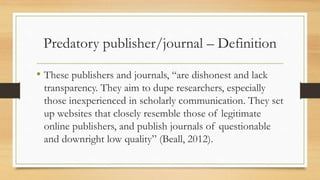
Predatory publisher/journal – Definition
• These publishers and journals, “are dishonest and lack
transparency. They aim to dupe researchers, especially
those inexperienced in scholarly communication. They set
up websites that closely resemble those of legitimate
online publishers, and publish journals of questionable
and downright low quality” (Beall, 2012).
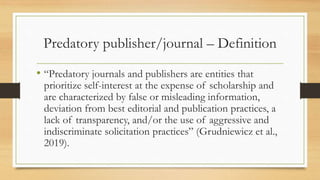
Predatory publisher/journal – Definition
• “Predatory journals and publishers are entities that
prioritize self-interest at the expense of scholarship and
are characterized by false or misleading information,
deviation from best editorial and publication practices, a
lack of transparency, and/or the use of aggressive and
indiscriminate solicitation practices” (Grudniewicz et al.,
2019).
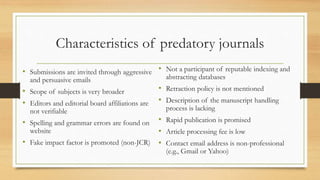
Characteristics of predatory journals
• Submissions are invited through aggressive
and persuasive emails
• Scope of subjects is very broader
• Editors and editorial board affiliations are
not verifiable
• Spelling and grammar errors are found on
website
• Fake impact factor is promoted (non-JCR)
• Not a participant of reputable indexing and
abstracting databases
• Retraction policy is not mentioned
• Description of the manuscript handling
process is lacking
• Rapid publication is promised
• Article processing fee is low
• Contact email address is non-professional
(e.g., Gmail or Yahoo)
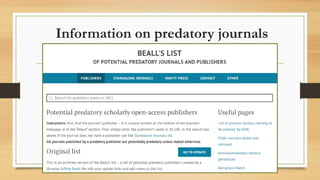
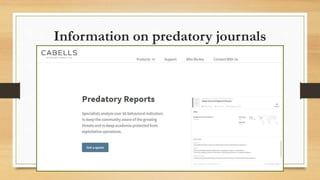
Information on predatory journals
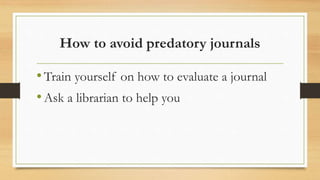
How to avoid predatory journals
•Train yourself on how to evaluate a journal
•Ask a librarian to help you
If you have already published a paper in a predatory journal
• It will:
• Be harmful for your CV and your repute
• Not be useful for any promotion, financial benefit, etc.
• Not get citations
• Immediately withdraw your paper
Best of luck for your
publishing career
You may also watch my videos at
Khalidmahmood.pk
Libraryinf.com

How to avoid predatory journals

  • 1.
    How to Avoid PredatoryJournals Prof. Dr. Khalid Mahmood Faculty of Economics and Management Sciences University of the Punjab
  • 2.
    Predatory publisher/journal –Definition • These publishers and journals, “are dishonest and lack transparency. They aim to dupe researchers, especially those inexperienced in scholarly communication. They set up websites that closely resemble those of legitimate online publishers, and publish journals of questionable and downright low quality” (Beall, 2012).
  • 3.
    Predatory publisher/journal –Definition • “Predatory journals and publishers are entities that prioritize self-interest at the expense of scholarship and are characterized by false or misleading information, deviation from best editorial and publication practices, a lack of transparency, and/or the use of aggressive and indiscriminate solicitation practices” (Grudniewicz et al., 2019).
  • 4.
    Characteristics of predatoryjournals • Submissions are invited through aggressive and persuasive emails • Scope of subjects is very broader • Editors and editorial board affiliations are not verifiable • Spelling and grammar errors are found on website • Fake impact factor is promoted (non-JCR) • Not a participant of reputable indexing and abstracting databases • Retraction policy is not mentioned • Description of the manuscript handling process is lacking • Rapid publication is promised • Article processing fee is low • Contact email address is non-professional (e.g., Gmail or Yahoo)
  • 5.
  • 6.
  • 7.
    How to avoidpredatory journals •Train yourself on how to evaluate a journal •Ask a librarian to help you
  • 8.
    If you havealready published a paper in a predatory journal • It will: • Be harmful for your CV and your repute • Not be useful for any promotion, financial benefit, etc. • Not get citations • Immediately withdraw your paper
  • 9.
    Best of luckfor your publishing career You may also watch my videos at Khalidmahmood.pk Libraryinf.com