Dr. Khalid Mahmood
Professor
University of the Punjab
 Either the first or among the first steps of
research process
 Backbone of the study
 Clarifies what is to be investigated, and
why
 If “Progress has been slow” and the literature
uses terms ranging from:
 Unknown
 Poorly understood
 Little is known
 Not completely understood to
 Mostly understood
 A problem is a theoretical conflict, if:
 two or more approaches to its solution exist
 Problem statements are a set of declarative
sentences
 Not stated in the form of a question
 Not contain statements about objectives,
goals, or purposes
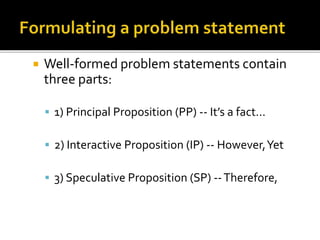
 Well-formed problem statements contain
three parts:
 1) Principal Proposition (PP) -- It’s a fact...
 2) Interactive Proposition (IP) -- However,Yet
 3) Speculative Proposition (SP) --Therefore,
 A starting point; a given; an assertion, or a
fact
 Find it in the literature
 One way to start: “According to so and so
(2012), the acknowledged expert in the field,
...”
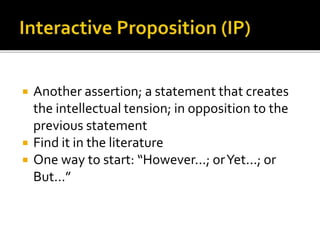
 Another assertion; a statement that creates
the intellectual tension; in opposition to the
previous statement
 Find it in the literature
 One way to start: “However...; orYet...; or
But…”
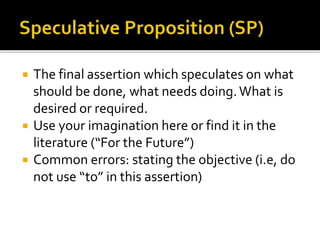
 The final assertion which speculates on what
should be done, what needs doing.What is
desired or required.
 Use your imagination here or find it in the
literature (“For the Future”)
 Common errors: stating the objective (i.e, do
not use “to” in this assertion)
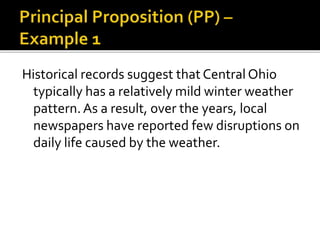
Historical records suggest that Central Ohio
typically has a relatively mild winter weather
pattern.As a result, over the years, local
newspapers have reported few disruptions on
daily life caused by the weather.
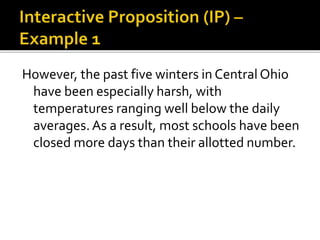
However, the past five winters in Central Ohio
have been especially harsh, with
temperatures ranging well below the daily
averages.As a result, most schools have been
closed more days than their allotted number.
If Central Ohio has had relatively mild winters in
the past based on historical information, and
if the recent winter weather pattern suggests
a new weather pattern, which may have
detrimental affects on daily life, then more
must be known about the most current
winter weather patterns of Central Ohio.
Studies have shown that managers in multi-national
enterprises (MNEs) confront issues of national
culture in their daily activities. For instance, policies
set by senior managers in one country may in fact
represent the cultural assumptions of that country
only and, as a result, may differ from the
assumptions held by managers who reside in
another country and who are expected to carry out
the policies. Such differences in national culture
may affect the behaviors of the managers and by
extension the effectiveness of the policies.
While a range of management behaviors have
been studied related to national culture,
there have been few if any studies focusing
on how human resource development might
differ based on national culture. Human
resource development has been shown to be
a critical factor in determining organizational
success.
If national culture may affect the way in which
managers carry out organizational policies and by
extension the effectiveness of those policies, and if
no studies have been conducted on how human
resource development might differ based on
national culture, which is a critical aspect in
determining organizational success, then more
should be known about how managers in a
multinational enterprise differ in their perceptions
of human resource development.
There are various technologies that have been grouped asWeb
2.0, the second version of the worldwide web. As in other
spheres of life, these technologies have their place in
academic libraries. Libraries and their users are enjoying the
benefits ofWeb 2.0 technologies but they are also prone to
problems and threats. However, no empirical data are
available on the impact of such technologies in libraries. In
order to improve the use of these technologies in libraries,
there is a need to study librarians’ perceptions (whether
positive or negative) ofWeb 2.0 technologies with regard to
academic library services.
The tools ofWeb 2.0 are rapidly gaining popularity in all walks
of life.They have enabled academic libraries to involve
faculty and students in their activities and solicit their
feedback for improvement in services. Library websites are
the windows through which they provide electronic services
to the distant users. It is assumed that many academic
libraries have already included a variety ofWeb 2.0 features
in their websites but there is a little research investigating
the extent and purpose of the adoption of such features.The
practices of the libraries of world’s top academic institutions
in this regard should be explored to guide other libraries in
getting maximum benefit of these technologies.

Problem statement

  • 1.
  • 2.
     Either thefirst or among the first steps of research process  Backbone of the study  Clarifies what is to be investigated, and why
  • 3.
     If “Progresshas been slow” and the literature uses terms ranging from:  Unknown  Poorly understood  Little is known  Not completely understood to  Mostly understood
  • 4.
     A problemis a theoretical conflict, if:  two or more approaches to its solution exist
  • 5.
     Problem statementsare a set of declarative sentences  Not stated in the form of a question  Not contain statements about objectives, goals, or purposes
  • 6.
     Well-formed problemstatements contain three parts:  1) Principal Proposition (PP) -- It’s a fact...  2) Interactive Proposition (IP) -- However,Yet  3) Speculative Proposition (SP) --Therefore,
  • 7.
     A startingpoint; a given; an assertion, or a fact  Find it in the literature  One way to start: “According to so and so (2012), the acknowledged expert in the field, ...”
  • 8.
     Another assertion;a statement that creates the intellectual tension; in opposition to the previous statement  Find it in the literature  One way to start: “However...; orYet...; or But…”
  • 9.
     The finalassertion which speculates on what should be done, what needs doing.What is desired or required.  Use your imagination here or find it in the literature (“For the Future”)  Common errors: stating the objective (i.e, do not use “to” in this assertion)
  • 10.
    Historical records suggestthat Central Ohio typically has a relatively mild winter weather pattern.As a result, over the years, local newspapers have reported few disruptions on daily life caused by the weather.
  • 11.
    However, the pastfive winters in Central Ohio have been especially harsh, with temperatures ranging well below the daily averages.As a result, most schools have been closed more days than their allotted number.
  • 12.
    If Central Ohiohas had relatively mild winters in the past based on historical information, and if the recent winter weather pattern suggests a new weather pattern, which may have detrimental affects on daily life, then more must be known about the most current winter weather patterns of Central Ohio.
  • 13.
    Studies have shownthat managers in multi-national enterprises (MNEs) confront issues of national culture in their daily activities. For instance, policies set by senior managers in one country may in fact represent the cultural assumptions of that country only and, as a result, may differ from the assumptions held by managers who reside in another country and who are expected to carry out the policies. Such differences in national culture may affect the behaviors of the managers and by extension the effectiveness of the policies.
  • 14.
    While a rangeof management behaviors have been studied related to national culture, there have been few if any studies focusing on how human resource development might differ based on national culture. Human resource development has been shown to be a critical factor in determining organizational success.
  • 15.
    If national culturemay affect the way in which managers carry out organizational policies and by extension the effectiveness of those policies, and if no studies have been conducted on how human resource development might differ based on national culture, which is a critical aspect in determining organizational success, then more should be known about how managers in a multinational enterprise differ in their perceptions of human resource development.
  • 16.
    There are varioustechnologies that have been grouped asWeb 2.0, the second version of the worldwide web. As in other spheres of life, these technologies have their place in academic libraries. Libraries and their users are enjoying the benefits ofWeb 2.0 technologies but they are also prone to problems and threats. However, no empirical data are available on the impact of such technologies in libraries. In order to improve the use of these technologies in libraries, there is a need to study librarians’ perceptions (whether positive or negative) ofWeb 2.0 technologies with regard to academic library services.
  • 17.
    The tools ofWeb2.0 are rapidly gaining popularity in all walks of life.They have enabled academic libraries to involve faculty and students in their activities and solicit their feedback for improvement in services. Library websites are the windows through which they provide electronic services to the distant users. It is assumed that many academic libraries have already included a variety ofWeb 2.0 features in their websites but there is a little research investigating the extent and purpose of the adoption of such features.The practices of the libraries of world’s top academic institutions in this regard should be explored to guide other libraries in getting maximum benefit of these technologies.