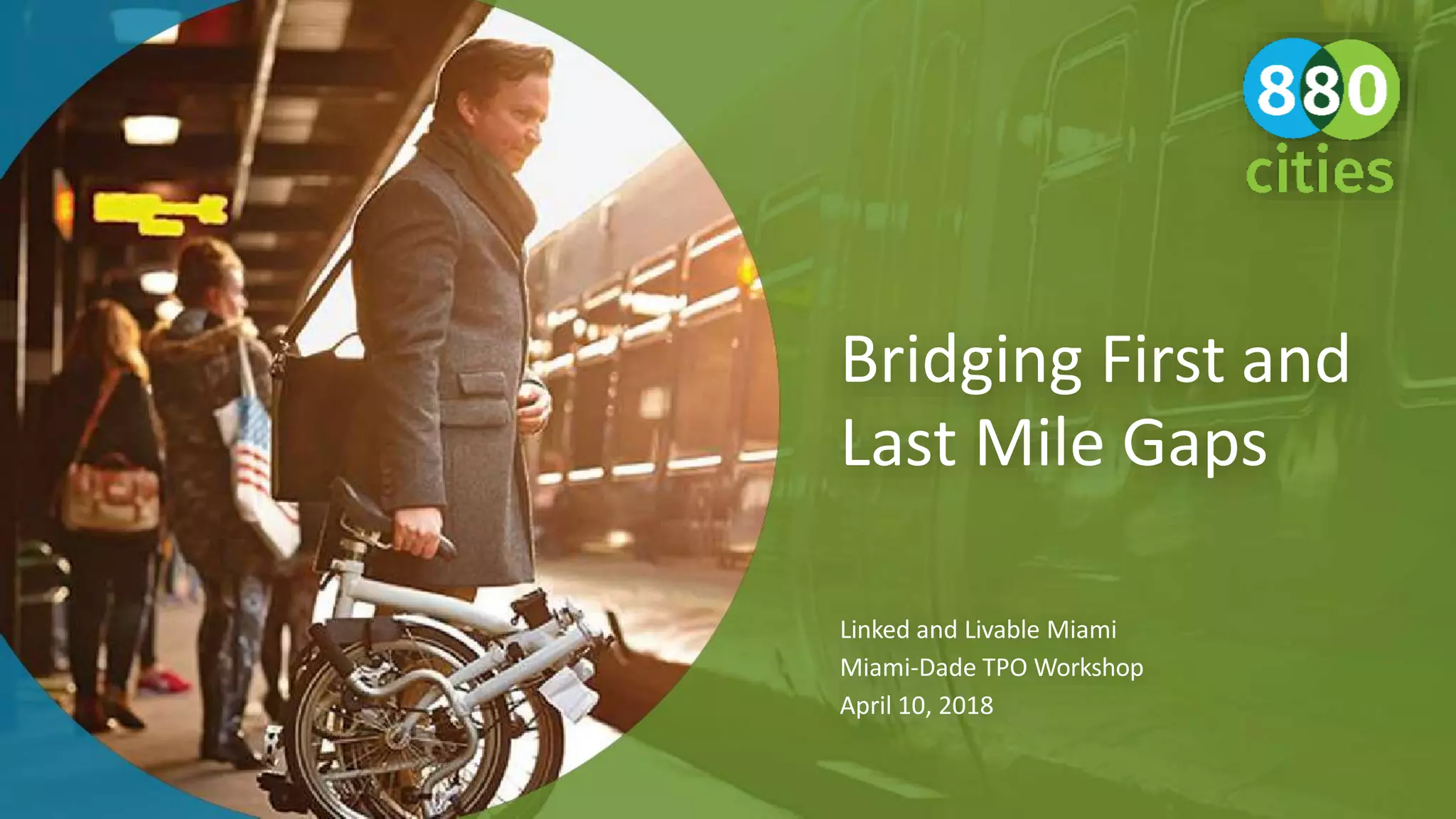





Bridging First and
Last Mile Gaps
Linked and Livable Miami
Miami-Dade TPO Workshop
April 10, 2018
Agenda
i. First and Last Mile Presentation
ii. Activity: Fist and Last Mile Gap
Identification
iii.Pilot Project Presentation
iv.Activity: Project Brainstorming
v. Wrap-Up
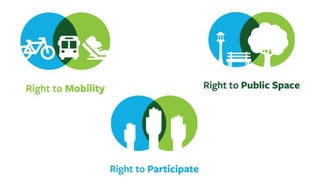
Creating cities for all
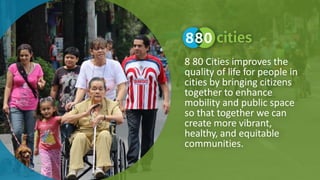
8 80 Cities improves the
quality of life for people in
cities by bringing citizens
together to enhance
mobility and public space
so that together we can
create more vibrant,
healthy, and equitable
communities.
ties
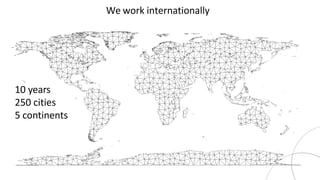
We work internationally
10 years
250 cities
5 continents
Why 8 80?
What do you do?
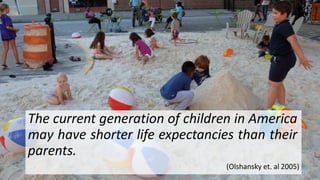
children
The current generation of children in America
may have shorter life expectancies than their
parents.
(Olshansky et. al 2005)
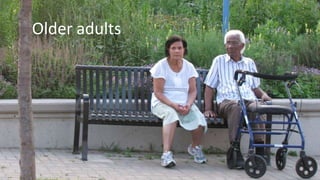
Older adults
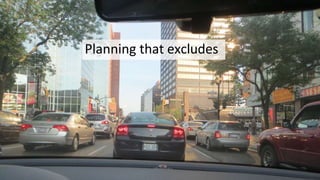
Planning that excludes
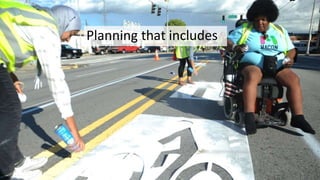
Planning that includes
8 80 goggles
Unconventional
Engagement
Everyone has a voice.
We provide the megaphone.
Creating cities for all
Open Streets
Planning
Change your city’s culture of health.
Creating cities for all
Ideas Lab
Push your ideas.
Create a concrete plan to achieve them.
Creating cities for all
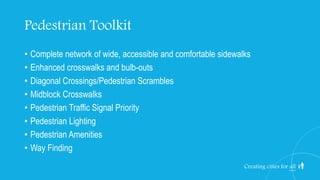
Pedestrian Toolkit
• Complete network of wide, accessible and comfortable sidewalks
• Enhanced crosswalks and bulb-outs
• Diagonal Crossings/Pedestrian Scrambles
• Midblock Crosswalks
• Pedestrian Traffic Signal Priority
• Pedestrian Lighting
• Pedestrian Amenities
• Way Finding
Creating cities for all
Cycling Toolkit
• All Ages and Abilities Cycling Tracks
• Secure Bike Storage
• Cycling Priority Traffic Signals
• Lower Vehicular Speeds
• Traffic Calming
• Removal of Parking
• Improved Signage
• Enhanced Enforcement
Creating cities for all
Activity
1. Using the maps in front of you, analyze the section of roadway with a First
and Last Mile lens
2. With green dots/markers, identify areas where pedestrian and cycling
infrastructure is performing well for all ages and abilities
3. With red dots/markers, identify areas where pedestrian and cycling
infrastructure is performing poorly for all ages and abilities
4. With sticky notes, identify what interventions from the First and Last Mile
toolkits can be utilized to improve conditions for all ages and abilities
Creating cities for all
8 80 goggles
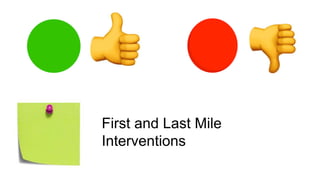
First and Last Mile
Interventions
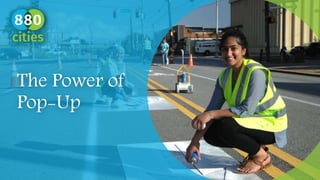
The Power of
Pop-Up
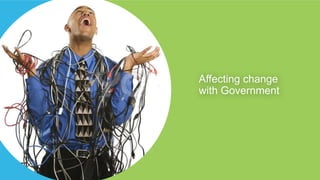
Affecting change
with Government
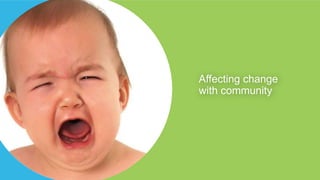
Affecting change
with community
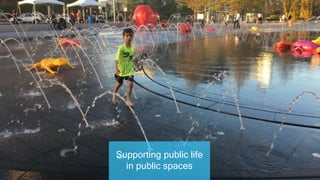
Supporting public life
in public spaces
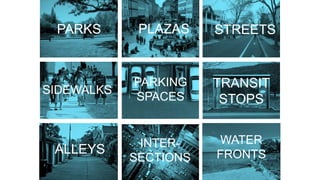
PARKS PLAZAS STREETS
ALLEYS
SIDEWALKS
TRANSIT
STOPS
INTER-
SECTIONS
WATER
FRONTS
PARKING
SPACES
Low-cost, temporary changes
to the built environment,
intended to improve public
spaces.
Temporary
Affordable
Strategic
Test in real time
Evidence
Creating cities for all
8 80 Rule
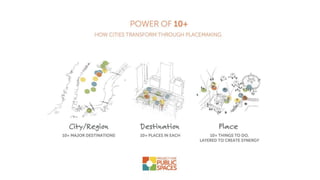
Power of 10
Measuring Public Life
Pop-up Project Tools
8 80
How do you
know if a place
is working?
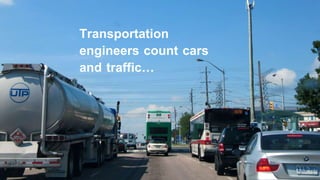
Transportation
engineers count cars
and traffic…
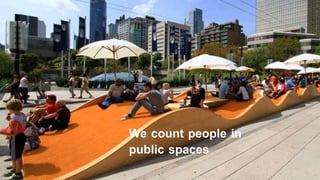
We count people in
public spaces
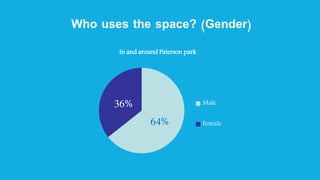
Who uses the space? (Gender)
64%
36%
In and around Paterson park
Male
Female
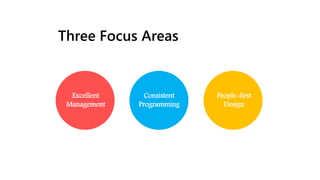
Three Focus Areas
Excellent
Management
Consistent
Programming
People-first
Design
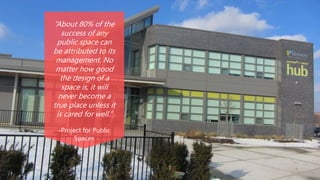
“About 80% of the
success of any
public space can
be attributed to its
management. No
matter how good
the design of a
space is, it will
never become a
true place unless it
is cared for well.”
-Project for Public
Spaces
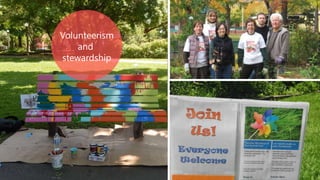
Volunteerism
and
stewardship
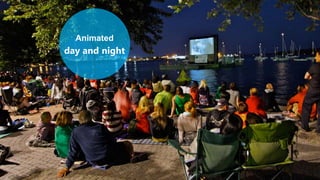
Animated
day and night
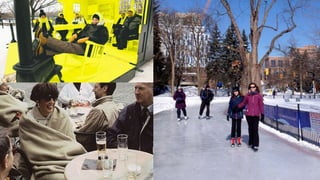
Activity – All year round –
All year
round
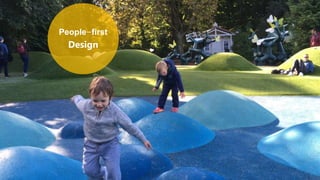
People-first
Design
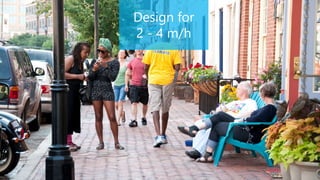
Design for
2 - 4 m/h
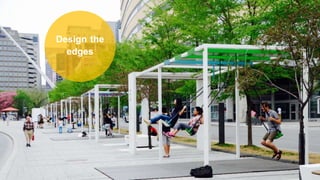
Design the
edges
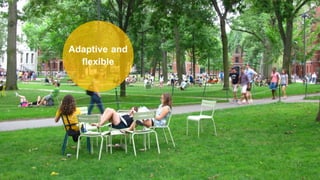
Adaptive and
flexible
Piloting Healthier
Neigborhoods
Macon, Georgia
Detroit, Michigan
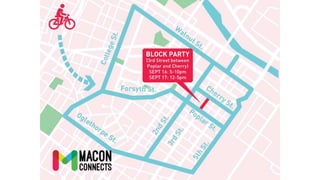
Macon Connects
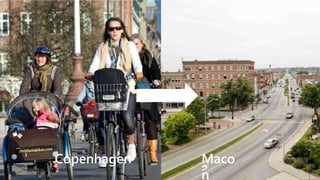
Copenhagen Maco
n
95% of people commute to
work/school by car.
A bold new initiative
that seeks to
transform the way
Macon residents get
around ―for the
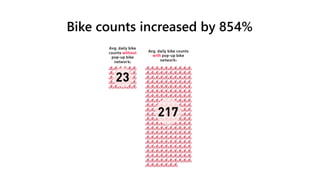
Bike counts increased by 854%
Brainstorm!
For the next two minutes, by yourself, come
up with as many ideas for pilot projects as
possible for strengthening connections and
building an all ages and abilities First and Last
Mile SMART Plan
Top Three!
For the next 20 minutes, work with your groups to
select your top three ideas. Focus on ideas that:
• Can be implemented in 0-12 months
• Build on skills and expertise in your group
Guiding Principles
1. Think big.
2. Abandon all preconceived notions.
3. Eliminate “can’t” from your vocabulary.
4. Share your expertise.
5. Have FUN!

8 80 First-Last Mile Workshop Presentation

Editor's Notes

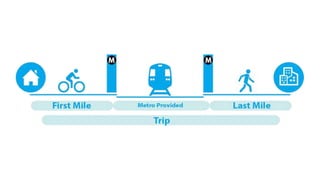
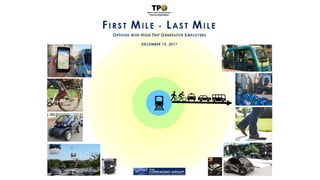
  • #17 -Should probably start with making sure we’re all on the same page when it comes to that term -How many of you are familiar with the First and Last Mile Concept? -It’s a term that actually originated in the telecommunications industry -But in recent years has used to describe passenger travel getting to and from public transit stops and stations -Whether it’s from home to the rail station or from the rail station to work, the first and last mile are those micro-trips that could be made by foot or by bike but are often made by private vehicle
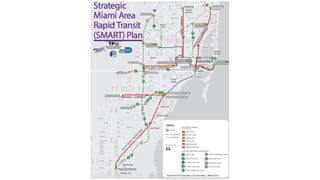
  • #18 -With the SMART Plan set to transform public transit in Miami-Dade, the questions becomes: How do we want residents to get to and from transit?
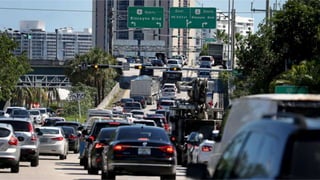
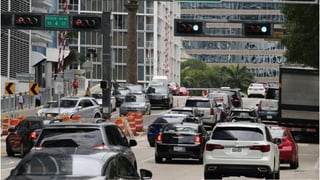
  • #19 -SMART Plan’s goal is expand access to transit in order to address congestion and promote transportation options other than driving for residents and visitors alike -If people’s transportation habits prior to SMART Plan are to drive to work, and after SMART Plan, are to drive to transit, we aren’t really addressing congestion, we’re just changing people’s destinations
  • #20 -In order to achieve meaningful reductions to congestion, SMART Plan is going to have to think holistically not just about transit itself, but how to make it safe, accessible and enjoyable to walk or bike to transit -We know that in addition to reducing congestion and reaping the economic benefits that entails, alternate transportation options like walking and biking lead to improvements in public health, in social connectivity and in environmental sustainability
  • #21 -And if all of that isn’t enough, Miami’s streets as they are now are deadly -In 2016, 83 pedestrians were killed on Miami-Dad streets. That’s the fifth highest county total in the country -By thinking holistically about the SMART Plan and incorporating FLM improvements, you’re not only going to reduce congestion, improve air quality, increase economic opportunity, improve public health and fight climate change -You’ll be saving lives as well
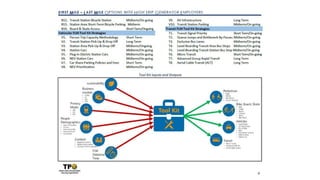
  • #22 -The good news is, that in January, Miami-Dade TPO adopted a massive 200 plus page report on First and Last Mile strategies in the county -How many of you are familiar or worked on this report? -The report lays out 47 different tools for improving FLM
  • #23 -Some of the report looks at transit station design and some of it looks at land use planning -And I won’t go over the 200 pages of the report or we’d be here all week
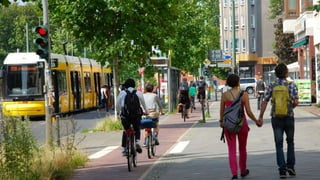
  • #24 -But we want to focus in on the strategies that speak to pedestrian and cycling access -Our expertise is strongest in those areas -And they are the areas municipalities and counties have direct control over -Land use planning requires private developers interested in building -Station location and technology uses requires involvement of state and federal officials as they’re often footing most of the bill
  • #25 -But sidewalks and bike lanes and crosswalks and wayfinding signage and street furniture, that’s all right in your wheelhouses -And those small scale things play a huge role in getting people out of their cars for those micro-trips and onto their feet
  • #26 -For Pedestrians, the FLM Report lays out the following tools available to the city and county to enhance the pedestrian experience -Won’t go over them in much detail, and we’ve got copies print off at each of your tables -But we’re looking at things like a connected AAA sidewalk network, bulb-outs, midblock crossings and street furniture
  • #27 -For Cycling, we’re again look at all ages and abilites cycle tracks, cycling friendly traffic signals, and traffic calming measures
  • #28 -Leads us to our first activity -At each table there are big maps of a roadway close to one of the 6 SMART Plan corridors
  • #31 -So we’ve spent some time identifying specific issues on streets near SMART Plan corridors that need to be addressed -But many of the solutions in your toolkits are potentially very difficult to implement -Getting support from the community and from other departments and elected officials at City Hall could be a tall mountain to scale - Change is hard -We know that -At 8 80 we often on our projects end up working as the bridge between governments and communities -So we see first hand how hard the smallest change can be
  • #32 -To anyone trying to affect change with government, it can feel like you’re fighting a tangled mess of competing objectives where the left hand and the right hand might as well be operating on different planets
  • #33 -While the public has been to simultaneously want nothing to change all their pet problems to be solved and go away tout-suite -Change is never easy as Gil says -But our next activity is going to focus on one of the best tool cities have at their disposal to effect change -Pop-Up Projects
  • #34 -Much of the work we do is about building healthier, more resilient and connected communities by improving public space
  • #35 -Usually people think of parks and plazas when they think of pubic space -But there is so much more to public space than that -All of these publicly owned assets have the potential to perform better than they currently are -The all can host interventions that lead to improvements in public health, in economic development, and in environmental sustainability -For the purposes of this workshop, they are your laboratories, your playgrounds -They can all be doing more to fill in those FLM gaps
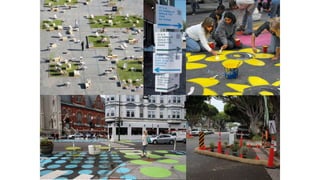
  • #36 -And let’s start with defining the term pop-up -In a nutshell, a pop-up is a quick and affordable way to test out changes to our streets, parks, and plazas -Or put much more elegantly, pop-ups are low cost temporary changes to the built environment intended to improve public spaces
  • #37 -When it comes to filling in the FLM gaps, Pilot projects have some distinct advantages in overcoming implementation hurdles -Well, they are: -Temporary – less red tape, less opposition -Affordable – often use cheap materials to replicate the feel of the ‘real thing’. Anyone can do it, whether you’re an individual or an organization. -Strategic – bring attention and raise awareness about a certain issue in your community. -Test in real time – better than renderings. People can see/feel/touch/experience. -Evidence – provides you proof or data to make sound decisions or to make a strong case for further investment
  • #38 -We’re going to share some examples of how small scale community led change can lead to big improvements -And some of the principals we apply when approaching pop up projects
  • #39 -When we look to evaluate and create new spaces we tend to use three rules of thumb -Frist, not surprisingly given our name, is the 8 80 rule -Think of a typical street in Miami -Now think of an 8 year old or 80 year old in your life, a child or parent or grandparent -Would you feel comfortable having that person walk across that street?
  • #40 -If yes, it’s safe enough -If not, it needs improvement The baseline person we design our cities for is often a middle aged, able bodied individual -As we think about pilot projects to fill in those FLM gaps -We want to make sure that is’ of course safe and accessible for all of us, small children and older adults most of all
  • #41 -Second rule is the Power of 10, or as I like to think of it as, ‘The rule of the burger’
  • #42 -When making a fantastic burger, it’s not just about having a perfectly cooked patty -You need all the ingredients, the bun, ketchup, mustard, mayo, grilled onions, mushrooms, pickles, lettuce, all working together to create a truly amazing culinary experience
  • #43 -Same thing with pilot projects -You want a project with lots of different flavors, something for everyone -Want it to reflect all the many different aspects people that call Miami home
  • #44 -Third rule, what I think of as the Sesame Street Rule, is ‘The Count Rule’ -How will we know if anything we try is actually working? If it’s actually getting us where want to go? -We have to count things
  • #45 -Typically when cities count things -They count cars -And nothing else
  • #46 We count people in public spaces. -We aren’t trying to make a safer, healthier Miami for cars, we’re trying to it healthier and more prosperous for people! -So that means we need to count people -We want to count who is using the space, how they are using it, when they are using it, what they are using it for! -This allows us to better assess a place in terms of how well it supports a wide rang of public experiences, such as belonging, companionship, risk taking, etc.
  • #47 -For example, we look at no just how many people use the space, but who they are -Women tend to be more discerning and less tolerant of spaces that are dirty, badly maintained or unsafe -If a space isn’t achieving a gender balance in it’s users, that’s telling you something important about how a space is functioning -Similarly, if a space isn’t reflecting the racial and ethnic diversity of a community, it again is telling you who that space is not serving
  • #48 -The pilot programs we’re going to develop should be created the one or more of these three key elements in mind -Excellent Management, Consistent Programming and People-first Design
  • #49 -Management is a bit difficult topic these days, particularly with austerity being the watchword for so many of our politicians -As our founder Gil always says “We can find millions to build our public spaces, but we can’t find the thousands to run them” -Wouldn’t build a community centre and then not hire the staff to run it -Apply the same thinking to outdoor spaces, treat them the same way you would a recreation facility
  • #50 Doesn’t necessary mean adding lots more city staff Residents are partners, not just users. For example, we worked on Dundonald Park in Ottawa Partnering with a local community group, Friends of Dundonald Park, on fostering more community ownership of a space The park was not very well used, despite being smack in the middle of a park deficient neighbourhood City of Ottawa was neglecting small ticket items, like maintenance of flower beds and park benches Friends of Dundonald Park stepped in so a few residents who live around the park starting took over the care of them. The Friends group also organized for artists to come to paint the benches and play a large role in the programming of the park The more members of the community became involved in the park, the more the animated and welcoming the park became, the more the park was utilized, the more people felt ownership of the park, the more people became involved
  • #51 -Second element is around programming -Programming and animation are key to creating those unique experiences that draw people out -They aren’t something that takes place from 9-5 -You want that programming to take place day and night
  • #52 -Animated 365 days of the year. -Danish have a concept called ‘Hygge’ -Means a sense of cosiness -Animate their spaces with heaters, blankets, fire pits so they can used all year round -Winnipeg creates warming huts in the winter -We spend millions and millions of dollars on creating and maintaining our public infrastrucutre -If we are only using them 8 hours a day and 6 months of the year, we aren’t getting anywhere near bang for our buck
  • #53 -Third element is people-first design -This is a park in Malmo Sweden -They worked with very small children, including some as young as 18 months old, on what kinds of activities they most enjoyed -Found that climbing was incredibly popular -So they developed these small rubber mounds, which were installed in various sizes -to kids of 18 months, they are massive, and are great challenges to climb -But they love trying, and as they do so, they are learning valuable skills related to balance and co-ordination -Self esteem goes through the roof when they are finally able to make it to the top
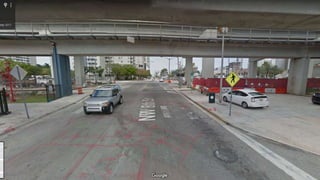
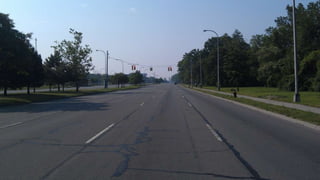
  • #54 -Even when we do try to include people in the design, we end up with this a lot of the time -This still isn’t very people friendly -This space looks unsafe, inconvenient, hot and uncomfortable, and completely uninteresting -That’s because it’s designed to be travelled through at spends of 40, 50 or 60 km per hour -People don’t move that fast
  • #55 -People move at this pace -Designing our streets and laneways for speeds of 2-4 is one of the best ways we can build healthy, prosperous communities
  • #56 -And the good thing that Miami has going for it is that there’s lots of opportunities at the edges of streets and public spaces -Use the edges of streets, sidewalks, entrances to build more people friendly spaces
  • #57 -Flexibility is another ingredient to keep in mind with your pilot projects -The more people can customize the space, the greater sense of ownership and connection they will have to it -Moveable furniture, such as seating, allows people to make the space their own, and adapt it to multiple uses.
  • #58 -So we’ve talked about some of the principals that we want you to keep in mind when developing some pilot projects for Overtown -Just want to highlight a couple of ideas for pilolts that other cities have undertaken
  • #59 -Folks from Macon came with us on a tour of Copenhagen -Really enjoyed the cycling infrastructure in that city and wanted to bring some of it back to Macon
  • #60 -Macon is not exactly a cycling friendly place -95% of people commute via car
  • #61 -So they created Macon Connects -Initiative to make cycling a more attractive option for residents and bring some of that Copenhagen culture to their city
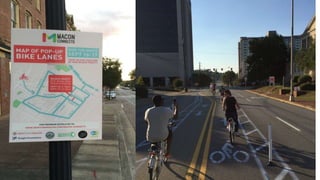
  • #62 -8 miles of pop up bike lanes connecting several neighborhoods and commercial districts -World’s largest pop-up bike lane
  • #63 -Tried out a variety of different layouts of bike lanes -Originally was supposed to last for two days -Mayor loved it so much, extended to a week
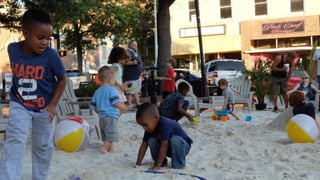
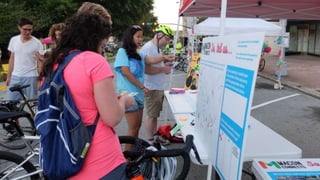
  • #64 -At the same time created neighborhood block parties in parks and plazas along the bike lanes
  • #65 -Those gave the opportunity to gather data about what people liked and didn’t like about the layouts of the lanes and other valuable info
  • #66 -The pilot really worked, proved the latent demand for cycling infrastructure -The City now has a staff member dedicated to planning and building their first separated bike lane network
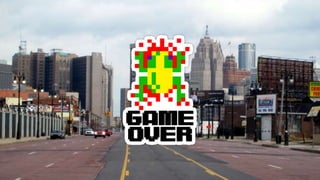
  • #67 -This is Michigan Avenue in Detroit -It’s nine lanes of traffic running through several low income neighborhoods -Crossing it felt like playing a game of Frogger
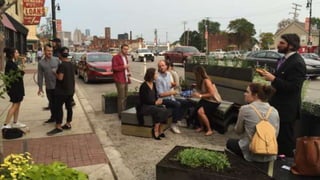
  • #68 -Someone we worked with through our Emerging City Champions program wanted to change that -No support from the City -So they took matters into their own hand and piloted a small parkette in the parking lane -Thousands of people would visit and enjoy in the days before the City removed it -Sad it couldn’t stay, but the City is now working with that individual and others on creating a parkette program that will be rolled out City wide
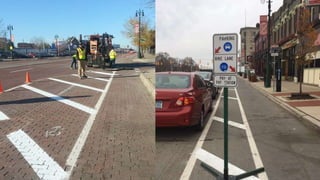
  • #69 -They’ve started adding bike lanes to Michigan Avenue in efforts to make it safer for vulnerable road users