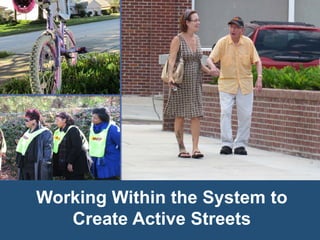
Working Within the System to 
Create Active Streets
“Walking Institute” America Walks Project for Public Spaces Walkable and Livable Communities Institute “Why Walking and Walkability? The Latest Info to Make the Case” “Core Principles of Walkable Places and Lessons Learned” “Creating Programs that Get People Walking” “Working within the System to Create Active Streets” “Talk with Walking/Walkability Experts” 3PM, Room 318 “Funding Community-Based Walkability Efforts” 4:15PM, Room 311
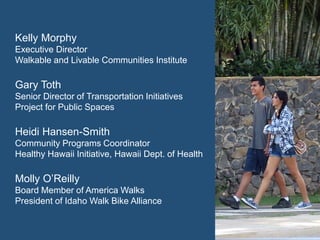
Kelly Morphy 
Executive Director 
Walkable and Livable Communities Institute 
Gary Toth 
Senior Director of Transportation Initiatives 
Project for Public Spaces 
Heidi Hansen-Smith 
Community Programs Coordinator 
Healthy Hawaii Initiative, Hawaii Dept. of Health 
Molly O’Reilly 
Board Member of America Walks 
President of Idaho Walk Bike Alliance
PROJECT FOR PUBLIC SPACES 
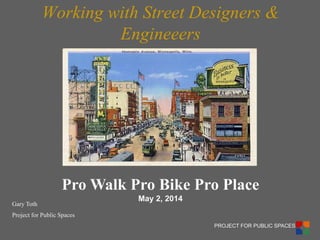
Working with Street Designers & Engineeers 
Gary Toth 
Project for Public Spaces 
Pro Walk Pro Bike Pro Place 
May 2, 2014
PROJECT FOR PUBLIC SPACES 
2 
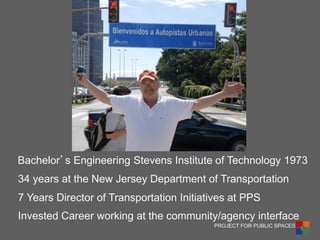
34 years at the New Jersey Department of Transportation 
7 Years Director of Transportation Initiatives at PPS 
Invested Career working at the community/agency interface 
Bachelor’s Engineering Stevens Institute of Technology 1973
PROJECT FOR PUBLIC SPACES 
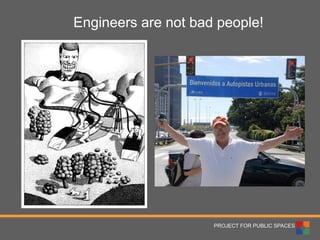
Engineers are not bad people!
PROJECT FOR PUBLIC SPACES 
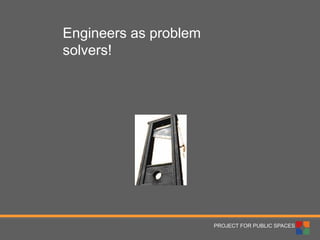
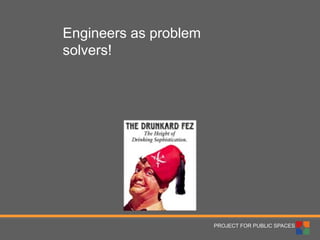
Engineers as problem solvers!
PROJECT FOR PUBLIC SPACES 
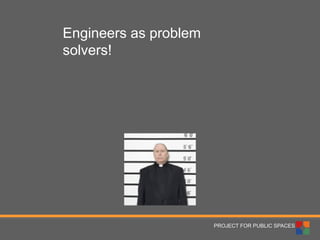
Engineers as problem solvers!
PROJECT FOR PUBLIC SPACES 
Engineers as problem solvers!
Engineers as problem solvers! 
PROJECT FOR PUBLIC SPACES
PROJECT FOR PUBLIC SPACES 
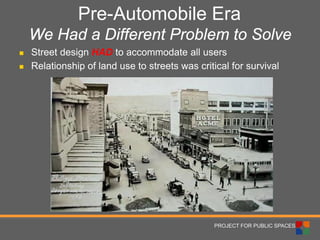
Pre-Automobile Era We Had a Different Problem to Solve 
 
Street design HAD to accommodate all users 
 
Relationship of land use to streets was critical for survival
PROJECT FOR PUBLIC SPACES 
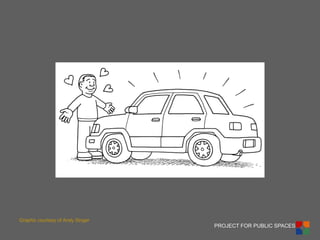
Graphic courtesy of Andy Singer
PROJECT FOR PUBLIC SPACES 
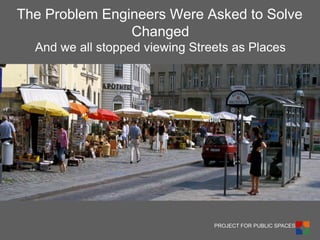
The Problem Engineers Were Asked to Solve Changed And we all stopped viewing Streets as Places
PROJECT FOR PUBLIC SPACES 
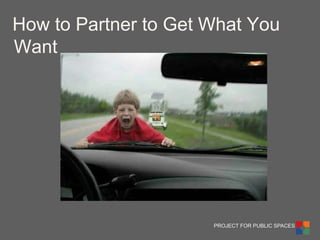
How to Partner to Get What You Want
PROJECT FOR PUBLIC SPACES 
How to Partner
PROJECT FOR PUBLIC SPACES 
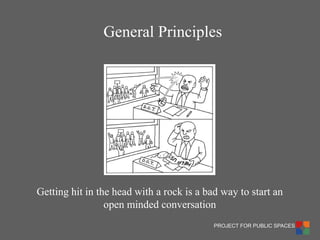
Getting hit in the head with a rock is a bad way to start an open minded conversation 
General Principles
PROJECT FOR PUBLIC SPACES 
Don’t be afraid to escalate 
If Respectful Communication Doesn’t Get You What You Want 
General Principles
PROJECT FOR PUBLIC SPACES 
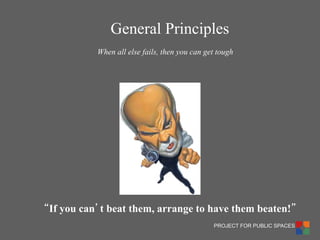
“If you can’t beat them, arrange to have them beaten!” 
When all else fails, then you can get tough 
General Principles
PROJECT FOR PUBLIC SPACES 
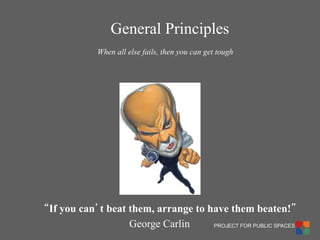
“If you can’t beat them, arrange to have them beaten!” 
George Carlin 
When all else fails, then you can get tough 
General Principles
PROJECT FOR PUBLIC SPACES 
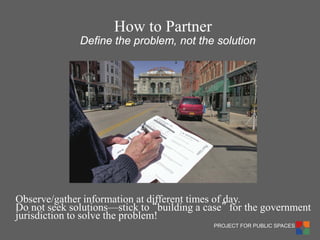
Observe/gather information at different times of day. 
Do not seek solutions—stick to “building a case” for the government jurisdiction to solve the problem! 
Define the problem, not the solution 
How to Partner
PROJECT FOR PUBLIC SPACES 
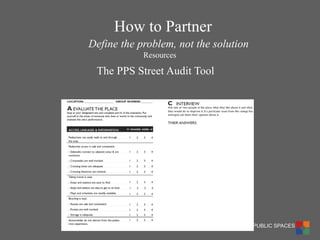
The PPS Street Audit Tool 
Define the problem, not the solution 
Resources 
How to Partner
PROJECT FOR PUBLIC SPACES 
Do Your Homework 
How to Partner
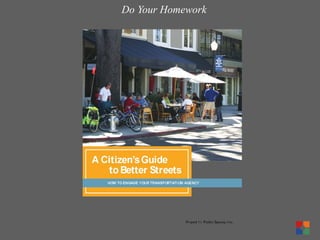
Do Your Homework
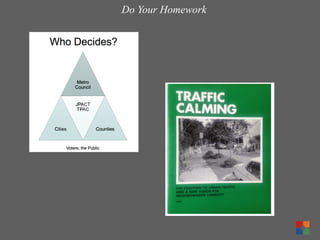
Do Your Homework
PROJECT FOR PUBLIC SPACES 
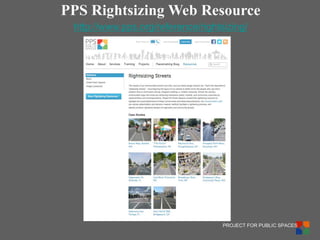
PPS Rightsizing Web Resource 
http://www.pps.org/reference/rightsizing/
PROJECT FOR PUBLIC SPACES 
Asking the Right Questions regarding Roadway Design Flexibility
PROJECT FOR PUBLIC SPACES 
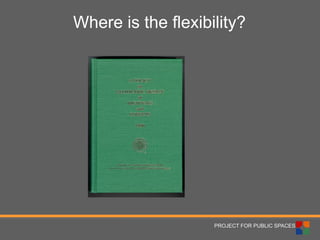
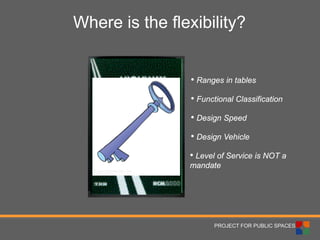
Where is the flexibility?
PROJECT FOR PUBLIC SPACES 
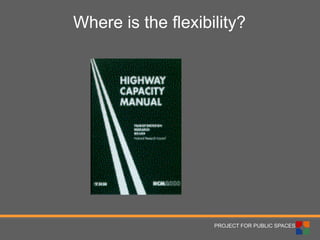
Where is the flexibility?
PROJECT FOR PUBLIC SPACES 
Where is the flexibility? 
• 
Functional Classification 
• 
Design Vehicle 
• 
Design Speed 
• 
Ranges in tables 
• 
Level of Service is NOT a mandate
PROJECT FOR PUBLIC SPACES 
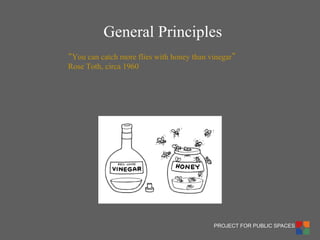
“You can catch more flies with honey than vinegar” Rose Toth, circa 1960 
General Principles
Gary Toth 
David Nelson 
212-620-5660 
Gtoth@pps.org
Working Within the System to Create Active Streets Pro Walk/Pro Bike/Pro Place Pittsburg, PA 2014
Hawaii State Department of Health Chronic Disease Prevention & Health Promotion Division Healthy Hawaii Initiative
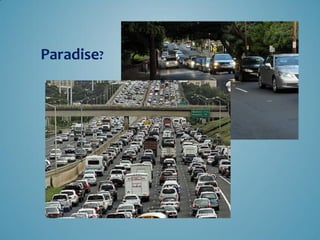
Paradise?
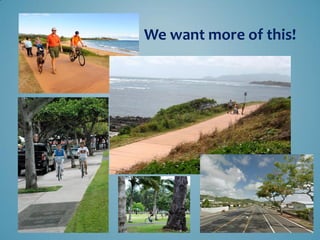
We want more of this!
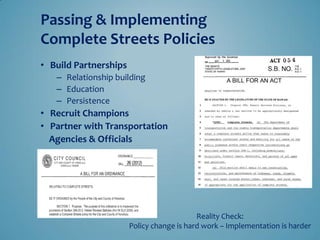
•Build Partnerships 
–Relationship building 
–Education 
–Persistence 
•Recruit Champions 
•Partner with Transportation 
Agencies & Officials 
Passing & Implementing Complete Streets Policies 
Reality Check: Policy change is hard work – Implementation is harder
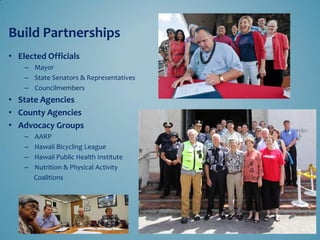
Build Partnerships 
• Elected Officials 
– Mayor 
– State Senators & Representatives 
– Councilmembers 
• State Agencies 
• County Agencies 
• Advocacy Groups 
– AARP 
– Hawaii Bicycling League 
– Hawaii Public Health Institute 
– Nutrition & Physical Activity 
Coalitions
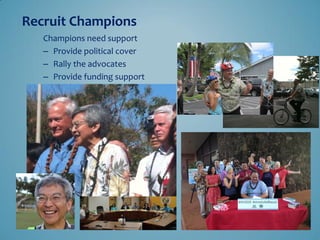
Champions need support 
–Provide political cover 
–Rally the advocates 
–Provide funding support 
Recruit Champions
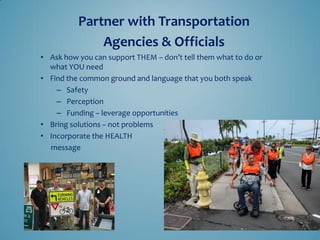
•Ask how you can support THEM – don’t tell them what to do or what YOU need 
•Find the common ground and language that you both speak 
–Safety 
–Perception 
–Funding – leverage opportunities 
•Bring solutions – not problems 
•Incorporate the HEALTH 
message 
Partner with Transportation 
Agencies & Officials
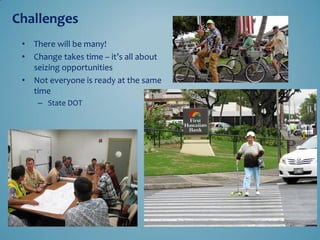
Challenges 
•There will be many! 
•Change takes time – it’s all about seizing opportunities 
•Not everyone is ready at the same time 
–State DOT
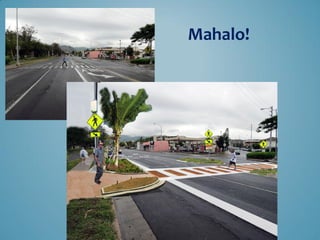
Mahalo!
Stopping a Proposed Freeway 
A Grassroots Victory -- 
Portland, OR 1989-1995
How We Won 
• 
Persistence! 
• 
Organize/Strategize 
• 
Build support widely 
• 
Analyze independently 
• 
Offer better alternatives 
• 
Find and support allies within the system; Find the ones who can say “YES”
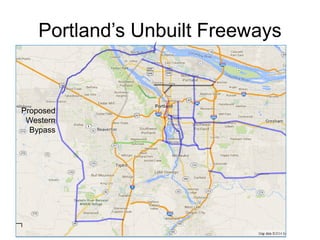
Portland’s Unbuilt Freeways 
Proposed Western Bypass
The Early Days 
• 
Good Luck: Premature Press Coverage 
• 
One Thousand Friends of Oregon 
– 
Connected those concerned 
– 
Ultimately a crucial ally 
• 
Organized from the first meeting 
– 
Chose a name: STOP – Sensible Transportation Options for People 
– 
Divided tasks 
– 
Coordinated regularly
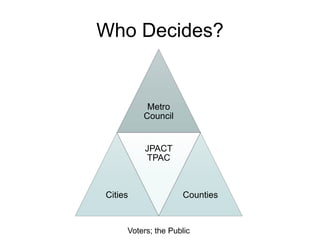
Who Decides? 
Metro Council 
Cities 
JPACT TPAC 
Counties 
Voters; the Public
We Deemed Important: 
• 
Independent Analysis 
– 
Reinterpreted study numbers to show project not needed, effective 
– 
Published and cited 
• 
Grassroots activation and education 
– 
Countless community meetings along alignment 
– 
Built membership ~500, newsletter list of 2,500 
– 
“If Freeways Were the Answer, Los Angeles Would be Paradise”
We Deemed Important, 2 
• 
Offering alternatives 
– 
People felt they couldn’t be “nimby” without an alternative (or two) 
– 
A new paradigm
Eight Myths of Traditional Traffic Planning 
Myth 1: Traffic projections are important in deciding what roads are needed. Myth 2: Planners are not responsible for how much people want to use their cars. Myth 3: Predicted traffic growth must be provided for. Myth 4: Bigger roads are safer roads. Myth 5: Bigger roads increase people’s mobility. Myth 6: Bigger roads advantage more people than they disadvantage. Myth 7: It is not the job of traffic planners to look at wider social, political and environmental trends. Myth 8: Planning should be left to the experts.
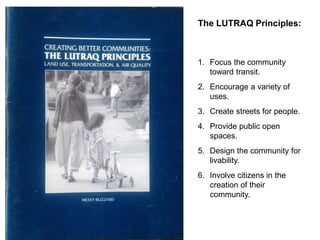
The LUTRAQ Principles: 
1. 
Focus the community toward transit. 
2. 
Encourage a variety of uses. 
3. 
Create streets for people. 
4. 
Provide public open spaces. 
5. 
Design the community for livability. 
6. 
Involve citizens in the creation of their community.
Our Work: 
• 
Working from the inside 
– 
Members of ODOT’s Citizen Advisory Committee 
– 
I served on Metro’s Transportation Policy Alternatives Committee (TPAC) 
– 
I became president of my Neighborhood Assn. to oppose from that platform 
– 
Others did similarly
Our Work 
• 
Swaying decision makers 
– 
Educating!! 
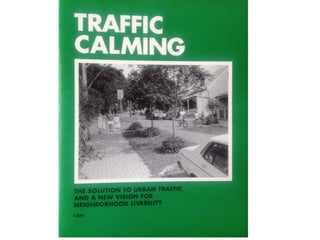
Copies of Traffic Calming 
Sharing news of developing LUTRAQ study 
– 
Attending hearings 
Large crowds, well identified 
– 
Behind the scenes
An Enduring Victory 
• 
Light rail has been extended throughout the Portland Metro region 
• 
Metro now takes walking and bicycling seriously 
• 
Portland’s newest bridge has no automobiles! 
• 
Smart Growth organizations are now serious players in transportation
Lessons Learned 
• 
Persistence! 
• 
Organize/Strategize 
• 
Build wide support 
• 
Analyze independently 
• 
Offer better alternatives 
• 
Find and support allies within the system; Win the ones who can say “YES”

Working within the System to Create Active Streets

  • 1.
    Working Within theSystem to Create Active Streets
  • 2.
    “Walking Institute” AmericaWalks Project for Public Spaces Walkable and Livable Communities Institute “Why Walking and Walkability? The Latest Info to Make the Case” “Core Principles of Walkable Places and Lessons Learned” “Creating Programs that Get People Walking” “Working within the System to Create Active Streets” “Talk with Walking/Walkability Experts” 3PM, Room 318 “Funding Community-Based Walkability Efforts” 4:15PM, Room 311
  • 3.
    Kelly Morphy ExecutiveDirector Walkable and Livable Communities Institute Gary Toth Senior Director of Transportation Initiatives Project for Public Spaces Heidi Hansen-Smith Community Programs Coordinator Healthy Hawaii Initiative, Hawaii Dept. of Health Molly O’Reilly Board Member of America Walks President of Idaho Walk Bike Alliance
  • 4.
    PROJECT FOR PUBLICSPACES Working with Street Designers & Engineeers Gary Toth Project for Public Spaces Pro Walk Pro Bike Pro Place May 2, 2014
  • 5.
    PROJECT FOR PUBLICSPACES 2 34 years at the New Jersey Department of Transportation 7 Years Director of Transportation Initiatives at PPS Invested Career working at the community/agency interface Bachelor’s Engineering Stevens Institute of Technology 1973
  • 6.
    PROJECT FOR PUBLICSPACES Engineers are not bad people!
  • 7.
    PROJECT FOR PUBLICSPACES Engineers as problem solvers!
  • 8.
    PROJECT FOR PUBLICSPACES Engineers as problem solvers!
  • 9.
    PROJECT FOR PUBLICSPACES Engineers as problem solvers!
  • 10.
    Engineers as problemsolvers! PROJECT FOR PUBLIC SPACES
  • 11.
    PROJECT FOR PUBLICSPACES Pre-Automobile Era We Had a Different Problem to Solve  Street design HAD to accommodate all users  Relationship of land use to streets was critical for survival
  • 12.
    PROJECT FOR PUBLICSPACES Graphic courtesy of Andy Singer
  • 13.
    PROJECT FOR PUBLICSPACES The Problem Engineers Were Asked to Solve Changed And we all stopped viewing Streets as Places
  • 14.
    PROJECT FOR PUBLICSPACES How to Partner to Get What You Want
  • 15.
    PROJECT FOR PUBLICSPACES How to Partner
  • 16.
    PROJECT FOR PUBLICSPACES Getting hit in the head with a rock is a bad way to start an open minded conversation General Principles
  • 17.
    PROJECT FOR PUBLICSPACES Don’t be afraid to escalate If Respectful Communication Doesn’t Get You What You Want General Principles
  • 18.
    PROJECT FOR PUBLICSPACES “If you can’t beat them, arrange to have them beaten!” When all else fails, then you can get tough General Principles
  • 19.
    PROJECT FOR PUBLICSPACES “If you can’t beat them, arrange to have them beaten!” George Carlin When all else fails, then you can get tough General Principles
  • 20.
    PROJECT FOR PUBLICSPACES Observe/gather information at different times of day. Do not seek solutions—stick to “building a case” for the government jurisdiction to solve the problem! Define the problem, not the solution How to Partner
  • 21.
    PROJECT FOR PUBLICSPACES The PPS Street Audit Tool Define the problem, not the solution Resources How to Partner
  • 22.
    PROJECT FOR PUBLICSPACES Do Your Homework How to Partner
  • 23.
  • 24.
  • 25.
    PROJECT FOR PUBLICSPACES PPS Rightsizing Web Resource http://www.pps.org/reference/rightsizing/
  • 26.
    PROJECT FOR PUBLICSPACES Asking the Right Questions regarding Roadway Design Flexibility
  • 27.
    PROJECT FOR PUBLICSPACES Where is the flexibility?
  • 28.
    PROJECT FOR PUBLICSPACES Where is the flexibility?
  • 29.
    PROJECT FOR PUBLICSPACES Where is the flexibility? • Functional Classification • Design Vehicle • Design Speed • Ranges in tables • Level of Service is NOT a mandate
  • 30.
    PROJECT FOR PUBLICSPACES “You can catch more flies with honey than vinegar” Rose Toth, circa 1960 General Principles
  • 31.
    Gary Toth DavidNelson 212-620-5660 Gtoth@pps.org
  • 32.
    Working Within theSystem to Create Active Streets Pro Walk/Pro Bike/Pro Place Pittsburg, PA 2014
  • 33.
    Hawaii State Departmentof Health Chronic Disease Prevention & Health Promotion Division Healthy Hawaii Initiative
  • 34.
  • 35.
    We want moreof this!
  • 36.
    •Build Partnerships –Relationshipbuilding –Education –Persistence •Recruit Champions •Partner with Transportation Agencies & Officials Passing & Implementing Complete Streets Policies Reality Check: Policy change is hard work – Implementation is harder
  • 37.
    Build Partnerships •Elected Officials – Mayor – State Senators & Representatives – Councilmembers • State Agencies • County Agencies • Advocacy Groups – AARP – Hawaii Bicycling League – Hawaii Public Health Institute – Nutrition & Physical Activity Coalitions
  • 38.
    Champions need support –Provide political cover –Rally the advocates –Provide funding support Recruit Champions
  • 39.
    •Ask how youcan support THEM – don’t tell them what to do or what YOU need •Find the common ground and language that you both speak –Safety –Perception –Funding – leverage opportunities •Bring solutions – not problems •Incorporate the HEALTH message Partner with Transportation Agencies & Officials
  • 40.
    Challenges •There willbe many! •Change takes time – it’s all about seizing opportunities •Not everyone is ready at the same time –State DOT
  • 41.
  • 42.
    Stopping a ProposedFreeway A Grassroots Victory -- Portland, OR 1989-1995
  • 43.
    How We Won • Persistence! • Organize/Strategize • Build support widely • Analyze independently • Offer better alternatives • Find and support allies within the system; Find the ones who can say “YES”
  • 44.
    Portland’s Unbuilt Freeways Proposed Western Bypass
  • 45.
    The Early Days • Good Luck: Premature Press Coverage • One Thousand Friends of Oregon – Connected those concerned – Ultimately a crucial ally • Organized from the first meeting – Chose a name: STOP – Sensible Transportation Options for People – Divided tasks – Coordinated regularly
  • 46.
    Who Decides? MetroCouncil Cities JPACT TPAC Counties Voters; the Public
  • 47.
    We Deemed Important: • Independent Analysis – Reinterpreted study numbers to show project not needed, effective – Published and cited • Grassroots activation and education – Countless community meetings along alignment – Built membership ~500, newsletter list of 2,500 – “If Freeways Were the Answer, Los Angeles Would be Paradise”
  • 48.
    We Deemed Important,2 • Offering alternatives – People felt they couldn’t be “nimby” without an alternative (or two) – A new paradigm
  • 50.
    Eight Myths ofTraditional Traffic Planning Myth 1: Traffic projections are important in deciding what roads are needed. Myth 2: Planners are not responsible for how much people want to use their cars. Myth 3: Predicted traffic growth must be provided for. Myth 4: Bigger roads are safer roads. Myth 5: Bigger roads increase people’s mobility. Myth 6: Bigger roads advantage more people than they disadvantage. Myth 7: It is not the job of traffic planners to look at wider social, political and environmental trends. Myth 8: Planning should be left to the experts.
  • 51.
    The LUTRAQ Principles: 1. Focus the community toward transit. 2. Encourage a variety of uses. 3. Create streets for people. 4. Provide public open spaces. 5. Design the community for livability. 6. Involve citizens in the creation of their community.
  • 52.
    Our Work: • Working from the inside – Members of ODOT’s Citizen Advisory Committee – I served on Metro’s Transportation Policy Alternatives Committee (TPAC) – I became president of my Neighborhood Assn. to oppose from that platform – Others did similarly
  • 53.
    Our Work • Swaying decision makers – Educating!! Copies of Traffic Calming Sharing news of developing LUTRAQ study – Attending hearings Large crowds, well identified – Behind the scenes
  • 54.
    An Enduring Victory • Light rail has been extended throughout the Portland Metro region • Metro now takes walking and bicycling seriously • Portland’s newest bridge has no automobiles! • Smart Growth organizations are now serious players in transportation
  • 55.
    Lessons Learned • Persistence! • Organize/Strategize • Build wide support • Analyze independently • Offer better alternatives • Find and support allies within the system; Win the ones who can say “YES”