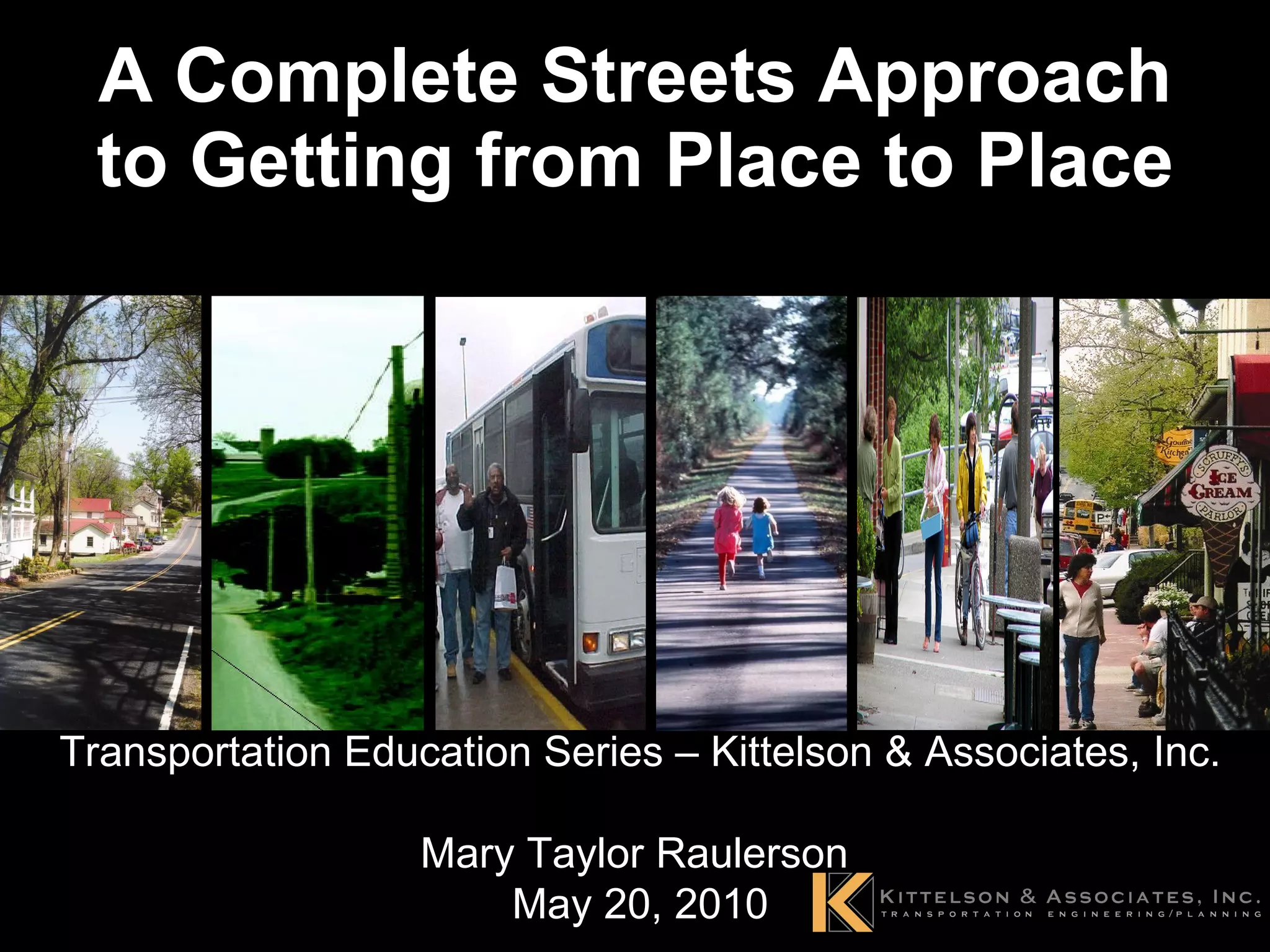
A Complete Streets Approach to Getting from Place to Place Transportation Education Series – Kittelson & Associates, Inc.  Mary Taylor Raulerson  May 20, 2010
What are  Complete Streets ?
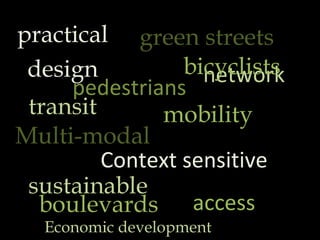
practicaldesign pedestrians Multi-modal Context sensitive green streets network mobility transit access boulevards Economic development sustainable bicyclists
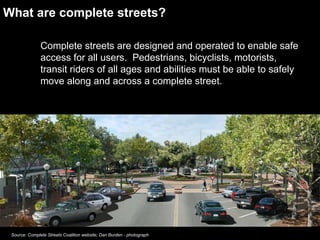
What are complete streets? Complete streets are designed and operated to enable safe access for all users.  Pedestrians, bicyclists, motorists, transit riders of all ages and abilities must be able to safely move along and across a complete street.  Source: Complete Streets Coalition website; Dan Burden - photograph
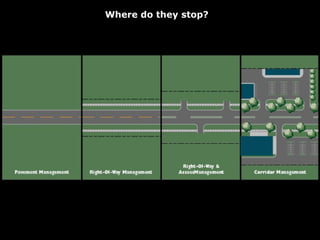
Where do they stop?
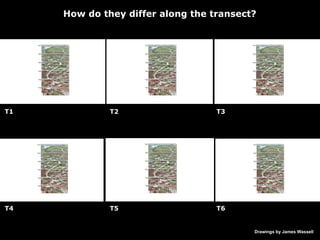
How do they differ along the transect? Drawings by James Wassell T1 T2 T3 T4 T5 T6
What is the  role  of the street?
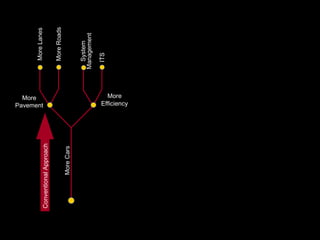
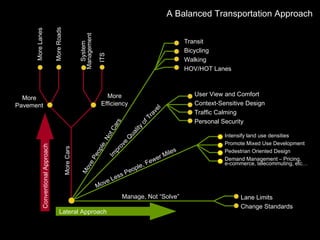
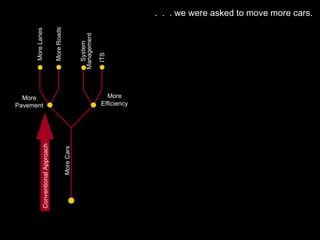
Conventional Approach More Efficiency System Management More Pavement More Lanes More Roads ITS More Cars
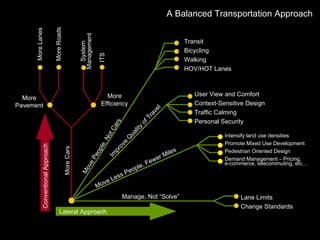
A Balanced Transportation Approach Lateral Approach Move Less People, Fewer Miles Intensify land use densities Promote Mixed Use Development Pedestrian Oriented Design Demand Management – Pricing,  e-commerce, telecommuting, etc… Conventional Approach More Efficiency System Management More Pavement More Lanes More Roads ITS More Cars Improve Quality of Travel User View and Comfort Context-Sensitive Design Traffic Calming Personal Security Lane Limits Change Standards Manage, Not “Solve” Transit Bicycling Walking HOV/HOT Lanes Move People, Not Cars
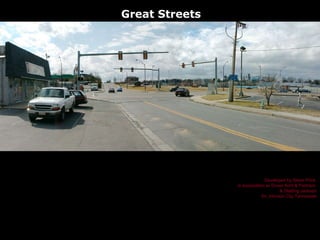
Great Streets Developed by Steve Price  in association w/ Dover Kohl & Partners  & Glatting Jackson for Johnson City Tennessee
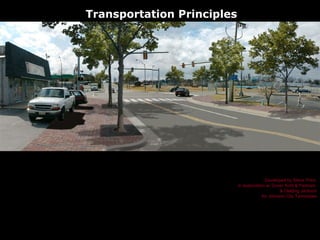
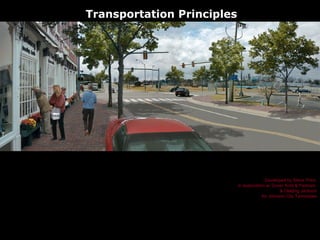
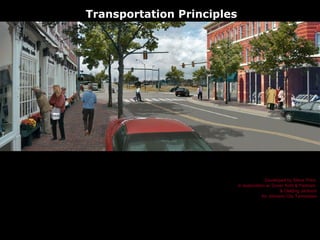
Developed by Steve Price  in association w/ Dover Kohl & Partners  & Glatting Jackson for Johnson City Tennessee Transportation Principles
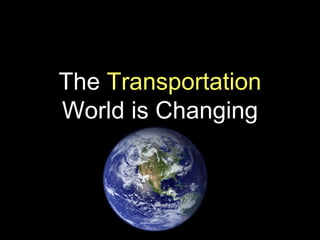
The  Transportation   World is Changing
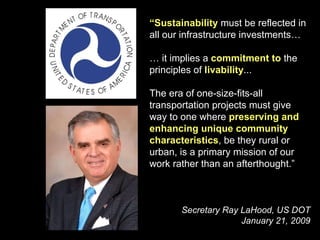
“ Sustainability  must be reflected in all our infrastructure investments…  …  it implies a  commitment to  the principles of  livability ...  The era of one-size-fits-all transportation projects must give way to one where  preserving and enhancing unique community characteristics , be they rural or urban, is a primary mission of our work rather than an afterthought.” Secretary Ray LaHood, US DOT January 21, 2009
Enhance integrated planning and investment.  integrate housing, transportation, water infrastructure, and land use planning and investment.  Redefine housing affordability.  Develop housing affordability measures that include housing and transportation costs.  Redevelop underutilized sites.  Target development to locations with infrastructure and transportation choices.  Develop livability measures and tools.  Align HUD, DOT, and EPA programs.  Partnership on Livability Source: EPA website (http://www.epa.gov/dced/2009-0616-epahuddot.htm)
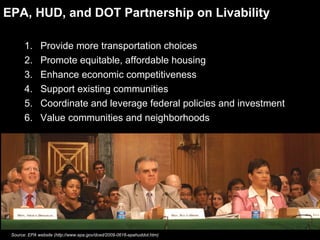
EPA, HUD, and DOT Partnership on Livability Provide more transportation choices Promote equitable, affordable housing Enhance economic competitiveness Support existing communities Coordinate and leverage federal policies and investment Value communities and neighborhoods Source: EPA website (http://www.epa.gov/dced/2009-0616-epahuddot.htm)
What is  Livability ?
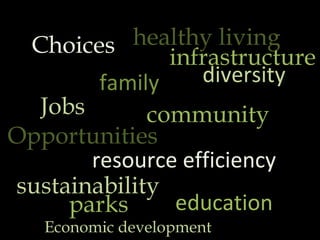
Choices family Opportunities resource efficiency healthy living diversity community Jobs education parks Economic development sustainability infrastructure
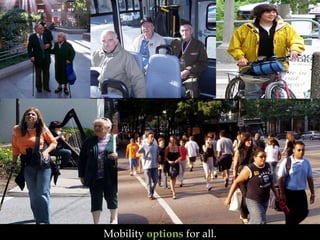
Mobility  options  for all.
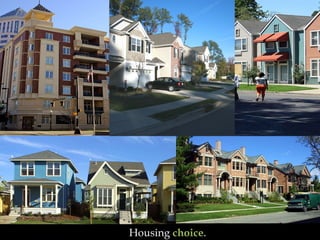
Housing  choice .
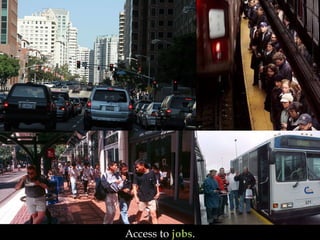
Access to  jobs .
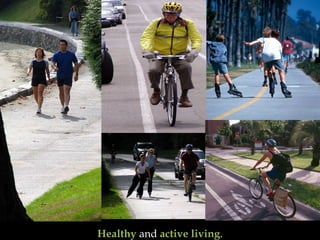
Healthy  and  active living .
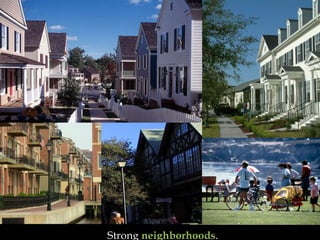
Strong  neighborhoods .
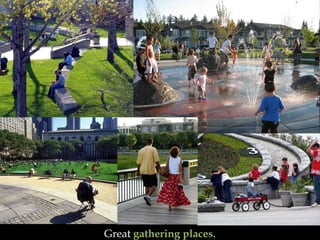
Great  gathering places .
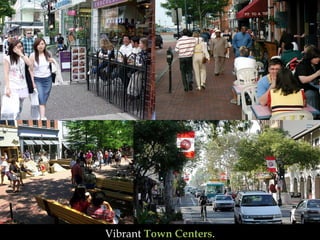
Vibrant  Town Centers .
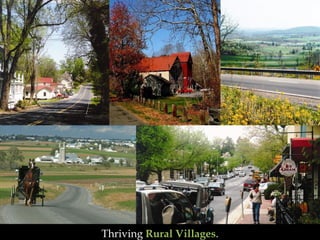
Thriving  Rural Villages .
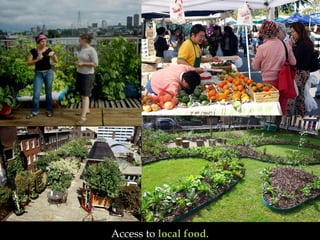
Access to  local food .
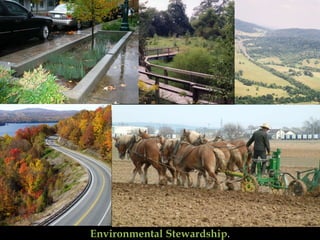
Environmental Stewardship .
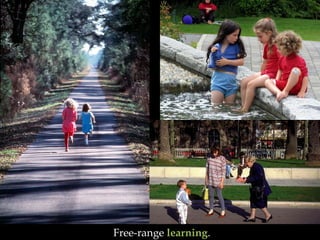
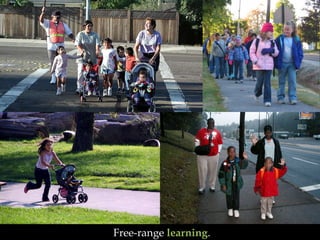
Free-range  learning .
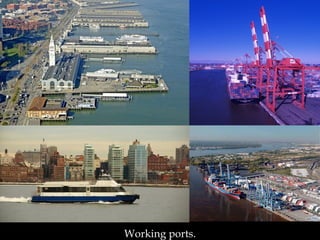
Working ports.
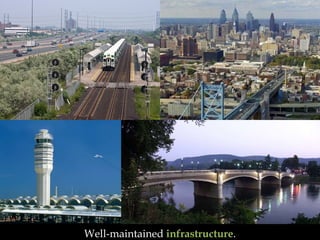
Well-maintained  infrastructure .
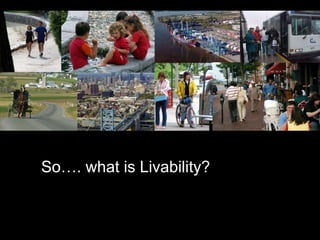
So…. what is Livability?
Conventional Approach More Efficiency System Management More Pavement More Lanes More Roads ITS More Cars .  .  . we were asked to move more cars.
A Balanced Transportation Approach Lateral Approach Move Less People, Fewer Miles Intensify land use densities Promote Mixed Use Development Pedestrian Oriented Design Demand Management – Pricing,  e-commerce, telecommuting, etc… Conventional Approach More Efficiency System Management More Pavement More Lanes More Roads ITS More Cars Improve Quality of Travel User View and Comfort Context-Sensitive Design Traffic Calming Personal Security Lane Limits Change Standards Manage, Not “Solve” Transit Bicycling Walking HOV/HOT Lanes Move People, Not Cars
 
Transportation agencies and/or their partners do not have a clear or unified vision of what they want (Visioning) Established project development processes and organizational structures may limit transportation projects from achieving today’s livability goals (Planning and Process) Transportation policies may not support livability goals and objectives (Policy) Difficult decisions and livable projects require long-term and trusting partnerships (Partnership) Delivering livability at the project level requires new design approaches (Design) Challenges to implementing livable transportation projects
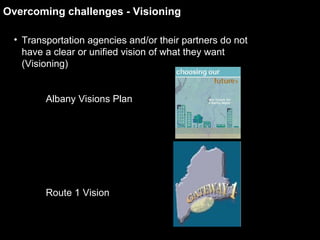
Transportation agencies and/or their partners do not have a clear or unified vision of what they want (Visioning) Albany Visions Plan Route 1 Vision  Overcoming challenges - Visioning
Albany Visions Plan Regional-level visioning Attract growth by leveraging investments Aligned LRTP with a broad set of community-responsive project types Emphasized a broad range of modes and community needs in project definition and programming
Albany Visions Plan Developed 25 guiding principles that: Plan and build for all modes of transportation Preserve and manage the existing investments Develop the region’s potential to grow into a “uniquely attractive, vibrant and diverse metropolitan area” Link land use and transportation planning Linkage forum – mandatory regional roundtable of municipal planners  to address regional planning issues at the local level (state has no oversight or approval functions for local plans) Match project choice processes to vision
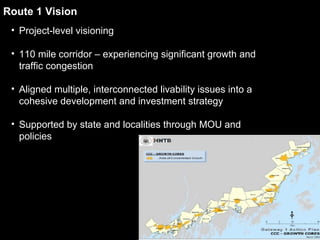
Route 1 Vision Project-level visioning 110 mile corridor – experiencing significant growth and traffic congestion Aligned multiple, interconnected livability issues into a cohesive development and investment strategy Supported by state and localities through MOU and policies
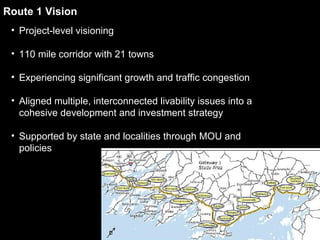
Route 1 Vision Project-level visioning 110 mile corridor with 21 towns Experiencing significant growth and traffic congestion Aligned multiple, interconnected livability issues into a cohesive development and investment strategy Supported by state and localities through MOU and policies
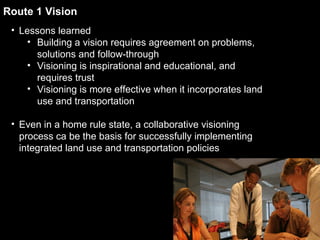
Route 1 Vision Lessons learned Building a vision requires agreement on problems, solutions and follow-through Visioning is inspirational and educational, and requires trust Visioning is more effective when it incorporates land use and transportation Even in a home rule state, a collaborative visioning process ca be the basis for successfully implementing integrated land use and transportation policies
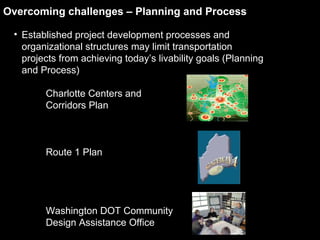
Established project development processes and organizational structures may limit transportation projects from achieving today’s livability goals (Planning and Process) Charlotte Centers and  Corridors Plan Route 1 Plan  Washington DOT Community Design Assistance Office Overcoming challenges – Planning and Process
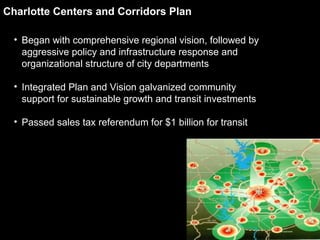
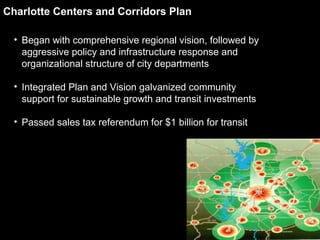
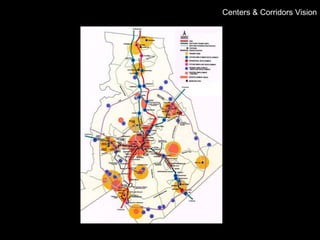
Charlotte Centers and Corridors Plan Began with comprehensive regional vision, followed by aggressive policy and infrastructure response and organizational structure of city departments Integrated Plan and Vision galvanized community support for sustainable growth and transit investments Passed sales tax referendum for $1 billion for transit
 
Centers & Corridors Vision
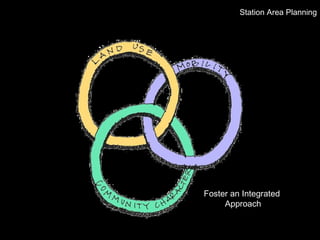
Foster an Integrated  Approach Station Area Planning
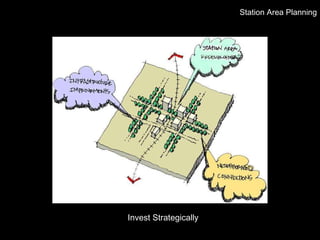
Invest Strategically Station Area Planning
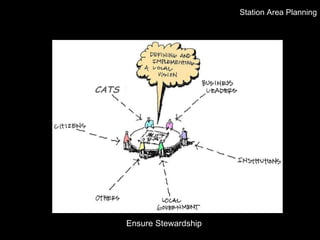
Ensure Stewardship CATS Station Area Planning
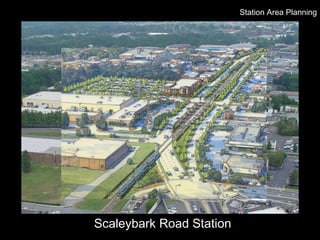
Scaleybark Road Station Station Area Planning
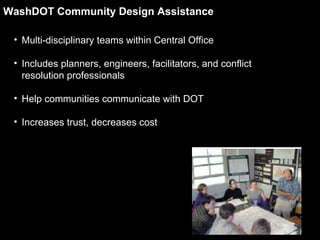
WashDOT Community Design Assistance Multi-disciplinary teams within Central Office Includes planners, engineers, facilitators, and conflict resolution professionals Help communities communicate with DOT Increases trust, decreases cost
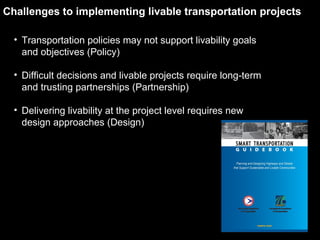
Transportation policies may not support livability goals and objectives (Policy) Difficult decisions and livable projects require long-term and trusting partnerships (Partnership) Delivering livability at the project level requires new design approaches (Design) Challenges to implementing livable transportation projects
Money counts Leverage and preserve existing investments Choose projects with high value/price ratio Safety always and maybe safety only Look beyond level-of-service Accommodate all modes of travel Enhance local network Build towns not sprawl Understand the context; plan and design within the context Develop local governments as strong land use partners Policy, design and partnerships
 
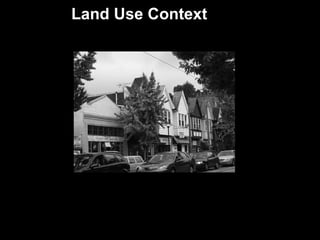
Land Use Context   +  Roadway Type Land Use Context
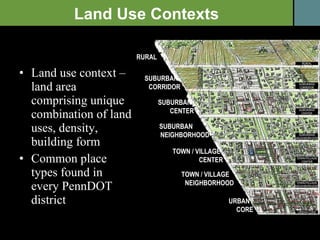
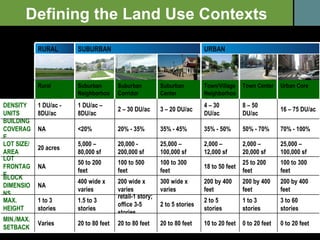
Land use context – land area comprising unique combination of land uses, density, building form Common place types found in every PennDOT district RURAL SUBURBAN   CORRIDOR TOWN / VILLAGE    CENTER TOWN / VILLAGE   NEIGHBORHOOD URBAN    CORE SUBURBAN   CENTER SUBURBAN   NEIGHBORHOOD Land Use Contexts
Defining the Land Use Contexts RURAL SUBURBAN URBAN Rural Suburban Neighborhood Suburban Corridor Suburban Center Town/Village Neighborhood Town Center Urban Core DENSITY UNITS 1 DU/ac - 8DU/ac 1 DU/ac – 8DU/ac 2 – 30 DU/ac 3 – 20 DU/ac 4 – 30 DU/ac 8 – 50 DU/ac 16 – 75 DU/ac BUILDING COVERAGE NA <20% 20% - 35%  35% - 45% 35% - 50% 50% - 70% 70% - 100% LOT SIZE/AREA 20 acres 5,000 – 80,000 sf 20,000 - 200,000 sf 25,000 – 100,000 sf 2,000 – 12,000 sf 2,000 – 20,000 sf 25,000 – 100,000 sf LOT FRONTAGE NA 50 to 200 feet 100 to 500 feet 100 to 300 feet 18 to 50 feet 25 to 200 feet  100 to 300 feet BLOCK DIMENSIONS NA 400 wide x varies 200 wide x varies 300 wide x varies 200 by 400 feet 200 by 400 feet 200 by 400 feet MAX. HEIGHT 1 to 3 stories 1.5 to 3 stories retail-1 story;  office 3-5 stories 2 to 5 stories 2 to 5 stories 1 to 3 stories 3 to 60 stories MIN./MAX. SETBACK Varies 20 to 80 feet 20 to 80 feet 20 to 80 feet 10 to 20 feet 0 to 20 feet 0 to 20 feet
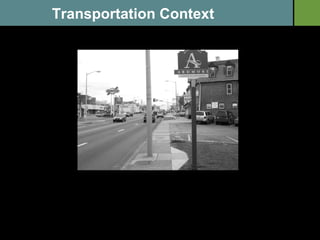
Land Use Context  +  Roadway Type Transportation Context
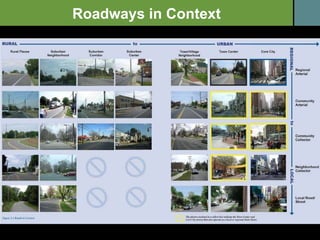
Roadways in Context
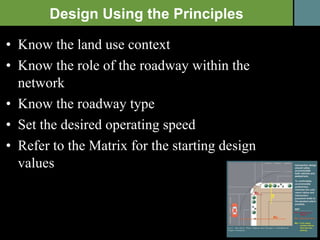
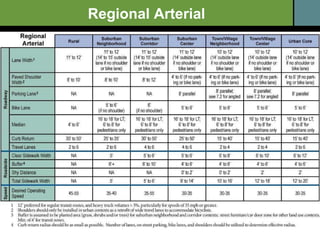
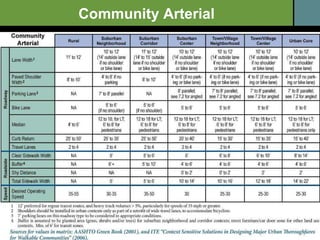
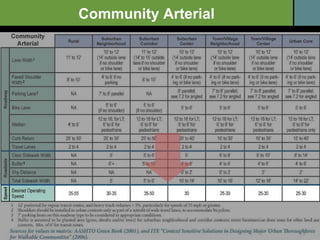
Know the land use context Know the role of the roadway within the network Know the roadway type Set the desired operating speed Refer to the Matrix for the starting design values Design Using the Principles
Regional Arterial
Community Arterial
Community Arterial
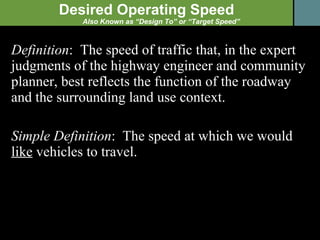
Definition :  The speed of traffic that, in the expert judgments of the highway engineer and community planner, best reflects the function of the roadway and the surrounding land use context. Simple Definition :  The speed at which we would  like  vehicles to travel. Desired Operating Speed Also Known as “Design To” or “Target Speed”
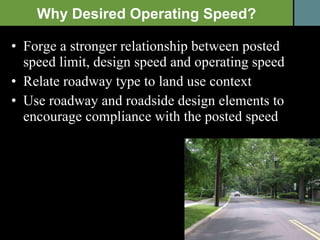
Forge a stronger relationship between posted speed limit, design speed and operating speed Relate roadway type to land use context  Use roadway and roadside design elements to encourage compliance with the posted speed Why Desired Operating Speed?
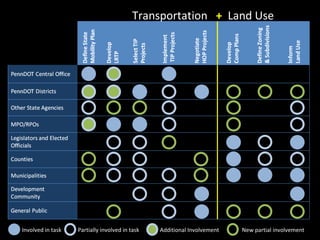
Transportation   +  Land Use Involved in task Partially involved in task Additional Involvement New partial involvement
 
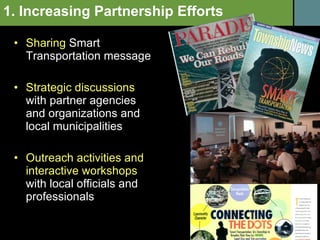
Sharing  Smart Transportation message Strategic discussions  with partner agencies and organizations and local municipalities Outreach activities and interactive workshops  with local officials and professionals 1. Increasing Partnership Efforts
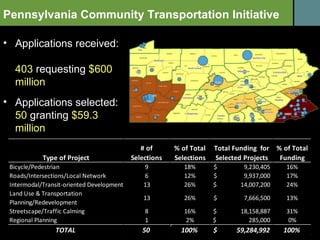
Pennsylvania Community Transportation Initiative All photographs and images from PennDOT, Glatting Jackson Kercher Anglin, or public domain, unless otherwise noted. Applications received:  403  requesting  $600 million Applications selected:  50  granting  $59.3 million
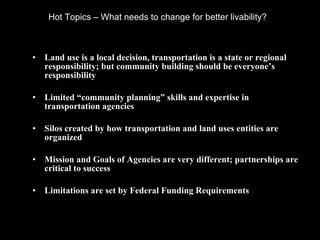
Hot Topics – What needs to change for better livability?  Land use is a local decision, transportation is a state or regional responsibility; but community building should be everyone’s responsibility Limited “community planning” skills and expertise in transportation agencies Silos created by how transportation and land uses entities are organized Mission and Goals of Agencies are very different; partnerships are critical to success Limitations are set by Federal Funding Requirements
What are  complete streets  in your community?  What is  livability  to you?
 

Complete Streets workshop presentation

  • 1.
    A Complete StreetsApproach to Getting from Place to Place Transportation Education Series – Kittelson & Associates, Inc. Mary Taylor Raulerson May 20, 2010
  • 2.
    What are Complete Streets ?
  • 3.
    practicaldesign pedestrians Multi-modalContext sensitive green streets network mobility transit access boulevards Economic development sustainable bicyclists
  • 4.
    What are completestreets? Complete streets are designed and operated to enable safe access for all users. Pedestrians, bicyclists, motorists, transit riders of all ages and abilities must be able to safely move along and across a complete street. Source: Complete Streets Coalition website; Dan Burden - photograph
  • 5.
  • 6.
    How do theydiffer along the transect? Drawings by James Wassell T1 T2 T3 T4 T5 T6
  • 7.
    What is the role of the street?
  • 8.
    Conventional Approach MoreEfficiency System Management More Pavement More Lanes More Roads ITS More Cars
  • 9.
    A Balanced TransportationApproach Lateral Approach Move Less People, Fewer Miles Intensify land use densities Promote Mixed Use Development Pedestrian Oriented Design Demand Management – Pricing, e-commerce, telecommuting, etc… Conventional Approach More Efficiency System Management More Pavement More Lanes More Roads ITS More Cars Improve Quality of Travel User View and Comfort Context-Sensitive Design Traffic Calming Personal Security Lane Limits Change Standards Manage, Not “Solve” Transit Bicycling Walking HOV/HOT Lanes Move People, Not Cars
  • 10.
    Great Streets Developedby Steve Price in association w/ Dover Kohl & Partners & Glatting Jackson for Johnson City Tennessee
  • 11.
    Developed by StevePrice in association w/ Dover Kohl & Partners & Glatting Jackson for Johnson City Tennessee Transportation Principles
  • 12.
    Developed by StevePrice in association w/ Dover Kohl & Partners & Glatting Jackson for Johnson City Tennessee Transportation Principles
  • 13.
    Developed by StevePrice in association w/ Dover Kohl & Partners & Glatting Jackson for Johnson City Tennessee Transportation Principles
  • 14.
    The Transportation World is Changing
  • 15.
    “ Sustainability must be reflected in all our infrastructure investments… … it implies a commitment to the principles of livability ... The era of one-size-fits-all transportation projects must give way to one where preserving and enhancing unique community characteristics , be they rural or urban, is a primary mission of our work rather than an afterthought.” Secretary Ray LaHood, US DOT January 21, 2009
  • 16.
    Enhance integrated planningand investment. integrate housing, transportation, water infrastructure, and land use planning and investment. Redefine housing affordability. Develop housing affordability measures that include housing and transportation costs. Redevelop underutilized sites. Target development to locations with infrastructure and transportation choices. Develop livability measures and tools. Align HUD, DOT, and EPA programs. Partnership on Livability Source: EPA website (http://www.epa.gov/dced/2009-0616-epahuddot.htm)
  • 17.
    EPA, HUD, andDOT Partnership on Livability Provide more transportation choices Promote equitable, affordable housing Enhance economic competitiveness Support existing communities Coordinate and leverage federal policies and investment Value communities and neighborhoods Source: EPA website (http://www.epa.gov/dced/2009-0616-epahuddot.htm)
  • 18.
    What is Livability ?
  • 19.
    Choices family Opportunitiesresource efficiency healthy living diversity community Jobs education parks Economic development sustainability infrastructure
  • 20.
  • 21.
  • 22.
    Access to jobs .
  • 23.
    Healthy and active living .
  • 24.
  • 25.
  • 26.
    Vibrant TownCenters .
  • 27.
    Thriving RuralVillages .
  • 28.
    Access to local food .
  • 29.
  • 30.
  • 31.
  • 32.
  • 33.
  • 34.
    So…. what isLivability?
  • 35.
    Conventional Approach MoreEfficiency System Management More Pavement More Lanes More Roads ITS More Cars . . . we were asked to move more cars.
  • 36.
    A Balanced TransportationApproach Lateral Approach Move Less People, Fewer Miles Intensify land use densities Promote Mixed Use Development Pedestrian Oriented Design Demand Management – Pricing, e-commerce, telecommuting, etc… Conventional Approach More Efficiency System Management More Pavement More Lanes More Roads ITS More Cars Improve Quality of Travel User View and Comfort Context-Sensitive Design Traffic Calming Personal Security Lane Limits Change Standards Manage, Not “Solve” Transit Bicycling Walking HOV/HOT Lanes Move People, Not Cars
  • 37.
  • 38.
    Transportation agencies and/ortheir partners do not have a clear or unified vision of what they want (Visioning) Established project development processes and organizational structures may limit transportation projects from achieving today’s livability goals (Planning and Process) Transportation policies may not support livability goals and objectives (Policy) Difficult decisions and livable projects require long-term and trusting partnerships (Partnership) Delivering livability at the project level requires new design approaches (Design) Challenges to implementing livable transportation projects
  • 39.
    Transportation agencies and/ortheir partners do not have a clear or unified vision of what they want (Visioning) Albany Visions Plan Route 1 Vision Overcoming challenges - Visioning
  • 40.
    Albany Visions PlanRegional-level visioning Attract growth by leveraging investments Aligned LRTP with a broad set of community-responsive project types Emphasized a broad range of modes and community needs in project definition and programming
  • 41.
    Albany Visions PlanDeveloped 25 guiding principles that: Plan and build for all modes of transportation Preserve and manage the existing investments Develop the region’s potential to grow into a “uniquely attractive, vibrant and diverse metropolitan area” Link land use and transportation planning Linkage forum – mandatory regional roundtable of municipal planners to address regional planning issues at the local level (state has no oversight or approval functions for local plans) Match project choice processes to vision
  • 42.
    Route 1 VisionProject-level visioning 110 mile corridor – experiencing significant growth and traffic congestion Aligned multiple, interconnected livability issues into a cohesive development and investment strategy Supported by state and localities through MOU and policies
  • 43.
    Route 1 VisionProject-level visioning 110 mile corridor with 21 towns Experiencing significant growth and traffic congestion Aligned multiple, interconnected livability issues into a cohesive development and investment strategy Supported by state and localities through MOU and policies
  • 44.
    Route 1 VisionLessons learned Building a vision requires agreement on problems, solutions and follow-through Visioning is inspirational and educational, and requires trust Visioning is more effective when it incorporates land use and transportation Even in a home rule state, a collaborative visioning process ca be the basis for successfully implementing integrated land use and transportation policies
  • 45.
    Established project developmentprocesses and organizational structures may limit transportation projects from achieving today’s livability goals (Planning and Process) Charlotte Centers and Corridors Plan Route 1 Plan Washington DOT Community Design Assistance Office Overcoming challenges – Planning and Process
  • 46.
    Charlotte Centers andCorridors Plan Began with comprehensive regional vision, followed by aggressive policy and infrastructure response and organizational structure of city departments Integrated Plan and Vision galvanized community support for sustainable growth and transit investments Passed sales tax referendum for $1 billion for transit
  • 47.
    Charlotte Centers andCorridors Plan Began with comprehensive regional vision, followed by aggressive policy and infrastructure response and organizational structure of city departments Integrated Plan and Vision galvanized community support for sustainable growth and transit investments Passed sales tax referendum for $1 billion for transit
  • 48.
  • 49.
  • 50.
    Foster an Integrated Approach Station Area Planning
  • 51.
  • 52.
    Ensure Stewardship CATSStation Area Planning
  • 53.
    Scaleybark Road StationStation Area Planning
  • 54.
    WashDOT Community DesignAssistance Multi-disciplinary teams within Central Office Includes planners, engineers, facilitators, and conflict resolution professionals Help communities communicate with DOT Increases trust, decreases cost
  • 55.
    Transportation policies maynot support livability goals and objectives (Policy) Difficult decisions and livable projects require long-term and trusting partnerships (Partnership) Delivering livability at the project level requires new design approaches (Design) Challenges to implementing livable transportation projects
  • 56.
    Money counts Leverageand preserve existing investments Choose projects with high value/price ratio Safety always and maybe safety only Look beyond level-of-service Accommodate all modes of travel Enhance local network Build towns not sprawl Understand the context; plan and design within the context Develop local governments as strong land use partners Policy, design and partnerships
  • 57.
  • 58.
    Land Use Context + Roadway Type Land Use Context
  • 59.
    Land use context– land area comprising unique combination of land uses, density, building form Common place types found in every PennDOT district RURAL SUBURBAN CORRIDOR TOWN / VILLAGE CENTER TOWN / VILLAGE NEIGHBORHOOD URBAN CORE SUBURBAN CENTER SUBURBAN NEIGHBORHOOD Land Use Contexts
  • 60.
    Defining the LandUse Contexts RURAL SUBURBAN URBAN Rural Suburban Neighborhood Suburban Corridor Suburban Center Town/Village Neighborhood Town Center Urban Core DENSITY UNITS 1 DU/ac - 8DU/ac 1 DU/ac – 8DU/ac 2 – 30 DU/ac 3 – 20 DU/ac 4 – 30 DU/ac 8 – 50 DU/ac 16 – 75 DU/ac BUILDING COVERAGE NA <20% 20% - 35% 35% - 45% 35% - 50% 50% - 70% 70% - 100% LOT SIZE/AREA 20 acres 5,000 – 80,000 sf 20,000 - 200,000 sf 25,000 – 100,000 sf 2,000 – 12,000 sf 2,000 – 20,000 sf 25,000 – 100,000 sf LOT FRONTAGE NA 50 to 200 feet 100 to 500 feet 100 to 300 feet 18 to 50 feet 25 to 200 feet 100 to 300 feet BLOCK DIMENSIONS NA 400 wide x varies 200 wide x varies 300 wide x varies 200 by 400 feet 200 by 400 feet 200 by 400 feet MAX. HEIGHT 1 to 3 stories 1.5 to 3 stories retail-1 story; office 3-5 stories 2 to 5 stories 2 to 5 stories 1 to 3 stories 3 to 60 stories MIN./MAX. SETBACK Varies 20 to 80 feet 20 to 80 feet 20 to 80 feet 10 to 20 feet 0 to 20 feet 0 to 20 feet
  • 61.
    Land Use Context + Roadway Type Transportation Context
  • 62.
  • 63.
    Know the landuse context Know the role of the roadway within the network Know the roadway type Set the desired operating speed Refer to the Matrix for the starting design values Design Using the Principles
  • 64.
  • 65.
  • 66.
  • 67.
    Definition : The speed of traffic that, in the expert judgments of the highway engineer and community planner, best reflects the function of the roadway and the surrounding land use context. Simple Definition : The speed at which we would like vehicles to travel. Desired Operating Speed Also Known as “Design To” or “Target Speed”
  • 68.
    Forge a strongerrelationship between posted speed limit, design speed and operating speed Relate roadway type to land use context Use roadway and roadside design elements to encourage compliance with the posted speed Why Desired Operating Speed?
  • 69.
    Transportation + Land Use Involved in task Partially involved in task Additional Involvement New partial involvement
  • 70.
  • 71.
    Sharing SmartTransportation message Strategic discussions with partner agencies and organizations and local municipalities Outreach activities and interactive workshops with local officials and professionals 1. Increasing Partnership Efforts
  • 72.
    Pennsylvania Community TransportationInitiative All photographs and images from PennDOT, Glatting Jackson Kercher Anglin, or public domain, unless otherwise noted. Applications received: 403 requesting $600 million Applications selected: 50 granting $59.3 million
  • 73.
    Hot Topics –What needs to change for better livability? Land use is a local decision, transportation is a state or regional responsibility; but community building should be everyone’s responsibility Limited “community planning” skills and expertise in transportation agencies Silos created by how transportation and land uses entities are organized Mission and Goals of Agencies are very different; partnerships are critical to success Limitations are set by Federal Funding Requirements
  • 74.
    What are complete streets in your community? What is livability to you?
  • 75.