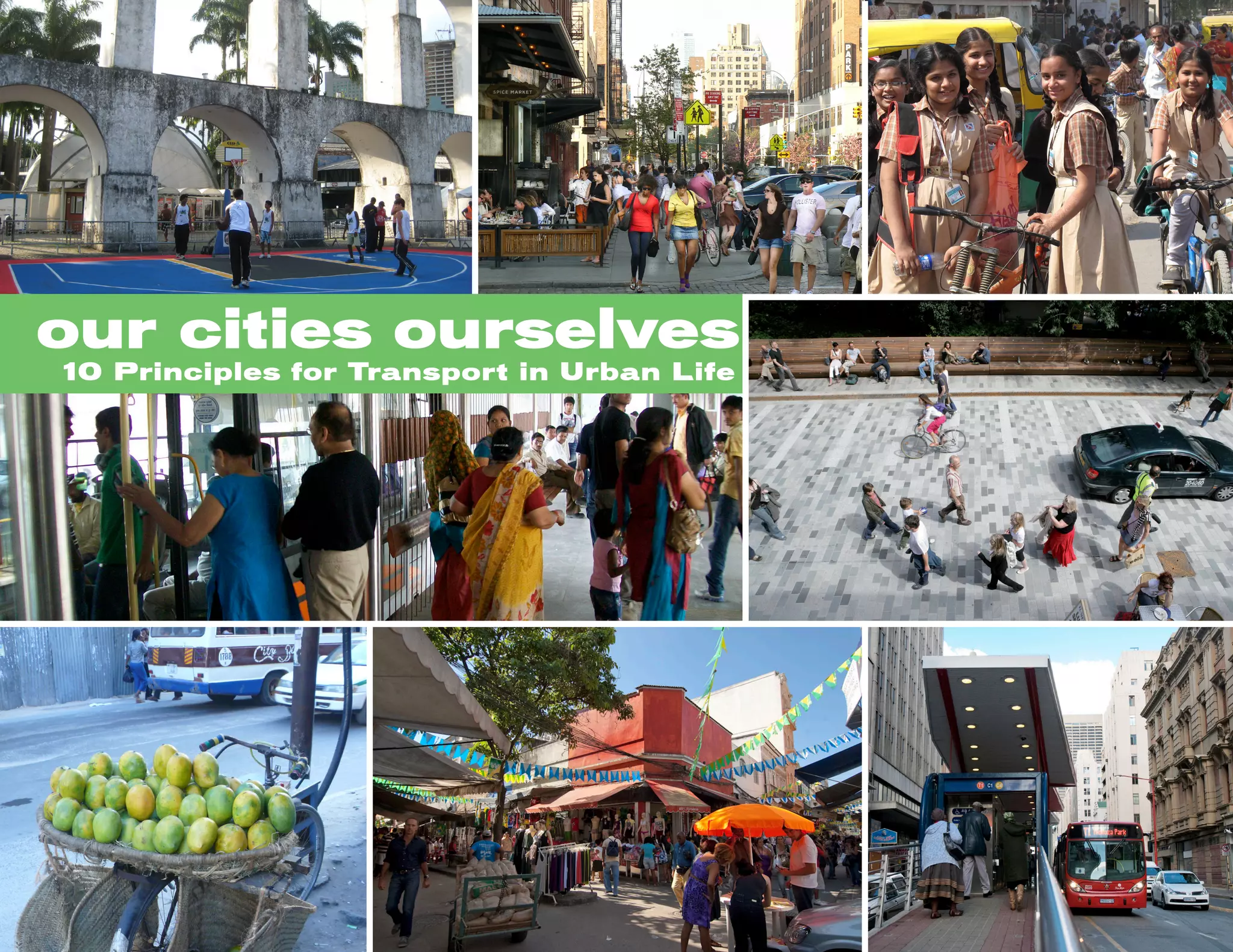
our cities ourselves
10 Principles for Transport in Urban Life
CREDITS


    Client, Co-Author                               Co-author                                Consultant:             Photo and statistic credits
    ITDP, Institute for Transportation &            Gehl Architects                          NelsonNygaard          ITDP, Gehl Architects and
    Development Policy                              -Urban Quality Consultants               consulting associates   NelsonNygaard
                                                                                                                     unless stated otherwise.
    Executive Director                              Director:                                Principal:
    Walter Hook                                     David Sim, Architect SAR/MSA             Michael King


    Global Policy Director and Founder              Project Leader:
    Michael Replogle                                Jeff Risom, MSc City Design and Social
                                                    Science
    Chief of Staff
    Aimée Gauthier                                  Project Team:
                                                    Ola Gustafsson, Architect MSA
    Technical Director, Urban Design                Henning Thomsen, Architect MAA, MBA
    Luc Nadal                                       Ewa Westermark,Architect SAR/MSA


2   Our Cities Ourselves · ITDP · Gehl Architects
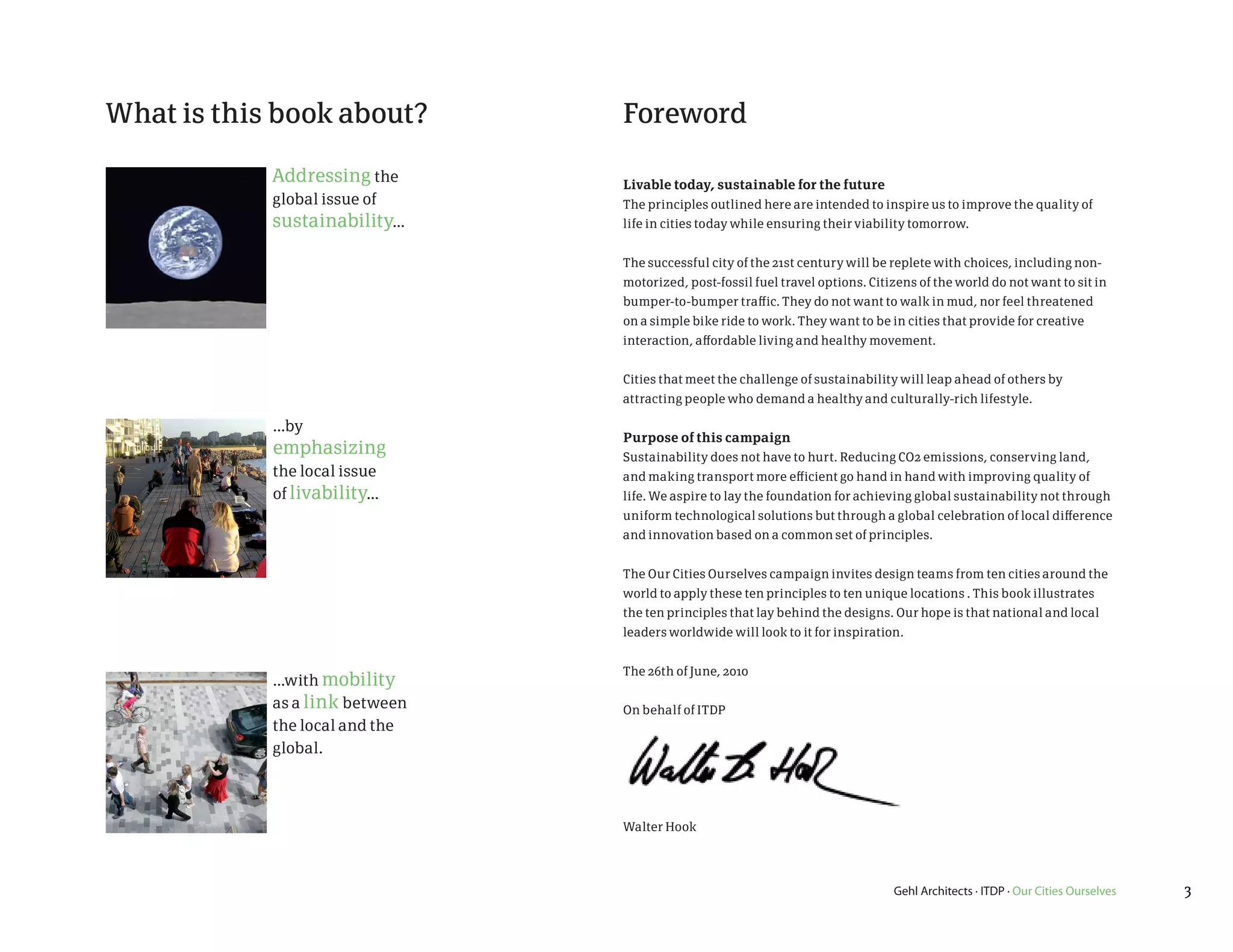
What is this book about?        Foreword

            Addressing the      Livable today, sustainable for the future
            global issue of     The principles outlined here are intended to inspire us to improve the quality of
            sustainability...   life in cities today while ensuring their viability tomorrow.


                                The successful city of the 21st century will be replete with choices, including non-
                                motorized, post-fossil fuel travel options. Citizens of the world do not want to sit in
                                bumper-to-bumper traffic. They do not want to walk in mud, nor feel threatened
                                on a simple bike ride to work. They want to be in cities that provide for creative
                                interaction, affordable living and healthy movement.


                                Cities that meet the challenge of sustainability will leap ahead of others by
                                attracting people who demand a healthy and culturally-rich lifestyle.

            ...by
                                Purpose of this campaign
            emphasizing         Sustainability does not have to hurt. Reducing CO2 emissions, conserving land,
            the local issue     and making transport more efficient go hand in hand with improving quality of
            of livability...    life. We aspire to lay the foundation for achieving global sustainability not through
                                uniform technological solutions but through a global celebration of local difference
                                and innovation based on a common set of principles.


                                The Our Cities Ourselves campaign invites design teams from ten cities around the
                                world to apply these ten principles to ten unique locations . This book illustrates
                                the ten principles that lay behind the designs. Our hope is that national and local
                                leaders worldwide will look to it for inspiration.


                                The 26th of June, 2010
            ...with mobility
            as a link between   On behalf of ITDP
            the local and the
            global.


                                Walter Hook


                                                                                Gehl Architects · ITDP · Our Cities Ourselves   3
4   Our Cities Ourselves · ITDP · Gehl Architects
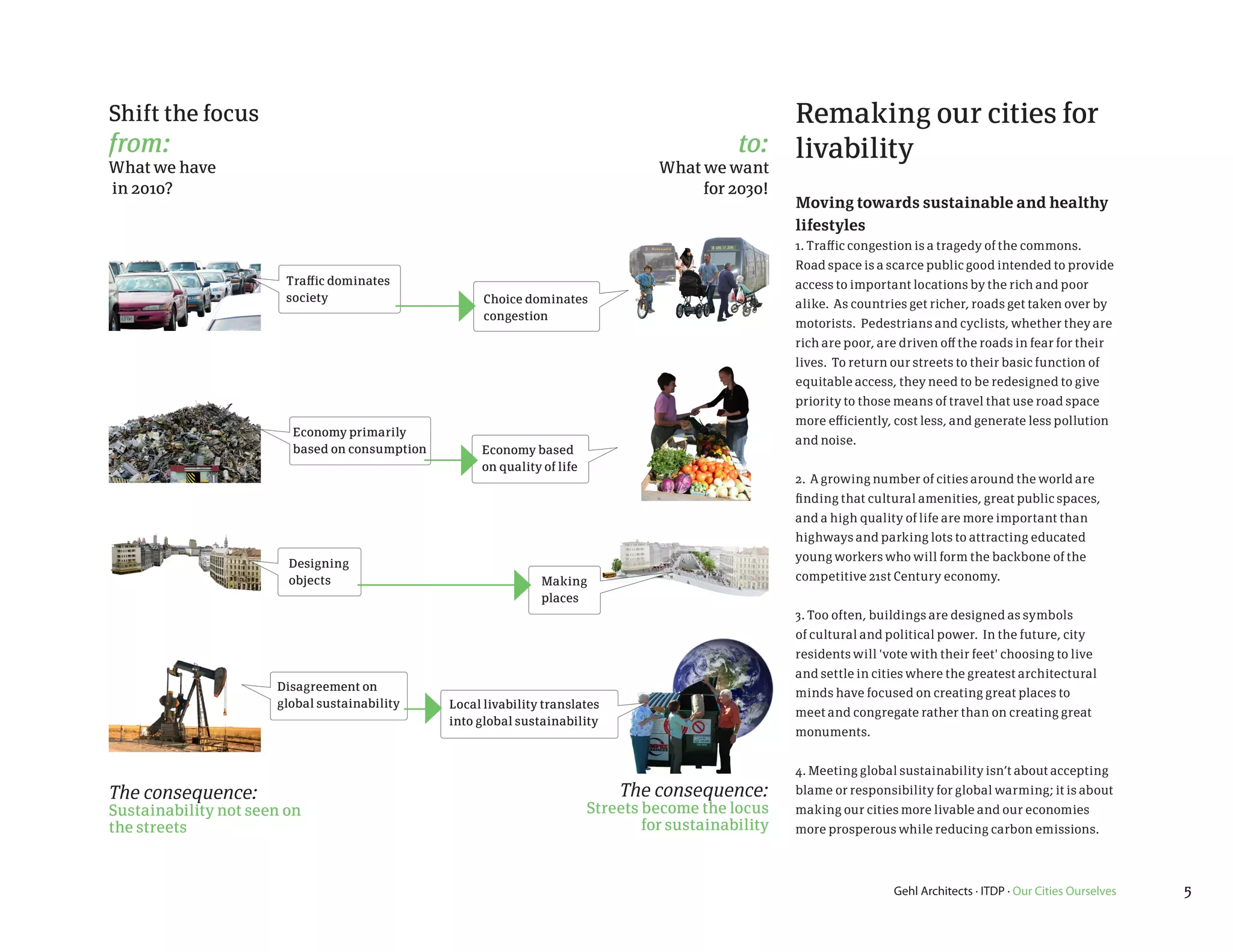
Shift the focus                                                                                    Remaking our cities for
from:                                                                                          to: livability
What we have                                                                        What we want
in 2010?                                                                                 for 2030!
                                                                                                       Moving towards sustainable and healthy
                                                                                                       lifestyles
                                                                                                       1. Traffic congestion is a tragedy of the commons.
                                                                                                       Road space is a scarce public good intended to provide
                        Traffic dominates                                                              access to important locations by the rich and poor
                        society                       Choice dominates                                 alike. As countries get richer, roads get taken over by
                                                      congestion
                                                                                                       motorists. Pedestrians and cyclists, whether they are
                                                                                                       rich are poor, are driven off the roads in fear for their
                                                                                                       lives. To return our streets to their basic function of
                                                                                                       equitable access, they need to be redesigned to give
                                                                                                       priority to those means of travel that use road space
                                                                                                       more efficiently, cost less, and generate less pollution
                         Economy primarily
                                                                                                       and noise.
                         based on consumption        Economy based
                                                     on quality of life
                                                                                                       2. A growing number of cities around the world are
                                                                                                       finding that cultural amenities, great public spaces,
                                                                                                       and a high quality of life are more important than
                                                                                                       highways and parking lots to attracting educated
                                                                                                       young workers who will form the backbone of the
                        Designing
                        objects                                 Making                                 competitive 21st Century economy.
                                                                places
                                                                                                       3. Too often, buildings are designed as symbols
                                                                                                       of cultural and political power. In the future, city
                                                                                                       residents will 'vote with their feet' choosing to live
                                                                                                       and settle in cities where the greatest architectural
                      Disagreement on
                                                                                                       minds have focused on creating great places to
                      global sustainability     Local livability translates
                                                                                                       meet and congregate rather than on creating great
                                                into global sustainability
                                                                                                       monuments.


                                                                                                       4. Meeting global sustainability isn’t about accepting
The consequence:                                                              The consequence:         blame or responsibility for global warming; it is about
Sustainability not seen on                                                Streets become the locus     making our cities more livable and our economies
the streets                                                                       for sustainability   more prosperous while reducing carbon emissions.


                                                                                                                         Gehl Architects · ITDP · Our Cities Ourselves   5
Cruise

    Principles overview                                                                                                                                                                                                                                 Control


    Walk the
    Walk!
                                                                                                                                                 Mass transport can move millions
                                                                                                                                                 of people quickly and comfortably


                                                                                                                                                                                                                                                                                                                                            Photo: Jeff Risom
                                                                                                                                                                                                                                                                                                      Managing
                                                                                                                                                 using a fraction of the fuel and street                                                                                                            traffic includes

                                                                                                                                                 space required by automobiles                                                                          Santiago, Chile
                                                                                                                                                                                                                                                                                               getting smart (using
                                                                                                                                                                                                                                                                                            technology), helping cars
                                                                                                                                                                                                                                                        Brighton, UK

                                                                                                                                                 Get on                                                                                                                                       slow down, paying for


                                                                                                                                                                                                                                                                                                                                            Photo: Gehl Architects
                                                                                                                                                                                                                                                                                                  the privilege, and

                                                                                                                                                 the bus!                                                                                                                                         re-routing traffic.


                                                                   Photo: Carlos Pardo
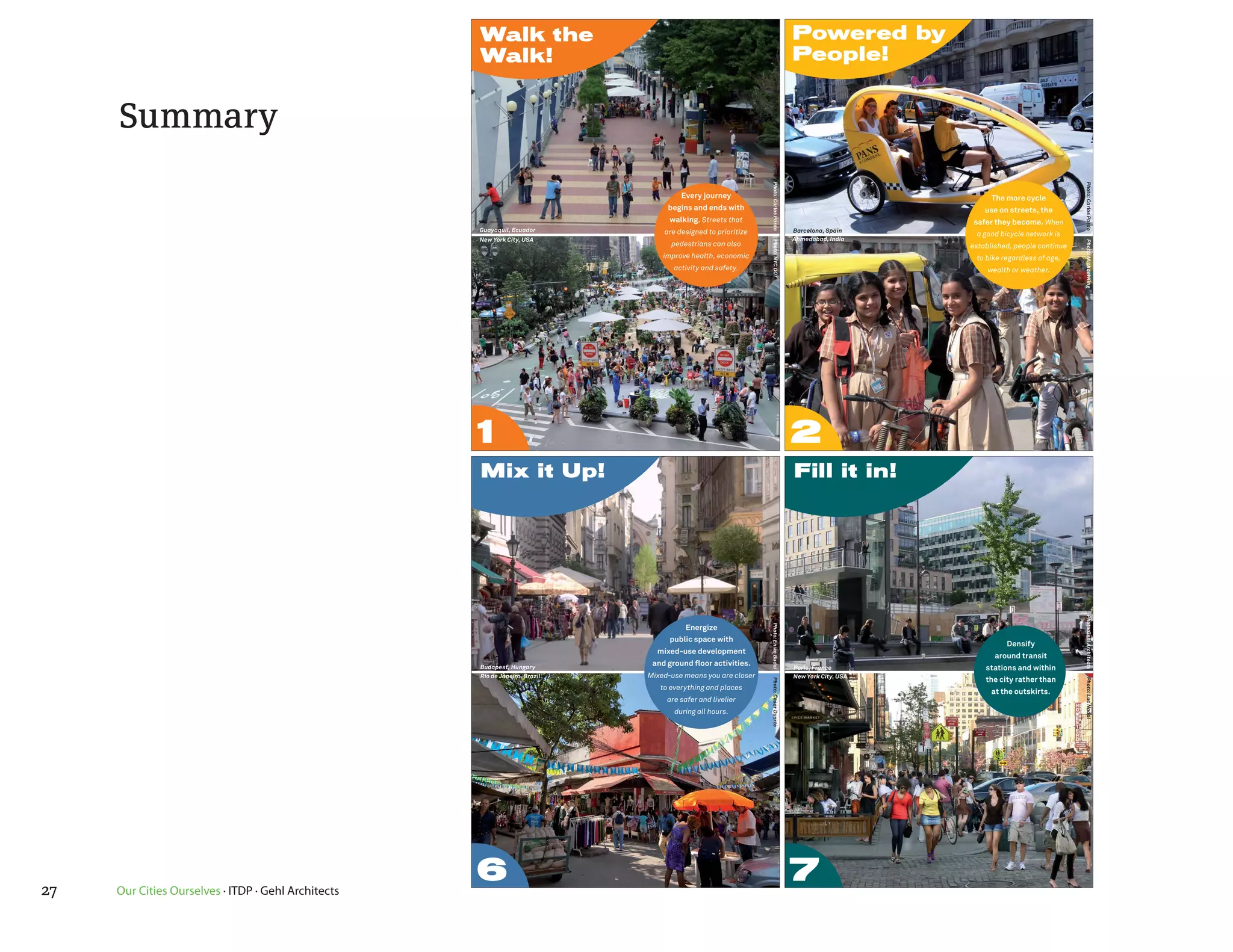
                                    Every journey
                                begins and ends with
                                walking. Streets that
    Guayaquil, Ecuador         are designed to prioritize
    New York City, USA


                                                                   Photo: NYC DOT
                                 pedestrians can also
                               improve health, economic
                                  activity and safety.


                                                                                                                                                                                                                   Photo: Anuj Malhotra
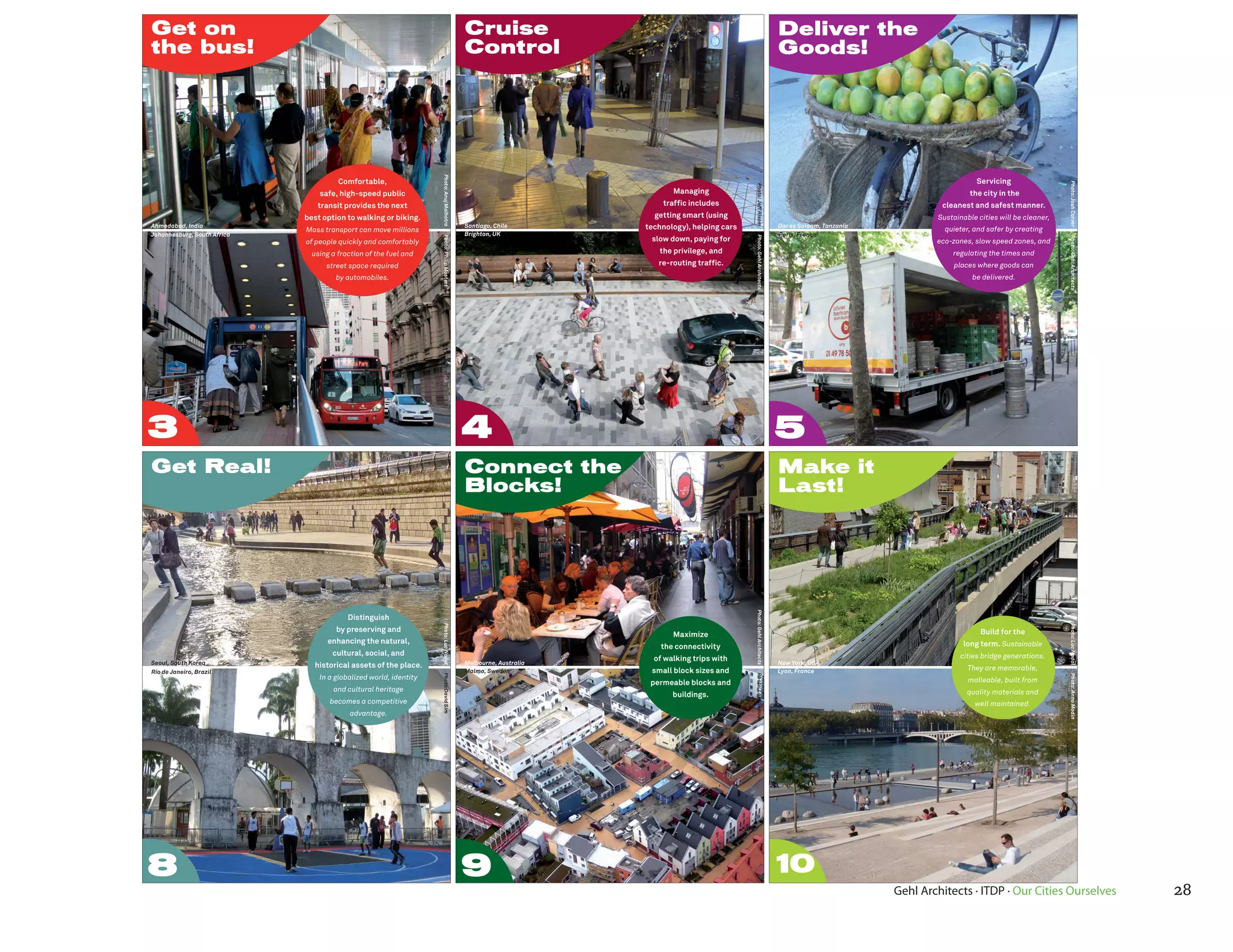
                                                                                                                                                                                        Comfortable,
                                                                                                                                                                                  safe, high-speed public


                                                                                                                                                 Ahmedabad, India
                                                                                                                                                 Johannesburg, South Africa
                                                                                                                                                                                 transit provides the next
                                                                                                                                                                              best option to walking or biking.
                                                                                                                                                                              Mass transport can move millions
                                                                                                                                                                                                                                                       4


                                                                                                                                                                                                                   Photo: Philip Mostert
                                                                                                                                                                              of people quickly and comfortably
                                                                                                                                                                                using a fraction of the fuel and
                                                                                                                                                                                    street space required
                                                                                                                                                                                                                                                     Some trips will need to be done by cars. By
                                                                                                                                                                                       by automobiles.                                               managing private car use and expanding
    1                                                                                                                                                                                                                                                car sharing, cities can minimize these
                                                                                                                                                                                                                                                     negative outcomes, while creating space for
    Great cities start with great pedestrian                                                                                                                                                                                                         pedestrians, mass and non-motorized transit.
    environments. Walking is the most
    universally accessible form of transport.


                                                                                                                                                 3                                                                                          Deliver the
                                                                                                                                                                                                                                            Goods!
                                                Powered by
                                                People!


                                                                                                                                                                                                                                                                                      Servicing


                                                                                                                                                                                                                                                                                                                   Photo: Josh Carver
                                                                                                                                                                                                                                                                                    the city in the
                                                                                                                                                                                                                                                                           cleanest and safest manner.
                                                                                                                                                                                                                                                                          Sustainable cities will be cleaner,
                                                                                                                        Photo: Carlos Pardo


                                                                                                                                                                                                                                            Dar es Salaam, Tanzania
                                                                                                                                                                                                                                                                            quieter, and safer by creating
                                                                                               The more cycle                                                                                                                               Paris, France


                                                                                                                                                                                                                                                                                                                   Photo: Gehl Architects
                                                                                                                                                                                                                                                                          eco-zones, slow speed zones, and
                                                                                             use on streets, the
                                                                                                                                                                                                                                                                              regulating the times and
                                                                                         safer they become. When
                                                Barcelona, Spain                                                                                                                                                                                                               places where goods can
                                                                                          a good bicycle network is
                                                Ahmedabad, India                                                                                                                                                                                                                    be delivered.
                                                                                                                        Photo: Michael King


                                                                                         established, people continue
                                                                                          to bike regardless of age,
                                                                                                                                              Dedicated space
                                                                                              wealth or weather.
                                                                                                                                              for non-motorized
                                                                                                                                              transit, like bike
                                                                                                                                              lanes, provides
                                                                                                                                              safety and
                                                                                                                                              convenience to
                                                                                                                                              riders, [free from

                                                                                                                                                                                                                                           5
                                                                                                                                              potential conflicts
                                                                                                                                              with vehicles], and
                                                                                                                                              a great incentive
                                               2                                                                                              to ride.                                                                                     Sustainable cities will provide some
                                                                                                                                                                                                                                           accommodation for clean and safe freight
                                                                                                                                                                                                                                           delivery, like rail, and help to make centralized
6   Our Cities Ourselves · ITDP · Gehl Architects                                                                                                                                                                                          distribution and non-motorized means of
                                                                                                                                                                                                                                           distribution more viable.
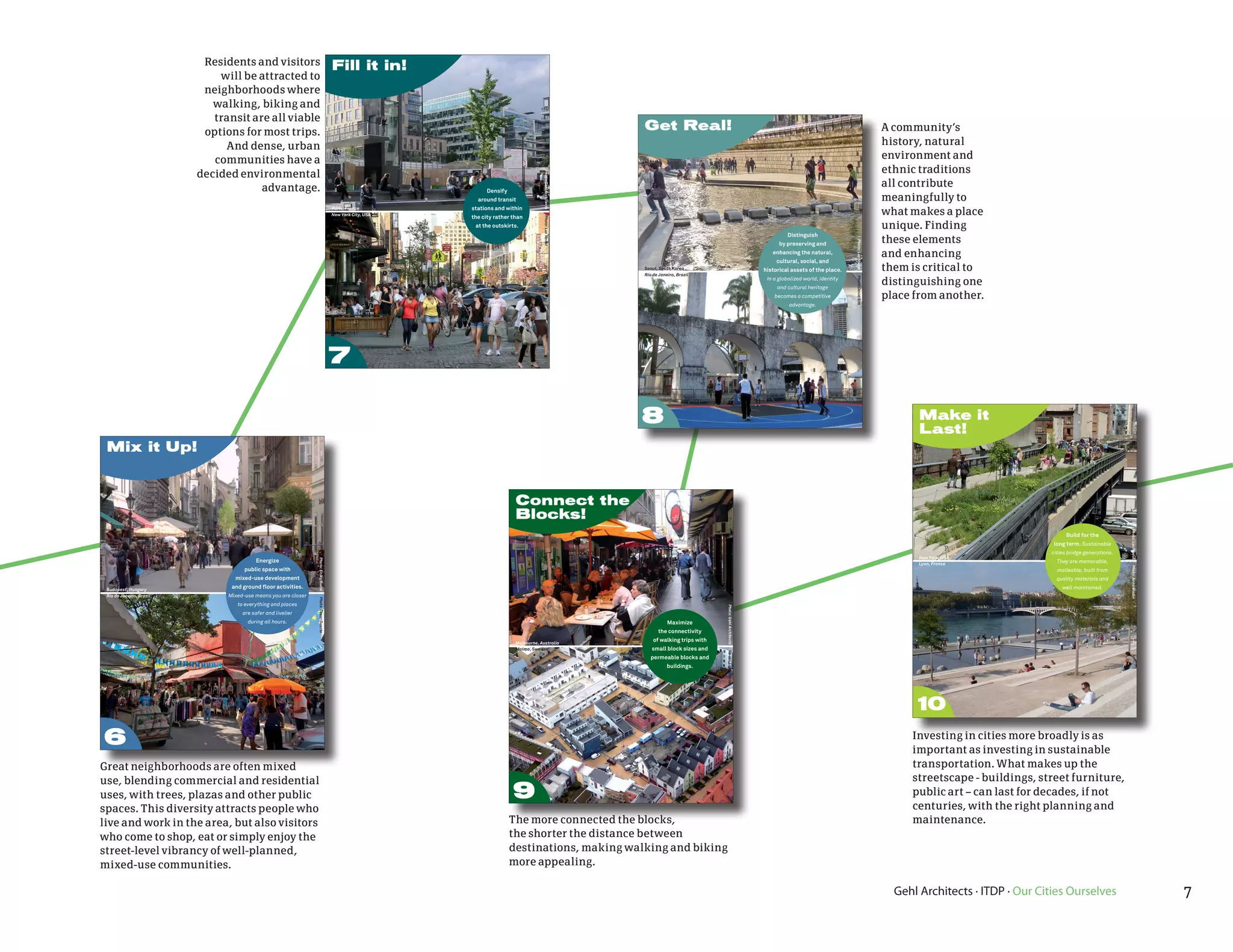
Residents and visitors                                      Fill it in!
                              will be attracted to
                           neighborhoods where
                             walking, biking and
                             transit are all viable
                           options for most trips.                                                                                                                Get Real!                                                                                                  A community’s
                                And dense, urban                                                                                                                                                                                                                             history, natural
                             communities have a                                                                                                                                                                                                                              environment and
                          decided environmental                                                                                                                                                                                                                              ethnic traditions


                                                                                                                                          Photo:Gehl Architects
                                       advantage.                                                                                                                                                                                                                            all contribute
                                                                                                                  Densify
                                                                                                              around transit                                                                                                                                                 meaningfully to
                                                                                       Paris, France
                                                                                       New York City, USA
                                                                                                            stations and within
                                                                                                            the city rather than
                                                                                                                                                                                                                                                                             what makes a place


                                                                                                                                          Photo: Luc Nadal
                                                                                                             at the outskirts.                                                                                                                                               unique. Finding
                                                                                                                                                                                                                                Distinguish
                                                                                                                                                                                                                                                                             these elements


                                                                                                                                                                                                                                                          Photo: Luc Nadal
                                                                                                                                                                                                                             by preserving and
                                                                                                                                                                                                                          enhancing the natural,                             and enhancing
                                                                                                                                                                                                                            cultural, social, and
                                                                                                                                                                  Seoul, South Korea
                                                                                                                                                                  Rio de Janeiro, Brazil
                                                                                                                                                                                                                       historical assets of the place.                       them is critical to
                                                                                                                                                                                                                                                                             distinguishing one


                                                                                                                                                                                                                                                          Photo:David Sim
                                                                                                                                                                                                                        In a globalized world, identity
                                                                                                                                                                                                                            and cultural heritage
                                                                                                                                                                                                                           becomes a competitive                             place from another.
                                                                                                                                                                                                                                 advantage.


                                                                                       7

                                                                                                                                                                  8                                                                                                                 Make it
                                                                                                                                                                                                                                                                                    Last!
 Mix it Up!


                                                                                                                            Connect the
                                                                                                                            the blocks!
                                                                                                                            Blocks!


                                                                                                                                                                                                                                                                                                                                           Photo: Luc Nadal
                                                                                                                                                                                                                                                                                                                    Build for the
                                                                                                                                                                                                                                                                                                               long term. Sustainable
                                                                                                                                                                                                                                                                                                              cities bridge generations.
                                                                                                                                                                                                                                                                                    New York, USA
                                          Energize
                                                                 Photo: Eniko Budai


                                                                                                                                                                                                                                                                                    Lyon, France                They are memorable,


                                                                                                                                                                                                                                                                                                                                           Photo: Anna Modin
                                      public space with                                                                                                                                                                                                                                                         malleable, built from
                                  mixed-use development                                                                                                                                                                                                                                                         quality materials and
 Budapest, Hungary
                                 and ground floor activities.                                                                                                                                                                                                                                                     well maintained.
 Rio de Janeiro, Brazil         Mixed-use means you are closer
                                                                 Photo: Cesar Duarte


                                   to everything and places


                                                                                                                                                                                              Photo: Gehl Architects
                                     are safer and livelier
                                       during all hours.                                                                                                                     Maximize
                                                                                                                                                                        the connectivity

                                                                                                                             Melbourne, Australia
                                                                                                                                                                      of walking trips with
                                                                                                                             Malmo, Sweden                           small block sizes and


                                                                                                                                                                                              Photo: Lars Gemzø e
                                                                                                                                                                     permeable blocks and
                                                                                                                                                                             buildings.


                                                                                                                                                                                                                                                                                   10
6                                                                                                                                                                                                                                                                                 Investing in cities more broadly is as
                                                                                                                                                                                                                                                                                  important as investing in sustainable
Great neighborhoods are often mixed                                                                                                                                                                                                                                               transportation. What makes up the
use, blending commercial and residential                                                                                                                                                                                                                                          streetscape - buildings, street furniture,
uses, with trees, plazas and other public                                                                                   9                                                                                                                                                     public art – can last for decades, if not
                                                                                                                                                                                                                                                                                  centuries, with the right planning and
spaces. This diversity attracts people who
live and work in the area, but also visitors                                                                                The more connected the blocks,                                                                                                                        maintenance.
who come to shop, eat or simply enjoy the                                                                                   the shorter the distance between
street-level vibrancy of well-planned,                                                                                      destinations, making walking and biking
mixed-use communities.                                                                                                      more appealing.

                                                                                                                                                                                                                                                                               Gehl Architects · ITDP · Our Cities Ourselves                                   7
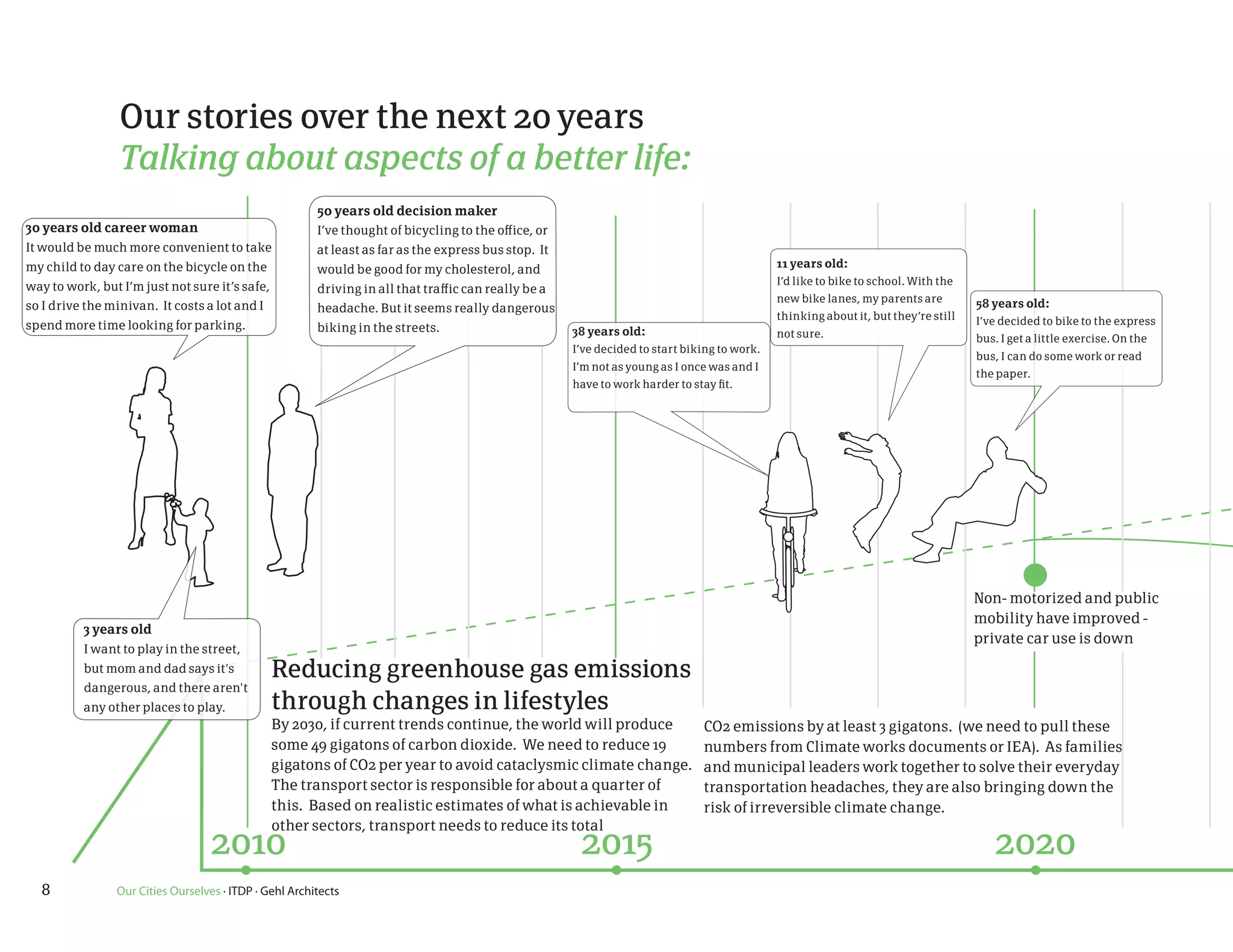
Our stories over the next 20 years
                 Talking about aspects of a better life:
                                                        50 years old decision maker
30 years old career woman                               I’ve thought of bicycling to the office, or
It would be much more convenient to take                at least as far as the express bus stop. It
my child to day care on the bicycle on the                                                                                                    11 years old:
                                                        would be good for my cholesterol, and
                                                                                                                                              I’d like to bike to school. With the
way to work, but I’m just not sure it’s safe,           driving in all that traffic can really be a
                                                                                                                                              new bike lanes, my parents are         58 years old:
so I drive the minivan. It costs a lot and I            headache. But it seems really dangerous
                                                                                                                                              thinking about it, but they’re still   I’ve decided to bike to the express
spend more time looking for parking.                    biking in the streets.                        38 years old:                           not sure.                              bus. I get a little exercise. On the
                                                                                                      I’ve decided to start biking to work.
                                                                                                                                                                                     bus, I can do some work or read
                                                                                                      I’m not as young as I once was and I
                                                                                                                                                                                     the paper.
                                                                                                      have to work harder to stay fit.


                                                                                                                                                                                     Non- motorized and public
                                                                                                                                                                                     mobility have improved -
          3 years old
                                                                                                                                                                                     private car use is down
          I want to play in the street,
          but mom and dad says it's             Reducing greenhouse gas emissions
          dangerous, and there aren't
          any other places to play.             through changes in lifestyles
                                                By 2030, if current trends continue, the world will produce                     CO2 emissions by at least 3 gigatons. (we need to pull these
                                                some 49 gigatons of carbon dioxide. We need to reduce 19                        numbers from Climate works documents or IEA). As families
                                                gigatons of CO2 per year to avoid cataclysmic climate change.                   and municipal leaders work together to solve their everyday
                                                The transport sector is responsible for about a quarter of                      transportation headaches, they are also bringing down the
                                                this. Based on realistic estimates of what is achievable in                     risk of irreversible climate change.
                                                other sectors, transport needs to reduce its total
                                   2010                                                                2015                                                                              2020
  8             Our Cities Ourselves · ITDP · Gehl Architects
18 years old:
                                         I wouldn’t think of going on a date
                                         in a car. Cars are so 2010. We’ll
                                         just pick up a couple of those
                                         shared bikes over by the school,
45 years old:                            bicycle together along the new
The new bus rapid transit system is      waterfront promenade, then drop
so much faster, I wouldn’t dream of      them back near the house.
driving to work on most days. Still,                             65 years old:
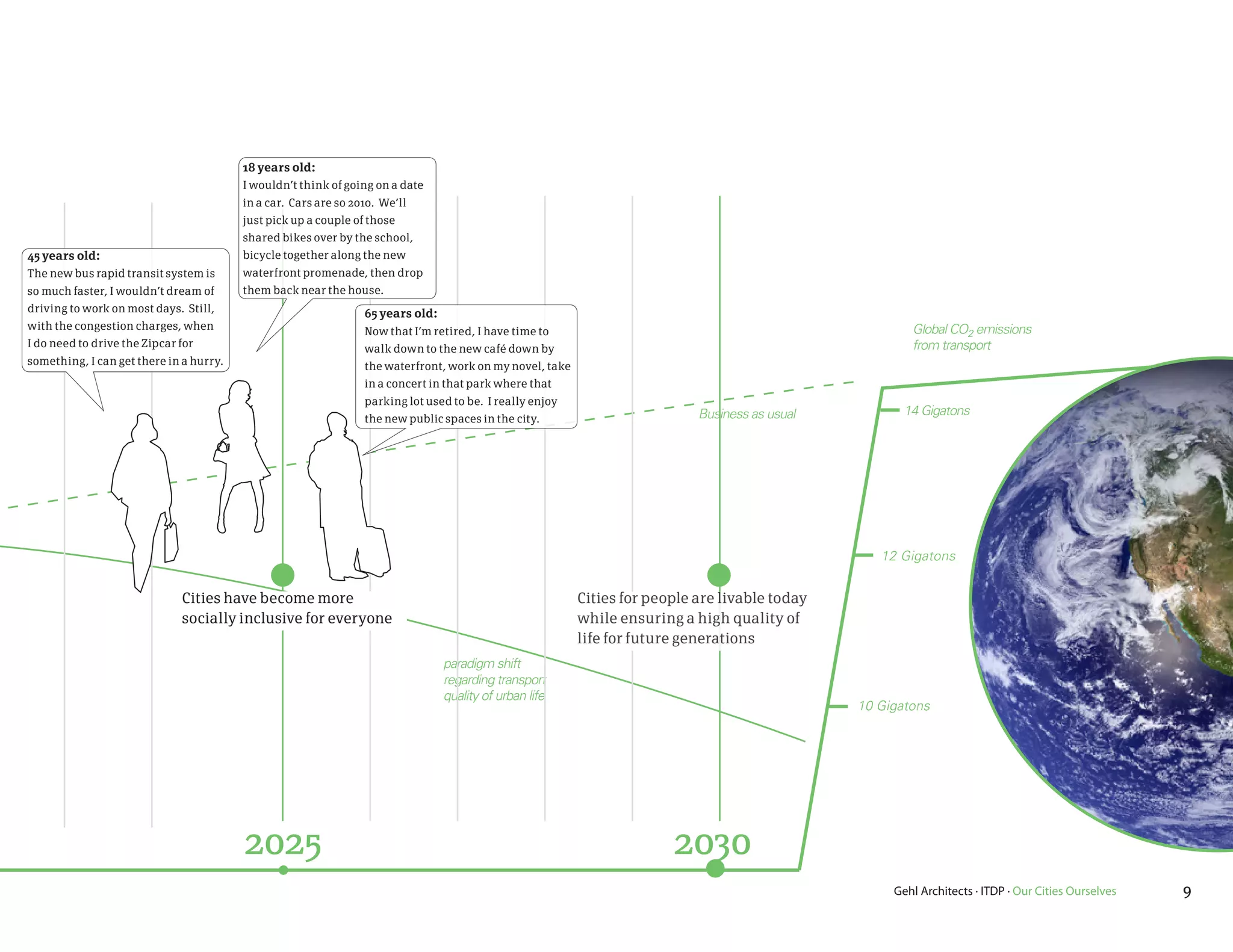
with the congestion charges, when                                Now that I’m retired, I have time to                                                   Global CO2 emissions
I do need to drive the Zipcar for                                walk down to the new café down by                                                      from transport
something, I can get there in a hurry.                           the waterfront, work on my novel, take
                                                                 in a concert in that park where that
                                                                 parking lot used to be. I really enjoy
                                                                                                                            Business as usual          14 Gigatons
                                                                 the new public spaces in the city.


                                                                                                                                                   12 Gigatons


                              Cities have become more                                                     Cities for people are livable today
                              socially inclusive for everyone                                             while ensuring a high quality of
                                                                                                          life for future generations
                                                                                 paradigm shift
                                                                                 regarding transport
                                                                                 quality of urban life
                                                                                                                                                10 Gigatons


                                         2025                                                                           2030
                                                                                                                                                     Gehl Architects · ITDP · Our Cities Ourselves   9
3194.JPG                                                                                                         410923195.JPG


           1        Walk the
                    Walk!
           Create great pedestrian environments
           We are all pedestrians. Walking is the most natural,
           affordable, healthy and clean way of getting around,
           but it requires more than just feet and legs. It requires
                                                                       Invite people to walk everywhere in the city

                                                                                                                                                                 Photo:


           walkable streets – the fundamental building blocks
           of a sustainable city.


           A great walking environment must protect
           pedestrians from motor vehicles. Vehicle speeds
           need to be radically slowed or else streets need
           sidewalks. Sidewalks need to be unobstructed,
           continuous, shaded, and well lit. Vehicle speeds
           at crossings must be slowed with tighter turns,
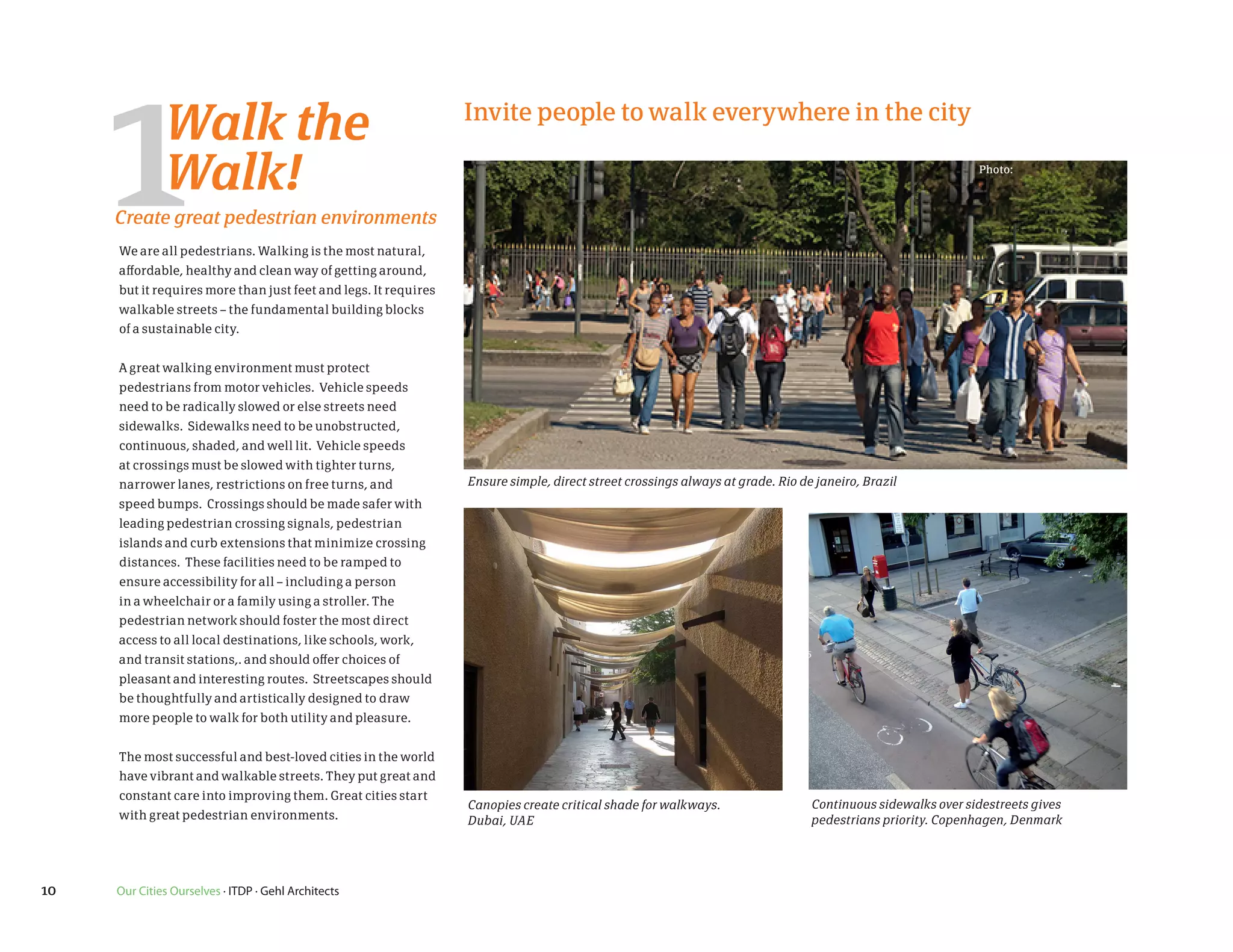
           narrower lanes, restrictions on free turns, and             Ensure simple, direct street crossings always at grade. Rio de janeiro, Brazil
           speed bumps. Crossings should be made safer with
           leading pedestrian crossing signals, pedestrian
           islands and curb extensions that minimize crossing
3196.JPG   distances. These facilities need to be ramped to                                                      410923198.JPG
           ensure accessibility for all – including a person
aphs       in a wheelchair or a family using a stroller. The
           pedestrian network should foster the most direct
           access to all local destinations, like schools, work,
           and transit stations,. and should offer choices of
           pleasant and interesting routes. Streetscapes should
           be thoughtfully and artistically designed to draw
           more people to walk for both utility and pleasure.


           The most successful and best-loved cities in the world
           have vibrant and walkable streets. They put great and
           constant care into improving them. Great cities start
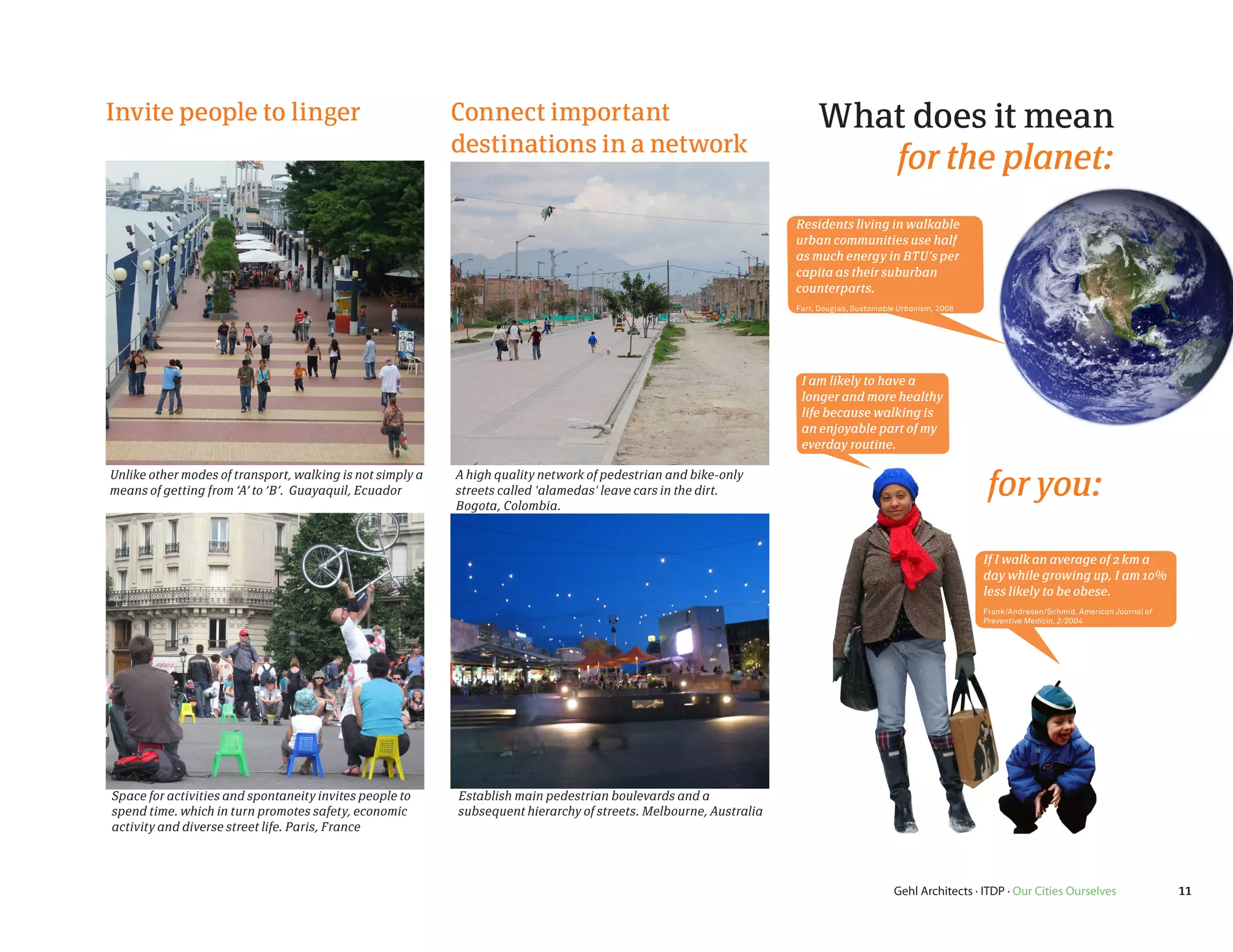
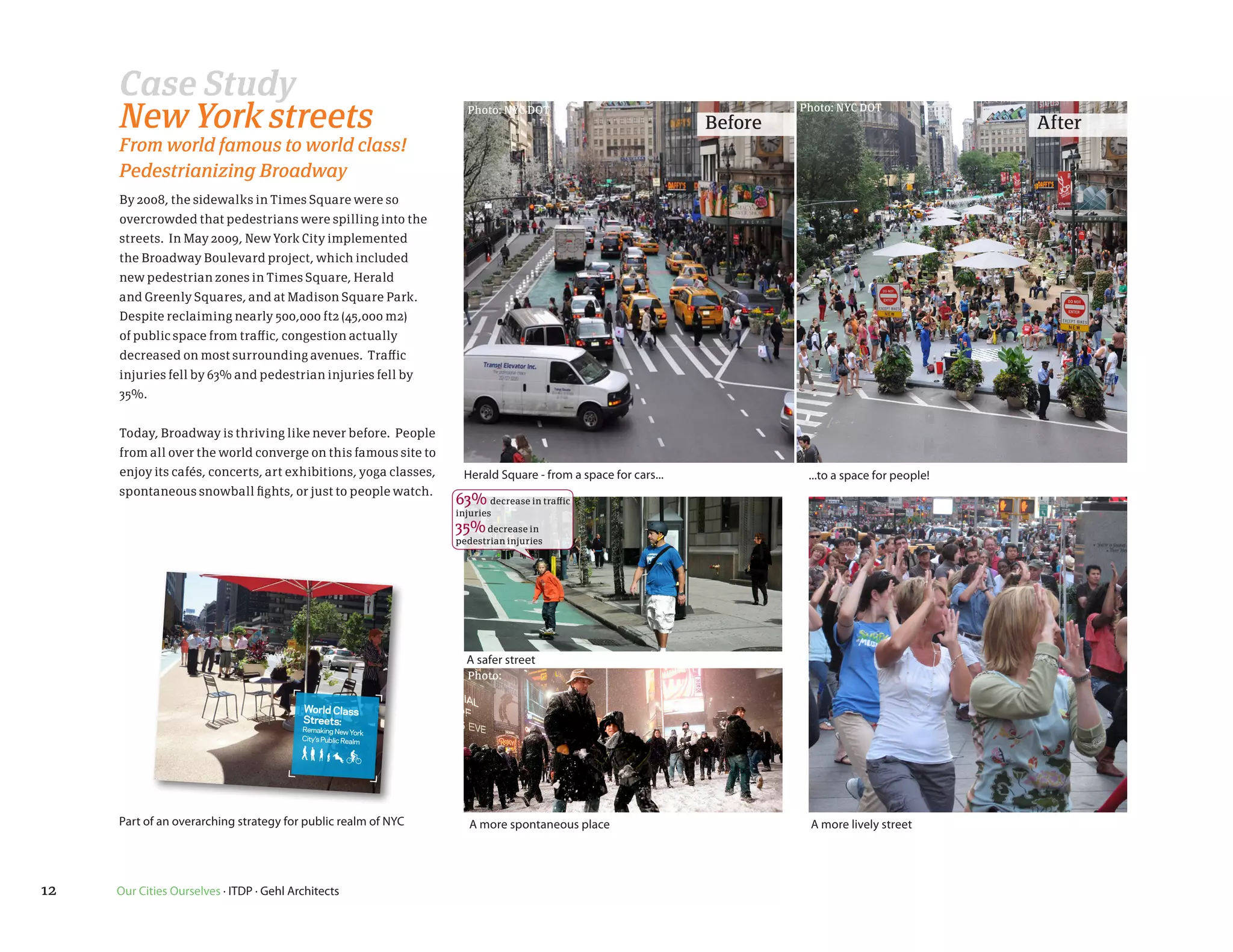
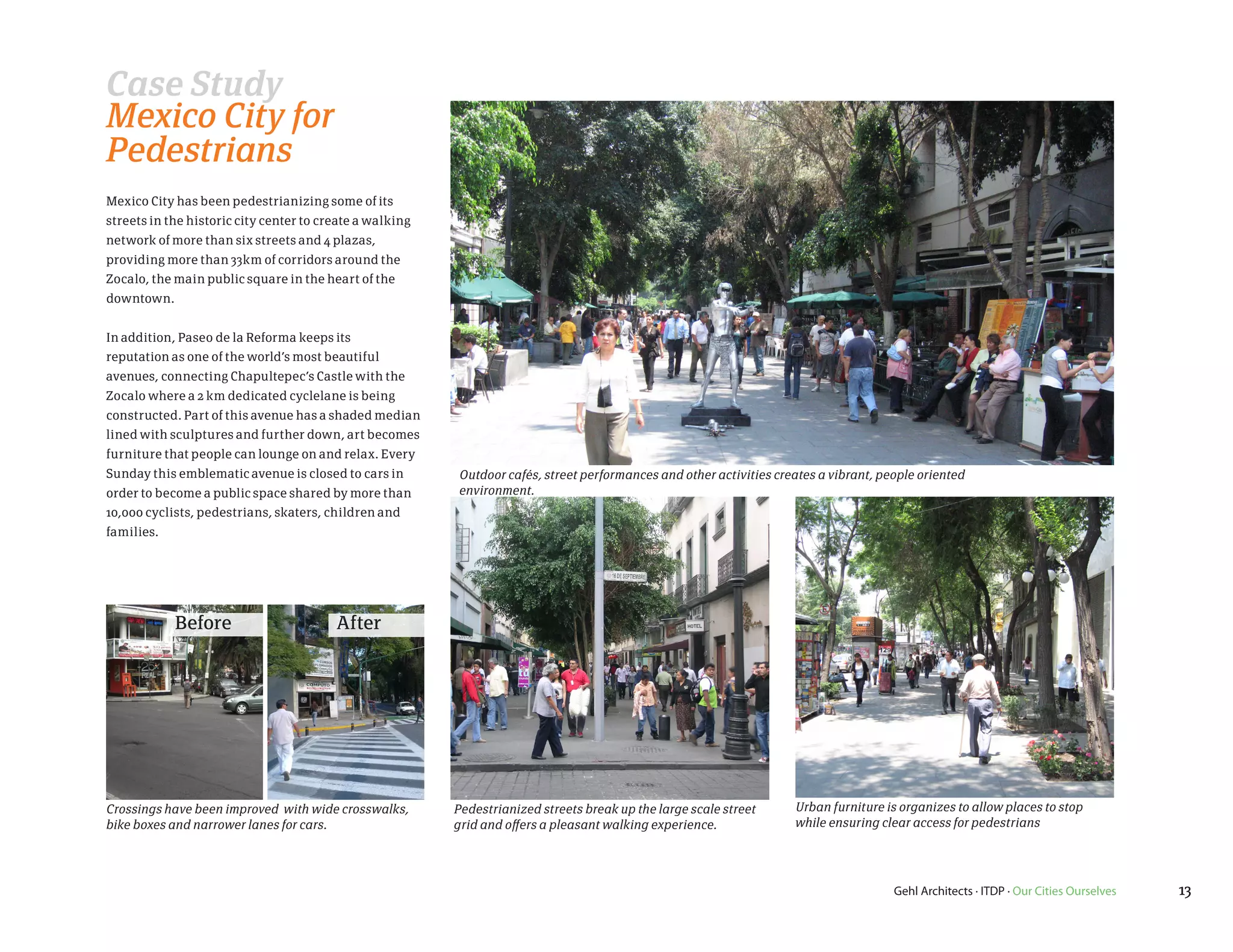
                                                                       Canopies create critical shade for walkways.                  Continuous sidewalks over sidestreets gives
           with great pedestrian environments.                         Dubai, UAE                                                    pedestrians priority. Copenhagen, Denmark


    10     Our Cities Ourselves · ITDP · Gehl Architects
Invite people to linger                                    Connect important                                            What does it mean
                                                           destinations in a network
                                                                                                                           for the planet:
                                                                                                                   Residents living in walkable
                                                                                                                   urban communities use half
                                                                                                                   as much energy in BTU’s per
                                                                                                                   capita as their suburban
                                                                                                                   counterparts.
                                                                                                                   Farr, Douglas, Sustainable Urbanism, 2008


                                                                                                                    I am likely to have a
                                                                                                                    longer and more healthy
                                                                                                                    life because walking is
                                                                                                                    an enjoyable part of my
                                                                                                                    everday routine.

Unlike other modes of transport, walking is not simply a
means of getting from ‘A’ to ‘B’. Guayaquil, Ecuador
                                                           A high quality network of pedestrian and bike-only
                                                           streets called 'alamedas' leave cars in the dirt.
                                                           Bogota, Colombia.
                                                                                                                                                                for you:
                                                                                                                                                               If I walk an average of 2 km a
                                                                                                                                                               day while growing up, I am 10%
                                                                                                                                                               less likely to be obese.
                                                                                                                                                               Frank/Andresen/Schmid, American Journal of
                                                                                                                                                               Preventive Medicin, 2/2004


Space for activities and spontaneity invites people to     Establish main pedestrian boulevards and a
spend time. which in turn promotes safety, economic        subsequent hierarchy of streets. Melbourne, Australia
activity and diverse street life. Paris, France


                                                                                                                                            Gehl Architects · ITDP · Our Cities Ourselves                   11
Case Study
                              New York streets                                                                                                                                                                                      Photo: NYC DOT
                                                                                                                                                                                                                                                                              Before
                                                                                                                                                                                                                                                                                       Photo: NYC DOT
                                                                                                                                                                                                                                                                                                                    After
                              From world famous to world class!
                              Pedestrianizing Broadway
                              By 2008, the sidewalks in Times Square were so
                              overcrowded that pedestrians were spilling into the
                              streets. In May 2009, New York City implemented
                              the Broadway Boulevard project, which included
                              new pedestrian zones in Times Square, Herald
                              and Greenly Squares, and at Madison Square Park.
                              Despite reclaiming nearly 500,000 ft2 (45,000 m2)
                              of public space from traffic, congestion actually
                              decreased on most surrounding avenues. Traffic
                              injuries fell by 63% and pedestrian injuries fell by
                              35%.


                              Today, Broadway is thriving like never before. People
                                                                                                                                                                                                                                             63% decrease in traffic
                              from all over the world converge on this famous site to                                                                                                                                                        injuries

                              enjoy its cafés, concerts, art exhibitions, yoga classes,                                                                                                                                            Herald Square - from a space for cars...             ...to a space for people!
                              spontaneous snowball fights, or just to people watch.
                                                                                                                                                                                                                                  63% decrease in traffic
                                                                                                                                                                                                                                  injuries
     World Class Streets:
                            Remaking New York
                                                City’s Public Realm
                                                                                                                                                                                                                                  35% decrease in
                                                                                          WORLD CLASS


                                                                                                                                                                 World Class Streets:
                                                                                                                                                                                        Remaking New York
                                                                                                                                                                                                            City’s Public Realm
                                                                                                                                                                                                                                  pedestrian injuries
                                                                                                      STREETS: REMAKING
                                                                                                                        NEW YORK CITY’S
                                                                                                                                        PUBLIC REALM


                                                                                                                                                                                                                                    A safer street
                                                                                                                                                                                                                                    Photo:
                                                                  NEW YORK CITY


                                                                                                                                                       World Class
                                                                                                                                                       Streets:
                                                                                DEPARTM


                                                                                                                                                       Remaking New York
                                                                                                                                                       City’s Public Realm
                                                             ENT OF TRANSPO
                                                            RTATION


                                            2


                                                                                                                                                                                                        3


                              Part of an overarching strategy for public realm of NYC                                                                                                                                                A more spontaneous place                           A more lively street


12                      Our Cities Ourselves · ITDP · Gehl Architects
Case Study
Mexico City for
Pedestrians
Mexico City has been pedestrianizing some of its
streets in the historic city center to create a walking
network of more than six streets and 4 plazas,
providing more than 33km of corridors around the
Zocalo, the main public square in the heart of the
downtown.


In addition, Paseo de la Reforma keeps its
reputation as one of the world’s most beautiful
avenues, connecting Chapultepec’s Castle with the
Zocalo where a 2 km dedicated cyclelane is being
constructed. Part of this avenue has a shaded median
lined with sculptures and further down, art becomes
furniture that people can lounge on and relax. Every
Sunday this emblematic avenue is closed to cars in        Outdoor cafés, street performances and other activities creates a vibrant, people oriented
order to become a public space shared by more than        environment.
10,000 cyclists, pedestrians, skaters, children and
families.


            Before                       After


Crossings have been improved with wide crosswalks,        Pedestrianized streets break up the large scale street     Urban furniture is organizes to allow places to stop
bike boxes and narrower lanes for cars.                   grid and offers a pleasant walking experience.             while ensuring clear access for pedestrians


                                                                                                                                       Gehl Architects · ITDP · Our Cities Ourselves   13
2             Powered by Make cycling convenient
                   People
     Create a great environment for
     bicycles and other non-motorized
     vehicles.
     Bicycles and other means of people-powered
     transport like pedicabs allow the convenience
     of door-to-door travel while using less space and
     fewer resources. They are the healthier and more
     sustainable alternative to cars and taxis for short
     trips. Many people will choose cycling if streets are
     made safe and comfortable. . Bike sharing,makes
     cycling possible for people who don’t have their
     own bikes with them. Making cycling possible has
     allowed some families to save up to a third of their
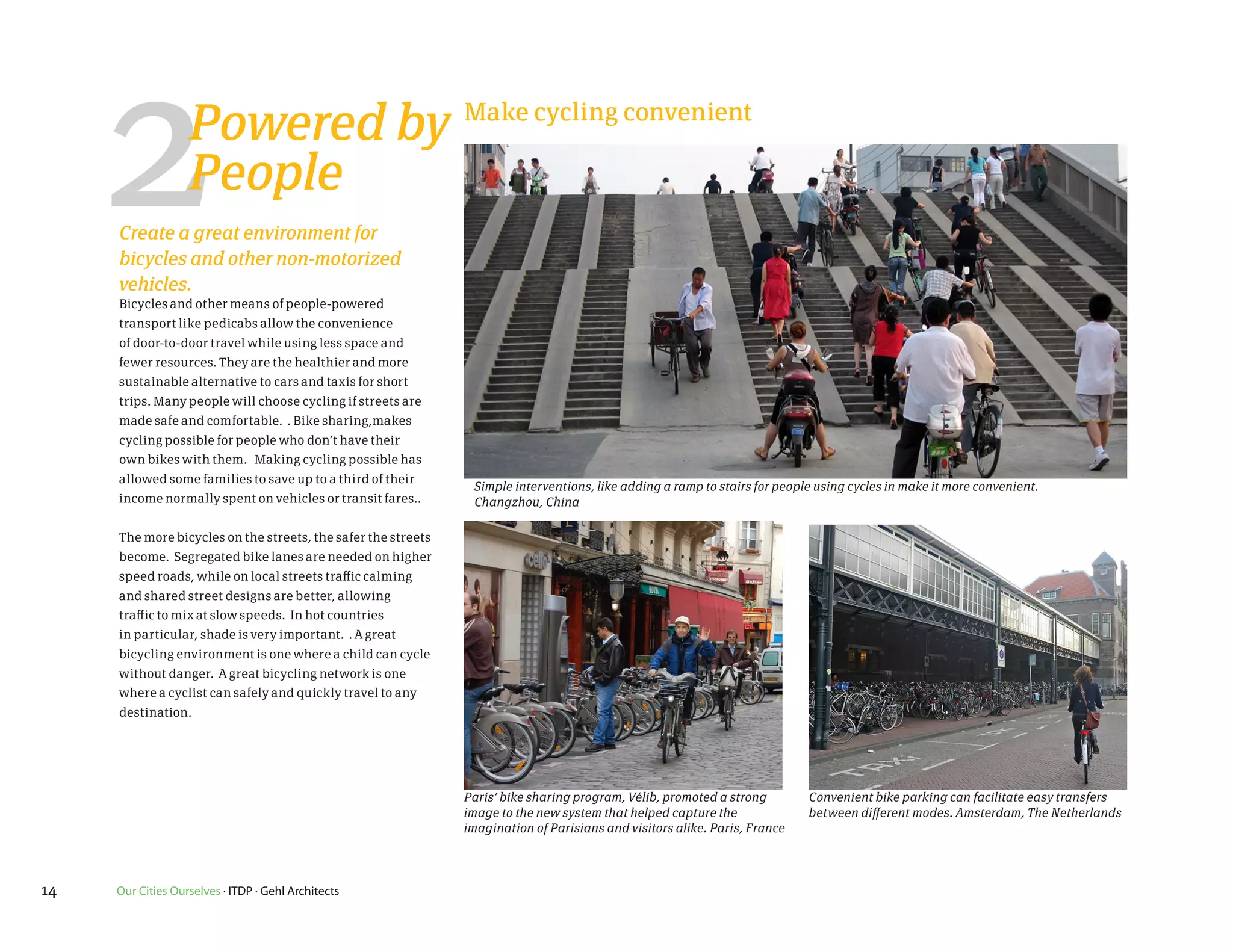
                                                                Simple interventions, like adding a ramp to stairs for people using cycles in make it more convenient.
     income normally spent on vehicles or transit fares..       Changzhou, China

     The more bicycles on the streets, the safer the streets
     become. Segregated bike lanes are needed on higher
     speed roads, while on local streets traffic calming
     and shared street designs are better, allowing
     traffic to mix at slow speeds. In hot countries
     in particular, shade is very important. . A great
     bicycling environment is one where a child can cycle
     without danger. A great bicycling network is one
     where a cyclist can safely and quickly travel to any
     destination.


                                                               Paris’ bike sharing program, Vélib, promoted a strong        Convenient bike parking can facilitate easy transfers
                                                               image to the new system that helped capture the              between different modes. Amsterdam, The Netherlands
                                                               imagination of Parisians and visitors alike. Paris, France


14   Our Cities Ourselves · ITDP · Gehl Architects
ITDP-Mx.16.JPG
Make cycling safe                                             Make cycling fun                                               What does it mean
                                                               Photo:
                                                                                                                                for the planet:
                                                                                                                       Biking is the most effecient form
                                                                                                                       of transportation yet invented.
                                                                                                                       Using the same amount of
                                                                                                                       energy you get 3 times as far as
                                                                                                                       walking (and 60 times as far as
                                                                                                                       driving a car).
                                                                                                                       Gehl, Cities for people, 2010


                                                                                                                                                                         If I bike to work instead of taking
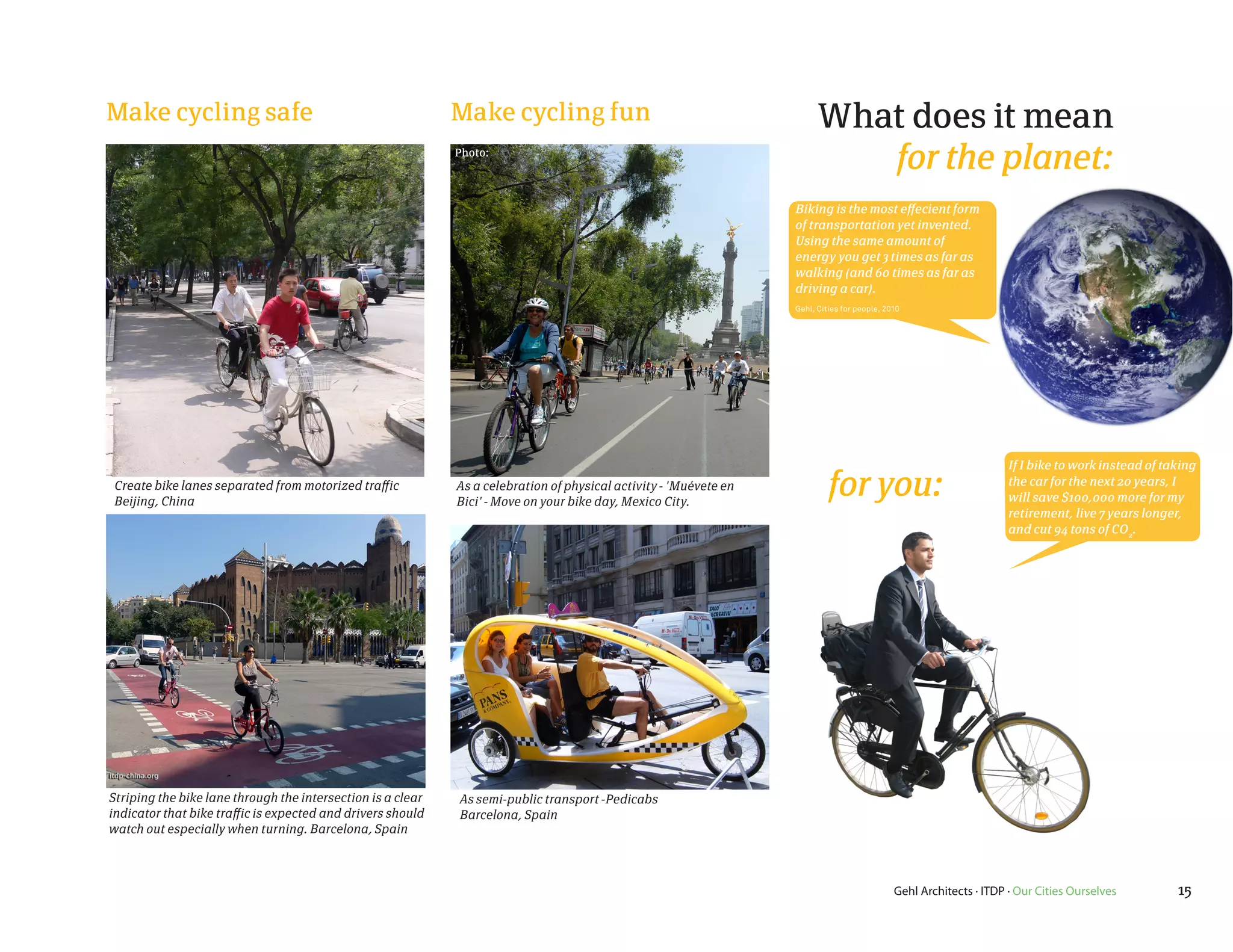
Create bike lanes separated from motorized traffic
Beijing, China
                                                               As a celebration of physical activity - 'Muévete en
                                                               Bici' - Move on your bike day, Mexico City.
                                                                                                                                for you:                                 the car for the next 20 years, I
                                                                                                                                                                         will save $100,000 more for my
                                                                                                                                                                         retirement, live 7 years longer,
                                                                                                      ITDP-Mx.18.JPG                                                     and cut 94 tons of CO2 .
                                                             Our Cities Ourselves Site Photographs


Striping the bike lane through the intersection is a clear     As semi-public transport -Pedicabs
indicator that bike traffic is expected and drivers should     Barcelona, Spain
watch out especially when turning. Barcelona, Spain


                                                                                                                                                  Gehl Architects · ITDP · Our Cities Ourselves         15
Case Study
     City for Cyclists
     Copenhagen, Denmark

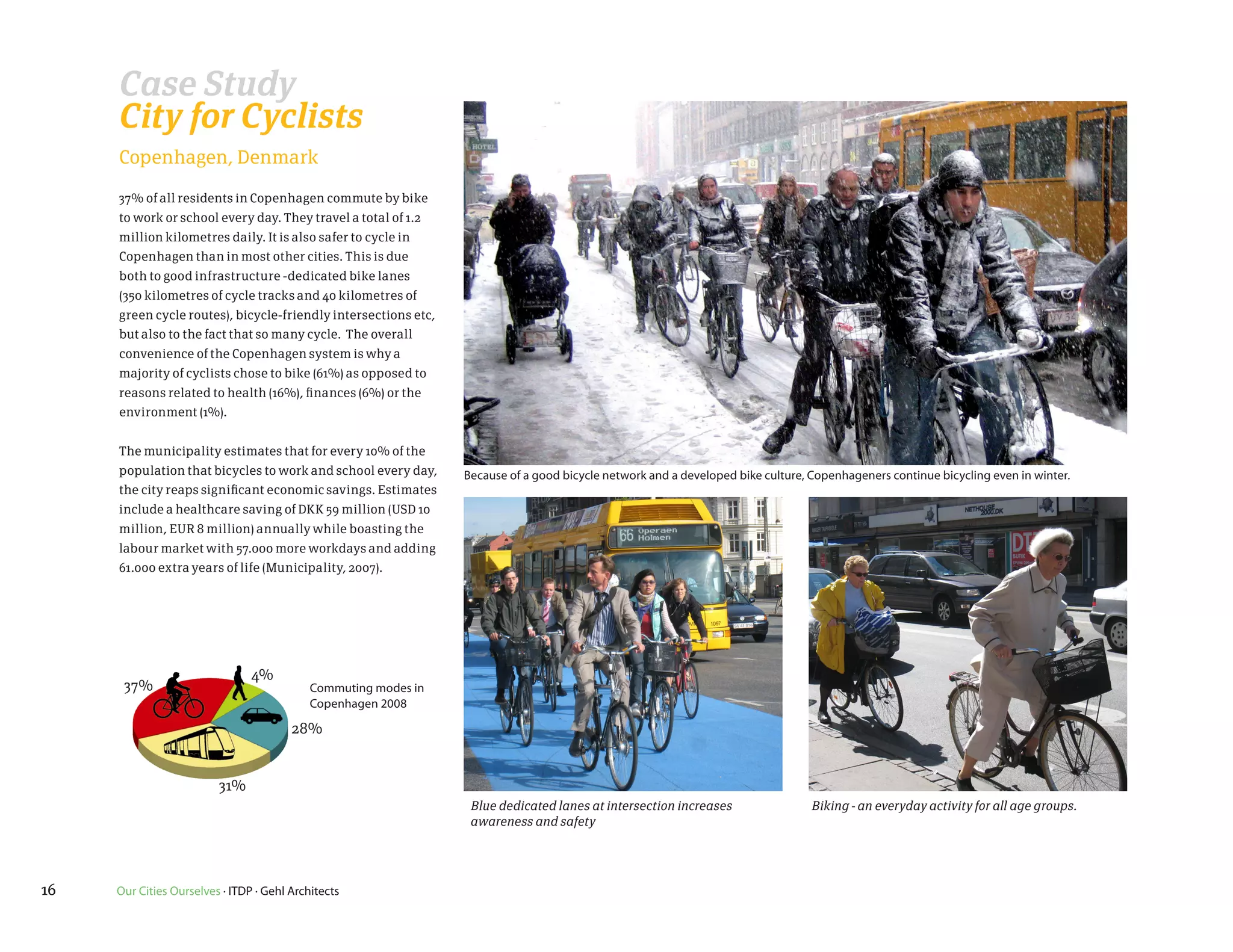
     37% of all residents in Copenhagen commute by bike
     to work or school every day. They travel a total of 1.2
     million kilometres daily. It is also safer to cycle in
     Copenhagen than in most other cities. This is due
     both to good infrastructure -dedicated bike lanes
     (350 kilometres of cycle tracks and 40 kilometres of
     green cycle routes), bicycle-friendly intersections etc,
     but also to the fact that so many cycle. The overall
     convenience of the Copenhagen system is why a
     majority of cyclists chose to bike (61%) as opposed to
     reasons related to health (16%), finances (6%) or the
     environment (1%).


     The municipality estimates that for every 10% of the
     population that bicycles to work and school every day,      Because of a good bicycle network and a developed bike culture, Copenhageners continue bicycling even in winter.
     the city reaps significant economic savings. Estimates
     include a healthcare saving of DKK 59 million (USD 10
     million, EUR 8 million) annually while boasting the
     labour market with 57.000 more workdays and adding
     61.000 extra years of life (Municipality, 2007).


                                4%
      37%                                   Commuting modes in
                                            Copenhagen 2008

                                        28%


                         31%
                                                                  Blue dedicated lanes at intersection increases                 Biking - an everyday activity for all age groups.
                                                                  awareness and safety


16   Our Cities Ourselves · ITDP · Gehl Architects
Case Study
World's largest
bike share
Hangzhou, China
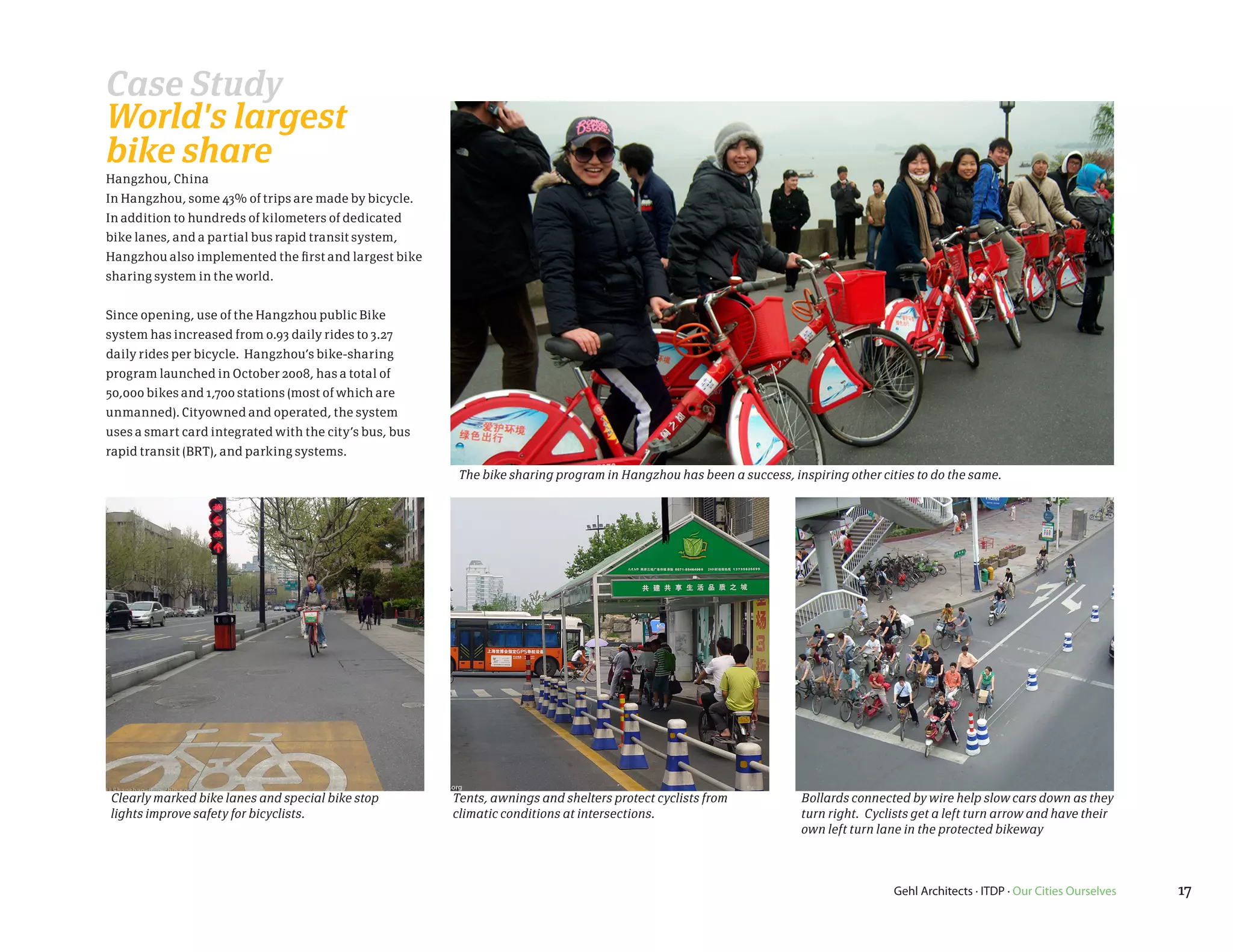
In Hangzhou, some 43% of trips are made by bicycle.
In addition to hundreds of kilometers of dedicated
bike lanes, and a partial bus rapid transit system,
Hangzhou also implemented the first and largest bike
sharing system in the world.


Since opening, use of the Hangzhou public Bike
system has increased from 0.93 daily rides to 3.27
daily rides per bicycle. Hangzhou’s bike-sharing
program launched in October 2008, has a total of
50,000 bikes and 1,700 stations (most of which are
unmanned). Cityowned and operated, the system
uses a smart card integrated with the city’s bus, bus
rapid transit (BRT), and parking systems.
                                                         The bike sharing program in Hangzhou has been a success, inspiring other cities to do the same.


Clearly marked bike lanes and special bike stop         Tents, awnings and shelters protect cyclists from           Bollards connected by wire help slow cars down as they
lights improve safety for bicyclists.                   climatic conditions at intersections.                       turn right. Cyclists get a left turn arrow and have their
                                                                                                                    own left turn lane in the protected bikeway


                                                                                                                                     Gehl Architects · ITDP · Our Cities Ourselves   17
3        Get on
              the Bus!
     Provide great, cost-effective public
                                                                   Focus on
                                                                   the passenger
                                                                                                                           Promote convenient,
                                                                                                                           cost-effective solutions


     transport

     Some trips are too long to make walking or cycling a
     viable option. As growing traffic from private cars and
     trucks slows down buses, cities need to intervene to
     improve their public transit systems. Mass transport
     can move millions of people quickly and comfortably
     using a fraction of the fuel and street space required
     by automobiles.


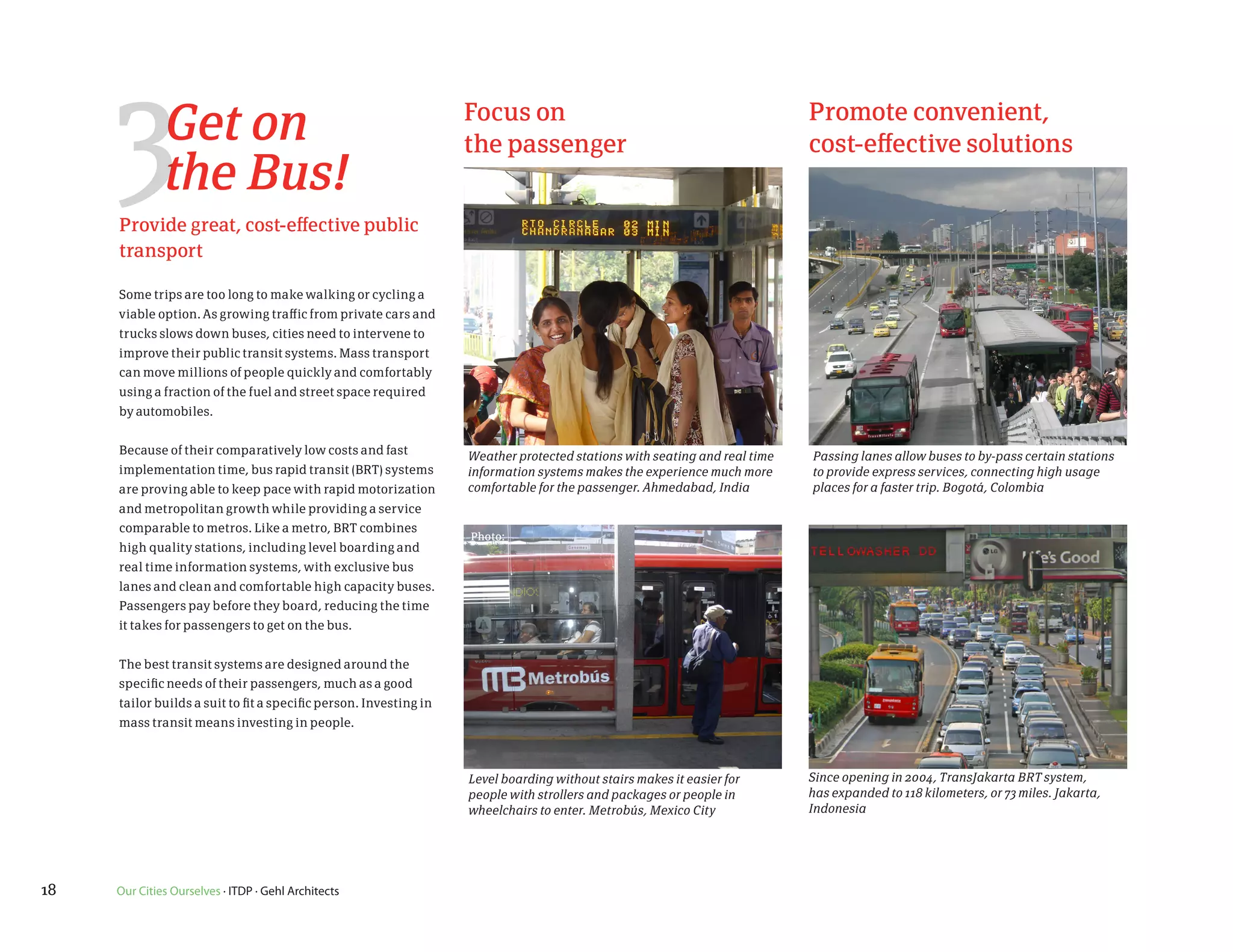
     Because of their comparatively low costs and fast             Weather protected stations with seating and real time   Passing lanes allow buses to by-pass certain stations
     implementation time, bus rapid transit (BRT) systems          information systems makes the experience much more      to provide express services, connecting high usage
     are proving able to keep pace with rapid motorization         comfortable for the passenger. Ahmedabad, India         places for a faster trip. Bogotá, Colombia
     and metropolitan growth while providing a service
     comparable to metros. Like a metro, BRT combines
                                                                   Photo:
     high quality stations, including level boarding and
     real time information systems, with exclusive bus
     lanes and clean and comfortable high capacity buses.
     Passengers pay before they board, reducing the time
     it takes for passengers to get on the bus.


     The best transit systems are designed around the
     specific needs of their passengers, much as a good
     tailor builds a suit to fit a specific person. Investing in
     mass transit means investing in people.


                                                                   Level boarding without stairs makes it easier for       Since opening in 2004, TransJakarta BRT system,
                                                                   people with strollers and packages or people in         has expanded to 118 kilometers, or 73 miles. Jakarta,
                                                                   wheelchairs to enter. Metrobús, Mexico City             Indonesia


18   Our Cities Ourselves · ITDP · Gehl Architects
Make it flexible                                         Make it sensitive to the                                 What does it mean
and responsive                                           street environment
                                                                                                                     for the planet:
                                                                                                               A bus can typically carry over
                                                                                                               8 times as many people as
                                                                                                               cars and proportionately use a
                                                                                                               fraction of the amount of energy
                                                                                                               per passenger. This benefits
                                                                                                               both global climate and street
                                                                                                               environment in cities.


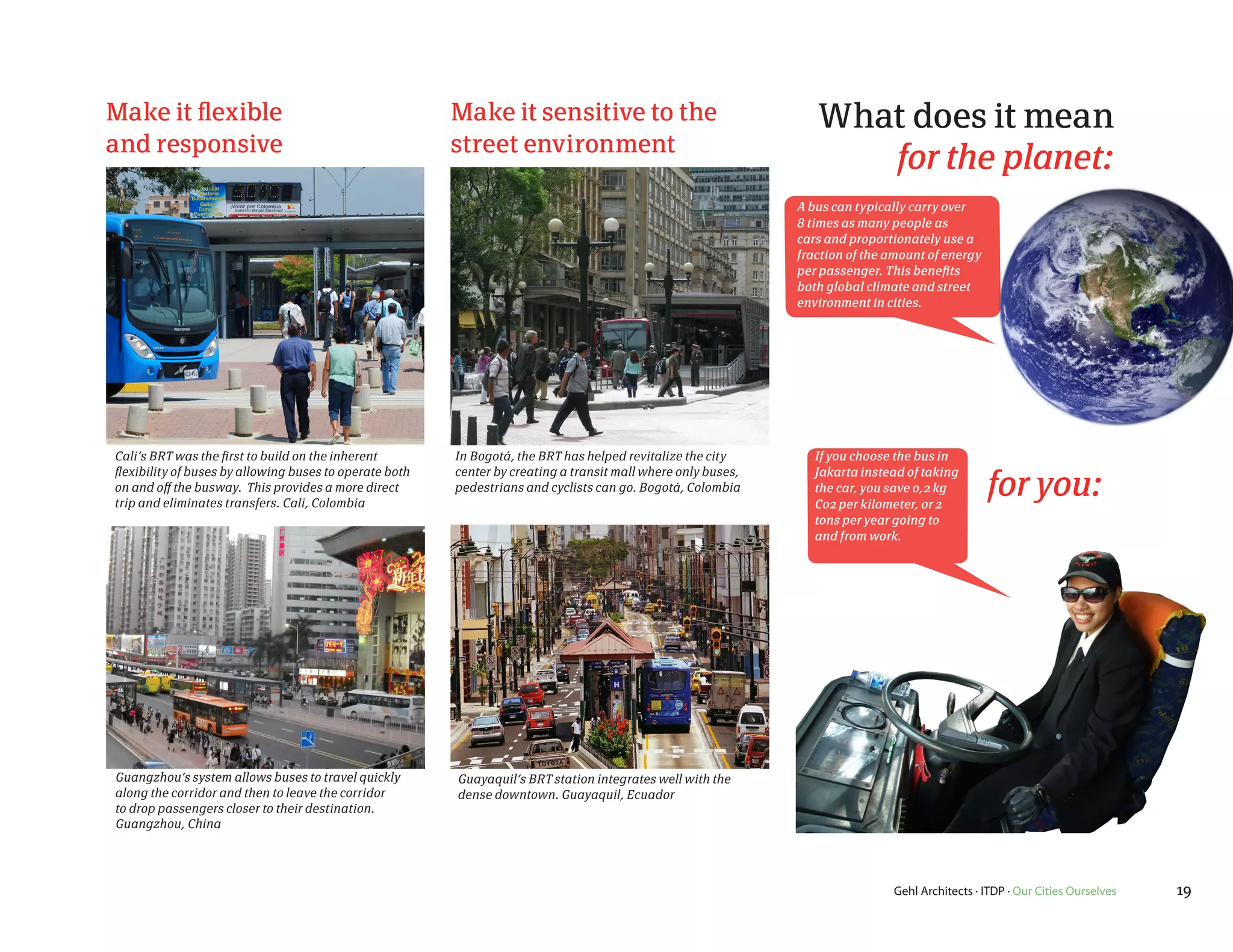
Cali’s BRT was the first to build on the inherent        In Bogotá, the BRT has helped revitalize the city        If you choose the bus in

                                                                                                                                                  for you:
flexibility of buses by allowing buses to operate both   center by creating a transit mall where only buses,      Jakarta instead of taking
on and off the busway. This provides a more direct       pedestrians and cyclists can go. Bogotá, Colombia        the car, you save 0,2 kg
trip and eliminates transfers. Cali, Colombia                                                                     Co2 per kilometer, or 2
                                                                                                                  tons per year going to
                                                                                                                  and from work.


Guangzhou’s system allows buses to travel quickly        Guayaquil’s BRT station integrates well with the
along the corridor and then to leave the corridor        dense downtown. Guayaquil, Ecuador
to drop passengers closer to their destination.
Guangzhou, China


                                                                                                                               Gehl Architects · ITDP · Our Cities Ourselves   19
Case Study
     Rea Vaya BRT                                             Photo: Philip Mostert


     Johannesburg, South Africa

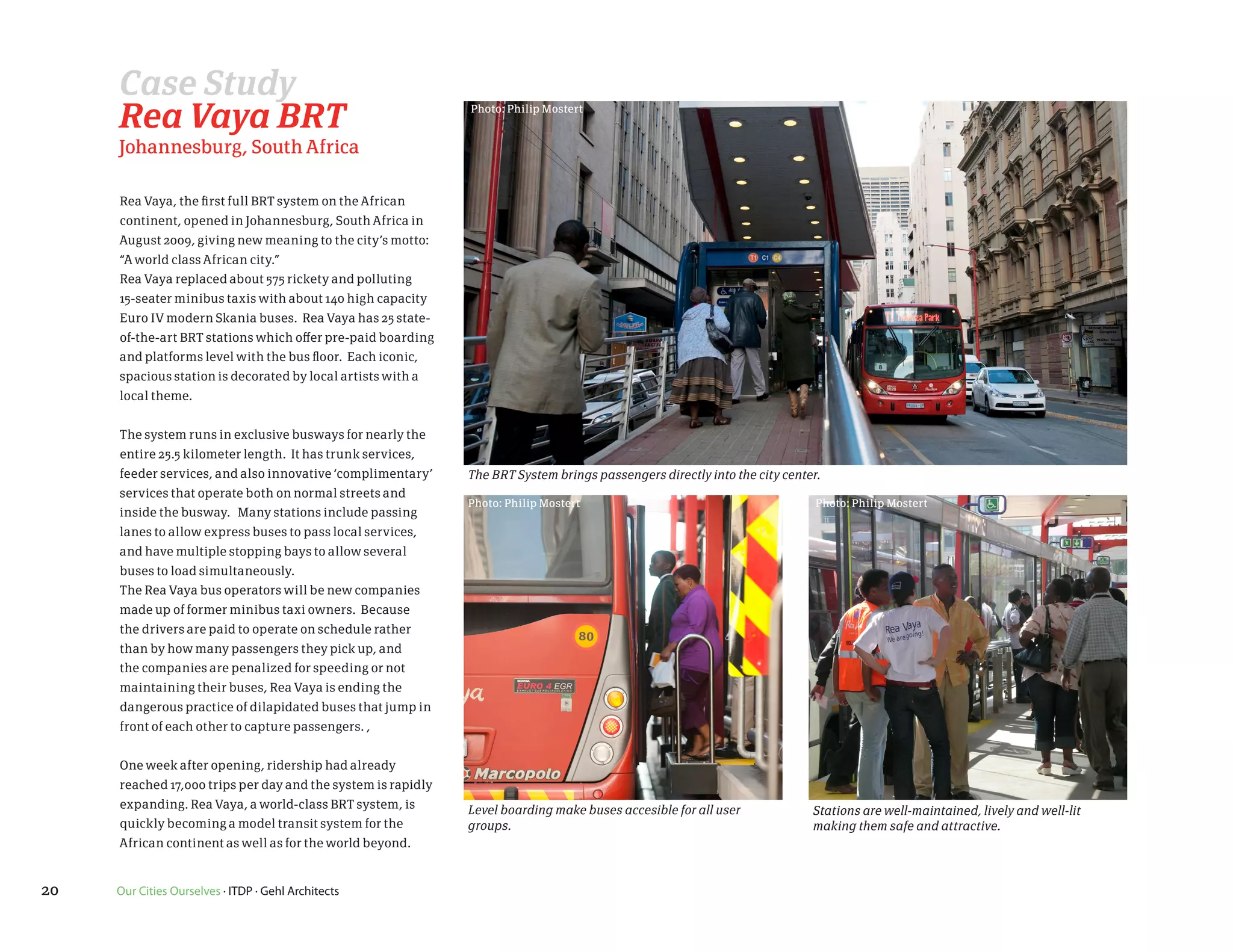
     Rea Vaya, the first full BRT system on the African
     continent, opened in Johannesburg, South Africa in
     August 2009, giving new meaning to the city’s motto:
     “A world class African city.”
     Rea Vaya replaced about 575 rickety and polluting
     15-seater minibus taxis with about 140 high capacity
     Euro IV modern Skania buses. Rea Vaya has 25 state-
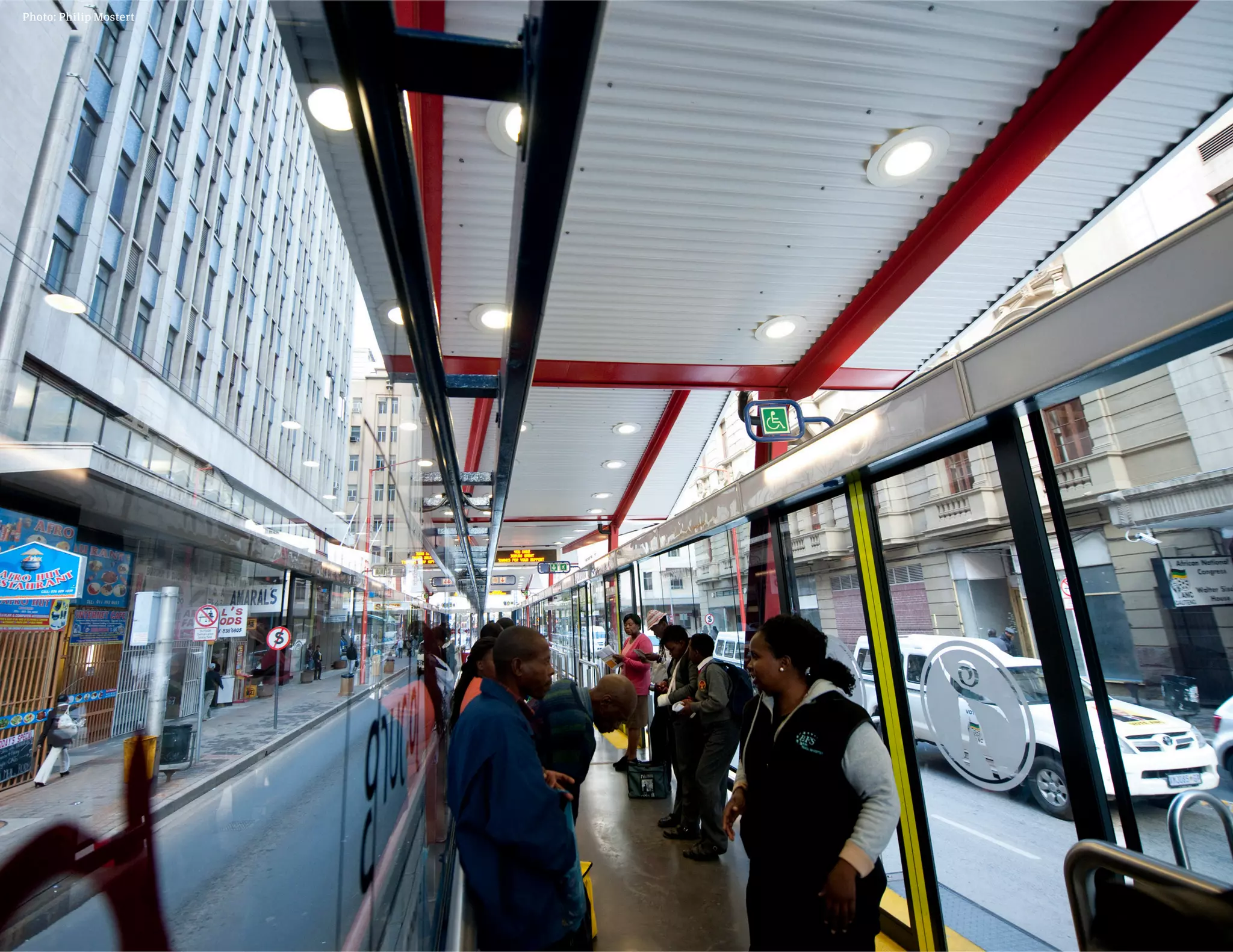
     of-the-art BRT stations which offer pre-paid boarding
     and platforms level with the bus floor. Each iconic,
     spacious station is decorated by local artists with a
     local theme.


     The system runs in exclusive busways for nearly the
     entire 25.5 kilometer length. It has trunk services,
     feeder services, and also innovative ‘complimentary’     The BRT System brings passengers directly into the city center.
     services that operate both on normal streets and
                                                              Photo: Philip Mostert                                         Photo: Philip Mostert
     inside the busway. Many stations include passing
     lanes to allow express buses to pass local services,
     and have multiple stopping bays to allow several
     buses to load simultaneously.
     The Rea Vaya bus operators will be new companies
     made up of former minibus taxi owners. Because
     the drivers are paid to operate on schedule rather
     than by how many passengers they pick up, and
     the companies are penalized for speeding or not
     maintaining their buses, Rea Vaya is ending the
     dangerous practice of dilapidated buses that jump in
     front of each other to capture passengers. ,


     One week after opening, ridership had already
     reached 17,000 trips per day and the system is rapidly
     expanding. Rea Vaya, a world-class BRT system, is        Level boarding make buses accesible for all user             Stations are well-maintained, lively and well-lit
     quickly becoming a model transit system for the          groups.                                                      making them safe and attractive.
     African continent as well as for the world beyond.


20   Our Cities Ourselves · ITDP · Gehl Architects
Photo: Philip Mostert


                        Gehl Architects · ITDP · Our Cities Ourselves   21
4           Cruise
                 Control
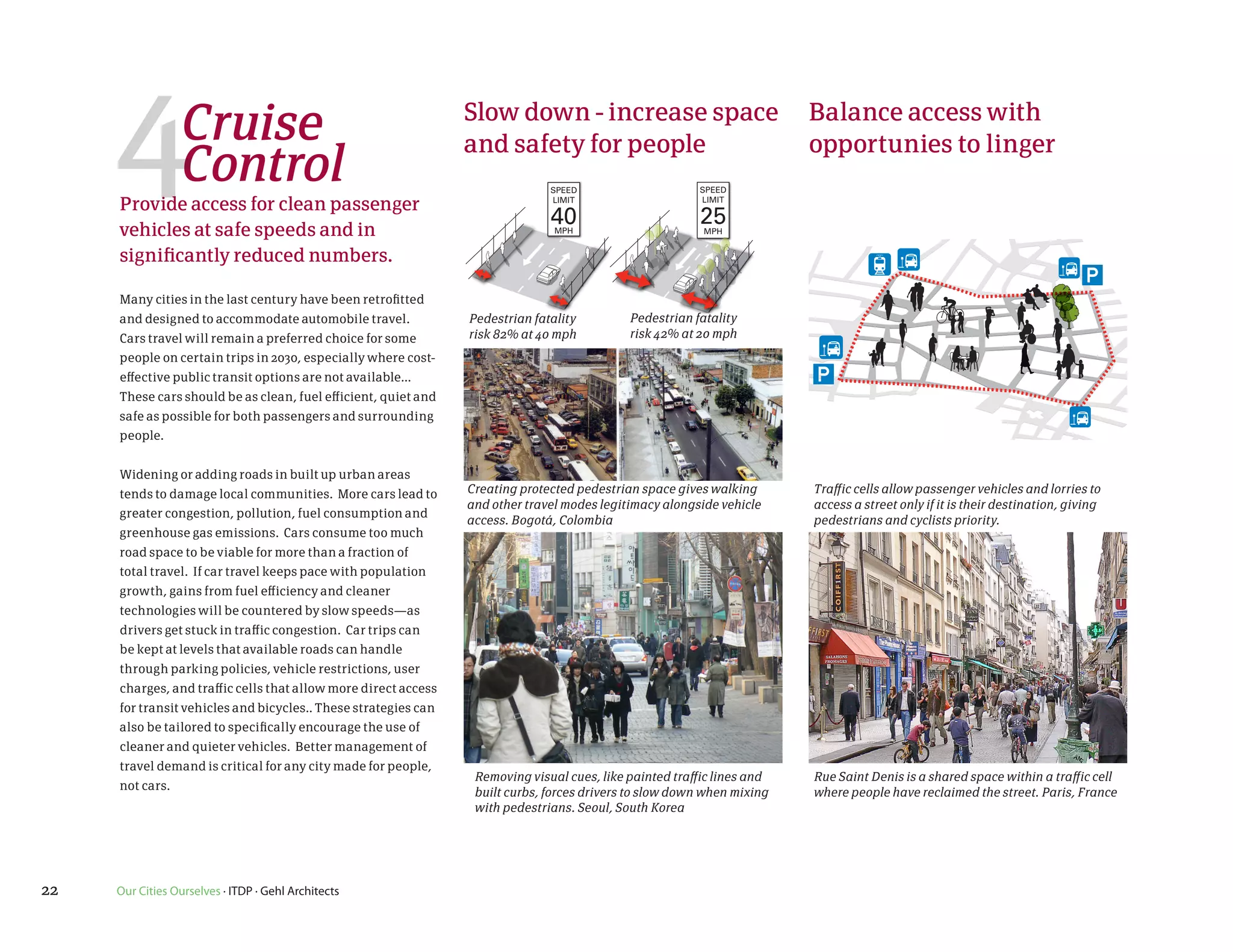
     Provide access for clean passenger
     vehicles at safe speeds and in
                                                                Slow down - increase space
                                                                and safety for people
                                                                              SPEED
                                                                              LIMIT

                                                                              40
                                                                               MPH
                                                                                                        SPEED
                                                                                                        LIMIT

                                                                                                        25
                                                                                                         MPH
                                                                                                                        Balance access with
                                                                                                                        opportunies to linger


     significantly reduced numbers.

     Many cities in the last century have been retrofitted
     and designed to accommodate automobile travel.             Pedestrian fatality         Pedestrian fatality
     Cars travel will remain a preferred choice for some        risk 82% at 40 mph          risk 42% at 20 mph
     people on certain trips in 2030, especially where cost-
     effective public transit options are not available...
     These cars should be as clean, fuel efficient, quiet and
     safe as possible for both passengers and surrounding
     people.


     Widening or adding roads in built up urban areas
     tends to damage local communities. More cars lead to       Creating protected pedestrian space gives walking       Traffic cells allow passenger vehicles and lorries to
                                                                and other travel modes legitimacy alongside vehicle     access a street only if it is their destination, giving
     greater congestion, pollution, fuel consumption and
                                                                access. Bogotá, Colombia                                pedestrians and cyclists priority.
     greenhouse gas emissions. Cars consume too much
     road space to be viable for more than a fraction of
     total travel. If car travel keeps pace with population
     growth, gains from fuel efficiency and cleaner
     technologies will be countered by slow speeds—as
     drivers get stuck in traffic congestion. Car trips can
     be kept at levels that available roads can handle
     through parking policies, vehicle restrictions, user
     charges, and traffic cells that allow more direct access
     for transit vehicles and bicycles.. These strategies can
     also be tailored to specifically encourage the use of
     cleaner and quieter vehicles. Better management of
     travel demand is critical for any city made for people,
                                                                 Removing visual cues, like painted traffic lines and   Rue Saint Denis is a shared space within a traffic cell
     not cars.
                                                                 built curbs, forces drivers to slow down when mixing   where people have reclaimed the street. Paris, France
                                                                 with pedestrians. Seoul, South Korea


22   Our Cities Ourselves · ITDP · Gehl Architects
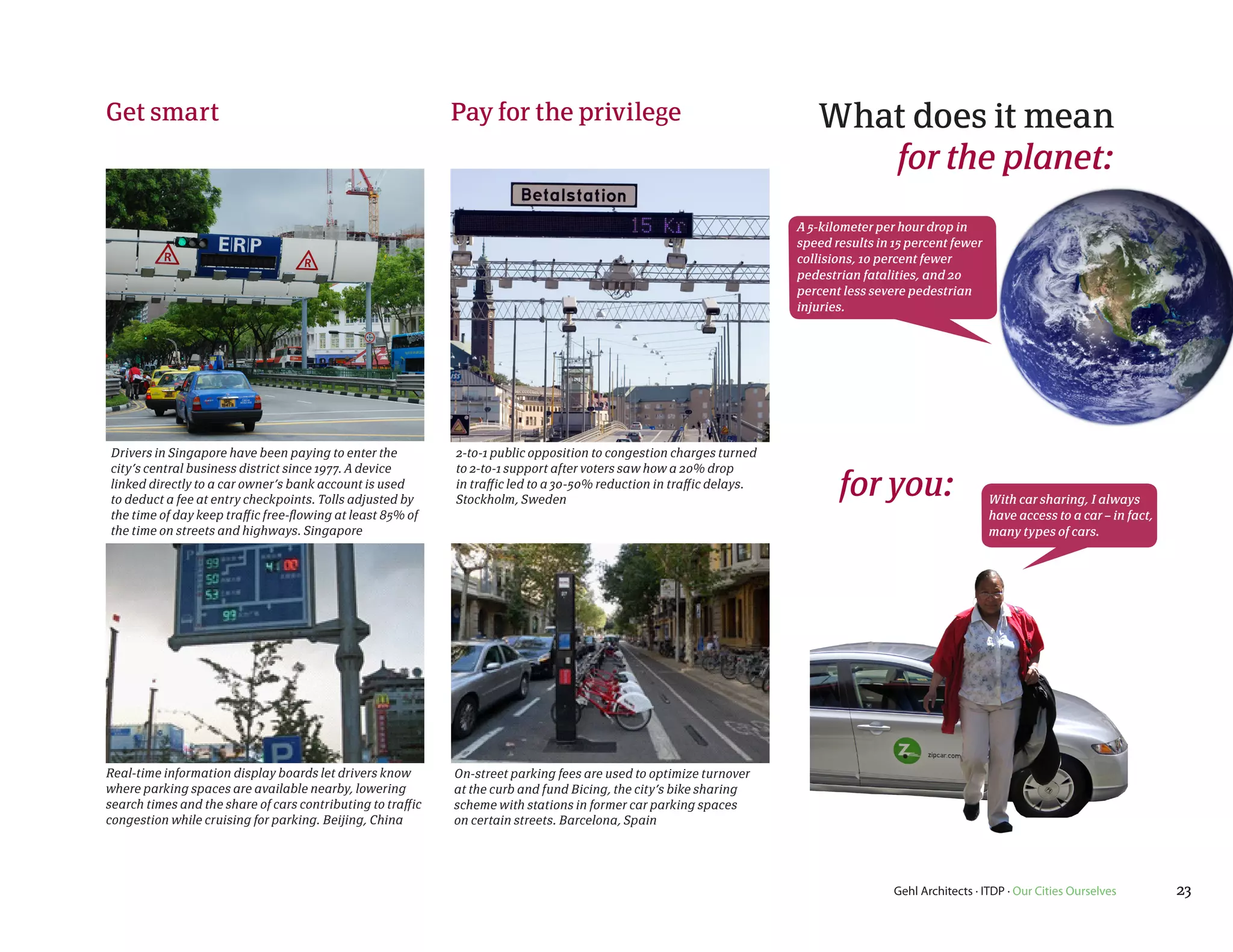
Get smart                                                    Pay for the privilege                                        What does it mean
                                                                                                                             for the planet:
                                                                                                                       A 5-kilometer per hour drop in
                                                                                                                       speed results in 15 percent fewer
                                                                                                                       collisions, 10 percent fewer
                                                                                                                       pedestrian fatalities, and 20
                                                                                                                       percent less severe pedestrian
                                                                                                                       injuries.


Drivers in Singapore have been paying to enter the           2-to-1 public opposition to congestion charges turned
city’s central business district since 1977. A device        to 2-to-1 support after voters saw how a 20% drop
linked directly to a car owner’s bank account is used
to deduct a fee at entry checkpoints. Tolls adjusted by
                                                             in traffic led to a 30-50% reduction in traffic delays.
                                                             Stockholm, Sweden
                                                                                                                              for you:                     With car sharing, I always
the time of day keep traffic free-flowing at least 85% of                                                                                                  have access to a car – in fact,
the time on streets and highways. Singapore                                                                                                                many types of cars.


Real-time information display boards let drivers know        On-street parking fees are used to optimize turnover
where parking spaces are available nearby, lowering          at the curb and fund Bicing, the city’s bike sharing
search times and the share of cars contributing to traffic   scheme with stations in former car parking spaces
congestion while cruising for parking. Beijing, China        on certain streets. Barcelona, Spain


                                                                                                                                        Gehl Architects · ITDP · Our Cities Ourselves        23
Case Study
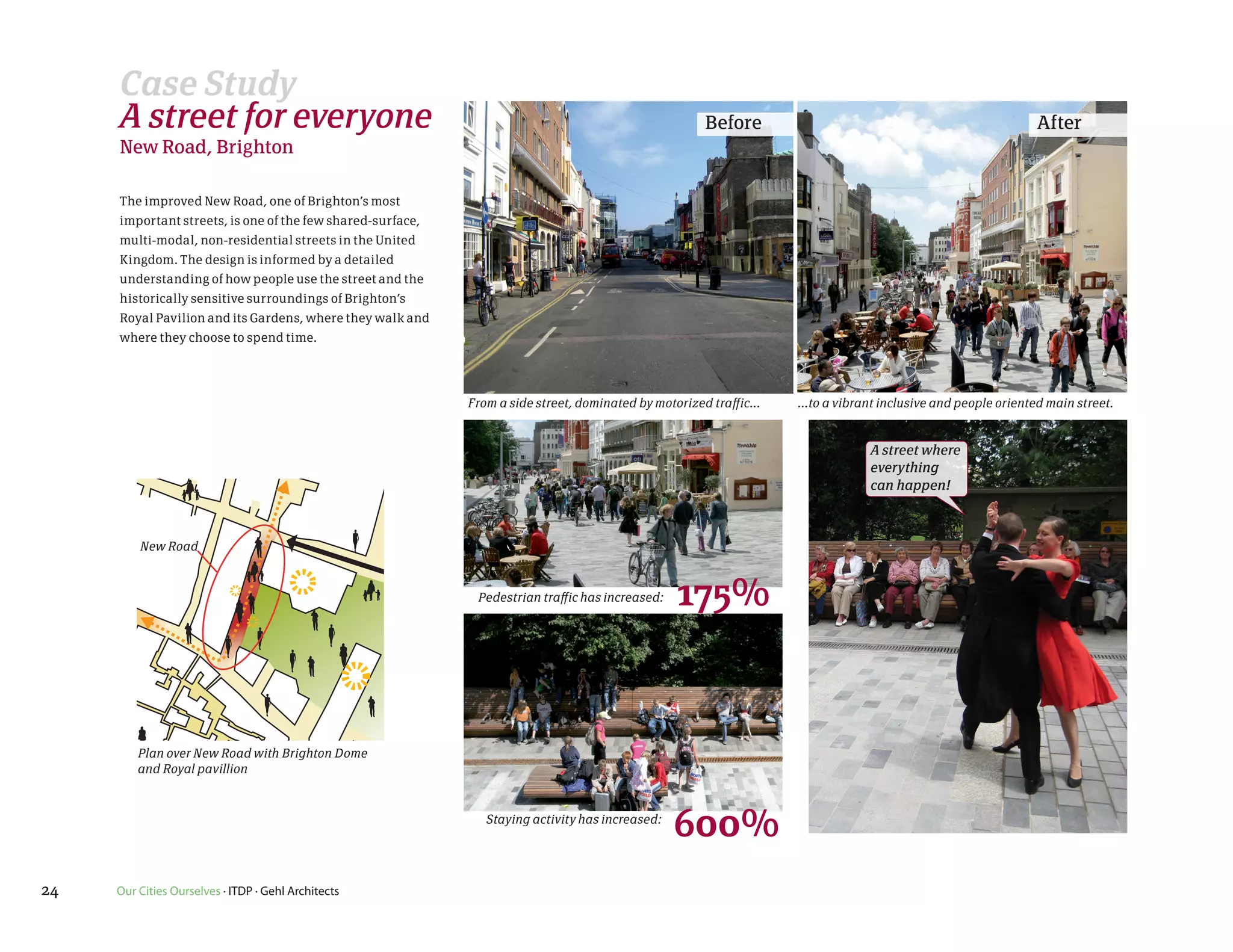
     A street for everyone                                                                            Before                                                    After
     New Road, Brighton

     The improved New Road, one of Brighton’s most
     important streets, is one of the few shared-surface,
     multi-modal, non-residential streets in the United
     Kingdom. The design is informed by a detailed
     understanding of how people use the street and the
     historically sensitive surroundings of Brighton’s
     Royal Pavilion and its Gardens, where they walk and
     where they choose to spend time.


                                                            From a side street, dominated by motorized traffic...   ...to a vibrant inclusive and people oriented main street.


                                                                                                                                 A street where
                                                                                                                                 everything ...to a vibrant,
                                                                                                                                 can happen! inclusive & people
                                                                                                                                               oriented street

         New Road


                                                             Pedestrian traffic has increased:   175%


         Plan over New Road with Brighton Dome
         and Royal pavillion


                                                               Staying activity has increased:
                                                                                                 600%
24   Our Cities Ourselves · ITDP · Gehl Architects
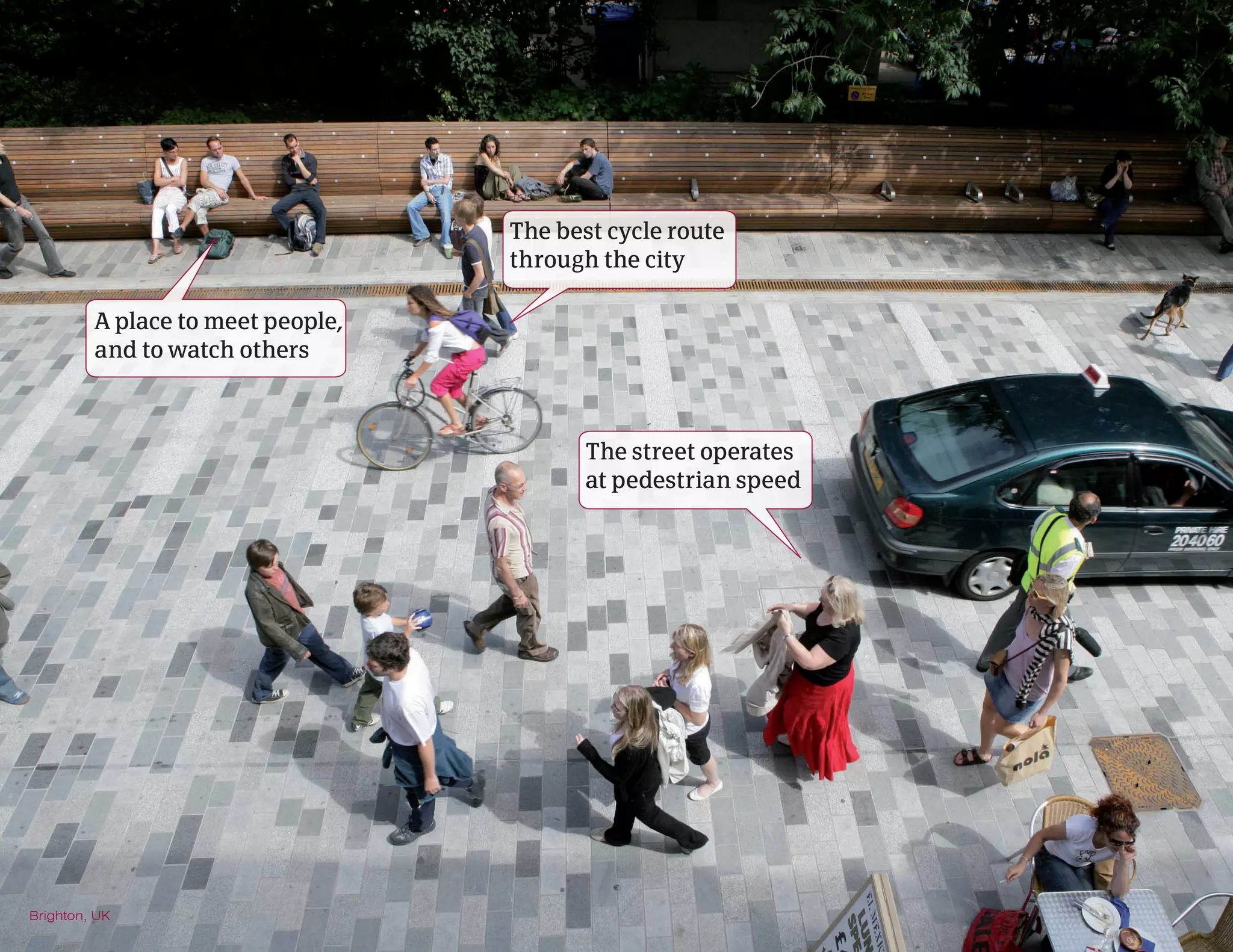
The best cycle route
                                   through the city

         A place to meet people,
         and to watch others


                                          The street operates
                                          at pedestrian speed


                                                                Gehl Architects · ITDP · Our Cities Ourselves   25
Brighton, UK
5           Deliver
                the Goods
    Servicing the city in the cleanest
                                                             Going the last mile


                                                                   City
                                                                                           Regional distribution
                                                                                           centres
                                                                                                                        Regulate for results


    and safest manner                                                                                                                                               CO2
                                                                small Vehicles

                                                                                                                         CO2
                                                                                                                                             CO2
                                                                                                                                    +                     =
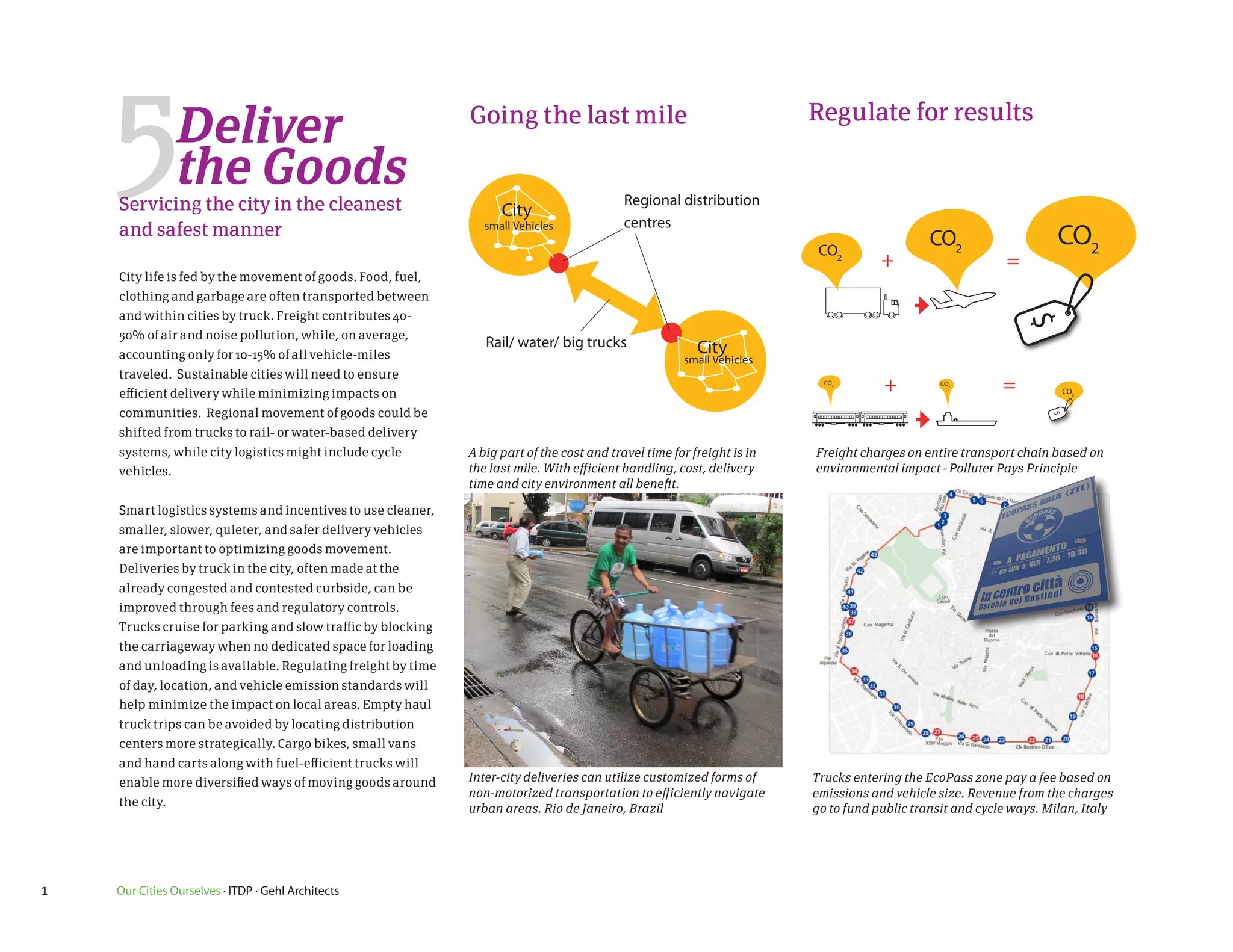
    City life is fed by the movement of goods. Food, fuel,
    clothing and garbage are often transported between
    and within cities by truck. Freight contributes 40-


                                                                                                                                                              $
    50% of air and noise pollution, while, on average,
                                                                Rail/ water/ big trucks                  City
    accounting only for 10-15% of all vehicle-miles                                                   small Vehicles
    traveled. Sustainable cities will need to ensure
    efficient delivery while minimizing impacts on
                                                                                                                          CO2
                                                                                                                                    +          CO2
                                                                                                                                                          =            CO2

    communities. Regional movement of goods could be


                                                                                                                                                                   $
    shifted from trucks to rail- or water-based delivery
    systems, while city logistics might include cycle        A big part of the cost and travel time for freight is in   Freight charges on entire transport chain based on
    vehicles.                                                the last mile. With efficient handling, cost, delivery     environmental impact - Polluter Pays Principle
                                                             time and city environment all benefit.

    Smart logistics systems and incentives to use cleaner,
    smaller, slower, quieter, and safer delivery vehicles
    are important to optimizing goods movement.
    Deliveries by truck in the city, often made at the
    already congested and contested curbside, can be
    improved through fees and regulatory controls.
    Trucks cruise for parking and slow traffic by blocking
    the carriageway when no dedicated space for loading
    and unloading is available. Regulating freight by time
    of day, location, and vehicle emission standards will
    help minimize the impact on local areas. Empty haul
    truck trips can be avoided by locating distribution
    centers more strategically. Cargo bikes, small vans
    and hand carts along with fuel-efficient trucks will
    enable more diversified ways of moving goods around      Inter-city deliveries can utilize customized forms of      Trucks entering the EcoPass zone pay a fee based on
                                                             non-motorized transportation to efficiently navigate       emissions and vehicle size. Revenue from the charges
    the city.
                                                             urban areas. Rio de Janeiro, Brazil                        go to fund public transit and cycle ways. Milan, Italy


1   Our Cities Ourselves · ITDP · Gehl Architects
Manage the curb                                            Diversify deliveries                                           What does it mean
                                                                                                                             for the planet:
                                                                                                                    Every year in the state of
                                                                                                                    california, the air pollution
                                                                                                                    generated by the movement of
                                                                                                                    goods causes an estimated 3,940

            10am-                                                                                                   Californians to die prematurely
                                                                                                                    and costs $34 billion in associated

             2 pm                                                                                                   health care costs.
                                                                                                                    Lin/Prakash, Taking a Toll, 2009


                                                                                                                                                           If you live in New York,buying
                                                                                                                                                           a bottle of wine from California
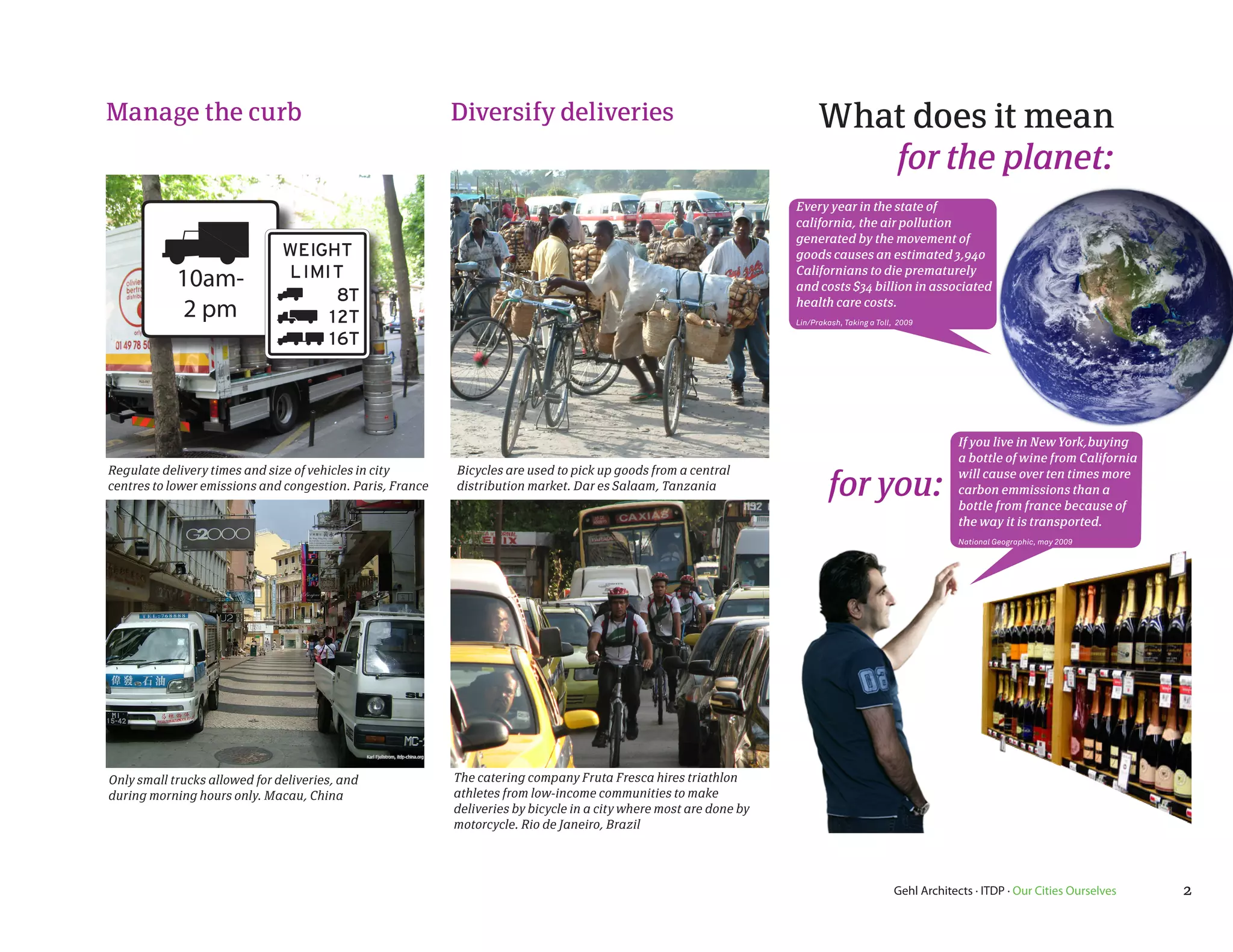
Regulate delivery times and size of vehicles in city       Bicycles are used to pick up goods from a central
                                                                                                                            for you:
                                                                                                                                                           will cause over ten times more
centres to lower emissions and congestion. Paris, France   distribution market. Dar es Salaam, Tanzania                                                    carbon emmissions than a
                                                                                                                                                           bottle from france because of
                                                                                                                                                           the way it is transported.
                                                                                                                                                           National Geographic, may 2009


Only small trucks allowed for deliveries, and              The catering company Fruta Fresca hires triathlon
during morning hours only. Macau, China                    athletes from low-income communities to make
                                                           deliveries by bicycle in a city where most are done by
                                                           motorcycle. Rio de Janeiro, Brazil


                                                                                                                                              Gehl Architects · ITDP · Our Cities Ourselves   2
Case Study
    German Incentives                                        www.dasautoblog.com
                                                                                                                           Over one-third of trucks that
    for Clean Trucking                                                                                                     use German highways are
                                                                                                                           from neighboring countries.

    Between Cities
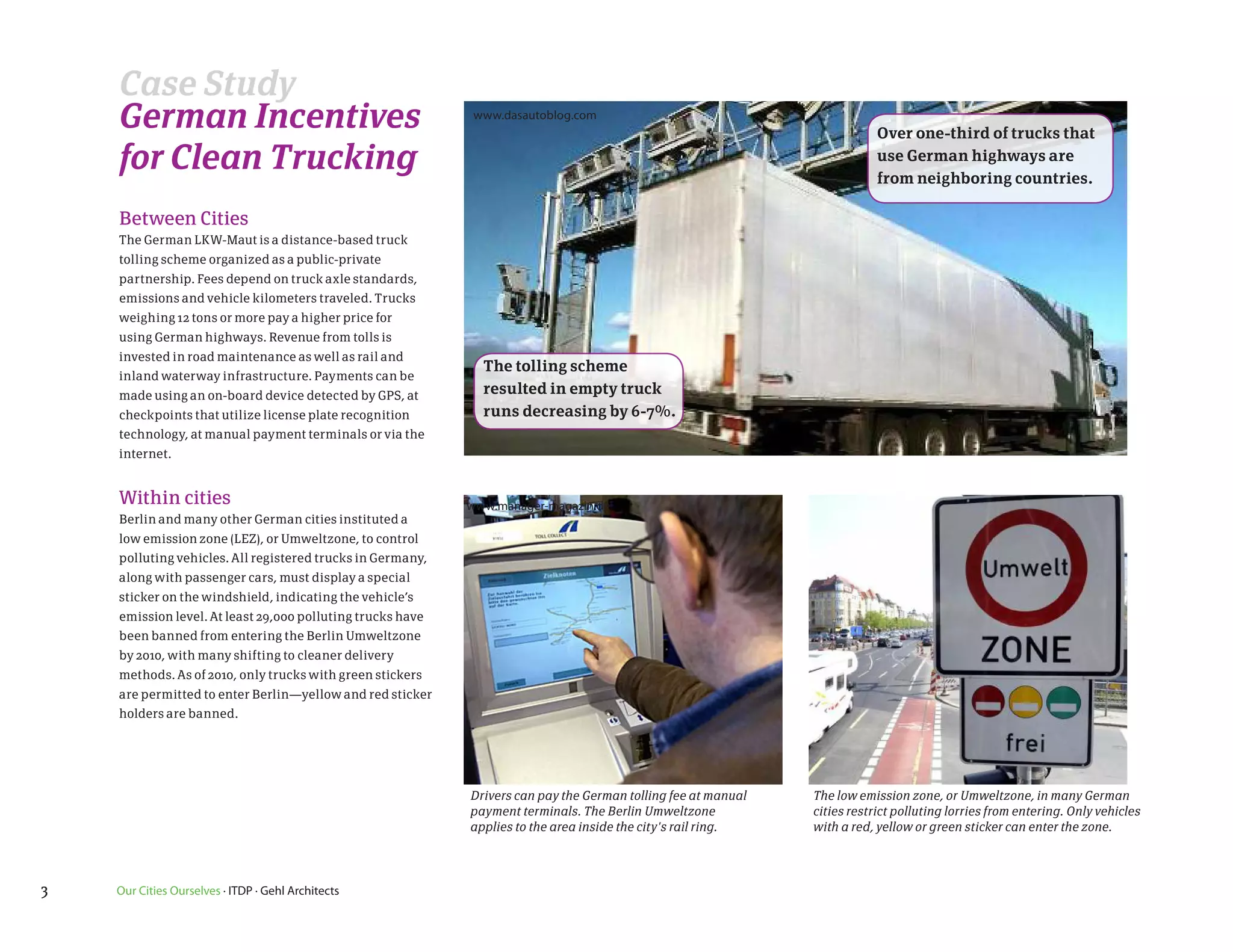
    The German LKW-Maut is a distance-based truck
    tolling scheme organized as a public-private
    partnership. Fees depend on truck axle standards,
    emissions and vehicle kilometers traveled. Trucks
    weighing 12 tons or more pay a higher price for
    using German highways. Revenue from tolls is
    invested in road maintenance as well as rail and
                                                              The tolling scheme
    inland waterway infrastructure. Payments can be
    made using an on-board device detected by GPS, at         resulted in empty truck
    checkpoints that utilize license plate recognition        runs decreasing by 6-7%.
    technology, at manual payment terminals or via the
    internet.


    Within cities                                           www.manager-magazin.de
    Berlin and many other German cities instituted a
    low emission zone (LEZ), or Umweltzone, to control
    polluting vehicles. All registered trucks in Germany,
    along with passenger cars, must display a special
    sticker on the windshield, indicating the vehicle’s
    emission level. At least 29,000 polluting trucks have
    been banned from entering the Berlin Umweltzone
    by 2010, with many shifting to cleaner delivery
    methods. As of 2010, only trucks with green stickers
    are permitted to enter Berlin—yellow and red sticker
    holders are banned.


                                                            Drivers can pay the German tolling fee at manual   The low emission zone, or Umweltzone, in many German
                                                            payment terminals. The Berlin Umweltzone           cities restrict polluting lorries from entering. Only vehicles
                                                            applies to the area inside the city's rail ring.   with a red, yellow or green sticker can enter the zone.


3   Our Cities Ourselves · ITDP · Gehl Architects
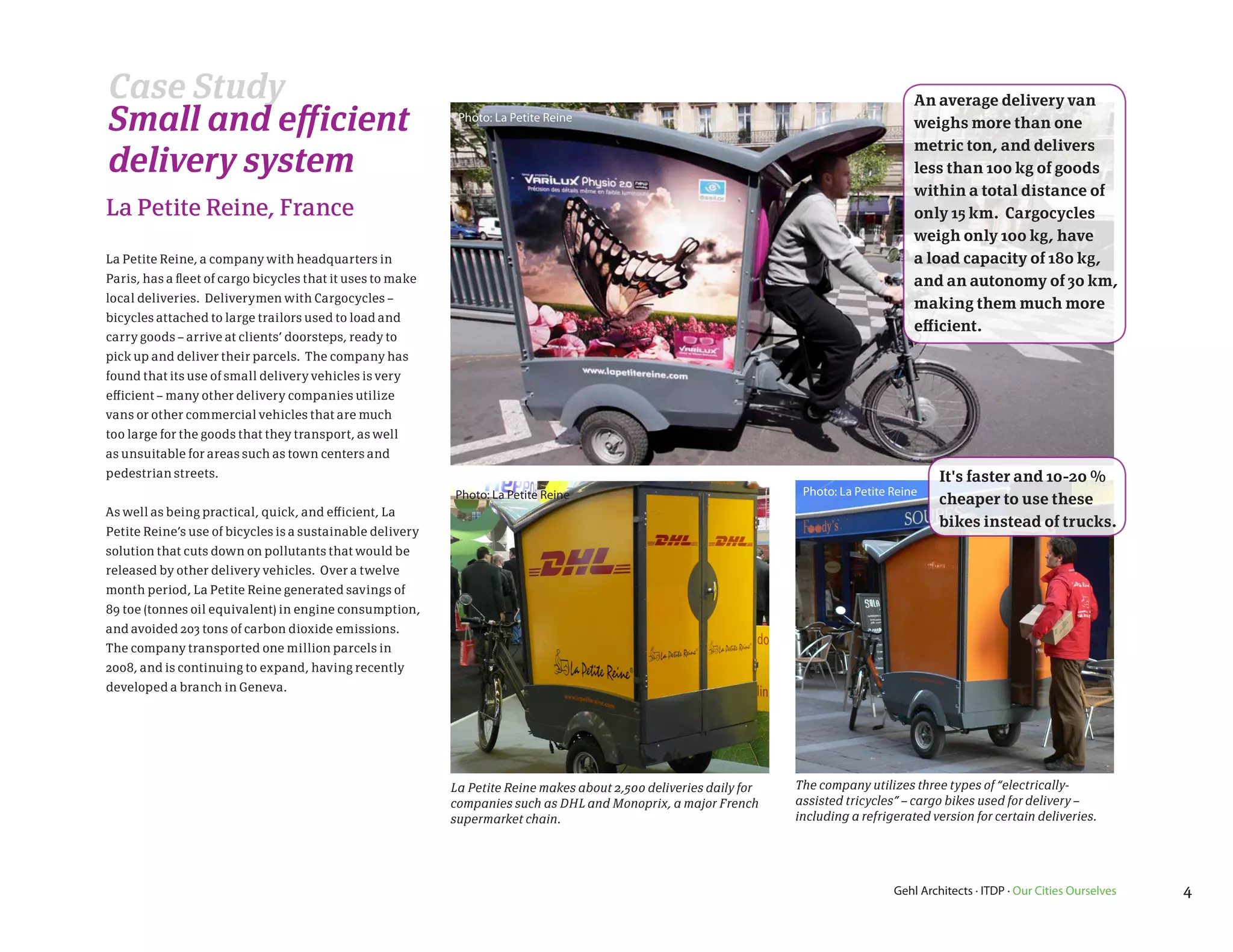
Case Study                                                                                                                                 An average delivery van
Small and efficient                                          Photo: La Petite Reine
                                                                                                                                           weighs more than one
                                                                                                                                           metric ton, and delivers
delivery system                                                                                                                            less than 100 kg of goods
                                                                                                                                           within a total distance of
La Petite Reine, France                                                                                                                    only 15 km. Cargocycles
                                                                                                                                           weigh only 100 kg, have
La Petite Reine, a company with headquarters in                                                                                            a load capacity of 180 kg,
Paris, has a fleet of cargo bicycles that it uses to make                                                                                  and an autonomy of 30 km,
local deliveries. Deliverymen with Cargocycles –                                                                                           making them much more
bicycles attached to large trailors used to load and
                                                                                                                                           efficient.
carry goods – arrive at clients’ doorsteps, ready to
pick up and deliver their parcels. The company has
found that its use of small delivery vehicles is very
efficient – many other delivery companies utilize
vans or other commercial vehicles that are much
too large for the goods that they transport, as well
as unsuitable for areas such as town centers and
pedestrian streets.                                                                                                                             It's faster and 10-20 %
                                                            Photo: La Petite Reine                                    Photo: La Petite Reine
                                                                                                                                                cheaper to use these
As well as being practical, quick, and efficient, La
                                                                                                                                                bikes instead of trucks.
Petite Reine’s use of bicycles is a sustainable delivery
solution that cuts down on pollutants that would be
released by other delivery vehicles. Over a twelve
month period, La Petite Reine generated savings of
89 toe (tonnes oil equivalent) in engine consumption,
and avoided 203 tons of carbon dioxide emissions.
The company transported one million parcels in
2008, and is continuing to expand, having recently
developed a branch in Geneva.


                                                            La Petite Reine makes about 2,500 deliveries daily for   The company utilizes three types of “electrically-
                                                            companies such as DHL and Monoprix, a major French       assisted tricycles” – cargo bikes used for delivery –
                                                            supermarket chain.                                       including a refrigerated version for certain deliveries.


                                                                                                                                       Gehl Architects · ITDP · Our Cities Ourselves   4
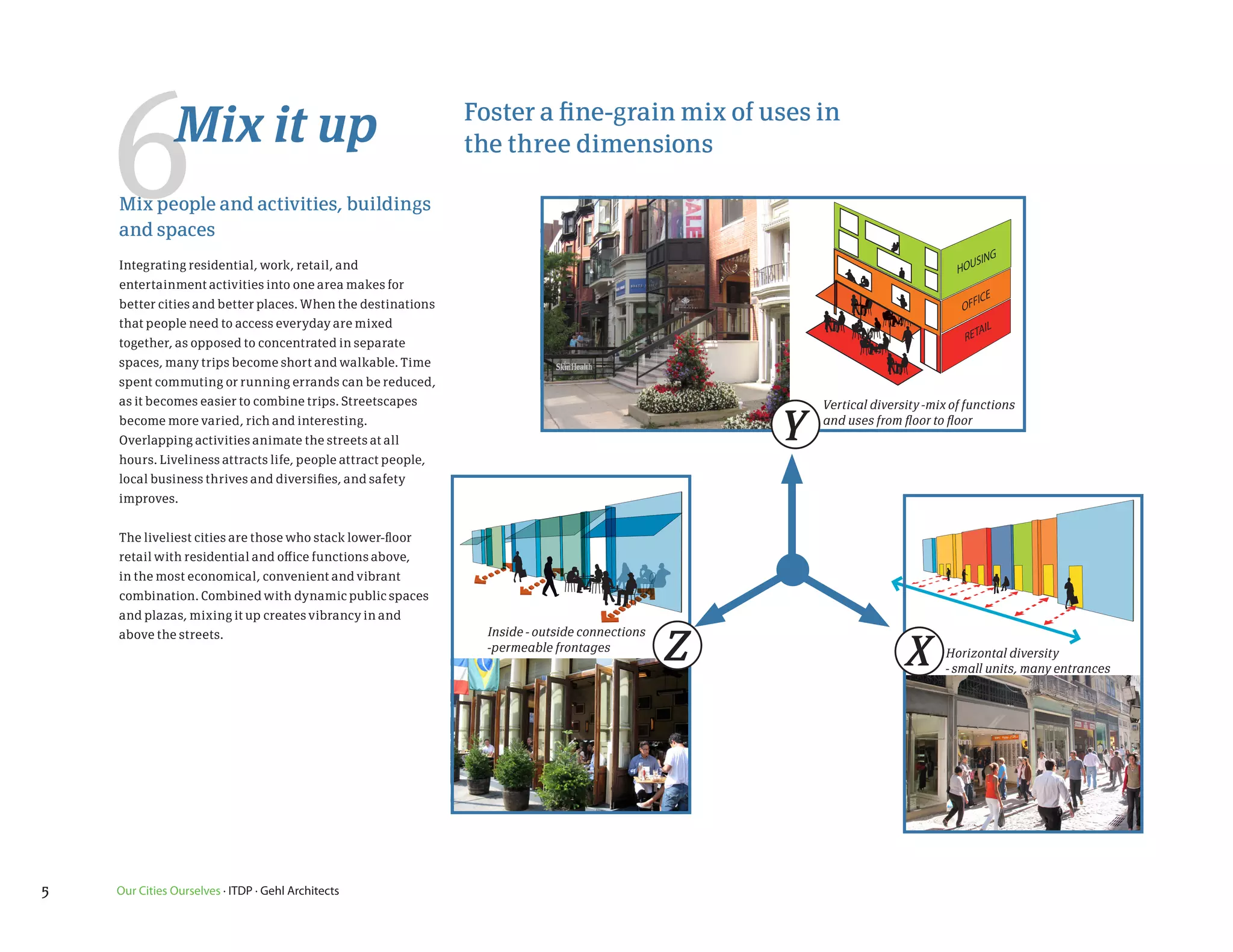
6          Mix it up                                      Foster a fine-grain mix of uses in
                                                              the three dimensions

    Mix people and activities, buildings
    and spaces
    Integrating residential, work, retail, and
    entertainment activities into one area makes for
    better cities and better places. When the destinations
    that people need to access everyday are mixed
    together, as opposed to concentrated in separate
    spaces, many trips become short and walkable. Time
    spent commuting or running errands can be reduced,
    as it becomes easier to combine trips. Streetscapes                                                Vertical diversity -mix of functions
    become more varied, rich and interesting.
    Overlapping activities animate the streets at all                                              Y   and uses from floor to floor


    hours. Liveliness attracts life, people attract people,
    local business thrives and diversifies, and safety
    improves.


    The liveliest cities are those who stack lower-floor
    retail with residential and office functions above,
    in the most economical, convenient and vibrant
    combination. Combined with dynamic public spaces
    and plazas, mixing it up creates vibrancy in and


                                                                                               Z
                                                                Inside - outside connections

                                                                                                                      X
    above the streets.
                                                                -permeable frontages                                          Horizontal diversity
                                                                                                                              - small units, many entrances


5   Our Cities Ourselves · ITDP · Gehl Architects
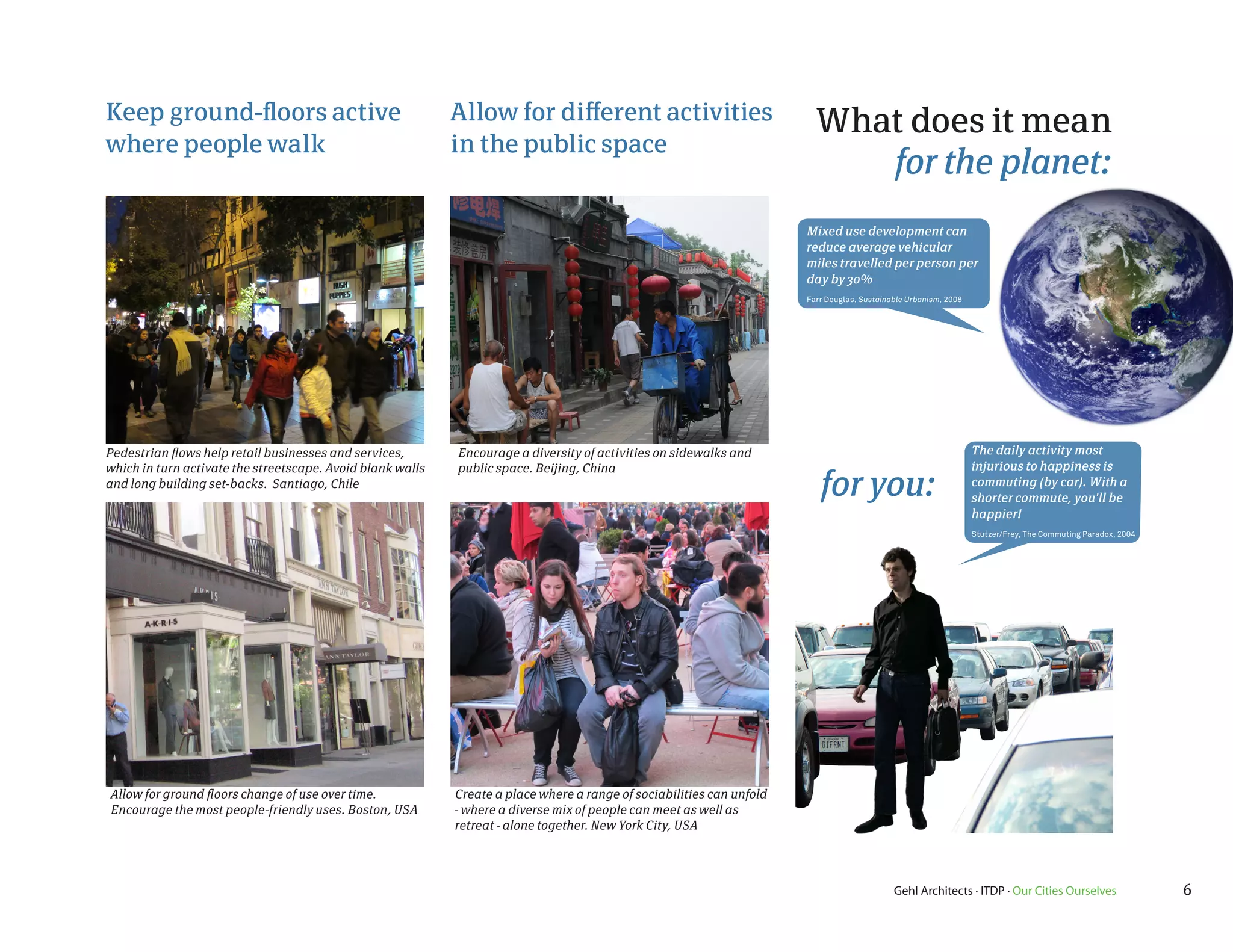
Keep ground-floors active                                   Allow for different activities                               What does it mean
where people walk                                           in the public space
                                                                                                                            for the planet:
                                                                                                                       Mixed use development can
                                                                                                                       reduce average vehicular
                                                                                                                       miles travelled per person per
                                                                                                                       day by 30%
                                                                                                                       Farr Douglas, Sustainable Urbanism, 2008


Pedestrian flows help retail businesses and services,       Encourage a diversity of activities on sidewalks and                                                  The daily activity most
which in turn activate the streetscape. Avoid blank walls   public space. Beijing, China                                                                          injurious to happiness is
and long building set-backs. Santiago, Chile
                                                                                                                          for you:                                commuting (by car). With a
                                                                                                                                                                  shorter commute, you'll be
                                                                                                                                                                  happier!
                                                                                                                                                                  Stutzer/Frey, The Commuting Paradox, 2004


Allow for ground floors change of use over time.            Create a place where a range of sociabilities can unfold
Encourage the most people-friendly uses. Boston, USA        - where a diverse mix of people can meet as well as
                                                            retreat - alone together. New York City, USA


                                                                                                                                             Gehl Architects · ITDP · Our Cities Ourselves                    6
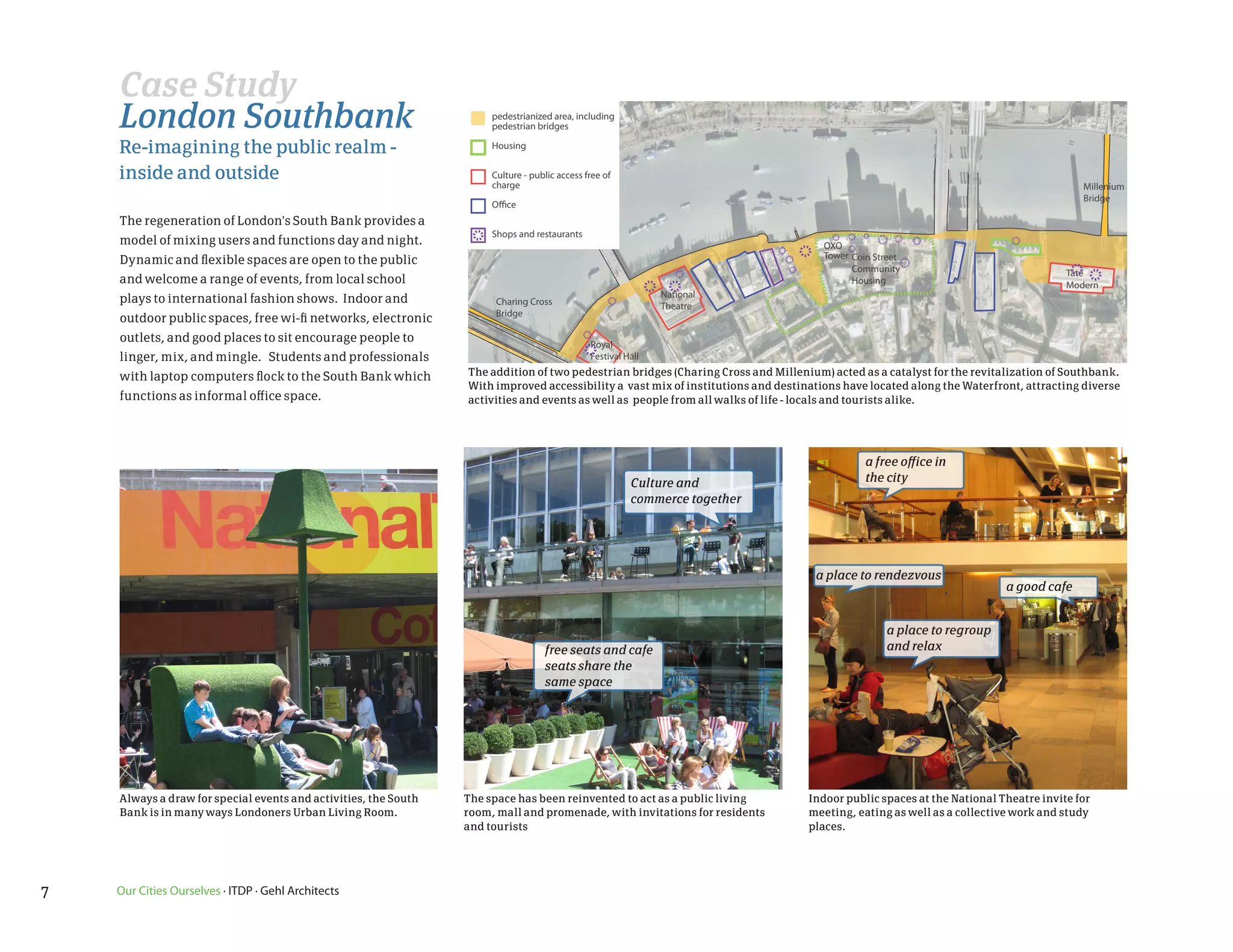
Case Study
    London Southbank                                                  pedestrianized area, including
                                                                      pedestrian bridges

    Re-imagining the public realm -                                   Housing


    inside and outside                                                Culture - public access free of
                                                                      charge                                                                                                           Millenium
                                                                                                                                                                                       Bridge
                                                                      O ce
    The regeneration of London's South Bank provides a
                                                                      Shops and restaurants
    model of mixing users and functions day and night.                                                                               OXO
                                                                                                                                     Tower Coin Street
    Dynamic and flexible spaces are open to the public
                                                                                                                                           Community                                Tate
    and welcome a range of events, from local school                                                                                       Housing                                  Modern
                                                                                                               National
    plays to international fashion shows. Indoor and                   Charing Cross                           Theatre
                                                                       Bridge
    outdoor public spaces, free wi-fi networks, electronic
    outlets, and good places to sit encourage people to                                        Royal
    linger, mix, and mingle. Students and professionals                                        Festival Hall

    with laptop computers flock to the South Bank which          The addition of two pedestrian bridges (Charing Cross and Millenium) acted as a catalyst for the revitalization of Southbank.
                                                                 With improved accessibility a vast mix of institutions and destinations have located along the Waterfront, attracting diverse
    functions as informal office space.                          activities and events as well as people from all walks of life - locals and tourists alike.


                                                                                                                                              a free office in
                                                                                                         Culture and                          the city
                                                                                                         commerce together


                                                                                                                                   a place to rendezvous
                                                                                                                                                                        a good cafe


                                                                                                                                                   a place to regroup
                                                                                   free seats and cafe                                             and relax
                                                                                   seats share the
                                                                                   same space


    Always a draw for special events and activities, the South   The space has been reinvented to act as a public living          Indoor public spaces at the National Theatre invite for
    Bank is in many ways Londoners Urban Living Room.            room, mall and promenade, with invitations for residents         meeting, eating as well as a collective work and study
                                                                 and tourists                                                     places.


7   Our Cities Ourselves · ITDP · Gehl Architects
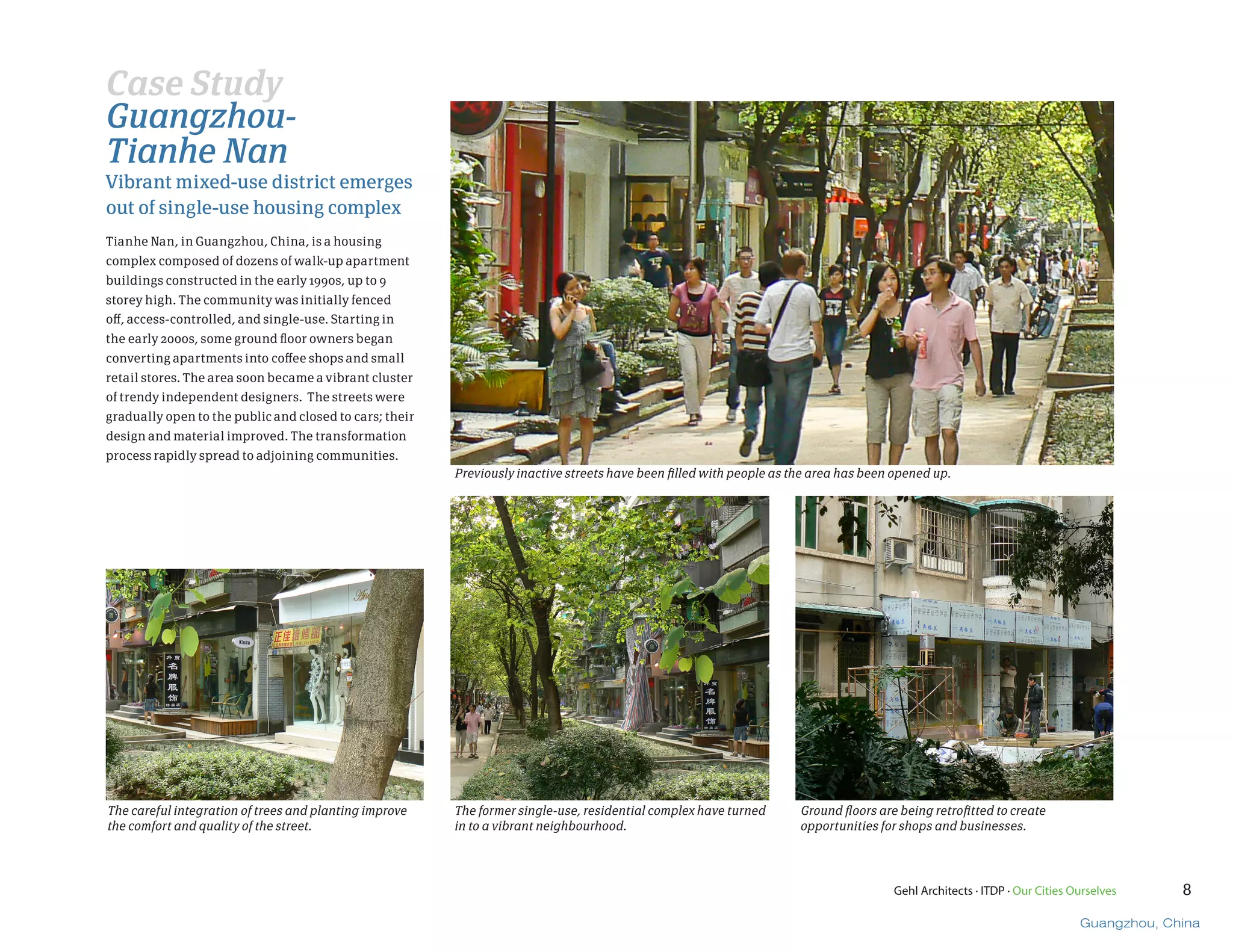
Case Study
Guangzhou-
Tianhe Nan
Vibrant mixed-use district emerges
out of single-use housing complex
Tianhe Nan, in Guangzhou, China, is a housing
complex composed of dozens of walk-up apartment
buildings constructed in the early 1990s, up to 9
storey high. The community was initially fenced
off, access-controlled, and single-use. Starting in
the early 2000s, some ground floor owners began
converting apartments into coffee shops and small
retail stores. The area soon became a vibrant cluster
of trendy independent designers. The streets were
gradually open to the public and closed to cars; their
design and material improved. The transformation
process rapidly spread to adjoining communities.
                                                         Previously inactive streets have been filled with people as the area has been opened up.


The careful integration of trees and planting improve    The former single-use, residential complex have turned       Ground floors are being retrofitted to create
the comfort and quality of the street.                   in to a vibrant neighbourhood.                               opportunities for shops and businesses.


                                                                                                                                       Gehl Architects · ITDP · Our Cities Ourselves     8

                                                                                                                                                                            Guangzhou, China
7          Fill it in
    Build dense, people and transit
                                                            Build density around transit nodes


    oriented urban districts that are
    desirable.
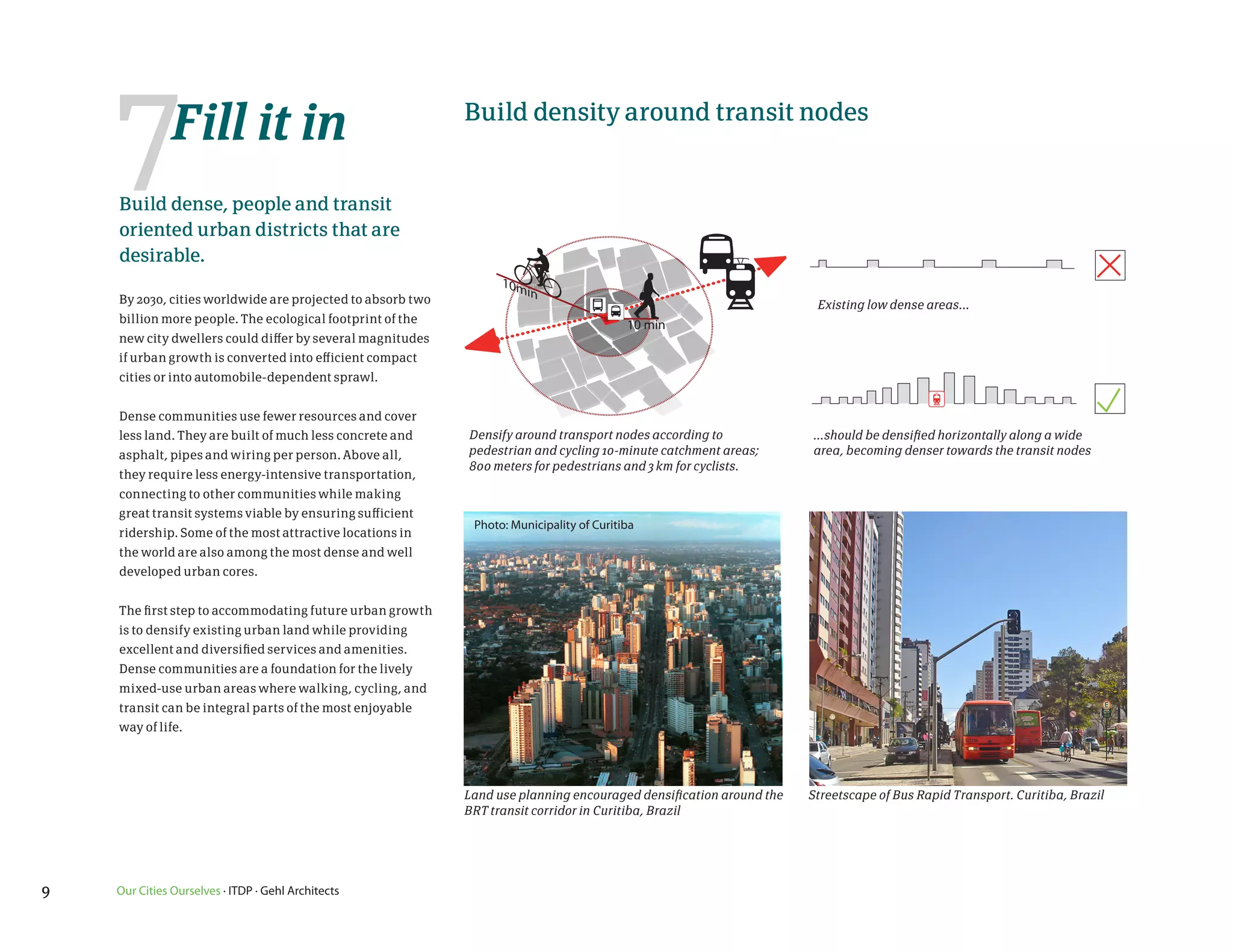
                                                                  10m
                                                                       in
    By 2030, cities worldwide are projected to absorb two                                                            Existing low dense areas...
    billion more people. The ecological footprint of the                                  10 min
    new city dwellers could differ by several magnitudes
    if urban growth is converted into efficient compact
    cities or into automobile-dependent sprawl.


    Dense communities use fewer resources and cover
    less land. They are built of much less concrete and     Densify around transport nodes according to             ...should be densified horizontally along a wide
    asphalt, pipes and wiring per person. Above all,        pedestrian and cycling 10-minute catchment areas;       area, becoming denser towards the transit nodes
                                                            800 meters for pedestrians and 3 km for cyclists.
    they require less energy-intensive transportation,
    connecting to other communities while making
    great transit systems viable by ensuring sufficient
                                                             Photo: Municipality of Curitiba
    ridership. Some of the most attractive locations in
    the world are also among the most dense and well
    developed urban cores.


    The first step to accommodating future urban growth
    is to densify existing urban land while providing
    excellent and diversified services and amenities.
    Dense communities are a foundation for the lively
    mixed-use urban areas where walking, cycling, and
    transit can be integral parts of the most enjoyable
    way of life.


                                                            Land use planning encouraged densification around the   Streetscape of Bus Rapid Transport. Curitiba, Brazil
                                                            BRT transit corridor in Curitiba, Brazil


9   Our Cities Ourselves · ITDP · Gehl Architects
Revitalize the existing                                  Intensify the urban fabric                                     What does it mean
before building new                                      by building in the gaps
                                                                                                                           for the planet:
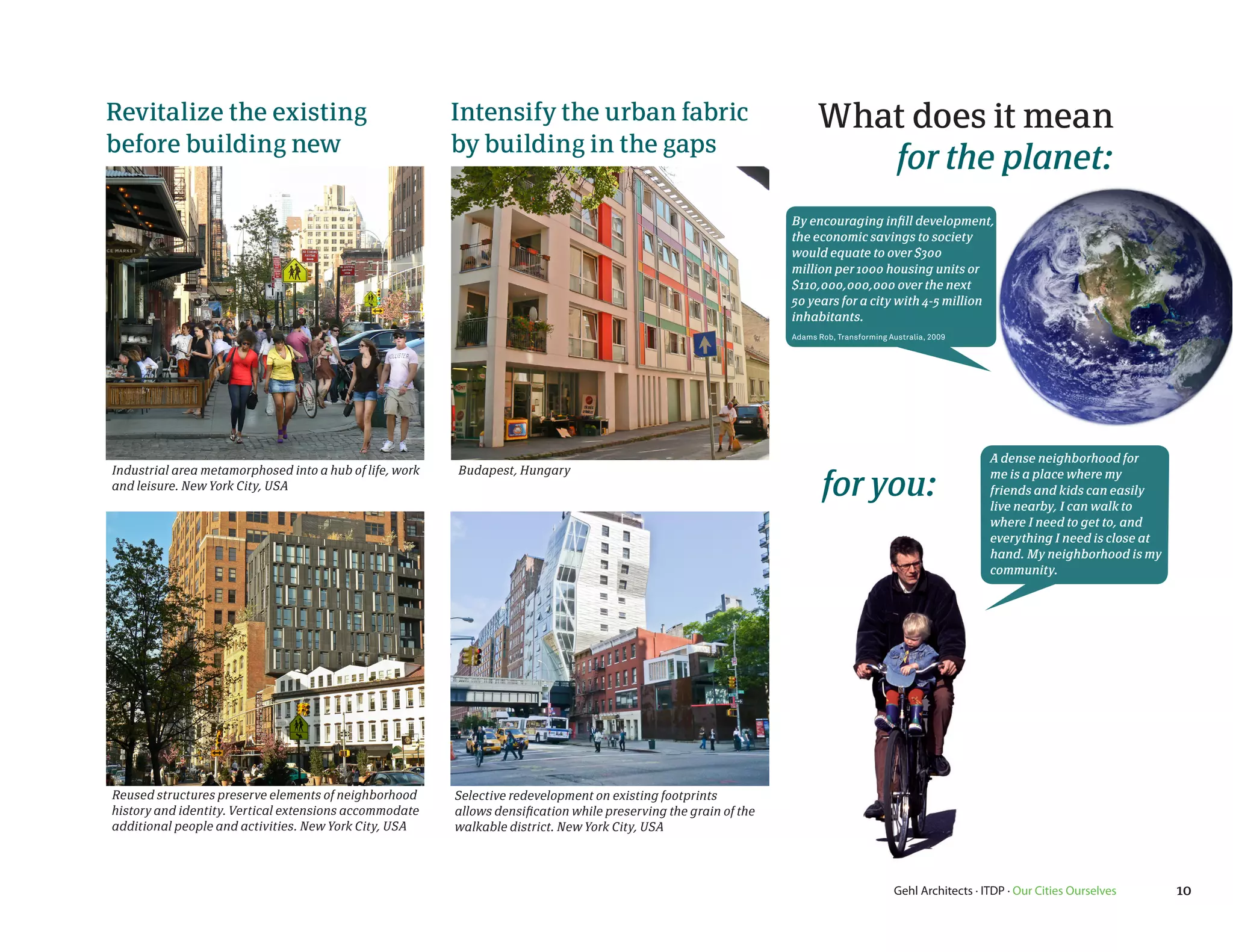
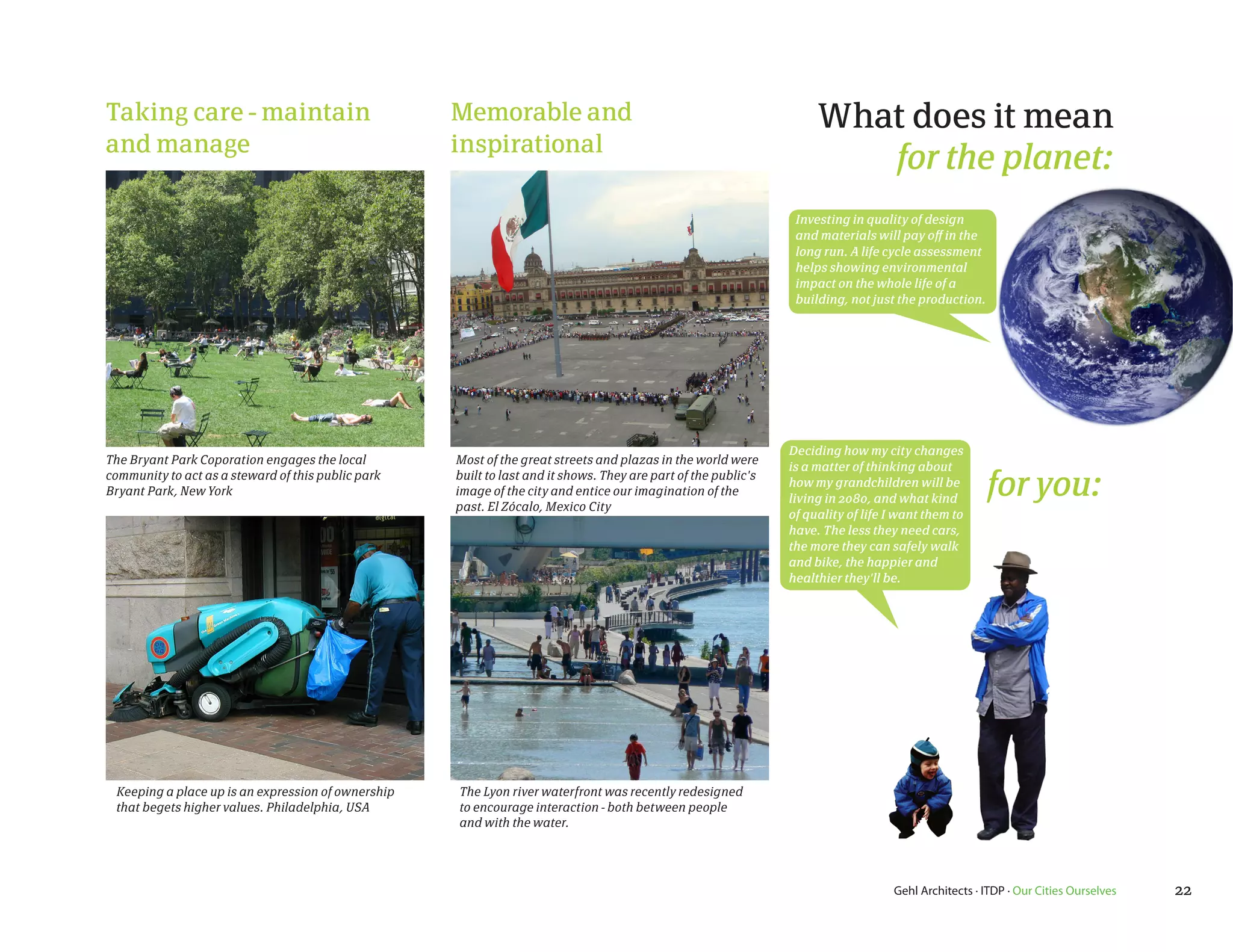
                                                                                                                  By encouraging infill development,
                                                                                                                  the economic savings to society
                                                                                                                  would equate to over $300
                                                                                                                  million per 1000 housing units or
                                                                                                                  $110,000,000,000 over the next
                                                                                                                  50 years for a city with 4-5 million
                                                                                                                  inhabitants.
                                                                                                                  Adams Rob, Transforming Australia, 2009


                                                                                                                                                              A dense neighborhood for
Industrial area metamorphosed into a hub of life, work   Budapest, Hungary
and leisure. New York City, USA                                                                                          for you:                             me is a place where my
                                                                                                                                                              friends and kids can easily
                                                                                                                                                              live nearby, I can walk to
                                                                                                                                                              where I need to get to, and
                                                                                                                                                              everything I need is close at
                                                                                                                                                              hand. My neighborhood is my
                                                                                                                                                              community.


Reused structures preserve elements of neighborhood      Selective redevelopment on existing footprints
history and identity. Vertical extensions accommodate    allows densification while preserving the grain of the
additional people and activities. New York City, USA     walkable district. New York City, USA


                                                                                                                                           Gehl Architects · ITDP · Our Cities Ourselves      10
Case Study
     Massena, Paris
     From obsolete industrial district to
     people and transit oriented, dense
     and mixed used neighborhood.
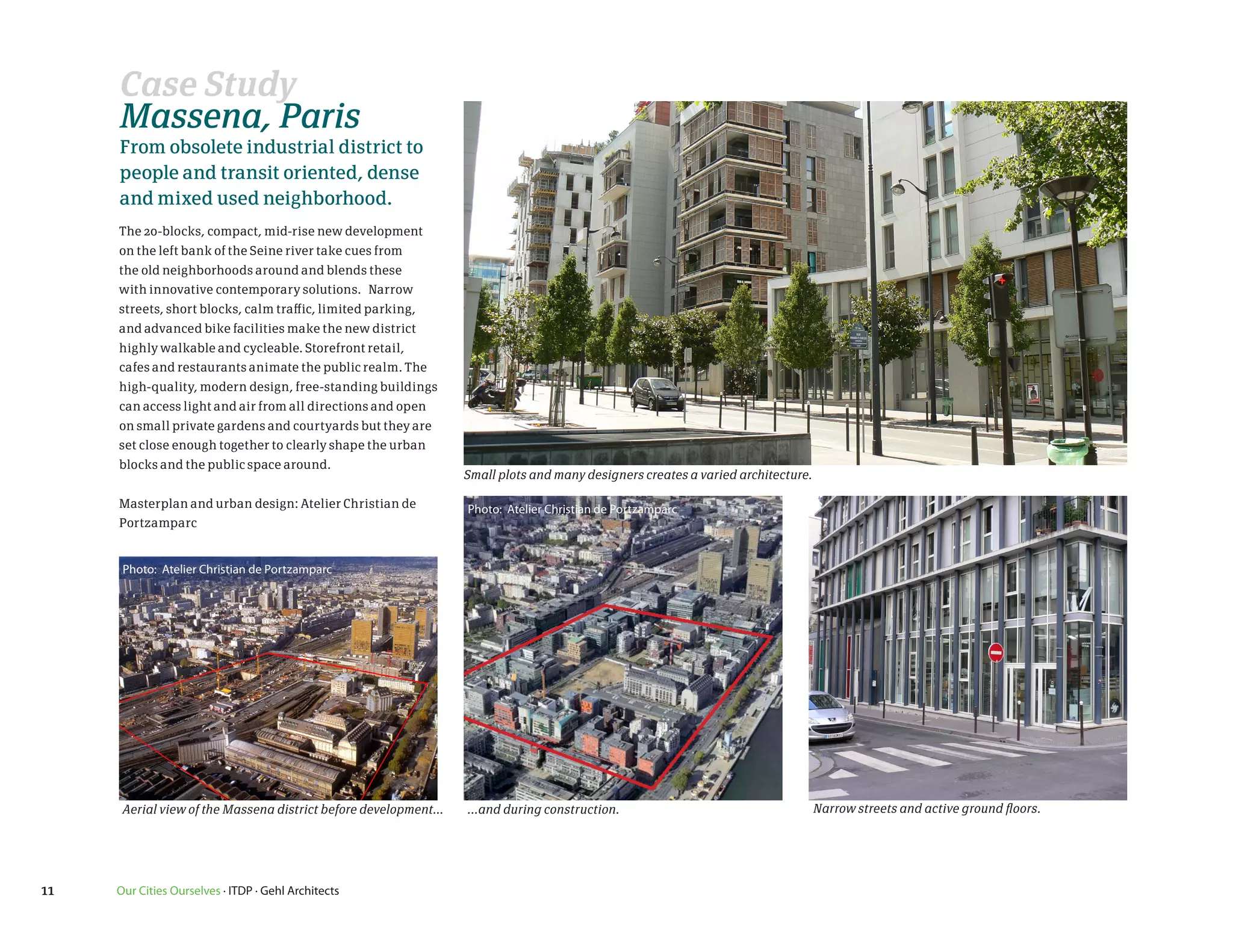
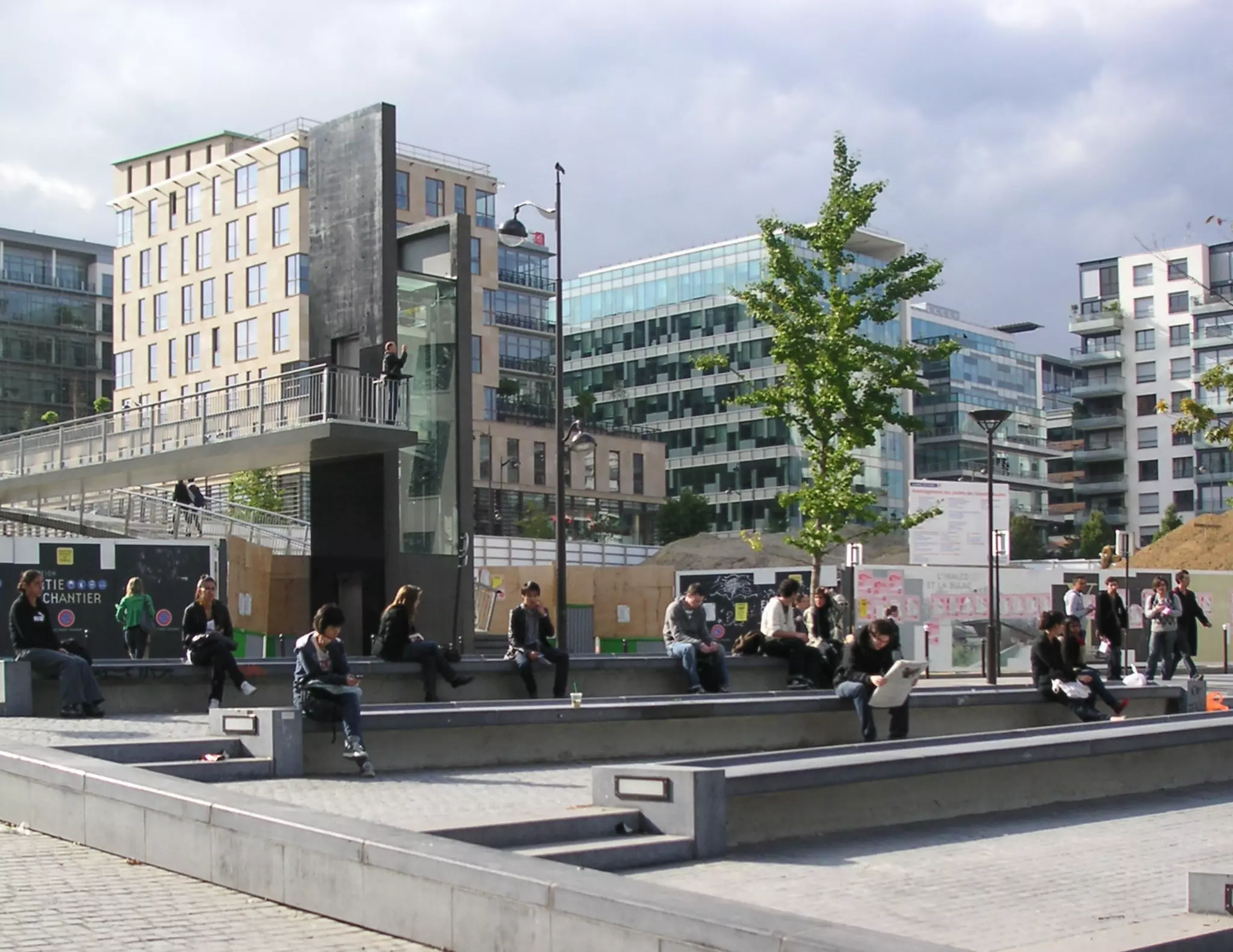
     The 20-blocks, compact, mid-rise new development
     on the left bank of the Seine river take cues from
     the old neighborhoods around and blends these
     with innovative contemporary solutions. Narrow
     streets, short blocks, calm traffic, limited parking,
     and advanced bike facilities make the new district
     highly walkable and cycleable. Storefront retail,
     cafes and restaurants animate the public realm. The
     high-quality, modern design, free-standing buildings
     can access light and air from all directions and open
     on small private gardens and courtyards but they are
     set close enough together to clearly shape the urban
     blocks and the public space around.
                                                                  Small plots and many designers creates a varied architecture.

     Masterplan and urban design: Atelier Christian de            Photo: Atelier Christian de Portzamparc
     Portzamparc


      Photo: Atelier Christian de Portzamparc


      Aerial view of the Massena district before development...   ...and during construction.                                     Narrow streets and active ground floors.


11   Our Cities Ourselves · ITDP · Gehl Architects
Gehl Architects · ITDP · Our Cities Ourselves   12
8         Get Real                                       Embrace diversity and         Protect cultural assets
                                                                      enhance social networksGuangzhou Contact Sheet
                                                                                                                                  Photo:
             Preserve and enhance the local
             natural, cultural, social, and
             historical assets
             What makes a place special? It’s history, its natural
             environment, the culture(s) of the people who live
             and work there? It’s all of these things.


             Cities must grow and transform. They must
             accommodate a rising urban population, satisfy
             new needs and wants, and adapt to the historical
             change brought by economic, social, climate related,
             and other factors. The identity of the place, and the
1G9105.jpg   livelihoods of its residents should be preserved and               HL1G9500.jpg
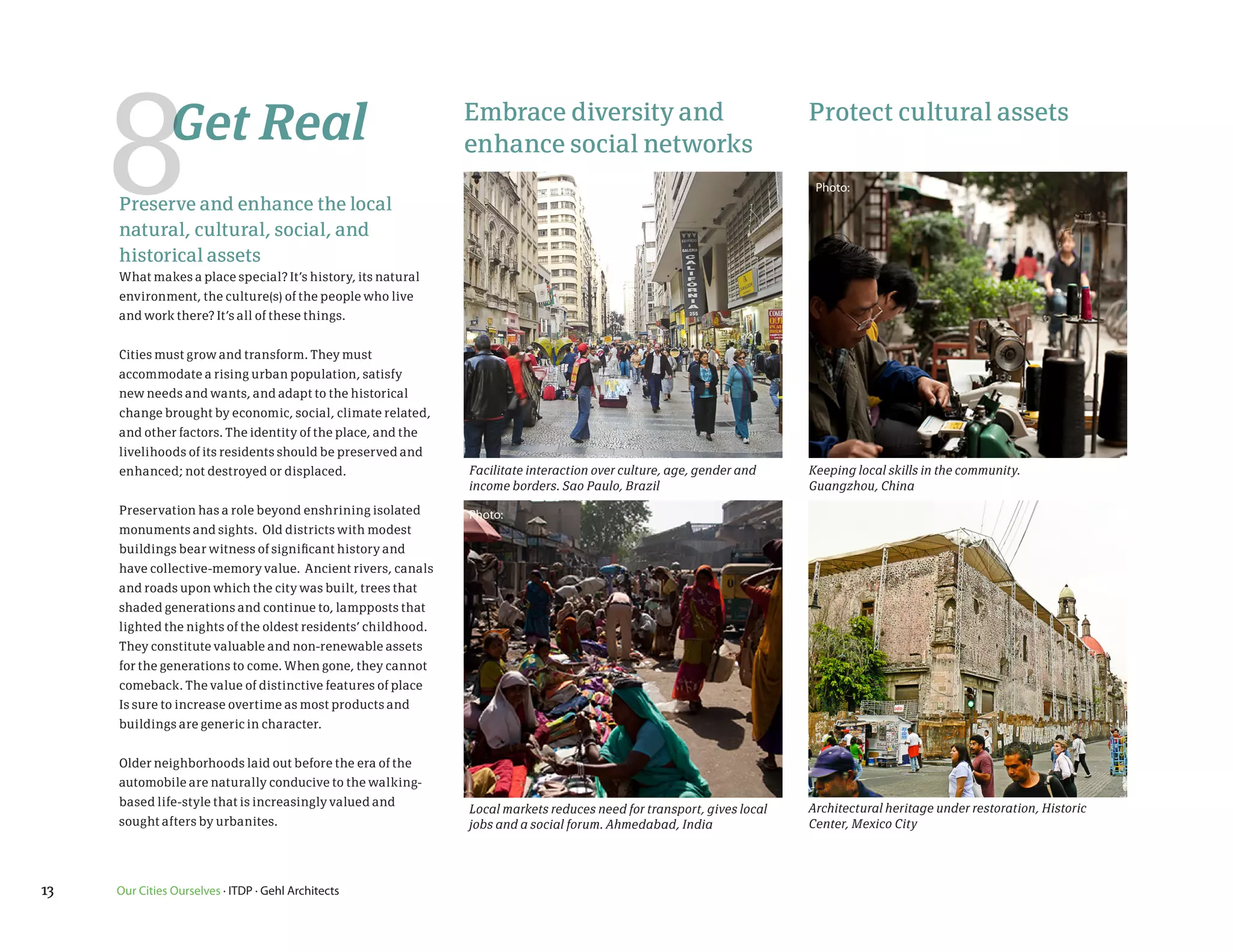
             enhanced; not destroyed or displaced.                    Facilitate interaction over culture, age, gender and       Keeping local skills in the community.much-Manying75.jpg
                                                                                                                                  DSC_29street tailor-i like this image so
                                                                      income borders. Sao Paulo, Brazil                          Guangzhou, China
             Preservation has a role beyond enshrining isolated       Photo:
             monuments and sights. Old districts with modest
             buildings bear witness of significant history and
             have collective-memory value. Ancient rivers, canals
             and roads upon which the city was built, trees that
             shaded generations and continue to, lampposts that
             lighted the nights of the oldest residents’ childhood.
             They constitute valuable and non-renewable assets
             for the generations to come. When gone, they cannot
             comeback. The value of distinctive features of place
             Is sure to increase overtime as most products and
             buildings are generic in character.


             Older neighborhoods laid out before the era of the
             automobile are naturally conducive to the walking-
             based life-style that is increasingly valued and
                                                                      Local markets reduces need for transport, gives local      Architectural groundfloor of Oi restoration, Historic
                                                                                                                                               heritage under Kwan Dasha.jpg
             sought afters by urbanites.                              jobs and a social forum. Ahmedabad, India                  Center, Mexico City
                                                                                                                         Our Cities Ourselves Site Photographs
1G9530.jpg                                                                      HL1G9583.jpg
graphs
      13     Our Cities Ourselves · ITDP · Gehl Architects
Rediscover neglected                                     Reuse rather than                                               What does it mean
amenities                                                redevelop                                                          for the planet:
                                                                                                                  With renovation of old buildings,
                                                                                                                  energy use from heating can be
                                                                                                                  reduced by 77%. The energy used
                                                                                                                  from renovating an old building is
                                                                                                                  far less than from constructing a
                                                                                                                  new building.
                                                                                                                  Haselsteiner, Edeltraud, New Standards for Old
                                                                                                                  Houses, 2005


                                                                                                                                                            When you buy food and
                                                                                                                                                            services from locally owned
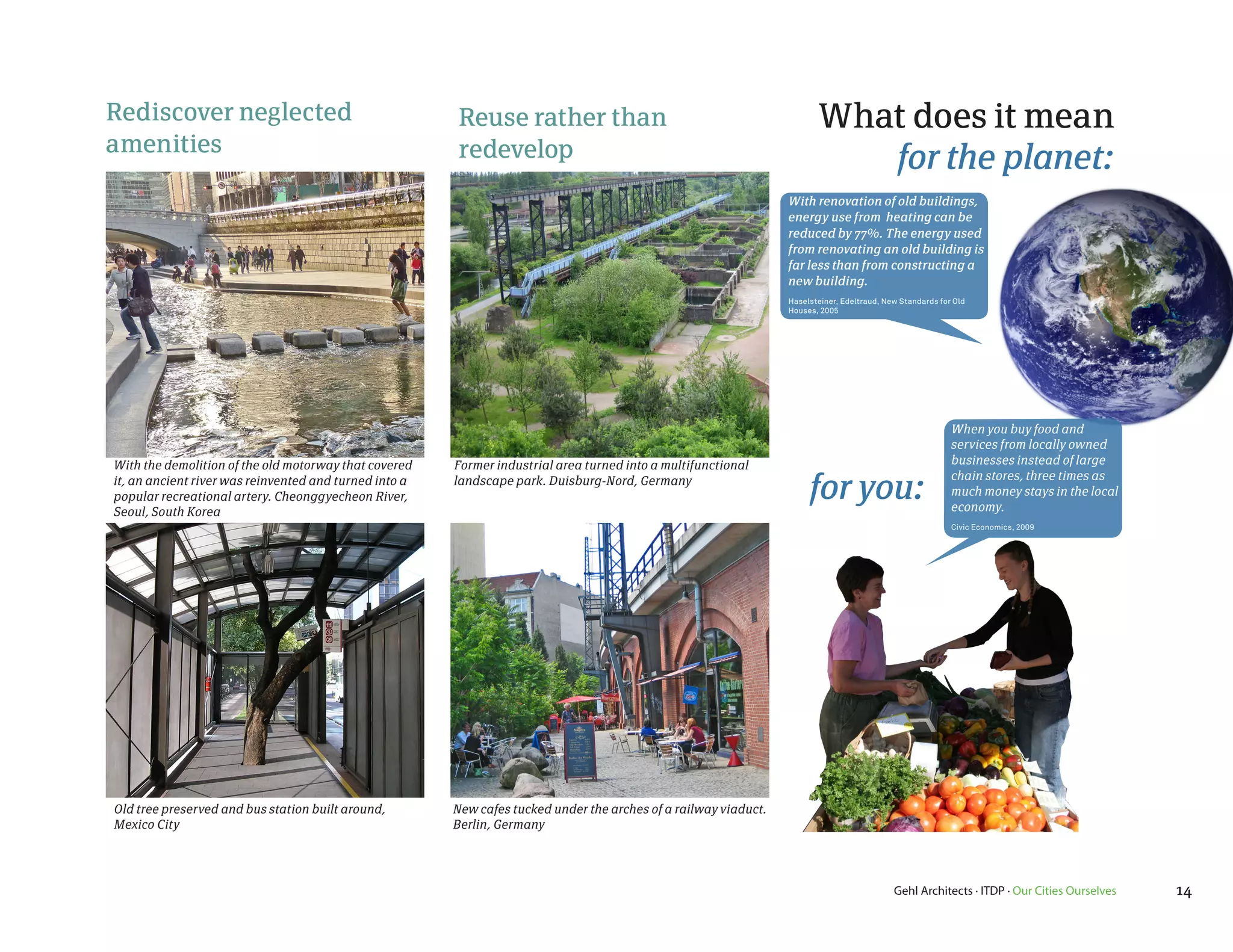
With the demolition of the old motorway that covered    Former industrial area turned into a multifunctional                                                businesses instead of large

                                                                                                                       for you:
it, an ancient river was reinvented and turned into a   landscape park. Duisburg-Nord, Germany                                                              chain stores, three times as
popular recreational artery. Cheonggyecheon River,                                                                                                          much money stays in the local
Seoul, South Korea                                                                                                                                          economy.
                                                                                                                                                            Civic Economics, 2009


Old tree preserved and bus station built around,        New cafes tucked under the arches of a railway viaduct.
Mexico City                                             Berlin, Germany


                                                                                                                                             Gehl Architects · ITDP · Our Cities Ourselves   14
Case Study
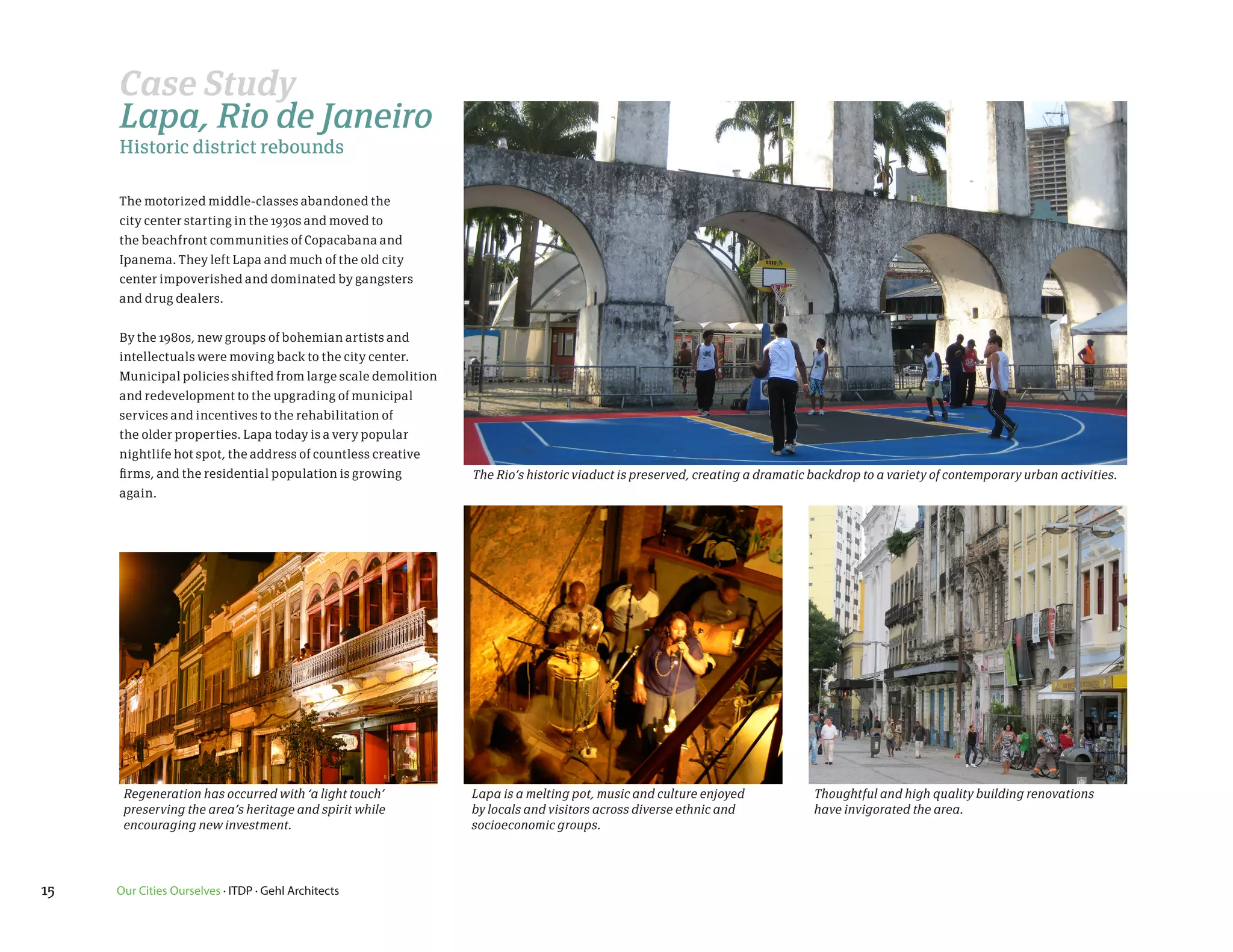
     Lapa, Rio de Janeiro
     Historic district rebounds

     The motorized middle-classes abandoned the
     city center starting in the 1930s and moved to
     the beachfront communities of Copacabana and
     Ipanema. They left Lapa and much of the old city
     center impoverished and dominated by gangsters
     and drug dealers.


     By the 1980s, new groups of bohemian artists and
     intellectuals were moving back to the city center.
     Municipal policies shifted from large scale demolition
     and redevelopment to the upgrading of municipal
     services and incentives to the rehabilitation of
     the older properties. Lapa today is a very popular
     nightlife hot spot, the address of countless creative
     firms, and the residential population is growing         The Rio’s historic viaduct is preserved, creating a dramatic backdrop to a variety of contemporary urban activities.
     again.


      Regeneration has occurred with ‘a light touch’          Lapa is a melting pot, music and culture enjoyed             Thoughtful and high quality building renovations
      preserving the area’s heritage and spirit while         by locals and visitors across diverse ethnic and             have invigorated the area.
      encouraging new investment.                             socioeconomic groups.


15   Our Cities Ourselves · ITDP · Gehl Architects
Case Study
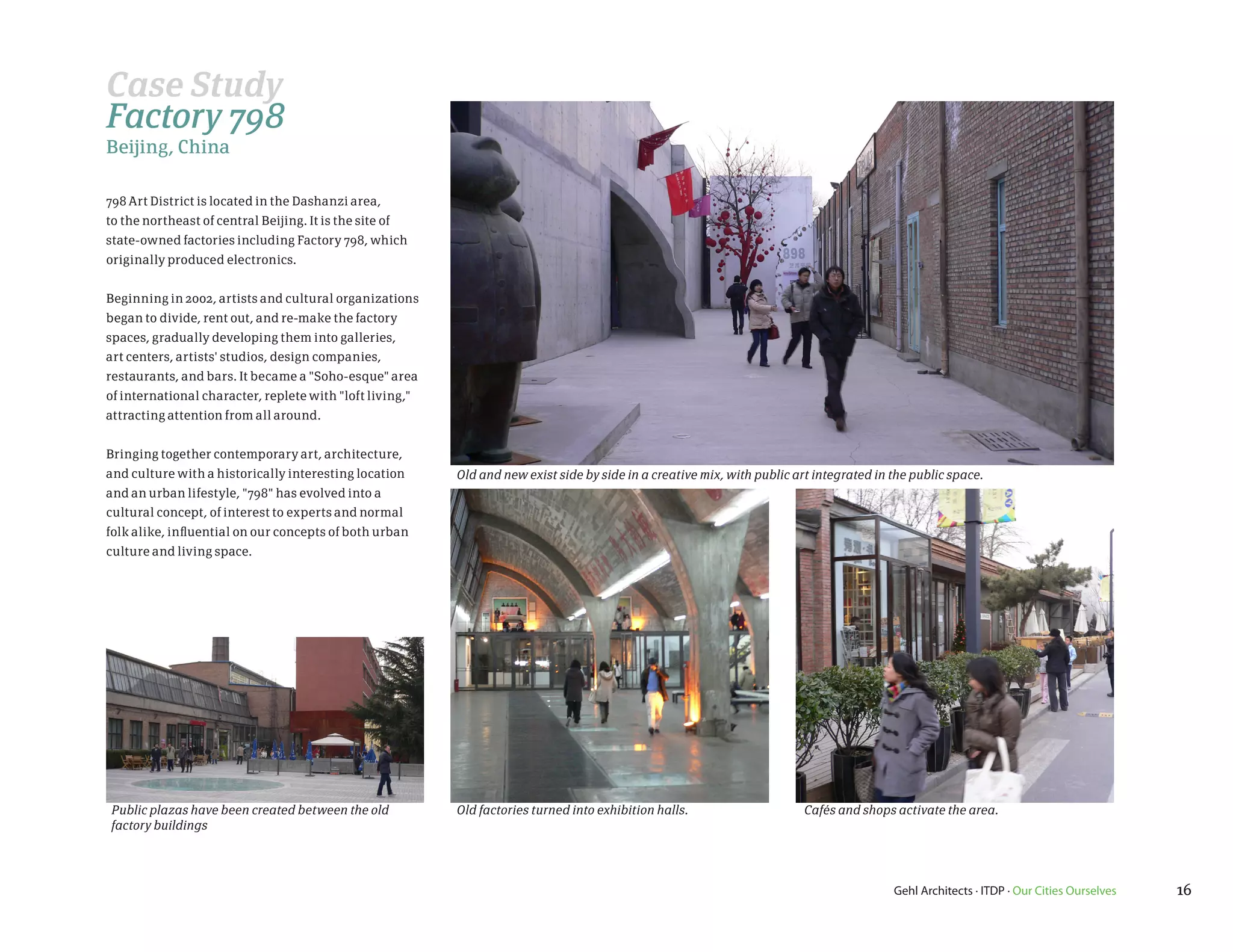
Factory 798
Beijing, China

798 Art District is located in the Dashanzi area,
to the northeast of central Beijing. It is the site of
state-owned factories including Factory 798, which
originally produced electronics.


Beginning in 2002, artists and cultural organizations
began to divide, rent out, and re-make the factory
spaces, gradually developing them into galleries,
art centers, artists' studios, design companies,
restaurants, and bars. It became a "Soho-esque" area
of international character, replete with "loft living,"
attracting attention from all around.


Bringing together contemporary art, architecture,
and culture with a historically interesting location      Old and new exist side by side in a creative mix, with public art integrated in the public space.
and an urban lifestyle, "798" has evolved into a
cultural concept, of interest to experts and normal
folk alike, influential on our concepts of both urban
culture and living space.


Public plazas have been created between the old           Old factories turned into exhibition halls.                    Cafés and shops activate the area.
factory buildings


                                                                                                                                          Gehl Architects · ITDP · Our Cities Ourselves   16
9           Connect
                 the blocks
     Make walking trips more direct,
     interesting and productive with
                                                       Protect fine grain environments


     small-size, permeable buildings
     and blocks
                                                                                      the human dimension
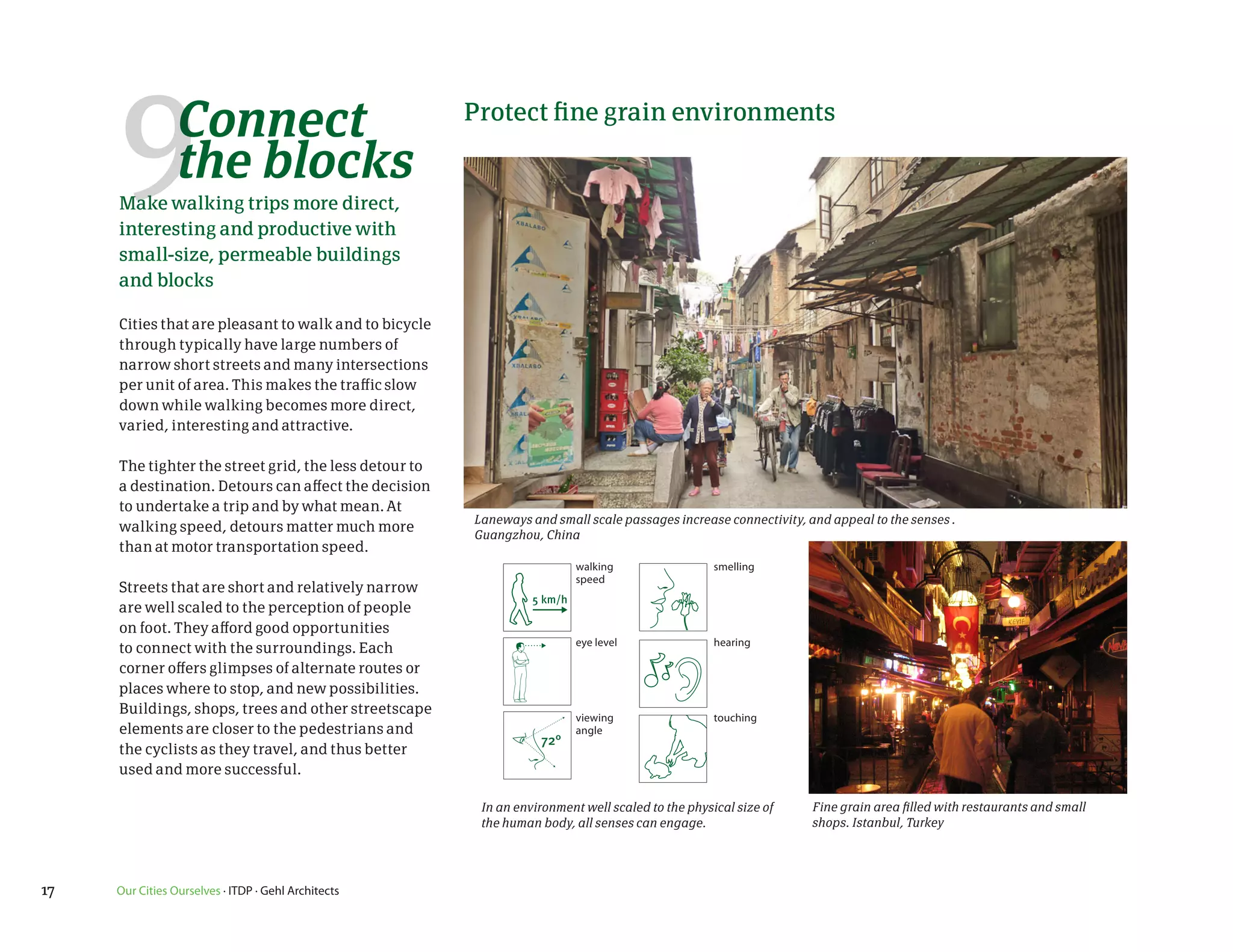
     Cities that are pleasant to walk and to bicycle
     through typically have large numbers of                                                      Walking speed 5 KM/H
     narrow short streets and many intersections
     per unit of area. This makes the traffic slow
     down while walking becomes more direct,
                                                                                                  Eye level
     varied, interesting and attractive.

     The tighter the street grid, the less detour to
     a destination. Detours can affect the decision                                               Viewing angle 72°
     to undertake a trip and by what mean. At
                                                                                       72°
                                                       Laneways and small scale passages increase connectivity, and appeal to the senses .
     walking speed, detours matter much more
                                                       Guangzhou, China
                                                           the human dimension
     than at motor transportation speed.
                                                                          Walking speed 5 KM/H smelling
                                                                         walking                Smelling
                                                                         speed
     Streets that are short and relatively narrow
     are well scaled to the perception of people
     on foot. They afford good opportunities
                                                                          Eye level
                                                                         eye level                Hearing
                                                                                                  hearing
     to connect with the surroundings. Each
     corner offers glimpses of alternate routes or
     places where to stop, and new possibilities.
     Buildings, shops, trees and other streetscape
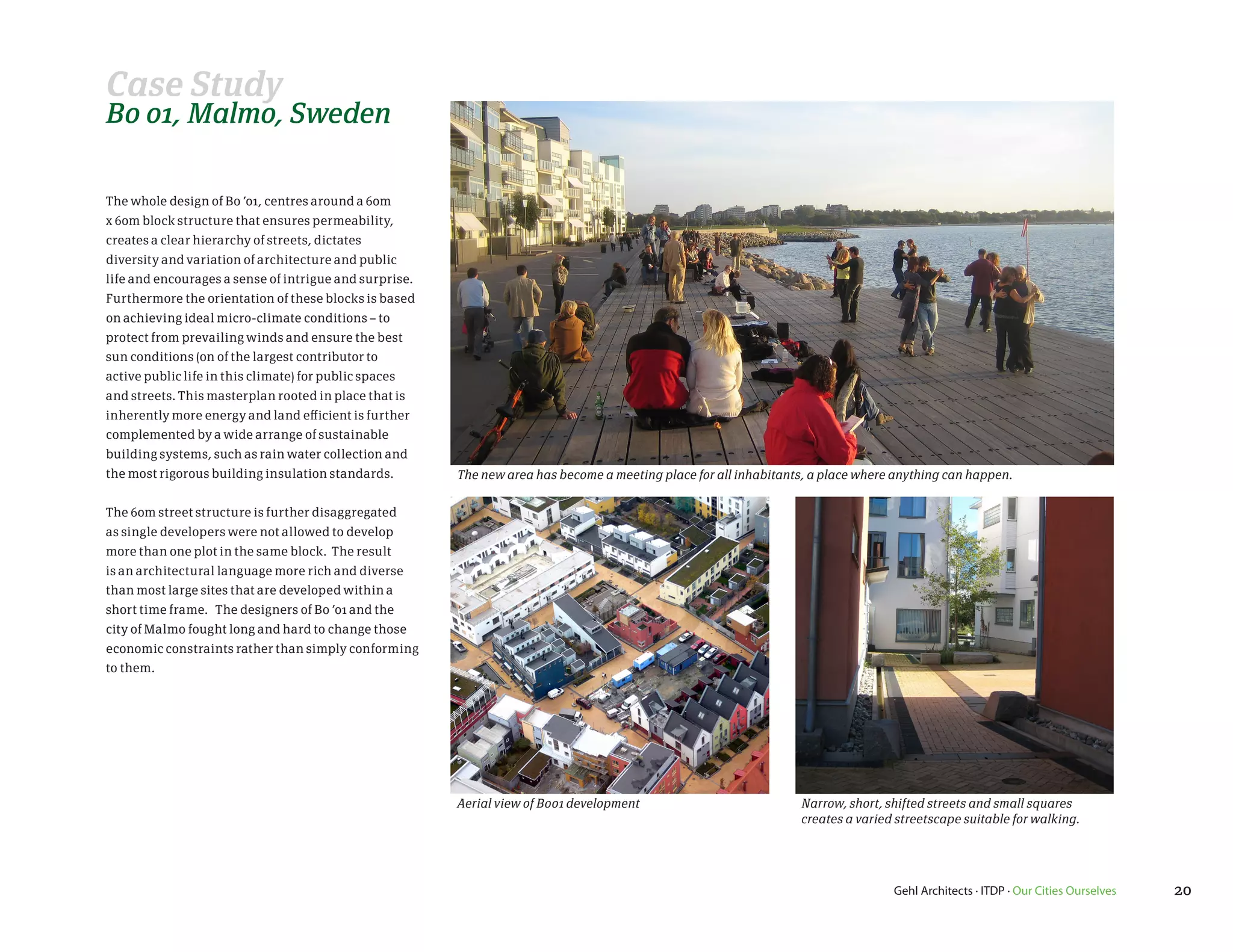
                                                                         viewing angle 72°
                                                                          Viewing                  Touching
                                                                                                  touching
     elements are closer to the pedestrians and                          angle
                                                                  72°
     the cyclists as they travel, and thus better
     used and more successful.
                                                                        Smelling
                                                        In an environment well scaled to the physical size of    Fine grain area filled with restaurants and small
                                                        the human body, all senses can engage.                   shops. Istanbul, Turkey


                                                                          Hearing

17   Our Cities Ourselves · ITDP · Gehl Architects


                                                                          Touching
Make new city blocks short                         Save resources; build                                         What does it mean
and easy to walk                                   compact blocks
                                                                                                                    for the planet:
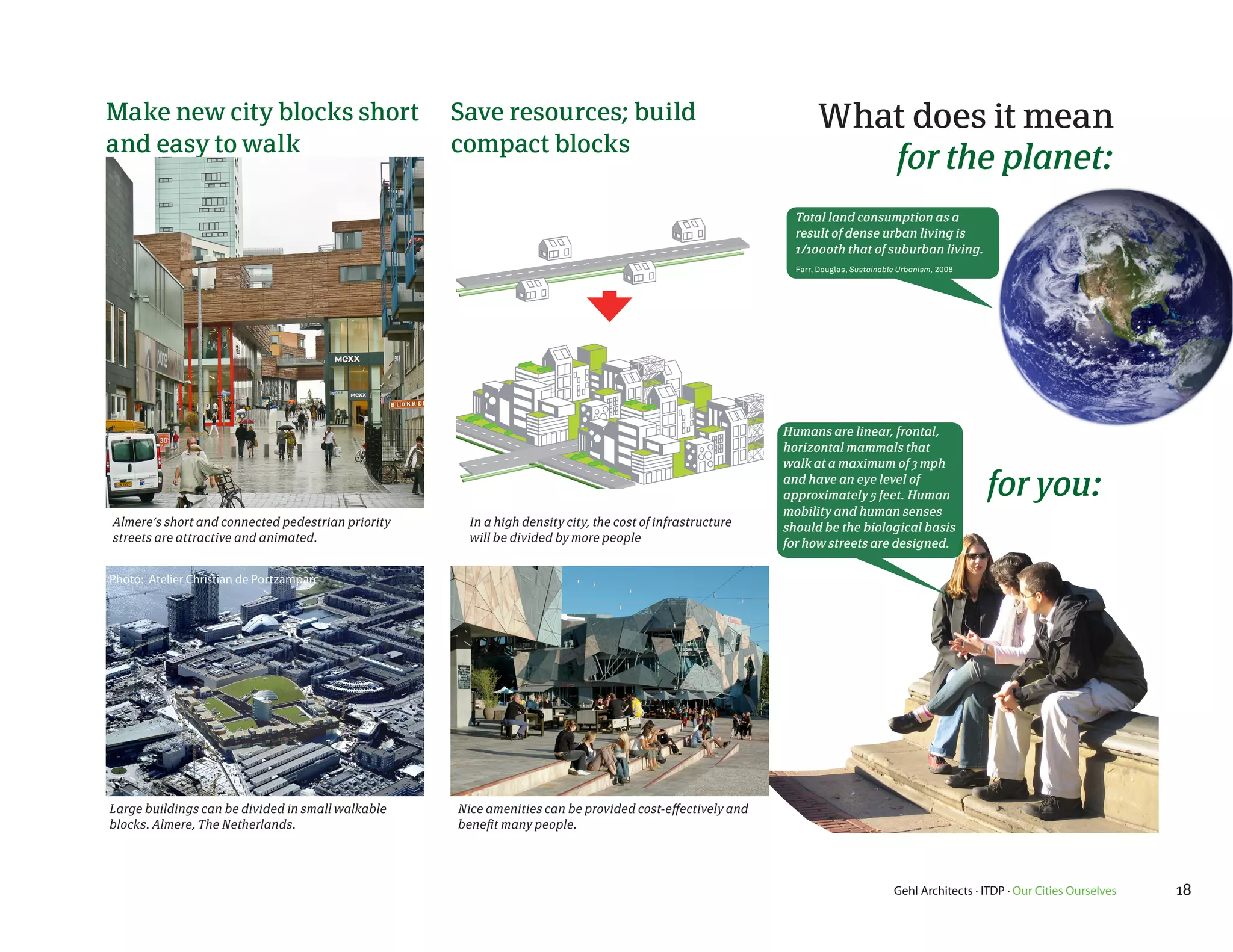
                                                                                                            Total land consumption as a
                                                                                                            result of dense urban living is
                                                                                                            1/1000th that of suburban living.
                                                                                                            Farr, Douglas, Sustainable Urbanism, 2008


                                                                                                          Humans are linear, frontal,
                                                                                                          horizontal mammals that
                                                                                                          walk at a maximum of 3 mph
                                                                                                          and have an eye level of
                                                                                                          approximately 5 feet. Human                   for you:
                                                                                                          mobility and human senses
Almere’s short and connected pedestrian priority     In a high density city, the cost of infrastructure   should be the biological basis
streets are attractive and animated.                 will be divided by more people                       for how streets are designed.

Photo: Atelier Christian de Portzamparc


Large buildings can be divided in small walkable   Nice amenities can be provided cost-effectively and
blocks. Almere, The Netherlands.                   benefit many people.


                                                                                                                                     Gehl Architects · ITDP · Our Cities Ourselves   18
Case Study
                                            Opening up the laneways                                                                                   Before                                                         After
                                            Melbourne

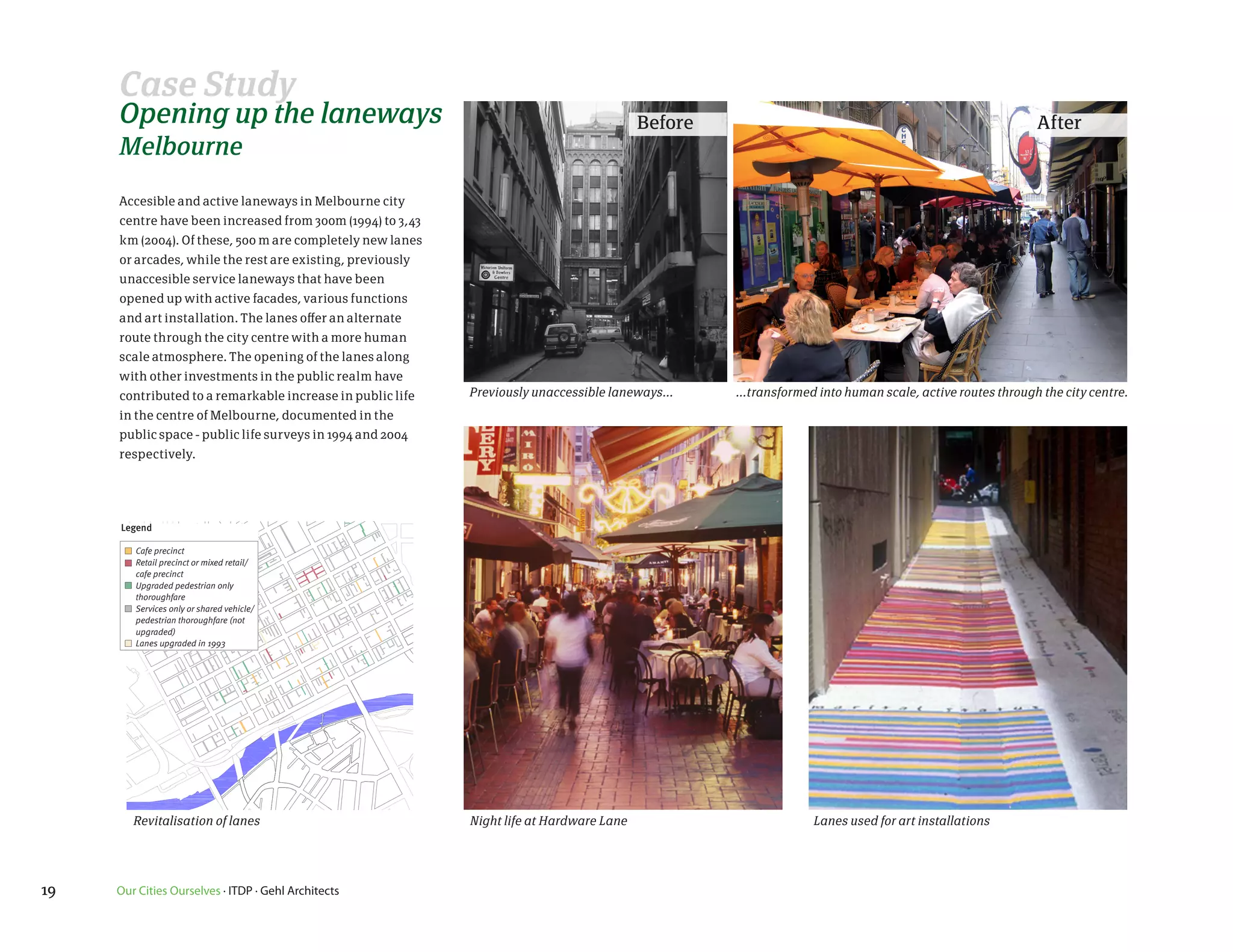
                                            Accesible and active laneways in Melbourne city
                                            centre have been increased from 300m (1994) to 3,43
                                            km (2004). Of these, 500 m are completely new lanes
                                            or arcades, while the rest are existing, previously
                                            unaccesible service laneways that have been
                                            opened up with active facades, various functions
                                            and art installation. The lanes offer an alternate
                                            route through the city centre with a more human
                                            scale atmosphere. The opening of the lanes along
                                            with other investments in the public realm have
                                            contributed to a remarkable increase in public life                         Previously unaccessible laneways...    ...transformed into human scale, active routes through the city centre.
                                            in the centre of Melbourne, documented in the
                                            public space - public life surveys in 1994 and 2004

                                     1.6respectively.
                                           a revitalised                           network of lanes and arcades
                                       1.6 a          revitalised network of lanes and arcades
87                            2004
                                     2004

                                            Legend
                                             Legend

                                                Cafe precinct
                                               Cafe precinct or mixed retail/
                                                Retail precinct
                                                cafe precinct
                                               Retail precinct or mixed retail/
                                                Upgraded pedestrian only
                                               cafe precinct
                                                thoroughfare

                                               Upgradedorpedestrian only
                                                Services only shared vehicle/
                                                pedestrian thoroughfare (not
                                               thoroughfare
                                                upgraded)

                                               Services only 1993shared vehicle/
                                                Lanes upgraded in
                                                                  or
                                               pedestrian thoroughfare (not
                                               upgraded)
     Degraves Street (above) and
     Lt Collins Street (below) are             Lanes upgraded in 1993
     fine examples amongst many
     in the city’s laneway
     revitalisation program.


et (above) and
 t (below) are
 amongst many
neway
program.
                       12


                                               Revitalisation of lanes                                                  Night life at Hardware Lane                         Lanes used for art installations
                                                                                            places for people 2004 2


       12

                 19                         Our Cities Ourselves · ITDP · Gehl Architects
Case Study
Bo 01, Malmo, Sweden

The whole design of Bo ’01, centres around a 60m
x 60m block structure that ensures permeability,
creates a clear hierarchy of streets, dictates
diversity and variation of architecture and public
life and encourages a sense of intrigue and surprise.
Furthermore the orientation of these blocks is based
on achieving ideal micro-climate conditions – to
protect from prevailing winds and ensure the best
sun conditions (on of the largest contributor to
active public life in this climate) for public spaces
and streets. This masterplan rooted in place that is
inherently more energy and land efficient is further
complemented by a wide arrange of sustainable
building systems, such as rain water collection and
the most rigorous building insulation standards.        The new area has become a meeting place for all inhabitants, a place where anything can happen.


The 60m street structure is further disaggregated
as single developers were not allowed to develop
more than one plot in the same block. The result
is an architectural language more rich and diverse
than most large sites that are developed within a
short time frame. The designers of Bo ’01 and the
city of Malmo fought long and hard to change those
economic constraints rather than simply conforming
to them.


                                                        Aerial view of Bo01 development                           Narrow, short, shifted streets and small squares
                                                                                                                  creates a varied streetscape suitable for walking.


                                                                                                                                  Gehl Architects · ITDP · Our Cities Ourselves   20
10                  Make it
                         last
     Build for the long term

     Sustainable cities bridge generations. They are
                                                               Quality of materials,
                                                               design and production
                                                                                                                        Robustness and re-use


     memorable, malleable, built from quality materials,
     and well maintained.


     Memorable - most of the great streets and plazas in
     the world were built to last and it shows. They are
     part of the public's image of the city and entice our
     imagination of the past.


     Malleable – cities that adapt survive. Just like a good
     building, cities grow and expand to accommodate
                                                               The use of high quality, sustainable materials bestows   Needs may change, but a robust design can
     current demands. The best streets and spaces evolve;
                                                               a sense of pride to a place, marking its importance.     accommodate change. Paris, France
     they are constantly repurposed, yet the structure         Hamburg, Germany
     remains.


     Materials – the use of high quality, sustainable
     materials bestows a sense of pride to a place.


     Maintenance – cities that are well maintained attract
     investment, both personal and financial. Keeping the
     place up is an expression of ownership that begets
     higher values. Local management groups, citizens
     bridgades, people shoveling snow all contribute.
     Instead of allowing deteriation, sustainable
     communities fix it first.


                                                               High quality materials ensure resilience despite         Re-use of old building- former industrial building
                                                               rigorous use. Berlin, Germany                            retrofitted to attractive office space - London, UK


21   Our Cities Ourselves · ITDP · Gehl Architects
Taking care - maintain                              Memorable and                                                    What does it mean
and manage                                          inspirational
                                                                                                                        for the planet:
                                                                                                                 Investing in quality of design
                                                                                                                 and materials will pay off in the
                                                                                                                 long run. A life cycle assessment
                                                                                                                 helps showing environmental
                                                                                                                 impact on the whole life of a
                                                                                                                 building, not just the production.


                                                                                                                Deciding how my city changes
The Bryant Park Coporation engages the local        Most of the great streets and plazas in the world were
                                                                                                                is a matter of thinking about
community to act as a steward of this public park
Bryant Park, New York
                                                    built to last and it shows. They are part of the public's
                                                    image of the city and entice our imagination of the
                                                    past. El Zócalo, Mexico City
                                                                                                                how my grandchildren will be
                                                                                                                living in 2080, and what kind
                                                                                                                                                      for you:
                                                                                                                of quality of life I want them to
                                                                                                                have. The less they need cars,
                                                                                                                the more they can safely walk
                                                                                                                and bike, the happier and
                                                                                                                healthier they'll be.


 Keeping a place up is an expression of ownership   The Lyon river waterfront was recently redesigned
 that begets higher values. Philadelphia, USA       to encourage interaction - both between people
                                                    and with the water.


                                                                                                                                   Gehl Architects · ITDP · Our Cities Ourselves   22
Case Study
     Vauban - Freiburg
     Small solutions to big
     problems
     The once military area belonging to the state was
     left by the French after the German reunification. In
     1992 it was bought by the City of Freiburg deciding
     to develop a new urban district. In 1994, an urban
     planning competition for Vauan was carried out. At
     the same time, different groups of committed citizens
     started taking an interest in the area.


     Finished in 2006, Vauban is now a sustainable
     pattern city with 5,500 residents and 600 workplaces.
     Through extended participatory processes, building
     communities and other bottom-up actions, Freiburg
     has achieved the creation of an urban district of
     highly modern, ecological standard. Here, the
     residents have had a strong influence on the design of   A close-knit community providing a social network.
     the neighbourhood.


                                                     1000m

            Plan of Vauban                                    Aerial view of Vauban                                Direct involvment by the inhabitants in the design
                                                                                                                   process have contributed to a human scale environment.


23   Our Cities Ourselves · ITDP · Gehl Architects
Case Study
The High Line, New York
The High Line, a public park in New York City, was
designed as a redevelopment of an elevated rail
structure formerly used to transport goods and
post to the factories and warehouses of the West
Side. Because of its innovative nature, the project
captured attention nationally, regionally and locally
long before it opened in 2009, helping to contribute
to the revitalization of the Meat Packing District, a
historically industrial area of Manhattan.


The first section of which opened in 2009. Support
was headed by the Friends of the Highline, a non-
profit partner to the New York City Department of
Parks and Recreation. The organization, a bottom-
up initiative headed by citizens, is responsible for
maintenance of the park and provides over 70 percent
of its annual budget. Section two of the High Line,
                                                          A concrete pathway spans the length of the High Line, providing an interesting walking experience, as well as new
which will expand the park to its full 1.5 mile length,   views of the city.
is projected to be completed in 2011.


Projects like the High Line exemplify the 21st century
trend of focusing on usable landmarks to improve
the quality of urban public life, rather than iconic
monuments connected to the designer or political
power. The park provides a unique public space
that expands over the city’s bustling streets, giving
individuals the opportunity to experience New York
City in a new way.


                                                          Both stationary and movable seating gives chances          More intimate niches are integrated throughout the
                                                          for rest and observation.                                  High Line.


                                                                                                                                       Gehl Architects · ITDP · Our Cities Ourselves   24
Summary                                         Example group 2


     1. Walk the Walk!                               1.1 Invite people to walk everywhere in the city   1.2 Invite people to linger


     2. Powered by People                            2.1 Make cycling convenient                        2.2 Make cycling safe


     3. Get on the Bus!                              3.1 Focus on the passenger                         3.2 Promote convenient, cost effective solutions


                                                     4.1 Slow down - increase space
     4. Cruise Control                               and safety for people
                                                                                                        4.2 Balance access with opportunities to linger


     5. Deliver the Goods                            5.1 Going the last mile                            5.2 regulate for results


                                                     6.1 Foster a fine-grain mix of uses in the three
     6. Mix it Up                                    dimensions
                                                                                                        6.2 Keep ground-floors active where people walk


     7. Fill it in                                   7.1 Build density around transit nodes             Revitalize the existing before building new


                                                     8.1 Embrace diversity and enhance social
     8. Get real                                     networks
                                                                                                        8.2 Protect cultural assets


     9. Connect the Blocks                           9.1Protect fine grain environments                 9.2 Make new city blocks short and easy to walk


                                                     10.1 Quality of materials, design and
     10. Make it last                                production
                                                                                                        10.2 Robustness and re-use


25   Our Cities Ourselves · ITDP · Gehl Architects
Example group 1                                                                                      Example group 1
                                                                                                     Interrelated:
                                                                                                     You also achieve number 3 (Get on the Bus) –
                                                                                                     Public transport will become more attractive
                                                                                                     and more people will use it, when you
                                                                                                     implement these other sub-principles.
1.3 Connect important destinations in a network                                                      1.3 Connect important destinations
                                                                                                     2.1 Make cycling convenient
                                                                                                     4.4 Pay for the privilege
2.3 Make cycling fun                                                                                 7.1 Build density around transit nodes

                                                                                                     Larger Whole:
3.3 Make it flexible and responsive                3.4 Make it sensitive to the street environment   Thus reducing traffic and making the city a
                                                                                                     quieter, safer place to spend time

4.3 Get smart                                      4.4 Pay for the privilege                         Example group 2
                                                                                                     Interrelated:
                                                                                                     By implementing these other sub principles
5.3 Manage the curb                                5.4 Diversify deliveries                          below - you will achieve the principles in
                                                                                                     1.1, 1.2, and 1.3. It will be “possible to walk
6.3 Allow for different activities in the public                                                     everywhere”, there will be “great places to
space                                                                                                stay” and “important destinations will be
                                                                                                     connected”.
                                                                                                     More people will chose to Walk when
7.3 Intensify the urban fabric by building in the gaps                                               4.1 Slow down - increase space
                                                                                                     and safety for people
                                                                                                     6.1 Allow for different activities in the public
8.3 Rediscover neglected amenities                 8.4 Reuse rather than redevelop                   space
                                                                                                     7.1 revitalize existing before building new
                                                                                                     9.1 Protect fine grain environments
9.3 Save resources; build compact blocks                                                             10.4 Memorable and inspirational


                                                                                                     Larger Whole:
                                                                                                     livelier, more attractive and sustainable city
10.3 Taking care - maintain and manage             10.4 Memorable and inspirational


                                                                                                                    Gehl Architects · ITDP · Our Cities Ourselves   26
Walk the                                                                        Powered by
                                                     Walk!                                                                           People!


     Summary


                                                                                                               Photo: Carlos Pardo


                                                                                                                                                                                         Photo: Carlos Pardo
                                                                                       Every journey                                                            The more cycle
                                                                                   begins and ends with                                                       use on streets, the
                                                                                    walking. Streets that                                                 safer they become. When
                                                     Guayaquil, Ecuador           are designed to prioritize                         Barcelona, Spain
                                                                                                                                                           a good bicycle network is
                                                     New York City, USA                                                              Ahmedabad, India


                                                                                                               Photo: NYC DOT
                                                                                    pedestrians can also


                                                                                                                                                                                         Photo: Michael King
                                                                                                                                                          established, people continue
                                                                                  improve health, economic                                                 to bike regardless of age,
                                                                                     activity and safety.                                                      wealth or weather.


                                                     1                                                                               2
                                                     Mix it Up!                                                                      Fill it in!


                                                                                                                                                                                         Photo:Gehl Architects
                                                                                        Energize


                                                                                                               Photo: Eniko Budai
                                                                                    public space with
                                                                                                                                                                    Densify
                                                                                mixed-use development
                                                                                                                                                                 around transit
                                                                               and ground floor activities.
                                                     Budapest, Hungary                                                               Paris, France            stations and within
                                                     Rio de Janeiro, Brazil   Mixed-use means you are closer                         New York City, USA
                                                                                                                                                              the city rather than


                                                                                                               Photo: Cesar Duarte


                                                                                                                                                                                         Photo: Luc Nadal
                                                                                 to everything and places
                                                                                                                                                                at the outskirts.
                                                                                   are safer and livelier
                                                                                     during all hours.


27   Our Cities Ourselves · ITDP · Gehl Architects
                                                     6                                                                               7
Get on                                                                                     Cruise                                                                      Deliver the
the bus!                                                                                   Control                                                                     Goods!


                                                                   Photo: Anuj Malhotra
                                       Comfortable,                                                                                                                                                                  Servicing


                                                                                                                                                                                                                                               Photo: Josh Carver
                                                                                                                                              Photo: Jeff Risom
                                 safe, high-speed public                                                                 Managing                                                                                  the city in the
                                transit provides the next                                                             traffic includes                                                                    cleanest and safest manner.
                             best option to walking or biking.                                                      getting smart (using                                                                 Sustainable cities will be cleaner,
Ahmedabad, India                                                                           Santiago, Chile        technology), helping cars                            Dar es Salaam, Tanzania
                             Mass transport can move millions                                                                                                                                              quieter, and safer by creating
Johannesburg, South Africa                                                                 Brighton, UK                                                                Paris, France
                                                                                                                   slow down, paying for


                                                                   Photo: Philip Mostert


                                                                                                                                              Photo: Gehl Architects


                                                                                                                                                                                                                                               Photo: Gehl Architects
                             of people quickly and comfortably                                                                                                                                           eco-zones, slow speed zones, and
                               using a fraction of the fuel and                                                      the privilege, and                                                                      regulating the times and
                                   street space required                                                             re-routing traffic.                                                                      places where goods can
                                      by automobiles.                                                                                                                                                              be delivered.


3                                                                                          4                                                                           5
Get Real!                                                                                  Connect the                                                                 Make it
                                                                                           the blocks!
                                                                                           Blocks!                                                                     Last!


                                                                                                                                              Photo: Gehl Architects
                                          Distinguish
                                                                   Photo: Luc Nadal


                                                                                                                                                                                                                                               Photo: Luc Nadal
                                      by preserving and                                                                                                                                                               Build for the
                                                                                                                         Maximize
                                   enhancing the natural,                                                                                                                                                       long term. Sustainable
                                                                                                                      the connectivity
                                     cultural, social, and                                                                                                                                                      cities bridge generations.
                                                                                           Melbourne, Australia
                                                                                                                    of walking trips with                              New York, USA
Seoul, South Korea             historical assets of the place.
Rio de Janeiro, Brazil                                                                     Malmo, Sweden           small block sizes and                               Lyon, France                               They are memorable,
                                                                   Photo:David Sim


                                 In a globalized world, identity


                                                                                                                                                                                                                                               Photo: Anna Modin
                                                                                                                                              Photo: Lars Gemzø e
                                                                                                                   permeable blocks and                                                                           malleable, built from
                                     and cultural heritage                                                                                                                                                        quality materials and
                                                                                                                         buildings.
                                    becomes a competitive                                                                                                                                                           well maintained.
                                           advantage.


8                                                                                          9                                                                           10
                                                                                                                                                                                                 Gehl Architects · ITDP · Our Cities Ourselves                          28
www.ourcitiesourselves.org   www.itdp.org   www.gehlarchitects.dk

Oco booklet gehl_itdp

  • 1.
    our cities ourselves 10Principles for Transport in Urban Life
  • 2.
    CREDITS Client, Co-Author Co-author Consultant: Photo and statistic credits ITDP, Institute for Transportation & Gehl Architects NelsonNygaard ITDP, Gehl Architects and Development Policy -Urban Quality Consultants consulting associates NelsonNygaard unless stated otherwise. Executive Director Director: Principal: Walter Hook David Sim, Architect SAR/MSA Michael King Global Policy Director and Founder Project Leader: Michael Replogle Jeff Risom, MSc City Design and Social Science Chief of Staff Aimée Gauthier Project Team: Ola Gustafsson, Architect MSA Technical Director, Urban Design Henning Thomsen, Architect MAA, MBA Luc Nadal Ewa Westermark,Architect SAR/MSA 2 Our Cities Ourselves · ITDP · Gehl Architects
  • 3.
    What is thisbook about? Foreword Addressing the Livable today, sustainable for the future global issue of The principles outlined here are intended to inspire us to improve the quality of sustainability... life in cities today while ensuring their viability tomorrow. The successful city of the 21st century will be replete with choices, including non- motorized, post-fossil fuel travel options. Citizens of the world do not want to sit in bumper-to-bumper traffic. They do not want to walk in mud, nor feel threatened on a simple bike ride to work. They want to be in cities that provide for creative interaction, affordable living and healthy movement. Cities that meet the challenge of sustainability will leap ahead of others by attracting people who demand a healthy and culturally-rich lifestyle. ...by Purpose of this campaign emphasizing Sustainability does not have to hurt. Reducing CO2 emissions, conserving land, the local issue and making transport more efficient go hand in hand with improving quality of of livability... life. We aspire to lay the foundation for achieving global sustainability not through uniform technological solutions but through a global celebration of local difference and innovation based on a common set of principles. The Our Cities Ourselves campaign invites design teams from ten cities around the world to apply these ten principles to ten unique locations . This book illustrates the ten principles that lay behind the designs. Our hope is that national and local leaders worldwide will look to it for inspiration. The 26th of June, 2010 ...with mobility as a link between On behalf of ITDP the local and the global. Walter Hook Gehl Architects · ITDP · Our Cities Ourselves 3
  • 4.
    4 Our Cities Ourselves · ITDP · Gehl Architects
  • 5.
    Shift the focus Remaking our cities for from: to: livability What we have What we want in 2010? for 2030! Moving towards sustainable and healthy lifestyles 1. Traffic congestion is a tragedy of the commons. Road space is a scarce public good intended to provide Traffic dominates access to important locations by the rich and poor society Choice dominates alike. As countries get richer, roads get taken over by congestion motorists. Pedestrians and cyclists, whether they are rich are poor, are driven off the roads in fear for their lives. To return our streets to their basic function of equitable access, they need to be redesigned to give priority to those means of travel that use road space more efficiently, cost less, and generate less pollution Economy primarily and noise. based on consumption Economy based on quality of life 2. A growing number of cities around the world are finding that cultural amenities, great public spaces, and a high quality of life are more important than highways and parking lots to attracting educated young workers who will form the backbone of the Designing objects Making competitive 21st Century economy. places 3. Too often, buildings are designed as symbols of cultural and political power. In the future, city residents will 'vote with their feet' choosing to live and settle in cities where the greatest architectural Disagreement on minds have focused on creating great places to global sustainability Local livability translates meet and congregate rather than on creating great into global sustainability monuments. 4. Meeting global sustainability isn’t about accepting The consequence: The consequence: blame or responsibility for global warming; it is about Sustainability not seen on Streets become the locus making our cities more livable and our economies the streets for sustainability more prosperous while reducing carbon emissions. Gehl Architects · ITDP · Our Cities Ourselves 5
  • 6.
    Cruise Principles overview Control Walk the Walk! Mass transport can move millions of people quickly and comfortably Photo: Jeff Risom Managing using a fraction of the fuel and street traffic includes space required by automobiles Santiago, Chile getting smart (using technology), helping cars Brighton, UK Get on slow down, paying for Photo: Gehl Architects the privilege, and the bus! re-routing traffic. Photo: Carlos Pardo Every journey begins and ends with walking. Streets that Guayaquil, Ecuador are designed to prioritize New York City, USA Photo: NYC DOT pedestrians can also improve health, economic activity and safety. Photo: Anuj Malhotra Comfortable, safe, high-speed public Ahmedabad, India Johannesburg, South Africa transit provides the next best option to walking or biking. Mass transport can move millions 4 Photo: Philip Mostert of people quickly and comfortably using a fraction of the fuel and street space required Some trips will need to be done by cars. By by automobiles. managing private car use and expanding 1 car sharing, cities can minimize these negative outcomes, while creating space for Great cities start with great pedestrian pedestrians, mass and non-motorized transit. environments. Walking is the most universally accessible form of transport. 3 Deliver the Goods! Powered by People! Servicing Photo: Josh Carver the city in the cleanest and safest manner. Sustainable cities will be cleaner, Photo: Carlos Pardo Dar es Salaam, Tanzania quieter, and safer by creating The more cycle Paris, France Photo: Gehl Architects eco-zones, slow speed zones, and use on streets, the regulating the times and safer they become. When Barcelona, Spain places where goods can a good bicycle network is Ahmedabad, India be delivered. Photo: Michael King established, people continue to bike regardless of age, Dedicated space wealth or weather. for non-motorized transit, like bike lanes, provides safety and convenience to riders, [free from 5 potential conflicts with vehicles], and a great incentive 2 to ride. Sustainable cities will provide some accommodation for clean and safe freight delivery, like rail, and help to make centralized 6 Our Cities Ourselves · ITDP · Gehl Architects distribution and non-motorized means of distribution more viable.
  • 7.
    Residents and visitors Fill it in! will be attracted to neighborhoods where walking, biking and transit are all viable options for most trips. Get Real! A community’s And dense, urban history, natural communities have a environment and decided environmental ethnic traditions Photo:Gehl Architects advantage. all contribute Densify around transit meaningfully to Paris, France New York City, USA stations and within the city rather than what makes a place Photo: Luc Nadal at the outskirts. unique. Finding Distinguish these elements Photo: Luc Nadal by preserving and enhancing the natural, and enhancing cultural, social, and Seoul, South Korea Rio de Janeiro, Brazil historical assets of the place. them is critical to distinguishing one Photo:David Sim In a globalized world, identity and cultural heritage becomes a competitive place from another. advantage. 7 8 Make it Last! Mix it Up! Connect the the blocks! Blocks! Photo: Luc Nadal Build for the long term. Sustainable cities bridge generations. New York, USA Energize Photo: Eniko Budai Lyon, France They are memorable, Photo: Anna Modin public space with malleable, built from mixed-use development quality materials and Budapest, Hungary and ground floor activities. well maintained. Rio de Janeiro, Brazil Mixed-use means you are closer Photo: Cesar Duarte to everything and places Photo: Gehl Architects are safer and livelier during all hours. Maximize the connectivity Melbourne, Australia of walking trips with Malmo, Sweden small block sizes and Photo: Lars Gemzø e permeable blocks and buildings. 10 6 Investing in cities more broadly is as important as investing in sustainable Great neighborhoods are often mixed transportation. What makes up the use, blending commercial and residential streetscape - buildings, street furniture, uses, with trees, plazas and other public 9 public art – can last for decades, if not centuries, with the right planning and spaces. This diversity attracts people who live and work in the area, but also visitors The more connected the blocks, maintenance. who come to shop, eat or simply enjoy the the shorter the distance between street-level vibrancy of well-planned, destinations, making walking and biking mixed-use communities. more appealing. Gehl Architects · ITDP · Our Cities Ourselves 7
  • 8.
    Our stories overthe next 20 years Talking about aspects of a better life: 50 years old decision maker 30 years old career woman I’ve thought of bicycling to the office, or It would be much more convenient to take at least as far as the express bus stop. It my child to day care on the bicycle on the 11 years old: would be good for my cholesterol, and I’d like to bike to school. With the way to work, but I’m just not sure it’s safe, driving in all that traffic can really be a new bike lanes, my parents are 58 years old: so I drive the minivan. It costs a lot and I headache. But it seems really dangerous thinking about it, but they’re still I’ve decided to bike to the express spend more time looking for parking. biking in the streets. 38 years old: not sure. bus. I get a little exercise. On the I’ve decided to start biking to work. bus, I can do some work or read I’m not as young as I once was and I the paper. have to work harder to stay fit. Non- motorized and public mobility have improved - 3 years old private car use is down I want to play in the street, but mom and dad says it's Reducing greenhouse gas emissions dangerous, and there aren't any other places to play. through changes in lifestyles By 2030, if current trends continue, the world will produce CO2 emissions by at least 3 gigatons. (we need to pull these some 49 gigatons of carbon dioxide. We need to reduce 19 numbers from Climate works documents or IEA). As families gigatons of CO2 per year to avoid cataclysmic climate change. and municipal leaders work together to solve their everyday The transport sector is responsible for about a quarter of transportation headaches, they are also bringing down the this. Based on realistic estimates of what is achievable in risk of irreversible climate change. other sectors, transport needs to reduce its total 2010 2015 2020 8 Our Cities Ourselves · ITDP · Gehl Architects
  • 9.
    18 years old: I wouldn’t think of going on a date in a car. Cars are so 2010. We’ll just pick up a couple of those shared bikes over by the school, 45 years old: bicycle together along the new The new bus rapid transit system is waterfront promenade, then drop so much faster, I wouldn’t dream of them back near the house. driving to work on most days. Still, 65 years old: with the congestion charges, when Now that I’m retired, I have time to Global CO2 emissions I do need to drive the Zipcar for walk down to the new café down by from transport something, I can get there in a hurry. the waterfront, work on my novel, take in a concert in that park where that parking lot used to be. I really enjoy Business as usual 14 Gigatons the new public spaces in the city. 12 Gigatons Cities have become more Cities for people are livable today socially inclusive for everyone while ensuring a high quality of life for future generations paradigm shift regarding transport quality of urban life 10 Gigatons 2025 2030 Gehl Architects · ITDP · Our Cities Ourselves 9
  • 10.
    3194.JPG 410923195.JPG 1 Walk the Walk! Create great pedestrian environments We are all pedestrians. Walking is the most natural, affordable, healthy and clean way of getting around, but it requires more than just feet and legs. It requires Invite people to walk everywhere in the city Photo: walkable streets – the fundamental building blocks of a sustainable city. A great walking environment must protect pedestrians from motor vehicles. Vehicle speeds need to be radically slowed or else streets need sidewalks. Sidewalks need to be unobstructed, continuous, shaded, and well lit. Vehicle speeds at crossings must be slowed with tighter turns, narrower lanes, restrictions on free turns, and Ensure simple, direct street crossings always at grade. Rio de janeiro, Brazil speed bumps. Crossings should be made safer with leading pedestrian crossing signals, pedestrian islands and curb extensions that minimize crossing 3196.JPG distances. These facilities need to be ramped to 410923198.JPG ensure accessibility for all – including a person aphs in a wheelchair or a family using a stroller. The pedestrian network should foster the most direct access to all local destinations, like schools, work, and transit stations,. and should offer choices of pleasant and interesting routes. Streetscapes should be thoughtfully and artistically designed to draw more people to walk for both utility and pleasure. The most successful and best-loved cities in the world have vibrant and walkable streets. They put great and constant care into improving them. Great cities start Canopies create critical shade for walkways. Continuous sidewalks over sidestreets gives with great pedestrian environments. Dubai, UAE pedestrians priority. Copenhagen, Denmark 10 Our Cities Ourselves · ITDP · Gehl Architects
  • 11.
    Invite people tolinger Connect important What does it mean destinations in a network for the planet: Residents living in walkable urban communities use half as much energy in BTU’s per capita as their suburban counterparts. Farr, Douglas, Sustainable Urbanism, 2008 I am likely to have a longer and more healthy life because walking is an enjoyable part of my everday routine. Unlike other modes of transport, walking is not simply a means of getting from ‘A’ to ‘B’. Guayaquil, Ecuador A high quality network of pedestrian and bike-only streets called 'alamedas' leave cars in the dirt. Bogota, Colombia. for you: If I walk an average of 2 km a day while growing up, I am 10% less likely to be obese. Frank/Andresen/Schmid, American Journal of Preventive Medicin, 2/2004 Space for activities and spontaneity invites people to Establish main pedestrian boulevards and a spend time. which in turn promotes safety, economic subsequent hierarchy of streets. Melbourne, Australia activity and diverse street life. Paris, France Gehl Architects · ITDP · Our Cities Ourselves 11
  • 12.
    Case Study New York streets Photo: NYC DOT Before Photo: NYC DOT After From world famous to world class! Pedestrianizing Broadway By 2008, the sidewalks in Times Square were so overcrowded that pedestrians were spilling into the streets. In May 2009, New York City implemented the Broadway Boulevard project, which included new pedestrian zones in Times Square, Herald and Greenly Squares, and at Madison Square Park. Despite reclaiming nearly 500,000 ft2 (45,000 m2) of public space from traffic, congestion actually decreased on most surrounding avenues. Traffic injuries fell by 63% and pedestrian injuries fell by 35%. Today, Broadway is thriving like never before. People 63% decrease in traffic from all over the world converge on this famous site to injuries enjoy its cafés, concerts, art exhibitions, yoga classes, Herald Square - from a space for cars... ...to a space for people! spontaneous snowball fights, or just to people watch. 63% decrease in traffic injuries World Class Streets: Remaking New York City’s Public Realm 35% decrease in WORLD CLASS World Class Streets: Remaking New York City’s Public Realm pedestrian injuries STREETS: REMAKING NEW YORK CITY’S PUBLIC REALM A safer street Photo: NEW YORK CITY World Class Streets: DEPARTM Remaking New York City’s Public Realm ENT OF TRANSPO RTATION 2 3 Part of an overarching strategy for public realm of NYC A more spontaneous place A more lively street 12 Our Cities Ourselves · ITDP · Gehl Architects
  • 13.
    Case Study Mexico Cityfor Pedestrians Mexico City has been pedestrianizing some of its streets in the historic city center to create a walking network of more than six streets and 4 plazas, providing more than 33km of corridors around the Zocalo, the main public square in the heart of the downtown. In addition, Paseo de la Reforma keeps its reputation as one of the world’s most beautiful avenues, connecting Chapultepec’s Castle with the Zocalo where a 2 km dedicated cyclelane is being constructed. Part of this avenue has a shaded median lined with sculptures and further down, art becomes furniture that people can lounge on and relax. Every Sunday this emblematic avenue is closed to cars in Outdoor cafés, street performances and other activities creates a vibrant, people oriented order to become a public space shared by more than environment. 10,000 cyclists, pedestrians, skaters, children and families. Before After Crossings have been improved with wide crosswalks, Pedestrianized streets break up the large scale street Urban furniture is organizes to allow places to stop bike boxes and narrower lanes for cars. grid and offers a pleasant walking experience. while ensuring clear access for pedestrians Gehl Architects · ITDP · Our Cities Ourselves 13
  • 14.
    2 Powered by Make cycling convenient People Create a great environment for bicycles and other non-motorized vehicles. Bicycles and other means of people-powered transport like pedicabs allow the convenience of door-to-door travel while using less space and fewer resources. They are the healthier and more sustainable alternative to cars and taxis for short trips. Many people will choose cycling if streets are made safe and comfortable. . Bike sharing,makes cycling possible for people who don’t have their own bikes with them. Making cycling possible has allowed some families to save up to a third of their Simple interventions, like adding a ramp to stairs for people using cycles in make it more convenient. income normally spent on vehicles or transit fares.. Changzhou, China The more bicycles on the streets, the safer the streets become. Segregated bike lanes are needed on higher speed roads, while on local streets traffic calming and shared street designs are better, allowing traffic to mix at slow speeds. In hot countries in particular, shade is very important. . A great bicycling environment is one where a child can cycle without danger. A great bicycling network is one where a cyclist can safely and quickly travel to any destination. Paris’ bike sharing program, Vélib, promoted a strong Convenient bike parking can facilitate easy transfers image to the new system that helped capture the between different modes. Amsterdam, The Netherlands imagination of Parisians and visitors alike. Paris, France 14 Our Cities Ourselves · ITDP · Gehl Architects
  • 15.
    ITDP-Mx.16.JPG Make cycling safe Make cycling fun What does it mean Photo: for the planet: Biking is the most effecient form of transportation yet invented. Using the same amount of energy you get 3 times as far as walking (and 60 times as far as driving a car). Gehl, Cities for people, 2010 If I bike to work instead of taking Create bike lanes separated from motorized traffic Beijing, China As a celebration of physical activity - 'Muévete en Bici' - Move on your bike day, Mexico City. for you: the car for the next 20 years, I will save $100,000 more for my retirement, live 7 years longer, ITDP-Mx.18.JPG and cut 94 tons of CO2 . Our Cities Ourselves Site Photographs Striping the bike lane through the intersection is a clear As semi-public transport -Pedicabs indicator that bike traffic is expected and drivers should Barcelona, Spain watch out especially when turning. Barcelona, Spain Gehl Architects · ITDP · Our Cities Ourselves 15
  • 16.
    Case Study City for Cyclists Copenhagen, Denmark 37% of all residents in Copenhagen commute by bike to work or school every day. They travel a total of 1.2 million kilometres daily. It is also safer to cycle in Copenhagen than in most other cities. This is due both to good infrastructure -dedicated bike lanes (350 kilometres of cycle tracks and 40 kilometres of green cycle routes), bicycle-friendly intersections etc, but also to the fact that so many cycle. The overall convenience of the Copenhagen system is why a majority of cyclists chose to bike (61%) as opposed to reasons related to health (16%), finances (6%) or the environment (1%). The municipality estimates that for every 10% of the population that bicycles to work and school every day, Because of a good bicycle network and a developed bike culture, Copenhageners continue bicycling even in winter. the city reaps significant economic savings. Estimates include a healthcare saving of DKK 59 million (USD 10 million, EUR 8 million) annually while boasting the labour market with 57.000 more workdays and adding 61.000 extra years of life (Municipality, 2007). 4% 37% Commuting modes in Copenhagen 2008 28% 31% Blue dedicated lanes at intersection increases Biking - an everyday activity for all age groups. awareness and safety 16 Our Cities Ourselves · ITDP · Gehl Architects
  • 17.
    Case Study World's largest bikeshare Hangzhou, China In Hangzhou, some 43% of trips are made by bicycle. In addition to hundreds of kilometers of dedicated bike lanes, and a partial bus rapid transit system, Hangzhou also implemented the first and largest bike sharing system in the world. Since opening, use of the Hangzhou public Bike system has increased from 0.93 daily rides to 3.27 daily rides per bicycle. Hangzhou’s bike-sharing program launched in October 2008, has a total of 50,000 bikes and 1,700 stations (most of which are unmanned). Cityowned and operated, the system uses a smart card integrated with the city’s bus, bus rapid transit (BRT), and parking systems. The bike sharing program in Hangzhou has been a success, inspiring other cities to do the same. Clearly marked bike lanes and special bike stop Tents, awnings and shelters protect cyclists from Bollards connected by wire help slow cars down as they lights improve safety for bicyclists. climatic conditions at intersections. turn right. Cyclists get a left turn arrow and have their own left turn lane in the protected bikeway Gehl Architects · ITDP · Our Cities Ourselves 17
  • 18.
    3 Get on the Bus! Provide great, cost-effective public Focus on the passenger Promote convenient, cost-effective solutions transport Some trips are too long to make walking or cycling a viable option. As growing traffic from private cars and trucks slows down buses, cities need to intervene to improve their public transit systems. Mass transport can move millions of people quickly and comfortably using a fraction of the fuel and street space required by automobiles. Because of their comparatively low costs and fast Weather protected stations with seating and real time Passing lanes allow buses to by-pass certain stations implementation time, bus rapid transit (BRT) systems information systems makes the experience much more to provide express services, connecting high usage are proving able to keep pace with rapid motorization comfortable for the passenger. Ahmedabad, India places for a faster trip. Bogotá, Colombia and metropolitan growth while providing a service comparable to metros. Like a metro, BRT combines Photo: high quality stations, including level boarding and real time information systems, with exclusive bus lanes and clean and comfortable high capacity buses. Passengers pay before they board, reducing the time it takes for passengers to get on the bus. The best transit systems are designed around the specific needs of their passengers, much as a good tailor builds a suit to fit a specific person. Investing in mass transit means investing in people. Level boarding without stairs makes it easier for Since opening in 2004, TransJakarta BRT system, people with strollers and packages or people in has expanded to 118 kilometers, or 73 miles. Jakarta, wheelchairs to enter. Metrobús, Mexico City Indonesia 18 Our Cities Ourselves · ITDP · Gehl Architects
  • 19.
    Make it flexible Make it sensitive to the What does it mean and responsive street environment for the planet: A bus can typically carry over 8 times as many people as cars and proportionately use a fraction of the amount of energy per passenger. This benefits both global climate and street environment in cities. Cali’s BRT was the first to build on the inherent In Bogotá, the BRT has helped revitalize the city If you choose the bus in for you: flexibility of buses by allowing buses to operate both center by creating a transit mall where only buses, Jakarta instead of taking on and off the busway. This provides a more direct pedestrians and cyclists can go. Bogotá, Colombia the car, you save 0,2 kg trip and eliminates transfers. Cali, Colombia Co2 per kilometer, or 2 tons per year going to and from work. Guangzhou’s system allows buses to travel quickly Guayaquil’s BRT station integrates well with the along the corridor and then to leave the corridor dense downtown. Guayaquil, Ecuador to drop passengers closer to their destination. Guangzhou, China Gehl Architects · ITDP · Our Cities Ourselves 19
  • 20.
    Case Study Rea Vaya BRT Photo: Philip Mostert Johannesburg, South Africa Rea Vaya, the first full BRT system on the African continent, opened in Johannesburg, South Africa in August 2009, giving new meaning to the city’s motto: “A world class African city.” Rea Vaya replaced about 575 rickety and polluting 15-seater minibus taxis with about 140 high capacity Euro IV modern Skania buses. Rea Vaya has 25 state- of-the-art BRT stations which offer pre-paid boarding and platforms level with the bus floor. Each iconic, spacious station is decorated by local artists with a local theme. The system runs in exclusive busways for nearly the entire 25.5 kilometer length. It has trunk services, feeder services, and also innovative ‘complimentary’ The BRT System brings passengers directly into the city center. services that operate both on normal streets and Photo: Philip Mostert Photo: Philip Mostert inside the busway. Many stations include passing lanes to allow express buses to pass local services, and have multiple stopping bays to allow several buses to load simultaneously. The Rea Vaya bus operators will be new companies made up of former minibus taxi owners. Because the drivers are paid to operate on schedule rather than by how many passengers they pick up, and the companies are penalized for speeding or not maintaining their buses, Rea Vaya is ending the dangerous practice of dilapidated buses that jump in front of each other to capture passengers. , One week after opening, ridership had already reached 17,000 trips per day and the system is rapidly expanding. Rea Vaya, a world-class BRT system, is Level boarding make buses accesible for all user Stations are well-maintained, lively and well-lit quickly becoming a model transit system for the groups. making them safe and attractive. African continent as well as for the world beyond. 20 Our Cities Ourselves · ITDP · Gehl Architects
  • 21.
    Photo: Philip Mostert Gehl Architects · ITDP · Our Cities Ourselves 21
  • 22.
    4 Cruise Control Provide access for clean passenger vehicles at safe speeds and in Slow down - increase space and safety for people SPEED LIMIT 40 MPH SPEED LIMIT 25 MPH Balance access with opportunies to linger significantly reduced numbers. Many cities in the last century have been retrofitted and designed to accommodate automobile travel. Pedestrian fatality Pedestrian fatality Cars travel will remain a preferred choice for some risk 82% at 40 mph risk 42% at 20 mph people on certain trips in 2030, especially where cost- effective public transit options are not available... These cars should be as clean, fuel efficient, quiet and safe as possible for both passengers and surrounding people. Widening or adding roads in built up urban areas tends to damage local communities. More cars lead to Creating protected pedestrian space gives walking Traffic cells allow passenger vehicles and lorries to and other travel modes legitimacy alongside vehicle access a street only if it is their destination, giving greater congestion, pollution, fuel consumption and access. Bogotá, Colombia pedestrians and cyclists priority. greenhouse gas emissions. Cars consume too much road space to be viable for more than a fraction of total travel. If car travel keeps pace with population growth, gains from fuel efficiency and cleaner technologies will be countered by slow speeds—as drivers get stuck in traffic congestion. Car trips can be kept at levels that available roads can handle through parking policies, vehicle restrictions, user charges, and traffic cells that allow more direct access for transit vehicles and bicycles.. These strategies can also be tailored to specifically encourage the use of cleaner and quieter vehicles. Better management of travel demand is critical for any city made for people, Removing visual cues, like painted traffic lines and Rue Saint Denis is a shared space within a traffic cell not cars. built curbs, forces drivers to slow down when mixing where people have reclaimed the street. Paris, France with pedestrians. Seoul, South Korea 22 Our Cities Ourselves · ITDP · Gehl Architects
  • 23.
    Get smart Pay for the privilege What does it mean for the planet: A 5-kilometer per hour drop in speed results in 15 percent fewer collisions, 10 percent fewer pedestrian fatalities, and 20 percent less severe pedestrian injuries. Drivers in Singapore have been paying to enter the 2-to-1 public opposition to congestion charges turned city’s central business district since 1977. A device to 2-to-1 support after voters saw how a 20% drop linked directly to a car owner’s bank account is used to deduct a fee at entry checkpoints. Tolls adjusted by in traffic led to a 30-50% reduction in traffic delays. Stockholm, Sweden for you: With car sharing, I always the time of day keep traffic free-flowing at least 85% of have access to a car – in fact, the time on streets and highways. Singapore many types of cars. Real-time information display boards let drivers know On-street parking fees are used to optimize turnover where parking spaces are available nearby, lowering at the curb and fund Bicing, the city’s bike sharing search times and the share of cars contributing to traffic scheme with stations in former car parking spaces congestion while cruising for parking. Beijing, China on certain streets. Barcelona, Spain Gehl Architects · ITDP · Our Cities Ourselves 23
  • 24.
    Case Study A street for everyone Before After New Road, Brighton The improved New Road, one of Brighton’s most important streets, is one of the few shared-surface, multi-modal, non-residential streets in the United Kingdom. The design is informed by a detailed understanding of how people use the street and the historically sensitive surroundings of Brighton’s Royal Pavilion and its Gardens, where they walk and where they choose to spend time. From a side street, dominated by motorized traffic... ...to a vibrant inclusive and people oriented main street. A street where everything ...to a vibrant, can happen! inclusive & people oriented street New Road Pedestrian traffic has increased: 175% Plan over New Road with Brighton Dome and Royal pavillion Staying activity has increased: 600% 24 Our Cities Ourselves · ITDP · Gehl Architects
  • 25.
    The best cycleroute through the city A place to meet people, and to watch others The street operates at pedestrian speed Gehl Architects · ITDP · Our Cities Ourselves 25 Brighton, UK
  • 26.
    5 Deliver the Goods Servicing the city in the cleanest Going the last mile City Regional distribution centres Regulate for results and safest manner CO2 small Vehicles CO2 CO2 + = City life is fed by the movement of goods. Food, fuel, clothing and garbage are often transported between and within cities by truck. Freight contributes 40- $ 50% of air and noise pollution, while, on average, Rail/ water/ big trucks City accounting only for 10-15% of all vehicle-miles small Vehicles traveled. Sustainable cities will need to ensure efficient delivery while minimizing impacts on CO2 + CO2 = CO2 communities. Regional movement of goods could be $ shifted from trucks to rail- or water-based delivery systems, while city logistics might include cycle A big part of the cost and travel time for freight is in Freight charges on entire transport chain based on vehicles. the last mile. With efficient handling, cost, delivery environmental impact - Polluter Pays Principle time and city environment all benefit. Smart logistics systems and incentives to use cleaner, smaller, slower, quieter, and safer delivery vehicles are important to optimizing goods movement. Deliveries by truck in the city, often made at the already congested and contested curbside, can be improved through fees and regulatory controls. Trucks cruise for parking and slow traffic by blocking the carriageway when no dedicated space for loading and unloading is available. Regulating freight by time of day, location, and vehicle emission standards will help minimize the impact on local areas. Empty haul truck trips can be avoided by locating distribution centers more strategically. Cargo bikes, small vans and hand carts along with fuel-efficient trucks will enable more diversified ways of moving goods around Inter-city deliveries can utilize customized forms of Trucks entering the EcoPass zone pay a fee based on non-motorized transportation to efficiently navigate emissions and vehicle size. Revenue from the charges the city. urban areas. Rio de Janeiro, Brazil go to fund public transit and cycle ways. Milan, Italy 1 Our Cities Ourselves · ITDP · Gehl Architects
  • 27.
    Manage the curb Diversify deliveries What does it mean for the planet: Every year in the state of california, the air pollution generated by the movement of goods causes an estimated 3,940 10am- Californians to die prematurely and costs $34 billion in associated 2 pm health care costs. Lin/Prakash, Taking a Toll, 2009 If you live in New York,buying a bottle of wine from California Regulate delivery times and size of vehicles in city Bicycles are used to pick up goods from a central for you: will cause over ten times more centres to lower emissions and congestion. Paris, France distribution market. Dar es Salaam, Tanzania carbon emmissions than a bottle from france because of the way it is transported. National Geographic, may 2009 Only small trucks allowed for deliveries, and The catering company Fruta Fresca hires triathlon during morning hours only. Macau, China athletes from low-income communities to make deliveries by bicycle in a city where most are done by motorcycle. Rio de Janeiro, Brazil Gehl Architects · ITDP · Our Cities Ourselves 2
  • 28.
    Case Study German Incentives www.dasautoblog.com Over one-third of trucks that for Clean Trucking use German highways are from neighboring countries. Between Cities The German LKW-Maut is a distance-based truck tolling scheme organized as a public-private partnership. Fees depend on truck axle standards, emissions and vehicle kilometers traveled. Trucks weighing 12 tons or more pay a higher price for using German highways. Revenue from tolls is invested in road maintenance as well as rail and The tolling scheme inland waterway infrastructure. Payments can be made using an on-board device detected by GPS, at resulted in empty truck checkpoints that utilize license plate recognition runs decreasing by 6-7%. technology, at manual payment terminals or via the internet. Within cities www.manager-magazin.de Berlin and many other German cities instituted a low emission zone (LEZ), or Umweltzone, to control polluting vehicles. All registered trucks in Germany, along with passenger cars, must display a special sticker on the windshield, indicating the vehicle’s emission level. At least 29,000 polluting trucks have been banned from entering the Berlin Umweltzone by 2010, with many shifting to cleaner delivery methods. As of 2010, only trucks with green stickers are permitted to enter Berlin—yellow and red sticker holders are banned. Drivers can pay the German tolling fee at manual The low emission zone, or Umweltzone, in many German payment terminals. The Berlin Umweltzone cities restrict polluting lorries from entering. Only vehicles applies to the area inside the city's rail ring. with a red, yellow or green sticker can enter the zone. 3 Our Cities Ourselves · ITDP · Gehl Architects
  • 29.
    Case Study An average delivery van Small and efficient Photo: La Petite Reine weighs more than one metric ton, and delivers delivery system less than 100 kg of goods within a total distance of La Petite Reine, France only 15 km. Cargocycles weigh only 100 kg, have La Petite Reine, a company with headquarters in a load capacity of 180 kg, Paris, has a fleet of cargo bicycles that it uses to make and an autonomy of 30 km, local deliveries. Deliverymen with Cargocycles – making them much more bicycles attached to large trailors used to load and efficient. carry goods – arrive at clients’ doorsteps, ready to pick up and deliver their parcels. The company has found that its use of small delivery vehicles is very efficient – many other delivery companies utilize vans or other commercial vehicles that are much too large for the goods that they transport, as well as unsuitable for areas such as town centers and pedestrian streets. It's faster and 10-20 % Photo: La Petite Reine Photo: La Petite Reine cheaper to use these As well as being practical, quick, and efficient, La bikes instead of trucks. Petite Reine’s use of bicycles is a sustainable delivery solution that cuts down on pollutants that would be released by other delivery vehicles. Over a twelve month period, La Petite Reine generated savings of 89 toe (tonnes oil equivalent) in engine consumption, and avoided 203 tons of carbon dioxide emissions. The company transported one million parcels in 2008, and is continuing to expand, having recently developed a branch in Geneva. La Petite Reine makes about 2,500 deliveries daily for The company utilizes three types of “electrically- companies such as DHL and Monoprix, a major French assisted tricycles” – cargo bikes used for delivery – supermarket chain. including a refrigerated version for certain deliveries. Gehl Architects · ITDP · Our Cities Ourselves 4
  • 30.
    6 Mix it up Foster a fine-grain mix of uses in the three dimensions Mix people and activities, buildings and spaces Integrating residential, work, retail, and entertainment activities into one area makes for better cities and better places. When the destinations that people need to access everyday are mixed together, as opposed to concentrated in separate spaces, many trips become short and walkable. Time spent commuting or running errands can be reduced, as it becomes easier to combine trips. Streetscapes Vertical diversity -mix of functions become more varied, rich and interesting. Overlapping activities animate the streets at all Y and uses from floor to floor hours. Liveliness attracts life, people attract people, local business thrives and diversifies, and safety improves. The liveliest cities are those who stack lower-floor retail with residential and office functions above, in the most economical, convenient and vibrant combination. Combined with dynamic public spaces and plazas, mixing it up creates vibrancy in and Z Inside - outside connections X above the streets. -permeable frontages Horizontal diversity - small units, many entrances 5 Our Cities Ourselves · ITDP · Gehl Architects
  • 31.
    Keep ground-floors active Allow for different activities What does it mean where people walk in the public space for the planet: Mixed use development can reduce average vehicular miles travelled per person per day by 30% Farr Douglas, Sustainable Urbanism, 2008 Pedestrian flows help retail businesses and services, Encourage a diversity of activities on sidewalks and The daily activity most which in turn activate the streetscape. Avoid blank walls public space. Beijing, China injurious to happiness is and long building set-backs. Santiago, Chile for you: commuting (by car). With a shorter commute, you'll be happier! Stutzer/Frey, The Commuting Paradox, 2004 Allow for ground floors change of use over time. Create a place where a range of sociabilities can unfold Encourage the most people-friendly uses. Boston, USA - where a diverse mix of people can meet as well as retreat - alone together. New York City, USA Gehl Architects · ITDP · Our Cities Ourselves 6
  • 32.
    Case Study London Southbank pedestrianized area, including pedestrian bridges Re-imagining the public realm - Housing inside and outside Culture - public access free of charge Millenium Bridge O ce The regeneration of London's South Bank provides a Shops and restaurants model of mixing users and functions day and night. OXO Tower Coin Street Dynamic and flexible spaces are open to the public Community Tate and welcome a range of events, from local school Housing Modern National plays to international fashion shows. Indoor and Charing Cross Theatre Bridge outdoor public spaces, free wi-fi networks, electronic outlets, and good places to sit encourage people to Royal linger, mix, and mingle. Students and professionals Festival Hall with laptop computers flock to the South Bank which The addition of two pedestrian bridges (Charing Cross and Millenium) acted as a catalyst for the revitalization of Southbank. With improved accessibility a vast mix of institutions and destinations have located along the Waterfront, attracting diverse functions as informal office space. activities and events as well as people from all walks of life - locals and tourists alike. a free office in Culture and the city commerce together a place to rendezvous a good cafe a place to regroup free seats and cafe and relax seats share the same space Always a draw for special events and activities, the South The space has been reinvented to act as a public living Indoor public spaces at the National Theatre invite for Bank is in many ways Londoners Urban Living Room. room, mall and promenade, with invitations for residents meeting, eating as well as a collective work and study and tourists places. 7 Our Cities Ourselves · ITDP · Gehl Architects
  • 33.
    Case Study Guangzhou- Tianhe Nan Vibrantmixed-use district emerges out of single-use housing complex Tianhe Nan, in Guangzhou, China, is a housing complex composed of dozens of walk-up apartment buildings constructed in the early 1990s, up to 9 storey high. The community was initially fenced off, access-controlled, and single-use. Starting in the early 2000s, some ground floor owners began converting apartments into coffee shops and small retail stores. The area soon became a vibrant cluster of trendy independent designers. The streets were gradually open to the public and closed to cars; their design and material improved. The transformation process rapidly spread to adjoining communities. Previously inactive streets have been filled with people as the area has been opened up. The careful integration of trees and planting improve The former single-use, residential complex have turned Ground floors are being retrofitted to create the comfort and quality of the street. in to a vibrant neighbourhood. opportunities for shops and businesses. Gehl Architects · ITDP · Our Cities Ourselves 8 Guangzhou, China
  • 34.
    7 Fill it in Build dense, people and transit Build density around transit nodes oriented urban districts that are desirable. 10m in By 2030, cities worldwide are projected to absorb two Existing low dense areas... billion more people. The ecological footprint of the 10 min new city dwellers could differ by several magnitudes if urban growth is converted into efficient compact cities or into automobile-dependent sprawl. Dense communities use fewer resources and cover less land. They are built of much less concrete and Densify around transport nodes according to ...should be densified horizontally along a wide asphalt, pipes and wiring per person. Above all, pedestrian and cycling 10-minute catchment areas; area, becoming denser towards the transit nodes 800 meters for pedestrians and 3 km for cyclists. they require less energy-intensive transportation, connecting to other communities while making great transit systems viable by ensuring sufficient Photo: Municipality of Curitiba ridership. Some of the most attractive locations in the world are also among the most dense and well developed urban cores. The first step to accommodating future urban growth is to densify existing urban land while providing excellent and diversified services and amenities. Dense communities are a foundation for the lively mixed-use urban areas where walking, cycling, and transit can be integral parts of the most enjoyable way of life. Land use planning encouraged densification around the Streetscape of Bus Rapid Transport. Curitiba, Brazil BRT transit corridor in Curitiba, Brazil 9 Our Cities Ourselves · ITDP · Gehl Architects
  • 35.
    Revitalize the existing Intensify the urban fabric What does it mean before building new by building in the gaps for the planet: By encouraging infill development, the economic savings to society would equate to over $300 million per 1000 housing units or $110,000,000,000 over the next 50 years for a city with 4-5 million inhabitants. Adams Rob, Transforming Australia, 2009 A dense neighborhood for Industrial area metamorphosed into a hub of life, work Budapest, Hungary and leisure. New York City, USA for you: me is a place where my friends and kids can easily live nearby, I can walk to where I need to get to, and everything I need is close at hand. My neighborhood is my community. Reused structures preserve elements of neighborhood Selective redevelopment on existing footprints history and identity. Vertical extensions accommodate allows densification while preserving the grain of the additional people and activities. New York City, USA walkable district. New York City, USA Gehl Architects · ITDP · Our Cities Ourselves 10
  • 36.
    Case Study Massena, Paris From obsolete industrial district to people and transit oriented, dense and mixed used neighborhood. The 20-blocks, compact, mid-rise new development on the left bank of the Seine river take cues from the old neighborhoods around and blends these with innovative contemporary solutions. Narrow streets, short blocks, calm traffic, limited parking, and advanced bike facilities make the new district highly walkable and cycleable. Storefront retail, cafes and restaurants animate the public realm. The high-quality, modern design, free-standing buildings can access light and air from all directions and open on small private gardens and courtyards but they are set close enough together to clearly shape the urban blocks and the public space around. Small plots and many designers creates a varied architecture. Masterplan and urban design: Atelier Christian de Photo: Atelier Christian de Portzamparc Portzamparc Photo: Atelier Christian de Portzamparc Aerial view of the Massena district before development... ...and during construction. Narrow streets and active ground floors. 11 Our Cities Ourselves · ITDP · Gehl Architects
  • 37.
    Gehl Architects ·ITDP · Our Cities Ourselves 12
  • 38.
    8 Get Real Embrace diversity and Protect cultural assets enhance social networksGuangzhou Contact Sheet Photo: Preserve and enhance the local natural, cultural, social, and historical assets What makes a place special? It’s history, its natural environment, the culture(s) of the people who live and work there? It’s all of these things. Cities must grow and transform. They must accommodate a rising urban population, satisfy new needs and wants, and adapt to the historical change brought by economic, social, climate related, and other factors. The identity of the place, and the 1G9105.jpg livelihoods of its residents should be preserved and HL1G9500.jpg enhanced; not destroyed or displaced. Facilitate interaction over culture, age, gender and Keeping local skills in the community.much-Manying75.jpg DSC_29street tailor-i like this image so income borders. Sao Paulo, Brazil Guangzhou, China Preservation has a role beyond enshrining isolated Photo: monuments and sights. Old districts with modest buildings bear witness of significant history and have collective-memory value. Ancient rivers, canals and roads upon which the city was built, trees that shaded generations and continue to, lampposts that lighted the nights of the oldest residents’ childhood. They constitute valuable and non-renewable assets for the generations to come. When gone, they cannot comeback. The value of distinctive features of place Is sure to increase overtime as most products and buildings are generic in character. Older neighborhoods laid out before the era of the automobile are naturally conducive to the walking- based life-style that is increasingly valued and Local markets reduces need for transport, gives local Architectural groundfloor of Oi restoration, Historic heritage under Kwan Dasha.jpg sought afters by urbanites. jobs and a social forum. Ahmedabad, India Center, Mexico City Our Cities Ourselves Site Photographs 1G9530.jpg HL1G9583.jpg graphs 13 Our Cities Ourselves · ITDP · Gehl Architects
  • 39.
    Rediscover neglected Reuse rather than What does it mean amenities redevelop for the planet: With renovation of old buildings, energy use from heating can be reduced by 77%. The energy used from renovating an old building is far less than from constructing a new building. Haselsteiner, Edeltraud, New Standards for Old Houses, 2005 When you buy food and services from locally owned With the demolition of the old motorway that covered Former industrial area turned into a multifunctional businesses instead of large for you: it, an ancient river was reinvented and turned into a landscape park. Duisburg-Nord, Germany chain stores, three times as popular recreational artery. Cheonggyecheon River, much money stays in the local Seoul, South Korea economy. Civic Economics, 2009 Old tree preserved and bus station built around, New cafes tucked under the arches of a railway viaduct. Mexico City Berlin, Germany Gehl Architects · ITDP · Our Cities Ourselves 14
  • 40.
    Case Study Lapa, Rio de Janeiro Historic district rebounds The motorized middle-classes abandoned the city center starting in the 1930s and moved to the beachfront communities of Copacabana and Ipanema. They left Lapa and much of the old city center impoverished and dominated by gangsters and drug dealers. By the 1980s, new groups of bohemian artists and intellectuals were moving back to the city center. Municipal policies shifted from large scale demolition and redevelopment to the upgrading of municipal services and incentives to the rehabilitation of the older properties. Lapa today is a very popular nightlife hot spot, the address of countless creative firms, and the residential population is growing The Rio’s historic viaduct is preserved, creating a dramatic backdrop to a variety of contemporary urban activities. again. Regeneration has occurred with ‘a light touch’ Lapa is a melting pot, music and culture enjoyed Thoughtful and high quality building renovations preserving the area’s heritage and spirit while by locals and visitors across diverse ethnic and have invigorated the area. encouraging new investment. socioeconomic groups. 15 Our Cities Ourselves · ITDP · Gehl Architects
  • 41.
    Case Study Factory 798 Beijing,China 798 Art District is located in the Dashanzi area, to the northeast of central Beijing. It is the site of state-owned factories including Factory 798, which originally produced electronics. Beginning in 2002, artists and cultural organizations began to divide, rent out, and re-make the factory spaces, gradually developing them into galleries, art centers, artists' studios, design companies, restaurants, and bars. It became a "Soho-esque" area of international character, replete with "loft living," attracting attention from all around. Bringing together contemporary art, architecture, and culture with a historically interesting location Old and new exist side by side in a creative mix, with public art integrated in the public space. and an urban lifestyle, "798" has evolved into a cultural concept, of interest to experts and normal folk alike, influential on our concepts of both urban culture and living space. Public plazas have been created between the old Old factories turned into exhibition halls. Cafés and shops activate the area. factory buildings Gehl Architects · ITDP · Our Cities Ourselves 16
  • 42.
    9 Connect the blocks Make walking trips more direct, interesting and productive with Protect fine grain environments small-size, permeable buildings and blocks the human dimension Cities that are pleasant to walk and to bicycle through typically have large numbers of Walking speed 5 KM/H narrow short streets and many intersections per unit of area. This makes the traffic slow down while walking becomes more direct, Eye level varied, interesting and attractive. The tighter the street grid, the less detour to a destination. Detours can affect the decision Viewing angle 72° to undertake a trip and by what mean. At 72° Laneways and small scale passages increase connectivity, and appeal to the senses . walking speed, detours matter much more Guangzhou, China the human dimension than at motor transportation speed. Walking speed 5 KM/H smelling walking Smelling speed Streets that are short and relatively narrow are well scaled to the perception of people on foot. They afford good opportunities Eye level eye level Hearing hearing to connect with the surroundings. Each corner offers glimpses of alternate routes or places where to stop, and new possibilities. Buildings, shops, trees and other streetscape viewing angle 72° Viewing Touching touching elements are closer to the pedestrians and angle 72° the cyclists as they travel, and thus better used and more successful. Smelling In an environment well scaled to the physical size of Fine grain area filled with restaurants and small the human body, all senses can engage. shops. Istanbul, Turkey Hearing 17 Our Cities Ourselves · ITDP · Gehl Architects Touching
  • 43.
    Make new cityblocks short Save resources; build What does it mean and easy to walk compact blocks for the planet: Total land consumption as a result of dense urban living is 1/1000th that of suburban living. Farr, Douglas, Sustainable Urbanism, 2008 Humans are linear, frontal, horizontal mammals that walk at a maximum of 3 mph and have an eye level of approximately 5 feet. Human for you: mobility and human senses Almere’s short and connected pedestrian priority In a high density city, the cost of infrastructure should be the biological basis streets are attractive and animated. will be divided by more people for how streets are designed. Photo: Atelier Christian de Portzamparc Large buildings can be divided in small walkable Nice amenities can be provided cost-effectively and blocks. Almere, The Netherlands. benefit many people. Gehl Architects · ITDP · Our Cities Ourselves 18
  • 44.
    Case Study Opening up the laneways Before After Melbourne Accesible and active laneways in Melbourne city centre have been increased from 300m (1994) to 3,43 km (2004). Of these, 500 m are completely new lanes or arcades, while the rest are existing, previously unaccesible service laneways that have been opened up with active facades, various functions and art installation. The lanes offer an alternate route through the city centre with a more human scale atmosphere. The opening of the lanes along with other investments in the public realm have contributed to a remarkable increase in public life Previously unaccessible laneways... ...transformed into human scale, active routes through the city centre. in the centre of Melbourne, documented in the public space - public life surveys in 1994 and 2004 1.6respectively. a revitalised network of lanes and arcades 1.6 a revitalised network of lanes and arcades 87 2004 2004 Legend Legend Cafe precinct Cafe precinct or mixed retail/ Retail precinct cafe precinct Retail precinct or mixed retail/ Upgraded pedestrian only cafe precinct thoroughfare Upgradedorpedestrian only Services only shared vehicle/ pedestrian thoroughfare (not thoroughfare upgraded) Services only 1993shared vehicle/ Lanes upgraded in or pedestrian thoroughfare (not upgraded) Degraves Street (above) and Lt Collins Street (below) are Lanes upgraded in 1993 fine examples amongst many in the city’s laneway revitalisation program. et (above) and t (below) are amongst many neway program. 12 Revitalisation of lanes Night life at Hardware Lane Lanes used for art installations places for people 2004 2 12 19 Our Cities Ourselves · ITDP · Gehl Architects
  • 45.
    Case Study Bo 01,Malmo, Sweden The whole design of Bo ’01, centres around a 60m x 60m block structure that ensures permeability, creates a clear hierarchy of streets, dictates diversity and variation of architecture and public life and encourages a sense of intrigue and surprise. Furthermore the orientation of these blocks is based on achieving ideal micro-climate conditions – to protect from prevailing winds and ensure the best sun conditions (on of the largest contributor to active public life in this climate) for public spaces and streets. This masterplan rooted in place that is inherently more energy and land efficient is further complemented by a wide arrange of sustainable building systems, such as rain water collection and the most rigorous building insulation standards. The new area has become a meeting place for all inhabitants, a place where anything can happen. The 60m street structure is further disaggregated as single developers were not allowed to develop more than one plot in the same block. The result is an architectural language more rich and diverse than most large sites that are developed within a short time frame. The designers of Bo ’01 and the city of Malmo fought long and hard to change those economic constraints rather than simply conforming to them. Aerial view of Bo01 development Narrow, short, shifted streets and small squares creates a varied streetscape suitable for walking. Gehl Architects · ITDP · Our Cities Ourselves 20
  • 46.
    10 Make it last Build for the long term Sustainable cities bridge generations. They are Quality of materials, design and production Robustness and re-use memorable, malleable, built from quality materials, and well maintained. Memorable - most of the great streets and plazas in the world were built to last and it shows. They are part of the public's image of the city and entice our imagination of the past. Malleable – cities that adapt survive. Just like a good building, cities grow and expand to accommodate The use of high quality, sustainable materials bestows Needs may change, but a robust design can current demands. The best streets and spaces evolve; a sense of pride to a place, marking its importance. accommodate change. Paris, France they are constantly repurposed, yet the structure Hamburg, Germany remains. Materials – the use of high quality, sustainable materials bestows a sense of pride to a place. Maintenance – cities that are well maintained attract investment, both personal and financial. Keeping the place up is an expression of ownership that begets higher values. Local management groups, citizens bridgades, people shoveling snow all contribute. Instead of allowing deteriation, sustainable communities fix it first. High quality materials ensure resilience despite Re-use of old building- former industrial building rigorous use. Berlin, Germany retrofitted to attractive office space - London, UK 21 Our Cities Ourselves · ITDP · Gehl Architects
  • 47.
    Taking care -maintain Memorable and What does it mean and manage inspirational for the planet: Investing in quality of design and materials will pay off in the long run. A life cycle assessment helps showing environmental impact on the whole life of a building, not just the production. Deciding how my city changes The Bryant Park Coporation engages the local Most of the great streets and plazas in the world were is a matter of thinking about community to act as a steward of this public park Bryant Park, New York built to last and it shows. They are part of the public's image of the city and entice our imagination of the past. El Zócalo, Mexico City how my grandchildren will be living in 2080, and what kind for you: of quality of life I want them to have. The less they need cars, the more they can safely walk and bike, the happier and healthier they'll be. Keeping a place up is an expression of ownership The Lyon river waterfront was recently redesigned that begets higher values. Philadelphia, USA to encourage interaction - both between people and with the water. Gehl Architects · ITDP · Our Cities Ourselves 22
  • 48.
    Case Study Vauban - Freiburg Small solutions to big problems The once military area belonging to the state was left by the French after the German reunification. In 1992 it was bought by the City of Freiburg deciding to develop a new urban district. In 1994, an urban planning competition for Vauan was carried out. At the same time, different groups of committed citizens started taking an interest in the area. Finished in 2006, Vauban is now a sustainable pattern city with 5,500 residents and 600 workplaces. Through extended participatory processes, building communities and other bottom-up actions, Freiburg has achieved the creation of an urban district of highly modern, ecological standard. Here, the residents have had a strong influence on the design of A close-knit community providing a social network. the neighbourhood. 1000m Plan of Vauban Aerial view of Vauban Direct involvment by the inhabitants in the design process have contributed to a human scale environment. 23 Our Cities Ourselves · ITDP · Gehl Architects
  • 49.
    Case Study The HighLine, New York The High Line, a public park in New York City, was designed as a redevelopment of an elevated rail structure formerly used to transport goods and post to the factories and warehouses of the West Side. Because of its innovative nature, the project captured attention nationally, regionally and locally long before it opened in 2009, helping to contribute to the revitalization of the Meat Packing District, a historically industrial area of Manhattan. The first section of which opened in 2009. Support was headed by the Friends of the Highline, a non- profit partner to the New York City Department of Parks and Recreation. The organization, a bottom- up initiative headed by citizens, is responsible for maintenance of the park and provides over 70 percent of its annual budget. Section two of the High Line, A concrete pathway spans the length of the High Line, providing an interesting walking experience, as well as new which will expand the park to its full 1.5 mile length, views of the city. is projected to be completed in 2011. Projects like the High Line exemplify the 21st century trend of focusing on usable landmarks to improve the quality of urban public life, rather than iconic monuments connected to the designer or political power. The park provides a unique public space that expands over the city’s bustling streets, giving individuals the opportunity to experience New York City in a new way. Both stationary and movable seating gives chances More intimate niches are integrated throughout the for rest and observation. High Line. Gehl Architects · ITDP · Our Cities Ourselves 24
  • 50.
    Summary Example group 2 1. Walk the Walk! 1.1 Invite people to walk everywhere in the city 1.2 Invite people to linger 2. Powered by People 2.1 Make cycling convenient 2.2 Make cycling safe 3. Get on the Bus! 3.1 Focus on the passenger 3.2 Promote convenient, cost effective solutions 4.1 Slow down - increase space 4. Cruise Control and safety for people 4.2 Balance access with opportunities to linger 5. Deliver the Goods 5.1 Going the last mile 5.2 regulate for results 6.1 Foster a fine-grain mix of uses in the three 6. Mix it Up dimensions 6.2 Keep ground-floors active where people walk 7. Fill it in 7.1 Build density around transit nodes Revitalize the existing before building new 8.1 Embrace diversity and enhance social 8. Get real networks 8.2 Protect cultural assets 9. Connect the Blocks 9.1Protect fine grain environments 9.2 Make new city blocks short and easy to walk 10.1 Quality of materials, design and 10. Make it last production 10.2 Robustness and re-use 25 Our Cities Ourselves · ITDP · Gehl Architects
  • 51.
    Example group 1 Example group 1 Interrelated: You also achieve number 3 (Get on the Bus) – Public transport will become more attractive and more people will use it, when you implement these other sub-principles. 1.3 Connect important destinations in a network 1.3 Connect important destinations 2.1 Make cycling convenient 4.4 Pay for the privilege 2.3 Make cycling fun 7.1 Build density around transit nodes Larger Whole: 3.3 Make it flexible and responsive 3.4 Make it sensitive to the street environment Thus reducing traffic and making the city a quieter, safer place to spend time 4.3 Get smart 4.4 Pay for the privilege Example group 2 Interrelated: By implementing these other sub principles 5.3 Manage the curb 5.4 Diversify deliveries below - you will achieve the principles in 1.1, 1.2, and 1.3. It will be “possible to walk 6.3 Allow for different activities in the public everywhere”, there will be “great places to space stay” and “important destinations will be connected”. More people will chose to Walk when 7.3 Intensify the urban fabric by building in the gaps 4.1 Slow down - increase space and safety for people 6.1 Allow for different activities in the public 8.3 Rediscover neglected amenities 8.4 Reuse rather than redevelop space 7.1 revitalize existing before building new 9.1 Protect fine grain environments 9.3 Save resources; build compact blocks 10.4 Memorable and inspirational Larger Whole: livelier, more attractive and sustainable city 10.3 Taking care - maintain and manage 10.4 Memorable and inspirational Gehl Architects · ITDP · Our Cities Ourselves 26
  • 52.
    Walk the Powered by Walk! People! Summary Photo: Carlos Pardo Photo: Carlos Pardo Every journey The more cycle begins and ends with use on streets, the walking. Streets that safer they become. When Guayaquil, Ecuador are designed to prioritize Barcelona, Spain a good bicycle network is New York City, USA Ahmedabad, India Photo: NYC DOT pedestrians can also Photo: Michael King established, people continue improve health, economic to bike regardless of age, activity and safety. wealth or weather. 1 2 Mix it Up! Fill it in! Photo:Gehl Architects Energize Photo: Eniko Budai public space with Densify mixed-use development around transit and ground floor activities. Budapest, Hungary Paris, France stations and within Rio de Janeiro, Brazil Mixed-use means you are closer New York City, USA the city rather than Photo: Cesar Duarte Photo: Luc Nadal to everything and places at the outskirts. are safer and livelier during all hours. 27 Our Cities Ourselves · ITDP · Gehl Architects 6 7
  • 53.
    Get on Cruise Deliver the the bus! Control Goods! Photo: Anuj Malhotra Comfortable, Servicing Photo: Josh Carver Photo: Jeff Risom safe, high-speed public Managing the city in the transit provides the next traffic includes cleanest and safest manner. best option to walking or biking. getting smart (using Sustainable cities will be cleaner, Ahmedabad, India Santiago, Chile technology), helping cars Dar es Salaam, Tanzania Mass transport can move millions quieter, and safer by creating Johannesburg, South Africa Brighton, UK Paris, France slow down, paying for Photo: Philip Mostert Photo: Gehl Architects Photo: Gehl Architects of people quickly and comfortably eco-zones, slow speed zones, and using a fraction of the fuel and the privilege, and regulating the times and street space required re-routing traffic. places where goods can by automobiles. be delivered. 3 4 5 Get Real! Connect the Make it the blocks! Blocks! Last! Photo: Gehl Architects Distinguish Photo: Luc Nadal Photo: Luc Nadal by preserving and Build for the Maximize enhancing the natural, long term. Sustainable the connectivity cultural, social, and cities bridge generations. Melbourne, Australia of walking trips with New York, USA Seoul, South Korea historical assets of the place. Rio de Janeiro, Brazil Malmo, Sweden small block sizes and Lyon, France They are memorable, Photo:David Sim In a globalized world, identity Photo: Anna Modin Photo: Lars Gemzø e permeable blocks and malleable, built from and cultural heritage quality materials and buildings. becomes a competitive well maintained. advantage. 8 9 10 Gehl Architects · ITDP · Our Cities Ourselves 28
  • 54.
    www.ourcitiesourselves.org www.itdp.org www.gehlarchitects.dk