RELAXATION
DR.POOJA CHAUDHURI,P.T
HOD & ASSOC. PROF,
DEPARTMENT OF PHYSIOTHERAPY
UNIVERSITY OF SCIENCE AND TECHNOLOGY, MEGHALAYA
RELAXATION
Definition:
 Muscles which are relatively free from tension and at rest are said to be
relaxed.
 Relaxation is a state in which muscle tension and mental stress are reduced
as much as possible through conscious effort, or a process that decreases
the wear and tear of life's challenges on your mind and body.
Classification of Relaxation
1.Mental relaxation( reduce mental stress)
2.Physical relaxation ( reduce physical stress)
Also it can be classified into:-
 General relaxation( relaxation of whole body)
 Local relaxation ( relaxation of a particular muscle group or certain part )
Factors affecting Relaxation
1. Muscle Tone
 The muscles which are living is not ever free from tension because these
muscles have a tendency of firmness called as muscle tone even when
they are in relaxed state.
 Muscle tone is hence defined as the contractile state of the muscle at rest.
 Maintenance of muscle tone is done with the activity of the muscle
spindle circuit.
2. Postural Tone
 The contraction that persists at the muscles that is necessary for maintenance of
(mainly the Anti-gravity muscles) is known as postural tone.
 Maintenance of postural tone is done with a reflex mechanism called myotatic or
reflex.
 Degree and location of postural tone varies with any alteration in posture. It is greater
upright positions, where force of gravity stretches muscles more strongly, than it is in
recumbent positions, where effects of force of gravity is adequately counterbalanced
full support of the body.
 Recumbent positions provides full support to all segments of the body and
therefore most suitable for obtaining general relaxation.
3. Voluntary Movement
 After any muscle contraction and completion of the movement, the
rest & relaxes.
 Activity of living cells is followed by inhibition of that activity
(contraction=relaxation) as per the recognized biological principle.
 When there is contraction at one muscle group, it is accompanied with a
reciprocal relaxation in the antagonistic group so that movement occurs
smoothly. These facts are of importance during consideration of methods
designed to obtain relaxation of a particular group of muscles (Reciprocal
inhibition).
4. Mental Attitude
 Mental attitudes like anger, fear and excitement increases tension in
muscles and prepares muscle for fast or powerful action.
 Usually, this tension is relaxed when the need for it no longer exists, but in
some cases it persists and may become habitual and lead to change of
normal posture.
5. Pathological Tension in Muscle
 The tension of higher motor centers (upper motor neuron lesions) leads
increased tension of relaxed muscles.
 Reduction (temporary) of tension can be achieved in the affected area
suitable means that promotes relaxation, thus helps in re-educating any
functional activity.
RELAXATION TECHNIQUE
Relaxation Technique
General Relaxation Local Relaxation
GENERAL RELAXATION
 Relaxation technique, using methods of general relaxation (total body
relaxation), has been used by a variety of practitioners to help patient to
• Relieve pain
• Relieve muscle tension, anxiety or stress
• Relieve associated physical and mental dysfunctions, including tension
headaches, high blood pressure, and respiratory distress
TECHNIQUES OF GENERAL
RELAXATION
The salient conditions for General Relaxation are:
a) Support
b) Comfort
c) Restful atmosphere
a) SUPPORT
To achieve full support of the body, different arrangements & modifications
in lying position are adopted.
i) Lying supine
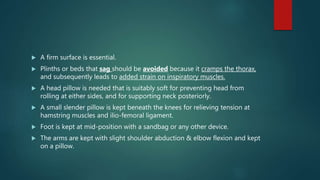
 A firm surface is essential.
 Plinths or beds that sag should be avoided because it cramps the thorax,
and subsequently leads to added strain on inspiratory muscles.
 A head pillow is needed that is suitably soft for preventing head from
rolling at either sides, and for supporting neck posteriorly.
 A small slender pillow is kept beneath the knees for relieving tension at
hamstring muscles and ilio-femoral ligament.
 Foot is kept at mid-position with a sandbag or any other device.
 The arms are kept with slight shoulder abduction & elbow flexion and kept
on a pillow.
Lying supine for Relaxation
ii)Half Lying
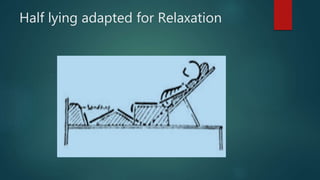
 Half lying position is same as previous position although breathing is
much easier in this position because there is little weight on the back and
abdominal pressure on diaphragm is decreased.
 An armchair is a good substitute for a bed, in this everything is fully
supported, feet rests on the ground, or a footstool, or a T- shaped
footrest is given.
Half lying adapted for Relaxation
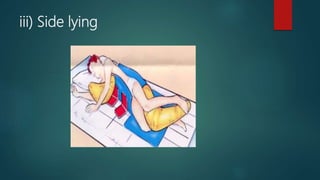
iii) Side lying
 Shoulder and pelvic girdles should be stabilised properly.
 The arms & the legs that are topmost should be rested over a supporting
surface, though part of the weight falls on the trunk and hence hinders
respiration.
 A head pillow which is not too high is given to support the neck & head in
array with the body.
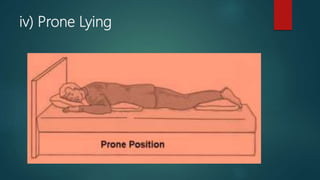
iv) Prone Lying
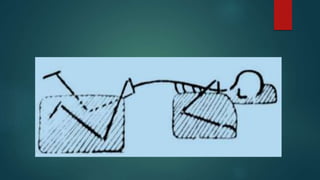
 A small head pillow is given to rest on and head is turned to any one side
whichever is comfortable.
 A pillow which is firm is kept underneath hips & lower abdomen, this helps
in preventing hollowing of back. But for women, pillow must extend a bit
higher for avoiding more pressure on breasts.
 The lower legs are elevated to keep knees slightly bent and the toes
unrestricted.
b) COMFORT
 For comfort the ingredients should be: freedom to breathe enormously,
warmth, an inactive abdomen and physical fatigue which is of mild
degree.
 It is essential to remove any tight clothing like corsets and belts, and any
supportor band used to hold socks up, buttons or suspenders which is
responsible to cause pressure should be also removed.
 Room should be cosy and warm with fresh air.
 During winter season, added warmth may be supplied with warm
blankets (of light weight), electric blanket, and hot-water bottle kept at
the feets or with non- luminous infra- red irradiation.
 A light meal which is well balanced, physical activity of short duration like
brisk walk in open air, and emptying of bladder before treatment are all
beneficial for general relaxation.
c) RESTFUL ATMOSPHERE
 Treatment room should be quiet as possible.
 Complete silence may worry few people, but in general sharp
intermittent sound of high pitch close in hand should be avoided. Instead,
a continuous low-pitched ‘hum’ at a distant is found to be more
soothing.
 Strong colours like red & bright yellow and bright lights are stimulating,
hence soothing colours like green and peach with low diffused lights
should be used in a room to achieve a suitable setting for relaxation.
 Lastly, favourable outcome of a restful atmosphere is the way and the
approach of a physiotherapist. The following points to be noted for a
successful restful atmosphere:
1.Physiotherapist should provide confidence
2.Physiotherapist should be tidy and properly dressed
3.Physiotherapist should be prompt and calm.
4.Physiotherapist behaviour should be well –mannered, polite, cheerful and
considerate. Voice should be clear & low – pitched.
5.Easy and simple explanation of the regimen is provided and patients should
be instructed in a language in which the patient understands.
d) ADDITIONAL METHODS OF
PROMOTING RELAXATION:
1.Autogenic training.
 Autogenic training is a mind- body healing technique.
 It is a method which teaches our body to respond to our own verbal
commands.
 These commands ask our body to relax and then control breathing.
 This method aims at achievement of deep relaxation and reduction of
stress and hence enables clients for self-heal.
 It can be done anywhere in less than 10 minutes without any special
equipment.
2. Progressive Relaxation:
 Progressive relaxation is a technique where relaxation is achieved
progressively.
 This method is designed & practised by Jacobson from Chicago. Same
pose also present in Yoga called as the ‘Savasana’ or ‘Still Pose’.
 It uses systemic, distal to proximal progression of voluntary contraction
and relaxation of muscles.
Sequence for progressive relaxation
techniques
 Place the patient in quiet area and in a comfortable position, and be sure
that restrictive clothing is loosened.
 Have the patient breath in a deep, relaxed manner.
 Ask the patient to contract the distal musculature in the hands or feet
voluntarily for several (5 to 7) seconds and then consciously relax those
muscles for 20 to 30 seconds.
 Suggest that the patient try to feel a sense of heaviness in the hands or feet
and a sense of warmth in the muscle just relaxed.
 Progress to a more proximal area of the body and have the patient actively
contract and actively relax the proximal musculature.
 Suggest to the patient that he or she should feel a sense of relaxation and
warmth throughout the entire limb and eventually throughout the whole
body.
3. Contrast method
Physiology
 Strong muscle contraction is followed with equal relaxation in the same
muscle.
Technique of Contrast Method
Contrast method technique involves
 The sequence of muscle contractions is carried out distal to proximally in
each limb or both limbs which is followed by relaxation for an equal or
longer period of time.
Procedure
 Pull the feet towards yourself and then relax them.
 Point the toes away from yourself and then relax them
 In supine lying position, contract the knees by pushing your knees down in a
pillow and if you are in sitting position, it can be done by pushing the feet
down in the ground and then relax
 Tighten the buttock and then relax them
 Making a fist (both hands)tightly and then relax them
 Open out hands by stretching them out and then relax them
 Tighten the elbows by either pushing down into the bed or onto the arms of
the chair and then relax them
 Bring the shoulders towards your ears and then relax them
 Push the head into the pillow and then relax the head
4.Physiological relaxation (Mitchell Method of Relaxation)
 This method was devised by Laura Mitchell in the year 1957.
 It is based on physiological principle of reciprocal relaxation.
Physiology
 Antagonistic muscles relaxes synchronically and equally to contraction of
agonist muscles. Tension is relieved with contraction of antagonistic
muscles.
Technique
1. Sequence is from proximal to distal usually.
2. Arrange comfortably where your body is well supported.
3. Room should be comfortably warm.
Each area of the body is given three
orders:
1.Move away from the position of stress
2. Stop
3. Be aware of and feel the new position.
Order to the arms
 Shoulders- “Push the shoulders towards the feet” – away from the ear.
STOP
Feel the shoulders are further down & feel a vast space between shoulder and
the ears.
 Elbow – “Open out Elbow”- Keeping the arms supported and slightly
away from the sides, open out the elbow joints.
STOP
The position of arms & elbows are felt and the pressure of the arms is felt
through sensations of skin.
 HANDS-“Open out fingers and thumbs with support”-Opening out fingers
& thumbs with the wrists resting on some support.
STOP
Feel the fingers & thumbs falling back in their support.
Orders to the legs
 Hips –“Turning the hips outwards” – Feeling the thighs & legs rolling
outwards.
STOP
Feeling the legs rolling outwards.
 Knees-“Moving the knees gently till it is comfortable.”
STOP
Feeling the knees are comfortable.
 Feet-“Pushing the feet further from the face.”- bending the ankles in a
downward direction to point the toes.
STOP
Feeling that the feets are softer as all the muscles of lower leg are relaxed.
Orders to the body
 “Pressing the body onto a support” –like the floor or bed or back support
of a chair
STOP
Feeling the pressure of the body into the support.
LOCAL RELAXATION
 To obtain general relaxation, it takes time & is not always required. The
methods of obtaining local relaxation depend on cause and distribution
in tension.
Preparatory to Massage and Passive
Movement
Massage and Passive movement.
 Massage and passive movement both provides relaxation at the area
under treatment. Relaxation can be obtained at a specific area with the
application of general principles which have been described earlier for the
whole body.
For Relief of Muscle Spasm.
 Spasm because of pain is protective in nature and is reduced efficiently
with the relief of pain that caused it. Although, if spasm still persists due
to fear of pain, techniques that establishes pain-free motion are
efficacious. Hold–relax is used in such circumstances, or pendular
movements starting in free range and gradually increase in amplitude
gains confidence & achieve relaxation.
To prevent adaptive shortening.
 Relaxation techniques for tightened muscles & strengthening techniques
for their antagonists for establishing increase in range of motion.
THANKS

Relaxation

  • 1.
    RELAXATION DR.POOJA CHAUDHURI,P.T HOD &ASSOC. PROF, DEPARTMENT OF PHYSIOTHERAPY UNIVERSITY OF SCIENCE AND TECHNOLOGY, MEGHALAYA
  • 2.
    RELAXATION Definition:  Muscles whichare relatively free from tension and at rest are said to be relaxed.  Relaxation is a state in which muscle tension and mental stress are reduced as much as possible through conscious effort, or a process that decreases the wear and tear of life's challenges on your mind and body.
  • 3.
    Classification of Relaxation 1.Mentalrelaxation( reduce mental stress) 2.Physical relaxation ( reduce physical stress)
  • 4.
    Also it canbe classified into:-  General relaxation( relaxation of whole body)  Local relaxation ( relaxation of a particular muscle group or certain part )
  • 5.
    Factors affecting Relaxation 1.Muscle Tone  The muscles which are living is not ever free from tension because these muscles have a tendency of firmness called as muscle tone even when they are in relaxed state.  Muscle tone is hence defined as the contractile state of the muscle at rest.  Maintenance of muscle tone is done with the activity of the muscle spindle circuit.
  • 6.
    2. Postural Tone The contraction that persists at the muscles that is necessary for maintenance of (mainly the Anti-gravity muscles) is known as postural tone.  Maintenance of postural tone is done with a reflex mechanism called myotatic or reflex.  Degree and location of postural tone varies with any alteration in posture. It is greater upright positions, where force of gravity stretches muscles more strongly, than it is in recumbent positions, where effects of force of gravity is adequately counterbalanced full support of the body.
  • 7.
     Recumbent positionsprovides full support to all segments of the body and therefore most suitable for obtaining general relaxation.
  • 8.
    3. Voluntary Movement After any muscle contraction and completion of the movement, the rest & relaxes.  Activity of living cells is followed by inhibition of that activity (contraction=relaxation) as per the recognized biological principle.  When there is contraction at one muscle group, it is accompanied with a reciprocal relaxation in the antagonistic group so that movement occurs smoothly. These facts are of importance during consideration of methods designed to obtain relaxation of a particular group of muscles (Reciprocal inhibition).
  • 9.
    4. Mental Attitude Mental attitudes like anger, fear and excitement increases tension in muscles and prepares muscle for fast or powerful action.  Usually, this tension is relaxed when the need for it no longer exists, but in some cases it persists and may become habitual and lead to change of normal posture.
  • 10.
    5. Pathological Tensionin Muscle  The tension of higher motor centers (upper motor neuron lesions) leads increased tension of relaxed muscles.  Reduction (temporary) of tension can be achieved in the affected area suitable means that promotes relaxation, thus helps in re-educating any functional activity.
  • 11.
  • 12.
    GENERAL RELAXATION  Relaxationtechnique, using methods of general relaxation (total body relaxation), has been used by a variety of practitioners to help patient to • Relieve pain • Relieve muscle tension, anxiety or stress • Relieve associated physical and mental dysfunctions, including tension headaches, high blood pressure, and respiratory distress
  • 13.
    TECHNIQUES OF GENERAL RELAXATION Thesalient conditions for General Relaxation are: a) Support b) Comfort c) Restful atmosphere
  • 14.
    a) SUPPORT To achievefull support of the body, different arrangements & modifications in lying position are adopted. i) Lying supine
  • 16.
     A firmsurface is essential.  Plinths or beds that sag should be avoided because it cramps the thorax, and subsequently leads to added strain on inspiratory muscles.  A head pillow is needed that is suitably soft for preventing head from rolling at either sides, and for supporting neck posteriorly.  A small slender pillow is kept beneath the knees for relieving tension at hamstring muscles and ilio-femoral ligament.  Foot is kept at mid-position with a sandbag or any other device.  The arms are kept with slight shoulder abduction & elbow flexion and kept on a pillow.
  • 17.
    Lying supine forRelaxation
  • 18.
    ii)Half Lying  Halflying position is same as previous position although breathing is much easier in this position because there is little weight on the back and abdominal pressure on diaphragm is decreased.  An armchair is a good substitute for a bed, in this everything is fully supported, feet rests on the ground, or a footstool, or a T- shaped footrest is given.
  • 19.
    Half lying adaptedfor Relaxation
  • 20.
  • 21.
     Shoulder andpelvic girdles should be stabilised properly.  The arms & the legs that are topmost should be rested over a supporting surface, though part of the weight falls on the trunk and hence hinders respiration.  A head pillow which is not too high is given to support the neck & head in array with the body.
  • 23.
  • 24.
     A smallhead pillow is given to rest on and head is turned to any one side whichever is comfortable.  A pillow which is firm is kept underneath hips & lower abdomen, this helps in preventing hollowing of back. But for women, pillow must extend a bit higher for avoiding more pressure on breasts.  The lower legs are elevated to keep knees slightly bent and the toes unrestricted.
  • 26.
    b) COMFORT  Forcomfort the ingredients should be: freedom to breathe enormously, warmth, an inactive abdomen and physical fatigue which is of mild degree.  It is essential to remove any tight clothing like corsets and belts, and any supportor band used to hold socks up, buttons or suspenders which is responsible to cause pressure should be also removed.  Room should be cosy and warm with fresh air.  During winter season, added warmth may be supplied with warm blankets (of light weight), electric blanket, and hot-water bottle kept at the feets or with non- luminous infra- red irradiation.  A light meal which is well balanced, physical activity of short duration like brisk walk in open air, and emptying of bladder before treatment are all beneficial for general relaxation.
  • 27.
    c) RESTFUL ATMOSPHERE Treatment room should be quiet as possible.  Complete silence may worry few people, but in general sharp intermittent sound of high pitch close in hand should be avoided. Instead, a continuous low-pitched ‘hum’ at a distant is found to be more soothing.  Strong colours like red & bright yellow and bright lights are stimulating, hence soothing colours like green and peach with low diffused lights should be used in a room to achieve a suitable setting for relaxation.
  • 28.
     Lastly, favourableoutcome of a restful atmosphere is the way and the approach of a physiotherapist. The following points to be noted for a successful restful atmosphere: 1.Physiotherapist should provide confidence 2.Physiotherapist should be tidy and properly dressed 3.Physiotherapist should be prompt and calm. 4.Physiotherapist behaviour should be well –mannered, polite, cheerful and considerate. Voice should be clear & low – pitched. 5.Easy and simple explanation of the regimen is provided and patients should be instructed in a language in which the patient understands.
  • 29.
    d) ADDITIONAL METHODSOF PROMOTING RELAXATION: 1.Autogenic training.  Autogenic training is a mind- body healing technique.  It is a method which teaches our body to respond to our own verbal commands.  These commands ask our body to relax and then control breathing.  This method aims at achievement of deep relaxation and reduction of stress and hence enables clients for self-heal.  It can be done anywhere in less than 10 minutes without any special equipment.
  • 30.
    2. Progressive Relaxation: Progressive relaxation is a technique where relaxation is achieved progressively.  This method is designed & practised by Jacobson from Chicago. Same pose also present in Yoga called as the ‘Savasana’ or ‘Still Pose’.  It uses systemic, distal to proximal progression of voluntary contraction and relaxation of muscles.
  • 32.
    Sequence for progressiverelaxation techniques  Place the patient in quiet area and in a comfortable position, and be sure that restrictive clothing is loosened.  Have the patient breath in a deep, relaxed manner.  Ask the patient to contract the distal musculature in the hands or feet voluntarily for several (5 to 7) seconds and then consciously relax those muscles for 20 to 30 seconds.  Suggest that the patient try to feel a sense of heaviness in the hands or feet and a sense of warmth in the muscle just relaxed.  Progress to a more proximal area of the body and have the patient actively contract and actively relax the proximal musculature.  Suggest to the patient that he or she should feel a sense of relaxation and warmth throughout the entire limb and eventually throughout the whole body.
  • 33.
    3. Contrast method Physiology Strong muscle contraction is followed with equal relaxation in the same muscle.
  • 34.
    Technique of ContrastMethod Contrast method technique involves  The sequence of muscle contractions is carried out distal to proximally in each limb or both limbs which is followed by relaxation for an equal or longer period of time.
  • 35.
    Procedure  Pull thefeet towards yourself and then relax them.  Point the toes away from yourself and then relax them  In supine lying position, contract the knees by pushing your knees down in a pillow and if you are in sitting position, it can be done by pushing the feet down in the ground and then relax  Tighten the buttock and then relax them  Making a fist (both hands)tightly and then relax them  Open out hands by stretching them out and then relax them  Tighten the elbows by either pushing down into the bed or onto the arms of the chair and then relax them  Bring the shoulders towards your ears and then relax them  Push the head into the pillow and then relax the head
  • 36.
    4.Physiological relaxation (MitchellMethod of Relaxation)  This method was devised by Laura Mitchell in the year 1957.  It is based on physiological principle of reciprocal relaxation. Physiology  Antagonistic muscles relaxes synchronically and equally to contraction of agonist muscles. Tension is relieved with contraction of antagonistic muscles.
  • 37.
    Technique 1. Sequence isfrom proximal to distal usually. 2. Arrange comfortably where your body is well supported. 3. Room should be comfortably warm.
  • 38.
    Each area ofthe body is given three orders: 1.Move away from the position of stress 2. Stop 3. Be aware of and feel the new position.
  • 39.
    Order to thearms  Shoulders- “Push the shoulders towards the feet” – away from the ear. STOP Feel the shoulders are further down & feel a vast space between shoulder and the ears.  Elbow – “Open out Elbow”- Keeping the arms supported and slightly away from the sides, open out the elbow joints.
  • 40.
    STOP The position ofarms & elbows are felt and the pressure of the arms is felt through sensations of skin.  HANDS-“Open out fingers and thumbs with support”-Opening out fingers & thumbs with the wrists resting on some support. STOP Feel the fingers & thumbs falling back in their support.
  • 41.
    Orders to thelegs  Hips –“Turning the hips outwards” – Feeling the thighs & legs rolling outwards. STOP Feeling the legs rolling outwards.  Knees-“Moving the knees gently till it is comfortable.” STOP Feeling the knees are comfortable.  Feet-“Pushing the feet further from the face.”- bending the ankles in a downward direction to point the toes.
  • 42.
    STOP Feeling that thefeets are softer as all the muscles of lower leg are relaxed.
  • 43.
    Orders to thebody  “Pressing the body onto a support” –like the floor or bed or back support of a chair STOP Feeling the pressure of the body into the support.
  • 44.
    LOCAL RELAXATION  Toobtain general relaxation, it takes time & is not always required. The methods of obtaining local relaxation depend on cause and distribution in tension.
  • 45.
    Preparatory to Massageand Passive Movement Massage and Passive movement.  Massage and passive movement both provides relaxation at the area under treatment. Relaxation can be obtained at a specific area with the application of general principles which have been described earlier for the whole body.
  • 46.
    For Relief ofMuscle Spasm.  Spasm because of pain is protective in nature and is reduced efficiently with the relief of pain that caused it. Although, if spasm still persists due to fear of pain, techniques that establishes pain-free motion are efficacious. Hold–relax is used in such circumstances, or pendular movements starting in free range and gradually increase in amplitude gains confidence & achieve relaxation.
  • 47.
    To prevent adaptiveshortening.  Relaxation techniques for tightened muscles & strengthening techniques for their antagonists for establishing increase in range of motion.
  • 48.

Editor's Notes

  • #27 Enormously- very large in size
  • #28 Soothing means calm effect