A light year is a way of measuring
distance.
 Light travels at 186,000 miles per second
(300,000 kilometers per second).
 Therefore, a light second is 186,000 miles
(300,000 kilometers).
 A light year is the distance that light can
travel in a year, or:
 186,000 miles/second * 60 seconds/minute
* 60 minutes/hour * 24 hours/day * 365
days/year = 5,865,696,000,000 miles/year
 OR…… 1 LIGHTYEAR
the branch of astronomy that deals with
the origin, large-scale properties, and
the evolution of the observable universe
the
branch
of
astronom
y that
deals
with the
origin,
large-
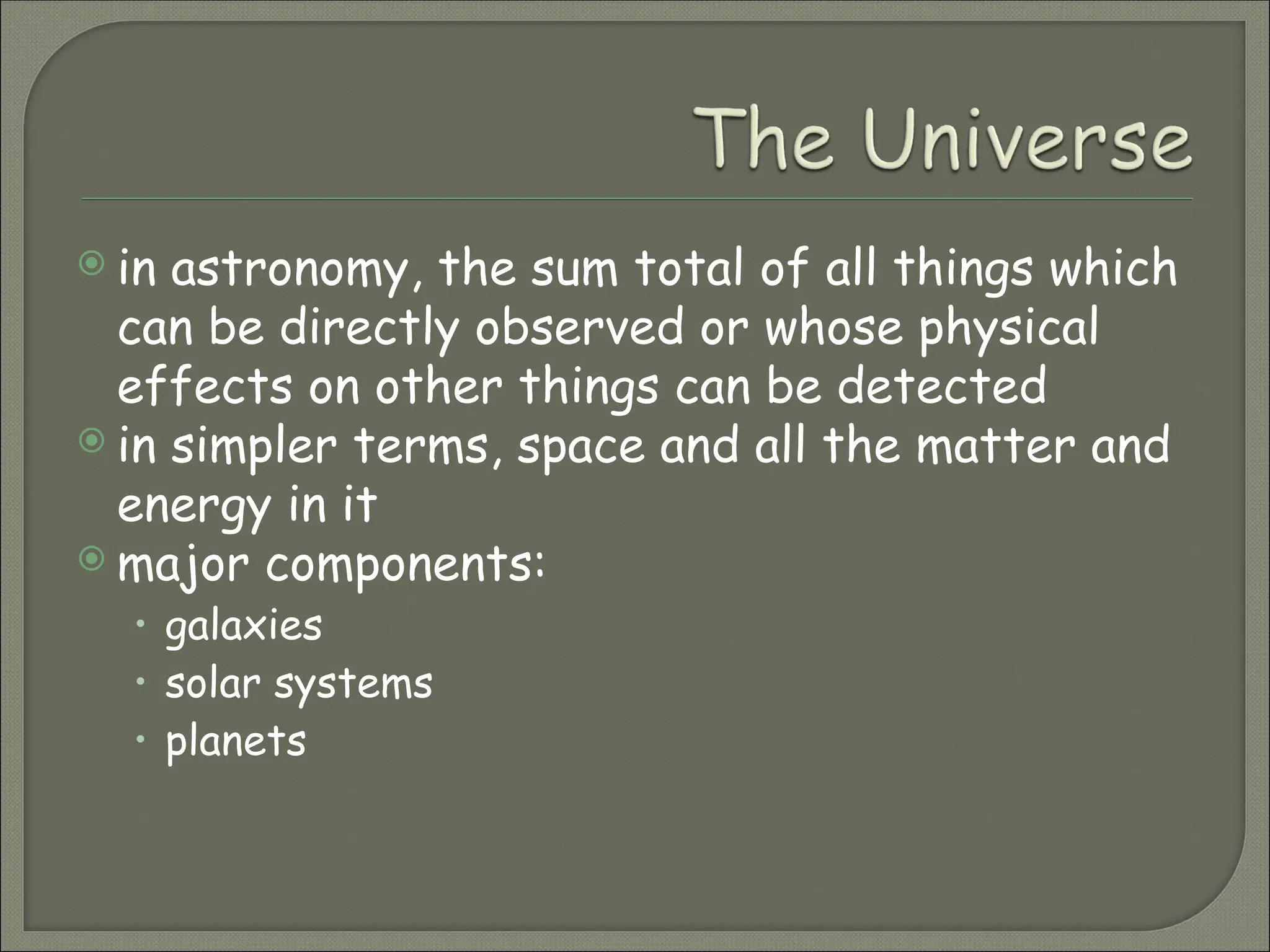
 in astronomy, the sum total of all things which
can be directly observed or whose physical
effects on other things can be detected
 in simpler terms, space and all the matter and
energy in it
 major components:
• galaxies
• solar systems
• planets
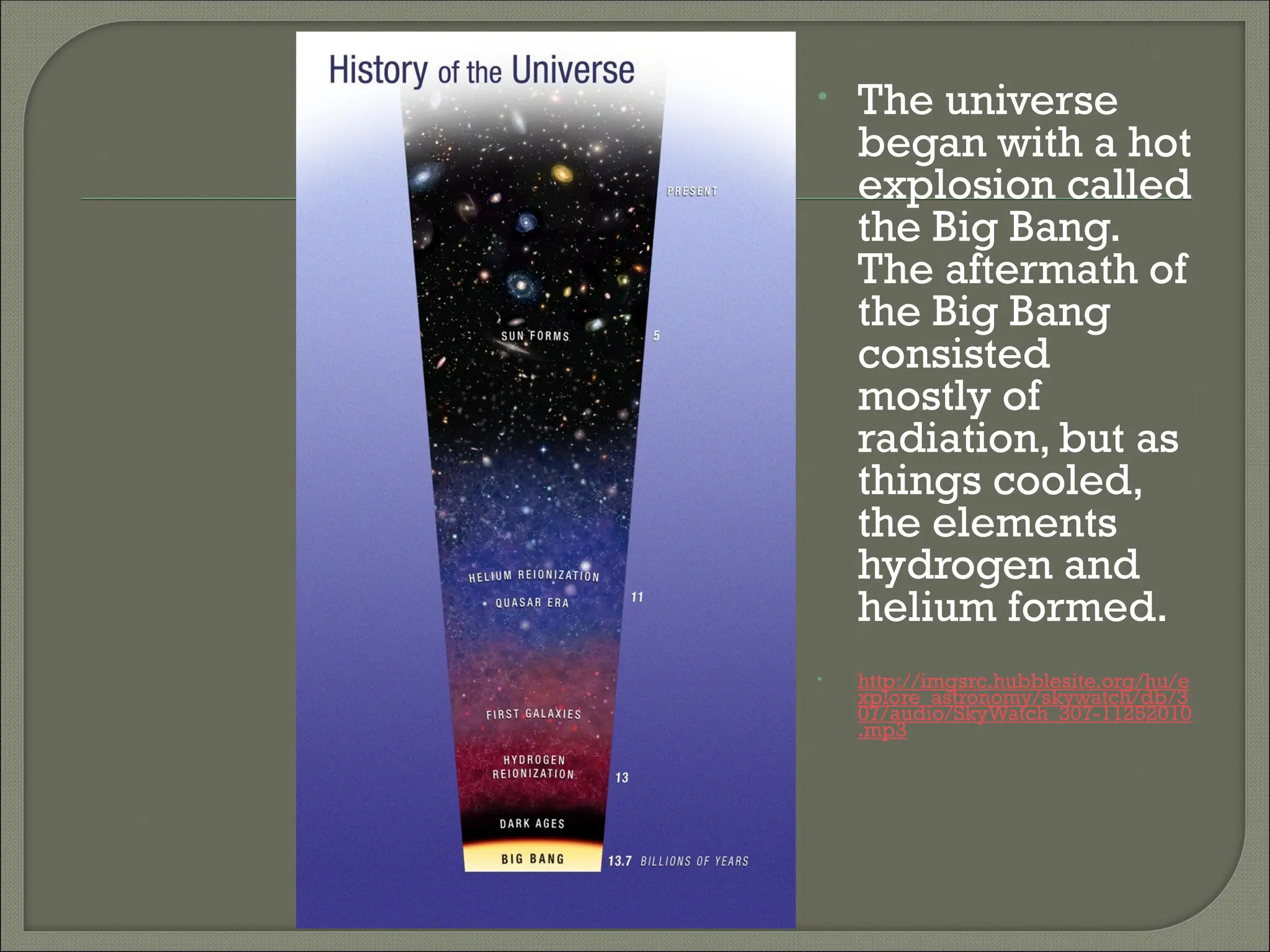
• The universe
began with a hot
explosion called
the Big Bang.
The aftermath of
the Big Bang
consisted
mostly of
radiation, but as
things cooled,
the elements
hydrogen and
helium formed.
• http://imgsrc.hubblesite.org/hu/e
xplore_astronomy/skywatch/db/3
07/audio/SkyWatch_307-11252010
.mp3
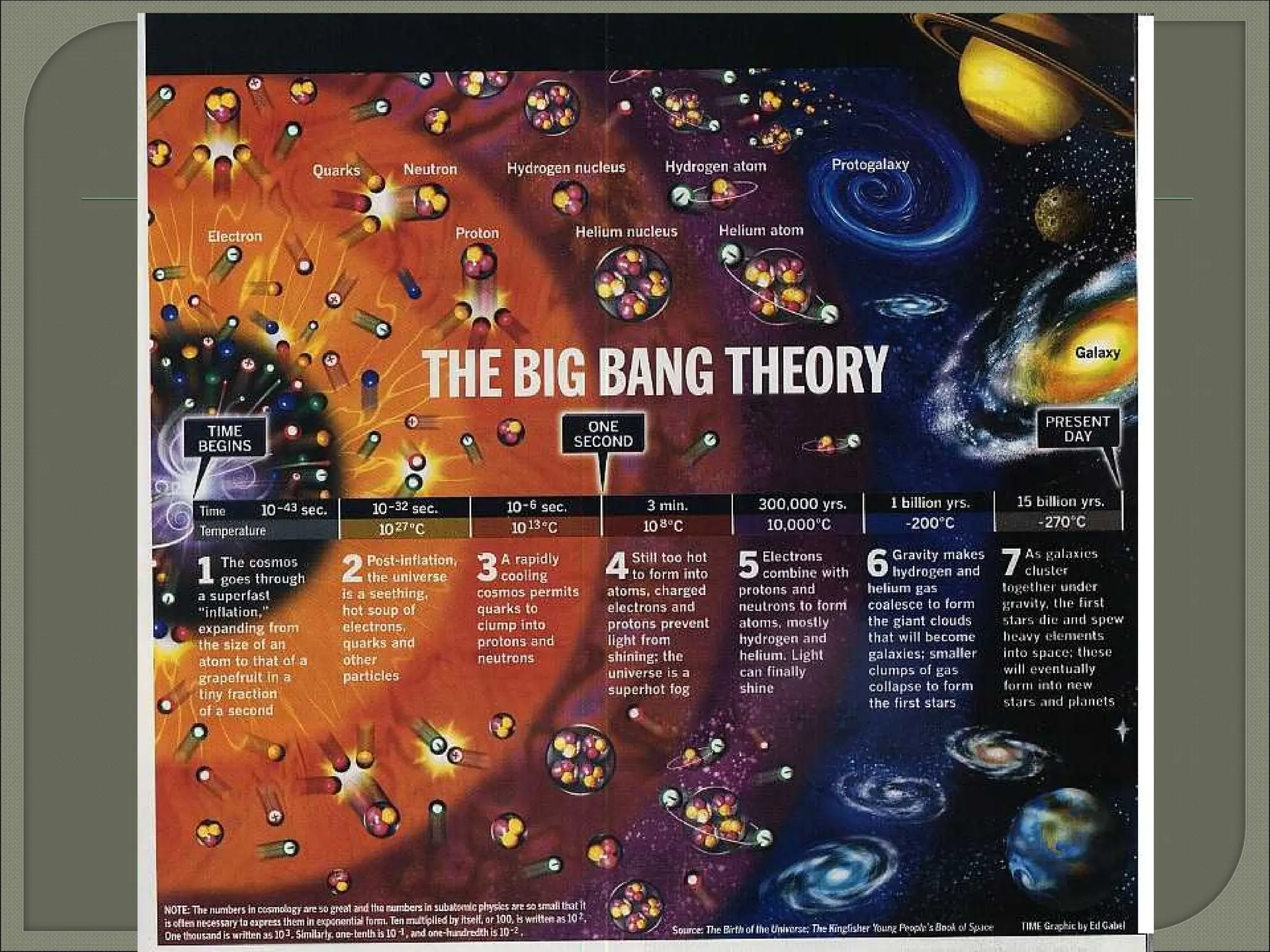
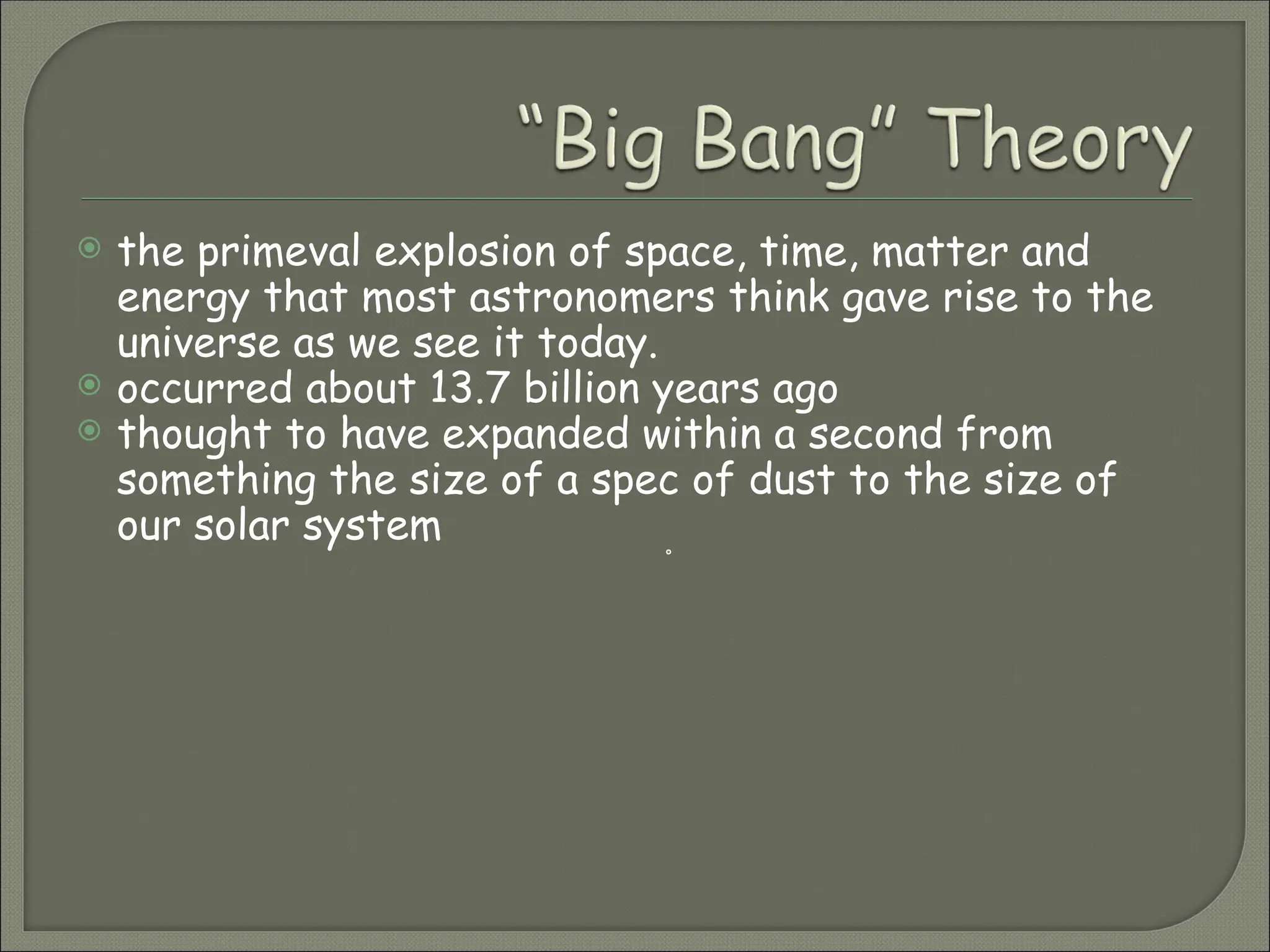
 the primeval explosion of space, time, matter and
energy that most astronomers think gave rise to the
universe as we see it today.
 occurred about 13.7 billion years ago
 thought to have expanded within a second from
something the size of a spec of dust to the size of
our solar system
• Big Bang Theory - Evidence for the Theory
• First of all, we are reasonably certain that the universe
has a beginning.
• Second, galaxies appear to be moving away from us at
speeds proportional to their distance. This is called
"Hubble's Law.” This observation supports the
expansion of the universe and suggests that the
universe was once compacted.
• Third, if the universe was initially very, very hot as the
Big Bang suggests, we should be able to find some
remnant of this heat. In 1965, this was discovered a 2.725
degree Kelvin (-454.765 degree Fahrenheit, -270.425 degree Celsius) Cosmic
Microwave Background radiation (CMB) which pervades the observable universe.
• Finally, the abundance of the "light elements"
Hydrogen and Helium found in the observable
universe are thought to support the Big Bang model of
origins.
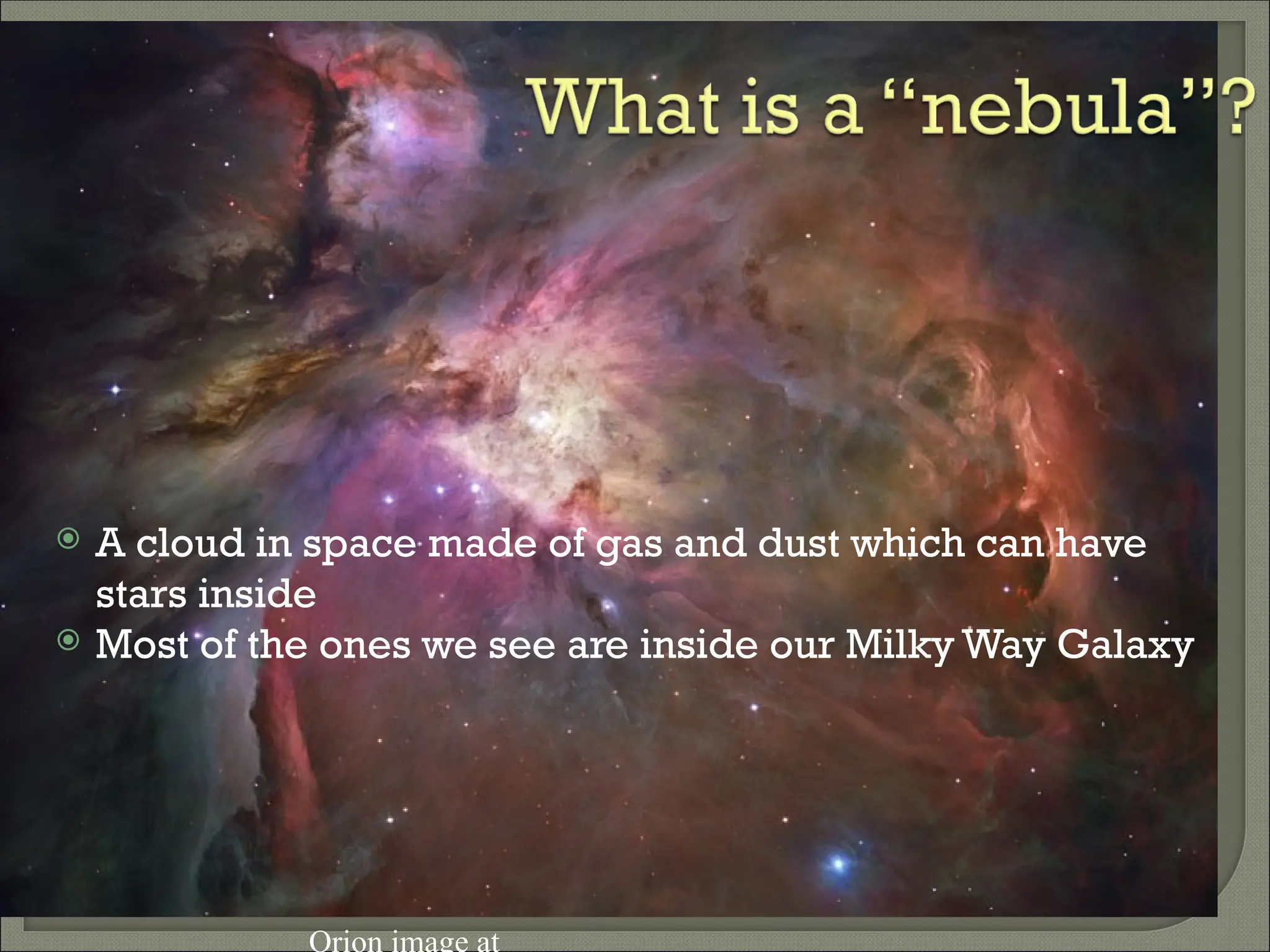
 A cloud in space made of gas and dust which can have
stars inside
 Most of the ones we see are inside our Milky Way Galaxy
Orion image at
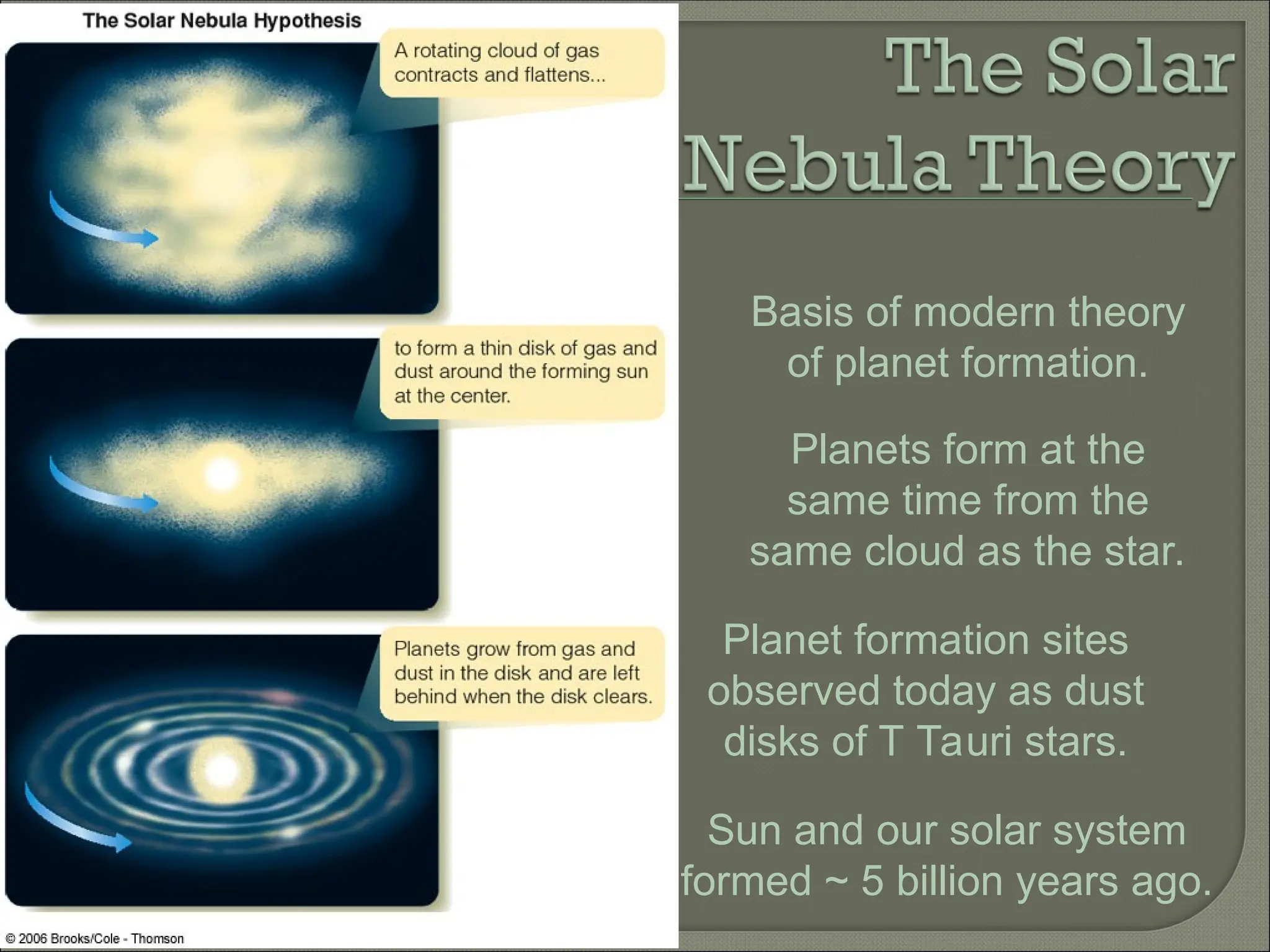
Basis of modern theory
of planet formation.
Planets form at the
same time from the
same cloud as the star.
Sun and our solar system
formed ~ 5 billion years ago.
Planet formation sites
observed today as dust
disks of T Tauri stars.
 a),(b) The solar nebula contracts and
flattens into a spinning disk.The
large blob in the center will become
the Sun.Smaller blobs in the outer
regions may become jovian planets.
 (c) Dust grains act as condensation
nuclei,forming clumps of matter that
collide,stick together,and grow into
moon-sized planetesimals.
 (d) Strong winds from the still-
forming Sun expel the nebular gas.
 (e) Planetesimals continue to collide
and grow.
 (f) Over the course of a hundred
million years or so,planetesimals
form a few large planets that travel in
roughly circular orbits.
The Big Bang Theory considers the
creation of all the matter and energy that
exists in the universe.. Anywhere..
The Solar Nebula theory uses that matter
and energy, to create galaxies and solar
systems.
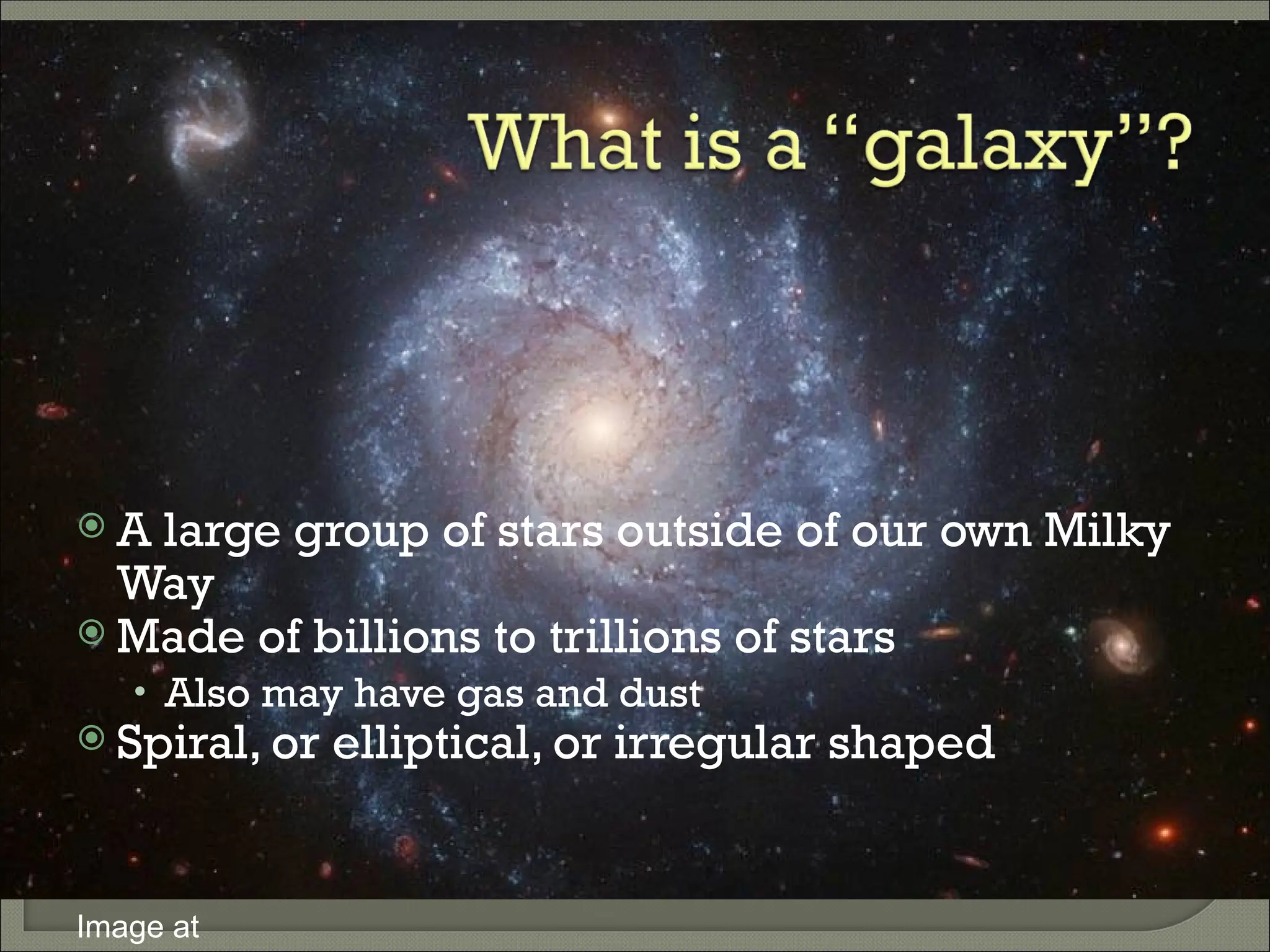
 A large group of stars outside of our own Milky
Way
 Made of billions to trillions of stars
• Also may have gas and dust
 Spiral, or elliptical, or irregular shaped
Image at
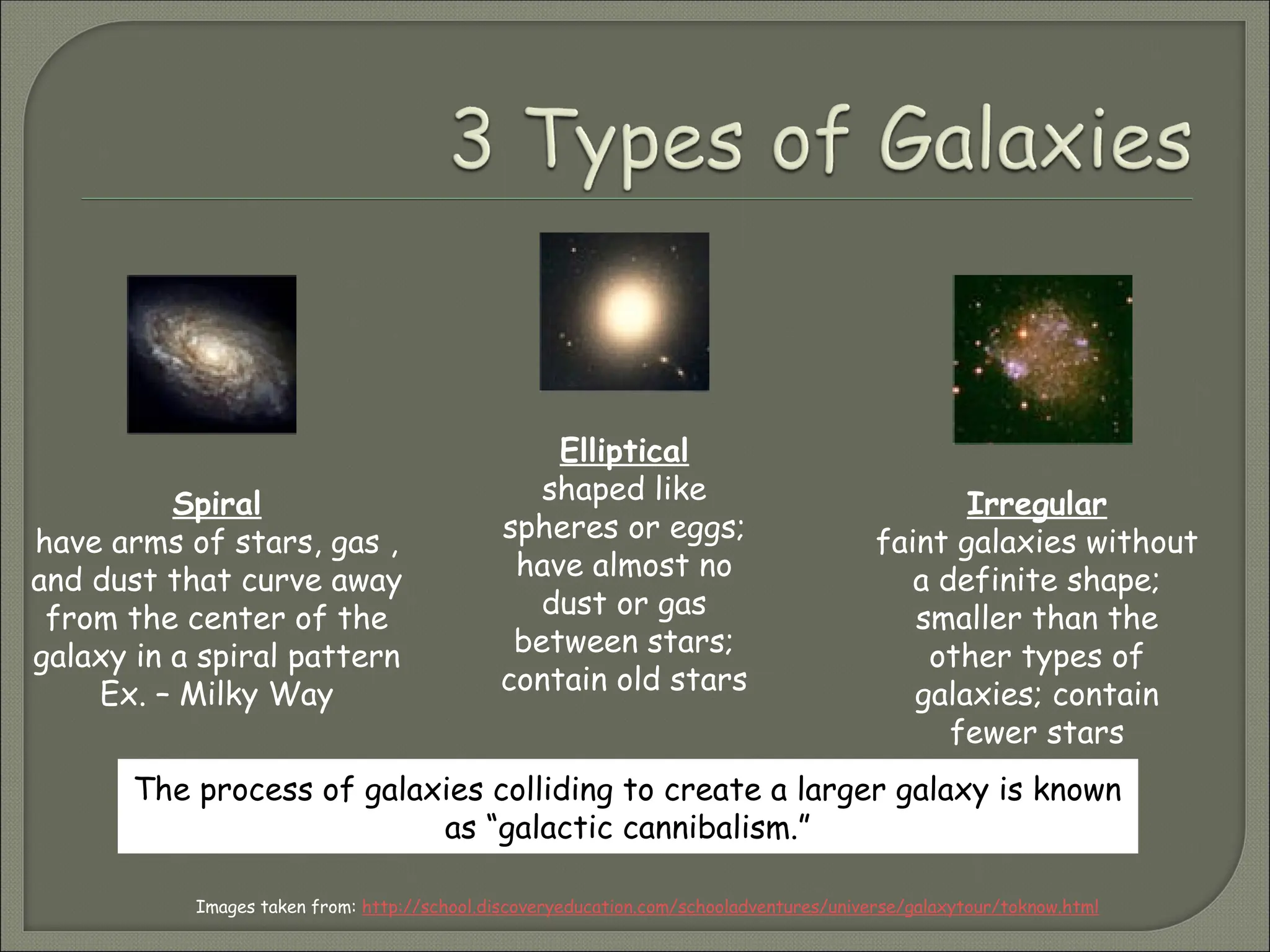
Spiral
have arms of stars, gas ,
and dust that curve away
from the center of the
galaxy in a spiral pattern
Ex. – Milky Way
Elliptical
shaped like
spheres or eggs;
have almost no
dust or gas
between stars;
contain old stars
Irregular
faint galaxies without
a definite shape;
smaller than the
other types of
galaxies; contain
fewer stars
The process of galaxies colliding to create a larger galaxy is known
as “galactic cannibalism.”
Images taken from: http://school.discoveryeducation.com/schooladventures/universe/galaxytour/toknow.html
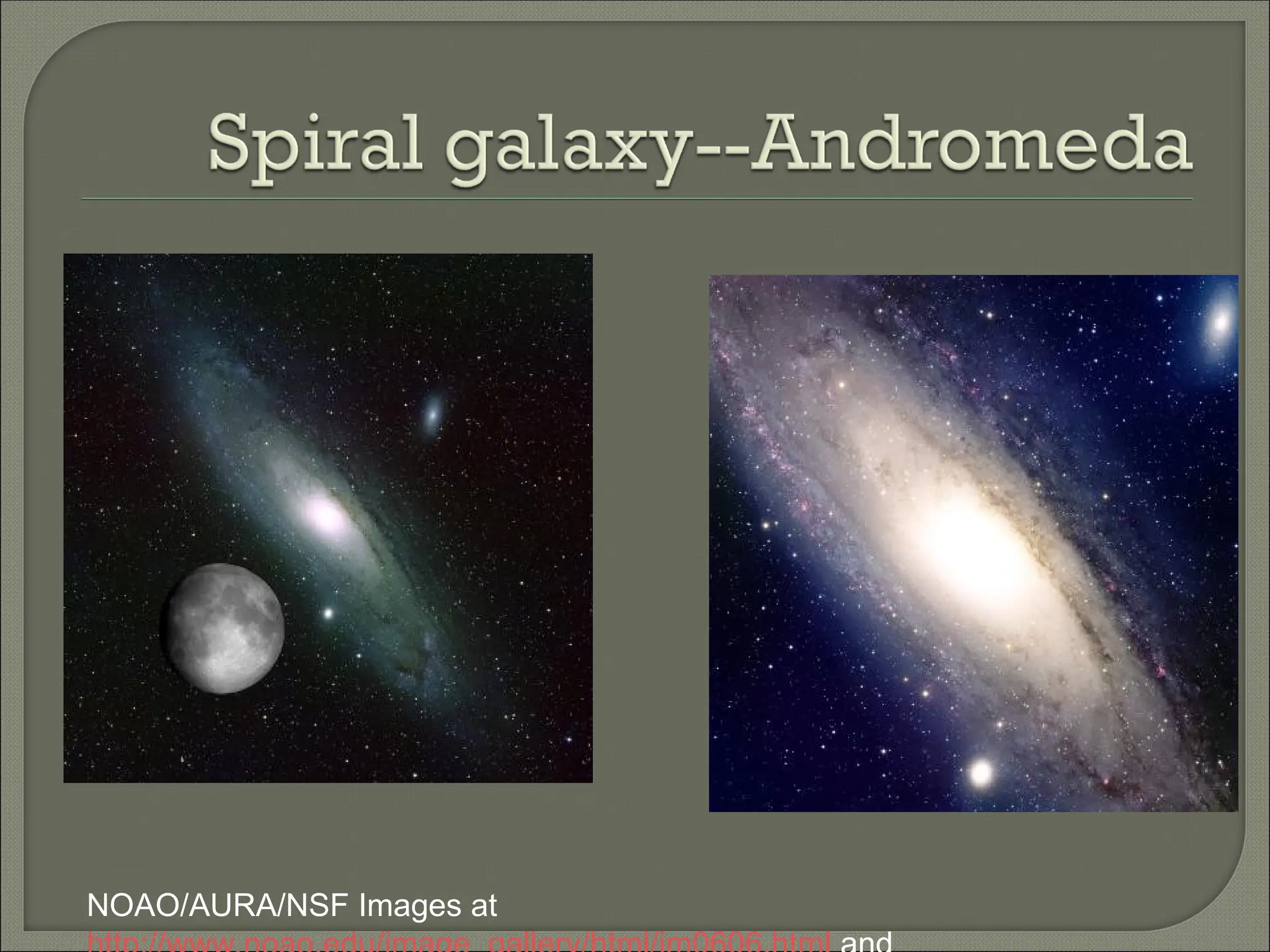
NOAO/AURA/NSF Images at
Located in the constellation of Andromeda,
the Princess, the Andromeda Galaxy is a
large spiral galaxy very similar to our
own Galaxy, the Milky Way. It is over
65,000 light-years in diameter and
approximately 2.2 million light-years in
distance.
Images at
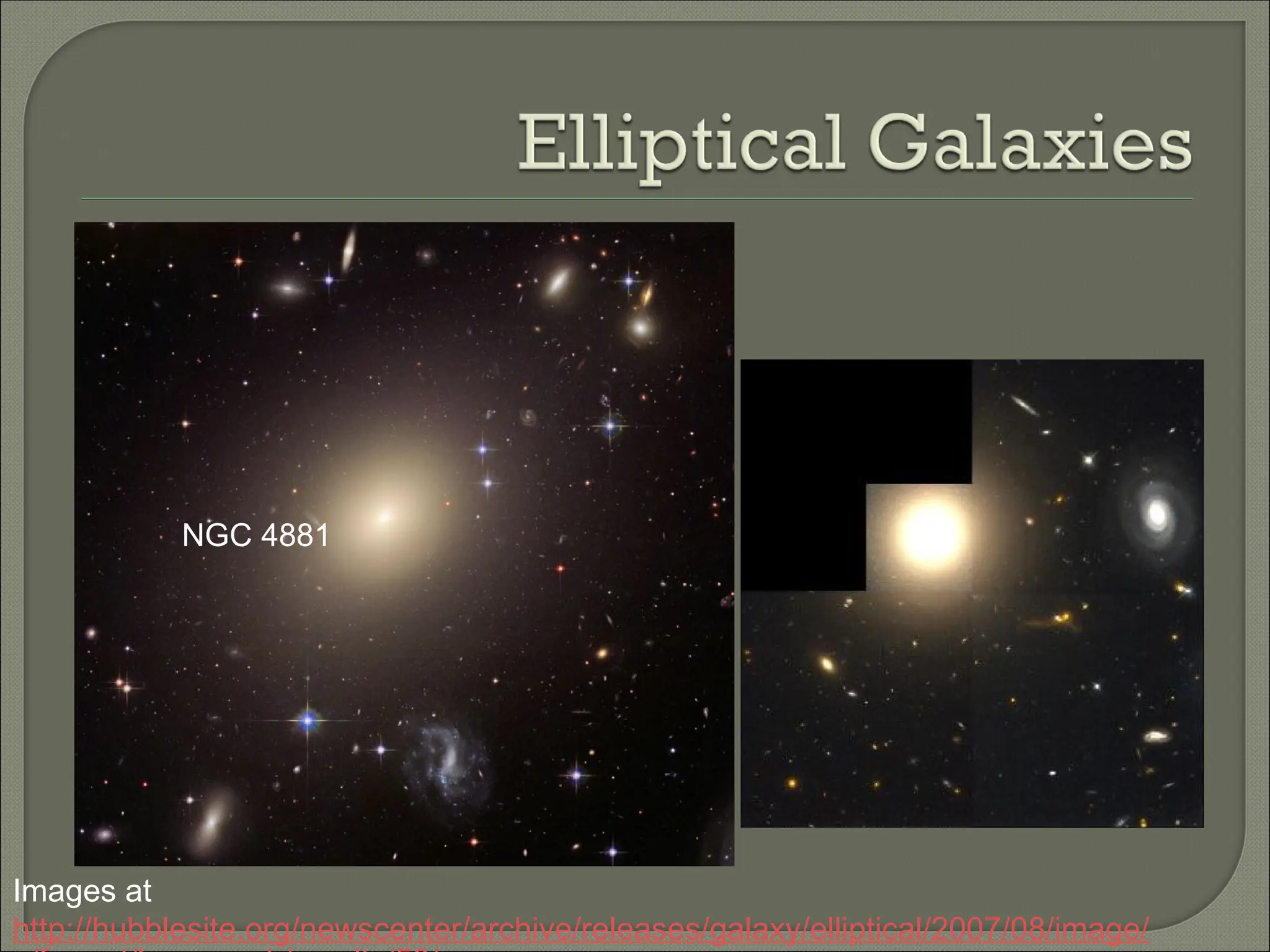
http://hubblesite.org/newscenter/archive/releases/galaxy/elliptical/2007/08/image/
NGC 4881
 The giant elliptical ESO 325-G004 looms large at
the cluster's center. The galaxy is as massive as
100 billion of our suns. Hubble resolves
thousands of globular star clusters orbiting ESO
325-G004. Globular clusters are compact groups
of hundreds of thousands of stars that are
gravitationally bound together. At the galaxy's
distance they appear as pinpoints of light
contained within the diffuse halo.
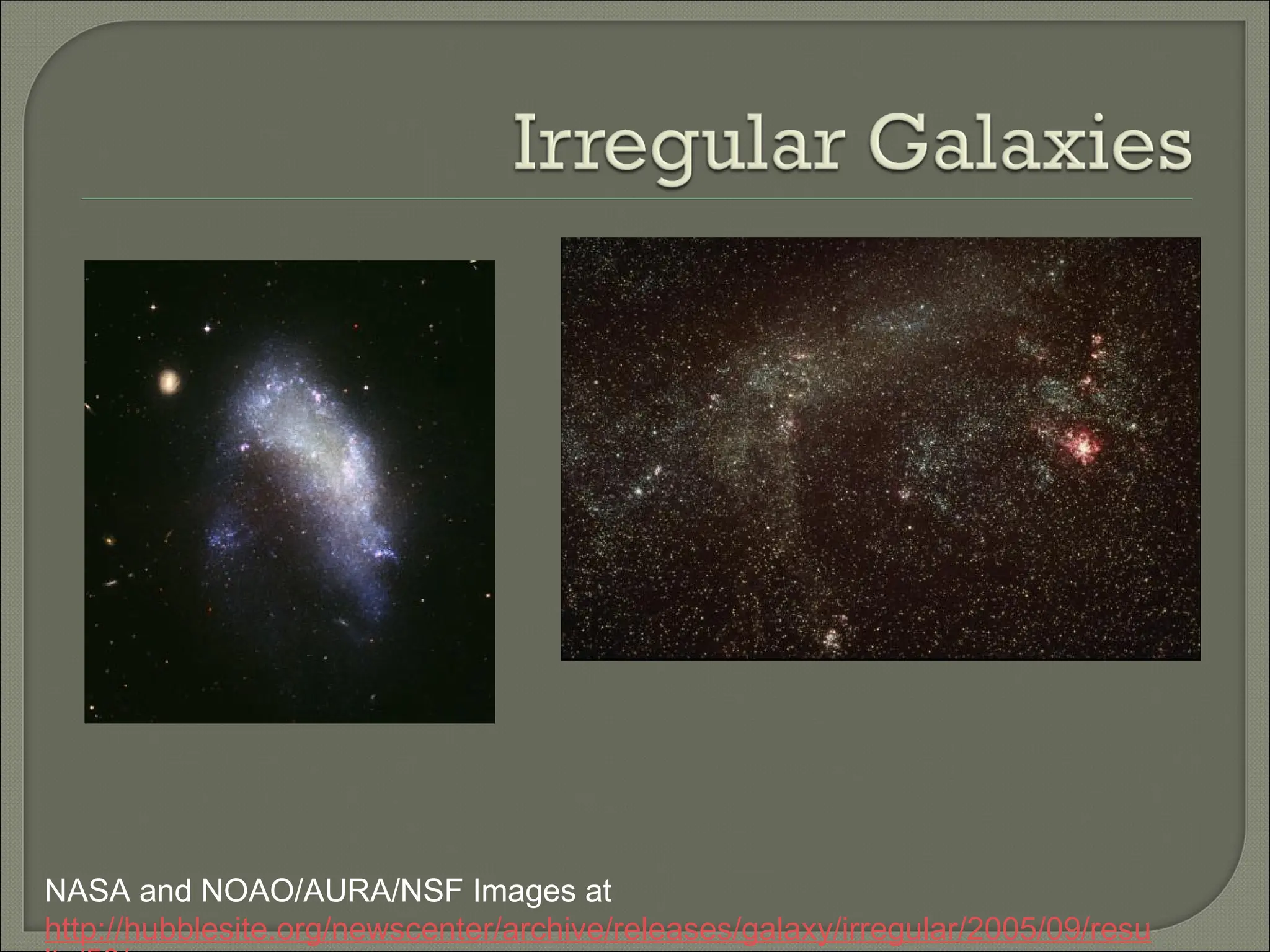
NASA and NOAO/AURA/NSF Images at
http://hubblesite.org/newscenter/archive/releases/galaxy/irregular/2005/09/resu
 The irregular galaxy NGC 1427A is a spectacular example of the resulting stellar
rumble. Under the gravitational grasp of a large gang of galaxies, called the Fornax
cluster, the small bluish galaxy is plunging headlong into the group at 600
kilometers per second or nearly 400 miles per second.
 1. IS NGC 1427A ACTIVELY FORMING STARS?
 NGC 1427A shows numerous hot, blue stars that have been formed very recently,
showing that star formation is occurring extensively throughout the galaxy. Within
the Fornax cluster, there is a considerable amount of gas lying between the galaxies.
When the gas within NGC 1427A collides with the Fornax gas, it is compressed to the
point that it starts to collapse under its own gravity. This leads to formation of the
myriad of new stars seen across NGC 1427A. The tidal forces of nearby galaxies in
the cluster may also play a role in triggering star formation on such a massive scale.
 2. WHAT IS THE EVENTUAL FATE FOR NGC 1427A?

NGC 1427A will not survive long as an identifiable galaxy passing through the
cluster.Within the next billion years, it will be completely disrupted, spilling its stars
and remaining gas into intergalactic space within the Fornax cluster.
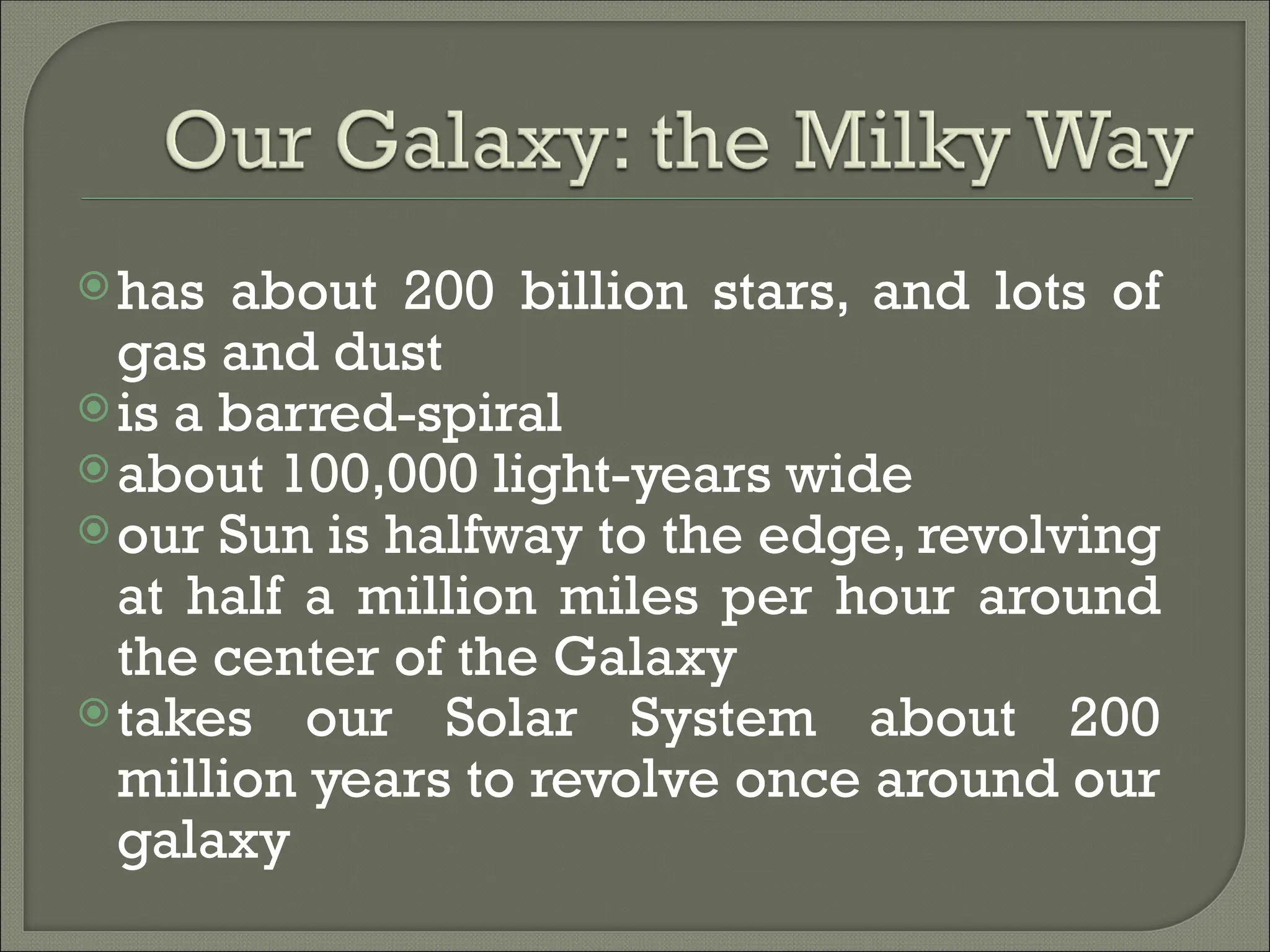
has about 200 billion stars, and lots of
gas and dust
is a barred-spiral
about 100,000 light-years wide
our Sun is halfway to the edge, revolving
at half a million miles per hour around
the center of the Galaxy
takes our Solar System about 200
million years to revolve once around our
galaxy
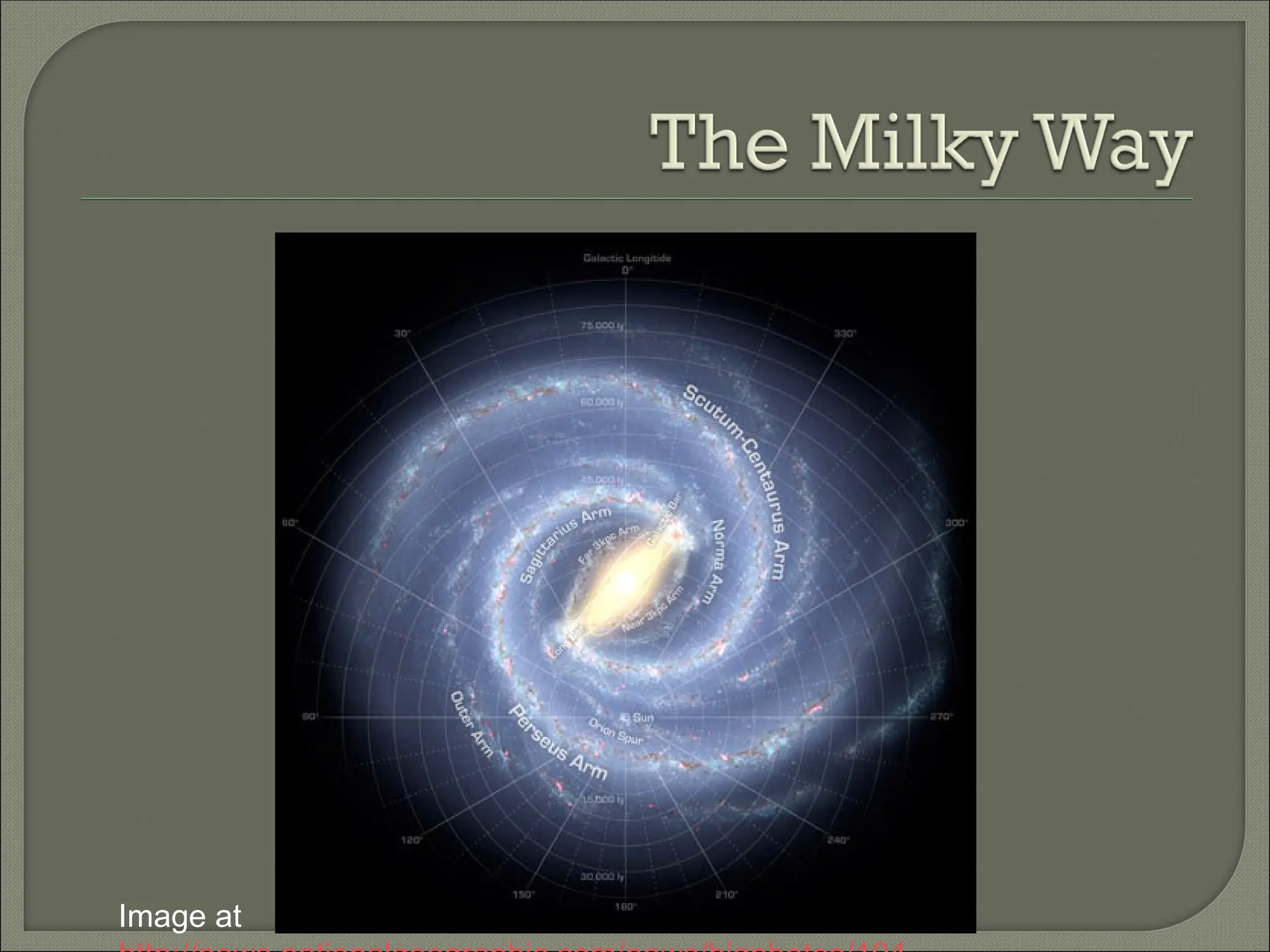
Image at
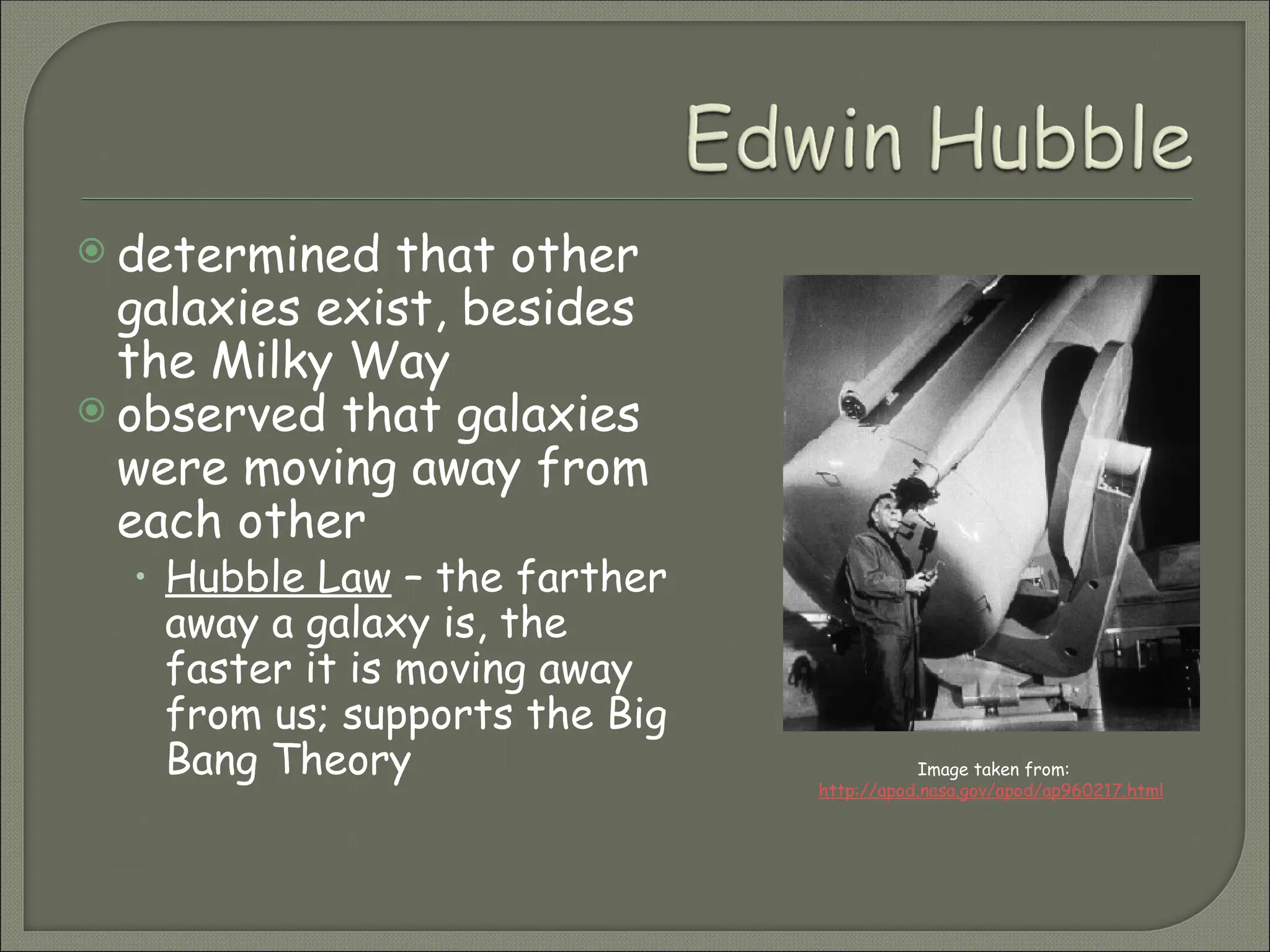
 determined that other
galaxies exist, besides
the Milky Way
 observed that galaxies
were moving away from
each other
• Hubble Law – the farther
away a galaxy is, the
faster it is moving away
from us; supports the Big
Bang Theory Image taken from:
http://apod.nasa.gov/apod/ap960217.html
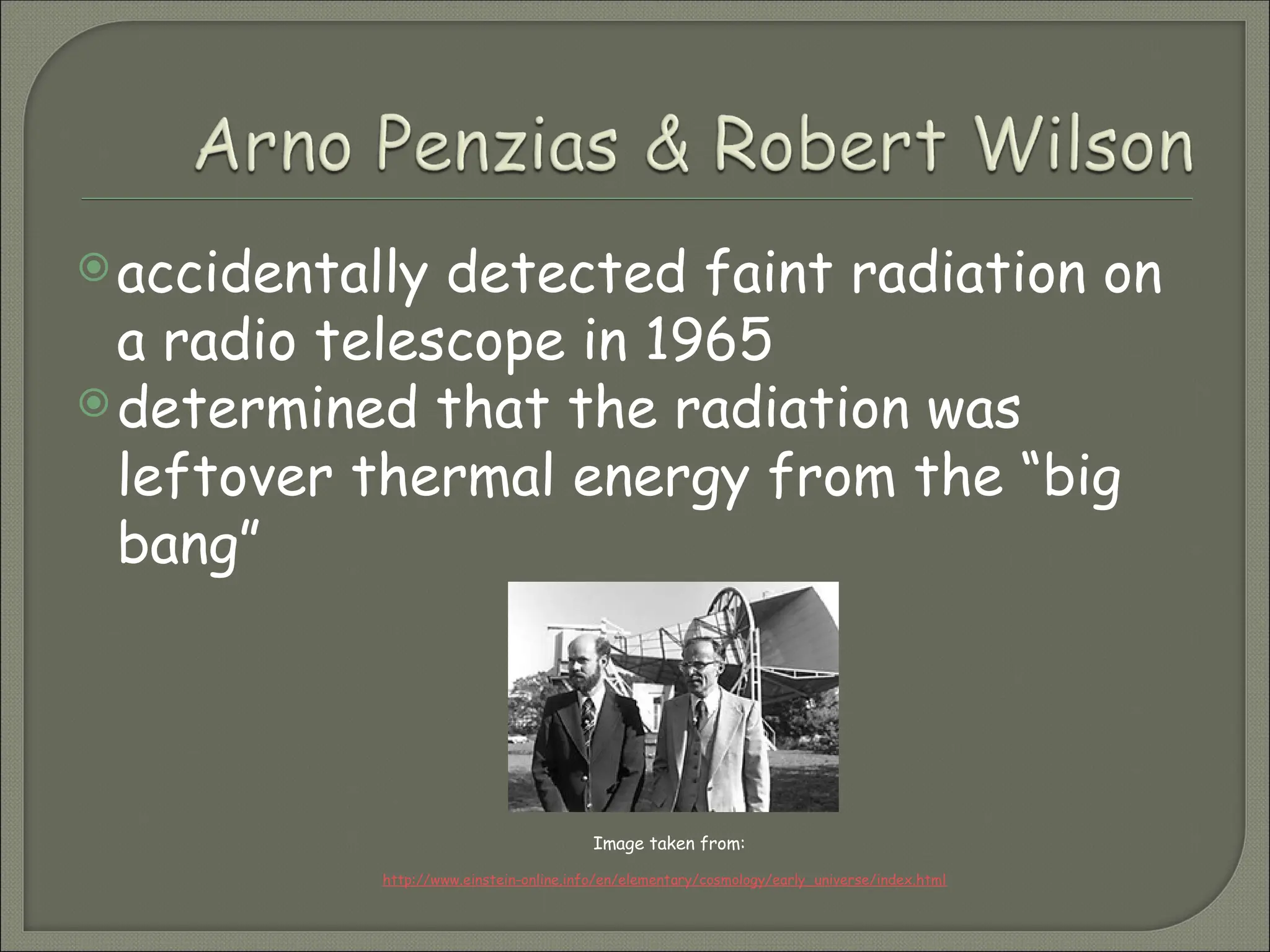
accidentally detected faint radiation on
a radio telescope in 1965
determined that the radiation was
leftover thermal energy from the “big
bang”
Image taken from:
http://www.einstein-online.info/en/elementary/cosmology/early_universe/index.html
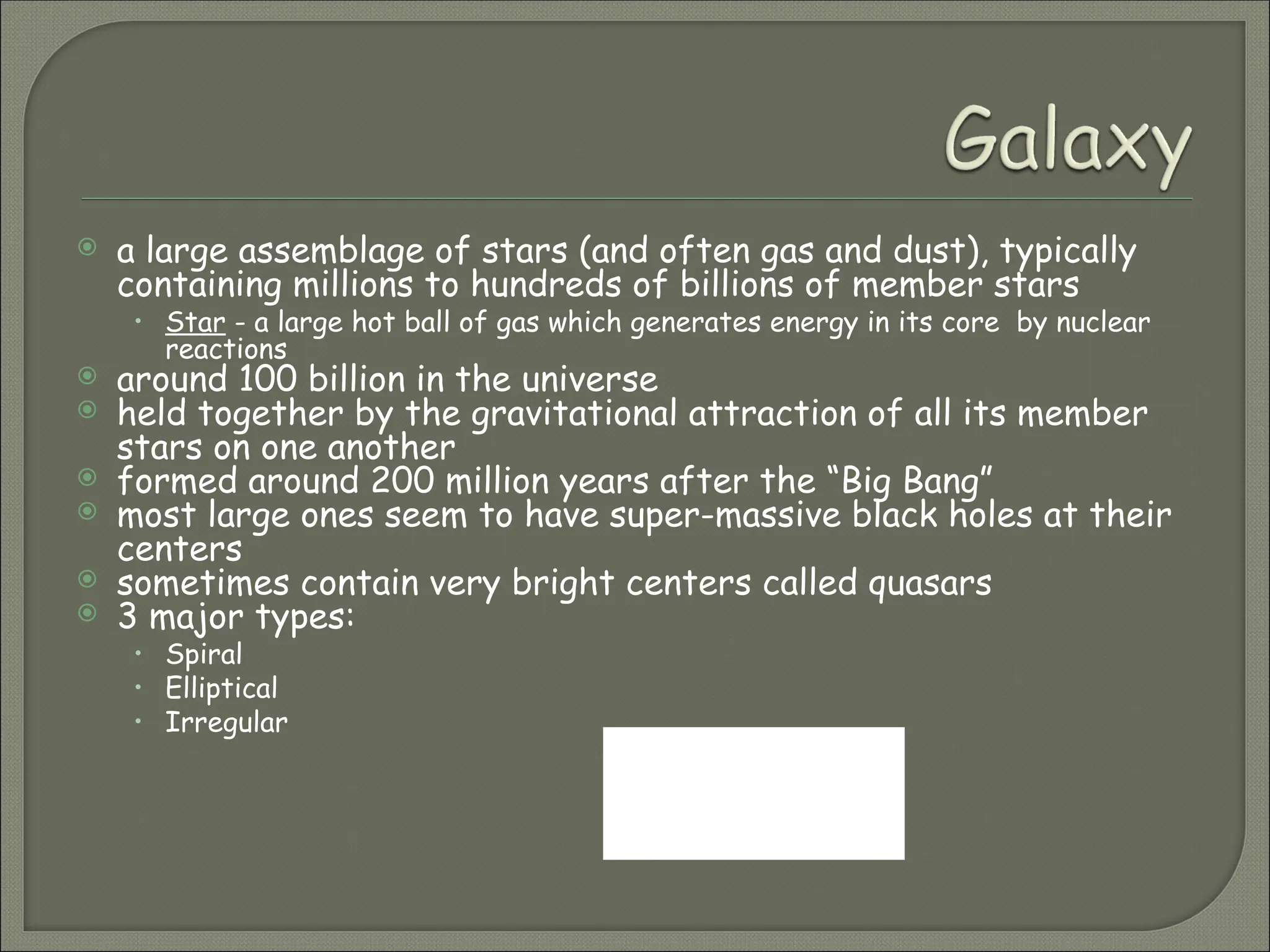
 a large assemblage of stars (and often gas and dust), typically
containing millions to hundreds of billions of member stars
• Star - a large hot ball of gas which generates energy in its core by nuclear
reactions
 around 100 billion in the universe
 held together by the gravitational attraction of all its member
stars on one another
 formed around 200 million years after the “Big Bang”
 most large ones seem to have super-massive black holes at their
centers
 sometimes contain very bright centers called quasars
 3 major types:
• Spiral
• Elliptical
• Irregular
What is the name
of the galaxy
we reside in?
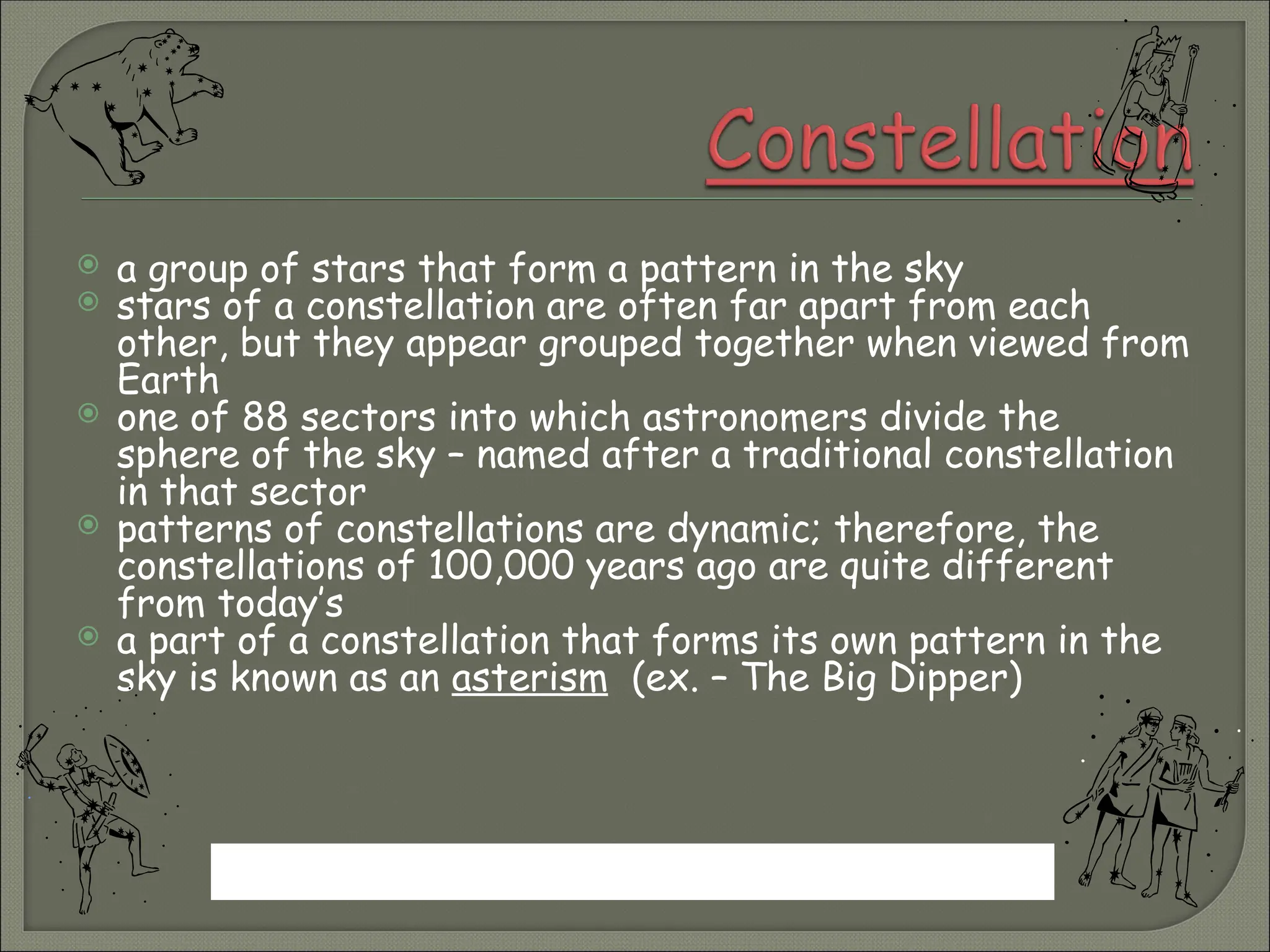
 a group of stars that form a pattern in the sky
 stars of a constellation are often far apart from each
other, but they appear grouped together when viewed from
Earth
 one of 88 sectors into which astronomers divide the
sphere of the sky – named after a traditional constellation
in that sector
 patterns of constellations are dynamic; therefore, the
constellations of 100,000 years ago are quite different
from today’s
 a part of a constellation that forms its own pattern in the
sky is known as an asterism (ex. – The Big Dipper)
Why is it not possible to see all constellations at once?
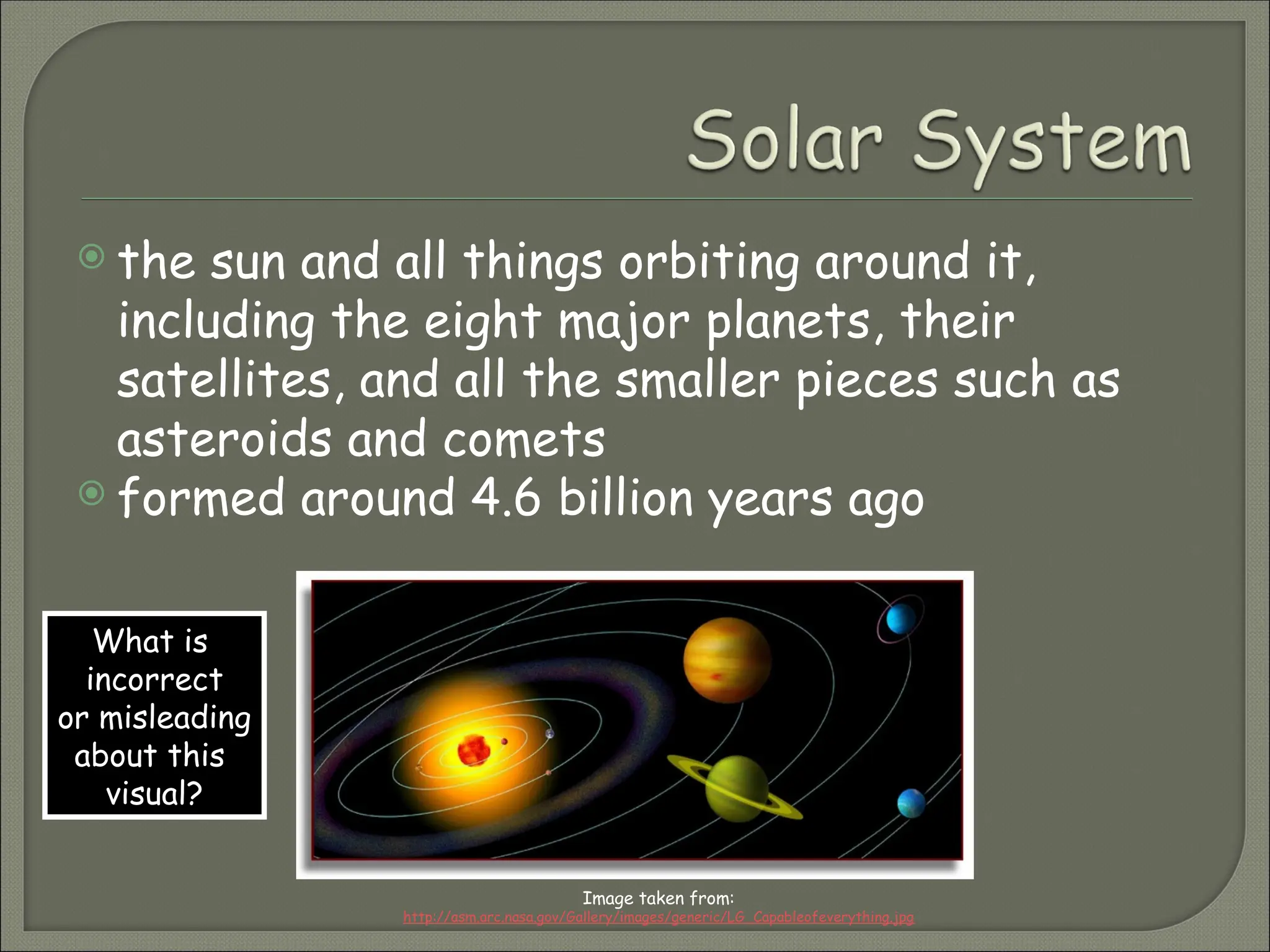
 the sun and all things orbiting around it,
including the eight major planets, their
satellites, and all the smaller pieces such as
asteroids and comets
 formed around 4.6 billion years ago
Image taken from:
http://asm.arc.nasa.gov/Gallery/images/generic/LG_Capableofeverything.jpg
What is
incorrect
or misleading
about this
visual?
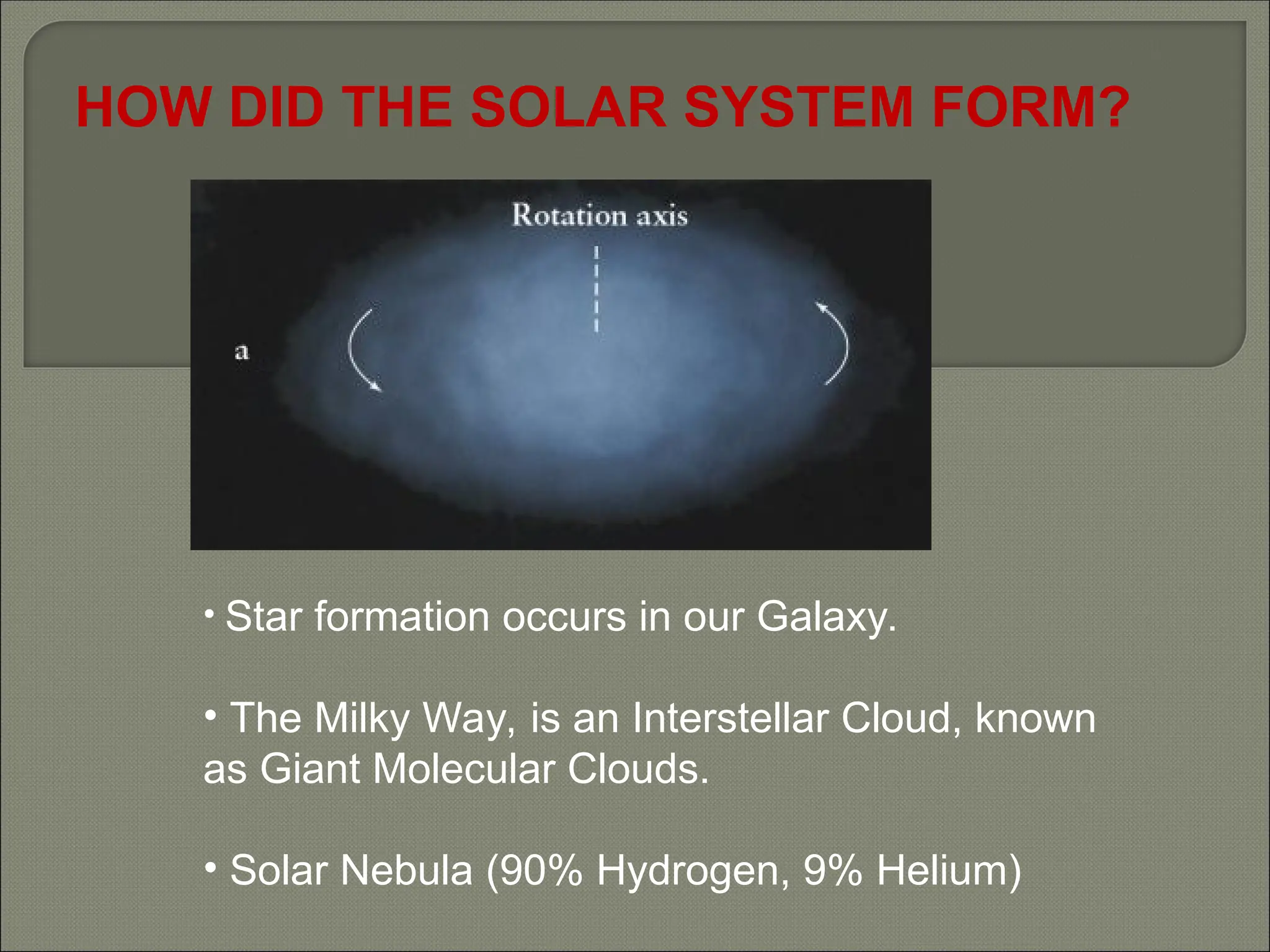
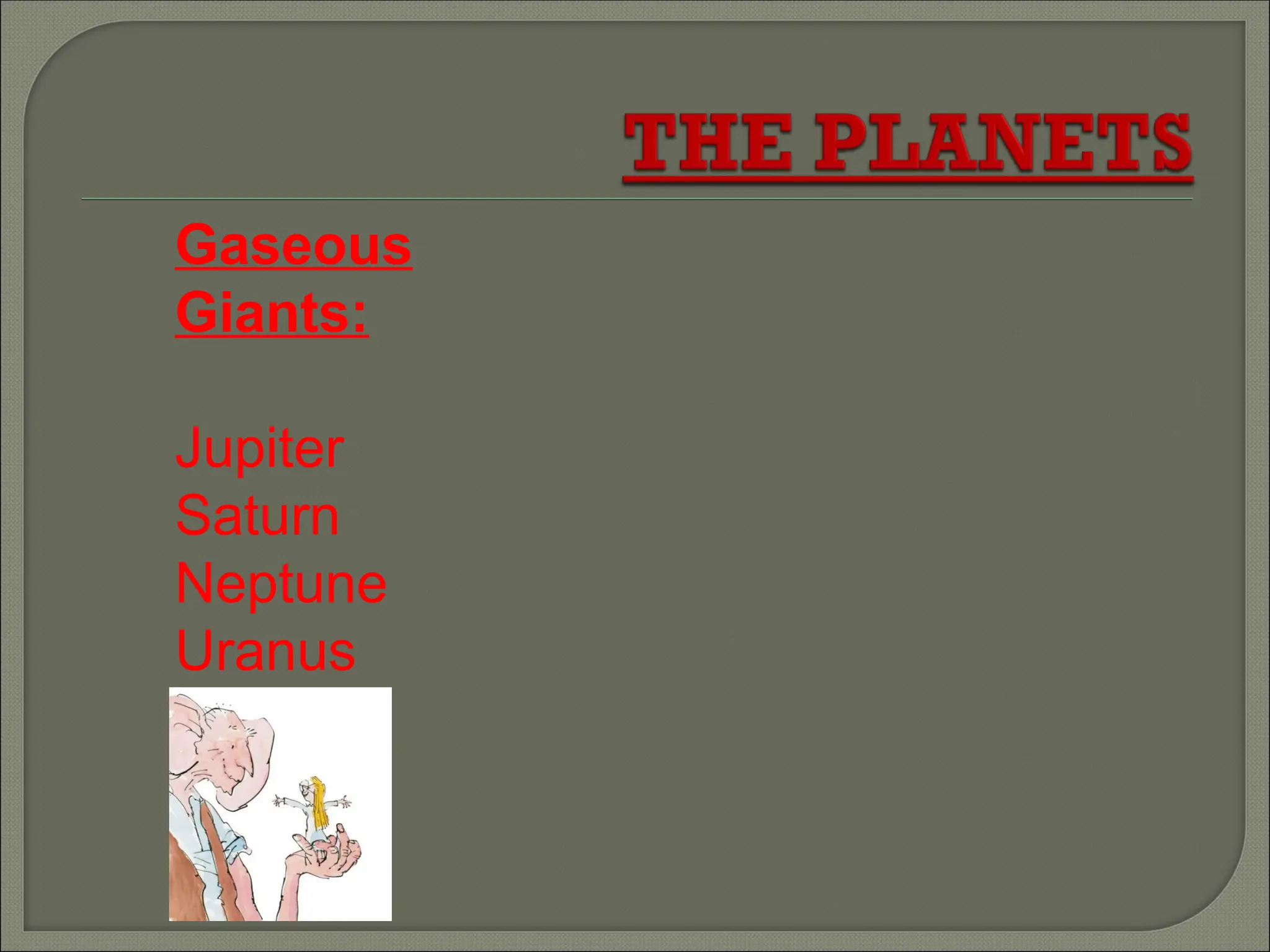
HOW DID THE SOLAR SYSTEM FORM?
• Star formation occurs in our Galaxy.
• The Milky Way, is an Interstellar Cloud, known
as Giant Molecular Clouds.
• Solar Nebula (90% Hydrogen, 9% Helium)
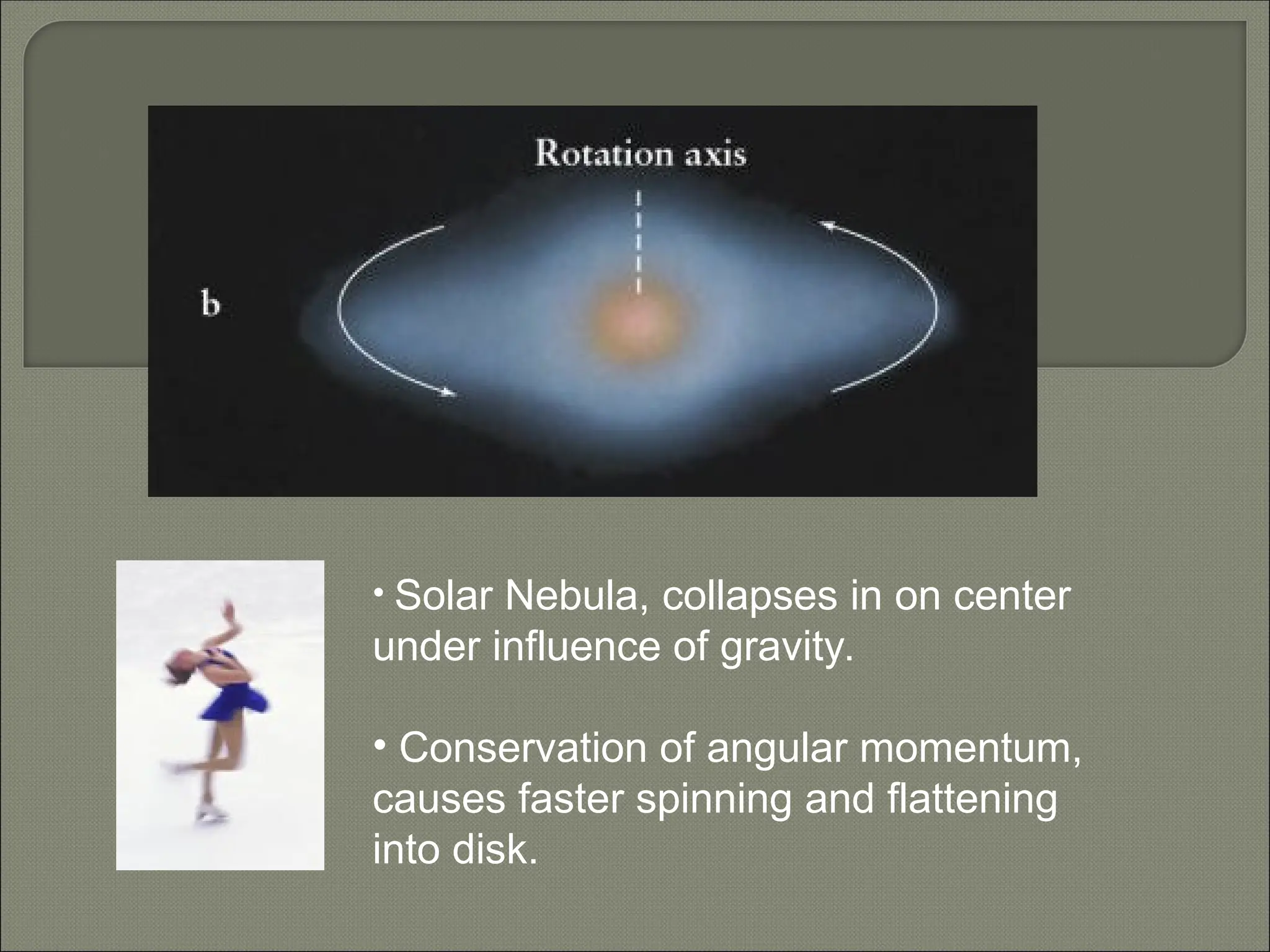
• Solar Nebula, collapses in on center
under influence of gravity.
• Conservation of angular momentum,
causes faster spinning and flattening
into disk.
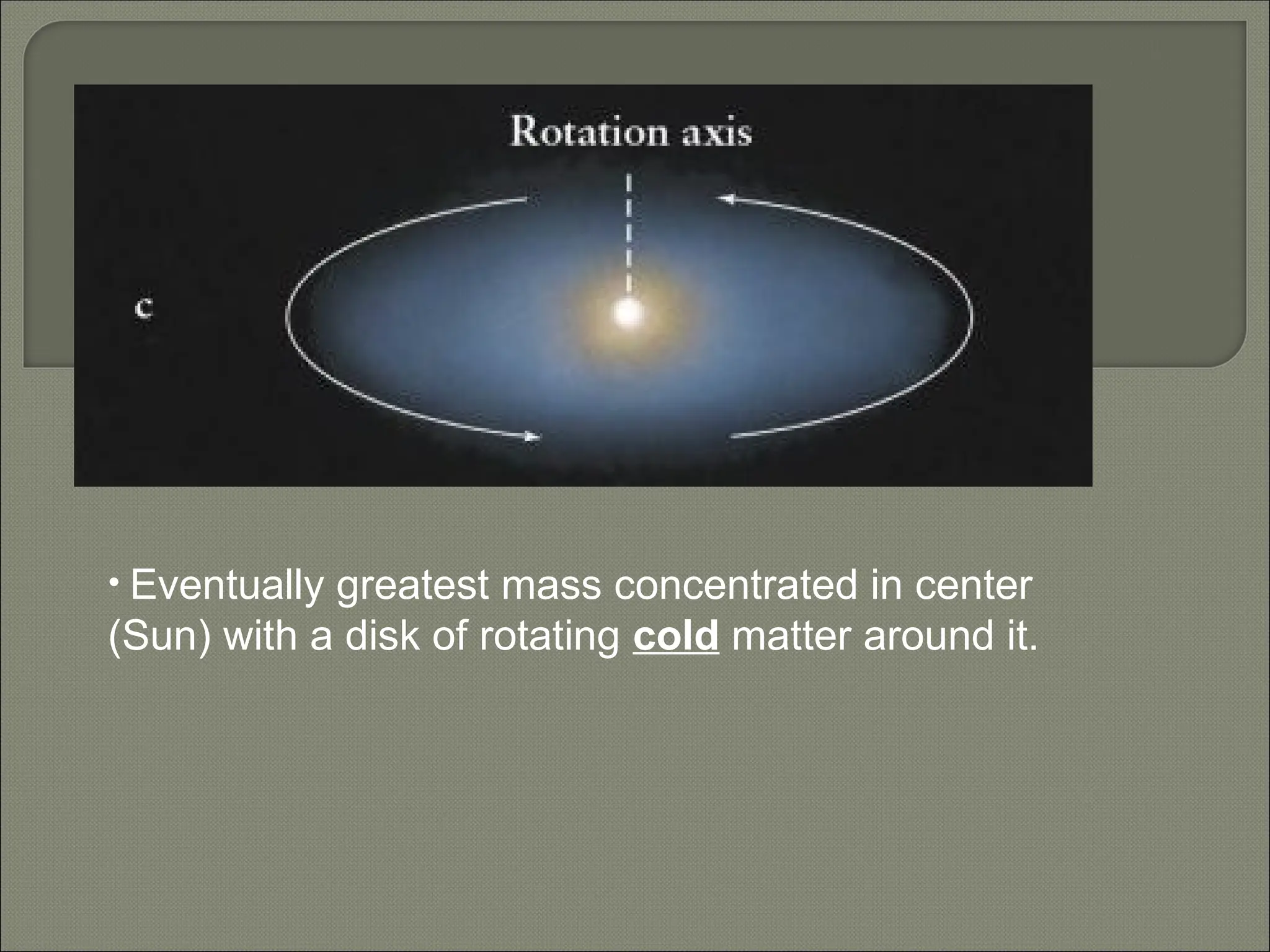
• Eventually greatest mass concentrated in center
(Sun) with a disk of rotating cold matter around it.
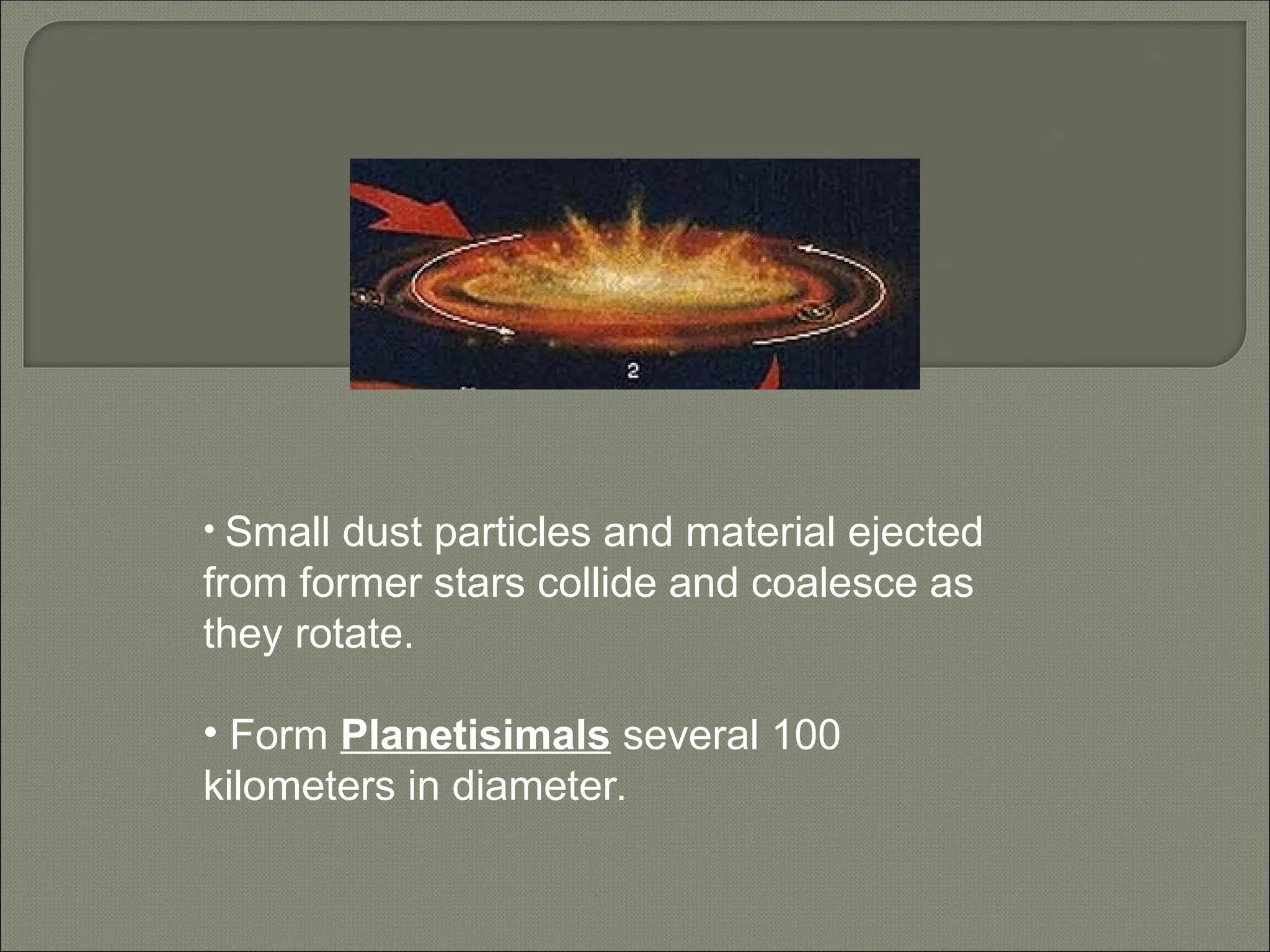
• Small dust particles and material ejected
from former stars collide and coalesce as
they rotate.
• Form Planetisimals several 100
kilometers in diameter.
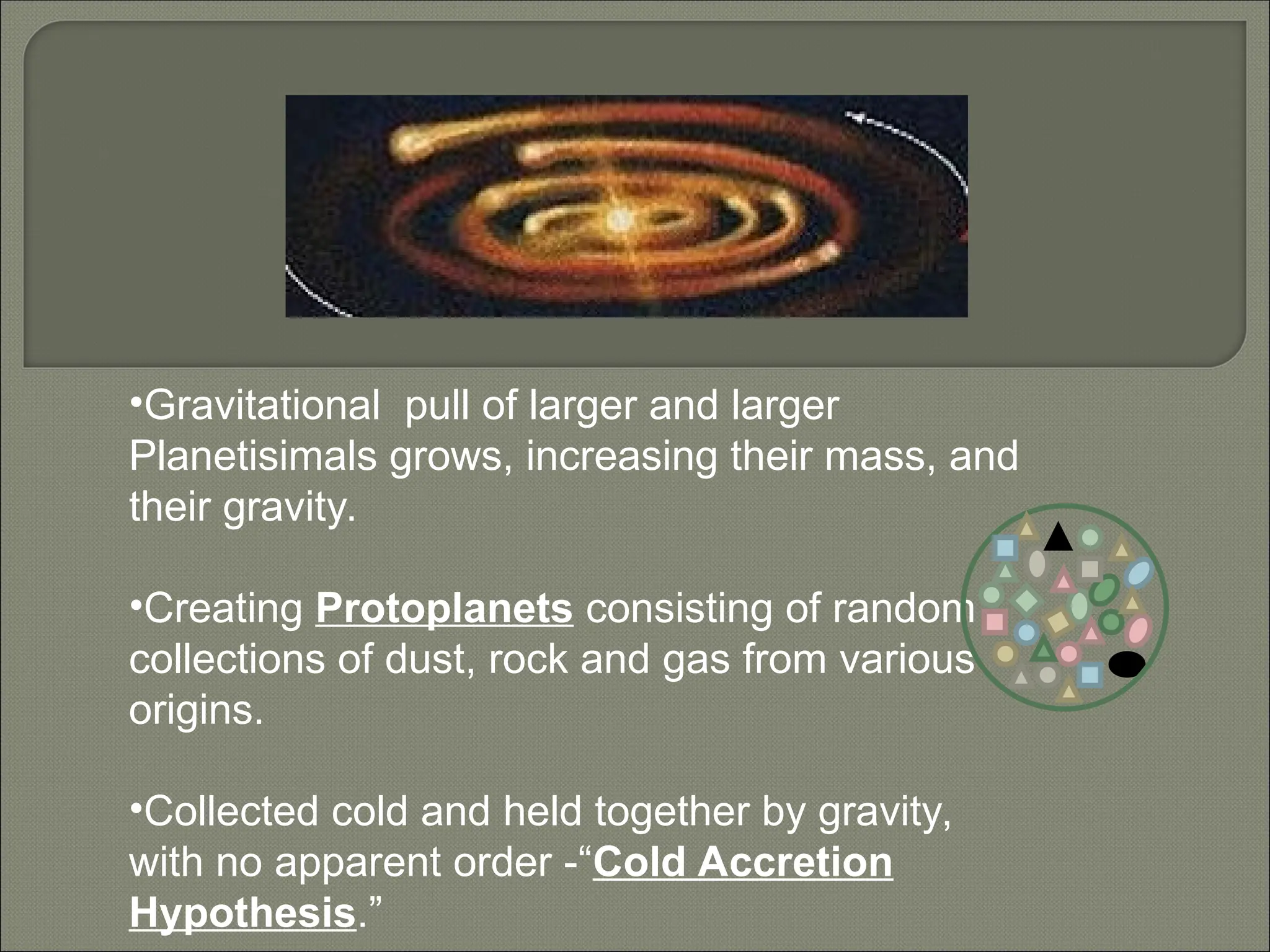
•Gravitational pull of larger and larger
Planetisimals grows, increasing their mass, and
their gravity.
•Creating Protoplanets consisting of random
collections of dust, rock and gas from various
origins.
•Collected cold and held together by gravity,
with no apparent order -“Cold Accretion
Hypothesis.”
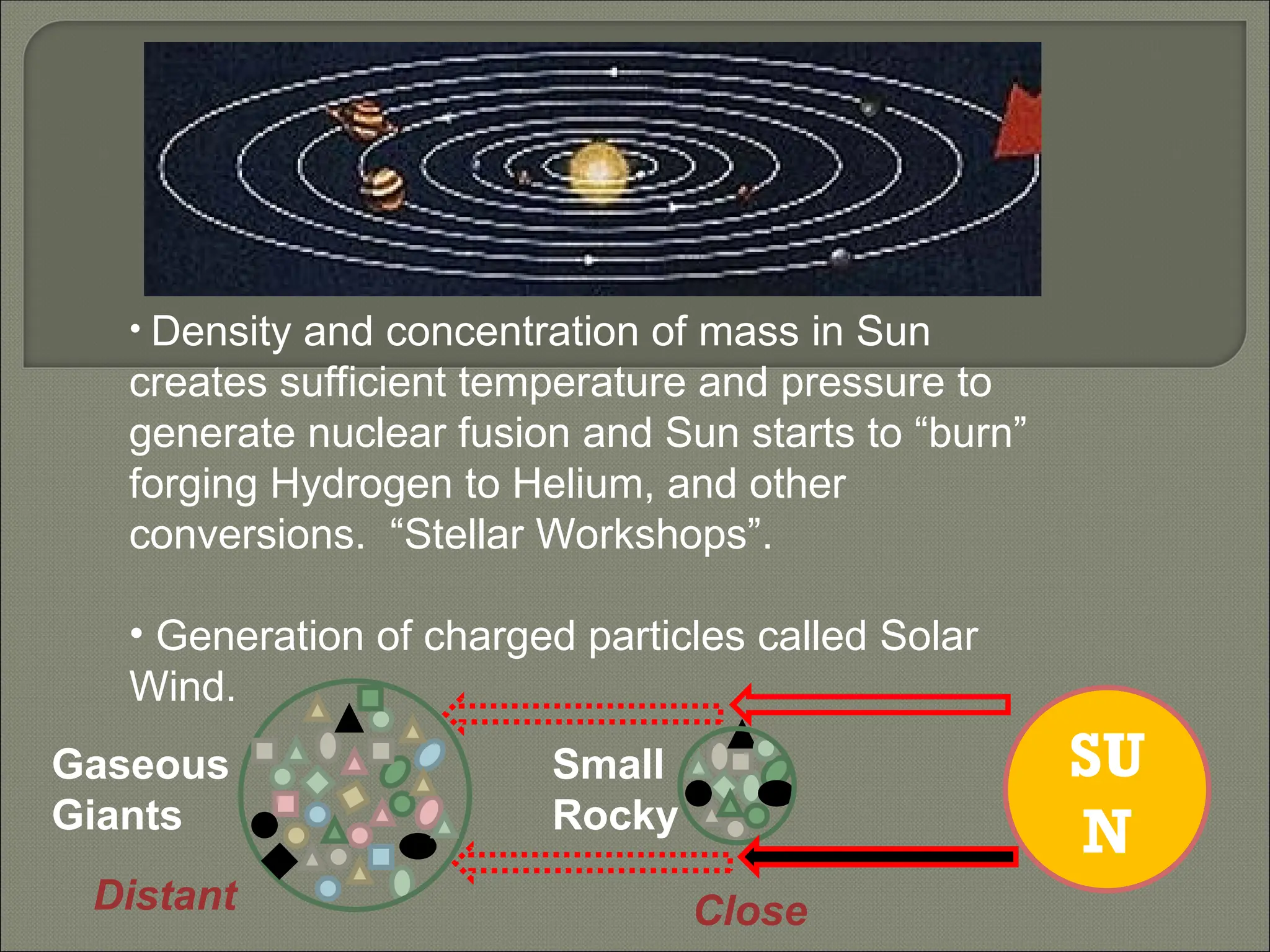
• Density and concentration of mass in Sun
creates sufficient temperature and pressure to
generate nuclear fusion and Sun starts to “burn”
forging Hydrogen to Helium, and other
conversions. “Stellar Workshops”.
• Generation of charged particles called Solar
Wind.
SU
N
Small
Rocky
Gaseous
Giants
Close
Distant
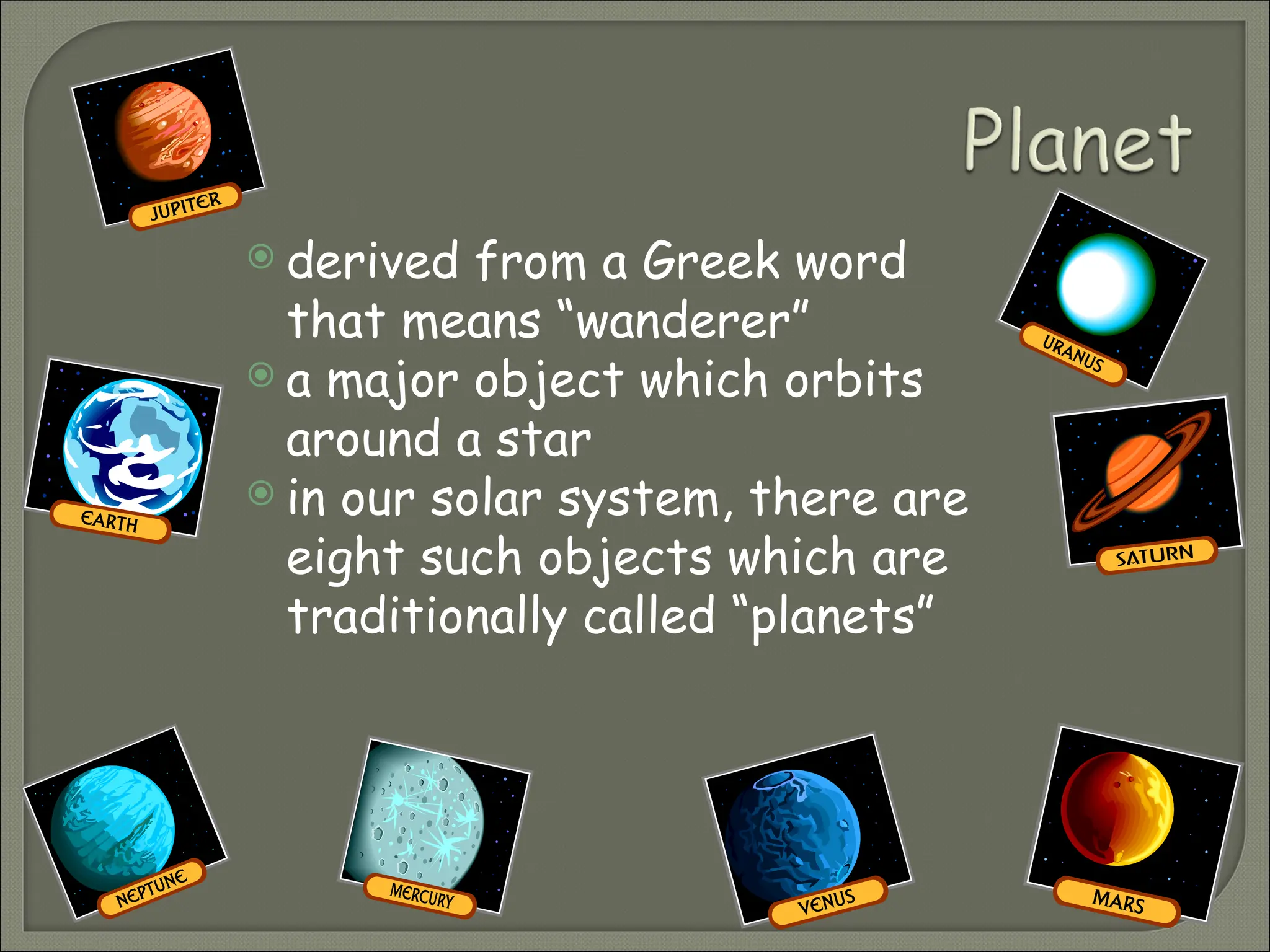
 derived from a Greek word
that means “wanderer”
 a major object which orbits
around a star
 in our solar system, there are
eight such objects which are
traditionally called “planets”
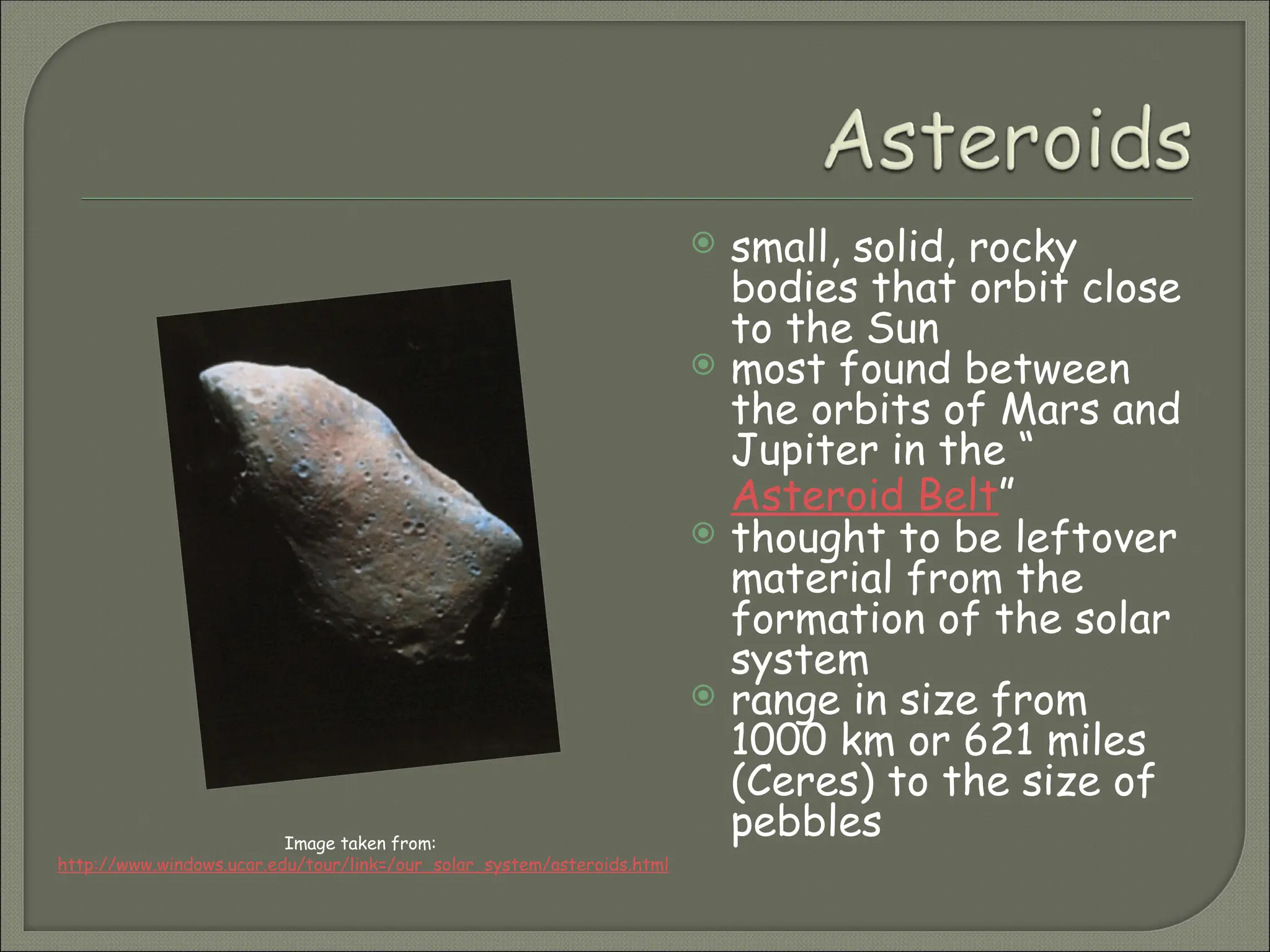
 small, solid, rocky
bodies that orbit close
to the Sun
 most found between
the orbits of Mars and
Jupiter in the “
Asteroid Belt”
 thought to be leftover
material from the
formation of the solar
system
 range in size from
1000 km or 621 miles
(Ceres) to the size of
pebbles
Image taken from:
http://www.windows.ucar.edu/tour/link=/our_solar_system/asteroids.html
Gaseous
Giants:
Jupiter
Saturn
Neptune
Uranus
Gaseous
Giants:
Jupiter
Saturn
Neptune
Uranus
Small
Rocky:
Mercury
Venus
Earth
Mars
Gaseous
Giants:
Jupiter
Saturn
Neptune
Uranus
Small
Rocky:
Mercury
Venus
Earth
Mars
Recently
Relegated:
Pluto
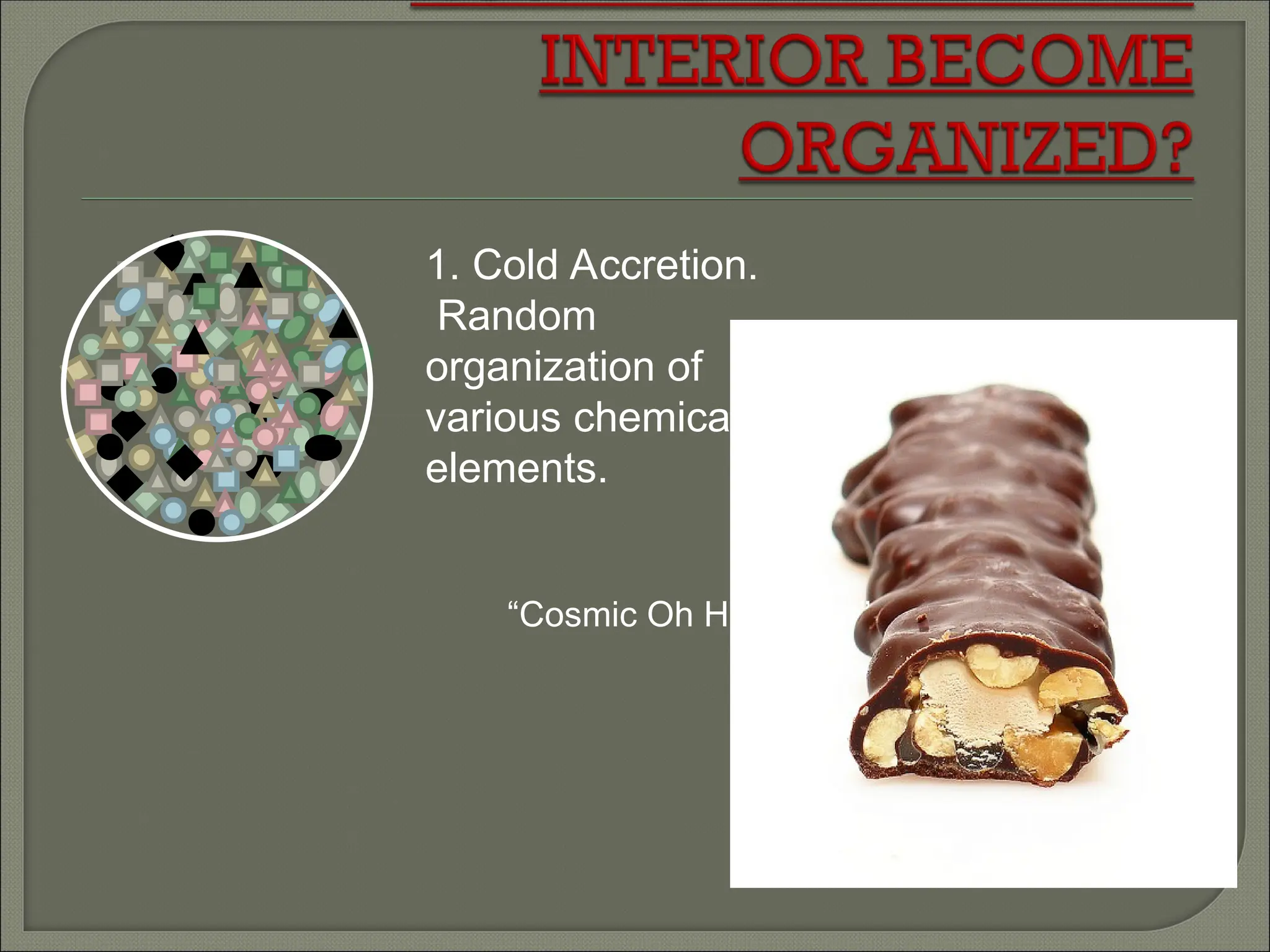
1. Cold Accretion.
Random
organization of
various chemical
elements.
“Cosmic Oh Henry bar”
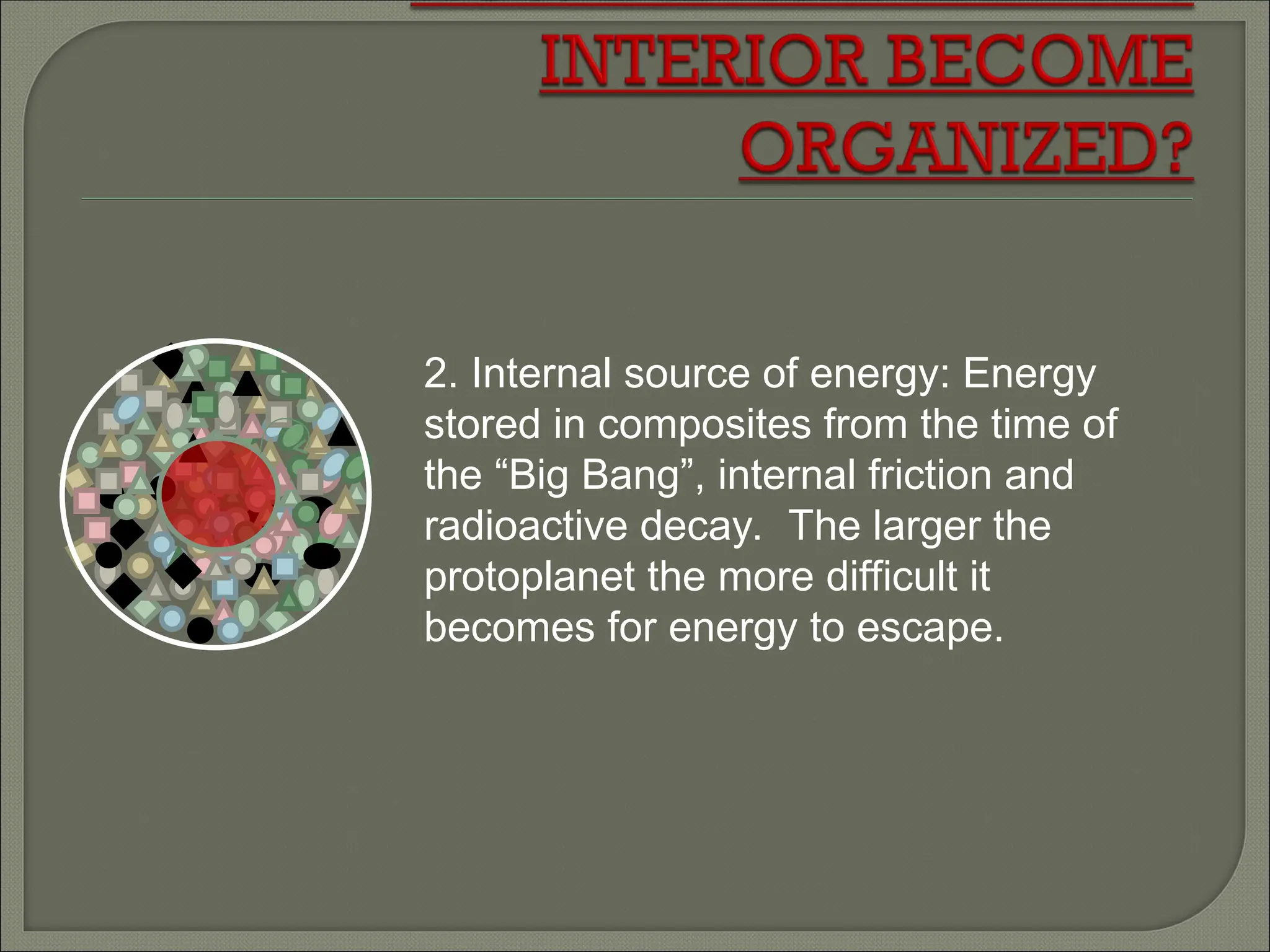
2. Internal source of energy: Energy
stored in composites from the time of
the “Big Bang”, internal friction and
radioactive decay. The larger the
protoplanet the more difficult it
becomes for energy to escape.
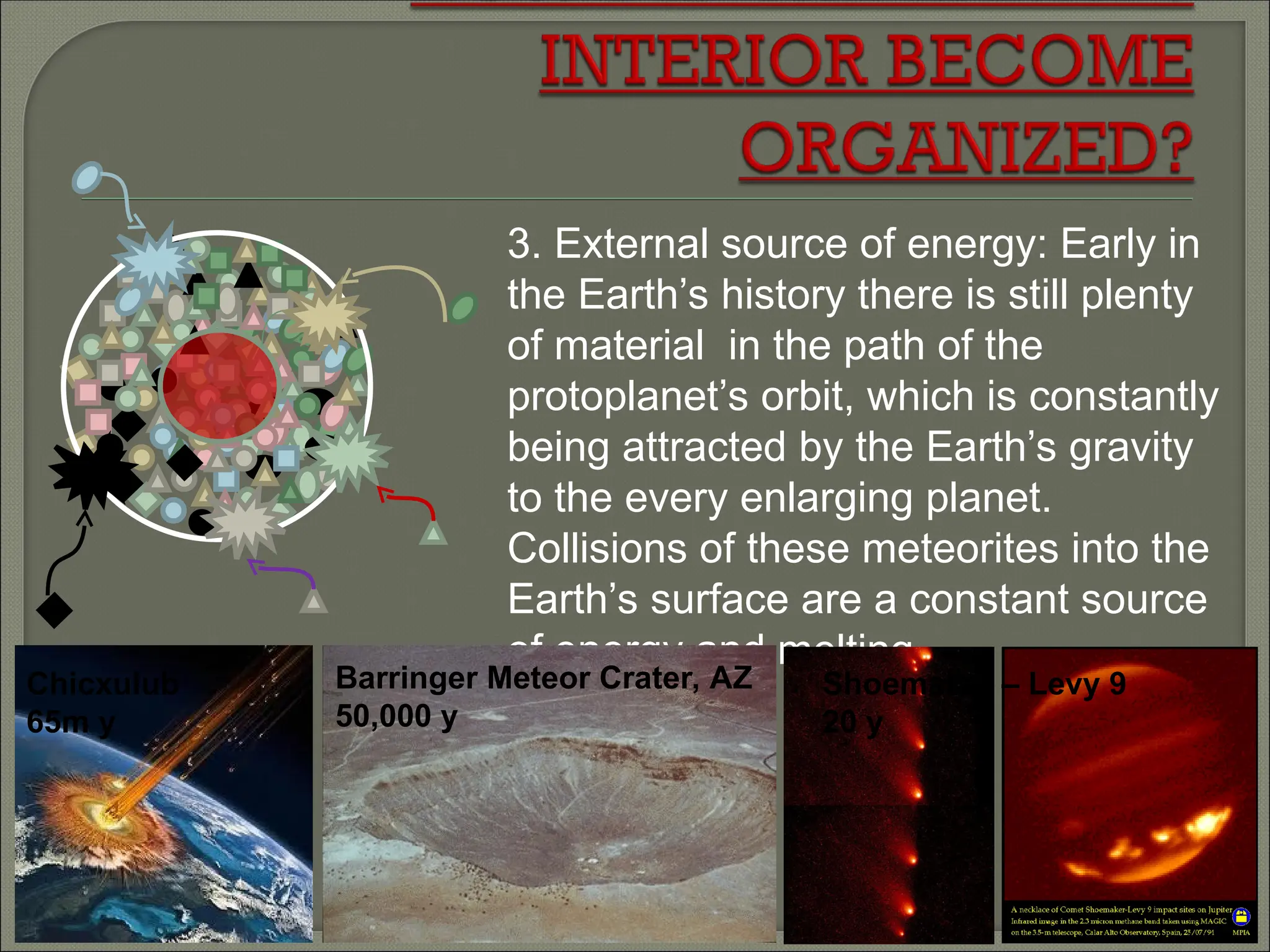
3. External source of energy: Early in
the Earth’s history there is still plenty
of material in the path of the
protoplanet’s orbit, which is constantly
being attracted by the Earth’s gravity
to the every enlarging planet.
Collisions of these meteorites into the
Earth’s surface are a constant source
of energy and melting.
Chicxulub
65m y
Barringer Meteor Crater, AZ
50,000 y
Shoemaker – Levy 9
20 y
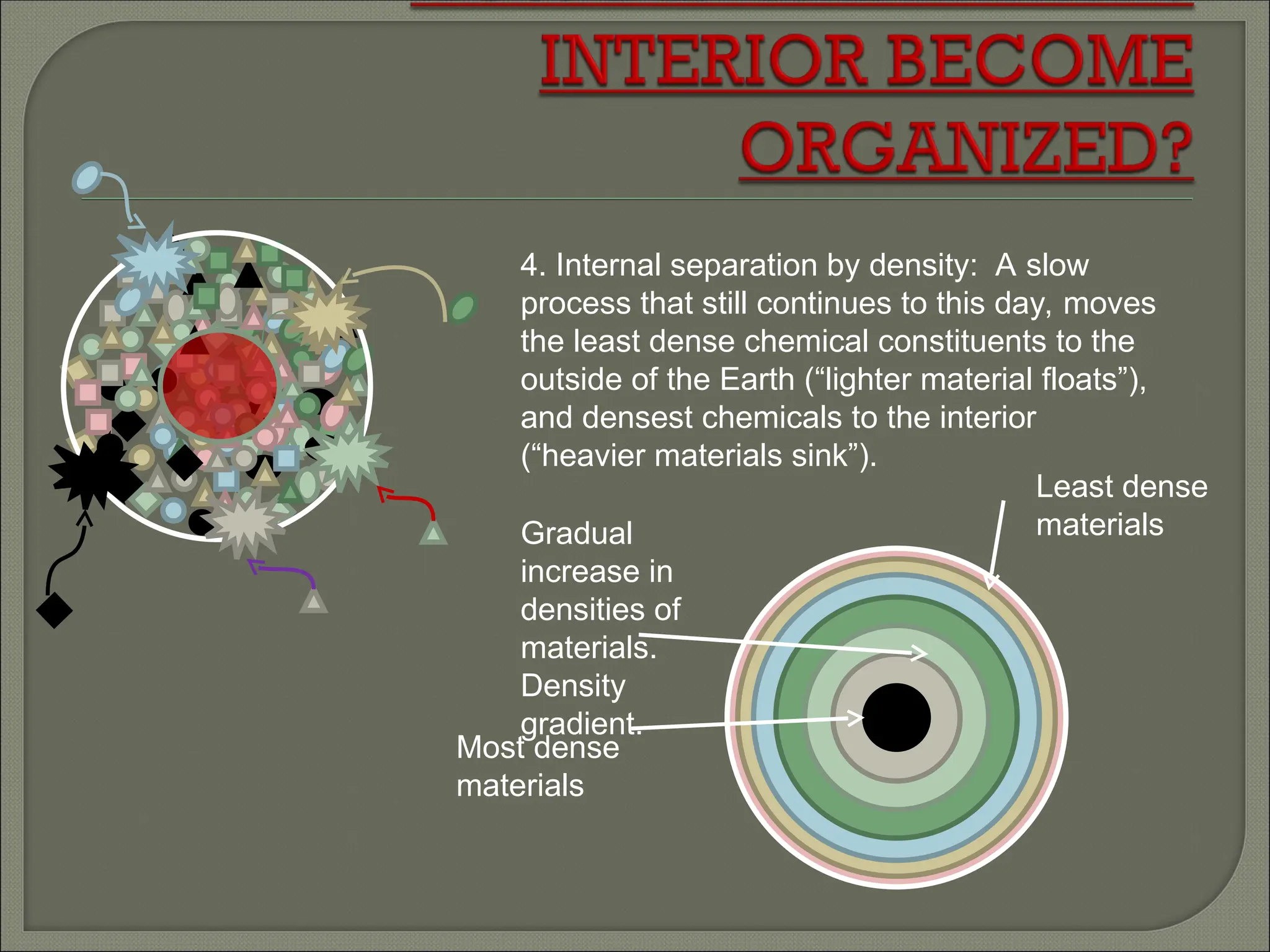
4. Internal separation by density: A slow
process that still continues to this day, moves
the least dense chemical constituents to the
outside of the Earth (“lighter material floats”),
and densest chemicals to the interior
(“heavier materials sink”).
Least dense
materials
Most dense
materials
Gradual
increase in
densities of
materials.
Density
gradient.
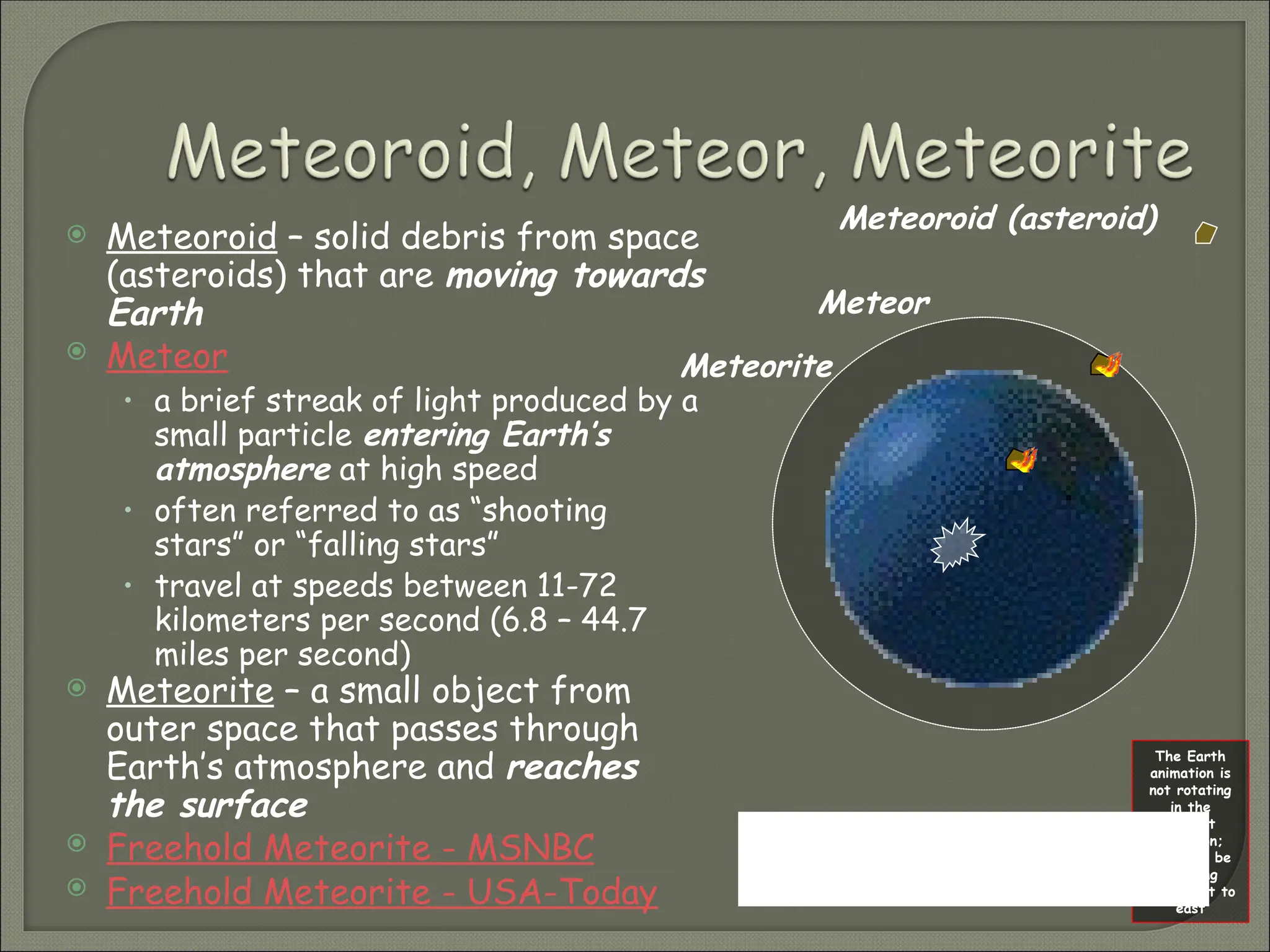
 Meteoroid – solid debris from space
(asteroids) that are moving towards
Earth
 Meteor
• a brief streak of light produced by a
small particle entering Earth’s
atmosphere at high speed
• often referred to as “shooting
stars” or “falling stars”
• travel at speeds between 11-72
kilometers per second (6.8 – 44.7
miles per second)
 Meteorite – a small object from
outer space that passes through
Earth’s atmosphere and reaches
the surface
 Freehold Meteorite - MSNBC
 Freehold Meteorite - USA-Today
Meteoroid (asteroid)
Meteor
Meteorite
The Earth
animation is
not rotating
in the
correct
direction;
it should be
rotating
from west to
east
What causes a meteor
shower to occur?
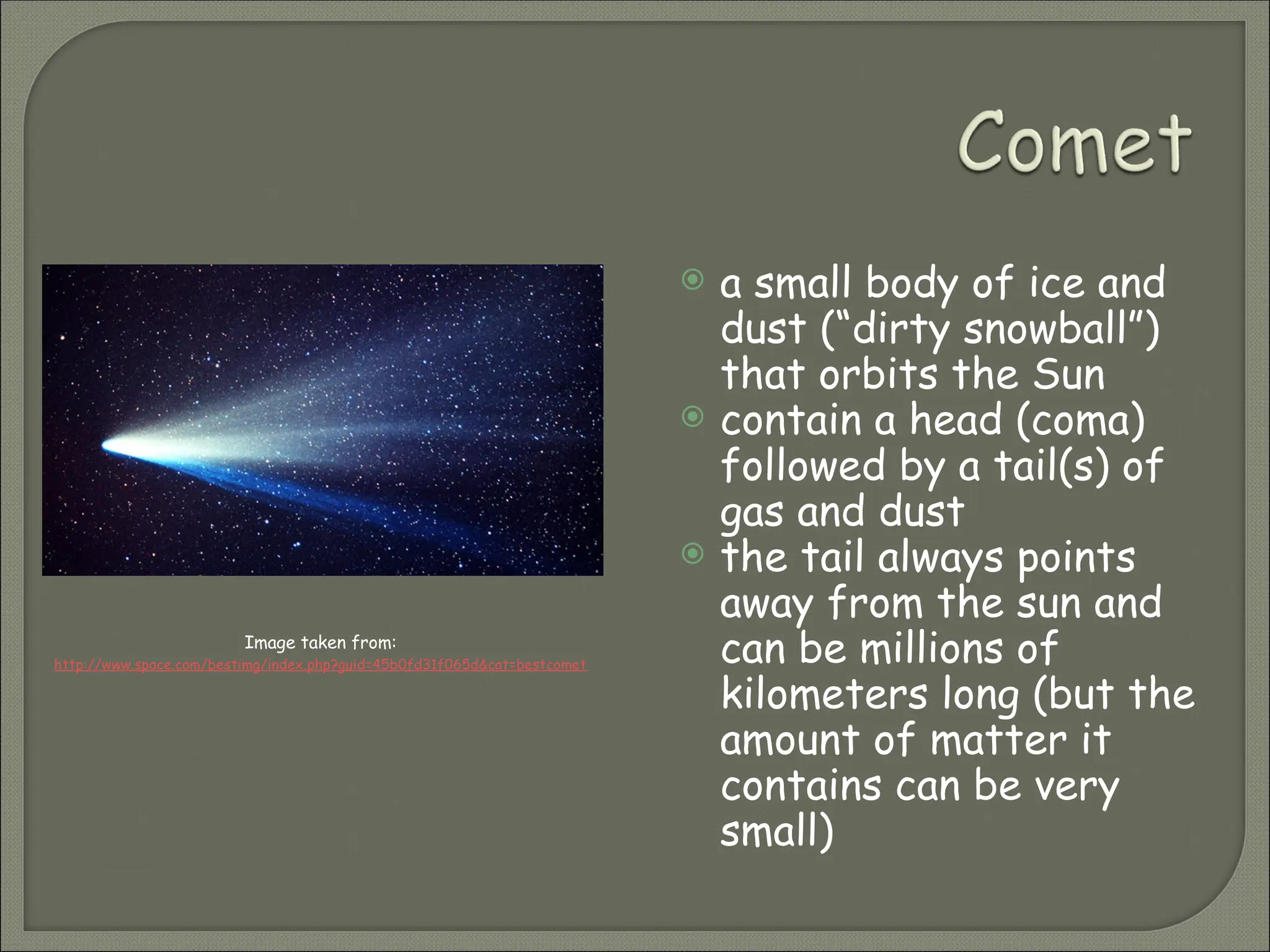
 a small body of ice and
dust (“dirty snowball”)
that orbits the Sun
 contain a head (coma)
followed by a tail(s) of
gas and dust
 the tail always points
away from the sun and
can be millions of
kilometers long (but the
amount of matter it
contains can be very
small)
Image taken from:
http://www.space.com/bestimg/index.php?guid=45b0fd31f065d&cat=bestcomet
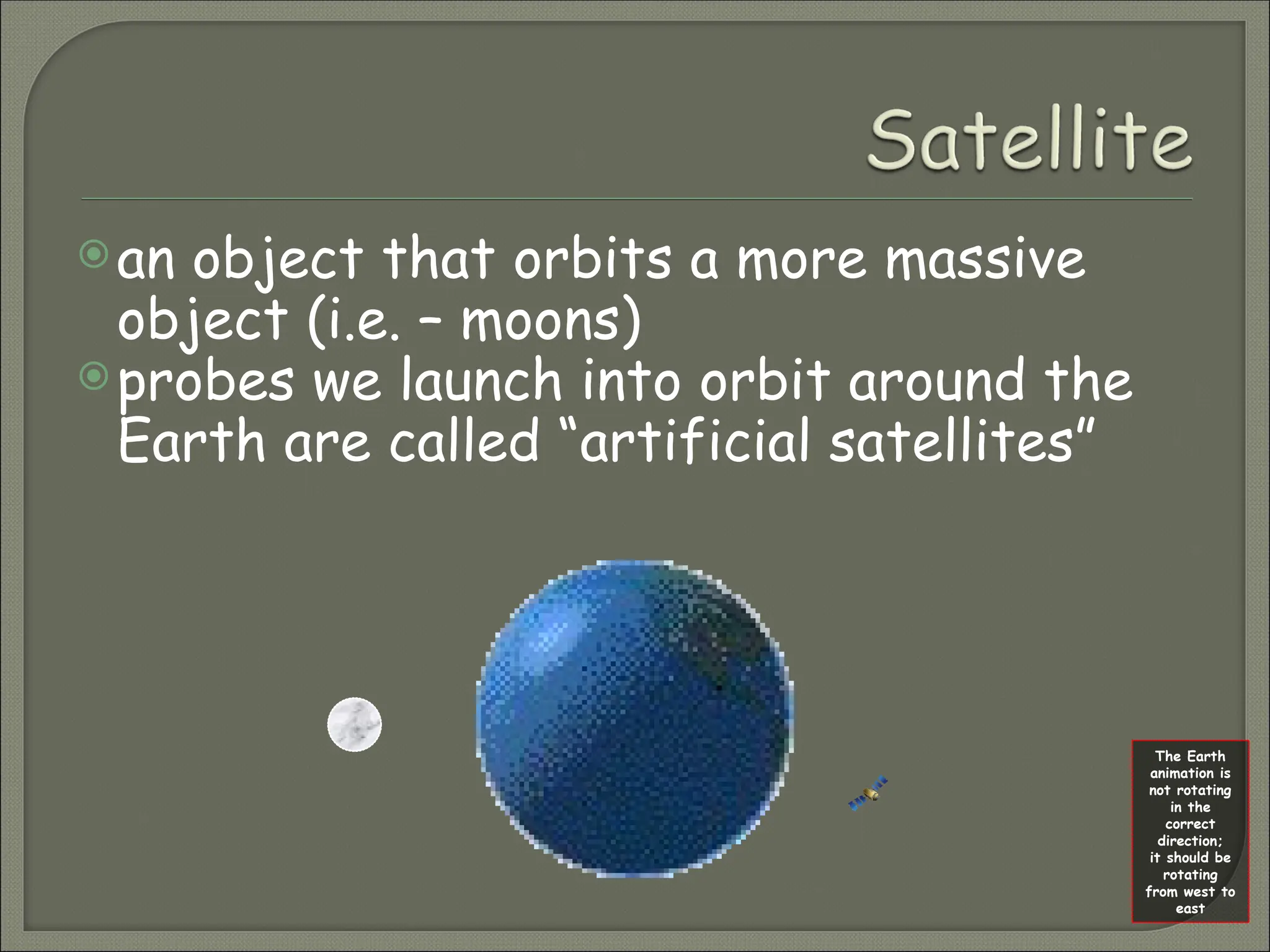
an object that orbits a more massive
object (i.e. – moons)
probes we launch into orbit around the
Earth are called “artificial satellites”
The Earth
animation is
not rotating
in the
correct
direction;
it should be
rotating
from west to
east
 a device that gathers electromagnetic radiation
 Types:
• Visible, infrared, ultraviolet – pick up visible,
infrared, and ultraviolet waves
 Reflecting - use mirrors that reflect the image being
viewed
 Refracting – using lenses, gathers light and focuses it near
the opposite end of the tube; works like a magnifying glass
• Radio - pick up radio waves emitted from space;
not effected by variables like weather or clouds
Internet Telescope
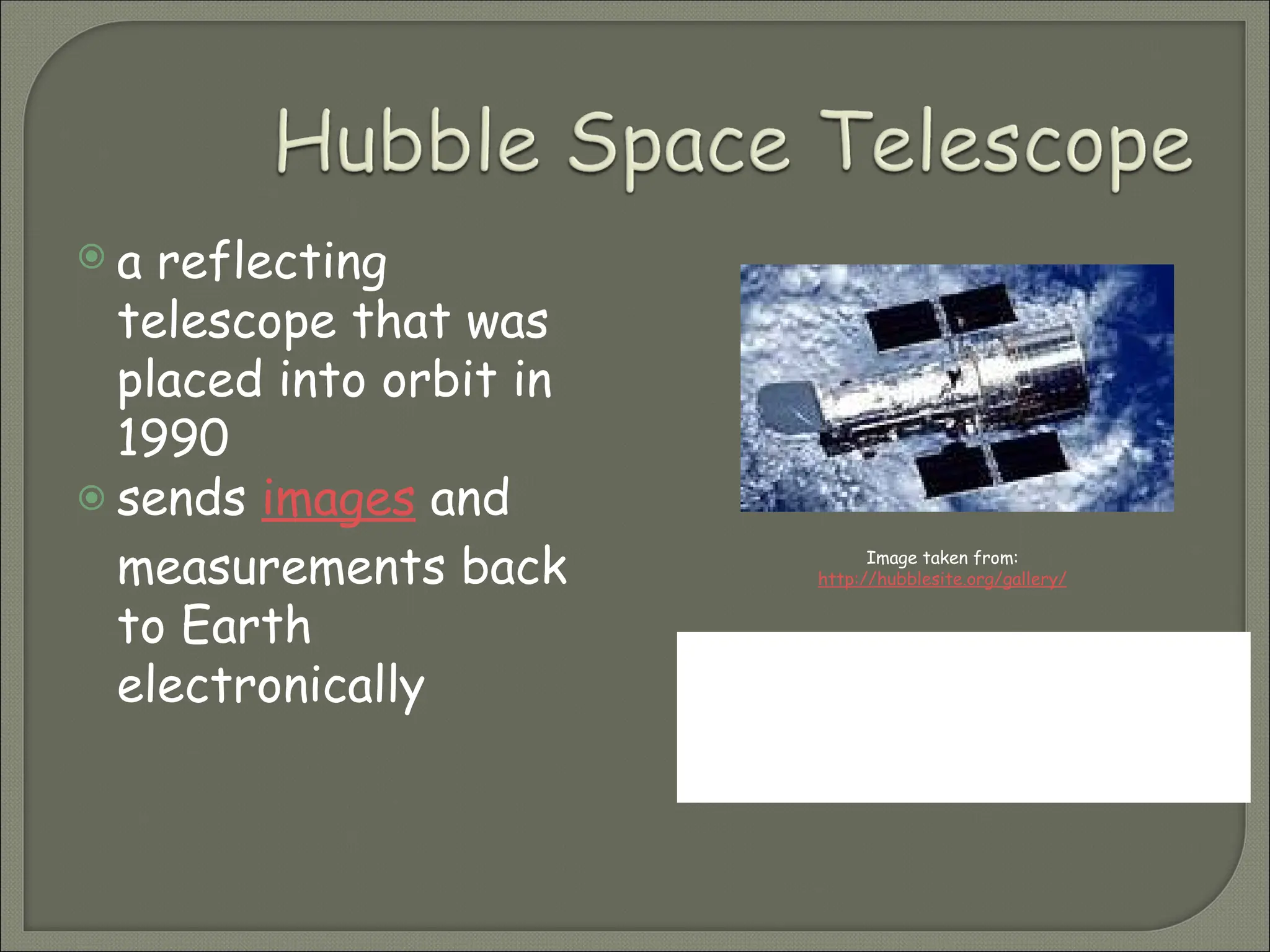
 a reflecting
telescope that was
placed into orbit in
1990
 sends images and
measurements back
to Earth
electronically
What is one of the main
benefits of having the Hubble Space
Telescope in orbit, as opposed to
it being here on Earth?
Image taken from:
http://hubblesite.org/gallery/
 unit of distance equal to the average spacing
between the Earth and the Sun
 equal to about 150 million kilometers (93
million miles)
 light takes about eight minutes to cover this
distance
150 million km
(93 million mi.)
The Earth
animation is
not rotating
in the
correct
direction;
it should be
rotating
from west to
east
unit of distance equal to about 3.26
light years (or 206,265 AU)
If one parsec equals 206, 265 AU, how
many miles is it equal to?
the apparent shift in position of an
object when viewed from different
locations
used by astronomers to measure
distance
Parallax Simulation
Parallax Simulation – 1
Parallax Simulation - 2
Find the Distance to HT Cas Using Parallax
Put your pointer finger in front of your face and begin
opening and closing your eyes in an alternating manner. What
do you notice about the your finger’s position?

formation of galaxies and universe and its galaxies.ppt

  • 2.
    A light yearis a way of measuring distance.
  • 3.
     Light travelsat 186,000 miles per second (300,000 kilometers per second).  Therefore, a light second is 186,000 miles (300,000 kilometers).  A light year is the distance that light can travel in a year, or:  186,000 miles/second * 60 seconds/minute * 60 minutes/hour * 24 hours/day * 365 days/year = 5,865,696,000,000 miles/year  OR…… 1 LIGHTYEAR
  • 4.
    the branch ofastronomy that deals with the origin, large-scale properties, and the evolution of the observable universe the branch of astronom y that deals with the origin, large-
  • 5.
     in astronomy,the sum total of all things which can be directly observed or whose physical effects on other things can be detected  in simpler terms, space and all the matter and energy in it  major components: • galaxies • solar systems • planets
  • 6.
    • The universe beganwith a hot explosion called the Big Bang. The aftermath of the Big Bang consisted mostly of radiation, but as things cooled, the elements hydrogen and helium formed. • http://imgsrc.hubblesite.org/hu/e xplore_astronomy/skywatch/db/3 07/audio/SkyWatch_307-11252010 .mp3
  • 8.
     the primevalexplosion of space, time, matter and energy that most astronomers think gave rise to the universe as we see it today.  occurred about 13.7 billion years ago  thought to have expanded within a second from something the size of a spec of dust to the size of our solar system
  • 9.
    • Big BangTheory - Evidence for the Theory • First of all, we are reasonably certain that the universe has a beginning. • Second, galaxies appear to be moving away from us at speeds proportional to their distance. This is called "Hubble's Law.” This observation supports the expansion of the universe and suggests that the universe was once compacted. • Third, if the universe was initially very, very hot as the Big Bang suggests, we should be able to find some remnant of this heat. In 1965, this was discovered a 2.725 degree Kelvin (-454.765 degree Fahrenheit, -270.425 degree Celsius) Cosmic Microwave Background radiation (CMB) which pervades the observable universe. • Finally, the abundance of the "light elements" Hydrogen and Helium found in the observable universe are thought to support the Big Bang model of origins.
  • 10.
     A cloudin space made of gas and dust which can have stars inside  Most of the ones we see are inside our Milky Way Galaxy Orion image at
  • 11.
    Basis of moderntheory of planet formation. Planets form at the same time from the same cloud as the star. Sun and our solar system formed ~ 5 billion years ago. Planet formation sites observed today as dust disks of T Tauri stars.
  • 12.
     a),(b) Thesolar nebula contracts and flattens into a spinning disk.The large blob in the center will become the Sun.Smaller blobs in the outer regions may become jovian planets.  (c) Dust grains act as condensation nuclei,forming clumps of matter that collide,stick together,and grow into moon-sized planetesimals.  (d) Strong winds from the still- forming Sun expel the nebular gas.  (e) Planetesimals continue to collide and grow.  (f) Over the course of a hundred million years or so,planetesimals form a few large planets that travel in roughly circular orbits.
  • 13.
    The Big BangTheory considers the creation of all the matter and energy that exists in the universe.. Anywhere.. The Solar Nebula theory uses that matter and energy, to create galaxies and solar systems.
  • 14.
     A largegroup of stars outside of our own Milky Way  Made of billions to trillions of stars • Also may have gas and dust  Spiral, or elliptical, or irregular shaped Image at
  • 15.
    Spiral have arms ofstars, gas , and dust that curve away from the center of the galaxy in a spiral pattern Ex. – Milky Way Elliptical shaped like spheres or eggs; have almost no dust or gas between stars; contain old stars Irregular faint galaxies without a definite shape; smaller than the other types of galaxies; contain fewer stars The process of galaxies colliding to create a larger galaxy is known as “galactic cannibalism.” Images taken from: http://school.discoveryeducation.com/schooladventures/universe/galaxytour/toknow.html
  • 16.
  • 17.
    Located in theconstellation of Andromeda, the Princess, the Andromeda Galaxy is a large spiral galaxy very similar to our own Galaxy, the Milky Way. It is over 65,000 light-years in diameter and approximately 2.2 million light-years in distance.
  • 18.
  • 19.
     The giantelliptical ESO 325-G004 looms large at the cluster's center. The galaxy is as massive as 100 billion of our suns. Hubble resolves thousands of globular star clusters orbiting ESO 325-G004. Globular clusters are compact groups of hundreds of thousands of stars that are gravitationally bound together. At the galaxy's distance they appear as pinpoints of light contained within the diffuse halo.
  • 20.
    NASA and NOAO/AURA/NSFImages at http://hubblesite.org/newscenter/archive/releases/galaxy/irregular/2005/09/resu
  • 21.
     The irregulargalaxy NGC 1427A is a spectacular example of the resulting stellar rumble. Under the gravitational grasp of a large gang of galaxies, called the Fornax cluster, the small bluish galaxy is plunging headlong into the group at 600 kilometers per second or nearly 400 miles per second.  1. IS NGC 1427A ACTIVELY FORMING STARS?  NGC 1427A shows numerous hot, blue stars that have been formed very recently, showing that star formation is occurring extensively throughout the galaxy. Within the Fornax cluster, there is a considerable amount of gas lying between the galaxies. When the gas within NGC 1427A collides with the Fornax gas, it is compressed to the point that it starts to collapse under its own gravity. This leads to formation of the myriad of new stars seen across NGC 1427A. The tidal forces of nearby galaxies in the cluster may also play a role in triggering star formation on such a massive scale.  2. WHAT IS THE EVENTUAL FATE FOR NGC 1427A?  NGC 1427A will not survive long as an identifiable galaxy passing through the cluster.Within the next billion years, it will be completely disrupted, spilling its stars and remaining gas into intergalactic space within the Fornax cluster.
  • 22.
    has about 200billion stars, and lots of gas and dust is a barred-spiral about 100,000 light-years wide our Sun is halfway to the edge, revolving at half a million miles per hour around the center of the Galaxy takes our Solar System about 200 million years to revolve once around our galaxy
  • 23.
  • 24.
     determined thatother galaxies exist, besides the Milky Way  observed that galaxies were moving away from each other • Hubble Law – the farther away a galaxy is, the faster it is moving away from us; supports the Big Bang Theory Image taken from: http://apod.nasa.gov/apod/ap960217.html
  • 25.
    accidentally detected faintradiation on a radio telescope in 1965 determined that the radiation was leftover thermal energy from the “big bang” Image taken from: http://www.einstein-online.info/en/elementary/cosmology/early_universe/index.html
  • 26.
     a largeassemblage of stars (and often gas and dust), typically containing millions to hundreds of billions of member stars • Star - a large hot ball of gas which generates energy in its core by nuclear reactions  around 100 billion in the universe  held together by the gravitational attraction of all its member stars on one another  formed around 200 million years after the “Big Bang”  most large ones seem to have super-massive black holes at their centers  sometimes contain very bright centers called quasars  3 major types: • Spiral • Elliptical • Irregular What is the name of the galaxy we reside in?
  • 27.
     a groupof stars that form a pattern in the sky  stars of a constellation are often far apart from each other, but they appear grouped together when viewed from Earth  one of 88 sectors into which astronomers divide the sphere of the sky – named after a traditional constellation in that sector  patterns of constellations are dynamic; therefore, the constellations of 100,000 years ago are quite different from today’s  a part of a constellation that forms its own pattern in the sky is known as an asterism (ex. – The Big Dipper) Why is it not possible to see all constellations at once?
  • 28.
     the sunand all things orbiting around it, including the eight major planets, their satellites, and all the smaller pieces such as asteroids and comets  formed around 4.6 billion years ago Image taken from: http://asm.arc.nasa.gov/Gallery/images/generic/LG_Capableofeverything.jpg What is incorrect or misleading about this visual?
  • 29.
    HOW DID THESOLAR SYSTEM FORM? • Star formation occurs in our Galaxy. • The Milky Way, is an Interstellar Cloud, known as Giant Molecular Clouds. • Solar Nebula (90% Hydrogen, 9% Helium)
  • 30.
    • Solar Nebula,collapses in on center under influence of gravity. • Conservation of angular momentum, causes faster spinning and flattening into disk.
  • 31.
    • Eventually greatestmass concentrated in center (Sun) with a disk of rotating cold matter around it.
  • 32.
    • Small dustparticles and material ejected from former stars collide and coalesce as they rotate. • Form Planetisimals several 100 kilometers in diameter.
  • 33.
    •Gravitational pull oflarger and larger Planetisimals grows, increasing their mass, and their gravity. •Creating Protoplanets consisting of random collections of dust, rock and gas from various origins. •Collected cold and held together by gravity, with no apparent order -“Cold Accretion Hypothesis.”
  • 34.
    • Density andconcentration of mass in Sun creates sufficient temperature and pressure to generate nuclear fusion and Sun starts to “burn” forging Hydrogen to Helium, and other conversions. “Stellar Workshops”. • Generation of charged particles called Solar Wind. SU N Small Rocky Gaseous Giants Close Distant
  • 35.
     derived froma Greek word that means “wanderer”  a major object which orbits around a star  in our solar system, there are eight such objects which are traditionally called “planets”
  • 36.
     small, solid,rocky bodies that orbit close to the Sun  most found between the orbits of Mars and Jupiter in the “ Asteroid Belt”  thought to be leftover material from the formation of the solar system  range in size from 1000 km or 621 miles (Ceres) to the size of pebbles Image taken from: http://www.windows.ucar.edu/tour/link=/our_solar_system/asteroids.html
  • 37.
  • 38.
  • 39.
  • 40.
    1. Cold Accretion. Random organizationof various chemical elements. “Cosmic Oh Henry bar”
  • 41.
    2. Internal sourceof energy: Energy stored in composites from the time of the “Big Bang”, internal friction and radioactive decay. The larger the protoplanet the more difficult it becomes for energy to escape.
  • 42.
    3. External sourceof energy: Early in the Earth’s history there is still plenty of material in the path of the protoplanet’s orbit, which is constantly being attracted by the Earth’s gravity to the every enlarging planet. Collisions of these meteorites into the Earth’s surface are a constant source of energy and melting. Chicxulub 65m y Barringer Meteor Crater, AZ 50,000 y Shoemaker – Levy 9 20 y
  • 43.
    4. Internal separationby density: A slow process that still continues to this day, moves the least dense chemical constituents to the outside of the Earth (“lighter material floats”), and densest chemicals to the interior (“heavier materials sink”). Least dense materials Most dense materials Gradual increase in densities of materials. Density gradient.
  • 44.
     Meteoroid –solid debris from space (asteroids) that are moving towards Earth  Meteor • a brief streak of light produced by a small particle entering Earth’s atmosphere at high speed • often referred to as “shooting stars” or “falling stars” • travel at speeds between 11-72 kilometers per second (6.8 – 44.7 miles per second)  Meteorite – a small object from outer space that passes through Earth’s atmosphere and reaches the surface  Freehold Meteorite - MSNBC  Freehold Meteorite - USA-Today Meteoroid (asteroid) Meteor Meteorite The Earth animation is not rotating in the correct direction; it should be rotating from west to east What causes a meteor shower to occur?
  • 45.
     a smallbody of ice and dust (“dirty snowball”) that orbits the Sun  contain a head (coma) followed by a tail(s) of gas and dust  the tail always points away from the sun and can be millions of kilometers long (but the amount of matter it contains can be very small) Image taken from: http://www.space.com/bestimg/index.php?guid=45b0fd31f065d&cat=bestcomet
  • 46.
    an object thatorbits a more massive object (i.e. – moons) probes we launch into orbit around the Earth are called “artificial satellites” The Earth animation is not rotating in the correct direction; it should be rotating from west to east
  • 47.
     a devicethat gathers electromagnetic radiation  Types: • Visible, infrared, ultraviolet – pick up visible, infrared, and ultraviolet waves  Reflecting - use mirrors that reflect the image being viewed  Refracting – using lenses, gathers light and focuses it near the opposite end of the tube; works like a magnifying glass • Radio - pick up radio waves emitted from space; not effected by variables like weather or clouds Internet Telescope
  • 48.
     a reflecting telescopethat was placed into orbit in 1990  sends images and measurements back to Earth electronically What is one of the main benefits of having the Hubble Space Telescope in orbit, as opposed to it being here on Earth? Image taken from: http://hubblesite.org/gallery/
  • 49.
     unit ofdistance equal to the average spacing between the Earth and the Sun  equal to about 150 million kilometers (93 million miles)  light takes about eight minutes to cover this distance 150 million km (93 million mi.) The Earth animation is not rotating in the correct direction; it should be rotating from west to east
  • 50.
    unit of distanceequal to about 3.26 light years (or 206,265 AU) If one parsec equals 206, 265 AU, how many miles is it equal to?
  • 51.
    the apparent shiftin position of an object when viewed from different locations used by astronomers to measure distance Parallax Simulation Parallax Simulation – 1 Parallax Simulation - 2 Find the Distance to HT Cas Using Parallax Put your pointer finger in front of your face and begin opening and closing your eyes in an alternating manner. What do you notice about the your finger’s position?

Editor's Notes

  • #11 Immanuel Kant, (1724-1804) German philosopher and scientist (astrophysics, mathematics, geography, anthropology) from East Prussia University of Königsberg, Königsberg now called Kaliningrad
  • #14 Information at http://hubblesite.org/newscenter/archive/releases/galaxy/spiral/2007/41/results/50/ NOVEMBER 29, 2007: Resembling festive lights on a holiday wreath, this NASA/ESA Hubble Space Telescope image of the nearby spiral galaxy M74 is an iconic reminder of the impending season. Bright knots of glowing gas light up the spiral arms, indicating a rich environment of star formation. M74 is located roughly 32 million light-years away in the direction of the constellation Pisces, the Fish. The image is a composite of Advanced Camera for Surveys data taken in 2003 and 2005.
  • #16 Located in the constellation of Andromeda, the Princess, the Andromeda Galaxy is a large spiral galaxy very similar to our own Galaxy, the Milky Way. It is over 65,000 light-years in diameter and approximately 2.2 million light-years in distance. The area shown in this image is quite large on the sky, covering about five times the area of the full Moon.
  • #18 Information on the galaxy on the left at http://hubblesite.org/newscenter/archive/releases/galaxy/elliptical/2007/08/image/a/results/50/ This image from NASA's Hubble Space Telescope shows the diverse collection of galaxies in the cluster Abell S0740 that is over 450 million light-years away in the direction of the constellation Centaurus. The giant elliptical ESO 325-G004 looms large at the cluster's center. The galaxy is as massive as 100 billion of our suns. Hubble resolves thousands of globular star clusters orbiting ESO 325-G004. Globular clusters are compact groups of hundreds of thousands of stars that are gravitationally bound together. At the galaxy's distance they appear as pinpoints of light contained within the diffuse halo. Other fuzzy elliptical galaxies dot the image. Some have evidence of a disk or ring structure that gives them a bow-tie shape. Several spiral galaxies are also present. The starlight in these galaxies is mainly contained in a disk and follows along spiral arms. This image was created by combining Hubble science observations taken in January 2005 with Hubble Heritage observations taken a year later to form a 3-color composite. The filters that isolate blue, red and infrared light were used with the Advanced Camera for Surveys aboard Hubble. Information on the galaxy on the right at http://hubblesite.org/newscenter/archive/releases/galaxy/elliptical/1995/07/results/50/ JUNE 14, 1995: This Hubble telescope photo mosaic shows a field of distant galaxies. The brightest object in this picture is NGC 4881 [just above center], an elliptical galaxy in the outskirts of the Coma Cluster, a great cluster of galaxies more than five times farther away than the Virgo Cluster. The distance to the Coma Cluster is an important cosmic yardstick for scaling the overall size of the universe.
  • #20 About Image on Left: MARCH 3, 2005: What happens when a galaxy falls in with the wrong crowd? The irregular galaxy NGC 1427A is a spectacular example of the resulting stellar rumble. Under the gravitational grasp of a large gang of galaxies, called the Fornax cluster, the small bluish galaxy is plunging headlong into the group at 600 kilometers per second or nearly 400 miles per second. 1. IS NGC 1427A ACTIVELY FORMING STARS? NGC 1427A shows numerous hot, blue stars that have been formed very recently, showing that star formation is occurring extensively throughout the galaxy. Within the Fornax cluster, there is a considerable amount of gas lying between the galaxies. When the gas within NGC 1427A collides with the Fornax gas, it is compressed to the point that it starts to collapse under its own gravity. This leads to formation of the myriad of new stars seen across NGC 1427A. The tidal forces of nearby galaxies in the cluster may also play a role in triggering star formation on such a massive scale. 2. WHAT IS THE EVENTUAL FATE FOR NGC 1427A? NGC 1427A will not survive long as an identifiable galaxy passing through the cluster. Within the next billion years, it will be completely disrupted, spilling its stars and remaining gas into intergalactic space within the Fornax cluster. About image on right, From http://www.noao.edu/image_gallery/html/im0993.html The glowing gas of the interstellar medium (ISM) is the breeding ground for the formation of new stars, and the cemetery where the ashes of dead stars ultimately return. A team led by astronomers from the National Optical Astronomy Observatory (NOAO) has conducted a new study called the Magellanic Cloud Emission Line Survey (MCELS) that focused expressly on the ISM in the Large Magellanic Cloud and Small Magellanic Cloud—the nearest major galaxies to the Milky Way.
  • #23 From http://news.nationalgeographic.com/news/2008/06/080603-milky-way.html Astronomers unveiled today what they are calling the best map ever produced of the Milky Way galaxy. The new view shows our spiral galaxy as it would look face-on to a very distant observer. The map is based on findings about the structural evolution of the Milky Way. The researchers determined that the Milky Way actually has two fewer major arms than previously believed. In barred spiral galaxies like our own, major arms have a high density of stars, produce lots of new stars, and are clearly connected to the long bar of stars at the galactic center. By contrast, minor arms have high gas density and presumably less star formation. Scientists had long thought that the Milky Way has four major arms. But the new images show that the spirals are actually made of two major arms and two minor ones. "These major arms plus the bar could be the things that really stand out if you were looking at the Milky Way galaxy from, say, [our nearest galactic neighbor] Andromeda," Benjamin said.