Grade 7 Unit 1 2014/2015
1

 Students will:
 Assess, critically, the economic competition related
to the control of the North American fur trade by
exploring and reflecting upon the following
questions and issues:
 How did the First Nations, French, British and Metis peoples interact with each
other as participants in the fur trade?
 How did the fur trade contribute to the foundations of the economy in North
America
 How was Britain's interest in the fur trade different from that of New France?
 How was the economic development in New France impacted by the changing
policies of the French Royal Government?
 What was the role of mercantilism before and after the 1763 Treaty of Paris?
Curricular Objectives
2

 Power point:
 3 periods
 Chapter Assignment:
 10 – 15 periods
Ch. 4 Lesson Timeline
3
4
Pages 105-136

 How did economic competition shape the fur trade?
 What roles did French, British, First Nations and
Metis peoples play in the fur trade?
 What impact did the fur trade have on diverse
people?
Focus Questions
5
pg. 107
6

What’s Competition?
Pg. 107
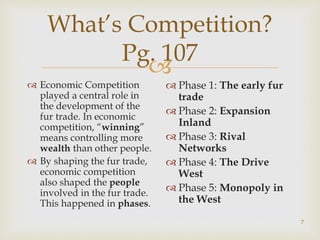
 Economic Competition
played a central role in
the development of the
fur trade. In economic
competition, “winning”
means controlling more
wealth than other people.
 By shaping the fur trade,
economic competition
also shaped the people
involved in the fur trade.
This happened in phases.
 Phase 1: The early fur
trade
 Phase 2: Expansion
Inland
 Phase 3: Rival
Networks
 Phase 4: The Drive
West
 Phase 5: Monopoly in
the West
7

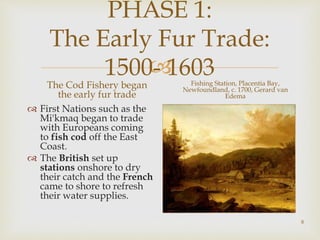
PHASE 1:
The Early Fur Trade:
1500- 1603
The Cod Fishery began
the early fur trade
 First Nations such as the
Mi'kmaq began to trade
with Europeans coming
to fish cod off the East
Coast.
 The British set up
stations onshore to dry
their catch and the French
came to shore to refresh
their water supplies.
Fishing Station, Placentia Bay,
Newfoundland, c. 1700, Gerard van
Edema
8

A Glimpse of the Early
Fur Trade
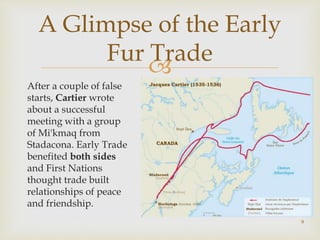
After a couple of false
starts, Cartier wrote
about a successful
meeting with a group
of Mi'kmaq from
Stadacona. Early Trade
benefited both sides
and First Nations
thought trade built
relationships of peace
and friendship.
9

10
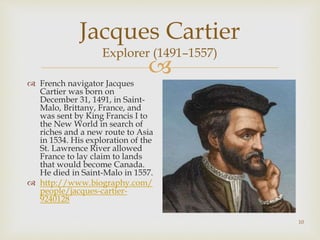
Jacques Cartier
Explorer (1491–1557)
 French navigator Jacques
Cartier was born on
December 31, 1491, in Saint-
Malo, Brittany, France, and
was sent by King Francis I to
the New World in search of
riches and a new route to Asia
in 1534. His exploration of the
St. Lawrence River allowed
France to lay claim to lands
that would become Canada.
He died in Saint-Malo in 1557.
 http://www.biography.com/
people/jacques-cartier-
9240128

Cartier’s Journal
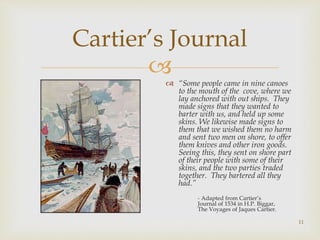
 “Some people came in nine canoes
to the mouth of the cove, where we
lay anchored with out ships. They
made signs that they wanted to
barter with us, and held up some
skins. We likewise made signs to
them that we wished them no harm
and sent two men on shore, to offer
them knives and other iron goods.
Seeing this, they sent on shore part
of their people with some of their
skins, and the two parties traded
together. They bartered all they
had.”
- Adapted from Cartier’s
Journal of 1534 in H.P. Biggar,
The Voyages of Jaques Cartier.
11

Phase 2:
Expansion Inland:
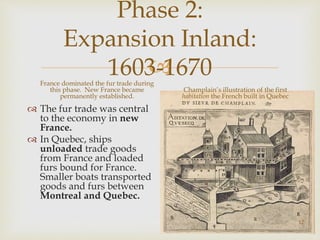
1603-1670France dominated the fur trade during
this phase. New France became
permanently established.
 The fur trade was central
to the economy in new
France.
 In Quebec, ships
unloaded trade goods
from France and loaded
furs bound for France.
Smaller boats transported
goods and furs between
Montreal and Quebec.
Champlain’s illustration of the first
habitation the French built in Quebec
12

The French-
Haudenosaunee War
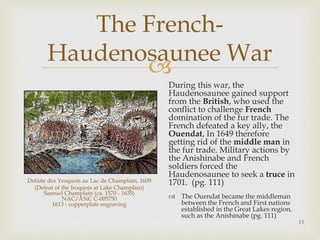
Defaite des Yroquois au Lac de Champlain, 1609
(Defeat of the Iroquois at Lake Champlain)
Samuel Champlain (ca. 1570 - 1635)
NAC/ANC C-005750
1613 - copperplate engraving
During this war, the
Haudenosaunee gained support
from the British, who used the
conflict to challenge French
domination of the fur trade. The
French defeated a key ally, the
Ouendat, In 1649 therefore
getting rid of the middle man in
the fur trade. Military actions by
the Anishinabe and French
soldiers forced the
Haudenosaunee to seek a truce in
1701. (pg. 111)
 The Ouendat became the middleman
between the French and First nations
established in the Great Lakes region,
such as the Anishinabe (pg. 111)
13

Coureurs de bois
Emerged
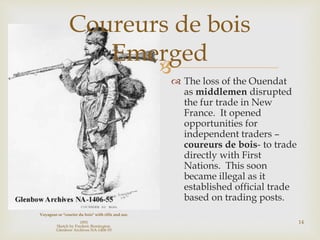
Voyageur or "courier du bois" with rifle and axe.
1891
Sketch by Frederic Remington.
Glenbow Archives NA-1406-55
 The loss of the Ouendat
as middlemen disrupted
the fur trade in New
France. It opened
opportunities for
independent traders –
coureurs de bois- to trade
directly with First
Nations. This soon
became illegal as it
established official trade
based on trading posts.
14

15
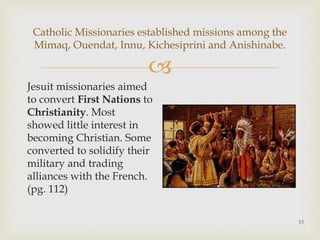
Catholic Missionaries established missions among the
Mimaq, Ouendat, Innu, Kichesiprini and Anishinabe.
Jesuit missionaries aimed
to convert First Nations to
Christianity. Most
showed little interest in
becoming Christian. Some
converted to solidify their
military and trading
alliances with the French.
(pg. 112)

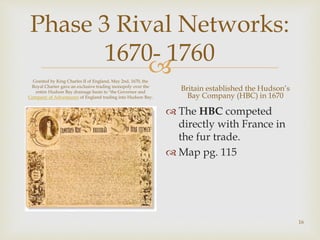
Phase 3 Rival Networks:
1670- 1760
Granted by King Charles II of England, May 2nd, 1670, the
Royal Charter gave an exclusive trading monopoly over the
entire Hudson Bay drainage basin to "the Governor and
Company of Adventurers of England trading into Hudson Bay.
Britain established the Hudson’s
Bay Company (HBC) in 1670
 The HBC competed
directly with France in
the fur trade.
 Map pg. 115
16

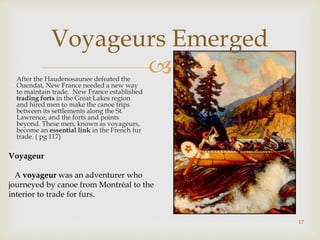
Voyageurs Emerged
After the Haudenosaunee defeated the
Ouendat, New France needed a new way
to maintain trade. New France established
trading forts in the Great Lakes region
and hired men to make the canoe trips
between its settlements along the St.
Lawrence, and the forts and points
beyond. These men, known as voyageurs,
become an essential link in the French fur
trade. ( pg 117)
17
Voyageur
A voyageur was an adventurer who
journeyed by canoe from Montréal to the
interior to trade for furs.
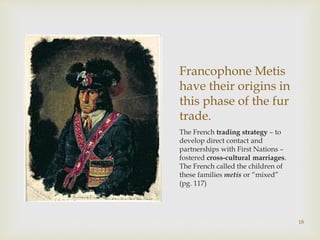
Francophone Metis
have their origins in
this phase of the fur
trade.
The French trading strategy – to
develop direct contact and
partnerships with First Nations –
fostered cross-cultural marriages.
The French called the children of
these families metis or “mixed”
(pg. 117)
18

Métis
 Métis are people of
mixed European and
First Nations ancestry,
and one of the three
recognized Aboriginal
peoples in Canada.
Canadien
 a descendant of the
settlers of New France
19

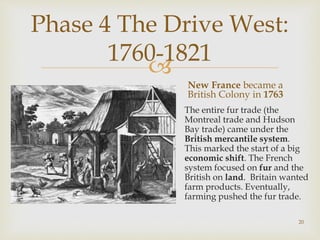
Phase 4 The Drive West:
1760-1821
New France became a
British Colony in 1763
The entire fur trade (the
Montreal trade and Hudson
Bay trade) came under the
British mercantile system.
This marked the start of a big
economic shift. The French
system focused on fur and the
British on land. Britain wanted
farm products. Eventually,
farming pushed the fur trade.
20

Development of the
Western Fur Trade
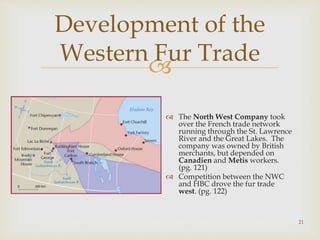
 The North West Company took
over the French trade network
running through the St. Lawrence
River and the Great Lakes. The
company was owned by British
merchants, but depended on
Canadien and Metis workers.
(pg. 121)
 Competition between the NWC
and HBC drove the fur trade
west. (pg. 122)
21

22
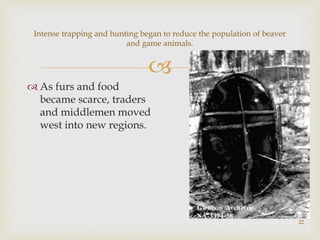
Intense trapping and hunting began to reduce the population of beaver
and game animals.
 As furs and food
became scarce, traders
and middlemen moved
west into new regions.

23
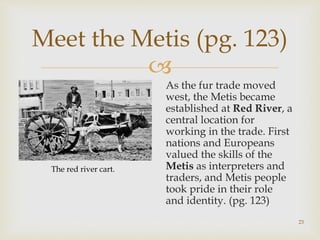
Meet the Metis (pg. 123)
As the fur trade moved
west, the Metis became
established at Red River, a
central location for
working in the trade. First
nations and Europeans
valued the skills of the
Metis as interpreters and
traders, and Metis people
took pride in their role
and identity. (pg. 123)
The red river cart.

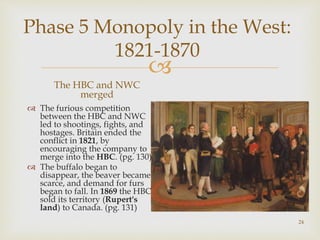
Phase 5 Monopoly in the West:
1821-1870
The HBC and NWC
merged
 The furious competition
between the HBC and NWC
led to shootings, fights, and
hostages. Britain ended the
conflict in 1821, by
encouraging the company to
merge into the HBC. (pg. 130)
 The buffalo began to
disappear, the beaver became
scarce, and demand for furs
began to fall. In 1869 the HBC
sold its territory (Rupert's
land) to Canada. (pg. 131)
24
25
What impact did the fur trade have on
diverse people?

How did the Fur Trade Influence
the Migration of Peoples?
Because of the fur trade, people
moved to new locations.
 Champlain established
Quebec because it had
better possibilities as a fur
trade center than Acadia
on the East Coast.
 The Metis put themselves
in the center of trade, both
professionally and
geographically in the
1800, at Red River.
 The Cree and
Anishinabe expanded
west with the fur trade
when the buffalo began
to disappear.
 The Fur trade brought
people West to AB, SK,
and MN.
26

7.1.4. lesson plan

  • 1.
    Grade 7 Unit1 2014/2015 1
  • 2.
      Students will: Assess, critically, the economic competition related to the control of the North American fur trade by exploring and reflecting upon the following questions and issues:  How did the First Nations, French, British and Metis peoples interact with each other as participants in the fur trade?  How did the fur trade contribute to the foundations of the economy in North America  How was Britain's interest in the fur trade different from that of New France?  How was the economic development in New France impacted by the changing policies of the French Royal Government?  What was the role of mercantilism before and after the 1763 Treaty of Paris? Curricular Objectives 2
  • 3.
      Power point: 3 periods  Chapter Assignment:  10 – 15 periods Ch. 4 Lesson Timeline 3
  • 4.
  • 5.
      How dideconomic competition shape the fur trade?  What roles did French, British, First Nations and Metis peoples play in the fur trade?  What impact did the fur trade have on diverse people? Focus Questions 5
  • 6.
  • 7.
     What’s Competition? Pg. 107 Economic Competition played a central role in the development of the fur trade. In economic competition, “winning” means controlling more wealth than other people.  By shaping the fur trade, economic competition also shaped the people involved in the fur trade. This happened in phases.  Phase 1: The early fur trade  Phase 2: Expansion Inland  Phase 3: Rival Networks  Phase 4: The Drive West  Phase 5: Monopoly in the West 7
  • 8.
     PHASE 1: The EarlyFur Trade: 1500- 1603 The Cod Fishery began the early fur trade  First Nations such as the Mi'kmaq began to trade with Europeans coming to fish cod off the East Coast.  The British set up stations onshore to dry their catch and the French came to shore to refresh their water supplies. Fishing Station, Placentia Bay, Newfoundland, c. 1700, Gerard van Edema 8
  • 9.
     A Glimpse ofthe Early Fur Trade After a couple of false starts, Cartier wrote about a successful meeting with a group of Mi'kmaq from Stadacona. Early Trade benefited both sides and First Nations thought trade built relationships of peace and friendship. 9
  • 10.
     10 Jacques Cartier Explorer (1491–1557) French navigator Jacques Cartier was born on December 31, 1491, in Saint- Malo, Brittany, France, and was sent by King Francis I to the New World in search of riches and a new route to Asia in 1534. His exploration of the St. Lawrence River allowed France to lay claim to lands that would become Canada. He died in Saint-Malo in 1557.  http://www.biography.com/ people/jacques-cartier- 9240128
  • 11.
     Cartier’s Journal  “Somepeople came in nine canoes to the mouth of the cove, where we lay anchored with out ships. They made signs that they wanted to barter with us, and held up some skins. We likewise made signs to them that we wished them no harm and sent two men on shore, to offer them knives and other iron goods. Seeing this, they sent on shore part of their people with some of their skins, and the two parties traded together. They bartered all they had.” - Adapted from Cartier’s Journal of 1534 in H.P. Biggar, The Voyages of Jaques Cartier. 11
  • 12.
     Phase 2: Expansion Inland: 1603-1670Francedominated the fur trade during this phase. New France became permanently established.  The fur trade was central to the economy in new France.  In Quebec, ships unloaded trade goods from France and loaded furs bound for France. Smaller boats transported goods and furs between Montreal and Quebec. Champlain’s illustration of the first habitation the French built in Quebec 12
  • 13.
     The French- Haudenosaunee War Defaitedes Yroquois au Lac de Champlain, 1609 (Defeat of the Iroquois at Lake Champlain) Samuel Champlain (ca. 1570 - 1635) NAC/ANC C-005750 1613 - copperplate engraving During this war, the Haudenosaunee gained support from the British, who used the conflict to challenge French domination of the fur trade. The French defeated a key ally, the Ouendat, In 1649 therefore getting rid of the middle man in the fur trade. Military actions by the Anishinabe and French soldiers forced the Haudenosaunee to seek a truce in 1701. (pg. 111)  The Ouendat became the middleman between the French and First nations established in the Great Lakes region, such as the Anishinabe (pg. 111) 13
  • 14.
     Coureurs de bois Emerged Voyageuror "courier du bois" with rifle and axe. 1891 Sketch by Frederic Remington. Glenbow Archives NA-1406-55  The loss of the Ouendat as middlemen disrupted the fur trade in New France. It opened opportunities for independent traders – coureurs de bois- to trade directly with First Nations. This soon became illegal as it established official trade based on trading posts. 14
  • 15.
     15 Catholic Missionaries establishedmissions among the Mimaq, Ouendat, Innu, Kichesiprini and Anishinabe. Jesuit missionaries aimed to convert First Nations to Christianity. Most showed little interest in becoming Christian. Some converted to solidify their military and trading alliances with the French. (pg. 112)
  • 16.
     Phase 3 RivalNetworks: 1670- 1760 Granted by King Charles II of England, May 2nd, 1670, the Royal Charter gave an exclusive trading monopoly over the entire Hudson Bay drainage basin to "the Governor and Company of Adventurers of England trading into Hudson Bay. Britain established the Hudson’s Bay Company (HBC) in 1670  The HBC competed directly with France in the fur trade.  Map pg. 115 16
  • 17.
     Voyageurs Emerged After theHaudenosaunee defeated the Ouendat, New France needed a new way to maintain trade. New France established trading forts in the Great Lakes region and hired men to make the canoe trips between its settlements along the St. Lawrence, and the forts and points beyond. These men, known as voyageurs, become an essential link in the French fur trade. ( pg 117) 17 Voyageur A voyageur was an adventurer who journeyed by canoe from Montréal to the interior to trade for furs.
  • 18.
    Francophone Metis have theirorigins in this phase of the fur trade. The French trading strategy – to develop direct contact and partnerships with First Nations – fostered cross-cultural marriages. The French called the children of these families metis or “mixed” (pg. 117) 18
  • 19.
     Métis  Métis arepeople of mixed European and First Nations ancestry, and one of the three recognized Aboriginal peoples in Canada. Canadien  a descendant of the settlers of New France 19
  • 20.
     Phase 4 TheDrive West: 1760-1821 New France became a British Colony in 1763 The entire fur trade (the Montreal trade and Hudson Bay trade) came under the British mercantile system. This marked the start of a big economic shift. The French system focused on fur and the British on land. Britain wanted farm products. Eventually, farming pushed the fur trade. 20
  • 21.
     Development of the WesternFur Trade  The North West Company took over the French trade network running through the St. Lawrence River and the Great Lakes. The company was owned by British merchants, but depended on Canadien and Metis workers. (pg. 121)  Competition between the NWC and HBC drove the fur trade west. (pg. 122) 21
  • 22.
     22 Intense trapping andhunting began to reduce the population of beaver and game animals.  As furs and food became scarce, traders and middlemen moved west into new regions.
  • 23.
     23 Meet the Metis(pg. 123) As the fur trade moved west, the Metis became established at Red River, a central location for working in the trade. First nations and Europeans valued the skills of the Metis as interpreters and traders, and Metis people took pride in their role and identity. (pg. 123) The red river cart.
  • 24.
     Phase 5 Monopolyin the West: 1821-1870 The HBC and NWC merged  The furious competition between the HBC and NWC led to shootings, fights, and hostages. Britain ended the conflict in 1821, by encouraging the company to merge into the HBC. (pg. 130)  The buffalo began to disappear, the beaver became scarce, and demand for furs began to fall. In 1869 the HBC sold its territory (Rupert's land) to Canada. (pg. 131) 24
  • 25.
    25 What impact didthe fur trade have on diverse people?
  • 26.
     How did theFur Trade Influence the Migration of Peoples? Because of the fur trade, people moved to new locations.  Champlain established Quebec because it had better possibilities as a fur trade center than Acadia on the East Coast.  The Metis put themselves in the center of trade, both professionally and geographically in the 1800, at Red River.  The Cree and Anishinabe expanded west with the fur trade when the buffalo began to disappear.  The Fur trade brought people West to AB, SK, and MN. 26