THE NORTHWEST
Land outside of Canadian Colonies
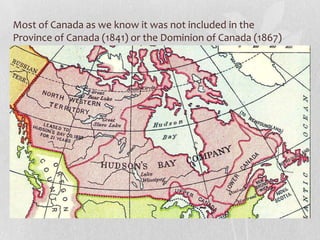
Most of Canada as we know it was not included in the
Province of Canada (1841) or the Dominion of Canada (1867)
The Northwest in 1800
• The land to the north and west of Canada West had
been occupied by First Nations and Fur traders from
the Hudson’s Bay Company (HBC) and the Northwest
Company (NWC)

• The Hudson’s Bay Company had been given trading
rights to Rupert’s Land – all the lands drained by
rivers flowing into Hudson Bay.
• Rupert’s Land was 1/3 the size of modern Canada
Hudson’s Bay Company Review
• Founded in 1670
• Built several trading posts, encouraging Assinboin, Cree and
Ojibway trappers to bring their furs to trade at the posts
• Employees of the HBC were British.

• Furs were shipped to England every summer, when Hudson Bay is
ice free from July to mid-September
• Competition from the NWC meant that HBC trading posts had to
built further away from Hudson Bay to be more accessible to
trappers
North West Company Review
• Established in 1783 by the “Montrealers”, as a merger of several
smaller companies
• Furs were shipped to England from Montreal
• The NWC headquarters were in Fort William (1803) , at the western
end of Lake Superior, allowing easier water transportation of furs
to Montreal
• English business men from Montreal seized the French fur trade in
1763 after the fall of New France.
• Different approach than HBC, many “employees” shared in
company profits which encouraged them to ensure its success
Role of First Nations in the Fur Trade
• Hunted and trapped animals for their fur, mainly beaver
• HBC expected the Assiniboine, Cree and Ojibwa trappers and
traders to bring the furs to their forts for trade

• Paid according to the value set by “made beaver” pelts that were
sent back to the UK to make hats/outer wear.
• Could buy goods at the trading post – exported from Europe and
generally unavailable from Canadian resources.

The northwest hbc & nwc

  • 1.
    THE NORTHWEST Land outsideof Canadian Colonies
  • 2.
    Most of Canadaas we know it was not included in the Province of Canada (1841) or the Dominion of Canada (1867)
  • 3.
    The Northwest in1800 • The land to the north and west of Canada West had been occupied by First Nations and Fur traders from the Hudson’s Bay Company (HBC) and the Northwest Company (NWC) • The Hudson’s Bay Company had been given trading rights to Rupert’s Land – all the lands drained by rivers flowing into Hudson Bay. • Rupert’s Land was 1/3 the size of modern Canada
  • 4.
    Hudson’s Bay CompanyReview • Founded in 1670 • Built several trading posts, encouraging Assinboin, Cree and Ojibway trappers to bring their furs to trade at the posts • Employees of the HBC were British. • Furs were shipped to England every summer, when Hudson Bay is ice free from July to mid-September • Competition from the NWC meant that HBC trading posts had to built further away from Hudson Bay to be more accessible to trappers
  • 5.
    North West CompanyReview • Established in 1783 by the “Montrealers”, as a merger of several smaller companies • Furs were shipped to England from Montreal • The NWC headquarters were in Fort William (1803) , at the western end of Lake Superior, allowing easier water transportation of furs to Montreal • English business men from Montreal seized the French fur trade in 1763 after the fall of New France. • Different approach than HBC, many “employees” shared in company profits which encouraged them to ensure its success
  • 6.
    Role of FirstNations in the Fur Trade • Hunted and trapped animals for their fur, mainly beaver • HBC expected the Assiniboine, Cree and Ojibwa trappers and traders to bring the furs to their forts for trade • Paid according to the value set by “made beaver” pelts that were sent back to the UK to make hats/outer wear. • Could buy goods at the trading post – exported from Europe and generally unavailable from Canadian resources.