

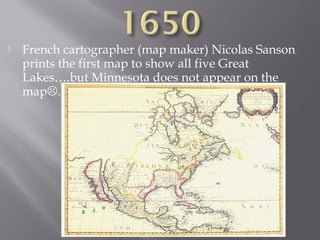
French cartographer (map maker) Nicolas Sanson
prints the first map to show all five Great
Lakes….but Minnesota does not appear on the
map.


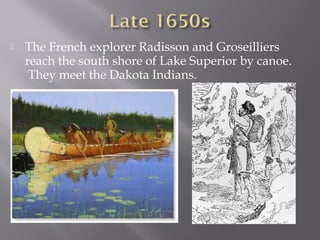
The French explorer Radisson and Groseilliers
reach the south shore of Lake Superior by canoe.
They meet the Dakota Indians.
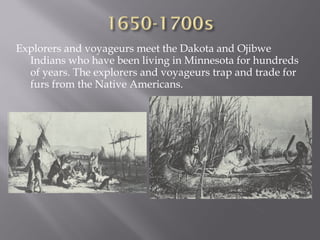
Explorers and voyageurs meet the Dakota and Ojibwe
Indians who have been living in Minnesota for hundreds
of years. The explorers and voyageurs trap and trade for
furs from the Native Americans.
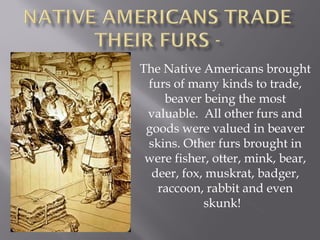
The Native Americans brought
furs of many kinds to trade,
beaver being the most
valuable. All other furs and
goods were valued in beaver
skins. Other furs brought in
were fisher, otter, mink, bear,
deer, fox, muskrat, badger,
raccoon, rabbit and even
skunk!
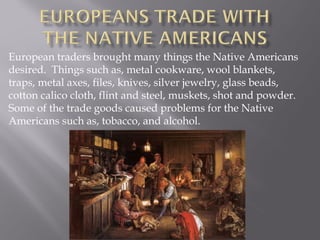
European traders brought many things the Native Americans
desired. Things such as, metal cookware, wool blankets,
traps, metal axes, files, knives, silver jewelry, glass beads,
cotton calico cloth, flint and steel, muskets, shot and powder.
Some of the trade goods caused problems for the Native
Americans such as, tobacco, and alcohol.


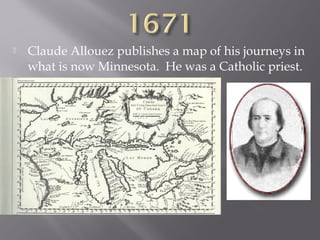
Claude Allouez publishes a map of his journeys in
what is now Minnesota. He was a Catholic priest.
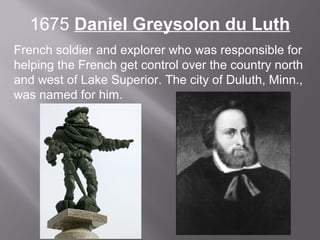
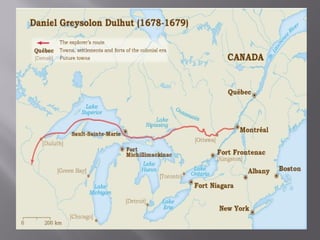
1675 Daniel Greysolon du Luth
French soldier and explorer who was responsible for
helping the French get control over the country north
and west of Lake Superior. The city of Duluth, Minn.,
was named for him.
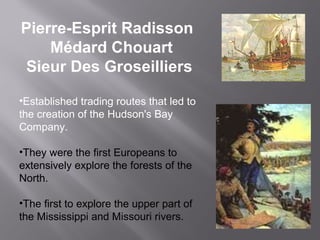
Pierre-Esprit Radisson
Médard Chouart
Sieur Des Groseilliers
•Established trading routes that led to
the creation of the Hudson's Bay
Company.
•They were the first Europeans to
extensively explore the forests of the
North.
•The first to explore the upper part of
the Mississippi and Missouri rivers.
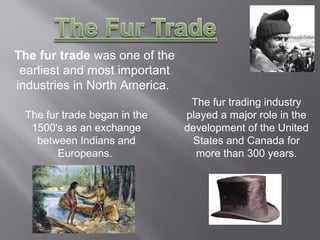
The fur trade was one of the
earliest and most important
industries in North America.
The fur trade began in the
1500's as an exchange
between Indians and
Europeans.

The fur trading industry
played a major role in the
development of the United
States and Canada for
more than 300 years.
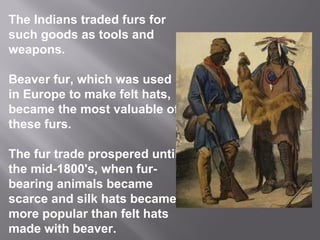
The Indians traded furs for
such goods as tools and
weapons.
Beaver fur, which was used
in Europe to make felt hats,
became the most valuable of
these furs.
The fur trade prospered until
the mid-1800's, when furbearing animals became
scarce and silk hats became
more popular than felt hats
made with beaver.
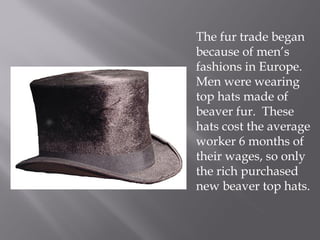
The fur trade began
because of men’s
fashions in Europe.
Men were wearing
top hats made of
beaver fur. These
hats cost the average
worker 6 months of
their wages, so only
the rich purchased
new beaver top hats.
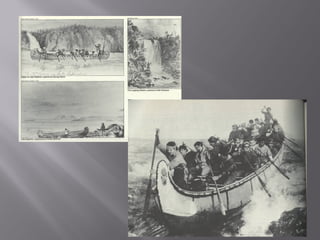
There were 3 main sizes of canoes used in the fur
trade. The smallest was called the Ojibway canoe.
It was 10 to 12 feet long, paddled by 1 or 2 people
and used on small lakes and rivers.
The most common canoe was the North Canoe. It
was 24 to 36 feet long and was used on larger
lakes and rivers, had between 6 to 10 paddlers and
could handle 3000 lbs. of cargo.
The Montreal canoe was used on the Great Lakes.
It was 36 to 48 ft long, carried 5000 lbs. of cargo. If
empty it could have up to 20 people on board.
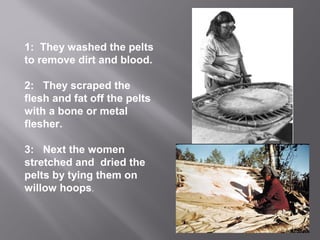
• Beaver pelts were very perishable and need to be
treated quickly to prevent decay.

• Indian women prepared the pelts in several steps.
1: They washed the pelts
to remove dirt and blood.
2: They scraped the
flesh and fat off the pelts
with a bone or metal
flesher.
3: Next the women
stretched and dried the
pelts by tying them on
willow hoops.
Fur trade clerk Michel Curot builds a fur post near
the St. Croix River. Minnesota’s fur trade booms.
By 1840 there were several issues that lead to end
of the fur trade.
1.Settlers were moving into Minnesota and forcing
out the fur gathering Native Americans.
2.The

number of fur bearing animals was going
down.
3.There

was a change in fashion. Men’s top hats
were now being made of silk.
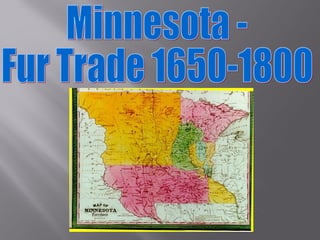
Minnesota fur trade

Minnesota fur trade

  • 2.
     French cartographer (mapmaker) Nicolas Sanson prints the first map to show all five Great Lakes….but Minnesota does not appear on the map.
  • 3.
     The French explorerRadisson and Groseilliers reach the south shore of Lake Superior by canoe. They meet the Dakota Indians.
  • 4.
    Explorers and voyageursmeet the Dakota and Ojibwe Indians who have been living in Minnesota for hundreds of years. The explorers and voyageurs trap and trade for furs from the Native Americans.
  • 5.
    The Native Americansbrought furs of many kinds to trade, beaver being the most valuable. All other furs and goods were valued in beaver skins. Other furs brought in were fisher, otter, mink, bear, deer, fox, muskrat, badger, raccoon, rabbit and even skunk!
  • 6.
    European traders broughtmany things the Native Americans desired. Things such as, metal cookware, wool blankets, traps, metal axes, files, knives, silver jewelry, glass beads, cotton calico cloth, flint and steel, muskets, shot and powder. Some of the trade goods caused problems for the Native Americans such as, tobacco, and alcohol.
  • 7.
     Claude Allouez publishesa map of his journeys in what is now Minnesota. He was a Catholic priest.
  • 8.
    1675 Daniel Greysolondu Luth French soldier and explorer who was responsible for helping the French get control over the country north and west of Lake Superior. The city of Duluth, Minn., was named for him.
  • 10.
    Pierre-Esprit Radisson Médard Chouart SieurDes Groseilliers •Established trading routes that led to the creation of the Hudson's Bay Company. •They were the first Europeans to extensively explore the forests of the North. •The first to explore the upper part of the Mississippi and Missouri rivers.
  • 11.
    The fur tradewas one of the earliest and most important industries in North America. The fur trade began in the 1500's as an exchange between Indians and Europeans. The fur trading industry played a major role in the development of the United States and Canada for more than 300 years.
  • 12.
    The Indians tradedfurs for such goods as tools and weapons. Beaver fur, which was used in Europe to make felt hats, became the most valuable of these furs. The fur trade prospered until the mid-1800's, when furbearing animals became scarce and silk hats became more popular than felt hats made with beaver.
  • 14.
    The fur tradebegan because of men’s fashions in Europe. Men were wearing top hats made of beaver fur. These hats cost the average worker 6 months of their wages, so only the rich purchased new beaver top hats.
  • 16.
    There were 3main sizes of canoes used in the fur trade. The smallest was called the Ojibway canoe. It was 10 to 12 feet long, paddled by 1 or 2 people and used on small lakes and rivers. The most common canoe was the North Canoe. It was 24 to 36 feet long and was used on larger lakes and rivers, had between 6 to 10 paddlers and could handle 3000 lbs. of cargo. The Montreal canoe was used on the Great Lakes. It was 36 to 48 ft long, carried 5000 lbs. of cargo. If empty it could have up to 20 people on board.
  • 18.
    • Beaver peltswere very perishable and need to be treated quickly to prevent decay. • Indian women prepared the pelts in several steps.
  • 19.
    1: They washedthe pelts to remove dirt and blood. 2: They scraped the flesh and fat off the pelts with a bone or metal flesher. 3: Next the women stretched and dried the pelts by tying them on willow hoops.
  • 20.
    Fur trade clerkMichel Curot builds a fur post near the St. Croix River. Minnesota’s fur trade booms.
  • 21.
    By 1840 therewere several issues that lead to end of the fur trade. 1.Settlers were moving into Minnesota and forcing out the fur gathering Native Americans. 2.The number of fur bearing animals was going down. 3.There was a change in fashion. Men’s top hats were now being made of silk.