] 
First Nations, Metis, and 
Inuit
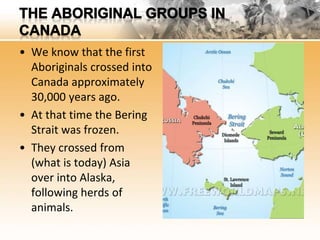
• We know that the first 
Aboriginals crossed into 
Canada approximately 
30,000 years ago. 
• At that time the Bering 
Strait was frozen. 
• They crossed from 
(what is today) Asia 
over into Alaska, 
following herds of 
animals.
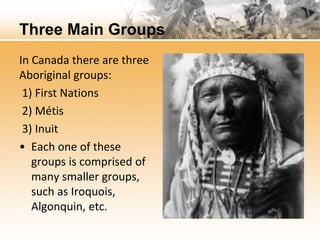
Three Main Groups 
In Canada there are three 
Aboriginal groups: 
1) First Nations 
2) Métis 
3) Inuit 
• Each one of these 
groups is comprised of 
many smaller groups, 
such as Iroquois, 
Algonquin, etc.
Part 1 – Early First Nations: The Six Main 
Geographical Groups 
• Before the arrival of Europeans, First Nations in 
what is now Canada were able to satisfy all of 
their material and spiritual needs through the 
resources of the natural world around them. 
• For the purposes of studying traditional First 
Nations cultures, historians have therefore 
tended to group First Nations in Canada 
according to the six main geographic areas of 
the country as it exists today. Within each of 
these six areas, First Nations had very similar 
cultures, largely shaped by a common 
environment.
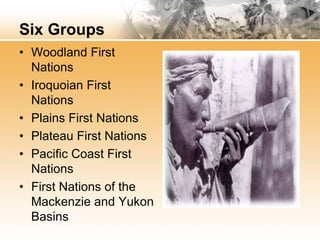
Six Groups 
• Woodland First 
Nations 
• Iroquoian First 
Nations 
• Plains First Nations 
• Plateau First Nations 
• Pacific Coast First 
Nations 
• First Nations of the 
Mackenzie and Yukon 
Basins
Similarities 
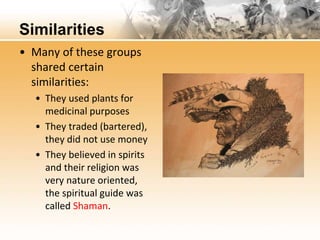
• Many of these groups 
shared certain 
similarities: 
• They used plants for 
medicinal purposes 
• They traded (bartered), 
they did not use money 
• They believed in spirits 
and their religion was 
very nature oriented, 
the spiritual guide was 
called Shaman.
Oral Traditions/Transportation 
• They did not write, instead they passed on their 
traditions through symbols and stories. 
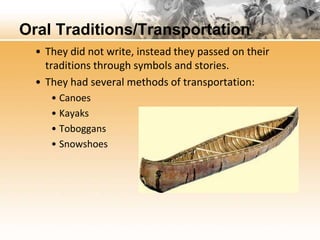
• They had several methods of transportation: 
• Canoes 
• Kayaks 
• Toboggans 
• Snowshoes
The Iroquois 
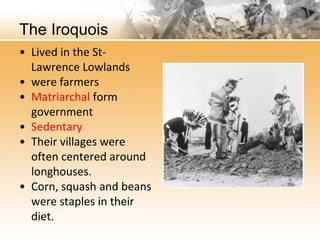
• Lived in the St- 
Lawrence Lowlands 
• were farmers 
• Matriarchal form 
government 
• Sedentary 
• Their villages were 
often centered around 
longhouses. 
• Corn, squash and beans 
were staples in their 
diet.
The Algonquin 
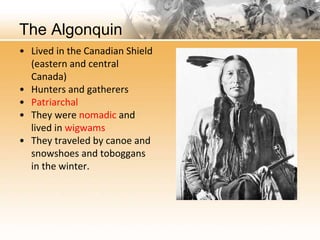
• Lived in the Canadian Shield 
(eastern and central 
Canada) 
• Hunters and gatherers 
• Patriarchal 
• They were nomadic and 
lived in wigwams 
• They traveled by canoe and 
snowshoes and toboggans 
in the winter.
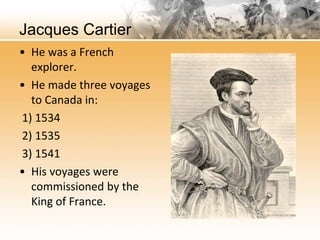
Jacques Cartier 
• He was a French 
explorer. 
• He made three voyages 
to Canada in: 
1) 1534 
2) 1535 
3) 1541 
• His voyages were 
commissioned by the 
King of France.
The 3 Main Reasons for Exploration 
1) find an alternate route to China 
2) bring back gold, silk and other riches 
3) claim land for the King of France Cartier’s three 
visits to N.A. 
• In his first voyage to North America Cartier claimed 
land in the name of the king and reported an 
abundance of fish, timber and furs (the Natives and 
French traded furs for trinkets) 
*Class Discussion* 
Do you think Cartier/King Henry II had a right to 
claim the land as France’s?
The Second Voyage 
• The second voyage brought more French men into 
North America Four ships sailed into the Native 
villages of Stradacona (Quebec City) and Hochelaga 
(Montreal). 
• The Natives showed the French how to survive the 
harsh winters. 
• The French returned to France, bringing several 
Native people with them.
The Third Visit 
• The purpose of Cartier’s third voyage was to setup a 
colony in the Stradacona area. 
• With him came Missionaries who wanted to convert 
the natives to Christianity. 
• France lost interest in the settlement after only a 
year and it was abandoned.
The meeting of two cultures 
*Class Discussion* 
What do you think happened when the French and 
Natives began to interact? 
Was it positive/Negative?
The Europeans 
• They learned how to survive in the wilderness, as 
well as the cold of the winter and the possibility of 
scurvy. 
• They learned how to make clothing out of leather, 
travel in the winter and use medicinal plants. 
• They learned of new foods, such as maple syrup and 
pumpkin.
The Natives: Positives 
• They learned of new foods, salt and bread. 
• The Europeans introduced them to woolen 
cloth. 
• They were also brought iron weapons, which 
they became increasingly dependent on.
The Natives: Negatives 
• The Europeans introduced them to alcohol, 
which had a tremendous effect on the 
Natives. 
• They brought diseases, like small pox, 
influenza and measles, which killed 
thousands. 
• The fur trade changed the Native’s ways of 
living. 
• The French tried to impose Christianity on 
them.
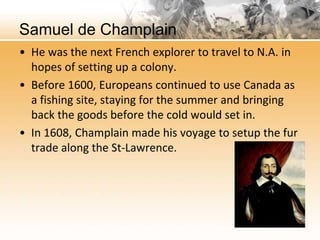
Samuel de Champlain 
• He was the next French explorer to travel to N.A. in 
hopes of setting up a colony. 
• Before 1600, Europeans continued to use Canada as 
a fishing site, staying for the summer and bringing 
back the goods before the cold would set in. 
• In 1608, Champlain made his voyage to setup the fur 
trade along the St-Lawrence.
The Fur trade in New France 
• Trade monopolies were granted to 
entrepreneurs, under the condition that they see 
to the evangelization of the Aboriginal people. 
• The Fur trade brought alliances between the 
French and Aboriginal groups, the Hurons and 
Algonquians. The Iroquois allied with the Dutch 
and English.
The Hudson Bay 
• Two main companies controlled the early fur trade economy: the 
Hudson's Bay Company and the North West Company. 
• The Hudson's Bay Company was incorporated under a Royal Charter in 
1670; and the North West Company was an independent company 
based out of Montreal. 
• Initially the Fur Trade was mutually beneficial. The Europeans depended 
upon Indian and Métis knowledge of the land and their labour; and 
provided manufactured goods to them. The result was balanced trade 
relations. 
• The Métis had a good command of European and Indian languages and 
became intermediaries in the fur trade economy. 
• The fur trade brought many changes: 
• Diseases such as small pox, tuberculosis and measles; 
• Missionaries brought Christianity; and 
• Many Indian and Métis people were faced with starvation due to over-hunting 
and trapping.
The Royal Proclamation Act 
• The Royal Proclamation of 1763 established 
British protection over unsettled land belonging 
to Indian tribes and recognized Indian title to 
lands not already colonized. Métis people were 
not recognized. 
• The Proclamation is considered to be one of the 
strongest guarantees of First Nations' land 
rights. Pre-existing land ownership was 
acknowledged and is a very important legal 
concept today.
The British North American 
Act 
• The British North America Act (BNA Act), 
Canada's original constitution, was the charter to 
Confederation in 1867. 
• Section 91(24) of the BNA Act established 
Federal jurisdiction over "Indians, and lands 
reserved for the Indians". The federal 
government implemented their responsibility 
through the Indian Act. 
• Once again, the Métis people were not 
recognized.
The Treatises 
• There are eleven Numbered Treaties signed between the Crown and 
First Nations from 1871 to 1921. There are six numbered Treaties in 
Saskatchewan. (Treaty 2, 4, 5, 6, 8, 10) signed between 1871 - 1906 
(Adhesions signed later). NOTE: No First Nation from Treaty 2 lives in 
Saskatchewan. 
• First Nations people maintain that promises made during negotiations 
were binding, even those that did not appear in the text of the Treaty. 
Treaty Commissioners made some promises that were not incorporated 
into the written Treaty. 
• Sacred Pipe ceremonies at the beginning of negotiations were 
statements of faith by the Indian people. Government participation in 
these ceremonies was taken as acceptance of the significance of this 
practice. 
• Indian people believe that the Treaties are binding agreements that are 
to last forever. 
• Present day interpretation of the Treaties continues to be defined by the 
courts and more recently, at treaty tables established between Canada 
and First Nations.
Consequences of these alliances 
• The fur trade caused many battles between 
Europeans and their Native allies. 
• It eventually led to the extinction of the Huron 
people by the Iroquois. 
*Class Discussion* 
Do you think the arrival and colonization by the 
Europeans can be blamed for the extinction of the 
Huron people?
The Indian Act 
• The Indian Act was legislation which created 
sharp distinctions between Indian and Métis 
people. Métis people are not recognized under 
this legislation. 
• The Indian Act was legislation which allowed for 
the administration of almost every aspect of an 
Indian person's life. 
• Throughout its history, the Indian Act had three 
main principles: 
• to civilize Indian people; 
• to manage Indian people and their lands; and 
• to define who was and was not an Indian.
Reserves 
• The more pressure there was for settlement of Western 
Canada, the more the government pressured Indian 
people to settle on Reserves. 
• Reserve clusters were kept far enough apart to 
discourage Bands from forming alliances against the 
government. 
• Indian Agents and Farm Instructors were sent to 
Reserves. Life on the Reserves centred around them -- 
they lived on Reserves and made all decisions: 
• they provided family and marriage counselling; 
• they married and buried people; 
• they kept law and order; 
• they did the work of the public health nurse; 
• sometimes they filled in as the teacher.
The Pass System 
• The Pass System was instituted during the Northwest 
Resistance years. It was to be a temporary measure 
during the events of 1885 to control and monitor Indian 
people and keep them from joining the Resistance. 
• Indian people were restricted to their Reserves. If they 
wanted to leave, they had to get permission from the 
Indian Agent. An Indian person who was absent from the 
Reserve without a Pass was classified as a criminal. 
• Neither the Indian Act nor any other Federal legislation 
empowered the Department to institute such a system. 
• The Pass system was still in use in the Treaty 4, 5 and 7 
areas as late as the mid 1930's. It was removed from the 
Indian Act in 1951.
The Permit System 
• The Department of Indian Affairs had control over the 
financial transactions of Indian people. Sales and 
purchase transactions were strictly monitored under the 
Permit system. 
• Indian people needed a permit to: 
• sell cattle and grain; 
• sell a load of hay, firewood, lime, charcoal; 
• sell produce grown on the Reserve; and 
• buy groceries or clothes 
• As Bands began to adopt elected forms of governments 
in the 1950's and 60's they began to acquire more 
authority and eventually superseded the Indian Agent. 
• The Permit system gradually disappeared. However, it 
remained in the Indian Act until 1995.
The Residential Schools 
The objectives were: 
• to Christianize; to teach the 3 R's; and to develop children 
into farmers and housekeepers. 
• The use of Indian languages in school was prohibited; 
children were punished severely for speaking their 
language, even if they knew no English. 
• Many children died as a result of health conditions at the 
schools. 
• Many other children ran away from school; upon their 
return they were severely punished. 
• Many encountered sexual abuse by people in authority. 
• Many suffered severe psychological harm as their identity 
as an Indian person was attacked. 
• Many lost their knowledge of traditional parenting 
practices.
The White Paper 
• In 1969, Jean Chretien, then (Minister of Indian Affairs) 
announced a new policy called "Statement of the 
Government of Canada on Indian Policy”. 
The policy consisted of three main principles: 
• to eliminate Treaty rights; to transfer responsibility for 
Indian people to the provinces; to eliminate the 
Department of Indian Affairs and the Indian Act. 
• Negative reaction from Indian communities was strong 
and the White Paper was retracted. 
• There was a change in Indian-government relations: 
Indian organizations became stronger and began to play 
a more active role in negotiations with government. 
Indian people also began to play a more significant role 
in managing their own affairs.

Nbe3 cj native studies-introduction

  • 1.
    ] First Nations,Metis, and Inuit
  • 2.
    • We knowthat the first Aboriginals crossed into Canada approximately 30,000 years ago. • At that time the Bering Strait was frozen. • They crossed from (what is today) Asia over into Alaska, following herds of animals.
  • 3.
    Three Main Groups In Canada there are three Aboriginal groups: 1) First Nations 2) Métis 3) Inuit • Each one of these groups is comprised of many smaller groups, such as Iroquois, Algonquin, etc.
  • 4.
    Part 1 –Early First Nations: The Six Main Geographical Groups • Before the arrival of Europeans, First Nations in what is now Canada were able to satisfy all of their material and spiritual needs through the resources of the natural world around them. • For the purposes of studying traditional First Nations cultures, historians have therefore tended to group First Nations in Canada according to the six main geographic areas of the country as it exists today. Within each of these six areas, First Nations had very similar cultures, largely shaped by a common environment.
  • 5.
    Six Groups •Woodland First Nations • Iroquoian First Nations • Plains First Nations • Plateau First Nations • Pacific Coast First Nations • First Nations of the Mackenzie and Yukon Basins
  • 6.
    Similarities • Manyof these groups shared certain similarities: • They used plants for medicinal purposes • They traded (bartered), they did not use money • They believed in spirits and their religion was very nature oriented, the spiritual guide was called Shaman.
  • 7.
    Oral Traditions/Transportation •They did not write, instead they passed on their traditions through symbols and stories. • They had several methods of transportation: • Canoes • Kayaks • Toboggans • Snowshoes
  • 8.
    The Iroquois •Lived in the St- Lawrence Lowlands • were farmers • Matriarchal form government • Sedentary • Their villages were often centered around longhouses. • Corn, squash and beans were staples in their diet.
  • 9.
    The Algonquin •Lived in the Canadian Shield (eastern and central Canada) • Hunters and gatherers • Patriarchal • They were nomadic and lived in wigwams • They traveled by canoe and snowshoes and toboggans in the winter.
  • 10.
    Jacques Cartier •He was a French explorer. • He made three voyages to Canada in: 1) 1534 2) 1535 3) 1541 • His voyages were commissioned by the King of France.
  • 11.
    The 3 MainReasons for Exploration 1) find an alternate route to China 2) bring back gold, silk and other riches 3) claim land for the King of France Cartier’s three visits to N.A. • In his first voyage to North America Cartier claimed land in the name of the king and reported an abundance of fish, timber and furs (the Natives and French traded furs for trinkets) *Class Discussion* Do you think Cartier/King Henry II had a right to claim the land as France’s?
  • 12.
    The Second Voyage • The second voyage brought more French men into North America Four ships sailed into the Native villages of Stradacona (Quebec City) and Hochelaga (Montreal). • The Natives showed the French how to survive the harsh winters. • The French returned to France, bringing several Native people with them.
  • 13.
    The Third Visit • The purpose of Cartier’s third voyage was to setup a colony in the Stradacona area. • With him came Missionaries who wanted to convert the natives to Christianity. • France lost interest in the settlement after only a year and it was abandoned.
  • 14.
    The meeting oftwo cultures *Class Discussion* What do you think happened when the French and Natives began to interact? Was it positive/Negative?
  • 15.
    The Europeans •They learned how to survive in the wilderness, as well as the cold of the winter and the possibility of scurvy. • They learned how to make clothing out of leather, travel in the winter and use medicinal plants. • They learned of new foods, such as maple syrup and pumpkin.
  • 16.
    The Natives: Positives • They learned of new foods, salt and bread. • The Europeans introduced them to woolen cloth. • They were also brought iron weapons, which they became increasingly dependent on.
  • 17.
    The Natives: Negatives • The Europeans introduced them to alcohol, which had a tremendous effect on the Natives. • They brought diseases, like small pox, influenza and measles, which killed thousands. • The fur trade changed the Native’s ways of living. • The French tried to impose Christianity on them.
  • 18.
    Samuel de Champlain • He was the next French explorer to travel to N.A. in hopes of setting up a colony. • Before 1600, Europeans continued to use Canada as a fishing site, staying for the summer and bringing back the goods before the cold would set in. • In 1608, Champlain made his voyage to setup the fur trade along the St-Lawrence.
  • 19.
    The Fur tradein New France • Trade monopolies were granted to entrepreneurs, under the condition that they see to the evangelization of the Aboriginal people. • The Fur trade brought alliances between the French and Aboriginal groups, the Hurons and Algonquians. The Iroquois allied with the Dutch and English.
  • 20.
    The Hudson Bay • Two main companies controlled the early fur trade economy: the Hudson's Bay Company and the North West Company. • The Hudson's Bay Company was incorporated under a Royal Charter in 1670; and the North West Company was an independent company based out of Montreal. • Initially the Fur Trade was mutually beneficial. The Europeans depended upon Indian and Métis knowledge of the land and their labour; and provided manufactured goods to them. The result was balanced trade relations. • The Métis had a good command of European and Indian languages and became intermediaries in the fur trade economy. • The fur trade brought many changes: • Diseases such as small pox, tuberculosis and measles; • Missionaries brought Christianity; and • Many Indian and Métis people were faced with starvation due to over-hunting and trapping.
  • 21.
    The Royal ProclamationAct • The Royal Proclamation of 1763 established British protection over unsettled land belonging to Indian tribes and recognized Indian title to lands not already colonized. Métis people were not recognized. • The Proclamation is considered to be one of the strongest guarantees of First Nations' land rights. Pre-existing land ownership was acknowledged and is a very important legal concept today.
  • 22.
    The British NorthAmerican Act • The British North America Act (BNA Act), Canada's original constitution, was the charter to Confederation in 1867. • Section 91(24) of the BNA Act established Federal jurisdiction over "Indians, and lands reserved for the Indians". The federal government implemented their responsibility through the Indian Act. • Once again, the Métis people were not recognized.
  • 23.
    The Treatises •There are eleven Numbered Treaties signed between the Crown and First Nations from 1871 to 1921. There are six numbered Treaties in Saskatchewan. (Treaty 2, 4, 5, 6, 8, 10) signed between 1871 - 1906 (Adhesions signed later). NOTE: No First Nation from Treaty 2 lives in Saskatchewan. • First Nations people maintain that promises made during negotiations were binding, even those that did not appear in the text of the Treaty. Treaty Commissioners made some promises that were not incorporated into the written Treaty. • Sacred Pipe ceremonies at the beginning of negotiations were statements of faith by the Indian people. Government participation in these ceremonies was taken as acceptance of the significance of this practice. • Indian people believe that the Treaties are binding agreements that are to last forever. • Present day interpretation of the Treaties continues to be defined by the courts and more recently, at treaty tables established between Canada and First Nations.
  • 24.
    Consequences of thesealliances • The fur trade caused many battles between Europeans and their Native allies. • It eventually led to the extinction of the Huron people by the Iroquois. *Class Discussion* Do you think the arrival and colonization by the Europeans can be blamed for the extinction of the Huron people?
  • 25.
    The Indian Act • The Indian Act was legislation which created sharp distinctions between Indian and Métis people. Métis people are not recognized under this legislation. • The Indian Act was legislation which allowed for the administration of almost every aspect of an Indian person's life. • Throughout its history, the Indian Act had three main principles: • to civilize Indian people; • to manage Indian people and their lands; and • to define who was and was not an Indian.
  • 26.
    Reserves • Themore pressure there was for settlement of Western Canada, the more the government pressured Indian people to settle on Reserves. • Reserve clusters were kept far enough apart to discourage Bands from forming alliances against the government. • Indian Agents and Farm Instructors were sent to Reserves. Life on the Reserves centred around them -- they lived on Reserves and made all decisions: • they provided family and marriage counselling; • they married and buried people; • they kept law and order; • they did the work of the public health nurse; • sometimes they filled in as the teacher.
  • 27.
    The Pass System • The Pass System was instituted during the Northwest Resistance years. It was to be a temporary measure during the events of 1885 to control and monitor Indian people and keep them from joining the Resistance. • Indian people were restricted to their Reserves. If they wanted to leave, they had to get permission from the Indian Agent. An Indian person who was absent from the Reserve without a Pass was classified as a criminal. • Neither the Indian Act nor any other Federal legislation empowered the Department to institute such a system. • The Pass system was still in use in the Treaty 4, 5 and 7 areas as late as the mid 1930's. It was removed from the Indian Act in 1951.
  • 28.
    The Permit System • The Department of Indian Affairs had control over the financial transactions of Indian people. Sales and purchase transactions were strictly monitored under the Permit system. • Indian people needed a permit to: • sell cattle and grain; • sell a load of hay, firewood, lime, charcoal; • sell produce grown on the Reserve; and • buy groceries or clothes • As Bands began to adopt elected forms of governments in the 1950's and 60's they began to acquire more authority and eventually superseded the Indian Agent. • The Permit system gradually disappeared. However, it remained in the Indian Act until 1995.
  • 29.
    The Residential Schools The objectives were: • to Christianize; to teach the 3 R's; and to develop children into farmers and housekeepers. • The use of Indian languages in school was prohibited; children were punished severely for speaking their language, even if they knew no English. • Many children died as a result of health conditions at the schools. • Many other children ran away from school; upon their return they were severely punished. • Many encountered sexual abuse by people in authority. • Many suffered severe psychological harm as their identity as an Indian person was attacked. • Many lost their knowledge of traditional parenting practices.
  • 30.
    The White Paper • In 1969, Jean Chretien, then (Minister of Indian Affairs) announced a new policy called "Statement of the Government of Canada on Indian Policy”. The policy consisted of three main principles: • to eliminate Treaty rights; to transfer responsibility for Indian people to the provinces; to eliminate the Department of Indian Affairs and the Indian Act. • Negative reaction from Indian communities was strong and the White Paper was retracted. • There was a change in Indian-government relations: Indian organizations became stronger and began to play a more active role in negotiations with government. Indian people also began to play a more significant role in managing their own affairs.

Editor's Notes

  • #6 The six groups were: Woodland First Nations, who lived in dense boreal forest in the eastern part of the country; Iroquoian First Nations, who inhabited the southernmost area, a fertile land suitable for planting corn, beans and squash; Plains First Nations, who lived on the grasslands of the Prairies; Plateau First Nations, whose geography ranged from semi-desert conditions in the south to high mountains and dense forest in the north; Pacific Coast First Nations, who had access to abundant salmon and shellfish and the gigantic red cedar for building huge houses; and the First Nations of the Mackenzie and Yukon River Basins, whose harsh environment consisted of dark forests, barren lands and the swampy terrain known as muskeg.
  • #26 Christianity was imposed on Indian people as a means of "civilizing" them. Potlatches and Sun Dances were outlawed in 1884. Persons who were caught celebrating these events could be imprisoned. Banning these traditional gatherings assisted missionaries in their attempts to replace Indian spiritual beliefs with Christian beliefs. "No Trespassing" signs were posted on the boundaries of Reserves. Enfranchisement (getting the right to vote) for the purposes of assimilation was a constant feature of the Indian Act. If an Indian person became enfranchised (accepted the right to vote) he or she had to relinquish their Indian Status. To this day, the provisions of the Indian Act allow for the administration of Indians on Reserves in areas such as: education, taxation, management of land, and membership. In 1960, the Federal Elections Act was amended to allow Indian people to vote. An Indian person could now be both an Indian and a Canadian citizen at the same time.  
  • #30 Before contact with Europeans, First Nations had their own educational processes. The goal was to become responsible members of society. Education was considered a life-long process. Elders were the transmitters of knowledge and wisdom. Traditional Indian cultures exhibited a close relationship with the environment and learning the relationship with nature was an essential component of a child's upbringing. After contact with Europeans, education became the primary instrument to assimilate Indian people. Residential and industrial schools were established in Saskatchewan following the signing of the Numbered Treaties. The objectives were: to Christianize; to teach the 3 R's; and to develop children into farmers and housekeepers.   Residential and industrial schools also began a legacy of despair for Indian people. Government and religious orders made all decisions about the education of Indian children. Children were removed from their homes with or without parental consent. The use of Indian languages in school was prohibited; children were punished severely for speaking their language, even if they knew no English. Many children died as a result of health conditions at the schools. Many other children ran away from school; upon their return they were severely punished. Many encountered sexual abuse by people in authority. Many suffered severe psychological harm as their identity as an Indian person was attacked. Many lost their knowledge of traditional parenting practices.   After a century of operation, the residential schools had nearly destroyed First Nations communities. These schools suppressed their language, culture, and spirituality. The extended period of time spent in these schools with caregivers who were often abusive resulted in this abuse of children moving into the Indian communities. The last government controlled residential school closed in 1986.