Multiplexing
Group 2
Multiplexing
• Multiplexing is the set of techniques that allows the
simultaneous transmission of multiple signals across a
single data link.
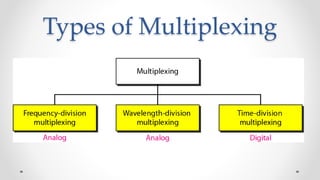
Types of Multiplexing
Frequency Division Multiplexing
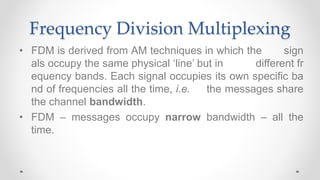
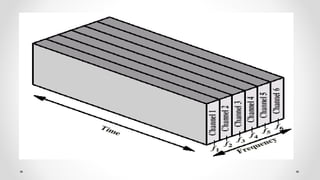
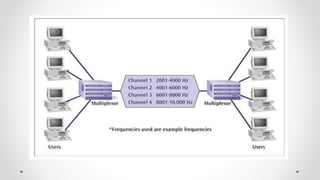
• FDM is derived from AM techniques in which the sign
als occupy the same physical ‘line’ but in different fr
equency bands. Each signal occupies its own specific ba
nd of frequencies all the time, i.e. the messages share
the channel bandwidth.
• FDM – messages occupy narrow bandwidth – all the
time.
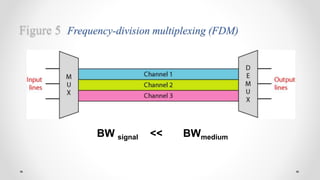
Figure 5 Frequency-division multiplexing (FDM)
BW signal << BWmedium
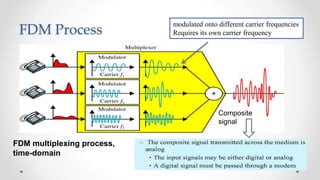
FDM Process
modulated onto different carrier frequencies
Requires its own carrier frequency
Composite
signal
FDM multiplexing process,
time-domain
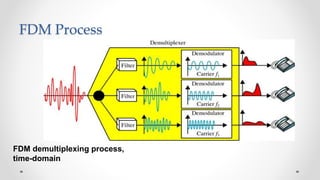
FDM Process
FDM demultiplexing process,
time-domain
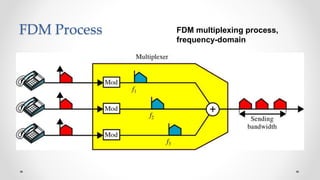
FDM Process FDM multiplexing process,
frequency-domain
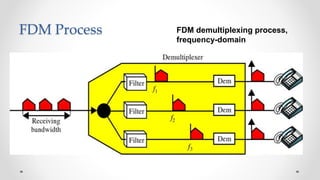
FDM Process FDM demultiplexing process,
frequency-domain
Example 1
Assume that a voice channel occupies a bandwidth of 4 kHz. We need
to combine three voice channels into a link with a bandwidth of 12
kHz, from 20 to 32 kHz. Show the configuration, using the frequency
domain. Assume there are no guard bands.
Solution
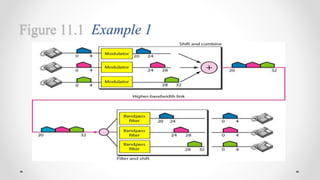
We shift (modulate) each of the three voice channels to a different
bandwidth, as shown in Figure 11.1. We use the 20- to 24-kHz
bandwidth for the first channel, the 24- to 28-kHz bandwidth for the
second channel, and the 28- to 32-kHz bandwidth for the third one.
Then we combine them as shown in Figure 11.1.
Figure 11.1 Example 1
Example 2
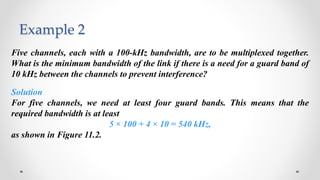
Five channels, each with a 100-kHz bandwidth, are to be multiplexed together.
What is the minimum bandwidth of the link if there is a need for a guard band of
10 kHz between the channels to prevent interference?
Solution
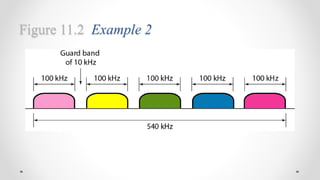
For five channels, we need at least four guard bands. This means that the
required bandwidth is at least
5 × 100 + 4 × 10 = 540 kHz,
as shown in Figure 11.2.
Figure 11.2 Example 2
Example 3
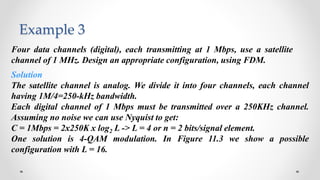
Four data channels (digital), each transmitting at 1 Mbps, use a satellite
channel of 1 MHz. Design an appropriate configuration, using FDM.
Solution
The satellite channel is analog. We divide it into four channels, each channel
having 1M/4=250-kHz bandwidth.
Each digital channel of 1 Mbps must be transmitted over a 250KHz channel.
Assuming no noise we can use Nyquist to get:
C = 1Mbps = 2x250K x log2 L -> L = 4 or n = 2 bits/signal element.
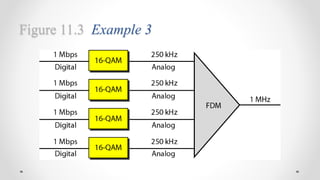
One solution is 4-QAM modulation. In Figure 11.3 we show a possible
configuration with L = 16.
Figure 11.3 Example 3

Multiplexing and Frequency Division Multiplexing

  • 1.
  • 2.
    Multiplexing • Multiplexing isthe set of techniques that allows the simultaneous transmission of multiple signals across a single data link.
  • 5.
  • 6.
    Frequency Division Multiplexing •FDM is derived from AM techniques in which the sign als occupy the same physical ‘line’ but in different fr equency bands. Each signal occupies its own specific ba nd of frequencies all the time, i.e. the messages share the channel bandwidth. • FDM – messages occupy narrow bandwidth – all the time.
  • 9.
    Figure 5 Frequency-divisionmultiplexing (FDM) BW signal << BWmedium
  • 10.
    FDM Process modulated ontodifferent carrier frequencies Requires its own carrier frequency Composite signal FDM multiplexing process, time-domain
  • 11.
    FDM Process FDM demultiplexingprocess, time-domain
  • 12.
    FDM Process FDMmultiplexing process, frequency-domain
  • 13.
    FDM Process FDMdemultiplexing process, frequency-domain
  • 16.
    Example 1 Assume thata voice channel occupies a bandwidth of 4 kHz. We need to combine three voice channels into a link with a bandwidth of 12 kHz, from 20 to 32 kHz. Show the configuration, using the frequency domain. Assume there are no guard bands. Solution We shift (modulate) each of the three voice channels to a different bandwidth, as shown in Figure 11.1. We use the 20- to 24-kHz bandwidth for the first channel, the 24- to 28-kHz bandwidth for the second channel, and the 28- to 32-kHz bandwidth for the third one. Then we combine them as shown in Figure 11.1.
  • 17.
  • 18.
    Example 2 Five channels,each with a 100-kHz bandwidth, are to be multiplexed together. What is the minimum bandwidth of the link if there is a need for a guard band of 10 kHz between the channels to prevent interference? Solution For five channels, we need at least four guard bands. This means that the required bandwidth is at least 5 × 100 + 4 × 10 = 540 kHz, as shown in Figure 11.2.
  • 19.
  • 20.
    Example 3 Four datachannels (digital), each transmitting at 1 Mbps, use a satellite channel of 1 MHz. Design an appropriate configuration, using FDM. Solution The satellite channel is analog. We divide it into four channels, each channel having 1M/4=250-kHz bandwidth. Each digital channel of 1 Mbps must be transmitted over a 250KHz channel. Assuming no noise we can use Nyquist to get: C = 1Mbps = 2x250K x log2 L -> L = 4 or n = 2 bits/signal element. One solution is 4-QAM modulation. In Figure 11.3 we show a possible configuration with L = 16.
  • 21.

Editor's Notes

  • #3 Multiplexing is the process of transmitting two or more signals simultaneously on a single channel
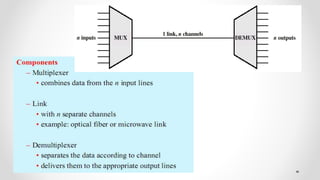
  • #4 MUX combines multiple signal to single signal DEMUX separates single signal to multiple signal
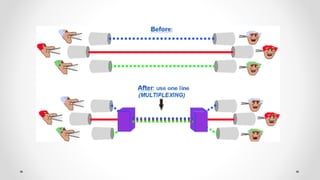
  • #5 Before a medium can carry only one signal at any moment in time Now, multiple signals share one medium, the medium must somehow be divided, giving each signal a portion of the total bandwidth
  • #8 FDM: all signals are transmitted at the same time (all the time) but in different frequency bands
  • #10 FDM (Frequency-Division Multiplexing) is an analog technique that can be applied when the bandwidth of a link (useful bandwidth of the medium excess) is greater than the combined bandwidths of the signals to be transmitted
  • #11 FDM process each telephone generates a signal of a similar frequency range these signals are modulated onto different carrier frequencies (f1, f2, f3)
  • #12 Demultiplexing separates the individual signals from their carries and passes them to the waiting receivers.
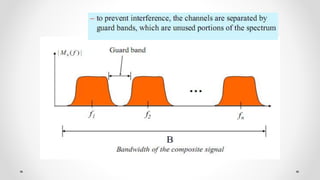
  • #15 guard bands - to reduce adjacent channel crosstalk.